




Choosing a finance and accounting outsourcing (FAO) provider is a decision that affects far more than operating costs. The right partner can help your business close resource gaps, improve financial reporting, strengthen compliance, and manage increasingly complex accounting operations. But with providers offering different levels of expertise, technology, and service coverage, finding the right fit requires careful evaluation.
The global finance and accounting outsourcing market is projected to reach $85.92 billion by 2031, reflecting growing demand for external finance capabilities.
This guide compares leading finance and accounting outsourcing companies, their services, industry expertise, and strengths to help you identify providers that match your operational requirements and long-term business priorities.
Which Finance and Accounting Outsourcing Provider Fits Your Business?
Different FAO providers serve different operating models, from enterprise-wide finance transformation to specialized accounting support and regulated financial operations. Use this comparison to identify which companies best match your outsourcing requirements.
| Provider | Best suited for | Why consider this provider |
|---|---|---|
| Helpware | Fintechs, banks, lenders, and regulated financial services companies | Dedicated back-office support for KYC/AML, loan and mortgage processing, transaction management, document verification, and financial data processing. |
| Accenture, Capgemini, Genpact, Infosys BPM, IBM | Global enterprises managing multiple finance processes, entities, and jurisdictions | Large-scale F&A operations, process standardization, automation, and finance transformation across complex organizations. |
| Deloitte | Multinationals seeking finance advisory and managed operations | Combines consulting expertise with F&A services. Audit independence requirements may restrict engagements with certain clients. |
| EXL | Insurance companies and enterprises integrating finance operations with analytics | Combines finance process management, data analytics, and industry-specific operational expertise. |
| Datamatics | Companies prioritizing automation across P2P, O2C, and R2R | Technology-led F&A services covering procurement, receivables, financial reporting, and process automation. |
| TOA Global | Accounting and CPA firms building offshore teams | Offshore staffing model that allows accounting firms to extend their teams while retaining control over client relationships and workflows. |
How We Selected These Finance and Accounting Outsourcing Companies
We selected providers based on their relevance to different finance outsourcing needs, from end-to-end F&A operations to specialized financial back-office services and dedicated accounting teams. The evaluation considered four criteria:
- Service scope and specialization: Coverage of P2P, O2C, R2R, FP&A, financial transaction processing, reconciliation, compliance-related documentation, and dedicated accounting roles.
- Delivery and engagement models: Availability of managed services, dedicated teams, offshore staffing, and technology-enabled finance operations.
- Independent recognition and customer feedback: Relevant Gartner, Everest Group, and ISG assessments, where available, alongside customer ratings and reviews on Gartner Peer Insights and Clutch.
- Compliance and demonstrated results: Published security certifications, documented compliance practices, and client case studies with measurable outcomes.
Provider profiles draw on publicly available information, including company disclosures, independent analyst assessments, and customer reviews. Helpware’s placement does not represent an independent ranking or imply superiority over other providers.
What Finance and Accounting Outsourcing Covers
Finance and accounting outsourcing means contracting a third-party provider to manage some or all of your financial back-office functions. Depending on your company’s size and complexity, that can mean outsourcing a single process like accounts payable or handing off an entire shared services function across multiple entities and geographies.
Providers organize the work into three core cycles:
- Purchase-to-pay (P2P): Invoice processing, supplier onboarding, purchase order management, payment execution, and vendor reconciliation
- Order-to-cash (O2C): Credit management, billing, collections, cash application, and dispute resolution
- Record-to-report (R2R): General ledger management, month-end and year-end close, financial reporting, reconciliations, and management accounts
Beyond those core cycles, many providers extend into financial planning and analysis (FP&A), treasury operations, tax compliance, payroll, and regulatory reporting under frameworks like IFRS, US GAAP, and local statutory requirements.
Use cases are broad. Fast-growing SaaS companies often outsource R2R to handle multi-entity complexity as they expand internationally. Private equity-backed businesses outsource P2P during integration periods when AP volume spikes and internal bandwidth is thin. Healthcare organizations outsource billing and revenue cycle management to navigate payer complexity.
When evaluating providers, the key capability questions are compliance depth across your operating jurisdictions, SLA attainment on core processing cycles, technology stack and automation capability, their ability to integrate with your existing ERP environment, and the audit evidence they can give your auditors about their controls.
F&A Outsourcing Delivery Models: How Responsibilities Differ
Finance and accounting outsourcing providers offer different levels of operational ownership. Some manage entire processes against agreed performance targets, while others supply dedicated specialists who work under your finance team’s direction. Understanding these differences helps buyers assess internal resource requirements, accountability, and contract terms.
| Managed F&A services | Dedicated teams | Offshore accounting staffing | |
|---|---|---|---|
| Process management | Provider manages agreed processes and workflows | Shared or client-led, depending on the contract | Client manages daily work and procedures |
| Performance accountability | Provider accountable for contracted service levels and outcomes | Provider accountable for agreed team and service obligations | Staffing provider primarily accountable for recruitment and staffing obligations |
| Quality control | Provider performs agreed quality checks; client retains oversight | Shared responsibilities for quality review and corrections | Client typically owns quality review and corrections |
| Internal management required | Governance, approvals, and performance reviews | Ongoing coordination, supervision, and escalation management | Direct supervision, training, and workload management |
| Best suited for | Enterprises outsourcing defined finance processes with measurable SLAs | Companies seeking dedicated capacity while retaining process control | Accounting and CPA firms expanding their teams |
The delivery model should determine how responsibilities are documented in the contract. For managed services, confirm process ownership, performance targets, remediation obligations, and reporting requirements. For dedicated teams and staffing arrangements, establish who supervises daily work, maintains procedures, reviews output, and resolves errors.
Regardless of the model, your organization retains responsibility for its financial reporting and applicable regulatory obligations. Request a clear responsibility matrix and relevant assurance reports, such as SOC 1 Type 2 where applicable, rather than assuming the provider’s controls cover every outsourced activity.
Top 10 Finance and Accounting Outsourcing Companies for 2027: Overview
| Company | Best suited for | F&A capabilities | Engagement model | Key differentiator |
|---|---|---|---|---|
| Helpware | Fintech, banking, and regulated businesses outsourcing financial back-office operations | Financial data processing, reconciliation support, KYC/AML documentation, loan and mortgage processing | Managed services, dedicated teams | Dedicated financial operations teams with document-intensive processing and compliance support |
| Accenture | Large enterprises transforming global finance functions | P2P, O2C, R2R, FP&A, finance transformation | Managed services | Combines finance operations, technology transformation, and consulting |
| Capgemini (including WNS) | Multinationals consolidating finance processes across entities | P2P, O2C, R2R, finance analytics | Managed services | Broad finance process coverage and analytics capabilities |
| Genpact | Enterprises modernizing high-volume finance operations | AP, invoice-to-cash, R2R, FP&A | Managed services | Finance process specialization with analytics and automation |
| Infosys BPM | Global enterprises standardizing transactional and analytical finance processes | P2P, quote-to-cash, R2R, FP&A, tax support | Managed services | Finance operations supported by technology and process automation |
| IBM Consulting | Enterprises integrating finance outsourcing with technology modernization | O2C, P2P, R2R, FP&A | Managed services | Integration of finance operations, enterprise technology, and AI |
| Deloitte | Multinationals seeking finance advisory and ongoing operations | FP&A, controllership, treasury, tax, internal controls | Advisory-led operate model | Combines finance advisory, transformation, and operated services |
| EXL | Insurance and financial services companies seeking analytics-intensive finance operations | Treasury, P2P, O2C, financial reporting, FP&A | Managed services | Domain expertise in insurance and financial services combined with analytics |
| Datamatics | Companies seeking platform-led finance processing or tax preparation support | P2P, O2C, R2R, FP&A, US and Canadian tax preparation | Platform-led managed services | Finance automation platforms and specialized tax processing |
| TOA Global | Accounting and CPA firms expanding offshore delivery capacity | Bookkeeping, accounting, audit, payroll, tax | Dedicated offshore staffing | Offshore accounting professionals integrated into client firms |
For enterprise-wide finance transformation and end-to-end F&A outsourcing, Accenture, Capgemini, Genpact, Infosys BPM, and IBM offer broader process coverage. Companies with more specialized requirements may find a better fit elsewhere: Helpware for regulated financial back-office operations, EXL for analytics-intensive finance processes, Datamatics for platform-led processing, and TOA Global for dedicated offshore accounting staff.
Top 10 Finance and Accounting Outsourcing Companies in 2027: Companies Overview
#1 Helpware

Helpware provides financial back-office outsourcing for banks, fintech companies, and other organizations managing document-intensive, compliance-sensitive operations. Founded in 2015 and headquartered in Lexington, Kentucky, this BPO provider supports financial data processing, KYC/AML documentation, loan application processing, and document review. Its banking and fintech BPO services can be delivered through managed operations or dedicated teams, allowing buyers to outsource defined workflows while aligning delivery with their existing procedures and controls.
Key details:
- Core services: Back-office operations, financial data processing, document verification, loan processing, and KYC/AML compliance support.
- Delivery model: Managed back-office services or dedicated teams, depending on the scope and allocation of operational responsibilities.
- Best suited for: Banks and fintech companies looking to expand verification, documentation, and financial processing capacity without outsourcing the entire finance function.
- Security and compliance: SOC 2 Type II and support for workflows subject to applicable data-protection and financial-services requirements.
- Industry recognition: IAOP Global Outsourcing 100.
- Customer feedback: Clutch: 4.8/5 from 47 reviews.
- Delivery footprint: Multicountry operations across the Americas, Europe, Africa, and Asia.
#2 Accenture
Accenture is a global finance and accounting outsourcing provider for enterprises seeking to consolidate finance operations while modernizing the systems and processes behind them. Its Finance Managed Services offering combines ongoing operational delivery with FP&A, enterprise performance management, and finance technology transformation. Accenture works with platforms including Anaplan, Celonis, Icertis, OneStream, and Workday, making it particularly relevant to organizations integrating outsourcing with broader finance transformation programs. The company was named a Leader in the 2026 Gartner Magic Quadrant for Finance and Accounting BPO.
Key details:
- Core services: Finance managed services, FP&A, enterprise performance management, and finance technology transformation.
- Delivery model: Managed finance services with provider accountability for agreed processes and service levels.
- Best suited for: Multinational enterprises consolidating finance operations across business units and regions while pursuing technology-led transformation.
- Distinctive capability: Combines finance process outsourcing, transformation consulting, and integration with enterprise finance platforms.
- Analyst recognition: Gartner 2026 Leader; Everest Group FAO PEAK Matrix 2025 Leader; ISG Provider Lens FAO 2026 Leader.
- Customer reviews: Gartner Peer Insights: 4.5/5 from 72 ratings.
#3 Capgemini

Capgemini combines finance and accounting outsourcing with enterprise transformation, automation, and analytics. Following its acquisition of WNS in October 2025, the company expanded its business process capabilities through the Intelligent Business Operations division. Its Frictionless Finance offering supports end-to-end finance operations, while the D-GEM framework helps organizations standardize processes alongside SAP S/4HANA modernization. This combination makes Capgemini particularly relevant to multinational enterprises looking to consolidate fragmented finance operations, integrate technology platforms, and establish a more unified operating model. The company was named a Leader in the 2026 Gartner Magic Quadrant for Finance and Accounting BPO.
Key details:
- Core services: P2P, O2C, record-to-analyze, finance analytics, and automation for payables, receivables, and controllership.
- Delivery model: Managed finance and accounting services, including transformation-led engagements.
- Best suited for: Large enterprises consolidating multi-entity finance operations, particularly alongside SAP S/4HANA modernization.
- Distinctive capability: Combines end-to-end finance process management with ERP transformation expertise and WNS business process capabilities.
- Client results: WNS reported 98% average SLA attainment across P2P, O2C, and R2R after consolidating approximately 30 entities for a global electronics company.
- Analyst recognition: Gartner 2026 Leader; Everest Group 2025 Leaders (Capgemini and WNS); ISG 2026 Leader; NelsonHall F&A Transformation NEAT 2026 Leader.
- Customer reviews: Gartner Peer Insights: Capgemini 4.3/5 (61 ratings) and WNS 4.5/5 (43 ratings).
#4 Genpact
Genpact is a global finance and accounting outsourcing provider with a strong focus on process automation and operational transformation. Originally established as General Electric’s global capability center in 1997, the company has developed specialized finance technology, including its AP Suite, Accounts Receivable Suite, and Record-to-Report Suite. These platforms support transaction processing, exception management, and financial close activities across complex enterprise environments. Genpact also offers its AP Suite as a standalone software solution, giving organizations the option to adopt automation without transferring the entire process to an external provider.
Key details:
- Core services: Accounts payable and P2P, invoice-to-cash, R2R, FP&A, and F&A consulting.
- Delivery model: Managed finance services; AP Suite also available as separately licensed software.
- Best suited for: Large enterprises with multi-entity, multi-jurisdiction finance operations requiring process standardization and automation.
- Distinctive capability: Proprietary finance automation suites covering payables, receivables, and record-to-report operations.
- Analyst recognition: Everest Group FAO PEAK Matrix 2025 Leader; ISG Provider Lens FAO 2026 Leader; Gartner Magic Quadrant for F&A BPO 2025 Leader.
- Security and compliance: ISO/IEC 27001 certification covering sites in 19 countries and ISO 22301 covering six sites in India, held by Genpact India Private Limited.
- Customer reviews: Gartner Peer Insights: 4.6/5 from 98 ratings.
#5 Infosys BPM
Infosys BPM is the business process management subsidiary of Infosys Limited, providing finance and accounting outsourcing services to global enterprises. Established in 2002, the company combines finance operations with technology integration across SAP, Oracle, and NetSuite environments. Its Intelligent Close Platform, developed within the Infosys Topaz AI ecosystem, supports the automation of financial close activities and reconciliation workflows. With 42 delivery centers across 14 countries, Infosys BPM offers a distributed delivery network for organizations managing finance operations across multiple regions.
Key details:
- Core services: Procure-to-pay (P2P), quote-to-cash, record-to-report (R2R), FP&A, tax support, and cloud-based accounts payable.
- Delivery model: Managed finance and accounting services.
- Best suited for: Large enterprises using SAP, Oracle, or NetSuite that need to standardize and outsource finance processes across regions.
- Distinctive capability: ERP-integrated finance operations supported by the Infosys Topaz AI ecosystem and Intelligent Close Platform.
- Analyst recognition: Leader in the 2026 Gartner Magic Quadrant for Finance and Accounting BPO, Everest Group FAO PEAK Matrix 2025, and ISG Provider Lens FAO 2026.
- Customer reviews: Gartner Peer Insights: 4.1/5 from 48 ratings.
#6 IBM Consulting
IBM Consulting provides finance and accounting outsourcing as part of its broader business transformation and technology services. Its approach connects finance process delivery with enterprise systems such as SAP, Oracle, Microsoft, Salesforce, and Celonis. IBM has also developed AI Collections and AI Reconciliations solutions to support receivables management, reconciliation, and exception handling. For enterprises undertaking major ERP modernization programs, this creates an opportunity to coordinate finance operations, systems integration, and automation within a single engagement.
Key details:
- Core services: Order-to-cash (O2C), procure-to-pay (P2P), record-to-report (R2R), FP&A, ERP integration, and finance transformation consulting.
- Delivery model: Managed finance services integrated with technology and consulting engagements.
- Best suited for: Large enterprises aligning finance outsourcing with ERP modernization, systems integration, and AI adoption.
- Distinctive capability: Finance-specific AI tools combined with IBM’s enterprise technology and systems integration expertise.
- Analyst recognition: Leader in the 2026 Gartner Magic Quadrant for Finance and Accounting BPO and Everest Group FAO PEAK Matrix 2025; Leader in two of four quadrants of the ISG Provider Lens FAO 2026.
- Customer reviews: Gartner Peer Insights: 4.2/5 from 28 ratings.
#7 Deloitte

Deloitte offers finance and accounting outsourcing through its Finance Operate practice, combining ongoing operational delivery with advisory expertise in finance transformation, governance, and regulatory requirements. Unlike providers focused primarily on managed services, Deloitte offers several engagement structures, including finance-as-a-service, strategic finance capacity, build-operate-transform-transfer, and optimization of existing captive centers. Its Zora AI agents support activities such as invoice management, expense processing, and working-capital analysis. This approach allows enterprises to redesign their finance operating model while maintaining access to Deloitte’s consulting and specialist capabilities.
Key details:
- Core services: FP&A, order-to-cash (O2C), procure-to-pay (P2P), controllership, internal controls, treasury, and tax.
- Delivery model: Advisory-led managed services, finance-as-a-service, and build-operate-transform-transfer arrangements.
- Best suited for: Multinational enterprises requiring finance transformation advisory, cross-border compliance expertise, and ongoing operational delivery.
- Distinctive capability: Combines finance advisory, managed operations, and captive-center development within one engagement.
- Analyst recognition: Leader in the 2026 Gartner Magic Quadrant for Finance and Accounting BPO and ISG Provider Lens FAO 2026; Major Contender in Everest Group FAO PEAK Matrix 2025.
- Customer reviews: Gartner Peer Insights: 4.6/5 from 28 ratings.
#8 EXL Service
EXL Service combines finance and accounting outsourcing with advanced analytics and industry-specific expertise, particularly in insurance and financial services. Founded in 1999 and headquartered in New York, the company supports organizations seeking greater visibility into financial performance, working capital, and operational efficiency. Its approach integrates data analytics with ongoing finance operations to identify process inefficiencies, improve decision-making, and uncover cost-saving opportunities. In a published case involving a US Fortune 500 media and communications company, EXL reported approximately $6 million in incremental savings through a supplier discount-capture program.
Key details:
- Core services: Treasury, procure-to-pay (P2P), order-to-cash (O2C), financial reporting, FP&A, finance transformation, and finance analytics.
- Delivery model: Managed finance and accounting services.
- Best suited for: Insurance, banking, healthcare, and other data-intensive organizations seeking finance operations supported by advanced analytics.
- Distinctive capability: Combines finance process management with analytics and specialized expertise in insurance and financial services.
- Analyst recognition: Leader in the Gartner Magic Quadrant for F&A BPO 2025 and ISG Provider Lens FAO 2026; Major Contender in Everest Group FAO PEAK Matrix 2025.
- Customer reviews: Gartner Peer Insights: 4.6/5 from 84 ratings; Clutch: 3.8/5 from four reviews.
#9 Datamatics
Datamatics is a Mumbai-based technology and business process outsourcing provider with a finance and accounting practice built around its proprietary FINATO platform. Founded in 1975, the company combines outsourced finance operations with automation tools that integrate with SAP, Oracle, and Microsoft Dynamics. It also provides US and Canadian tax return preparation services for accounting and CPA firms. This combination gives buyers the option to outsource finance processes through a technology-led operating model or obtain specialized support for tax preparation and accounting workloads.
Key details:
- Core services: Procure-to-pay (P2P), order-to-cash (O2C), record-to-report (R2R), FP&A, US and Canadian tax return preparation, bookkeeping, and AI-powered finance operations.
- Delivery model: Platform-led managed finance and accounting services.
- Best suited for: Mid-market companies seeking technology-enabled F&A outsourcing and North American CPA firms requiring additional tax preparation capacity.
- Distinctive capability: Proprietary FINATO platform integrating finance process automation with major ERP systems.
- Analyst recognition: Niche Player in the 2026 Gartner Magic Quadrant for Finance and Accounting BPO; Major Contender in Everest Group FAO PEAK Matrix 2025.
- Security and compliance: ISO 9001, ISO 27001, and ISO 42001 certifications.
- Customer reviews: Gartner Peer Insights: 4.6/5 from 28 ratings; Clutch: 4.7/5 from 13 reviews, primarily for software development services.
#10 TOA Global
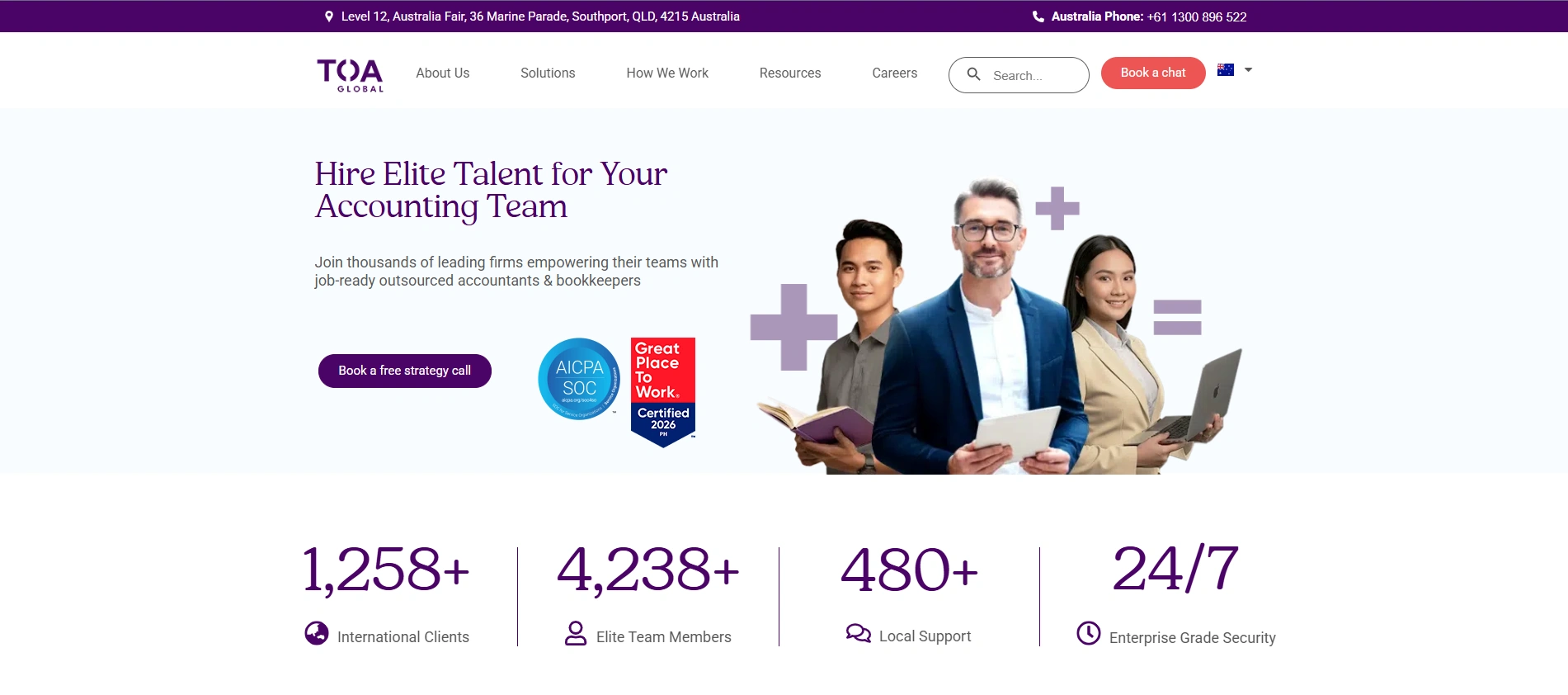
TOA Global specializes in offshore accounting staffing for firms that want to expand their workforce while retaining direct control over daily operations. A division of Humanverse, the company recruits and employs accounting professionals and provides the supporting infrastructure, including payroll, HR, IT, and office facilities. Its delivery operations are concentrated in the Philippines, with an additional presence in South Africa. TOA Global also supports professional development through the affiliated Ab² Institute of Accounting and reports working with more than 1,250 accounting and bookkeeping firms across the US, Canada, Australia, and New Zealand.
Key details:
- Core services: Accounting, bookkeeping, audit, payroll, accounts receivable, accounts payable, tax preparation, financial reporting, and compliance administration.
- Delivery model: Dedicated offshore staffing, with clients retaining responsibility for process management, supervision, and quality control.
- Best suited for: Accounting, tax, and bookkeeping firms seeking permanent offshore professionals to expand capacity within their existing workflows.
- Distinctive capability: Recruitment and employment of dedicated accounting professionals, supported by HR, payroll, IT infrastructure, and specialized accounting training.
- Security and compliance: SOC 2, as stated by TOA Global.
- Delivery footprint: Accounting teams in the Philippines, with an additional delivery center in Cape Town, South Africa.
Unlock your hidden CX savings with Helpware
Get ROI projection for current support needs.
-40% annually
/monthly costs with Helpware
vs
/internal team costs (approx)
Your requirements fall outside our standard parameters.
Let's discuss your results
Fill in your details to schedule a consultation.
-40% annually
/monthly costs with Helpware
vs
/internal team costs (approx)
Your requirements fall outside our standard parameters.
-40% annually
/monthly costs with Helpware
vs
/internal team costs (approx)
Your requirements fall outside our standard parameters.
Support staff included in the package:
Shared Team Leader
Shared L&D Specalist
Shared QA Specialist
Account Executive by default
Shared Ops Delivery Manager
Admin/Finance/Legal support for the agents by default
1-2 Dedicated Team Leaders
Shared L&D Specialist
Shared to 1 Dedicated QA Specialist
Shared Ops Manager
Account Executive by default
Admin/Finance/Legal support for the agents by default
Shared Real Time Analyst
2-5 Dedicated Team Leaders
0,5 to 1,5 Dedicated L&D Specialists
1-2 Dedicated QA Specialists
Up to half of a dedicated Ops Manager
Account Executive by default
Admin/Finance/Legal support for the agents by default
1 Dedicated Real Time Analyst
Ready to get a personalized estimate for your team?
Contact us for a personalized assessment tailored to your specific needs.
*These projections are estimates for informational purposes only and do not represent a formal offer. Contact us for a personalized quote.
Thank you!
You’ll hear from us within one business day.
Pricing Models for Finance and Accounting Outsourcing
Finance and accounting outsourcing contracts use different pricing structures depending on process scope, transaction volumes, and the level of responsibility transferred to the provider. For enterprise buyers, the key consideration is how each model allocates costs, volume risk, and productivity gains between the client and the provider.
| Pricing model | How it works | Best suited for | What buyers should negotiate |
|---|---|---|---|
| FTE-based | Fixed monthly rate per dedicated employee | Dedicated finance teams, back-office operations, and specialized accounting support | Minimum staffing commitments, replacement costs, utilization, and how automation affects required headcount |
| Per-transaction | Fixed fee per invoice, payment, or other defined transaction | High-volume AP, AR, and document processing with measurable workloads | Volume tiers, exception handling, transaction definitions, and productivity-related price adjustments |
| Fixed-fee | Agreed recurring fee for a defined service scope | Managed F&A processes with relatively predictable workloads and deliverables | Scope changes, volume thresholds, service levels, and charges for work outside the agreed scope |
| Outcome-based or gainsharing | Part of the provider’s compensation depends on agreed results or verified savings | Mature outsourcing relationships with reliable performance baselines | Measurement methodology, baseline adjustments, attribution of savings, and payment caps |
Compare total contract costs, not just headline rates
Different pricing models can produce substantially different costs over the life of an F&A outsourcing agreement. To compare proposals, calculate the expected total contract cost under the same transaction volumes, service scope, and performance assumptions.
For transaction-based services, a cost-per-unit comparison can help, but the calculation should include relevant transition costs, platform fees, exception handling, and retained internal management expenses. Invoice-processing benchmarks, such as those published by Ardent Partners, can provide additional context when their methodology and reporting period are comparable.
Before signing, request separate pricing for:
- Transition and implementation: Knowledge transfer, system integration, parallel operations, and process documentation.
- Technology and data access: Platform licensing, integration fees, reporting tools, and access to operational data after termination.
- Volume and staffing commitments: Minimum charges, volume bands, headcount requirements, and fees for demand fluctuations.
- Productivity improvements: Contractual mechanisms for sharing automation savings or reducing unit prices as efficiency improves.
- Contract exit and transition: Data extraction, knowledge transfer, migration support, and charges associated with moving services to another provider.
For multi-year agreements, compare the total cost across expected demand scenarios rather than relying on the first-year price. The contract should also specify how pricing changes when transaction volumes, automation levels, or the scope of outsourced processes change.
How to Use Analyst Assessments When Shortlisting F&A Outsourcing Providers
Independent analyst assessments can help enterprise buyers evaluate providers’ finance process capabilities, technology investments, and market position. Three widely referenced evaluations include:
- Gartner Magic Quadrant for Finance and Accounting BPO: Assesses providers based on their Ability to Execute and Completeness of Vision. Gartner’s Critical Capabilities research provides additional comparisons across specific use cases.
- Everest Group FAO PEAK Matrix Assessment: Evaluates providers’ market impact and vision and capability, including service delivery and technology investments.
- ISG Provider Lens for Finance and Accounting Outsourcing Services: Compares providers across finance process categories, including invoice-to-pay, order-to-cash, record-to-report, tax, and FP&A.
These assessments provide useful evidence of a provider’s capabilities, but analyst recognition alone does not establish suitability for a particular engagement. A provider recognized for large-scale, multi-process finance outsourcing may not be the strongest choice for a specialized accounting function, a specific ERP environment, or a dedicated staffing arrangement.
Use analyst assessments to identify potential providers, then evaluate shortlisted companies against your process requirements, delivery model, industry experience, and documented client results.
Controls and Audit Evidence to Request
When outsourcing finance and accounting operations, buyers need to establish which controls the provider operates and which remain the client’s responsibility. The required assurance depends on the processes being outsourced, their impact on financial reporting, and the organization’s regulatory obligations.
Two commonly used assurance reports serve different purposes:
| Report | What it covers | When it matters |
|---|---|---|
| SOC 1 | Controls relevant to a client’s internal control over financial reporting | When outsourced activities, such as journal posting, reconciliations, or payment processing, affect financial reporting controls |
| SOC 2 | Controls related to security, availability, processing integrity, confidentiality, and privacy, depending on the report’s scope | When the provider handles sensitive financial data, operates systems, or processes confidential information |
A SOC 2 report does not replace SOC 1 assurance over financial reporting controls. Depending on the engagement, buyers may need one or both reports, together with additional evidence of security and regulatory compliance.
What to verify during due diligence:
- Report type and period: Type 1 assesses control design at a specific point in time; Type 2 also evaluates operating effectiveness over a defined period. Review the reporting period and discuss any coverage gaps with your auditors.
- Service and system coverage: Confirm that the assurance report includes the relevant services, systems, locations, and any material subcontractors.
- Complementary user entity controls: Identify controls the client must maintain, such as transaction approvals or vendor master data authorization, and assign internal ownership.
- Segregation of duties: Define who can create or modify vendor records, approve invoices, post journals, and release payments.
- ERP access controls: Require role-based permissions, individual user accounts, and periodic access reviews for personnel handling financial transactions.
Review these requirements with internal audit, finance, and information security teams before finalizing the outsourcing agreement. Where assurance reports do not cover the contracted services, request alternative evidence and establish appropriate contractual controls.
Final Thoughts: Choosing the Right F&A Outsourcing Partner
The right finance and accounting outsourcing partner depends on which processes you plan to outsource, how much operational responsibility you want to transfer, and what level of automation and financial control your organization requires. Large enterprises may prioritize end-to-end finance transformation, while companies with more focused needs may benefit from specialized back-office services or dedicated accounting teams.
Before making a decision, compare providers on process expertise, measurable client results, total contract costs, and the controls they can demonstrate. A well-defined scope and clear performance expectations will do more to support a successful outsourcing engagement than a provider’s market position alone.