








Accounts payable issues usually build up before they become obvious. Invoices start piling up, an approver is out of the office, or a duplicate payment slips through during month-end close. That’s why a growing number of CFOs now hand the work to specialist accounts payable outsourcing companies instead of expanding their in-house teams.
The market continues to grow. According to Grand View Research, the global finance and accounting outsourcing market is on track to reach $142.66 billion by 2033, growing 9.3 percent a year from 2026. The same source also found that finance and accounting made up the largest share of the overall outsourcing market in 2025, at more than 21.4 percent of revenue. This guide compares 14 providers for AP outsourcing, so you can match a partner to your invoice volume, control requirements, and budget.
What Accounts Payable Outsourcing Companies Do
Not every provider means the same thing by accounts payable. Some companies focus on basic tasks like entering invoices and following up on approvals. Others manage the full procure-to-pay process and take responsibility for the records your auditors review. Typical services include invoice capture, general ledger coding, two-way and three-way matching with purchase orders and receipts, approval routing, exception handling, payment processing, vendor support, and reconciliation reporting.
Most providers offer one of three service models:
- A managed service takes over the entire AP function and works to agreed service levels.
- A dedicated team gives you assigned staff who work inside your existing systems, often starting with one or two people.
- A procure-to-pay engagement includes AP as part of a broader finance outsourcing relationship.
Deciding which model you need makes it much easier to narrow your options.
How Accounts Payable Outsourcing Is Priced
Pricing can be difficult to compare because providers use different billing models. Knowing how each one works before you start evaluating vendors makes it easier to compare total costs.
Per-invoice pricing. You pay a fixed fee for every invoice processed. Some providers charge different rates for PO and non-PO invoices. This model works well for businesses with consistent, high invoice volumes.
Per-seat or full-time-equivalent pricing. You pay a monthly fee for each dedicated team member. This works best for steady workloads and gives you a team that becomes familiar with your processes.
Hourly pricing. Work is billed by the hour. This is a good option for clearing backlogs, handling seasonal peaks, or completing short-term projects where the workload is uncertain.
Managed service or fixed monthly fee. The provider takes responsibility for the entire AP function for a fixed monthly price tied to an agreed scope and service levels. Budgeting is straightforward, but it’s important to define the scope clearly.
Hybrid pricing. A base fee covers a committed volume, and a variable rate kicks in above it. This approach works well for businesses with seasonal fluctuations or steady growth.
Outcome-based pricing. Fees track results like touchless processing rate or cycle time instead of tasks completed. It aligns incentives well, but only a handful of providers will put a number like touchless rate into the contract.
As a rough guide, high-volume teams gravitate toward per-invoice or outcome-based deals, lean finance departments favor a dedicated team or managed service, and businesses facing a one-time backlog reach for hourly help first.
What Drives the Cost of Accounts Payable Outsourcing
The difference in prices usually comes down to a few key factors.
Invoice volume and complexity. Processing more invoices generally lowers the cost per invoice, but complexity increases it. Multi-line invoices, multiple currencies, and large amounts of non-PO spending all require more work.
Delivery location. For the US, onshore staff usually cost the most, but they understand your culture instantly. Offshore teams in countries like India and the Philippines offer the lowest rates, while nearshore teams in Latin America provide a balance between cost and time-zone alignment. Ask where the work will actually be performed.
Level of automation. Providers that combine people with automation for invoice capture, matching, and exception detection can process more invoices with less manual effort. A low-cost manual service may become more expensive over time if exceptions keep increasing.
Exception and approval friction. Held invoices and slow internal approvals add time and cost. If your process generates a lot of exceptions, expect to pay for the human judgment needed to clear them.
Compliance and controls. Segregation of duties, SOC reporting, SOX support, and data security all increase costs but are essential for regulated businesses. Always verify certifications instead of assuming they are in place.
Team attrition. High employee turnover can reduce service quality because new staff need time to learn your processes. Providers with low attrition usually deliver more consistent results. Helpware, for example, reports a monthly attrition rate of about 2.8% in its back-office operations, well below the typical industry range of 6% to 8%.
ERP and integration depth. Plugging into NetSuite, SAP, Oracle, QuickBooks, or a homegrown system takes setup work. The more integration you need, the more the transition costs, though it often leads to better accuracy and smoother workflows over time.
Once you understand these factors, you can compare quotes based on your own workload and business needs.
The 14 Best Accounts Payable Outsourcing Companies in 2026: Comparison
| Company | AP service focus | Global presence | Employees | Founded |
|---|---|---|---|---|
| Helpware | AP, AR, bookkeeping, invoice and data entry (back office) | USA, Mexico, Philippines, Ukraine, Georgia, Puerto Rico, Poland, Uganda (19 locations) | ~4,000 | 2015 |
| Genpact | Invoice processing, approvals, T&E, payments (F&A) | USA, India, Philippines, Mexico, Romania, Poland (30+ countries) | ~125,000 | 1997 |
| WNS Global Services | F&A outsourcing including AP, part of Capgemini | India, USA, UK, Philippines, South Africa, Sri Lanka (64 centers) | ~66,000 | 1996 |
| Infosys BPM | Procure-to-pay and AP on cloud, F&A | India, USA, UK, Poland, Czechia, Mexico, Philippines (13 countries) | ~60,966 | 2002 |
| Auxis | Nearshore AP, P2P, AR, general accounting | USA, Costa Rica, Colombia, Mexico, Argentina, Guatemala | Not disclosed | 1997 |
| GEP | AP within procure-to-pay managed services | USA, UK, India, Czechia, Brazil, Australia | Not disclosed | 1999 |
| Corcentric | Managed AP plus payments and AP software | USA, UK, India | ~600 | 1996 |
| Cognizant | F&A and AP within business process services | USA, India and 30+ countries | ~336,000 | 1994 |
| Datamatics | F&A outsourcing and FINATO procure-to-pay | India, USA, Philippines, UK, Germany, Australia (28 locations) | ~5,560 | 1975 |
| Invensis | Full-cycle AP, AR, bookkeeping, F&A | India, USA (Bangalore, Hyderabad, Rajahmundry, Texas) | ~6,000 | 2000 |
| Flatworld Solutions | AP analysts plus OCR, matching, anomaly checks | USA, UK, India, Philippines, Bolivia, Colombia | ~1,000 to 5,000 | 2004 |
| QX Global Group | AP and F&A via QX Finance & Accounts Services | UK, USA, Canada, India (19 locations) | ~2,400 | 2003 |
| Personiv | Dedicated offshore AP, AR, F&A teams | USA, Philippines, India, Australia | ~2,000 | 1985 |
| ARDEM | High-volume invoice capture and AP automation | USA (New Jersey) | Not disclosed | 2004 |
The 14 Best Accounts Payable Outsourcing Companies in 2026
1. Helpware

Helpware handles accounts payable as part of a broader back-office support services instead of offering AP on its own. Along with AP, the company supports accounts receivable, bookkeeping, invoice tracking, and data entry. It uses automation for invoice capture, duplicate detection, approval workflows, and mismatch checks, while dedicated teams manage exceptions and more complex cases. This works well for finance teams that want one partner to support multiple back-office functions.
Why we picked it. Helpware reports a monthly attrition rate of about 2.8%, compared with an industry average of 6% to 8%, helping teams keep experienced staff and consistent processes. The company also reports 90% CSAT, average client relationships of more than five years, and holds SOC 2 Type II, HIPAA, and GDPR compliance.
- Services offered: Accounts payable and receivable, bookkeeping, invoice and data entry, order processing, plus broader back-office and customer support, with AI-assisted capture, matching, and anomaly detection.
- Pros: 2.8% monthly attrition, 90% CSAT, more than five-year average partnerships, SOC 2 Type II, HIPAA, and GDPR coverage, up to 50% savings as opposed to an in-house team, support in 45+ languages across 19 locations.
- Cons: Best suited to clients who want AP inside broader back-office operations rather than a pure finance-transformation program, and the consultative onboarding takes longer than a plug-and-play tool.
- Industry expertise: Healthcare, SaaS and software, ecommerce and retail, fintech and banking, logistics, public sector, and gaming.
- Best for: Mid-market to enterprise companies that want accounts payable handled alongside the rest of their back office, with real compliance depth and low staff turnover.
- Pricing: Custom, based on scope and team size, with up to 50 percent savings versus in-house.
- Year established: 2015.
- Location: Lexington, Kentucky (headquarters), with delivery across the USA, Mexico, the Philippines, Ukraine, Georgia, Puerto Rico, Poland, and Uganda.
2. Genpact
Genpact is one of the best-known names in finance outsourcing. Originally launched as a General Electric back-office unit in 1997, it now serves companies worldwide as a publicly traded business. Its AP services include invoice processing, document management, approvals, payment processing, travel and expense support, and ERP integrations. Genpact says it supports more than 200 Fortune Global companies and achieves about 65% touchless invoice processing using AI.
Why we picked it. With more than 125,000 employees across 30+ countries, Genpact offers the scale, ERP expertise, and structured processes that large global businesses need.
- Services offered: Accounts payable, invoice-to-cash, record-to-report, travel and expense, payment processing, and CFO advisory across the finance and accounting value chain.
- Pros: Enterprise scale, deep ERP coverage, mature automation and agentic AI, and a track record with large multinational programs.
- Cons: Service levels tend to commit to process activity, not guaranteed outcome metrics, and the size can feel heavy for a smaller buyer.
- Industry expertise: Banking and capital markets, insurance, consumer goods, life sciences, healthcare, high tech, and manufacturing.
- Best for: Large enterprises that need AP on a global scale alongside a wider finance and accounting transformation.
- Pricing: Custom enterprise pricing.
- Year established: 1997.
- Location: New York City, New York (headquarters), with delivery across India, the Philippines, Mexico, Romania, Poland, and more.
3. WNS Global Services

Founded in 1996 as British Airways’ back-office operation, WNS has grown into a major finance and accounting outsourcing provider. In 2025, it was acquired by Capgemini in a $3.3 billion deal. Its AP services are part of a broader finance portfolio that also covers procurement, customer experience, and analytics. The company has more than 66,000 employees across 64 delivery centers and serves over 700 clients.
Why we picked it. WNS combines broad finance expertise with industry-specific experience in sectors such as banking, insurance, travel, and logistics, where AP processes often differ.
- Services offered: Finance and accounting outsourcing, including accounts payable, customer experience services, procurement, human resources, and data analytics.
- Pros: Strong industry specialization, large delivery network, and the added reach of Capgemini ownership.
- Cons: The Capgemini integration is still settling, and engagements skew toward larger enterprises.
- Industry expertise: Insurance, banking and financial services, travel and leisure, shipping and logistics, healthcare, retail, and utilities.
- Best for: Mid-to-large enterprises that want AP inside an industry-tailored finance and accounting program.
- Pricing: Custom.
- Year established: 1996.
- Location: Mumbai, India (headquarters), with offices in New York and London and delivery across 13 countries.
4. Infosys BPM
Infosys BPM brings the automation expertise of its parent company into accounts payable. Its procure-to-pay services cover invoice scanning, processing, vendor management, master data, payment processing, and supplier support. The company also employs more than 18,000 finance and accounting specialists and uses its own Infosys Accounts Payable on Cloud platform. Industry analysts consistently rank it among the leading finance outsourcing providers.
Why we picked it. Founded in 2002 and spread across 38 delivery centers in 13 countries, Infosys BPM is a strong fit for buyers who want automation-led P2P backed by analyst-recognized delivery.
- Services offered: Procure-to-pay and accounts payable, order-to-cash, record-to-report, financial planning and analysis, and broader F&A.
- Pros: Deep automation and analytics, ERP-agnostic delivery, and recognized leadership in finance and accounting outsourcing.
- Cons: Geared to mid-sized and large enterprises, so companies with very small AP volumes may not be the priority.
- Industry expertise: Financial services, manufacturing, consumer packaged goods, technology, healthcare, and communications.
- Best for: Mid-to-large enterprises that prioritize automation and measurable process benchmarks.
- Pricing: Custom.
- Year established: 2002.
- Location: Bengaluru, India (headquarters), with delivery across India, the USA, UK, Poland, Czechia, Mexico, and the Philippines.
5. Auxis
Where most large outsourcers send AP offshore, Auxis built its business around nearshore delivery from Costa Rica and Colombia, making it a popular choice for U.S. companies that want teams working in similar time zones. Its AP outsourcing combines finance consulting with automation, and the company reports average touchless invoice processing above 80%. Teams are trained in both U.S. GAAP and IFRS accounting standards. Auxis also recently joined Grant Thornton, expanding its consulting capabilities.
Why we picked it. Auxis is one of the few market players with a true nearshore footprint, and it positions AP as a transformation action as opposed to a simple cost cut. The company says clients typically save between 30% and 50%.
- Services offered: Accounts payable, accounts receivable, general accounting, financial planning and analysis, procure-to-pay, and finance transformation consulting.
- Pros: Nearshore time-zone alignment, strong automation and touchless rates, U.S. GAAP and IFRS expertise, and consulting depth.
- Cons: Latin America focus offers less coverage for buyers needing Asia-based delivery or very large language ranges.
- Industry expertise: Manufacturing, retail and consumer goods, hospitality, healthcare, and financial services.
- Best for: North American companies that want close collaboration, shared business hours, and finance modernization alongside AP.
- Pricing: Custom.
- Year established: 1997.
- Location: Fort Lauderdale, Florida (headquarters), with nearshore centers in Costa Rica and Colombia and hubs in Mexico, Argentina, and Guatemala.
6. GEP
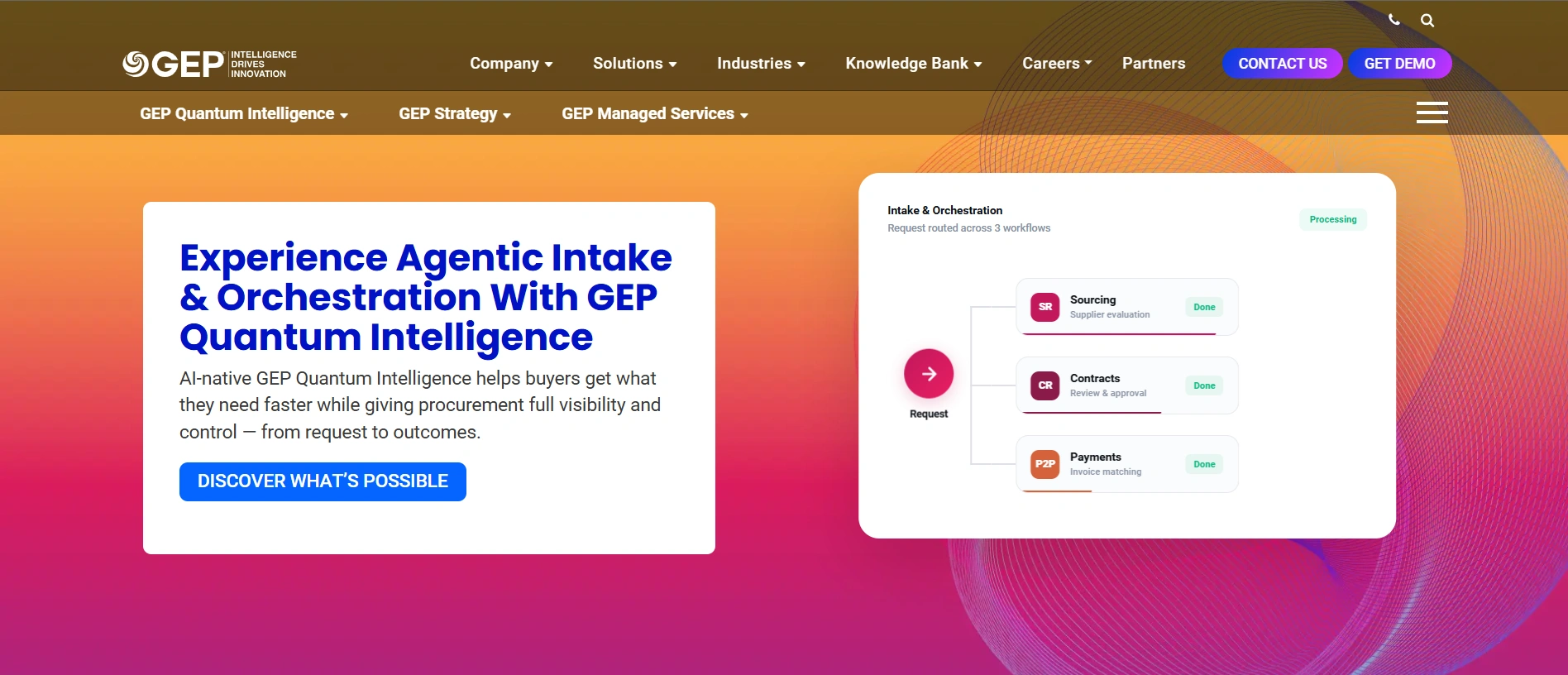
GEP approaches accounts payable through the wider procure-to-pay process. Its managed services include invoice capture, mailroom operations, two- and three-way matching, exception handling, payment processing, and reconciliation, all supported by the SMART by GEP platform. The company processes more than 10 million purchasing transactions each year and provides supplier support in more than 18 languages.
Why we picked it. Founded in 1999 and serving over 1,000 Fortune 500 and Global 2000 enterprises, GEP is the natural choice when AP and procurement should be run as one connected process.
- Services offered: Accounts payable, procure-to-pay transaction management, procurement operations, supplier management, and source-to-pay consulting.
- Pros: Tight link between procurement and payables, multilingual 24-hour support, and proven high transaction volumes.
- Cons: The procurement-led approach is most valuable when you outsource both functions, and the platform draws buyers toward its ecosystem.
- Industry expertise: Manufacturing, consumer goods, life sciences, energy, technology, and other Fortune 500 verticals.
- Best for: Enterprises that want accounts payable integrated with procurement and broader source-to-pay operations.
- Pricing: Custom.
- Year established: 1999.
- Location: Clark, New Jersey (headquarters), with delivery across North America, Europe, and Asia.
7. Corcentric
Corcentric combines software with managed services. Founded in 1996 as AmeriQuest, the New Jersey company offers a managed accounts payable service that combines its own AP technology, payment capabilities, and a team that runs the function for you, so you are not left administering a tool on your own. It serves mid-market and Fortune 1000 finance teams and also offers source-to-pay and order-to-cash services.
Why we picked it. Corcentric provides both the platform and the operational support, helping companies avoid the problem of buying software without having enough staff to manage it.
- Services offered: Managed accounts payable, AP and AR automation software, B2B payments, procurement, and advisory services.
- Pros: Combined technology and managed service, integrated B2B payments, and recognized procure-to-pay platform strength.
- Cons: Smaller delivery footprint than the global F&A giants, and the model leans toward its own payment network.
- Industry expertise: Transportation and fleet, manufacturing, distribution, healthcare, and financial services.
- Best for: Mid-market and Fortune 1000 teams that want managed AP and payments from a single technology-and-service provider.
- Pricing: Custom.
- Year established: 1996.
- Location: Cherry Hill, New Jersey (headquarters), with offices across North America and Europe.
8. Cognizant
Better known for IT services, Cognizant also runs finance and accounting operations, including accounts payable, through its business process services arm. The company began in 1994 as a Dun & Bradstreet technology unit in Chennai and today employs more than 330,000 people worldwide. Its AP services are often part of larger finance and digital transformation projects, allowing clients to improve both their processes and the systems behind them.
Why we picked it. Cognizant is a strong option for enterprises that want to modernize their finance operations and ERP systems alongside outsourcing accounts payable.
- Services offered: Finance and accounting business process services, including accounts payable, plus IT consulting, application services, and analytics.
- Pros: Enterprise scale, strong technology and ERP capability, and the ability to pair AP with system modernization.
- Cons: AP is one offering within a vast IT-led portfolio, so finance buyers should confirm the dedicated F&A team and depth.
- Industry expertise: Banking and financial services, insurance, healthcare, manufacturing, and retail.
- Best for: Large enterprises that want AP delivered alongside digital and ERP transformation.
- Pricing: Custom.
- Year established: 1994.
- Location: Teaneck, New Jersey (headquarters), with delivery across India and more than 30 countries.
9. Datamatics
Datamatics pairs five decades of process experience with its own automation technology. Founded in 1975 and listed in India, the company delivers finance and accounting outsourcing and runs the FINATO procure-to-pay platform for AP automation, covering invoice processing, two- and three-way matching, travel and expense, and payment release. The company has managed AP operations for large businesses, including technology distributor Ingram Micro’s European payables.
Why we picked it. The combination of a proprietary P2P platform and offshore F&A delivery suits enterprises that want automation and a service team from the same partner.
- Services offered: Accounts payable and receivable, procure-to-pay automation, treasury and cash management, record-to-report, and intelligent document processing.
- Pros: Proprietary FINATO platform, long process heritage, and combined automation plus offshore delivery.
- Cons: Brand recognition lower than most large F&A players, and delivery is concentrated in India.
- Industry expertise: Banking and financial services, insurance, healthcare, manufacturing, and media and publishing.
- Best for: Enterprises that want AP automation software paired with an offshore finance and accounting team.
- Pricing: Custom.
- Year established: 1975.
- Location: Mumbai, India (headquarters), with a U.S. office in Edison, New Jersey, and delivery across India, the USA, and the Philippines.
10. Invensis
For smaller and mid-market finance teams, Invensis offers full-cycle payables without the enterprise overhead. Operating since 2000 from Bangalore with U.S. operations in Texas, the company delivers finance and accounting outsourcing that runs bookkeeping, accounts payable and receivable, payroll, tax, and reporting. Its teams work with platforms including QuickBooks, Xero, NetSuite, and Sage. It employs more than 6,000 professionals and holds CMMI Level 3 and ISO 27001 certifications.
Why we picked it. Invensis covers the whole AP cycle for businesses that want a single dependable partner for payables and the books behind them, at offshore pricing.
- Services offered: Accounts payable and receivable, bookkeeping, payroll, tax preparation, financial analysis, and record-to-report.
- Pros: Full-cycle AP, popular accounting tool support, CMMI Level 3 and ISO 27001 certifications, and offshore cost savings.
- Cons: Generalist BPO breadth can mean less niche specialization than a finance-only firm.
- Industry expertise: Healthcare, logistics and supply chain, retail, real estate, insurance, and finance.
- Best for: Small and mid-market companies wanting full-cycle AP bundled with broader accounting support.
- Pricing: Custom.
- Year established: 2000.
- Location: Bangalore, India (headquarters), with U.S. operations in Lewisville, Texas.
11. Flatworld Solutions
Flatworld Solutions has offered outsourcing services since 2004, with accounts payable as one of its core finance services. More than 200 analysts trained in U.S. GAAP and IFRS support its AP operations. OCR and machine learning handle invoice capture, three-way matching, and duplicate or suspicious invoice detection before payments are made. The company serves more than 18,000 clients across 100 countries and is Sarbanes-Oxley compliant.
Why we picked it. Flatworld combines affordable offshore delivery with dedicated analysts who manage exceptions, a sensible middle path for growing finance teams.
- Services offered: Accounts payable, accounts receivable, bookkeeping, invoice processing, payroll, and general accounting.
- Pros: Analyst-led delivery, automation for capture and matching, duplicate and fraud anomaly detection, and Sarbanes-Oxley compliance.
- Cons: Wide service range across many functions can dilute finance-specific depth.
- Industry expertise: Healthcare, finance, retail, real estate, legal, and logistics.
- Best for: Small to mid-market companies seeking cost-effective offshore AP with strong controls.
- Pricing: Custom.
- Year established: 2004.
- Location: New Jersey, USA, the UK (corporate offices), with delivery in India, the Philippines, Bolivia, and Colombia.
12. QX Global Group
UK-headquartered QX Global Group runs payables through QX Finance & Accounts Services, the finance arm of a business process group that also serves recruitment and property sectors. Its finance and accounting outsourcing handles accounts payable and receivable for mid-market and high-growth businesses, and the group leans hard on security, holding ISO 27001, ISO 27701, and ISO 9001 certifications along with BSI certification and GDPR compliance.
Why we picked it. With 2,400-plus staff and a strong certification stack, QX is a solid choice for organizations where data protection is a top priority.
- Services offered: Accounts payable and receivable, finance and accounting operations, accounting for CPA firms, and recruitment process outsourcing.
- Pros: Strong security certifications, offshore economics, and recognized finance and accounting delivery.
- Cons: Smaller scale than the global giants, with delivery concentrated in India.
- Industry expertise: Accounting and audit firms, property management, recruitment, manufacturing, and retail.
- Best for: Accounting firms and mid-market businesses that prioritize security certifications and offshore cost savings.
- Pricing: Custom.
- Year established: 2003.
- Location: United Kingdom (headquarters), with offices in the USA and Canada and delivery centers across India.
13. Personiv
Personiv, an eClerx company operating since 1985, sells a dedicated-team model that lets you start small and scale. Through its finance and accounting service, it provides offshore AP, AR, payroll, and financial planning teams, starting with as few as one person, each paired with a U.S.-based account manager. The Austin-based firm reports cost savings of up to 50 percent and holds SOC 2 Type II certification.
Why we picked it. Personiv makes it easy to start small, making it a good option for companies trying AP outsourcing for the first time.
- Services offered: Accounts payable and receivable, payroll, financial planning and analysis, procure-to-pay, order-to-cash, and back-office support.
- Pros: Start with a single dedicated person, U.S.-based account management, SOC 2 Type II certification, and up to 50% savings.
- Cons: The dedicated-team model is less suited to buyers wanting a fully hands-off managed service from day one.
- Industry expertise: Technology, oil and gas, professional services, and capital investment.
- Best for: Companies that want a scalable offshore finance team and prefer to grow the engagement gradually.
- Pricing: Custom.
- Year established: 1985.
- Location: Austin, Texas (headquarters), with delivery in the Philippines, India, and Australia.
14. ARDEM
ARDEM focuses on high-volume invoice and document processing. Founded in 2004 and based in New Jersey, the company uses its own Invoice Capture and Extraction software, which it says achieves 99.7% data extraction accuracy and supports three- and four-way matching. ARDEM processes 12 to 15 million pages each year for retailers, manufacturers, government agencies, and other large organizations. It also claims it can launch a new client team in about two weeks.
Why we picked it. When the core challenge is sheer invoice and document volume with custom requirements, ARDEM’s automation-plus-analyst model is a good choice.
- Services offered: Invoice capture and extraction, accounts payable processing, data entry, document processing, and business process automation.
- Pros: Proprietary capture software, high stated accuracy, fast team setup, and experience with very large document volumes.
- Cons: Focus on processing and automation means less full-scope finance and accounting breadth than a dedicated F&A firm.
- Industry expertise: Retail, manufacturing, insurance, logistics, healthcare, and the public sector.
- Best for: Businesses with high invoice and document volumes or unusual processing requirements.
- Pricing: Custom.
- Year established: 2004.
- Location: Hazlet, New Jersey, USA.
Why Choose Helpware for Accounts Payable Support
Across these 14 providers, Helpware stands out for a buyer who wants payables handled as part of a stable, long-running back-office relationship and not a one-off transaction contract. One of its biggest strengths is consistency. Monthly attrition near 2.8% keeps the same people on your processes, which is exactly what protects accuracy in AP, where a single misread invoice has real consequences. Pair that with 90% CSAT and client partnerships averaging more than five years, and the picture is one of consistency.
The compliance side matters too. SOC 2 Type II, HIPAA, and GDPR coverage suit finance teams in regulated industries, and the back-office model combines automation for capture, duplicate detection, and approval routing with people who handle exceptions and more complex cases.
Helpware is best suited for businesses looking for broader back-office support that includes AP, not a standalone finance-transformation program of the kind a pure F&A specialist runs. For companies that value retention, compliance, and a real partnership, that trade is an easy one.
How to Choose an Accounts Payable Outsourcing Partner
The best provider is the one that fits the way your finance team works. Before comparing vendors, decide what you want to outsource. Some businesses hand over the entire AP function, while others prefer a dedicated team or include AP as part of a larger finance outsourcing engagement. Also consider delivery location and whether your team needs regular overlap in working hours.
Look beyond pricing when comparing providers. Ask about staff turnover, touchless processing rates, security controls, and fraud prevention measures. Request a clear service-level agreement and do not rely solely on marketing materials. A small pilot project can reveal far more than a sales presentation. The strongest providers spend time learning your business before recommending a solution.