






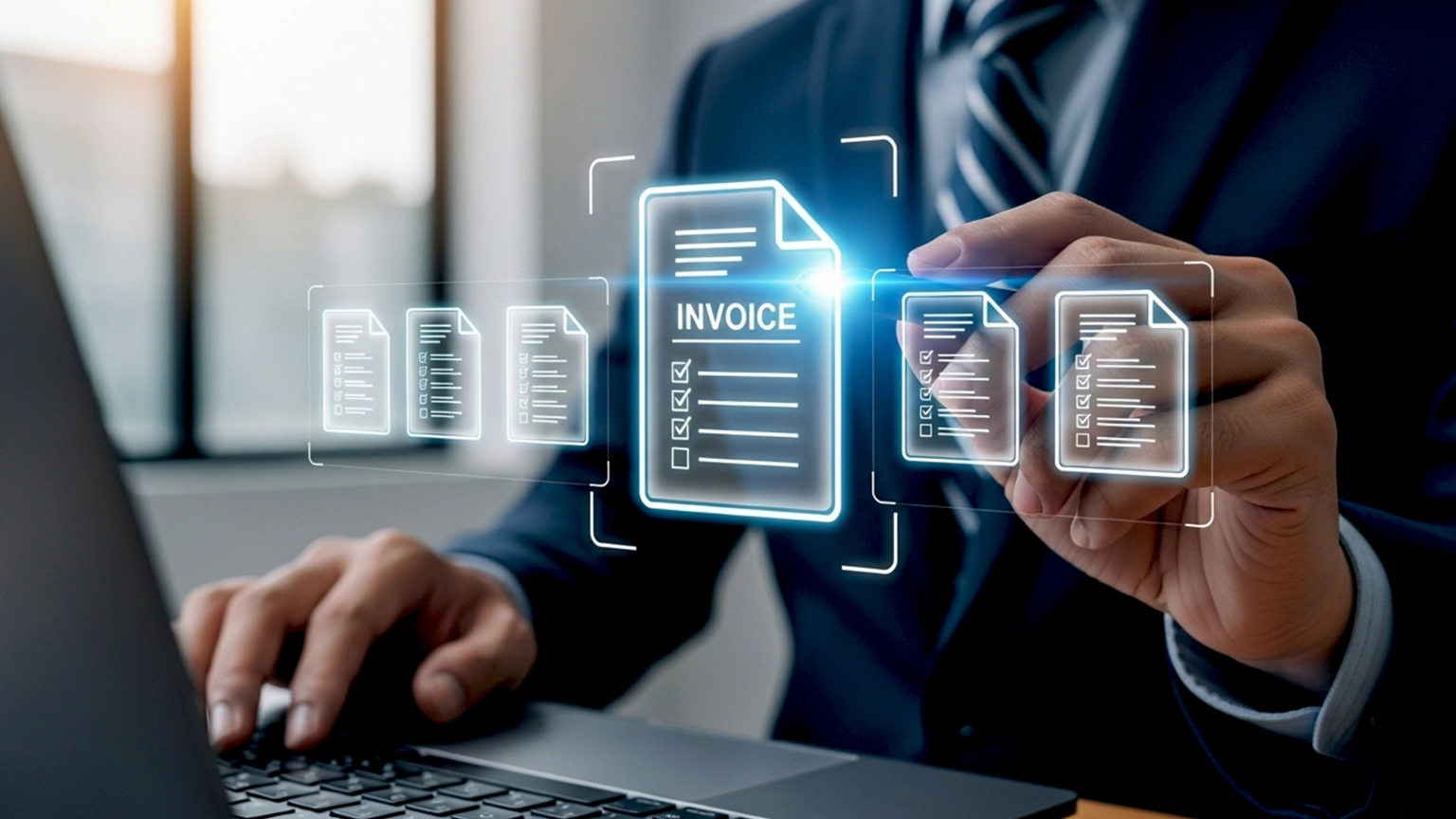
The global accounts payable (AP) automation market is expected to go from USD 4.2 billion in 2026 USD to 7.1 billion by 2030, growing at an annual rate of 12.5%. The driving force is straightforward: companies are replacing manual invoice processing with AI-assisted workflows. And North America currently accounts for 33.2% of the market.
Today’s AP automation companies offer everything from self-service software and procure-to-pay platforms to AI-powered invoice tools and managed service providers that handle the work on your behalf. This guide is for finance leaders, controllers, and AP managers looking to process invoices more efficiently.
But before comparing vendors, it’s worth understanding the trends shaping the market in 2026. Below, we look at the key developments, compare 14 leading providers, and explain what to consider when choosing a solution.
What’s Shaping AP Automation in 2026
Trend 1: AI Moves Invoice Capture from Reading to Reasoning
Invoice automation used to focus mainly on optical character recognition (OCR), which extracted information from documents and placed it into the right fields. Today’s systems can code invoices, match them to purchase orders, and identify exceptions with minimal human involvement.
According to Grand View Research, AI and machine learning are among the main factors driving market growth. For buyers, the important question is no longer whether a system can read an invoice. It’s how much of the process it can complete on its own and how well it handles invoices that don’t follow a standard format.
Trend 2: Cloud Deployment Opens the Door for Smaller Teams
A decade ago, implementing AP automation often meant a lengthy IT project and on-premises software. That has changed significantly today. Cloud-based solutions already held the largest share of the market in 2023, and Grand View Research expects strong growth among small and midsize businesses through 2030.
Subscription pricing has also lowered the barrier to entry. Companies that once could not justify a large software investment can now access many of the same capabilities used by larger enterprises. As a result, the conversation has shifted from affordability to finding the right fit for your team’s workflow.
Trend 3: Managed Services Grow Alongside Software
Software remains the largest segment of the market, accounting for 62.2% of revenue in 2023, but demand for services is rising as well.
Many finance teams don’t want to spend time managing an AP platform themselves. They want invoices processed accurately and on time. That demand has created opportunities for providers that combine automation with trained AP specialists who handle exceptions, approvals, and vendor communications. Grand View Research expects consulting, implementation, and managed support services to see strong growth over the rest of the decade.
Trend 4: Compliance and E-Invoicing Reshape the Buying Criteria
Compliance is now a major consideration when evaluating AP automation vendors. Regulatory requirements are an important driver of adoption, with banking, financial services, and insurance leading the way. Governments across Europe, Latin America, and Asia continue to expand e-invoicing requirements, increasing the need for systems that support local tax rules and approved invoice formats. For companies operating across multiple countries or in highly regulated industries, compliance capabilities are no longer optional. They are often a requirement from day one.
Top 14 AP Automation Companies for Invoice Processing: At a Glance
| Company | Services | Global Presence | Employees | Year Est. |
|---|---|---|---|---|
| Helpware | Managed back-office AP and invoice processing, data entry, customer and technical support, CX consulting | USA, Mexico, Philippines, Ukraine, Georgia, Uganda, Puerto Rico, Poland, Germany (19 locations) | ~4,000 | 2015 |
| Tipalti | Global payables, invoice processing, payments, procurement, expense | USA, Canada, UK, Netherlands, Israel, Georgia (multiple offices) | ~1,250 | 2010 |
| BILL | AP and AR automation, invoice processing, bill pay, spend and expense | USA (San Jose HQ), payments to 130+ countries | ~3,300 | 2006 |
| AvidXchange | AP automation, invoice and payment processing, AvidPay network | USA (Charlotte HQ), 7 office locations | ~1,800 | 2000 |
| Coupa | Total spend management, AP and invoice, procurement, payments | USA, UK, India, offices worldwide | ~3,600 | 2006 |
| SAP Concur | Concur Invoice (AP), expense, travel management | USA (Bellevue HQ), global SAP network | ~4,600 | 1993 |
| Stampli | AP automation, invoice processing, procure-to-pay, cards, payments | USA (Mountain View HQ), Israel | ~300 | 2015 |
| Medius | Source-to-pay, autonomous AP, invoice processing, payments | Sweden (Linkoping HQ), USA, UK, Australia, Nordics | ~350 | 2001 |
| Basware | Invoice lifecycle management, AP automation, e-invoicing, P2P | Finland (Espoo HQ), Europe, USA, Asia | ~1,700 | 1985 |
| Esker | Source-to-pay, AP and invoice automation, order-to-cash | France (Lyon HQ), USA (Madison), global | ~1,200 | 1985 |
| Ramp | Bill Pay (AP), corporate cards, expense, procurement | USA (New York HQ, Miami, San Francisco) | ~1,200 | 2019 |
| Yooz | Cloud AP automation, invoice processing, P2P, payments | France, USA (Dallas), UK, UAE | ~500 | 2010 |
| Nanonets | AI document processing, invoice data extraction, AP automation | USA (San Francisco), India (Bengaluru) | Not disclosed | 2017 |
| Rossum | AI document processing, invoice capture, AP automation | Czech Republic (Prague HQ), UK, Europe | ~200 | 2017 |
Top 14 AP Automation Companies for Invoice Processing: Overview
#1 Helpware
Managed AP and invoice processing backed by global support teams
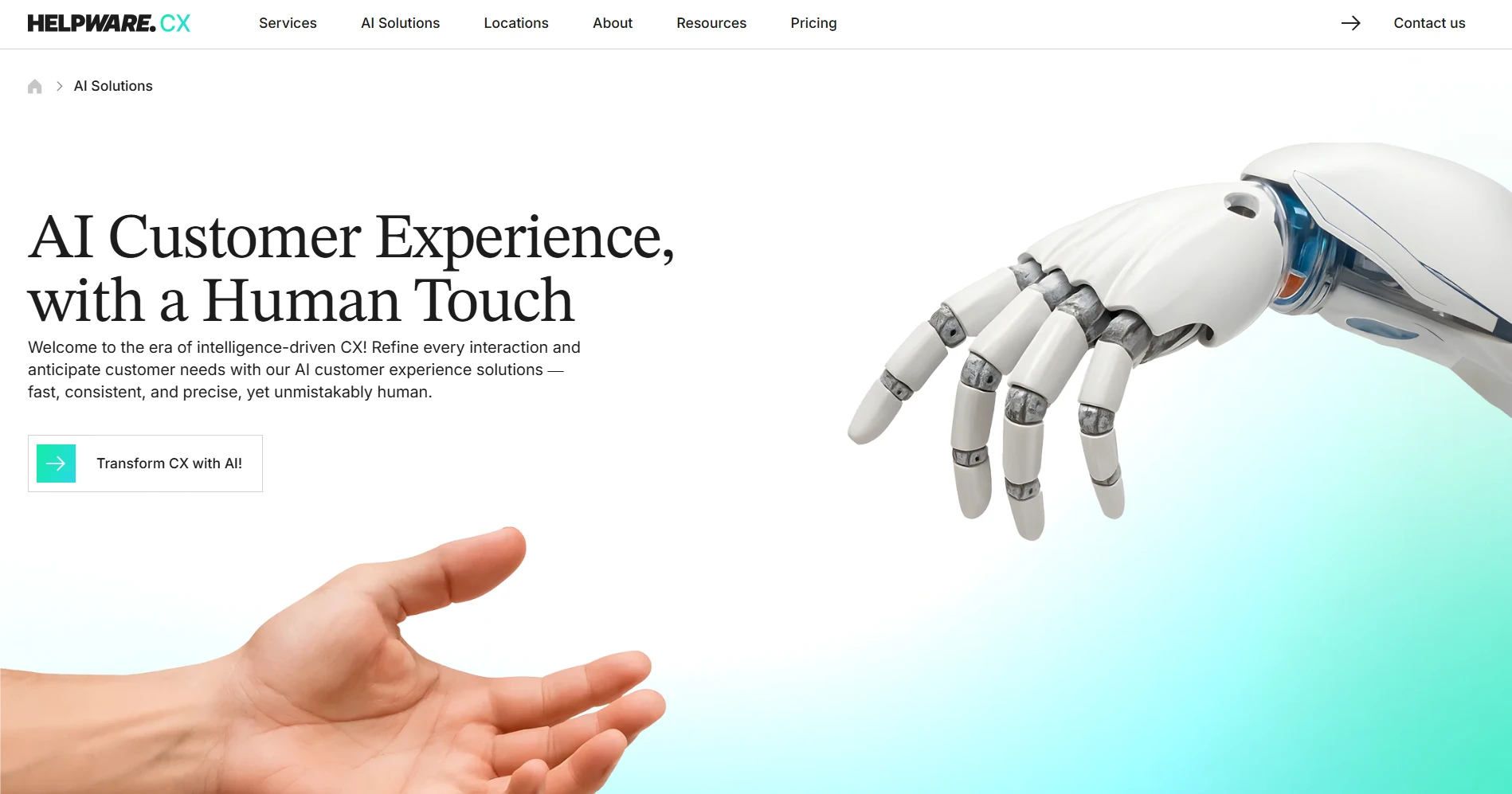
Helpware takes a service-led approach to accounts payable automation. Instead of providing only software, the company supplies trained back-office teams that manage invoice processing within your existing ERP and accounting systems. Founded in 2015 and headquartered in Lexington, Kentucky, Helpware supports accounts payable, accounts receivable, bookkeeping, data entry, invoice tracking, and other finance operations.
Its model combines automation for repetitive tasks with finance specialists who handle exceptions, approvals, and compliance reviews. This appeals to organizations that want invoices processed efficiently without adding another platform to manage.
Why we picked it
Helpware operates across 19 locations with more than 4,000 team members and support in 45+ languages. The company reports a 90% customer satisfaction score and a 2.8% monthly attrition rate compared to the industry average of 6-8%. Its teams work within your existing systems, which can make adoption faster and less disruptive.
- Services offered: Managed back-office and AP support (accounts payable and receivable, invoice processing, data entry, bookkeeping), customer support, technical support, call center services, CX consulting, data operations.
- Pros: Human-plus-AI model across capture, document handling, and error detection. 19 global locations for 24/7 coverage. 90% CSAT and 2.8% attrition versus a 6-8% industry average. SOC 2, HIPAA, GDPR, and PCI DSS certified. Up to 50% lower back-office costs. 5-year average client partnerships.
- Cons: A managed-services model, not a self-serve software platform. Consultative onboarding takes longer than signing up for an app.
- Industry expertise: Healthcare, SaaS and software, ecommerce and retail, fintech and banking, logistics, gaming, public sector.
- Best for: Mid-market to enterprise finance teams that want invoice processing handled by a trained team inside their current systems, with compliance depth for regulated work.
- Pricing: Custom, based on scope and complexity.
- Year established: 2015
- Location: Lexington, Kentucky (HQ), USA, Mexico, Philippines, Ukraine, Georgia, Uganda, Puerto Rico, Poland, Germany
#2 Tipalti
End-to-end global payables automation
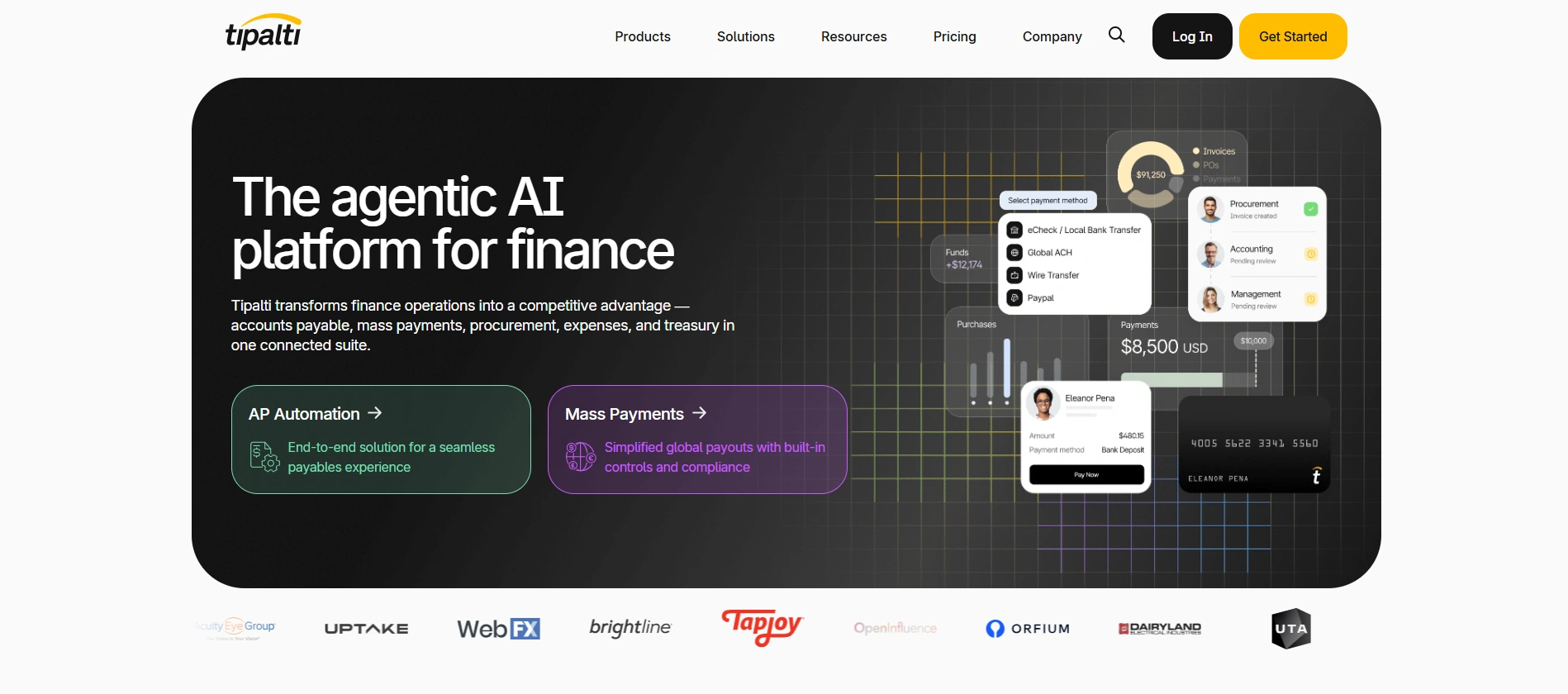
Tipalti manages the full accounts payable cycle in a single cloud platform, covering supplier onboarding, invoice processing, approvals, global payments, and reconciliation. Started in 2010 and headquartered in Foster City, California, the company serves more than 5,000 businesses and supports payments in roughly 200 countries.
Beyond core AP, the platform includes tax compliance, procurement, expense management, and AI-powered automation features.
Why we picked it
Tipalti is especially strong for companies with international supplier networks. Its support for multiple currencies, payment methods, and tax requirements makes it a leading option for global payables.
- Services offered: AP automation, invoice processing, global payments, supplier management, tax compliance, procurement, expense management.
- Pros: Payments across roughly 200 countries. AI assistant and agents across the AP process. Integrates with NetSuite, Sage Intacct, and QuickBooks.
- Cons: Built for mid-market and up. May be more than very small teams need.
- Best for: High-velocity, global companies scaling finance operations.
- Pricing: Custom. Platform fee plus usage.
- Year established: 2010
- Location: Foster City, California (HQ), USA, Canada, UK, Netherlands, Israel, Georgia
#3 BILL
AP automation designed for small and midsize businesses
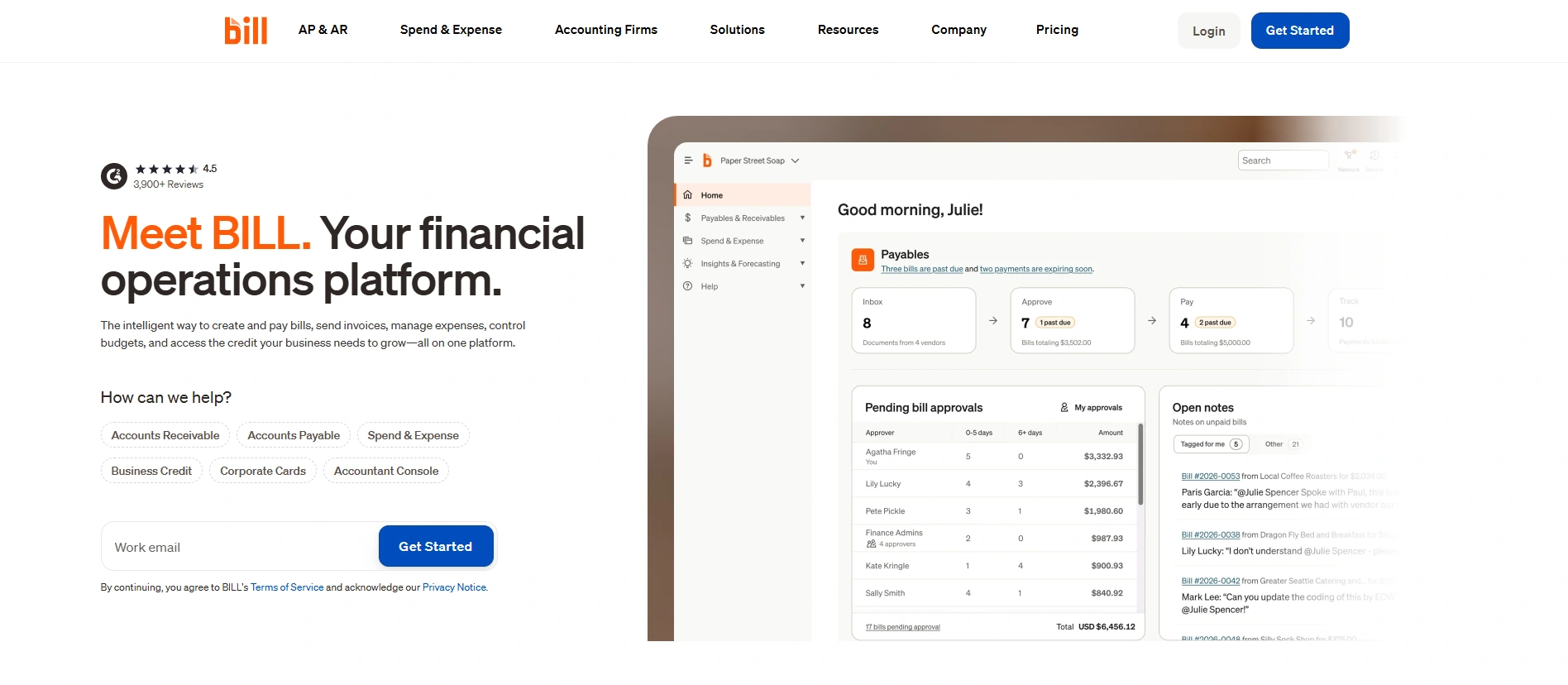
BILL helps smaller companies automate accounts payable and receivable workflows. Public on the NYSE and headquartered in San Jose, California since 2006, it serves close to 500,000 businesses and pushes payments across more than 130 countries. Its newer Invoice Coding Agent applies machine learning to read and categorize invoices, and the platform folds in spend and expense management through its Divvy card business.
Why we picked it
BILL stands out for ease of use and accessibility. Strong integrations with popular accounting software and a large supplier network make it a practical choice for growing businesses.
- Services offered: AP and AR automation, invoice processing, bill pay, spend and expense management, vendor payments.
- Pros: Close to 500,000 customers. Strong accounting-software syncs. AI invoice coding. Combined card and AP spend view.
- Cons: Geared to SMBs. Larger or highly complex finance teams may outgrow it.
- Best for: Small and mid-sized businesses and accounting firms.
- Pricing: Subscription tiers per user, plus transaction fees.
- Year established: 2006
- Location: San Jose, California (HQ), payments across 130+ countries
#4 AvidXchange
AP and payment automation purpose-built for the middle market
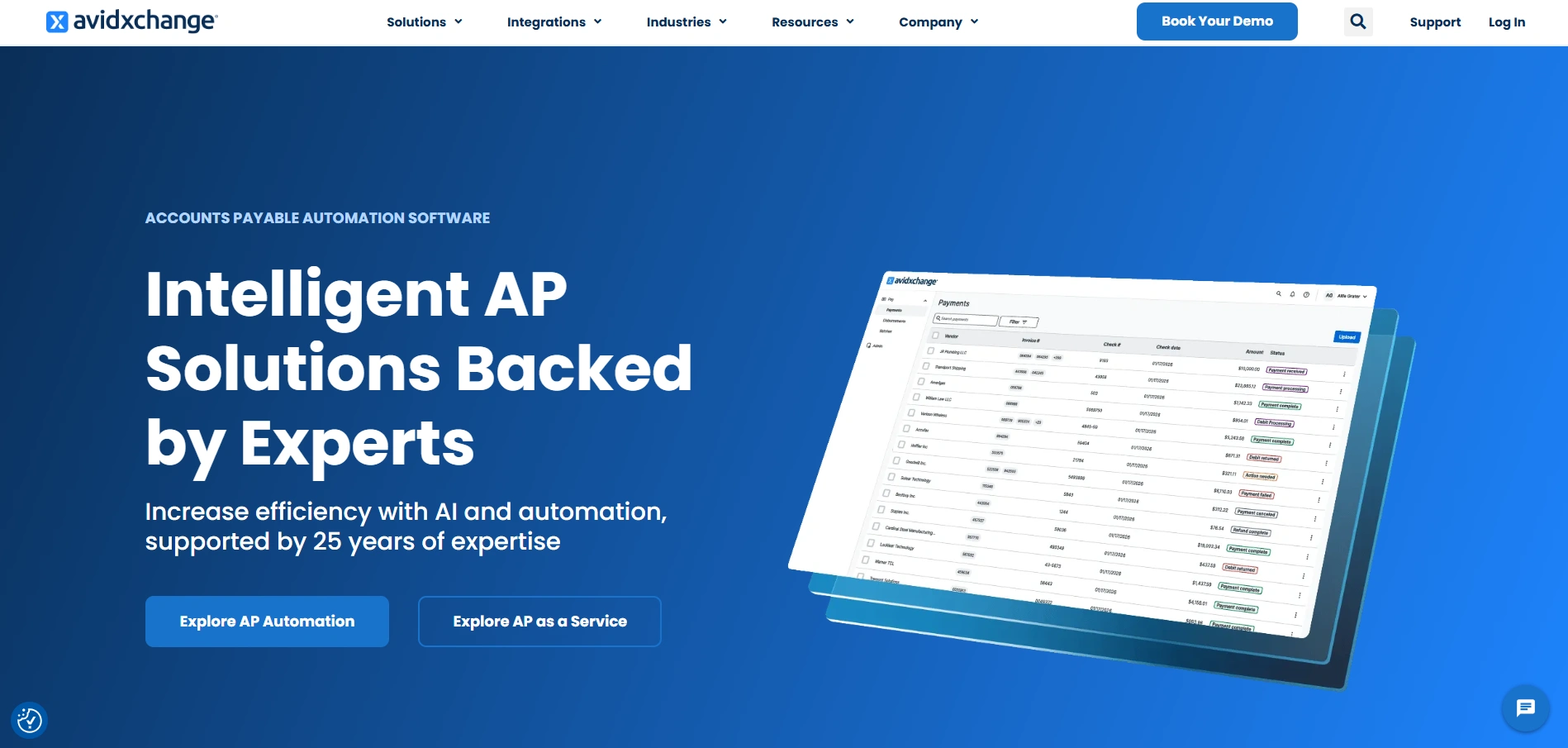
Founded in 2000 and headquartered in Charlotte, North Carolina, AvidXchange focuses on invoice and payment automation for mid-sized organizations. The company serves more than 8,000 businesses and operates the AvidPay supplier network, which includes more than one million suppliers.
It offers specialized workflows for industries such as real estate, construction, community association management, and healthcare.
Why we picked it
AvidXchange stands out for its industry expertise. Organizations in sectors with complex approval and payment processes can benefit from workflows built specifically for their needs.
- Services offered: AP automation, invoice capture and approval, supplier payments, AvidPay network.
- Pros: 8,000+ mid-market customers. Strong vertical expertise. Large embedded payment network. Onboarding support team.
- Cons: North America focused. Less suited to global, multi-currency payables.
- Best for: Mid-market companies in real estate, construction, HOA, and healthcare.
- Pricing: Custom, based on volume and modules.
- Year established: 2000
- Location: Charlotte, North Carolina (HQ), seven office locations
#5 Coupa
Enterprise spend management with AP built in
Coupa approaches AP automation as part of a broader spend management platform that includes procurement, sourcing, payments, and supply chain management. Founded in 2006, headquartered in Foster City, California, and now owned by Thoma Bravo, Coupa runs an AI-native platform connected to a community network of more than 10 million buyers and suppliers. Invoice automation is one component of a larger system designed to manage company spending from end to end.
Why we picked it
Coupa is a strong fit for organizations looking to manage procurement, purchasing, and payments in a single platform. Its biggest advantage is visibility across the entire spending process, from purchase request through final payment.
- Services offered: Total spend management, AP and invoice automation, procurement, sourcing, payments, supply chain.
- Pros: Unified spend platform. Large buyer-supplier network. AI agents for spend. Strong enterprise controls.
- Cons: Enterprise scope and cost. Heavier than teams needing AP alone.
- Best for: Large enterprises consolidating procurement and AP on one platform.
- Pricing: Custom enterprise pricing.
- Year established: 2006
- Location: Foster City, California (HQ), offices worldwide
#6 SAP Concur
Connected travel, expense, and invoice management at enterprise scale
Concur Technologies was founded in 1993 and acquired by SAP in 2014. The company is based in Bellevue, Washington.
SAP Concur offers accounts payable automation through its Concur Invoice product, which helps companies capture, route, approve, and pay invoices more efficiently. Its biggest strength is integration. Concur connects invoice management with travel and expense processes while working closely with SAP and many other ERP systems.
Why we picked it
SAP Concur is a strong choice for enterprises with complex approval workflows, strict audit requirements, and large ERP environments. The ability to manage multiple spending categories in one ecosystem adds significant value.
- Services offered: Concur Invoice (AP automation), expense management, travel management, spend analytics.
- Pros: Deep ERP integration. Mature compliance and audit controls. One system for travel, expenses, and invoices.
- Cons: Overhead can outweigh value for small, low-complexity teams.
- Best for: Enterprises with complex spend, audit needs, and international operations.
- Pricing: Custom, based on modules and volume.
- Year established: 1993
- Location: Bellevue, Washington (HQ), global via SAP
#7 Stampli
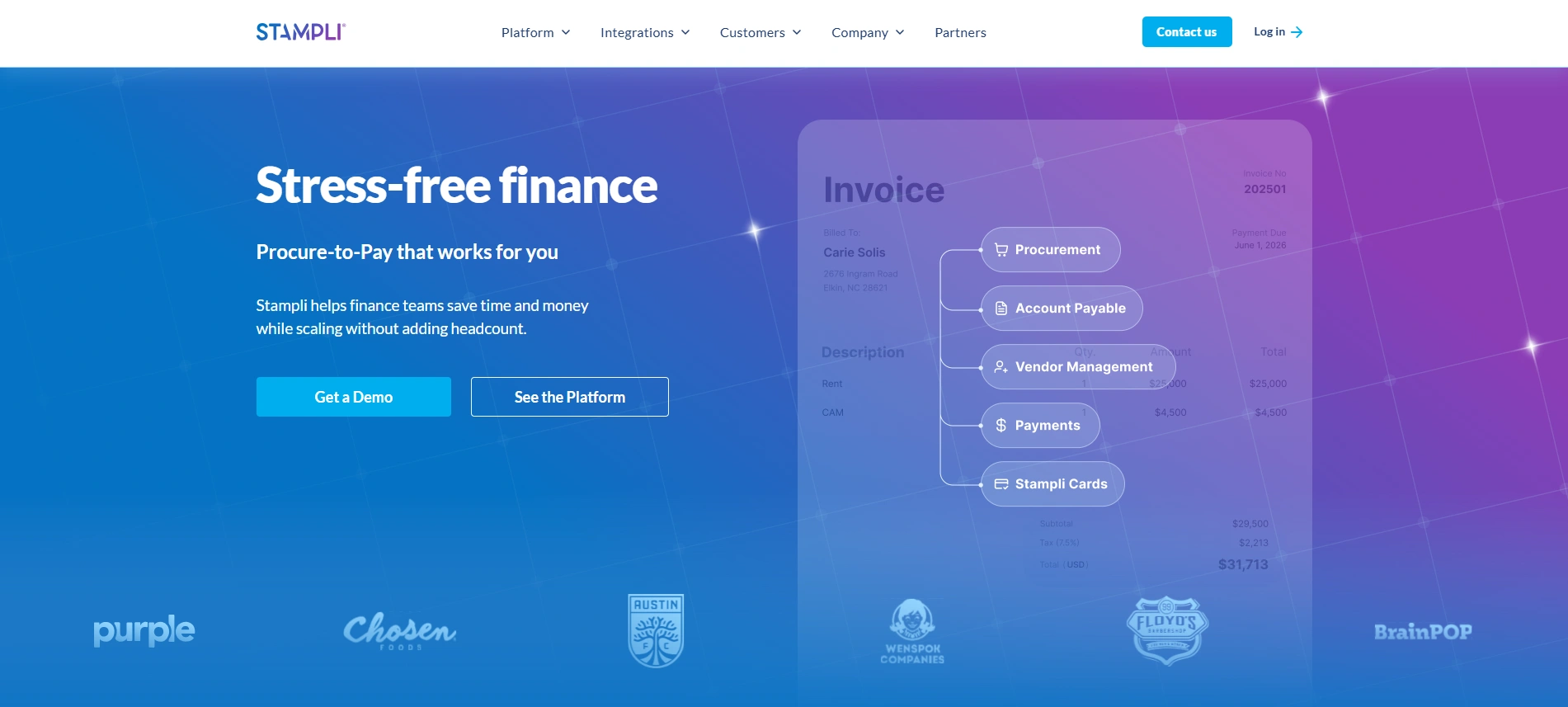
Invoice-focused AP automation powered by AI
Stampli puts the invoice at the center of the workflow. Founded in 2015 and headquartered in Mountain View, California, the company serves more than 1,700 customers and integrates with over 70 ERP systems.
Its AI assistant, Billy, helps with invoice coding, routing, matching, validation, duplicate detection, and fraud prevention. All communication, approvals, and supporting documents stay attached to the invoice, making collaboration easier.
Why we picked it
Stampli stands out for its speed. Keeping conversations and approvals in one place helps AP teams reduce delays and spend less time chasing information.
- Services offered: AP automation, invoice processing, procure-to-pay, vendor management, corporate cards, payments.
- Pros: Fast deployment. 70+ ERP integrations. Invoice-centric collaboration. AI coding and duplicate detection.
- Cons: AP-first scope. Less of a full enterprise procurement suite.
- Best for: Mid-market finance teams wanting quick setup and strong AP collaboration.
- Pricing: Custom, based on invoice volume.
- Year established: 2015
- Location: Mountain View, California (HQ), Israel
#8 Medius
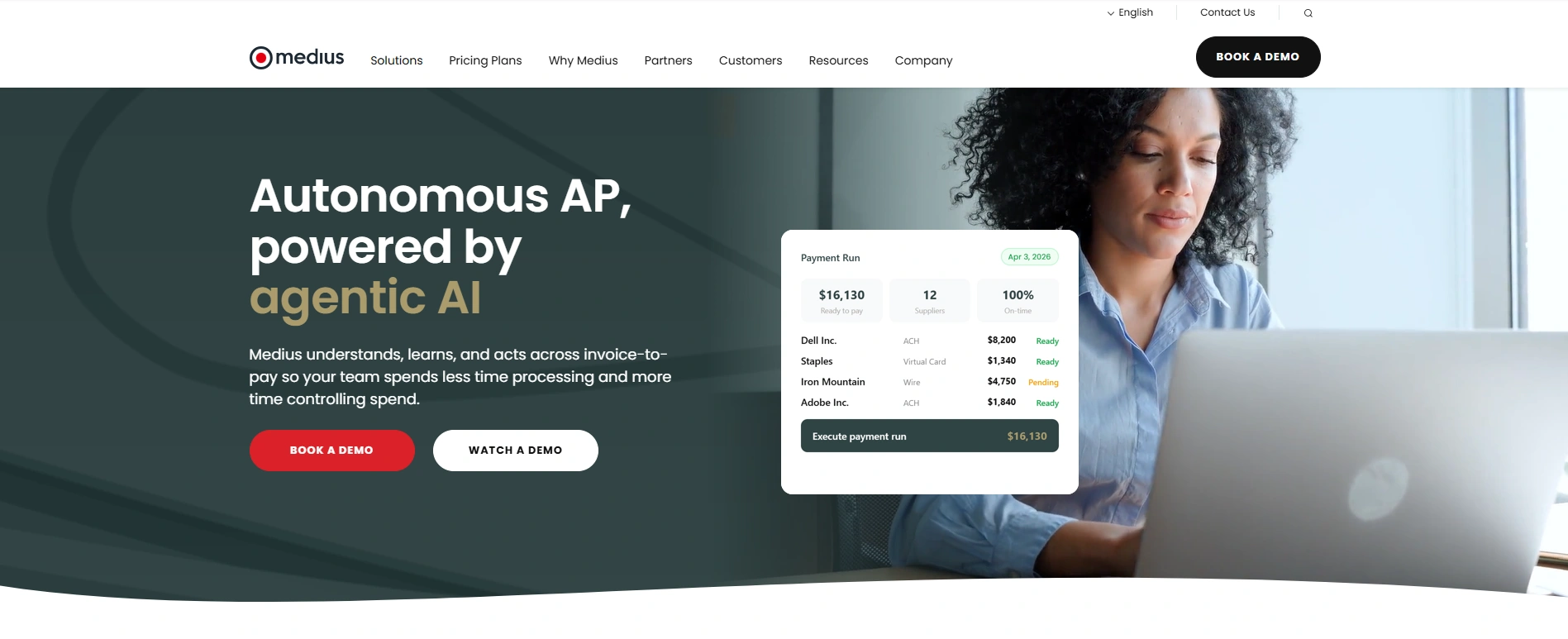
Autonomous, source-to-pay AP for finance teams that want hands-off processing
Medius focuses on automating the entire invoice workflow, from capture and coding to approval and payment. Founded in 2001 in Linköping, Sweden, the company also maintains a North American presence in Jacksonville, Florida. It serves thousands of customers and integrates with more than 100 ERP systems. Recent acquisitions have expanded its capabilities into procurement and expense management, creating a broader source-to-pay platform.
Why we picked it
Medius is well suited for finance teams looking to reduce manual work as much as possible. Its strength lies in helping organizations process large invoice volumes while focusing staff attention on exceptions and approvals.
- Services offered: Source-to-pay, autonomous AP, invoice processing, payments, procurement, expense management.
- Pros: High touchless rates. 100+ ERP connectors. Fast deployment. In-house AP support teams.
- Cons: Best value at higher invoice volumes. Smaller brand footprint in the US.
- Best for: Mid-market and enterprise teams targeting near-touchless AP.
- Pricing: Custom, tiered by package.
- Year established: 2001
- Location: Linköping, Sweden (HQ), USA, UK, Australia, Nordics
#9 Basware
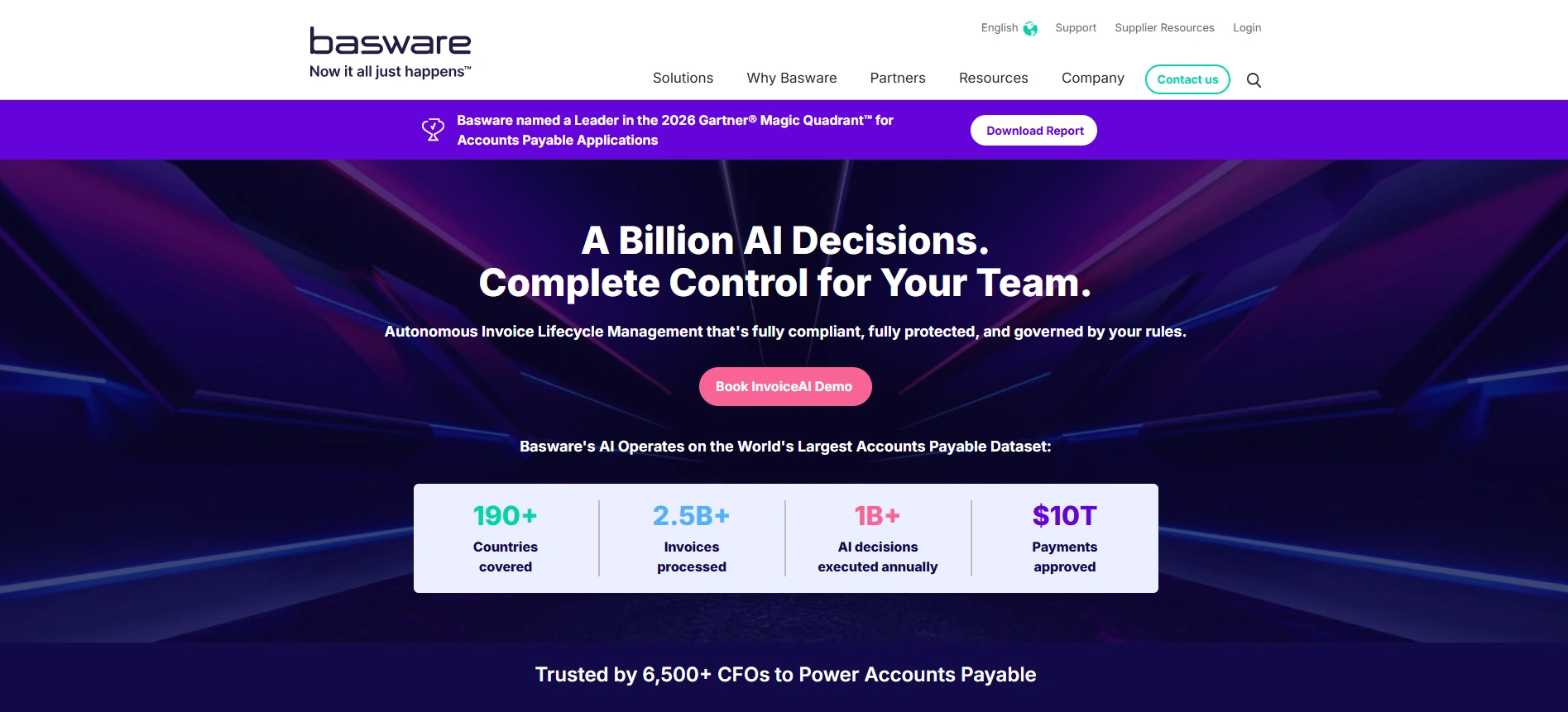
Invoice lifecycle management with deep global compliance
Founded in 1985 and headquartered in Espoo, Finland, Basware is one of the most established names in AP automation. The company serves more than 6,500 customers worldwide, including major global brands such as DHL, Heineken, and Sony.
Basware specializes in managing the full invoice lifecycle and offers extensive support for e-invoicing requirements across different countries. Its AI models are trained on billions of invoice transactions.
Why we picked it
Basware is a compliance specialist. Companies operating across multiple countries benefit from its experience with local e-invoicing regulations and tax requirements.
- Services offered: Invoice lifecycle management, AP automation, e-invoicing network, procure-to-pay, compliance.
- Pros: 40 years of focus. Strong global e-invoicing compliance. Large enterprise customer base. Deep SAP integration.
- Cons: Enterprise orientation. Can feel heavy for smaller teams.
- Best for: Large, multinational enterprises with cross-border compliance needs.
- Pricing: Custom enterprise pricing.
- Year established: 1985
- Location: Espoo, Finland (HQ), Europe, USA, Asia
#10 Esker
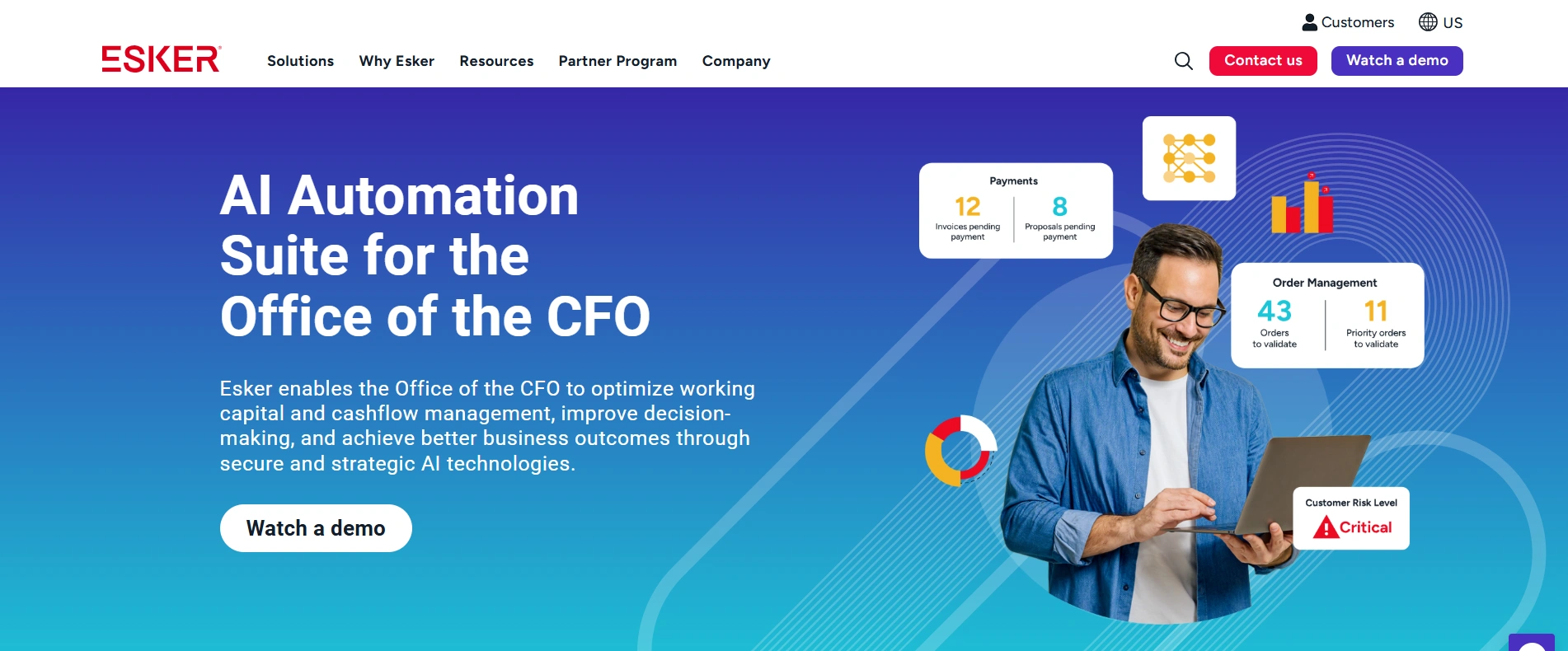
AP and AR automation on a single platform
Esker helps finance teams automate both accounts payable and accounts receivable processes. Founded in 1985 in Lyon, France, with U.S. operations in Madison, Wisconsin, the company serves more than 2,500 organizations and connects with over 70 ERP systems. Its AI capabilities support invoice capture, coding, matching, and workflow management across finance operations.
Why we picked it
Esker appeals to organizations that want one platform for both AP and AR. Its broad coverage of source-to-pay and order-to-cash processes helps finance teams standardize operations across departments.
- Services offered: Source-to-pay, AP and invoice automation, order-to-cash, procurement, supplier management.
- Pros: Covers AP and AR. 70+ ERP integrations. Agentic AI. Strong analyst recognition.
- Cons: Broad suite can be more than an AP-only buyer needs.
- Best for: Mid-market and enterprise finance teams automating across the CFO’s office.
- Pricing: Custom, modular pricing.
- Year established: 1985
- Location: Lyon, France (HQ), Madison, Wisconsin, global
#11 Ramp
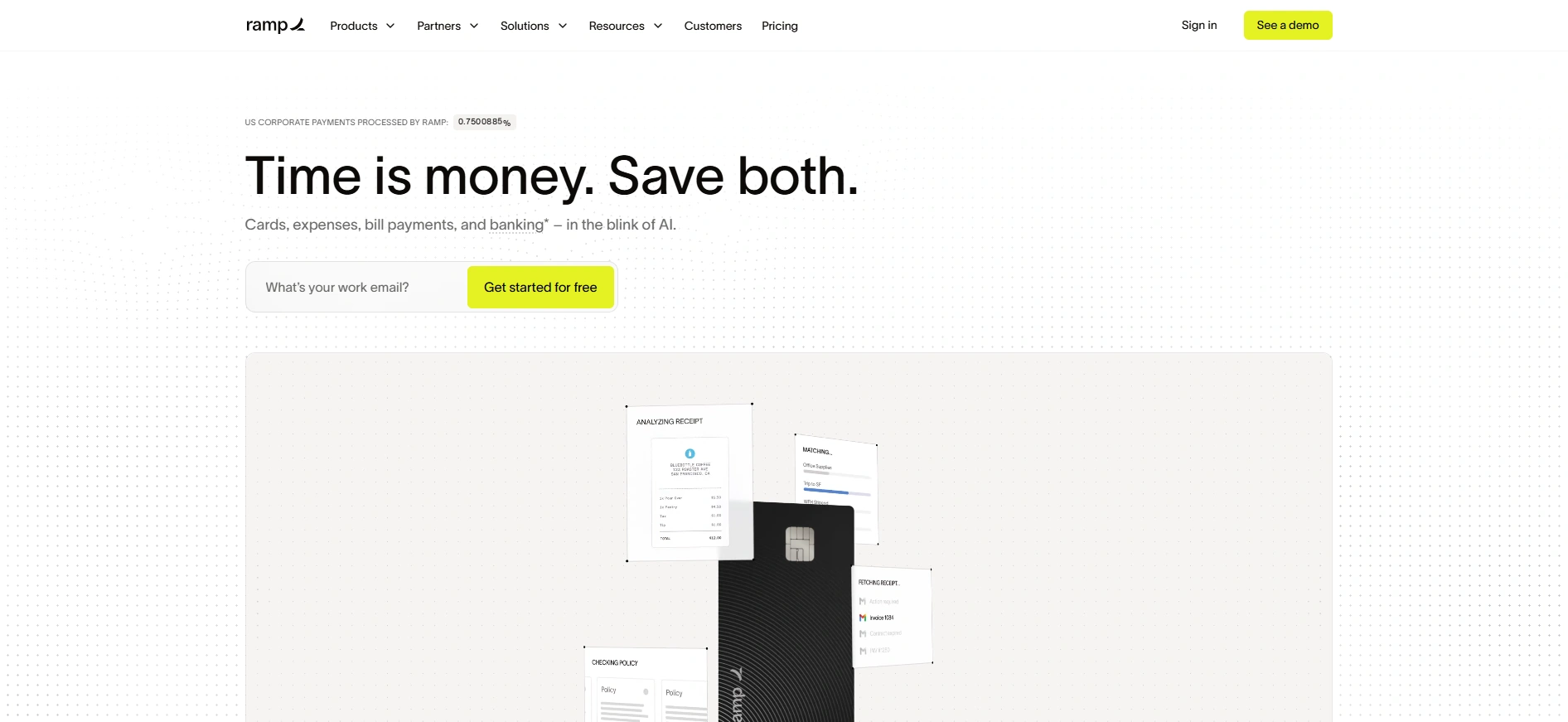
Fast-growing finance platform with free AP inside a spend suite
Ramp started with corporate cards and expanded into bill pay, building AP automation into a broader finance platform. Founded in 2019 and based in New York, it serves more than 45,000 customers. It recently launched Agents for AP to automate invoice coding, approval, and payment. Its Bill Pay module captures invoices with OCR and pushes near-touchless workflows.
- Services offered: Bill Pay (AP automation), corporate cards, expense management, procurement, travel, bookkeeping.
- Pros: Free core AP tier. Fast setup. AI agents for AP. Combined card and bill spend.
- Cons: ERP sync depth is lighter than legacy platforms. Advanced features sit behind paid tiers.
- Best for: Startups and SMBs to mid-market wanting an all-in-one spend platform.
- Pricing: Free core tier, paid plans from about $15 per user per month.
- Year established: 2019
- Location: New York (HQ), Miami, San Francisco
#12 Yooz
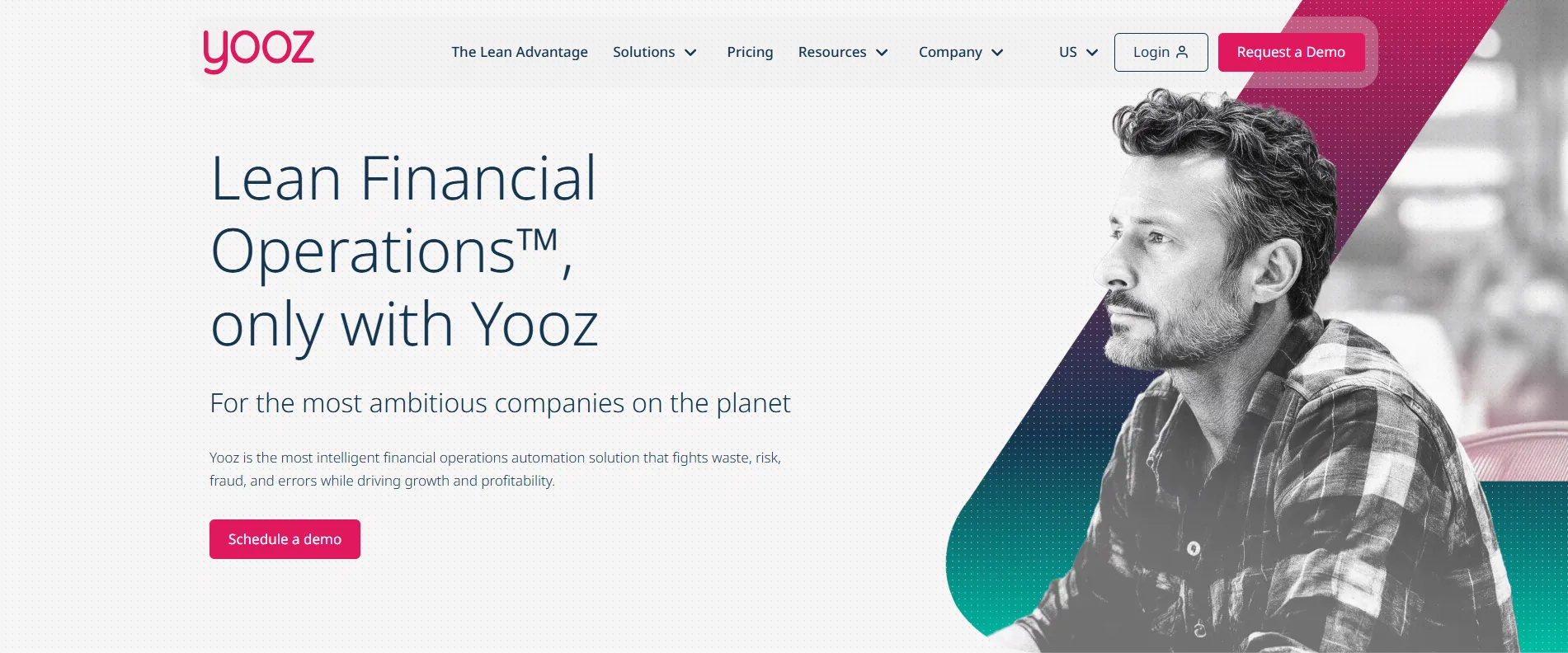
Cloud purchase-to-pay automation with strong e-invoicing compliance
Yooz delivers cloud-based AP and purchase-to-pay automation aimed at small and mid-sized finance teams. With roots in document-processing technology and a US base in Dallas, it serves more than 5,000 customers across 50-plus countries and integrates with over 250 ERP and accounting systems. Its AI-powered platform handles invoice capture, coding, approvals, and payment workflows, while integrating with more than 250 ERP and accounting systems.
- Services offered: Cloud AP automation, invoice processing, purchase-to-pay, payments, fraud detection.
- Pros: 250+ ERP integrations. Touchless processing. Strong e-invoicing compliance. SMB-friendly setup.
- Cons: Smaller scale than enterprise suites. Lighter procurement depth.
- Best for: Small and mid-sized teams wanting affordable, compliant AP automation.
- Pricing: Subscription.
- Year established: 2010
- Location: France and USA (Dallas), UK, UAE
#13 Nanonets
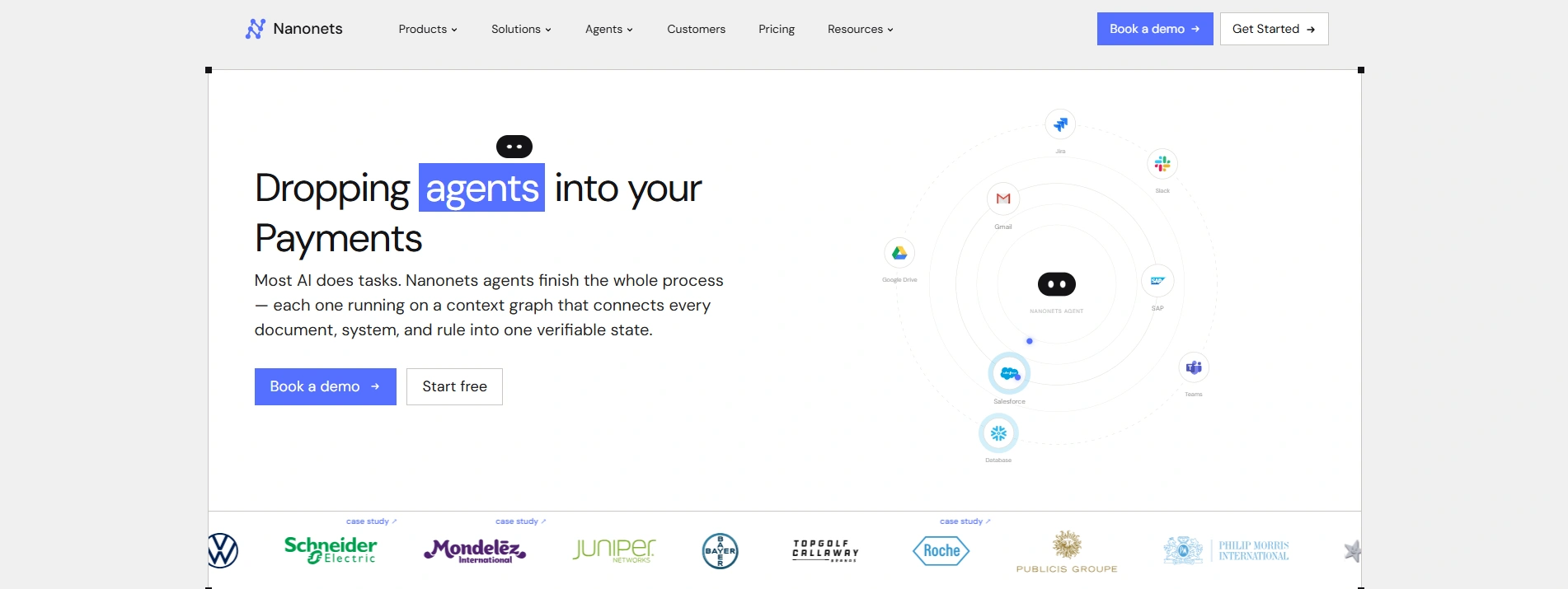
AI-first document processing for messy, varied invoice formats
Nanonets is an intelligent document processing platform that extracts data from invoices, receipts, and purchase orders without templates. Founded in 2017 in San Francisco, with an engineering hub in Bengaluru, the company serves more than 1,000 customers worldwide. Its platform uses AI to handle invoice capture, data extraction, approvals, and workflow automation without relying on fixed templates.
- Services offered: AI document processing, invoice data extraction, AP automation, PO matching, workflow automation.
- Pros: Template-free AI extraction. API-first and flexible. Handles messy and varied formats. 100+ languages.
- Cons: More a building block than a full AP suite. Needs configuration to operate as end-to-end AP.
- Best for: Teams wanting flexible, AI-driven extraction across diverse documents.
- Pricing: Usage-based, plans based on document volume.
- Year established: 2017
- Location: San Francisco, California, Bengaluru, India
#14 Rossum
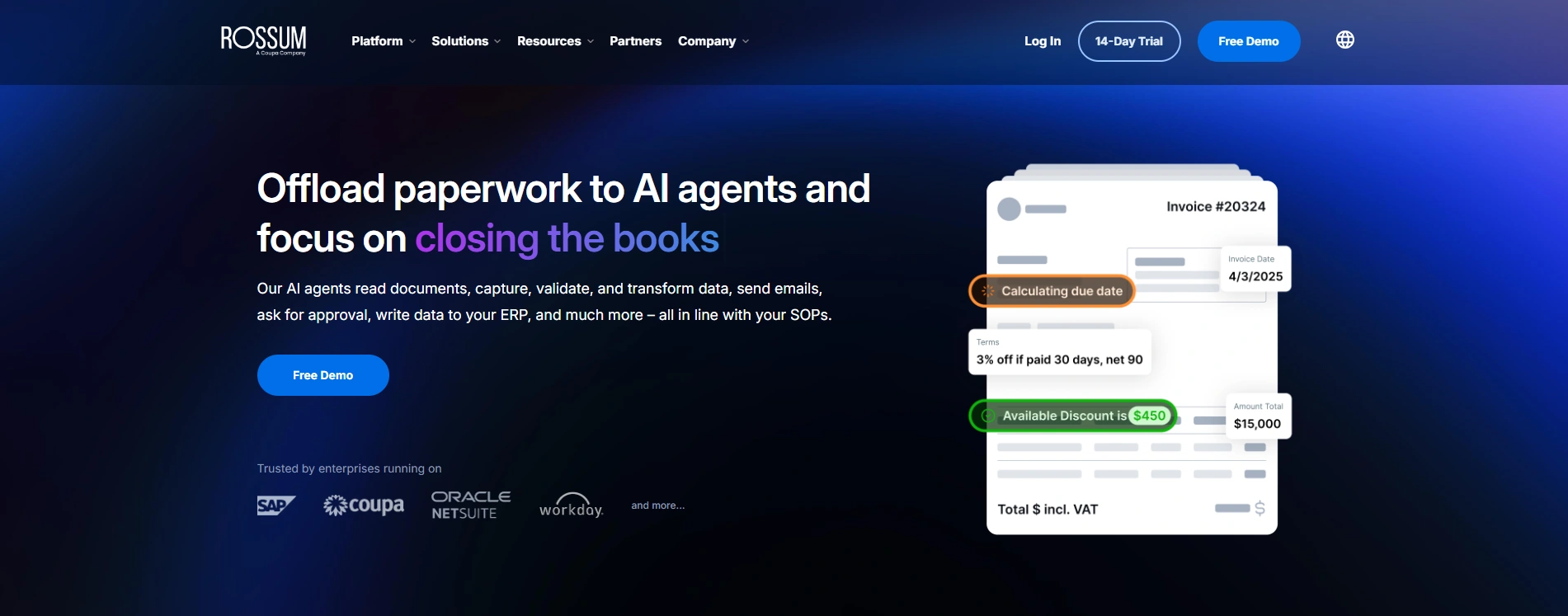
Template-free AI document processing for high-volume enterprises.
Rossum uses cognitive, template-free AI to read invoices and business documents and route the data into downstream systems. Founded in 2017 in Prague by three AI PhD students, it serves enterprises across 60-plus countries and has customers like Adyen and Fugro. It pairs computer vision with natural language processing and adds built-in EU e-invoicing compliance.
- Services offered: AI document processing, invoice capture, AP automation, approval workflows, e-invoicing compliance.
- Pros: Template-free cognitive extraction. Strong accuracy on complex layouts. EU e-invoicing support. Fast implementation.
- Cons: Enterprise pricing. The value is harder to justify for companies with lower document volumes.
- Best for: Large enterprises with high-volume, varied document processing.
- Pricing: Custom enterprise pricing.
- Year established: 2017
- Location: Prague, Czech Republic (HQ), UK, Europe
Read our latest roundup on the top accounts payable outsourcing companies.
Helpware: Our Top Choice
Among the 14 providers in this comparison, Helpware stands out because it focuses on managing the invoice process itself, not just providing software.
Many AP automation platforms give finance teams powerful tools but still leave them responsible for exception handling, vendor follow-up, and day-to-day processing. Helpware provides trained back-office teams that work within your existing ERP and accounting systems. Automation handles repetitive tasks, while experienced specialists manage exceptions, approvals, and compliance reviews.
This model aligns well with where AP automation is heading. As AI takes over more invoice capture and coding tasks, the remaining work increasingly involves judgment, problem-solving, and communication. Those are the areas where Helpware’s teams add the most value.
There is a trade-off. Helpware is not a self-service platform that can be switched on in a single afternoon. Implementation is more hands-on and collaborative. For organizations that want a partner to manage invoice operations end to end, that extra effort can pay off over time. Its average client relationship exceeds five years, and the company reports a 90% customer satisfaction score.
Ready to see if Helpware fits your operation?
How to Choose AP Automation Companies
The best AP automation provider is the one that fits your invoice volume, your team’s capacity, and the systems you already use. A few key factors can help you separate a good fit from an expensive mistake.
Start by deciding whether you want to run the process yourself or hand it off. Some companies want software their team can manage internally. Others prefer a full procure-to-pay platform. Some want a partner to handle invoice processing on their behalf. Each model solves a different problem, so it’s important to know what you’re looking for before evaluating vendors.
Next, look beyond AI marketing claims. Nearly every provider now promotes AI-powered automation. Ask what percentage of invoices can be processed without human involvement and how the system handles exceptions. The real challenge is rarely reading invoice data. It’s managing invoices that don’t follow the usual rules.
ERP integration should be near the top of your checklist. Whether you use NetSuite, Sage Intacct, SAP, or another system, a strong integration can save significant time and effort. Ask how data moves between systems and whether updates sync in both directions.
Compliance requirements matter too. If you process international invoices or work with regulated data, features like e-invoicing support and certifications such as SOC 2 and PCI DSS should be considered essential. Also think about who handles exceptions. With software alone, that responsibility stays with your team. With a managed service, the provider takes care of follow-up work, vendor communication, and issue resolution, which can be especially valuable during busy periods.