







You don’t need a massive outsourcing operation to benefit from external support. As your volume grows, you may need more agents, longer coverage hours, new languages, or extra capacity during seasonal peaks. But a provider built around thousands of seats and long-term global programs isn’t always designed for those needs.
That mismatch matters as more companies turn to outsourcing while also changing how they deliver support. In the Deloitte Global Outsourcing Survey, which polled more than 500 executives, 80% said they planned to maintain or increase their investment in third-party outsourcing. At the same time, 83% already used AI as part of their outsourced services. The market also includes providers built for enormous global programs, with hundreds of thousands of employees and operations spanning dozens of countries. That kind of scale can be valuable when you need broad global coverage, but it isn’t the only way to build a flexible support operation.
So what should you look for if a traditional big BPO isn’t the right fit? This guide breaks down eight alternatives for remote and flexible support, from dedicated managed teams to on-demand agent networks, staff augmentation, and AI-plus-human models. You’ll see how each model works, where it fits, and where it can fall short, along with the contract terms and security questions worth checking before signing a contract. The goal is to help you narrow the field based on how your support operation actually works, rather than choosing a provider simply because it has the biggest footprint.
Key Takeaways
- Staffing model comes first: Dedicated teams, on-demand networks, staff augmentation, shared pay-as-you-go support, and hybrid AI-plus-human teams address different volume and operational needs.
- Our 8 Alternatives to Big BPOs are Helpware, Influx, Peak Support, PartnerHero, SupportNinja, Boldr, Liveops, and Working Solutions. These companies represent a range of dedicated, managed, on-demand, augmentation, and AI-plus-human models.
- Contract terms determine flexibility: Minimum team size, initial term, pilot options, scale-down notice, ramp time, and exit terms can have more practical impact than the provider’s broader service offering.
- Volume pattern should guide the model: Dedicated teams fit steady, complex, or regulated work, while on-demand networks are suited to seasonal or unpredictable volume. Staff augmentation fits teams with strong internal leadership, while hybrid AI-plus-human models suit repeatable, high-volume support.
- Remote delivery raises security requirements: Provider evaluation should include system access, device management, call recordings, screen captures, and independent security certifications or reports.
- Pilots reduce commitment risk: Comparing two or three providers using the same contract and operational criteria provides a more consistent basis for selecting a long-term partner.
- Big BPOs remain relevant at global scale: Providers with thousands of seats, operations across dozens of countries, or a need for one global contract may still be the appropriate model for large multinational programs.
Why Growing Teams Look Past Big BPOs for Remote Support
Large BPOs are built to support complex programs at significant scale, often across multiple locations and countries. That can work well for global operations, but a growing team with 10 to 150 seats may need a different balance of flexibility, attention, and speed.
The difference becomes clearer when looking at the day-to-day requirements. A smaller remote support operation may not need a large global footprint or a long-term commitment. It may need a team that matches current demand, works directly in its existing tools, and can adjust as volume changes.
| What matters | What a large BPO is typically built for | What a 10- to 150-seat team may need |
|---|---|---|
| Program size | Multi-site programs with large, established teams | A team sized to current volume, with room to scale up or down |
| Commitment | Longer planning cycles and structured contracts | A pilot or shorter initial term that matches the forecast |
| Attention | Account teams supporting multiple programs | A dedicated lead who understands the product and operation |
| Delivery | Standardized processes across multiple locations | Remote or hybrid agents working directly in the team’s tools |
| Change speed | Formal processes for major staffing or operational changes | Staffing adjustments that can happen within weeks |
These are general patterns, and individual providers and contracts vary. For many mid-market teams, the practical question is whether the staffing model matches the work. A 15-person queue, for example, may be better served by a dedicated customer service team that builds deep product knowledge or an on-demand network that can add capacity as needed. Neither approach requires the footprint of a large global operation.
Pick the Staffing Model First: 5 Remote Support Models Compared
Choosing a provider before choosing a staffing model can create problems later. The right model depends on how much work you have, how predictable that work is, how much management your team can handle, and how much flexibility you need as volume changes.
The five models below cover the main ways a remote support operation can be structured. Each works well in a different situation, and the best fit depends as much on the work itself as on the provider you choose.
| Model | Who manages agents | Typical commitment | How it scales | Best for | Potential limitation |
|---|---|---|---|---|---|
| Dedicated managed team | The provider | A defined term, often after a pilot | Add or remove dedicated seats | Steady volume, complex products, or regulated work | Can be inefficient if volume falls below one full-time role |
| On-demand agent network | The provider through scheduling | Usage-based | Add contractor hours as needed | Seasonal peaks and unpredictable daily volume | Less suited to work that requires deep product knowledge |
| Staff augmentation | Your team | Per seat, per month | Add individual roles as needed | Teams with strong in-house leadership | Requires enough internal capacity to manage the added staff |
| Shared pay-as-you-go desk | The provider | Month to month | Buy additional ticket or support capacity | Low or unpredictable ticket volume | Less suitable for complex or highly brand-sensitive queries |
| Hybrid AI-plus-human pod | The provider | Term or outcome-based | AI handles routine volume while people handle escalations | High-volume queues with repeatable questions | Works best when the knowledge base and workflows are well maintained |
Two models can look similar at first but work very differently in practice: dedicated teams and shared support. Our comparison of dedicated and shared support teams goes deeper into the quality and operational trade-offs. Hybrid teams add another layer, combining AI for routine requests with people handling more complex conversations. Our AI customer service outsourcing page explains how that model works.
A couple of simple checks can help narrow the options. Start with your weekly workload. If you have less than 40 hours of support work, a fully dedicated agent may not be the most efficient setup, while a shared or usage-based model can give you more flexibility. Then look at the type of questions coming in. If agents need deep product knowledge or frequent judgment calls, a dedicated team may make more sense because it gives people more time to learn the product and build context.
Why it matters: Many teams eventually combine a dedicated core with extra capacity for peaks and seasonal spikes. Our on-demand customer service model is one example of how that approach can work.
How We Ranked The 8 Remote Support Alternatives
We compared each provider using information available on its public website and in public filings. We did not test the services directly, so the comparison focuses on what each provider publicly discloses rather than firsthand performance. When a provider did not publish enough information to support a claim, we left it out rather than filling the gap with assumptions.
We weighted six criteria based on how directly they affect the flexibility and practicality of a remote support operation:
| Criterion | Weight | What we looked for |
|---|---|---|
| Contract flexibility | 25% | Published minimums, contract terms, pilot options, and usage-based arrangements |
| Remote delivery model | 20% | Remote-first or hybrid staffing, plus a clear approach to team management |
| Ramp speed | 15% | Published timelines for launching, staffing, and scaling a team |
| Service depth | 15% | Channels, languages, support tiers, and types of work covered |
| Compliance posture | 15% | Published security certifications, privacy programs, and relevant compliance evidence |
| Public transparency | 10% | How much useful information the provider makes available before a sales conversation |
Big BPO Alternatives at a Glance
The eight providers below cover different staffing models, from dedicated managed teams to on-demand agent networks and hybrid AI-plus-human support. The last column highlights a specific flexibility signal from each provider’s published offering.
| Provider | Staffing model | Best for | Flexibility |
|---|---|---|---|
| Helpware | Dedicated managed teams, staff augmentation | Mid-market teams with regulated or multilingual queues | 30- to 60-day pilots; scale from pilot to 500+ FTE in 90 to 120 days |
| Influx | On-demand and dedicated teams | Startups and scaleups that need flexible commitments | Month-to-month, pay-as-you-go support |
| Peak Support | Dedicated teams | Teams that need five to 50 dedicated agents | Minimum team size of one full-time agent |
| PartnerHero | Managed teams with Crescendo AI | Tech and SaaS brands combining human support with AI | Outcome-based pricing; 60-day minimum launch deployment |
| SupportNinja | Managed teams or Talent-as-a-Service | Tech companies that want either managed support or more control | Fully managed or self-led team options |
| Boldr | Managed teams and staff augmentation | Brands that include social impact in their provider criteria | Managed outsourcing or augmentation of an existing team |
| Liveops | On-demand contractor network | Programs with seasonal or unpredictable volume | Pay for what you use; scale capacity up or down by the hour |
| Working Solutions | On-demand onshore contractor network | US and Canadian surge and seasonal support | On-demand staffing designed for surge volume |
The 8 Best Alternatives to Big BPOs for Remote Support
1. Helpware

Best for: Mid-market companies with regulated or multilingual queues.
Helpware is built around dedicated teams, with staff augmentation available when a client needs a more flexible staffing arrangement. The company run programs from 19 locations through a hub and spoke delivery model, with multilingual customer support covering 45+ languages.
Its security and compliance programs include SOC 2 Type II, ISO 27001, and other controls and certifications that support regulated work. For teams that want to start small, pilots typically run 30 to 60 days, with the ability to scale from pilot size to 500+ FTE in 90 to 120 days.
The trade-off is that Helpware centers on dedicated teams, so very low-volume, pay-per-ticket work is better suited to a shared support desk. For a mid-market team that wants one accountable operation with room to grow, that dedicated approach can make the relationship simpler to manage.
2. Influx
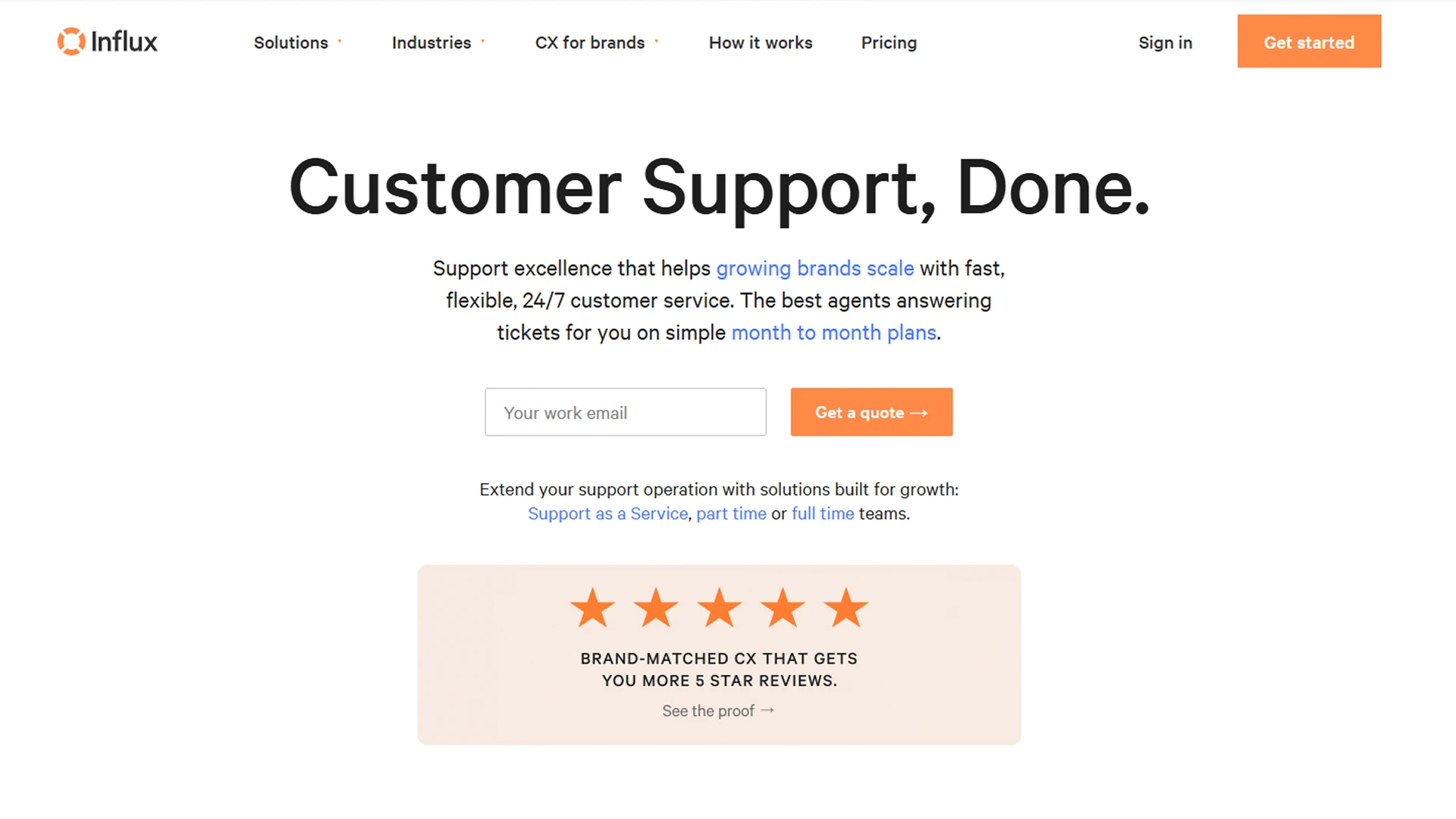
Best for: Startups and scaleups that want coverage without a long-term commitment.
Influx takes a more elastic approach to support, combining on-demand and dedicated teams under its “support as a service” model. It offers pay-as-you-go support that answers tickets 24/7, with clients including Blenders Eyewear and ClassPass.
One of the Influx’s significant benefits is its commitment model: support can run month to month rather than requiring a long-term contract. That makes the model particularly relevant for startups and scaleups whose volume is still changing.
The trade-off is that its positioning is geared toward those growth-stage companies, and teams handling health or payment card data should ask for the relevant compliance attestations before signing a contract. For ticket-based queues where keeping the commitment light matters, Influx offers one of the more flexible setups on this list.
3. Peak Support
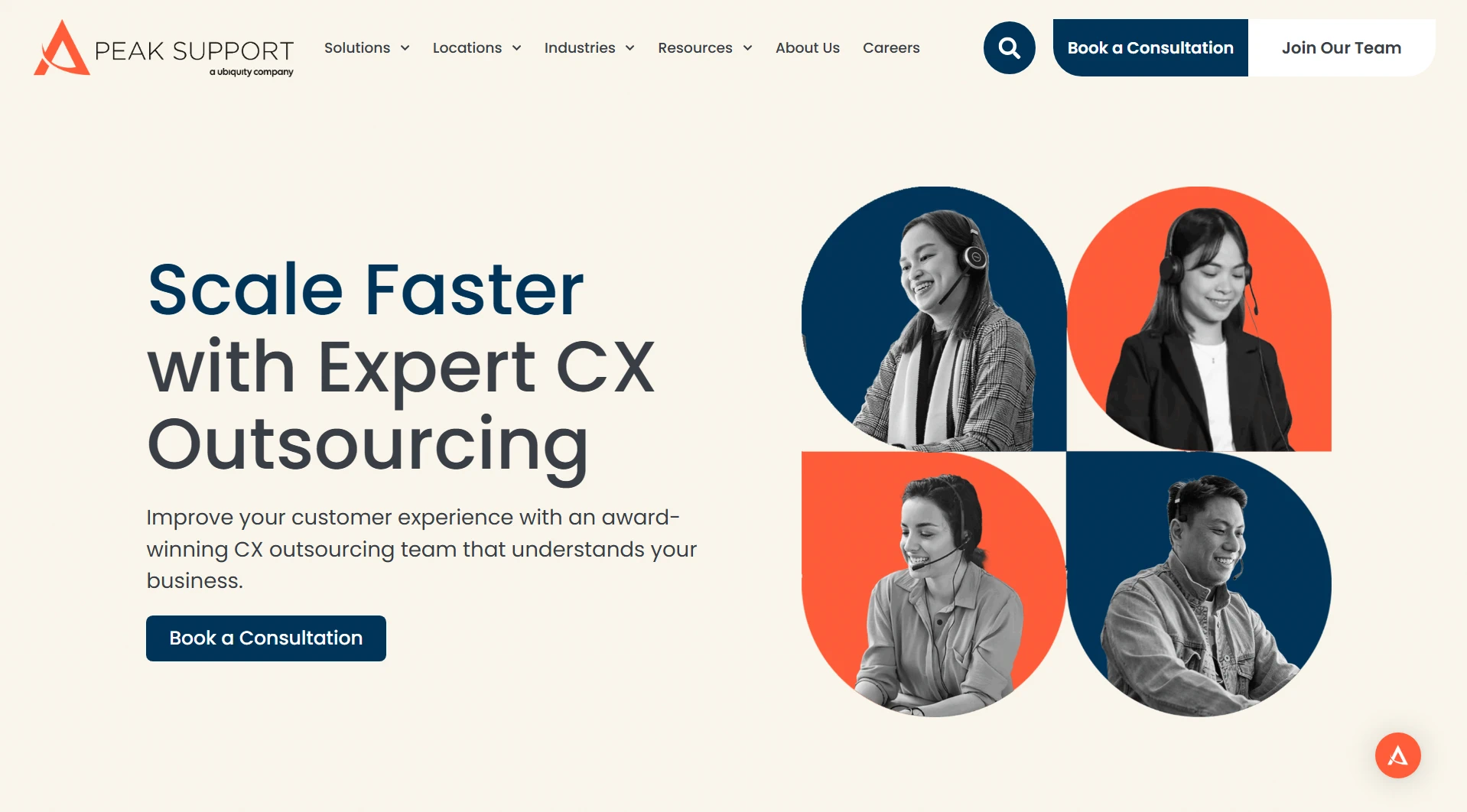
Best for: Teams of five to 50 agents that want dedicated attention.
Peak Support takes a deliberately focused approach. It describes itself as a boutique BPO and builds dedicated international and multilingual teams from five locations worldwide, with an average QA score of 95%.
Agents and team leads work for one client rather than being split across accounts, which gives the model a strong dedicated-team orientation. Peak Support has a minimum team size of one full-time agent, while specializing in teams of five to 50.
The limitation is the same thing that makes the model focused: it is dedicated-only, with no shared or per-ticket option for very low-volume work. For a company that wants a small team to know its brand inside and out, that focus can be the main draw.
4. PartnerHero
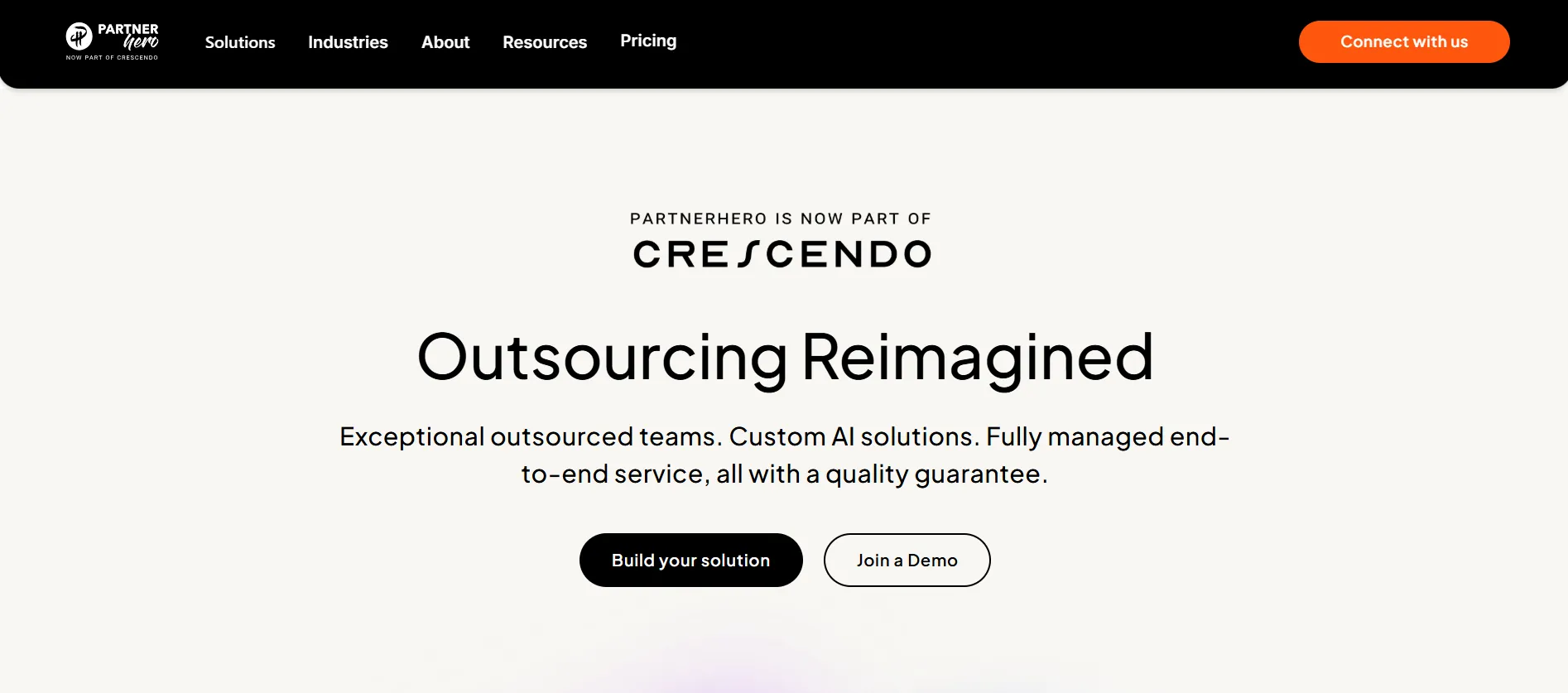
Best for: Tech and SaaS brands that want human support and AI under one contract.
PartnerHero combines managed CX teams with Crescendo AI, giving companies a way to put human agents and AI into the same support operation. Crescendo acquired PartnerHero in 2024, and the two are now offered together. PartnerHero boasts 24/7 professional CX teams, automated QA, and outcome-based pricing, while its launch-team deployment carries a 60-day minimum.
The model makes particular sense when automation is part of the support strategy rather than something added later. The trade-off is that the offer bundles Crescendo AI with the team, so companies looking for agents only, working entirely in their own tools, should confirm that setup before moving forward. For a tech or SaaS operation looking to automate routine volume without separating its AI and human support partners, the combined model is the main attraction.
5. SupportNinja
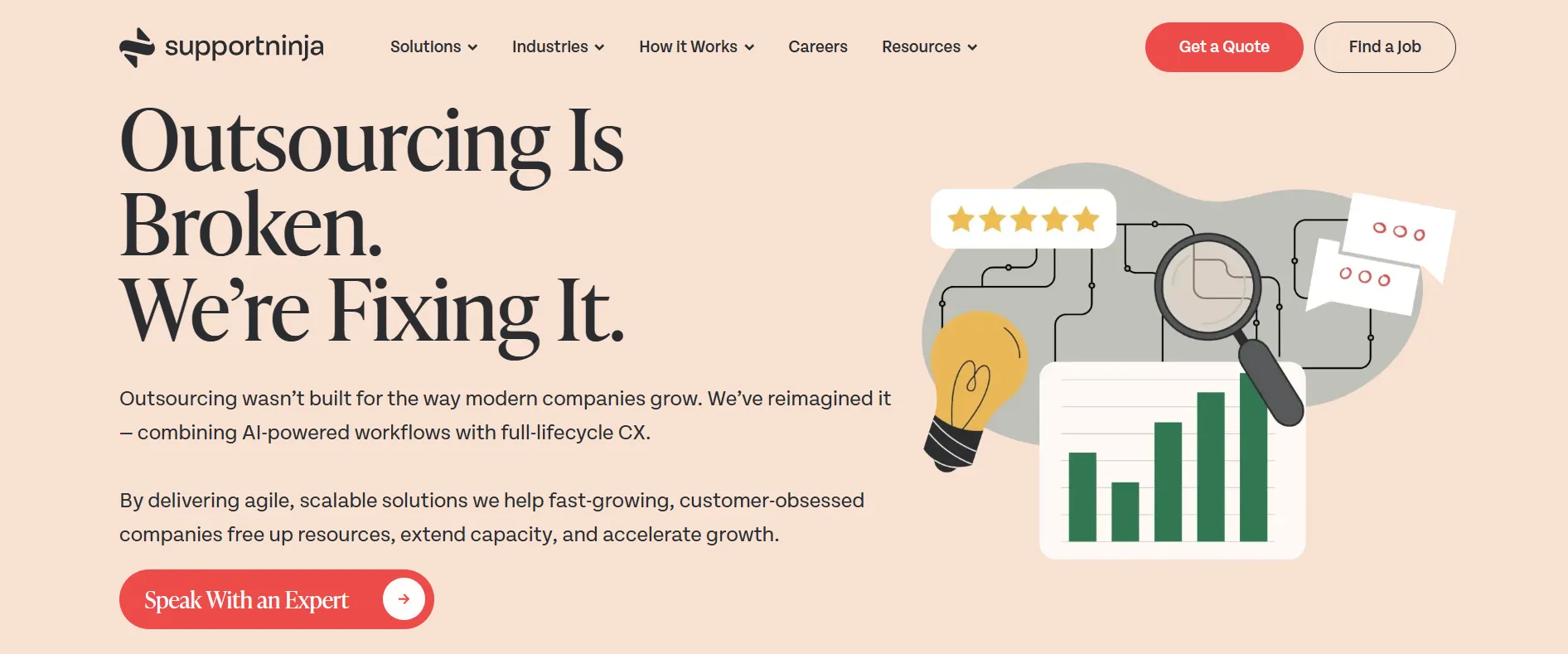
Best for: Tech companies that want to choose how much of the team they manage.
SupportNinja gives clients two different ways to structure the relationship: a fully managed team or Talent-as-a-Service, where the client takes a more active role. SupportNinja is headquartered in Austin, Texas, with centers in the Philippines and flagship EMEA operations in Romania.
With Talent-as-a-Service, SupportNinja provides vetted talent while the client interviews, hires, and manages the team directly. That makes the model useful for companies that want outside help finding talent without giving up day-to-day control.
The company’s geographic footprint is more limited than providers with Latin American nearshore hubs, so companies specifically looking for that setup will need to look elsewhere. For leaders who want the option to stay hands-off or take control of the team themselves, that flexibility is the core appeal.
6. Boldr

Best for: Brands that weigh social impact alongside service quality.
Boldr combines managed outsourcing with staff augmentation, giving companies the option to build a provider-managed operation or add people to an existing team. Its social-impact positioning is a clear part of the business: B Lab lists Boldr as a Certified B Corporation since November 2021, with operations in Canada, Guatemala, Mexico, the Philippines, South Africa, and the US.
In South Africa, Boldr operates from Cape Town and Hazyview. The model is built around dedicated teams rather than on-demand, per-ticket support, so it fits companies looking for an ongoing team and a partner whose approach to social impact is part of the relationship.
7. Liveops
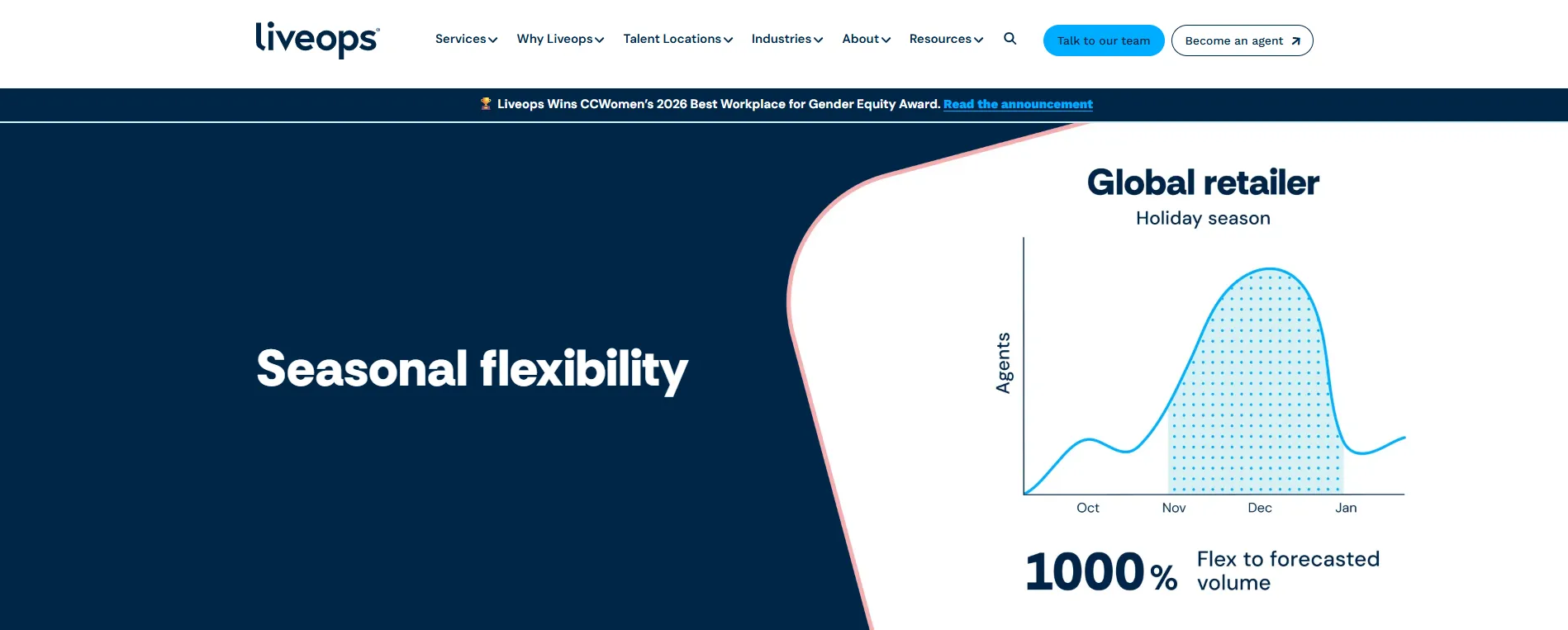
Best for: Programs with sharp daily or seasonal swings.
Liveops is designed around flexibility rather than a fixed team. With 25 years in business and delivery across onshore, nearshore, and offshore markets, the company offers an on-demand model that delivers independent contractor agents and schedules them around demand.
The commercial model follows the same logic: clients pay for what they use, and Liveops scales capacity up or down in hours. That makes it particularly suited to programs where contact volume can change quickly and maintaining a large fixed team would leave capacity sitting idle.
The main question for a smaller operation is program size, since Liveops primarily addresses enterprise customers on its site. For larger programs where volume can outrun a fixed team, the ability to adjust capacity quickly is the central value proposition.
8. Working Solutions
Best for: US and Canadian brands that need onshore coverage for surge and seasonal work.
Working Solutions has been focused on remote contact center work since its founding in 1996. According to the company, its founding idea helped spark the remote contact center outsourcing industry, and today its independent contractor agents work from home across the US and Canada.
Its services cover surge and seasonal support as well as more complex call handling and tech support, giving companies a way to add capacity without building another permanent team. The model is entirely on-demand and onshore, so there is no offshore delivery option for companies looking to reduce costs through geographic arbitrage. For brands that want a North American voice and expect demand to rise and fall around product launches, holidays, or other predictable peaks, that focus can be a strong fit.
6 Questions to Ask Your Provider Before Signing a Contract
A provider can promise flexibility during a sales call, but the contract is where you find out how flexible the relationship really is. These six questions can help clarify what happens when your team needs to start, scale, or change direction.
| What to ask | What to look for | Why it matters |
|---|---|---|
| What’s the minimum team size? | A minimum that matches your current needs | A high minimum can leave you paying for unused capacity |
| How long is the initial contract? | A pilot or shorter initial term before a longer commitment | You can test the relationship before committing long term |
| How much notice do you need to reduce the team? | A specific notice period in the contract | Scaling down should be as clear as scaling up |
| How quickly can new agents start? | A defined ramp timeline that includes training | A slow ramp can wipe out the benefit of flexible staffing |
| How do you secure remote agents? | Clear device, access, and security controls, plus relevant certifications or reports | Remote access creates additional risks for customer and company data |
| What happens when we leave? | A clear process for returning data, transferring knowledge, and winding down the account | A defined exit makes it easier to change providers if your needs change |
Security deserves a closer look, especially when remote agents will have access to customer or company systems. Ask how agents connect to your systems, whether the provider supplies and manages their devices, and how it protects call recordings and screen captures. It is also worth asking who audits those controls and how often. A current SOC 2 Type II report or ISO 27001 certificate gives you independent evidence that those controls have been reviewed.
Once you have the answers, get the important ones into the contract. A service level agreement can spell out response times, quality targets, and what happens when those targets are missed. For healthcare operations, also confirm that the remote setup and agents meet the requirements of a HIPAA-compliant call center (if applicable to your industry).
Wrapping Up
The right remote support partner starts with the work, not the provider. Steady, complex, or regulated volume usually calls for a dedicated team, while seasonal or unpredictable demand may fit an on-demand model better. If your internal team has the time and experience to manage agents directly, staff augmentation can give you more control. And if a large share of your volume is repetitive, a hybrid AI-plus-human model may help you handle it more efficiently.
Once you have a model in mind, compare two or three providers using the same questions. Look beyond the headline price and check minimum team sizes, contract terms, ramp times, security controls, and what happens if your needs change. A pilot can then show whether the provider can deliver the quality, coverage, and flexibility the operation actually needs.
Helpware builds dedicated remote support teams around each client’s volume, coverage requirements, languages, and security needs. In one online marketplace case study, our team helped raise QA scores to 95% in under 90 days. If a dedicated team looks like the right model for your operation, explore our CX pricing plans or contact our team to discuss your requirements and scope a 30- to 60-day pilot.