







Healthcare call center outsourcing operates with a quite peculiar pulse. Whether medical professionals venture into private startups or join the board of public healthcare institutions, they quickly realize that expertise in wellness alone isn’t enough. They must also provide a high-end customer experience to all patients and members to achieve business development.
Yet providing that experience is becoming increasingly difficult, particularly when patients struggle to reach the right people or schedule appointments. A Wakefield Research survey for Hyro and Pixel Health of 800 US patients found that 72% had postponed seeking care, while 51% had delayed seeing a doctor because scheduling an appointment was too difficult. The phone also remains an important communication channel, preferred by 33% of respondents, compared with 21% for text messages and 19% each for email and patient portals. These findings highlight a challenge for healthcare organizations: patients need convenient access to care, but overwhelmed internal teams can struggle to provide timely assistance across multiple channels.
Healthcare call center outsourcing offers a way to address these challenges by expanding support capacity, improving appointment scheduling, and making patient communication more accessible. It also forms part of the broader business process outsourcing (BPO) industry, which is projected to reach USD 695.8 billion by 2033. Still, choosing an outsourcing partner requires more than comparing workforce size or service costs. Healthcare organizations must consider patient communication experience, system integration, regulatory compliance, and the ability to handle sensitive inquiries accurately.
This guide compares 10 healthcare call center companies offering patient and member support, B2B outreach, and related technology solutions. It examines their capabilities, service models, and limitations to help you identify the right partner. You’ll also find a comparison of common healthcare call types, their staffing and compliance requirements, and practical criteria for evaluating providers before outsourcing your operations.
Key Takeaways
- Healthcare call centers play a critical role in patient access and experience. Appointment scheduling, insurance inquiries, billing assistance, and member services require timely, accurate support. Poor accessibility can delay care and increase administrative workloads.
- The 10 companies covered in this guide are Helpware, Hit Rate Solutions, Magellan Solutions, MicroSourcing, Calibrated Healthcare, Alorica, Martal Group, LeadSquared, DMT Business Development, and CIENCE Technologies. Their offerings range from healthcare support outsourcing to B2B sales development and call center software.
- Not every provider offers the same type of service. Healthcare BPO companies supply agents and manage customer interactions, while sales development agencies focus on business acquisition. Software providers such as LeadSquared offer technology rather than outsourced staffing.
- Compliance and clinical responsibility must guide provider selection. Healthcare call centers handling protected health information need appropriate HIPAA safeguards and contractual agreements. Clinical activities such as nurse triage require qualified professionals with applicable licenses.
- Outsourcing can improve coverage and reduce internal administrative pressure. Dedicated teams can handle routine inquiries and support multiple communication channels, allowing healthcare staff to concentrate on clinical responsibilities. Results depend on training, system access, and quality assurance.
- The best outsourcing partner is not necessarily the one with the lowest hourly rate. Evaluate total service costs alongside patient satisfaction, call resolution, staffing capacity, security controls, and integration with your existing healthcare systems. A limited pilot can help validate performance before expanding the engagement.
What is a Healthcare Call Center?
A modern healthcare call center is a compliance-driven support operation that handles patient, provider, and insurance inquiries across voice and secure digital channels, quickly triages critical cases, and escalates them through trained agents working within regulated, auditable systems.
Healthcare call center companies specialize in managing all phone inquiries related to specific medical needs. Equipped with a well-trained, typically outsourced team adept at addressing a spectrum of health-related queries, they also possess a rooted understanding of customer support protocols. This enables them to efficiently assess each situation and escalate urgent matters.
Since healthcare call centers handle sensitive patient information, staff training and data security are essential considerations when choosing a provider. HIPAA requires covered entities and business associates to train their workforce on applicable privacy policies and implement security awareness training. Yet HIPAA compliance should not be confused with certification. The US Department of Health and Human Services (HHS) does not certify companies or individuals as HIPAA compliant, and training completion certificates do not establish compliance. Before outsourcing patient communications, ask for workforce training records, a business associate agreement, and independent security assessment documentation.
When healthcare organizations, both public and private, choose to upgrade their customer service, they prefer to combine call center assistance with other BPO-focused features, such as medical consultations, insurance verification, information dissemination, and data sharing.
Healthcare BPO companies also open other digital channels besides phone calls, such as emails and chat sessions through advanced call center software. While the digital interface can not enable a physical patient examination, it does offer a more supportive role for providers, payers, and government agencies.
Worth reading: Medical answering service cost guide.
Benefits of Outsourcing Healthcare Call Center Solutions
Modern medical call center services are specifically tailored to the healthcare domain and take into account its unique characteristics to optimize operations, reduce costs, and level up patient care standards. These CX-focused businesses can provide a pool of seasoned professionals with expertise in diverse domains such as medical billing, appointment scheduling, coding, customer service, and IT support. This versatile expertise enables medical practices to address operational gaps and improve service delivery.
Care providers can only benefit from delegating front-and back-office functions such as appointment scheduling, resolving billing inquiries, or navigating insurance procedures to an expert BPO company.
Here are some of the most relevant benefits of outsourcing a healthcare call center:
Access to specialized expertise
Healthcare call centers require a unique blend of clinical knowledge, customer service prowess, and technical proficiency. Outsourcing your call center to a seasoned provider grants you immediate access to a team of specialists who have honed their skills in the healthcare domain.
Improved patient experience
High levels of patient satisfaction are one of the most important metrics that outsourcing healthcare call centers strive for, and they go to great lengths to achieve at least 90% PSAT (patient satisfaction) by integrating advanced call center technologies, implementing rigorous training protocols, and customizing workflows to the needs of patients and members. The services they deliver are personalized, empathetic, and efficient.
Adoption of high-performing systems
Medical call center outsourcing companies invest heavily in cutting-edge call center infrastructure, including cloud-based platforms, intelligent call routing, and data analytics tools. By adopting these state-of-the-art systems, healthcare organizations can modernize their operations, boost agent productivity, and unlock valuable insights to drive continuous improvement.
Mitigation of risks
With ever-changing rules and regulations in the healthcare sector, it’s tricky to navigate them without putting compliance at risk. Outsourcing healthcare call centers allows you to offload the burden of compliance, data security, and risk management.
Strengthened data protection measures
Another critical concern of medical care providers is data privacy and security. Experienced outsourcing companies take the security of data seriously. They deploy robust data protection measures, including advanced encryption, secure data storage, and comprehensive backup and disaster recovery protocols.
Enhancement of patient health outcomes
Ultimately, the benefits of outsourcing healthcare call center services go back to the foundation of the company itself: taking care of patients. By streamlining access to care, enhancing patient engagement, and leveraging data-driven insights, outsourcing can help you identify and address patient needs more effectively.
Top 10 Medical Call Center Companies in 2027
There are major global players in this arena who have already amassed huge experience and expertise in delivering a variety of services, including healthcare industry solutions. We have compiled a list of the best of the best inbound and outbound healthcare call centers in the current market to help you select a reliable BPO company you can trust your operations to.
Healthcare outsourcing providers featured in this list can be broadly divided into two main categories, depending on their core focus. The first group includes healthcare call center outsourcing providers that specialize in patient and member support. These companies handle inbound inquiries across multiple channels, assisting with appointment scheduling, billing questions, insurance verification, and general patient communication, with a strong emphasis on compliance and customer experience.
The second group consists of sales and patient acquisition outsourcing providers. Rather than focusing on support, these companies are geared toward outbound engagement, conducting outreach calls to promote healthcare services, plans, and programs, qualify leads, and drive patient acquisition and revenue growth.
Top Healthcare Call Center Outsourcing Providers
| Company | Operating model | Healthcare capabilities | Delivery coverage | Security and compliance | Best for | Pricing |
|---|---|---|---|---|---|---|
| Helpware | Managed healthcare outsourcing | Patient and provider support, care coordination, insurance verification, claims processing, technical support | 19 locations across 11 countries and territories, including the US, Mexico, Philippines, and Ukraine | SOC 2 Type II, ISO 27001, ISO 9001; HIPAA, GDPR, and PCI DSS compliance | Mid-market and enterprise healthcare organizations seeking managed, multilingual support | Custom quotes; multiple pricing models |
| Hit Rate Solutions | Inbound and outbound call center outsourcing | Patient outreach, appointment setting, prescription refill requests, reminders | Bacolod, Philippines; representative office in Chicago | Healthcare-specific credentials not published on its homepage | Small and midsize organizations seeking affordable call handling and outreach | From $7/hour |
| Magellan Solutions | Healthcare call center and BPO outsourcing | Inbound and outbound calls, healthcare administrative support | Philippines and Florida, US | Reports HIPAA, ISO 27001, and PCI DSS compliance | Small and midsize healthcare businesses needing outsourced call handling | Per-call and package pricing; rates on request |
| MicroSourcing | Client-managed dedicated offshore teams | Healthcare staffing; specific patient call services not detailed | 13 delivery locations across the Philippines and Colombia | ISO 27001, ISO 9001; HIPAA and PCI DSS compliance | Healthcare businesses building and supervising their own offshore teams | Not published |
| Calibrated Healthcare | Healthcare administrative outsourcing | Claims, medical management, coding, credentialing, member data; call center services not specified | Ontario, California; offshore delivery locations not disclosed | HITRUST certification | Health plans, MSOs, IPAs, TPAs, and at-risk medical groups | Not published |
| Alorica | Enterprise healthcare contact center outsourcing | Payer member services, enrollment, claims and billing, provider engagement, PBM support, clinical contact centers | 100,000+ employees across 16 countries | Reports HIPAA compliance, PCI DSS 4.0.1 Level 1, HITRUST r2, SOC 1 and SOC 2 Type 2 | Large payers, PBMs, healthcare providers, and life sciences companies | Not published |
| Martal Group | B2B sales and lead generation agency | B2B appointment setting for companies selling to healthcare organizations; no patient support | Canada, US, and France | Healthcare-specific credentials not published | Healthcare technology and service companies seeking B2B sales meetings | Three service tiers; custom quotes |
| LeadSquared | CRM and call center software | Patient inquiry management, call routing, scheduling workflows, automation; no outsourced agents | Software platform; agent delivery not applicable | Healthcare-specific certifications not listed on its healthcare page | Healthcare organizations seeking CRM and call center workflow technology | On request |
| DMT Business Development (formerly SalesNash) | B2B lead generation agency | Outbound prospecting and B2B appointment setting; patient call services not published | Ottawa, Canada; North American and European offices | Healthcare-specific credentials not published | Small and growing B2B healthcare service and technology businesses | Team plans from $3,750/month (third-party listing) |
| CIENCE Technologies (part of graph8) | B2B sales development and lead generation | Outbound B2B prospecting and sales development; patient support not published | Delivery locations not publicly specified | Healthcare-specific credentials not published | B2B companies seeking outsourced sales development and lead generation technology | Offshore SDRs from $1,750/month; graph8 platform from $499/month |
Helpware

Overview
Helpware stands out as a global BPM partner renowned for its comprehensive suite of services, including top-notch inbound call center solutions. The company is actively developing and expanding its service offering. They have recently undergone a major rebranding and formed three separate divisions: Helpware CX, Helpware Tech, and Helpware AI, each of which specialises in its particular domain, but working in synergy to ensure end-to-end solutions that provide total transformation of their clients’ operations. Still, at the core of their approach lies a seamless blend of human expertise, empathy, and cutting-edge technology.
Best suited for
Businesses seeking flexible, tech-driven solutions find an ideal ally in Helpware. Their services cater to diverse industries, including healthcare, finance, real estate, and ecommerce. Helpware ensures tailored support for organizations of all sizes, but the focus is on enterprises.
Pros
- Multilingual expertise: Helpware teams are proficient in over 45 languages, including rare ones such as Georgian and Korean.
- Scalable solutions: Operating across four continents, Helpware taps into a vast talent pool and is ready to scale fast if required.
- Advanced technology integration: Leveraging AI alongside human intelligence, Helpware aims to achieve maximum efficiency across all touchpoints.
Cons
- Cost consideration: While Helpware’s offerings are robust, smaller businesses may find the pricing prohibitive.
Pricing
Helpware offers flexible pricing models to accommodate varied requirements. Clients can choose from pre-designed packages or customize their solutions by adding supplementary services as needed.
Hit Rate Solutions
Overview
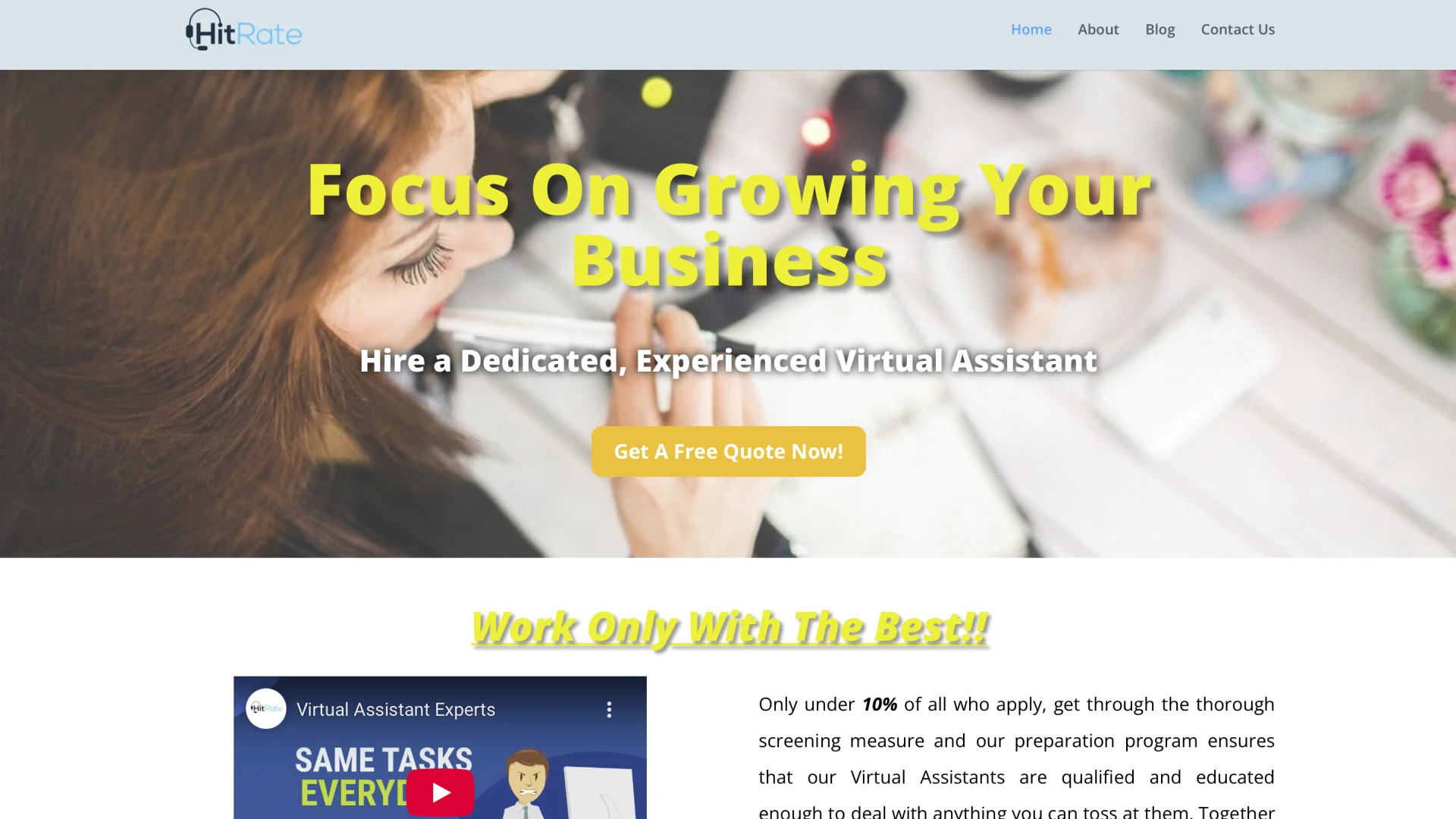
Hit Rate Solutions is an outsourcing brand that specializes in the US, Canada, UK, and Australian markets. They have established a solid foundation with clients all over the world who count on our knowledgeable staff to provide fast response times and high-quality customer service for many healthcare contact centers.
Best suited for
They mainly focus on midmarket ($10M – $1B) well-established companies, offering outsourced services for several industries including business services, consumer products & services, financial services, and manufacturing.
Pros
- Calls monitored and scored monthly: Actionable insights to optimize sales strategies and boost conversion rates.
- Well-trained associates: Professional call center agents to give potential and new clients the best experience possible.
- Cold calling services: Robust data-driven approach to maximize the effectiveness of cold calling campaigns
Cons
- Geographic limitations: Hit Rate Solutions is a Philippines-based outbound call center, which only allows a 24/7 service for clients in the USA, Australia, and Canada.
Pricing
Their pricing options vary depending on the hired service: Inbound call center, outbound call center, and virtual assistance services. They also have a starter package ($8/hr-80 hours) and an advanced package ($7.5/hr-160 hours).
Magellan Solutions
Overview
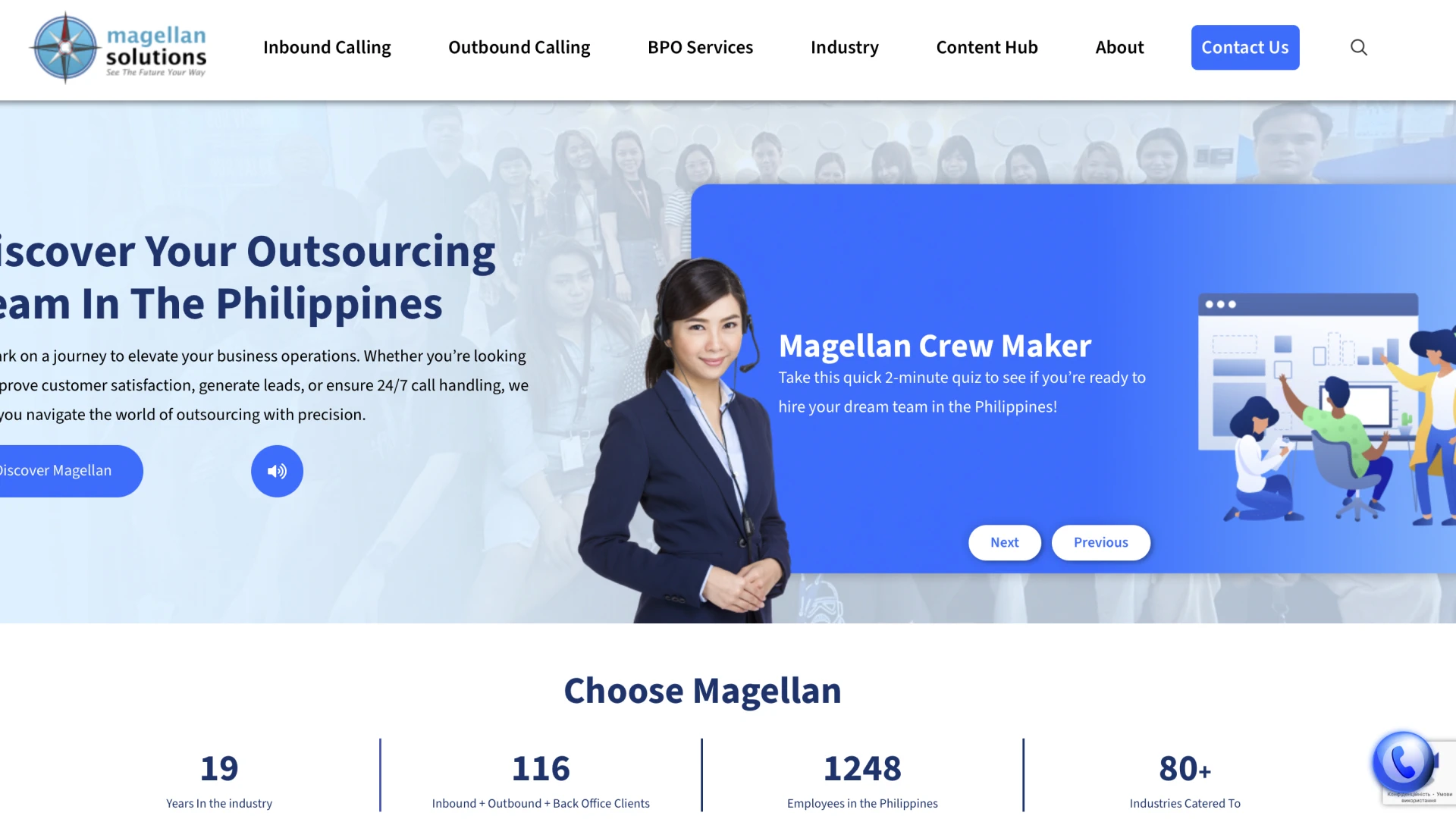
Magellan Solutions is an accredited call center services provider in the Philippines with many years of experience. They offer customer service outsourcing, inbound call center services, and BPO services for small and medium businesses globally.
Best suited for
The company focuses on helping SMEs expand and improve their BPO and call center operations. It is possible to get a price per call or packaged options, depending on the client’s needs and size.
Pros
- Virtual receptionist service: Customizable greetings and call routing to create a seamless customer experience.
- Telemarketing services: Experienced and well-trained telemarketing specialists who engage in outbound sales calls.
- Survey processing services: Efficient and accurate data collection through comprehensive survey processing.
Cons
- Smaller business-oriented: Magellan Solutions is very focused on escalating small businesses, which could fall short for medium and bigger companies that are already well established.
Pricing
No available packages are on display.
MicroSourcing
Overview
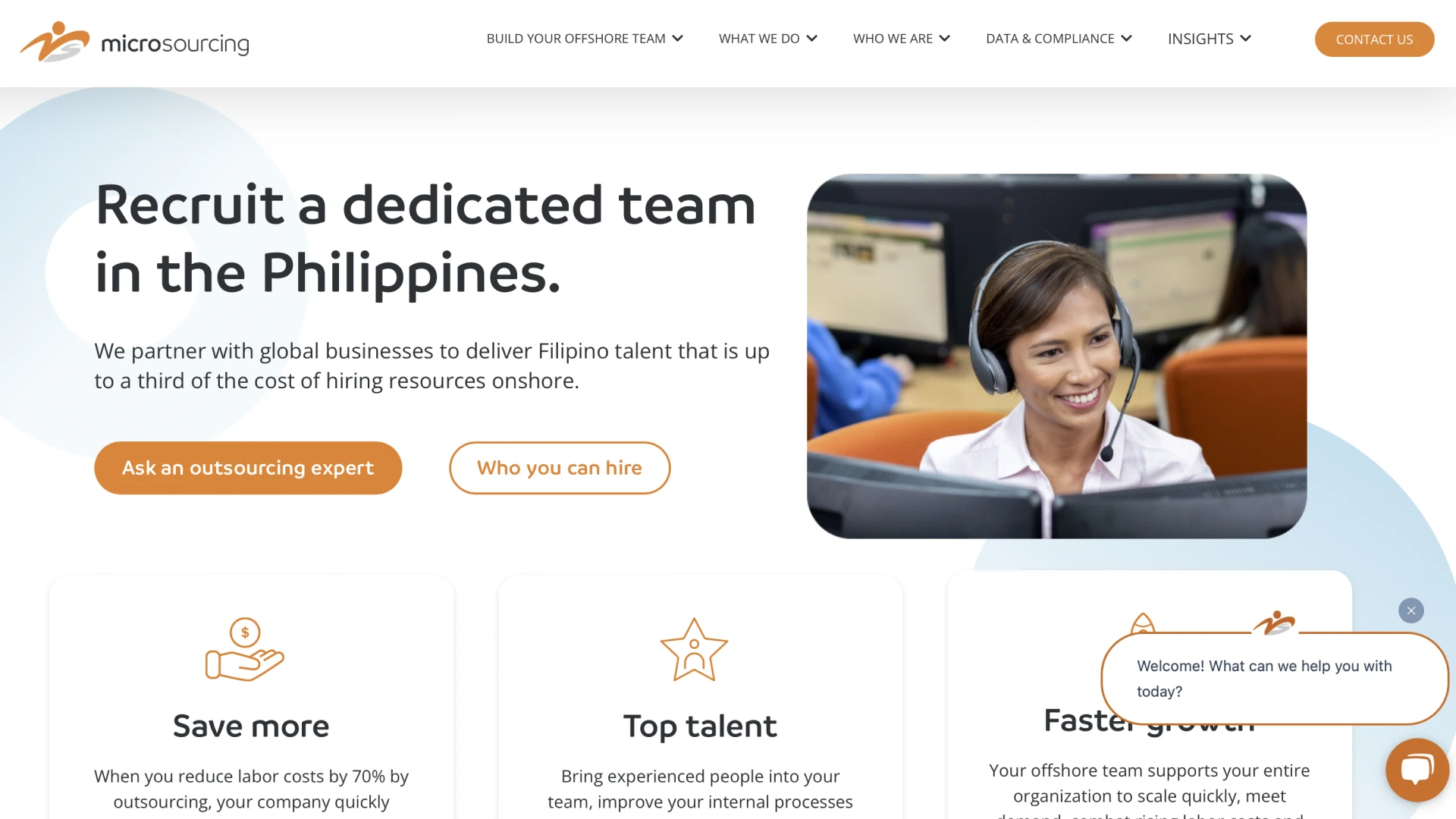
MicroSourcing connects businesses of all sizes with quality, ready-to-work talent in the Philippines. They are mostly focused on the UK, Australia, and the North American markets.
Best suited for
Offshore startups and small companies that wish to set up an overseas division for their companies, and get them to handle facilities, IT recruitment, and HR services.
Pros
- Build-your-own-team option: Flexible solution that allows clients to build their own customized team of sales representatives.
- Big-business infrastructure: Enterprise-grade technology, tools, and resources to support large-scale sales operations.
- Candidates ready for employment: Pre-screened and thoroughly vetted sales professionals ready to be deployed.
Cons
- Language barrier: As a fully-stacked Philippines BPO outsourcing provider, most of their touch points with clients are English-based, which closes the opportunity for other non-English-speaking countries.
Pricing
No available packages are on display.
Calibrated Healthcare
Overview
Calibrated Healthcare provides healthcare administrative and clinical services that increase quality while reducing costs. Calibrated caters to Health Plans, Management Services Organizations (MSOs), Independent Physician Associations (IPAs), Third Party Administrators (TPAs), and at-risk Medical Groups.
Best suited for
Healthcare-based companies based in the US that require offshore staffing expertise in all BPO services, both transactional and clinical.
Pros
- Healthcare-focused: Tailored solutions that address the specific challenges faced by healthcare organizations.
- Not a one-size-fits-all approach: Ability to adapt and scale services as per the evolving needs of the business.
- 24/7 oversight: Dedicated teams providing round-the-clock monitoring and support.
Cons
- Healthcare administration only: While Calibrated offers a very medical-grounded set of services, this also narrows down their expertise for companies that are more conversion-oriented.
Pricing
No available packages are on display.
Alorica
 Overview
 Overview
Alorica is a well-established BPO company that provides outsourcing call center services worldwide. They equip passionate people who are trained in each specific business with efficient technology to enhance performance.
Best suited for
They serve companies of all sizes and industries that aim to boost their market expansion, digital optimization, or engagement rate.
Pros
- Content moderation: Experienced team of moderators trained to identify and address inappropriate or harmful content.
- Revenue generation: Optimization of monetization channels and implementation of effective revenue models.
- Contact center optimization: Analytical approach to identify areas to improve patient satisfaction and implement optimization measures in all CX areas.
Cons
- Generalized assistance: Alorica specializes in so many different industries (banking & financial services, communications, energy & utilities, healthcare, public sector, and many more) that they may fall short in personalizing certain CX-derived solutions.
Pricing
No available packages are on display.
Sales & Patient Acquisition Outsourcing Providers
Martal Group
Overview
Martal Group is a top lead generation and sales agency servicing B2B companies. They help to scale companies by speeding the prospecting process and generating sales-qualified leads through high-performing international sales teams.
Best suited for
Martal Group’s BPO solutions are well-suited for small to medium-sized businesses (SMBs), startups, and enterprises across various sectors, including information technology, advertising & marketing, automotive, business services, and healthcare companies that wish to boost their appointment-setting services.
Pros
- Mid & Senior-level B2B-focused: Highly experienced team members with a deep understanding of the B2B landscape.
- Experienced sales talent: Collaborative approach to identify and address client pain points
- Technologically & culturally adept: Commitment to continuous learning and skill development to stay ahead of industry trends
Cons
- B2B sales-oriented: While Martal Group’s comprehensive call center services are very tech-savvy, the driven interactions may be more heavily focused on what matters the most for business growth: conversions.
Pricing
Martal Group offers four different tiers of pricing. These depend on the desired services or products: Outbound lead generation, inbound lead generation, sales & customer onboarding, and account management. It is possible to mix these services to provide a more complete solution.
LeadSquared
Overview
LeadSquared is a CRM and call center automation platform that helps healthcare businesses efficiently manage and assist their patient’s needs and queries.
Best suited for
LeadSquared serves various industries, including healthcare, real estate platforms, education, banking, insurance, and manufacturing. Whether a start-up or a large enterprise, it helps streamline marketing processes and enhance client/patient interactions.
Pros
- Instant response: Assist patients who are trying to make an urgent appointment by automating calls to available agents. Allocate agents according to the patient’s preference and needs (language, location, urgency, or other desired criteria).
- Customizable workflow: Healthcare organizations can tailor workflows to match specific operational requirements, such as patient details, appointments, visits, documentation, follow-ups, etc., ensuring proper resource allocation.
- Personalize conversations: Make patients feel comfortable by personalizing conversations based on the patient’s history and past activities – appointment, booking, preferred doctor, lab reports, etc.
Cons
- Learning curve: New users may need time to familiarize themselves with the features and functionalities of LeadSquared.
- Integration complexity: Integrating LeadSquared may require technical expertise to ensure seamless integration with existing systems.
Pricing
LeadSquared offers flexible pricing tailored to fit different business requirements. Pricing details are available upon request.
Worth reading: The ultimate guide on healthcare call center automation.
SalesNash
Overview
SalesNash is a lead generation and appointment-setting company with a deep specialization in outbound pre-sales. They have deep industry knowledge of customer demand and precision in the world of sales and B2B lead generation.
Best suited for
The brand’s solutions are focused on small businesses, midmarket, and scaling enterprises that offer outsourced services to several industries, such as information technology, healthcare, business services, and education.
Pros
- Advanced lead profiling: Comprehensive data gathering and segmentation to create detailed buyer personas.
- Professional call outreach: Excellent communication skills to nurture leads and guide them through the sales process.
- Dedicated assistants: Proactive communication and status updates to keep clients informed of progress.
Cons
- Small-sized in-house team: SalesNash, like many other BPOs, knows well how to select and outsource agents. That said, their inner team of experts is a bit small (50 people) when compared to other brands in the industry.
Pricing
They offer three different pricing options: Customized, standard team (from USD 3,750), and extended team (from USD 5,250).
CIENCE Technologies
Overview
CIENCE offers human-driven and machine-powered B2B software and lead generation services. The brand walks prospects through a personalized customer experience, resulting in more consistently set meetings.
Best suited for
They offer call center services, sales outsourcing, and advertising services to companies that range from small businesses to well-established organizations. CIENCE serves various industries, such as healthcare, information technology, business services, advertising & marketing, and financial services
Pros
- Multiple data-powered tools: Partners are granted access to a suite of advanced data analytics and lead intelligence tools.
- SDR-Team-as-a-Service solution: Rigorous candidate screening and continuous training to ensure high-quality medical answering services.
- Integrations with other apps: Seamless adaptation with popular CRM, marketing automation, and sales enablement platforms.
Cons
- Limited time zones and languages: CIENCE Technologies has created multiple tools to address different situations. That said, they only cover five time zones and mostly deploy English-grounded touchpoints.
Pricing
Their pricing options vary depending on the hired service. They have a free sign-up, software license, and price-per-meeting alternatives.
Related reading: Top financial services call center companies.
Healthcare Call Center Services and Their Requirements
Not all healthcare calls can be handled in the same way. Appointment scheduling and insurance verification typically involve administrative staff, while nurse triage requires licensed professionals. Calls involving Medicare plans, prescription medications, or patient information also come with specific regulatory requirements.
Before outsourcing, identify which calls your provider can handle, what qualifications its agents need, and which decisions must remain with your organization. The table below outlines the main requirements for common healthcare call center services and how responsibilities should be divided.
| Call type | Key requirements | What outsourced agents can handle | Your responsibilities |
|---|---|---|---|
| Appointment scheduling and patient access | Follow scheduling rules for each provider and location. Limit access to electronic health records (EHRs) to the information agents need. | Book, reschedule, and cancel appointments, collect referral and insurance details, and update scheduling systems. | Define appointment availability, scheduling policies, and clinical prioritization rules. |
| Insurance verification and benefits | Verify eligibility, coverage, and authorization requirements before care. In an Experian patient access survey, 28% of patients reported delays in care caused by insurance verification problems. | Check eligibility through payer portals, confirm benefits, document authorization status, and flag missing information before appointments. | Manage authorizations requiring clinical review and make financial counseling decisions. |
| Medicare Advantage and Part D member services | CMS call center standards include answering 80% of calls within 30 seconds, maintaining average hold times of no more than two minutes and disconnect rates of 5% or less, and providing interpreters within eight minutes for 80% of calls requiring language assistance. | Answer questions about benefits, claims, ID cards, and provider networks. Record grievances and appeal requests and route them for review. | Retain responsibility for coverage determinations, grievance and appeal decisions, and regulatory oversight. |
| Nurse triage | Nurses must be licensed to practice in the patient’s location, whether through an applicable state license or multistate privileges under the Nurse Licensure Compact. | Licensed registered nurses assess symptoms using approved protocols and recommend the appropriate level of care. Non-clinical agents transfer calls requiring medical assessment. | Approve clinical protocols, provide medical oversight, and verify that assigned nurses meet licensing requirements. |
| Pharmaceutical patient support and medical information | Drug manufacturers must report qualifying serious and unexpected adverse drug experiences to the FDA within 15 calendar days of initial receipt. | Identify possible adverse events and product complaints during calls, document relevant information, and escalate cases to the designated safety team within agreed deadlines. | Conduct clinical safety assessments, determine reportability, and manage required FDA submissions. |
| Outbound patient outreach and Medicare plan sales | Follow applicable TCPA consent and opt-out rules. CMS marketing requirements for contract year 2027 include recording Medicare Advantage and Part D sales and marketing calls, providing required third-party marketing disclosures, and retaining recordings for six years. | Conduct appointment reminders and authorized care-gap outreach. Appropriately licensed agents can handle Medicare plan sales using approved scripts and procedures. | Maintain consent records, approve outreach and sales scripts, verify agent licensing, and oversee marketing compliance. |
These distinctions should shape your outsourcing agreement. Define which agents can access patient records, when calls require clinical escalation, and who is responsible for meeting applicable service and reporting standards. Include these requirements in agent training, call scripts, quality assurance procedures, and service-level agreements so that responsibilities remain clear after the operation goes live.
What Compliance Evidence Should You Request From a Healthcare Call Center?
Healthcare call centers often handle protected health information (PHI), making data security and regulatory compliance essential when selecting an outsourcing partner. While providers may advertise HIPAA compliance or display security certifications, these claims do not necessarily establish which operations, employees, or delivery locations are covered.
Before granting access to patient information, request documentation that demonstrates how the provider protects sensitive data and manages compliance responsibilities.
- Business associate agreement (BAA): Confirm that the agreement covers the outsourced services and relevant subcontractors, defines permitted uses of PHI, and establishes breach notification procedures. HIPAA generally requires business associates to notify covered entities of a breach without unreasonable delay and no later than 60 days after discovery. You can negotiate a shorter contractual deadline to allow more time for investigation and response.
- Workforce training records: Request evidence that agents receive required HIPAA privacy training, security awareness training, and instruction on your organization’s specific procedures. Training should cover appropriate access to patient records, handling sensitive conversations, and reporting suspected security incidents.
- Security risk analysis: Ask for documentation describing the provider’s most recent HIPAA security risk analysis, including when it was completed, which systems and locations were assessed, and how identified risks are being addressed. This helps establish whether the provider evaluates security risks systematically rather than relying solely on written policies.
- Independent security assessments: Request a recent SOC 2 Type II report or applicable HITRUST assessment and verify its scope. A report covering one office or technology environment does not automatically apply to every delivery location. Check whether the assessment includes the systems, processes, and facilities that will support your account.
- Data access and location details: Establish which employees, locations, and countries can access your patient information. Confirm whether agents work remotely, what devices they use, and how the provider prevents unauthorized copying, downloads, or disclosure of sensitive records.
Healthcare organizations should also monitor changes to federal security requirements. In January 2025, HHS proposed amendments to the HIPAA Security Rule that would introduce more prescriptive safeguards, including expanded requirements for multi-factor authentication. Final action is projected for July 2027. Until any amendments take effect, organizations must continue meeting the current Security Rule while preparing for potential changes.
How to Choose a Healthcare Call Center Partner
Once you have established the provider’s compliance capabilities, the next step is determining whether it can meet your operational requirements. Healthcare call centers handle different types of inquiries, and a provider that performs well in appointment scheduling may not have the qualifications or processes needed for nurse triage or complex insurance issues.
A structured evaluation helps you compare providers using the same criteria and identify potential problems before committing to a long-term contract.
- Define your call types and staffing requirements. Start by reviewing your current contact volumes, the reasons patients and members call, and when demand is highest. Account for seasonal increases during open enrollment, flu season, or other predictable peaks. Separate administrative inquiries from activities requiring licensed clinical staff, so you can establish the appropriate qualifications and staffing levels for each service.
- Verify compliance across the proposed delivery operation. Review the security documentation described above and confirm that it applies to the specific locations, systems, and employees assigned to your account. If the provider uses offshore teams or remote agents, clarify how access to patient information is controlled and monitored. Include these requirements in the contract rather than relying solely on company-wide compliance statements.
- Assess integration with your existing systems. Agents need reliable access to the tools required to resolve inquiries, including electronic health records, appointment scheduling platforms, and payer portals. Ask prospective providers to demonstrate how agents complete common tasks within these systems. Check whether integrations require additional development, how permissions are assigned, and what happens when systems become unavailable.
- Test performance through a controlled pilot. Before transferring a large volume of calls, consider a 30–60-day pilot focused on one clearly defined service, such as appointment scheduling or insurance verification. Establish baseline performance and agree on measurable targets for answer times, abandoned calls, scheduling accuracy, and error rates. Review results regularly to identify training gaps, workflow problems, and improvements needed before expanding the operation.
- Compare total costs and contractual commitments. Healthcare call center providers may charge per agent hour, per transaction, or through monthly retainers. These healthcare BPO pricing models are not directly comparable unless they cover the same staffing, operating hours, technology, quality assurance, and management responsibilities. Request a fully loaded quote and clarify how charges change when call volumes rise or fall. The agreement should also specify termination conditions, transition support, and how patient data, call recordings, and performance records will be returned or securely disposed of when the engagement ends.
The goal is to confirm that the provider can deliver reliable patient support within your clinical, technical, and regulatory requirements. A lower hourly rate offers little advantage if poor integration, repeated errors, or inadequate staffing create additional work for your internal teams.
Healthcare Call Center Outsourcing vs. Call Center Software
Healthcare organizations can improve patient communication by outsourcing call handling, implementing new contact center technology, or combining both approaches. The key difference is who provides the people responsible for answering calls and managing patient inquiries.
A healthcare call center outsourcing provider supplies trained agents, supervisors, quality assurance, and workforce management. Depending on the agreement, the provider may operate within your existing EHR, scheduling, and contact center systems or use its own technology. This approach is suitable when you need additional staffing capacity, extended operating hours, or a dedicated team to manage patient and member communications.
Call center software, such as LeadSquared, provides tools for call routing, workflow automation, patient interaction tracking, and performance reporting. It can help your team organize inquiries and reduce manual administrative work, but it does not supply the agents who handle those interactions. You still need internal staff or an outsourcing partner to operate the system.
Many healthcare organizations use both models, combining outsourced teams with technology that supports consistent workflows and reporting. If you plan to change your software and outsourcing provider simultaneously, establish which party is responsible for implementation, integrations, user permissions, and technical support. Your contract should also clarify ownership and access rights for call recordings, quality assurance data, and patient information.
Ultimately, the choice depends on whether your main challenge is insufficient staffing capacity, limitations in your existing technology, or a combination of the two.
Boost Your CX Through Medical Call Center Outsourcing
Several compelling reasons underscore the decision of outsourcing a medical-savvy call center. Customer experience is a fundamental cornerstone for business development, and the wellness industry is accessing a higher level of consciousness around this topic.
While Helpware has collected a wide number of success stories derived from many digital-grounded industries over the years, we are firmly convinced that the healthcare BPO outsourcing market is only beginning to scratch the surface of how patients desire to be treated from now on.
Do you have any further questions about how we can ignite the customer experience for your patients/clients? Feel free to reach out to our crew of BPO experts so we can walk you through our high-end CX process.