






Getting paid for healthcare services is becoming increasingly complex. Hospitals, medical practices, and health systems must collect payments from patients, manage reimbursements from insurers, and reconcile transactions across multiple systems. Delays, manual processes, and denied claims make it harder to maintain predictable cash flow, while growing patient financial responsibility adds pressure to already stretched revenue cycle teams.
The scale of these challenges is significant. According to J.P. Morgan’s Trends in Healthcare Payments report, based on a 2025 provider survey, 63% of respondents identified large patient balances as a major challenge, while 41% reported increasing bad debt from unpaid balances. At the same time, 63% still relied primarily on manual, paper-based collection processes, and 70% needed at least two statements to collect a patient balance in full. These findings show how traditional payment processes can make collecting patient balances more difficult and time-consuming.
Collecting payments from health plans presents additional challenges. Although the CAQH Index found that 78% of medical claim payments and 87% of remittance advice transactions were fully electronic in 2024, the remaining transactions still required paper-based or manual processing. Delayed and denied claims add further administrative costs. According to the American Hospital Association’s Costs of Caring report, US hospitals spent an estimated $43 billion in 2025 pursuing payments owed by insurers for care already delivered.
As healthcare organizations look for ways to reduce these inefficiencies, investment in digital payment technology continues to grow. A Research and Markets report estimates that the global healthcare digital payments market will reach $28.18 billion in 2026, up from $23.01 billion in 2025. This broad market includes payment gateways, mobile wallets, point-of-sale systems, online banking, and payment security software used across healthcare.
But choosing the right solution involves more than adopting new payment technology. Some providers specialize in collecting patient payments, others manage insurer reimbursements or automate claims processing, while healthcare BPO companies provide the operational teams needed to manage payments and resolve exceptions. This guide compares 10 healthcare payment processing companies for 2027, explains their different operating models, and helps you identify which capabilities match your payment challenges. You’ll also learn how to evaluate pricing, security, and reconciliation requirements before selecting a partner.
Key Takeaways
- Healthcare payment processing involves multiple workflows. Patient collections, payer reimbursements, claims processing, and payment reconciliation require different technologies and operational capabilities.
- The top 10 healthcare payment processing companies for 2027 are Helpware, Waystar, R1 RCM, Experian Health, Zelis, Availity, Phreesia, Flywire, InstaMed, and Rectangle Health.
- Providers serve different payment needs. Software platforms automate billing and claims, payment networks transfer funds, and outsourcing partners manage revenue cycle operations and manual exceptions.
- Manual processes and denied claims drive costs. Unpaid patient balances, paper-based payments, and delayed insurer reimbursements increase administrative workloads and slow cash flow.
- Security and payment fees affect vendor selection. HIPAA safeguards, PCI DSS compliance, transaction fees, and payment methods determine both regulatory exposure and total costs.
- Successful payment operations depend on reconciliation. Accurate payment posting, matching deposits to remittances, and resolving exceptions are essential, even when payment collection and claims processing are automated.
Top 10 Healthcare Payment Processing Companies for 2027: Side-by-Side Comparison
Healthcare payment processing companies serve different parts of the payment cycle. Some focus on collecting payments from patients, others manage payer reimbursements or automate claims processing, while outsourcing providers handle payment posting, reconciliation, and related administrative work.
The table below compares the 10 providers by their payment capabilities, operating models, services, delivery locations, and company size. Use it to identify which companies address your specific payment challenges before reviewing their services in greater detail.
| Company | Payment flow | Operating model | Services | Delivery locations | Employees | Founded |
|---|---|---|---|---|---|---|
| Helpware | Operational support for patient and payer payments | Managed BPO teams working within the client’s existing systems | Payment posting and reconciliation, patient billing and payment plan support, PCI-compliant phone payment handling, claims processing support, denial follow-up, and eligibility verification | 19 locations across 11 countries and territories: USA, Puerto Rico, Guam, Mexico, Philippines, Ukraine, Georgia, Poland, Germany, Albania, and Uganda | 4,000+ | 2015 |
| Waystar | Claims, remittance processing, and patient payments | Cloud-based revenue cycle management software (SaaS) | RCM software, claims management, eligibility verification, patient financial services, and denial recovery | USA (Lehi, Utah, and Louisville, Kentucky) | 1,700+ | 2017 |
| R1 RCM | Full revenue cycle, including patient and payer collections | Technology-enabled, outsourced revenue cycle management | End-to-end RCM, patient access, medical billing and coding, denial management, and patient financial experience | USA, India, and the Philippines | ~30,000 (2023, last published) | 2003 |
| Experian Health | Claims processing and patient payments | Healthcare software and data solutions | Eligibility verification, prior authorization, claims and contract management, patient payments, and identity management | USA (Franklin, Tennessee) | Not published separately | Not published |
| Zelis | Payer-to-provider payments | Healthcare payment network, software, and services | Claims cost management, electronic payments, provider network management, and payment integrity | USA (Boston, Massachusetts) | Not published | Not published |
| Availity | Claims and remittance data exchange; does not transfer funds | Healthcare clearinghouse and information network | Eligibility verification, claims submission, prior authorization, ERA/EFT enrollment, and payer-provider connectivity | USA (Jacksonville, Florida) | Not published | 2001 |
| Phreesia | Patient payments | Cloud-based software (SaaS) with payment facilitation | Patient intake, registration, scheduling, payment collection, patient financing, and insurance verification | Fully remote, with employees in the US and internationally | 1,789 (January 2026) | 2005 |
| Flywire | Patient payments | Digital payment platform | Patient billing and payment collection, payment plans, digital billing, and international payments | USA (Boston headquarters); clients in 240+ countries and territories | ~1,400 | 2009 |
| InstaMed | Patient payments and payer-to-provider payments | Healthcare payments network owned by J.P. Morgan | Patient payment processing, ERA/EFT delivery, health plan payments to providers, member payments, and EHR-integrated payments | USA (Philadelphia, Pennsylvania) | Not published | 2004 |
| Rectangle Health | Patient payments and payer payment posting | Healthcare payment platform | Patient payment processing, PayerSync reconciliation, practice management integration, contactless payments, and patient financing | USA (Valhalla, New York) | Not published | 1993 |
How We Selected the Healthcare Payment Processing Companies
We evaluated healthcare payment processing providers based on their services, operational scale, and publicly available evidence of performance. To qualify for this comparison, companies had to meet three criteria:
- Relevant payment services: The company offers a clearly defined product or managed service covering patient-to-provider payments, payer-to-provider payments, or claims and remittance processing, as documented on its website.
- Verifiable operational scale: Information about its client base, provider network, transaction volumes, or payment activity is available through company disclosures, public filings, or industry publications.
- Independent assessment or financial transparency: The company has been evaluated by KLAS Research or publishes financial filings that provide insight into its operations.
Helpware publishes this guide and is included based on its payment operations capabilities, including payment posting, reconciliation, patient billing support, and phone payment handling. It meets the first two criteria but is an exception to the third, as KLAS does not assess its services and the company does not publish financial filings.
The providers on this list are presented in editorial order rather than ranked by overall quality. Company size, transaction volumes, and performance figures are provider-reported unless otherwise stated. Customer review ratings come from different platforms and should not be treated as directly comparable.
How to Match Healthcare Payment Processing Providers to Your Needs
Healthcare payment processing involves several distinct workflows, and no single provider necessarily handles all of them. You might use one platform to collect patient payments, another network to receive insurer reimbursements, and a clearinghouse to exchange claims data. An outsourced operations team can then handle payment posting, reconciliation, and exceptions that require manual review.
The best starting point is identifying where payments are being delayed, missed, or incorrectly recorded. Once you’ve established the problem, you can focus on providers that specialize in that part of the payment process.
- Patient payments: These include payments collected at check-in, outstanding balances, statements, payment plans, financing, and refunds. Phreesia, Flywire, InstaMed, and Rectangle Health offer patient payment processing, while Waystar and Experian Health provide payment collection and cost-estimation tools within their revenue cycle platforms. Paymentus, which isn’t included in the main comparison, also offers patient billing and payment solutions for hospitals. If you serve uninsured or self-pay patients, you’ll need to account for the No Surprises Act’s good faith estimate requirements. Providers generally must issue an estimate when a patient requests one or schedules eligible services at least three business days in advance. These estimates also support the federal patient-provider payment dispute process. When comparing platforms, confirm whether their estimation tools help you meet the applicable deadlines.
- Payer-to-provider payments: Health plans reimburse providers through electronic funds transfers (EFT), usually accompanied by electronic remittance advice (ERA), as well as virtual cards and paper checks. Zelis and InstaMed operate networks that facilitate these payments. Other major networks include Optum Pay, part of UnitedHealth Group, which reports processing more than $500 billion in healthcare payments annually, and ECHO Health, which reports more than $220 billion. Neither is profiled in this comparison. Since health plans typically choose their payment networks, your organization may need to work with several rather than selecting just one.
- Claims and remittance processing: Before payments arrive, your team needs to verify coverage, submit claims, and receive information explaining how insurers processed them. Availity, Waystar, and Experian Health support these workflows, including insurance eligibility verification and remittance data exchange. Availity operates as a clearinghouse rather than a payment network, meaning it exchanges claims and payment information but doesn’t transfer funds. Health plans send EFT payments directly to providers.
- Outsourced revenue cycle management: If you need support beyond payment technology, revenue cycle management outsourcing allows you to transfer billing, coding, collections, and denial management to an external provider. R1 RCM, for example, combines its own technology with operational teams to manage these functions. This model is particularly relevant when your organization needs ongoing revenue cycle capacity rather than another software platform.
- Payment operations support: Even with payment platforms and clearinghouses in place, you still need people to match EFT deposits with remittance records, post payments from electronic remittance advice (ERA) and paper explanations of benefits (EOBs), and investigate unmatched transactions. Your team may also need help responding to patient billing inquiries and accepting card payments by phone under PCI DSS controls. Helpware provides dedicated teams for patient billing services and payment posting within your existing systems. R1 performs similar activities as part of its broader RCM outsourcing contracts.
These services often complement one another rather than compete directly. If your primary problem is collecting patient balances, a payment platform may be the right investment. If claims are delayed or denied, you may need stronger revenue cycle tools or outsourced expertise. And if payments arrive but remain unapplied because your team cannot keep up with posting and reconciliation, additional software alone may not resolve the backlog.
Matching the provider to the specific payment problem helps you invest in the capabilities your organization needs without paying for services that don’t address the underlying issue.
Top 10 Healthcare Payment Processing Companies for 2027
#1 Helpware

Dedicated healthcare payment operations teams for posting, reconciliation, and patient billing support.
Helpware provides managed teams that handle the operational work behind healthcare payments, including posting transactions, reconciling deposits, answering patient billing questions, and following up on denied claims. Unlike payment software vendors or networks, Helpware works directly within your existing EHR, practice management, and clearinghouse systems.
Its payment posting teams process electronic remittance advice (ERA) files on the day they arrive, match paper explanations of benefits (EOBs) and manual remittances to patient accounts, and investigate unmatched checks, electronic funds transfers (EFTs), and portal payments until they are correctly applied.
Helpware also supports patient-facing financial operations. Billing specialists manage statements, set up payment plans, and respond to balance inquiries. Agents in its PCI-compliant call centers accept card payments over the phone, using keypad-tone masking and automated redaction to prevent card numbers from appearing in recordings or on agent screens. Helpware facilitates these transactions within client systems but does not process card payments itself or operate a payment network.
Founded in 2015 and headquartered in Lexington, Kentucky, Helpware employs more than 4,000 professionals across 19 locations in 11 countries, serving over 400 clients. Its broader healthcare BPO services include claims processing support, insurance verification, and HIPAA-compliant patient support.
These operations are backed by SOC 2 Type II, ISO 27001, and ISO 9001 certifications, along with HIPAA, GDPR, and PCI DSS compliance. Helpware also has an average monthly employee attrition rate of 2.8%, supporting continuity among specialists trained to handle sensitive patient financial information. For context, a NiCE survey of North American contact center leaders found annual attrition rates of 36% for agents and 32% for back-office employees, equivalent to approximately 3% and 2.7% per month.
Why we picked it
Helpware occupies a distinct position among the providers compared. Rather than selling payment software, operating a payment network, or requiring a full revenue cycle outsourcing contract, Helpware supplies dedicated teams to manage payment-related work within your existing systems.
This model is particularly relevant if your health system, medical group, or telehealth organization already has payment technology but needs additional capacity for posting, reconciliation, patient billing inquiries, or phone payments. Helpware boasts a 90% customer satisfaction (CSAT) score and client partnerships averaging more than five years, reflecting its focus on consistent service and long-term operational support.
- Services offered: Payment posting and reconciliation, unidentified payment research, HIPAA-compliant patient billing support covering statements, payment plans, and balance inquiries, PCI-compliant phone payment handling, insurance verification, claims processing assistance, denial follow-up, omnichannel healthcare customer support across phone, email, and chat, and medical appointment scheduling.
- Payment flow and model: Operational support for patient and payer payments through managed teams working in your existing systems.
- Pros: 90% CSAT, 2.8% monthly employee attrition, SOC 2 Type II, ISO 27001, and ISO 9001 certifications, HIPAA, GDPR, and PCI DSS compliance, native-speaking support in 45+ languages, 24/7 coverage across 19 global locations, and client partnerships averaging more than five years.
- Cons: Does not process card payments directly, operate a payment network, or sell claims software. Pricing is higher than offshore-only BPO alternatives, and consultative onboarding requires an initial time commitment.
- Industry expertise: Healthcare and telehealth, including hospital systems, health plans, telehealth platforms, and specialty clinics.
- Best for: Mid-market and enterprise healthcare organizations seeking HIPAA-compliant payment operations, revenue cycle back-office support, or high-volume patient billing assistance, with greater emphasis on service quality and continuity than the lowest possible staffing cost.
- Ownership: Privately held; majority recapitalization by Eir Partners in 2022.
- Pricing: Three engagement models, HW.Talent, HW.Team, and HW.Hub, with hourly, subscription, or outcome-based billing. Custom quotes available.
- Rating: 4.8/5 on Clutch (47 reviews) and 4.8/5 on Gartner (5 ratings).
- Year established: 2015.
- Location: Lexington, Kentucky headquarters, with operations in the USA, Puerto Rico, Guam, Mexico, the Philippines, Ukraine, Georgia, Poland, Germany, Albania, and Uganda.
#2 Waystar

Cloud-based revenue cycle software for claims management, denial prevention, and patient payments.
Founded in 2017 through the merger of Navicure and ZirMed, Waystar provides a cloud-based revenue cycle management platform that helps healthcare organizations manage claims, verify eligibility, recover denied payments, and improve patient collections. The company has been publicly traded on Nasdaq since 2024.
Waystar serves more than 30,000 client organizations representing over one million distinct healthcare providers, including 16 of the 20 institutions on the U.S. News Best Hospitals Honor Roll. In 2025, its platform processed more than 7.5 billion healthcare payment transactions, representing over $2.4 trillion in gross claims.
Its services cover claims management, eligibility verification, denial recovery, patient financial care, and healthcare data analytics. Waystar expanded these capabilities in October 2025 through its $1.26 billion acquisition of Iodine Software, adding clinical documentation integrity and utilization management tools.
Waystar’s main strength is its ability to identify potential claim errors before submission. Its platform uses AI and automation to improve billing accuracy, prevent avoidable denials, and reduce the time between delivering care and receiving payment. For health systems processing large claim volumes, fewer errors at submission mean less rework and faster collections.
Why we picked it
Waystar combines enterprise-scale transaction processing with revenue cycle software covering the full payment lifecycle. Its established presence among major US health systems and integrated capabilities for financial clearance, revenue capture, and denial prevention make it a strong option for organizations seeking more than a standalone patient payment platform.
- Services offered: Claims management and submission, eligibility and benefits verification, prior authorization, denial prevention and recovery, patient financial care, remittance and reconciliation, and revenue integrity analytics.
- Payment flow and model: Claims, remittance, and patient payments; cloud-based software (SaaS).
- Pros: Serves 1M+ providers across 30,000+ client organizations; processed 7.5B+ payment transactions in 2025; AI-powered claim accuracy tools; supports the revenue cycle from pre-service through post-service; publicly traded with an established enterprise client base.
- Cons: Software-only model requires internal staff for implementation and ongoing operations. Pricing can be complex for mid-sized practices, and integration with existing EHR systems is necessary.
- Industry expertise: Hospitals, health systems, physician groups, ambulatory care, post-acute care, and behavioral health.
- Best for: Large health systems and hospital networks seeking scalable revenue cycle software with claims automation and denial prevention capabilities.
- Ownership: Publicly traded (Nasdaq: WAY).
- Pricing: Custom quotes based on transaction volumes and selected services.
- Rating: 4.4/5 on G2 (119 reviews). Best in KLAS 2025 for Claims Management and Clearinghouse; Best in KLAS 2026 for Patient Access.
- Year established: 2017.
- Location: Lehi, Utah, and Louisville, Kentucky (headquarters).
#3 R1 RCM
Technology-enabled, end-to-end revenue cycle outsourcing for large healthcare systems.
R1 RCM is one of the largest dedicated revenue cycle management providers, combining operational teams with technology to manage financial workflows across hospitals and health systems.
Founded in 2003, the company previously operated as Accretive Health before adopting the R1 RCM name in 2017. Headquartered in Chicago, R1 reported approximately 30,000 employees across the US, India, and the Philippines at the end of 2023, its last published workforce figure before becoming privately held.
In November 2024, TowerBrook Capital Partners and Clayton, Dubilier & Rice completed an $8.9 billion acquisition of R1. Its last publicly reported annual revenue was $2.25 billion in 2023, reflecting the scale of its dedicated RCM operations.
The company has continued investing in automation. In March 2025, R1 launched R37, an AI laboratory developed with Palantir to automate coding, billing, and denial management workflows. In August 2026, it also acquired Humata Health, a company specializing in prior authorization automation.
Unlike software-only platforms, R1 combines its technology with teams that manage revenue cycle operations on behalf of healthcare organizations. This includes billing, coding, collections, and related financial processes. For hospitals looking to transfer responsibility for these functions, R1 provides both the workforce and systems required to operate them at enterprise scale.
Why we picked it
R1’s combination of technology, operational scale, and managed services makes it relevant for large health systems seeking comprehensive revenue cycle outsourcing. Its capabilities are supported by three 2026 Best in KLAS awards for Extended Business Office services for small organizations, Government Reimbursement, and Underpayment Recovery.
These awards recognize specific service categories rather than R1’s entire end-to-end RCM offering, but they provide independent evidence of performance across important revenue cycle functions.
- Services offered: Patient access and registration, medical billing and coding, claims management, denial resolution, revenue integrity, physician advisory services, patient financial experience, and AI-powered automation.
- Payment flow and model: Full revenue cycle, including patient and payer collections; outsourced RCM combining technology with managed operational teams.
- Pros: Approximately 30,000 employees as of 2023; three 2026 Best in KLAS awards; combines technology and managed services; established experience with major health systems; R37 AI lab supporting automation.
- Cons: Private ownership has reduced publicly available operational and financial information. Past regulatory and legal settlements warrant additional review, and its enterprise-focused services are generally less suited to smaller practices.
- Industry expertise: Hospitals, health systems, physician groups, academic medical centers, and emergency medical services.
- Best for: Large hospital systems and integrated delivery networks seeking comprehensive, technology-enabled revenue cycle outsourcing at national scale.
- Ownership: Privately held by TowerBrook Capital Partners and Clayton, Dubilier & Rice since November 2024.
- Pricing: Custom engagement-based pricing; quotes available upon request.
- Rating: Best in KLAS 2026 for Extended Business Office, Government Reimbursement, and Underpayment Recovery.
- Year established: 2003.
- Location: Chicago, Illinois (headquarters), with operations across the US, India, and the Philippines.
#4 Experian Health
Data-driven revenue cycle software focused on eligibility verification, claims accuracy, and denial prevention.
Experian Health combines healthcare technology with the data capabilities of its parent company, Experian plc. Headquartered in Franklin, Tennessee, the company provides revenue cycle management solutions covering patient eligibility verification, identity management, prior authorization, claims management, contract management, and patient payment and cost-estimation tools.
Its Contract Manager and Contract Analysis product ranked first in the Revenue Cycle: Contract Management category of the 2026 Best in KLAS report, marking its fourth consecutive year in the top position.
Experian Health serves hospitals, health systems, medical groups, and pharmacies across the US, with 1,796 direct payer connections. Its technology focuses heavily on preventing claim problems before they reach the payer, an area where many healthcare organizations continue to struggle.
In its latest State of Claims survey, 40% of healthcare professionals responsible for billing and claims decisions reported denial rates above 10%. Respondents identified services not covered by insurance as the leading cause, followed by missing coverage information, coding errors, changing payer policies, and prior authorization issues.
Several of these problems can be identified before claim submission. Experian Health’s eligibility, coverage verification, and authorization tools help providers address missing or incorrect information earlier, reducing the need for corrections and resubmissions.
Why we picked it
Experian Health combines four consecutive Best in KLAS wins in contract management with technology focused on preventing avoidable claim denials. Its eligibility verification, coverage, and authorization capabilities make it particularly relevant for healthcare organizations struggling with inaccurate patient information and incomplete claims.
- Services offered: Patient eligibility verification, prior authorization automation, identity management, revenue cycle management, contract management, price transparency, patient payments, patient engagement, and collections optimization.
- Payment flow and model: Claims processing and patient payments; healthcare software and data solutions.
- Pros: Ranked #1 in the 2026 Best in KLAS Revenue Cycle: Contract Management category; backed by Experian’s global data infrastructure; 1,796 direct payer connections; tools designed to reduce denials through better data accuracy before claim submission; serves hospitals, health systems, medical groups, and pharmacies; established security and compliance capabilities.
- Cons: Primarily focused on the US market. Some capabilities depend on integration with Experian’s broader platform, and its software-led model is less suitable for organizations seeking fully managed revenue cycle operations.
- Industry expertise: Hospitals and health systems, medical groups, pharmacies, and specialty clinics.
- Best for: Healthcare organizations experiencing high claim denial rates caused by eligibility errors, missing coverage information, and prior authorization problems.
- Ownership: Subsidiary of Experian plc (LSE: EXPN).
- Pricing: Custom quotes based on selected services.
- Rating: #1 Best in KLAS 2026, Revenue Cycle: Contract Management.
- Year established: Not publicly disclosed.
- Location: Franklin, Tennessee (headquarters).
#5 Zelis
Healthcare payment network connecting health plans and providers through electronic payments and claims cost management.
Headquartered in Boston, Massachusetts, Zelis operates across both sides of healthcare payments, helping health plans manage claim costs and deliver reimbursements to providers.
The company serves more than 750 payers, including all five major national health plans, Blue Cross Blue Shield insurers, regional health plans, and third-party administrators. Its services cover claims cost management, electronic payments, provider network management, payment integrity, and member engagement.
A central part of its offering is the Zelis Advanced Payment Platform (ZAPP), which delivers health plan payments to providers through automated clearing house (ACH) transfers accompanied by remittance information. According to Zelis, the network connects more than 550 payers and 850,000 providers.
Zelis’s main distinction is its ability to support both the payer and provider sides of a transaction. Health plans use its technology to price and pay claims, while providers receive payments through the same network. This helps connect claims cost management with electronic reimbursement rather than treating them as separate processes.
The company expanded its payment capabilities in January 2026 with the launch of ZAPP Edge, an updated provider payments platform.
Why we picked it
Zelis combines a large payer network with technology for managing claims costs and electronic disbursements. For health plans working with extensive provider networks, these capabilities support more consistent payment processing and greater visibility into reimbursement activity.
Its January 2026 acquisition of Rivet also added provider-facing revenue cycle analytics, extending Zelis’s capabilities beyond its established payer-focused payment services.
- Services offered: Claims cost management, electronic payments and disbursements, provider network management, payment integrity, out-of-network solutions, provider revenue cycle analytics through its Rivet acquisition, and member engagement.
- Payment flow and model: Payer-to-provider payments; healthcare payments network, software, and services.
- Pros: Serves 750+ payers, including all five major national health plans (company-reported); ZAPP connects 550+ payers and 850,000 providers; supports both payer and provider payment workflows; established claims cost management capabilities; 2024 minority investment led by Mubadala; expanding provider analytics capabilities.
- Cons: Its primary focus on payer operations may make some features less suited to provider-specific billing workflows. As a privately held company, Zelis publishes limited financial information.
- Industry expertise: Commercial health plans, Medicare Advantage, Blue Cross Blue Shield affiliates, regional health plans, third-party administrators (TPAs), and self-insured employers.
- Best for: Health plans and payers seeking to control claim payment costs, improve payment accuracy, and modernize electronic reimbursements to providers.
- Ownership: Privately held; Bain Capital and Parthenon Capital hold majority ownership, with a Mubadala-led minority investment completed in 2024.
- Pricing: Custom quotes based on engagement requirements.
- Rating: 3.8/5 on G2 (19 reviews).
- Year established: Not publicly disclosed.
- Location: Boston, Massachusetts (headquarters).
#6 Availity
Real-time healthcare clearinghouse connecting providers and health plans for claims and remittance data exchange.
Founded in 2001 by Humana and Blue Cross and Blue Shield of Florida, now Florida Blue and part of GuideWell, Availity operates one of the largest healthcare information networks in the US.
The company describes itself as the country’s largest dual-sided, real-time healthcare network and reports that more than half of US healthcare transactions pass through its infrastructure. According to its published figures, Availity connects more than three million providers with health plans and processes over 13 billion transactions annually.
Its core platform, Availity Essentials, gives providers free access to eligibility verification, claims submission, prior authorization, and enrollment for electronic remittance advice (ERA) and electronic funds transfer (EFT).
It’s important to distinguish Availity’s role from that of a payment network. Availity facilitates the exchange of claims and remittance information but does not transfer funds. Health plans send EFT reimbursements directly to providers.
Availity’s ownership also reflects its close connections to the payer industry. Its shareholders include Elevance Health, GuideWell, Health Care Service Corporation (HCSC), and Humana, while Novo Holdings has held a minority stake since 2021.
For providers, this structure supports connectivity with multiple health plans through a single network. Health plan buyers, meanwhile, should consider the implications of using infrastructure partly owned by competing insurers.
Availity also demonstrated its role in maintaining transaction connectivity during the February 2024 Change Healthcare cyberattack. Through its Lifeline program, the company helped affected providers transition to its clearinghouse within days of the disruption.
Why we picked it
Availity offers extensive payer connectivity, helping healthcare providers manage eligibility checks, claims submissions, and remittance information without maintaining separate connections to each health plan.
Its free core portal also makes these capabilities accessible to smaller practices that may not need or be able to justify the cost of enterprise revenue cycle software. For larger organizations working with multiple payers, Availity provides a central connection for managing routine administrative transactions.
- Services offered: Eligibility and benefits verification, claims submission and tracking, prior authorization, remittance management, clinical data exchange, payer-provider connectivity, and AI-enabled workflow automation.
- Payment flow and model: Claims and remittance data exchange; healthcare clearinghouse and information network that does not transfer funds.
- Pros: Connects 3M+ providers and more than 95% of payers (company-reported); free core portal access for providers; HITRUST-certified security; one network connection for multiple health plans; Lifeline continuity program during the 2024 Change Healthcare cyberattack.
- Cons: Ownership by several health plans may be a consideration for competing payers. The core portal is functional but may be less intuitive than some alternatives, advanced capabilities require paid subscriptions, and the platform is not a complete standalone RCM solution for complex billing operations.
- Industry expertise: Physician practices, hospitals, integrated delivery networks, pharmacies, laboratories, imaging centers, and other ancillary healthcare providers.
- Best for: Healthcare providers of all sizes that need real-time payer connectivity, eligibility verification, and claims data exchange, particularly organizations managing transactions across multiple health plans.
- Ownership: Privately held by health plans including Elevance Health, GuideWell, HCSC, and Humana, with a minority investment from Novo Holdings since 2021.
- Pricing: Free core portal access for providers; premium solutions available through custom pricing.
- Rating: 4.0/5 on G2 for Availity Essentials (42 reviews). Ranked second in KLAS’s 2025 Claims Management and Clearinghouse assessment, scoring 90.6.
- Year established: 2001.
- Location: Jacksonville, Florida (headquarters).
#7 Phreesia
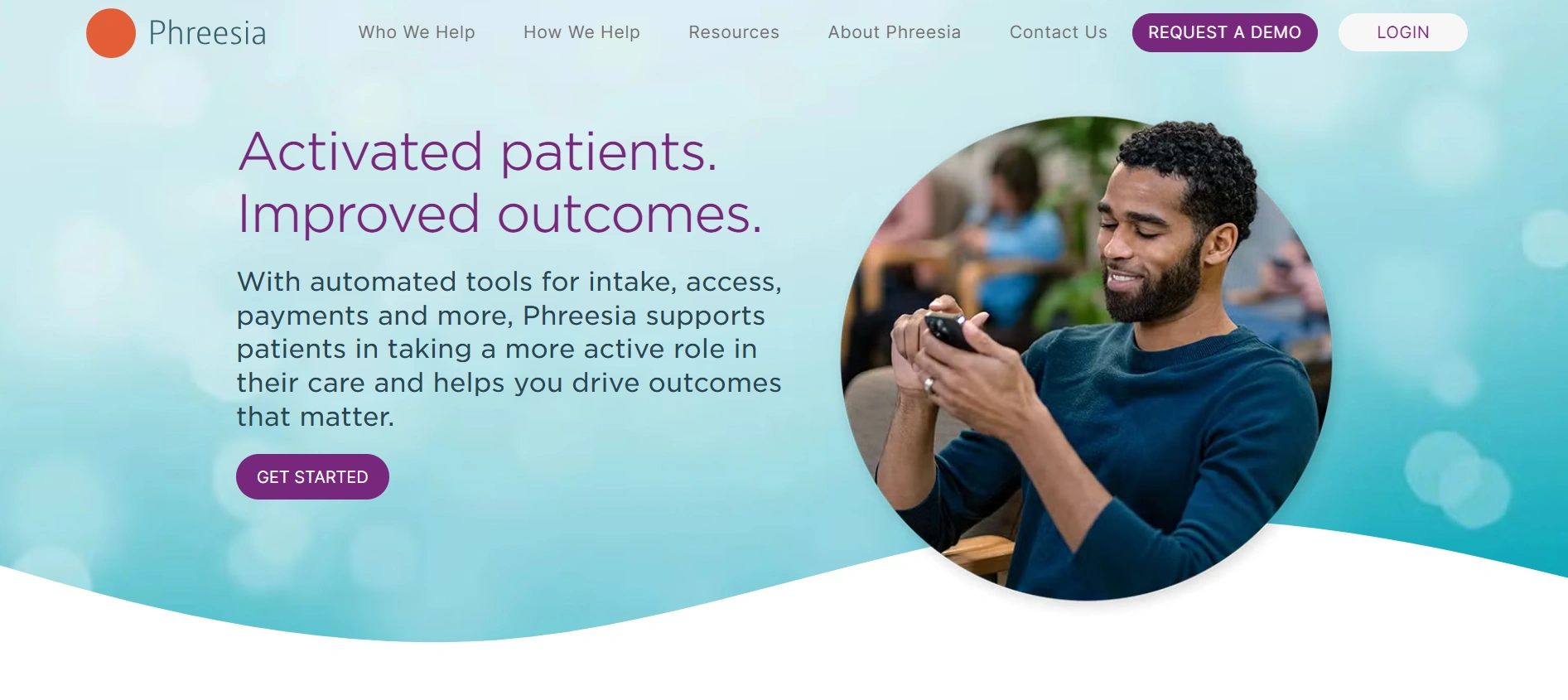
Patient intake and payment technology designed to simplify collections at the point of care.
Founded in 2005, Phreesia provides a patient intake and payment platform that helps healthcare organizations manage registration, scheduling, insurance verification, and payment collection in one system. Its technology supports digital intake and payment workflows through mobile devices, tablets, and kiosks, covering both point-of-service collections and post-visit billing.
Phreesia operates as a fully remote company and employed 1,789 full-time staff as of January 2026. During its 2026 fiscal year, the company facilitated approximately 180 million patient visits, which it estimates represents about one in six ambulatory visits in the US.
The company has steadily expanded its payment capabilities since going public in 2019. In November 2025, it acquired patient financing provider AccessOne for approximately $164 million, adding more options for patients who need to spread payments over time.
Phreesia’s financial results also demonstrate the scale of its payment operations. In the fiscal year ending January 31, 2026, the platform processed $4.87 billion in patient payments, with 83% handled through its own payment facilitator. The company reported $480.6 million in revenue during the same period.
Phreesia focuses primarily on patient-facing financial workflows rather than managing complex claims and reimbursements from health plans. Its tools help providers collect copays, deductibles, and outstanding balances through more accessible payment options.
Why we picked it
Phreesia combines patient intake and payment collection in a single platform, helping healthcare organizations collect patient balances during visits and follow up on outstanding payments afterward. Its EHR integrations, payment facilitation capabilities, and patient financing options make it particularly relevant for providers looking to improve collection rates without adding friction to the patient experience.
- Services offered: Patient registration and intake, appointment scheduling, insurance eligibility verification, point-of-service payment collection, post-visit billing, patient financing through AccessOne, and clinical support tools.
- Payment flow and model: Patient payments; cloud-based software (SaaS) with its own payment facilitator.
- Pros: Approximately 180 million patient visits annually; $4.87 billion in patient payments processed in fiscal 2026; strong EHR integrations; accessible patient payment options; AccessOne acquisition adds financing capabilities; publicly traded with financial transparency; recognized among Becker’s Top Places to Work in Healthcare in 2026.
- Cons: Focuses primarily on patient-facing collections rather than comprehensive claims or payer-side revenue cycle management. Smaller practices may find its extensive features more than they need.
- Industry expertise: Single-specialty practices, multispecialty groups, health systems, and ambulatory care.
- Best for: Healthcare providers seeking to improve patient payment collection at the point of service, reduce outstanding balances, and offer flexible payment and financing options.
- Ownership: Publicly traded (NYSE: PHR).
- Pricing: Annual subscriptions with fees based on selected features and payment volumes, plus transaction processing fees, according to its annual report. Custom quotes available.
- Rating: 4.0/5 on G2 (46 reviews). Named a Top 50 Software Company by The Software Report for four consecutive years.
- Year established: 2005.
- Location: Fully remote, with a mailing address in Wilmington, Delaware.
#8 Flywire
International patient payment processing with flexible billing and financing options.
Founded in 2009 and headquartered in Boston, Massachusetts, Flywire provides payment technology across healthcare, education, and travel. Its healthcare offering is particularly relevant for hospitals and health systems serving international patients or managing complex, high-value medical bills.
Flywire is publicly traded on Nasdaq (FLYW) and has approximately 1,400 employees and contractors. The company serves about 5,300 clients across more than 240 countries and territories, supporting transactions in over 140 currencies. Within healthcare, it works with more than 150 health systems, including four of the 10 largest US health systems by hospital size.
Its healthcare platform integrates with Epic and supports digital billing, contactless payments, and personalized payment plans. Flywire also uses estimates of patients’ ability to pay to recommend financing arrangements that better match their financial circumstances.
The company’s international payment infrastructure is its main differentiator. For healthcare organizations treating patients from multiple countries, collecting payments can involve currency conversion, international transfers, and reconciliation challenges. Flywire allows patients to pay in their home currency while helping providers receive and reconcile those funds, reducing the administrative difficulties associated with cross-border collections.
Why we picked it
Flywire combines international payment processing with healthcare-specific billing tools, making it relevant for organizations that need more than domestic payment collection. Its Epic integration, flexible payment plans, and global payment network support hospitals managing international patients and complex financial arrangements.
- Services offered: Patient billing and payment collection, payment plan management, international and cross-border payments, digital billing, contactless payments, and EHR-integrated payment workflows.
- Payment flow and model: Patient payments; digital payment platform with transaction-based fees.
- Pros: Supports payments across 240+ countries and territories in 140+ currencies; serves approximately 5,300 clients, including 150+ health systems; Epic integration partner; HITRUST CSF certified; digital payment tools designed for patient convenience; publicly traded with financial transparency.
- Cons: Best suited to organizations with international patients or complex healthcare billing requirements, making it potentially excessive for straightforward domestic collections. Healthcare is one of several industries Flywire serves. The company also reduced its workforce by approximately 10% during a February 2025 restructuring.
- Industry expertise: Academic medical centers, specialty hospitals, health systems, and international patient care programs.
- Best for: Health systems and specialty hospitals managing international patient payments, complex payment plans, or multiple payment methods across different markets.
- Ownership: Publicly traded (Nasdaq: FLYW).
- Pricing: Custom quotes based on service requirements.
- Rating: 4.6/5 on G2 (16 reviews).
- Year established: 2009.
- Location: Boston, Massachusetts headquarters, with offices across North America, Europe, and Asia-Pacific.
#9 InstaMed
Healthcare payments network connecting patient collections and payer reimbursements through one platform.
Founded in 2004 in Philadelphia, Pennsylvania, InstaMed operates a healthcare payments network serving providers, health plans, and their members. The company became part of J.P. Morgan in 2019, when JPMorgan Chase acquired it for more than $500 million, according to CNBC. Today, InstaMed is a wholly owned subsidiary of JPMorgan Chase Bank within J.P. Morgan Payments’ healthcare business.
InstaMed supports several payment flows through one network. Healthcare providers can collect patient payments online or at the point of service, while health plans can send reimbursements to providers with electronic remittance information, including electronic funds transfers (EFT), electronic remittance advice (ERA), and explanations of benefits (EOBs). The network also supports payer-side member payments.
To connect these transactions with existing financial workflows, InstaMed offers integrations with electronic health record (EHR) and practice management systems, a developer API, and clearinghouse services. The company reports that more than half of US healthcare provider organizations use the InstaMed Network for electronic payments.
InstaMed also provides payment data that informs J.P. Morgan’s annual Trends in Healthcare Payments report. The latest edition draws partly on $656 billion in healthcare payments processed through the network between 2022 and 2025. J.P. Morgan offers InstaMed alongside its treasury and banking services for healthcare organizations.
The company’s website displays PCI, point-to-point encryption (P2PE), HIPAA, and AICPA marks, although it does not publicly disclose pricing, employee headcount, or the number of payers connected to its network.
Why we picked it
InstaMed combines patient payment collection and payer-to-provider reimbursements within one network. This makes it relevant for health systems and health plans seeking to manage both payment flows through fewer vendors, particularly when they already use J.P. Morgan for banking and treasury services.
- Services offered: Patient payment processing, online and point-of-service payments, ERA/EFT and EOB delivery, health plan payments to providers, member payments, clearinghouse services, EHR and practice management integrations, and developer APIs.
- Payment flow and model: Patient payments and payer-to-provider payments; healthcare payments network.
- Pros: Supports patient and payer payments through one network; used by more than half of US healthcare provider organizations (company-reported); backed by JPMorgan Chase; integrates with EHR and practice management systems; publishes annual healthcare payments research using network data.
- Cons: Limited publicly available details about product performance and network scale, a relatively small number of G2 reviews with a lower average rating than other providers in this comparison, and no published pricing.
- Industry expertise: Hospitals, health systems, physician practices, and health plans.
- Best for: Health systems and health plans seeking one provider for patient collections and payer reimbursements, especially organizations already using J.P. Morgan’s banking services.
- Ownership: JPMorgan Chase, following its acquisition in 2019.
- Pricing: Not publicly disclosed; custom quotes available.
- Rating: 2.7/5 on G2 (11 reviews).
- Year established: 2004.
- Location: Philadelphia, Pennsylvania (headquarters).
#10 Rectangle Health
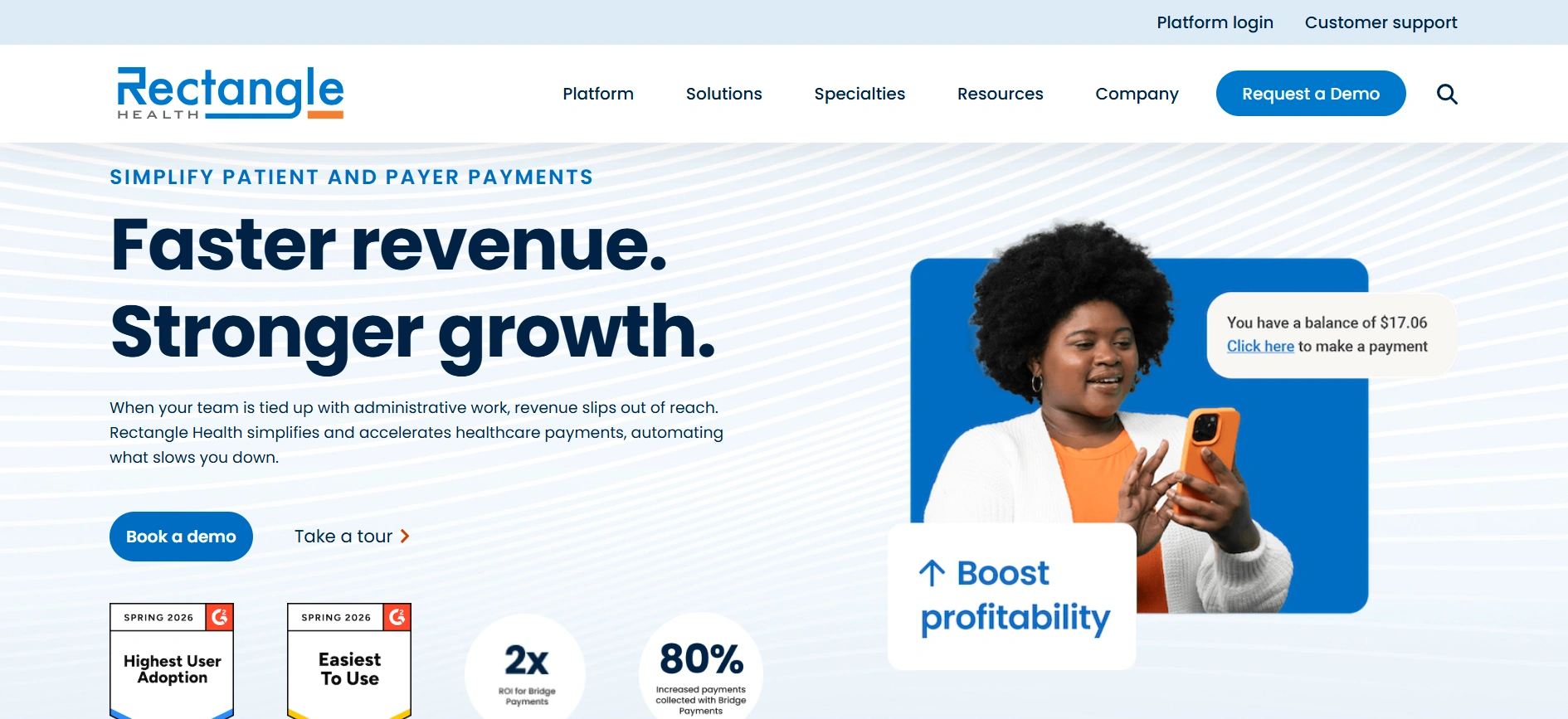
Integrated patient payment technology designed for medical and dental practices.
Founded in 1993 and headquartered in Valhalla, New York, Rectangle Health provides payment technology for medical practices, dental offices, and outpatient clinics. Its platform focuses on simplifying collections by connecting payment processing with the practice management and electronic health record (EHR) systems providers already use.
The company reports integrations with more than 500 practice management and EHR systems, allowing practices to collect payments and manage financial information without relying on separate, disconnected workflows.
In April 2025, Rectangle Health introduced PayerSync, a platform that combines payer payments and explanations of payment into a one-click posting workflow within practice management and electronic medical record (EMR) systems. An August 2025 partnership with ECHO Health expanded PayerSync’s reach to more than 450 payers.
These capabilities extend Rectangle Health beyond patient payment collection into payer payment reconciliation, helping practices reduce manual posting work alongside their everyday billing operations.
Rectangle Health serves more than 36,000 providers across physician practices, dental groups, and specialty clinics. It is also one of the few companies in this comparison with publicly available pricing. Subscription plans start at $40 per month, while payment processing rates begin at 1.99%, depending on transaction volume and payment mix.
Why we picked it
Rectangle Health offers an alternative to enterprise revenue cycle platforms for smaller healthcare providers that need integrated payment tools without extensive implementation requirements.
Its focus on practice-level workflows, combined with PayerSync’s automated payer payment posting, helps address both patient collections and reconciliation. The company’s operating history of more than 30 years also demonstrates its sustained presence in healthcare payment technology.
- Services offered: Patient payment processing, point-of-service collections, practice management integration, contactless payments, patient financing, and payer-to-provider payment reconciliation through PayerSync.
- Payment flow and model: Patient payments and payer payment posting; healthcare payment platform.
- Pros: Designed specifically for medical and dental practices; integrations with 500+ practice management and EHR systems (company-reported); PayerSync automates payer payment posting; validated PCI Level 1 service provider; published pricing; more than 30 years in healthcare payments; accessible to smaller practices.
- Cons: Less suitable for large health systems or complex hospital billing environments. Employee headcount and annual revenue are not publicly disclosed, and its capabilities are less extensive than those of enterprise RCM platforms.
- Industry expertise: Medical practices, dental offices, specialty clinics, and ambulatory care.
- Best for: Small and mid-sized physician practices and dental groups seeking integrated payment processing and reconciliation without the cost and complexity of enterprise revenue cycle software.
- Ownership: Privately held; GI Partners and TA Associates.
- Pricing: Published plans starting at $40 per month, with processing rates from 1.99%, depending on transaction volume and payment mix.
- Rating: 4.6/5 on G2 (120 reviews).
- Year established: 1993.
- Location: Valhalla, New York (headquarters).
See also: Top payment resolution companies in 2026.
What to Check Before Choosing a Healthcare Payment Processing Provider
When comparing healthcare payment processing providers, it’s important to look beyond their software features and advertised transaction rates. The total cost of collecting payments, the security controls protecting patient information, and the way payments are recorded in your systems all affect how well the solution works for your organization.
Who pays the payment fees?
Patient card payments typically carry processing fees calculated as a percentage of each transaction. Rectangle Health, for example, publishes rates starting at 1.99%, while Phreesia charges processing fees based on payment volume in addition to its subscription costs. Most other providers offer custom quotes.
To compare pricing accurately, use your actual payment mix. Consider how many patients pay by card versus ACH, how many transactions take place in person versus online, and what share of collections comes through payment plans. These differences can significantly affect your total processing costs even when vendors advertise similar rates.
Payments from health plans introduce another type of expense. Some insurers reimburse providers through virtual credit cards, which use a single-use card number processed through the provider’s payment terminal. Because these transactions run through card networks, providers typically pay a percentage-based processing fee.
Under CMS guidance, health plans can offer virtual card payments, but they must support the HIPAA-standard electronic funds transfer (EFT) method when a provider requests it. Plans also cannot require providers to receive EFT payments through a specific payment vendor.
This choice matters because payment methods continue to vary across the industry. In J.P. Morgan’s 2025 survey, 68% of payers reported still using paper checks to reimburse providers. At the same time, electronic payments are growing. Nacha recorded 548 million healthcare claim payments through EFT in 2025, a 7.3% increase from 2024.
When evaluating payer payment networks, confirm which payment methods they use by default, how you can decline virtual card payments, and whether standard EFT transactions carry additional fees.
Security and compliance requirements
Healthcare payment providers frequently handle both financial information and protected health information (PHI). As a result, their security controls must address PCI DSS requirements for cardholder data and HIPAA safeguards for patient information.
For payment card processing, request the provider’s current PCI DSS Attestation of Compliance and confirm whether it is a validated Level 1 service provider using point-to-point encryption (P2PE). Rectangle Health reports both credentials, while InstaMed displays PCI and P2PE marks on its website. If your provider accepts card payments by phone, it should also have controls that prevent card numbers from appearing in call recordings or being exposed to agents.
For HIPAA, establish whether a Business Associate Agreement (BAA) is required for the services involved and obtain one before sharing protected health information. HIPAA and GDPR do not have official certification programs, so compliance should be assessed through contracts, policies, employee training, and audit evidence rather than badges alone.
Independent security assessments provide additional assurance. Flywire and Availity report HITRUST CSF certification, while SOC 2 Type II reports can demonstrate how relevant security controls operated over time. Always confirm that the certification or report covers the specific products, systems, and delivery locations your organization will use.
Payment posting and reconciliation
Processing a payment is only part of the workflow. The money must also be recorded against the correct patient account or outstanding balance.
For payer reimbursements, each EFT deposit needs to be matched with its electronic remittance advice (ERA). Paper checks and explanations of benefits (EOBs) must be entered into the system, while patient payments from online portals, payment terminals, and lockboxes need to be applied to the appropriate accounts.
When these transactions remain unmatched or unapplied, your revenue cycle team has less reliable information about outstanding balances. This can delay denial management and patient statements, creating additional follow-up work.
Some platforms automate parts of this process. Rectangle Health’s PayerSync, for example, supports automated posting of payer payments into practice management systems. Even with automation, exceptions still occur when deposits cannot be matched to remittance records or account information is incomplete.
When comparing vendors, establish which posting and reconciliation tasks their technology handles and who resolves the exceptions. That responsibility may remain with your internal staff, fall to the technology provider, or be assigned to a dedicated outsourcing team.
For a more detailed explanation of these workflows, our guide to payment posting services covers how posting teams reconcile payments, investigate unmatched transactions, and manage exceptions that automated systems cannot resolve.
Ownership of payment networks
The ownership of healthcare payment networks is another factor worth considering, particularly if your organization manages transactions involving competing health plans.
Several major networks belong to companies with other interests in healthcare payments. Optum Pay is part of UnitedHealth Group, Availity is owned by multiple health plans, and InstaMed belongs to JPMorgan Chase.
These relationships do not automatically create a problem, but they make data governance important. If you’re a health plan considering a network owned by a competitor, review the provider’s data-use policies and contractual safeguards. Confirm how your information is separated from other clients’ data, what restrictions apply to its use, and which protections prevent unauthorized sharing.
Together, these checks will help you assess the full cost and operational implications of a payment processing arrangement, rather than focusing only on transaction fees or software capabilities.
Helpware CX — Our Top Choice
Among the 10 companies analyzed, Helpware CX occupies a distinct and important position. The technology platforms such as Waystar, Experian Health, Phreesia, and others, solve the software layer of healthcare payment processing effectively. But healthcare payment operations have a persistent human component that software doesn’t fully address: patients calling with billing confusion, claims that require manual review and appeal, insurance verification workflows that demand judgment alongside automation, and back-office processing queues that spike when systems fail.
Helpware CX’s HIPAA-compliant healthcare BPO services provide the operational layer that makes the technology work at scale. Key differentiators include a 90% CSAT score across client engagements, a 2.8% monthly attrition rate that ensures continuity in sensitive patient-facing roles, and SOC 2, HIPAA, and GDPR certifications that meet the compliance bar healthcare organizations require. With 19+ global offices and 45+ language capabilities, Helpware CX also handles the scale and multilingual complexity that large health systems and telehealth platforms face.
The trade-offs are real: Helpware CX is not a payment software vendor, runs at premium pricing relative to offshore-only BPO options, and requires a consultative onboarding process. Organizations looking for plug-in software should look elsewhere. But for healthcare operations leaders who need reliable, compliant, human-led support for the financial experience side of their revenue cycle (patient billing inquiries, claims support, back-office processing), Helpware CX delivers what the software alone cannot.
Choosing the Right Healthcare Payment Processing Partner
Choosing a healthcare payment processing partner starts with understanding where your revenue cycle needs the most support. If denied claims are delaying reimbursements, you may benefit from stronger claims management and automation tools. If patient balances remain unpaid, a platform focused on payment collection and financing may be a better fit.
The providers in this comparison address different needs. Waystar and Experian Health offer software for managing claims and reducing denials. Payment networks such as InstaMed and Zelis facilitate electronic reimbursements, while R1 RCM manages broader revenue cycle operations. Helpware supports the people-intensive work behind these systems, including payment posting, reconciliation, patient billing inquiries, and claims follow-up.
Before selecting a provider, identify where payments are delayed, where manual work creates backlogs, and which processes your internal team can manage. Then compare vendors based on their ability to address those problems, their integration with your existing systems, and the security and compliance standards they maintain.
If your organization already has payment technology but needs additional operational capacity, Helpware can help you manage payment workflows without replacing your existing systems. Our trained healthcare teams support patient billing, reconciliation, and revenue cycle back-office operations while working within your established processes.
Talk to our team to discuss your payment operations, current challenges, and the outsourcing model that fits your needs.