







Disputes are becoming a bigger challenge for merchants, fintech companies, and payment providers every year. Mastercard reports that global chargeback volume will reach 324 million cases by 2028, and roughly 60% of payment disputes eventually turn into chargebacks.
Every case creates extra work, cuts into revenue, and can push businesses closer to card-network monitoring thresholds. As dispute volumes continue to grow, many companies are turning to specialized payment resolution services to protect revenue and reduce operational strain. Payment resolution companies cover a wide range of dispute-related tasks that we will cover in the next section. The right choice depends on your transaction volume, risk profile, and internal resources.
This guide reviews 14 payment resolution providers serving merchants, banks, fintechs, and ecommerce businesses. You’ll see how different service models compare, what each provider does best, and will be able to evaluate which approach makes the most sense for your organization.
What Payment Resolution Services Actually Do
Payment resolution services generally support businesses in three key areas.
The first is dispute prevention. These tools help merchants resolve customer complaints before they become formal chargebacks, often through issuer alerts or transaction-detail sharing programs.
The second is chargeback recovery, also known as representment. Providers collect evidence, prepare responses, and submit cases to challenge chargebacks and recover lost revenue.
The third is dispute operations management. In this model, a dedicated team handles the day-to-day work associated with disputes, including case reviews, documentation, customer communication, reconciliation, and reporting.
Many businesses combine approaches. An online retailer may use prevention alerts alongside automated representment, while a bank or fintech company may outsource the entire dispute workflow. Understanding where your biggest pain points sit is the first step toward finding the right provider.
How We Chose These Providers
This list focuses on companies that actively help businesses manage disputes, whether through software, managed services, or a combination of both. We reviewed provider websites and independent sources to verify company information, service offerings, and market presence.
Our evaluation considered dispute expertise, card-network integrations, compliance standards such as PCI DSS, pricing models, and suitability for different business sizes. The result is a mix of specialized chargeback providers, network-backed solutions, and outsourced operations partners that address different parts of the dispute lifecycle.
Top 14 Payment Resolution Services for Dispute Handling in 2026: Comparison
| Provider | Core dispute services | Headquarters | Team size | Founded |
|---|---|---|---|---|
| Helpware | Managed dispute and chargeback operations, back office, KYC/AML support | Lexington, Kentucky, USA | ~4,000 | 2015 |
| Chargebacks911 | Prevention, alerts, representment, friendly-fraud remediation | Clearwater, Florida, USA | ~300 | 2011 |
| Justt | AI-driven, fully managed representment and alerts | Tel Aviv, Israel | Not disclosed | 2020 |
| Chargeflow | Automated recovery, prevention, deflection alerts | Wilmington, Delaware, USA | Not disclosed | 2020 |
| Chargeback Gurus | Managed prevention, alerts, representment, analytics | McKinney, Texas, USA | Not disclosed | 2014 |
| Genpact | Dispute management as a service, claims, fraud risk | New York, New York, USA | ~145,000 | 1997 |
| Accertify | Chargeback management, deflection, optional managed service | Itasca, Illinois, USA | Not disclosed | 2007 |
| ChargebackHelp | Unified Verifi and Ethoca tools, alerts, representment | Atascadero, California, USA | Not disclosed | n/a |
| Disputifier | Automated representment, alerts, prevention | United States | Not disclosed | n/a |
| Verifi (a Visa solution) | Order Insight, RDR, Cardholder Dispute Resolution Network | Los Angeles, California, USA | Part of Visa | 2005 |
| Ethoca (a Mastercard company) | Ethoca Alerts, Consumer Clarity, Mastercom | Toronto, Canada | Part of Mastercard | 2005 |
| Sutherland | Cards and issuer operations, fraud dispute resolution | Rochester, New York, USA | ~38,000 | 1986 |
| WNS | Payment operations, reconciliation, claims and dispute processing | New York, London, Mumbai | ~62,000 | 1996 |
| Teleperformance (TP) | Claims management, collections, back office, BFSI support | Paris, France | ~500,000 | 1978 |
The 14 Providers, Reviewed
1. Helpware

Fintech-focused BPO that manages dispute and chargeback operations from start to finish.
Helpware is a US-based BPO that provides dedicated teams for customer support, technical support, back-office operations, and contact center services. Founded in 2015, the company has grown to more than 4,000 employees across 19 locations worldwide, supporting over 400 clients in 45+ languages. Its banking and financial BPO practice handles KYC, AML, PCI DSS, and GDPR-aligned workflows, document review, monitoring, and reporting, while its back office team manages claims, reconciliation, and dispute documentation.
Why we picked it
Many providers focus on software or dispute networks. Helpware focuses on the operational side of dispute management. Its teams work directly within a client’s systems, making it a strong fit for banks, fintechs, and regulated businesses that need dispute handling, fraud support, and compliance processes managed as part of a broader operation.
- Services offered: Managed dispute and chargeback operations support, back office (claims, reconciliation, document review), KYC and AML support, omnichannel customer support, technical support, call center services, CX consulting.
- Pros: Dedicated trained teams in 45+ languages, 19 locations for 24/7 coverage, 90% CSAT and 2.8% monthly attrition against a 6–8% industry norm, SOC 2, HIPAA, and GDPR aligned, five-year average client partnerships.
- Cons: Premium pricing versus offshore-only vendors. Consultative onboarding takes longer than installing an app.
- Industry expertise: Fintech and banking, SaaS, ecommerce and retail, healthcare and telehealth, gaming, logistics.
- Best for: Banks, fintechs, and high-value merchants that want dispute and chargeback operations staffed and managed as part of a broader support function.
- Pricing: Roughly $8 to $15 per hour depending on scope, location, and engagement model.
- Year established: 2015.
- Location: Lexington, Kentucky (HQ). United States, Mexico, Philippines, Ukraine, Georgia, Puerto Rico, Poland, Germany, Albania, Uganda.
2. Chargebacks911
The original end-to-end chargeback management firm, built by former merchants.
Launched in 2011 by former merchant Monica Eaton, Chargebacks911 was the first company built solely to remediate chargebacks and first-party fraud. From its base in the Tampa Bay area of Florida, it now protects more than 2.4 billion transactions a year and represents clients across 87 countries. Its approach pairs patented technology and machine learning with human expertise, covering prevention, alerts, and representment under a performance-based ROI guarantee.
Why we picked it
Chargebacks911 set the example the rest of the market followed. When mid-market and enterprise merchants want a managed program instead of a self-serve app, Chargebacks911 brings scale, network relationships, and a long track record across travel, retail, and financial services.
- Services offered: Chargeback prevention, dispute alerts, representment, friendly-fraud remediation, merchant compliance review.
- Pros: First mover with deep expertise, technology plus human monitoring, presence across 87 countries, performance-based ROI guarantee.
- Cons: Built for higher volumes, so smaller Shopify sellers may find it heavier than they need. Pricing is quote-based.
- Industry expertise: Ecommerce, travel, retail, subscription, financial services.
- Best for: Mid-market to enterprise merchants wanting a managed, end-to-end chargeback program.
- Pricing: Custom, quote-based.
- Year established: 2011.
- Location: Clearwater, Florida.
3. Justt
AI-native, fully managed chargeback recovery that runs with little merchant effort.
Justt, founded in 2020 in Tel Aviv and formerly known as AcroCharge, fully automates representment on a merchant’s behalf. It integrates directly with payment processors, enriches each case with third-party data, and tailors arguments per dispute, not using templates. The company has raised $100 million and reports more than 250 enterprise merchants and 80,000 SMBs, with offices added in New York and London.
Why we picked it
Justt aims to replace the in-house mitigation team entirely. Its machine-learning engine runs A/B tests in the background and improves win rates over time, which appeals to merchants that want recovery handled at any volume.
- Services offered: Automated chargeback representment, dynamic evidence building, pre-chargeback alerts and RDR via Ethoca and Verifi, dispute optimization, analytics dashboard.
- Pros: Hands-off, full-service model, dynamic arguments instead of templates, scales to any volume, self-improving win rates.
- Cons: Full automation gives merchants less manual control over individual cases. Onboarding is enterprise-oriented.
- Industry expertise: Ecommerce, fintech, travel, subscriptions, crypto.
- Best for: Merchants of any size that want chargeback recovery fully outsourced to an AI-driven service.
- Pricing: Custom, performance-based.
- Year established: 2020.
- Location: Tel Aviv, Israel, with New York and London offices.
4. Chargeflow
Shopify-native chargeback automation with success-based pricing.
Built for ecommerce by ecommerce operators, Chargeflow was founded in 2020 by Ariel and Avia Chen, with a US base in Wilmington, Delaware. It automates the full chargeback lifecycle, prevention, real-time alerts, and AI-built representment, and is rated the top chargeback app in the Shopify App Store. Chargeflow reports more than 20,000 ecommerce brands, SaaS, and enterprise companies on the platform. Dispute experts check evidence for quality before submission.
Why we picked it
With Chargeflow, merchants pay only when a chargeback is recovered, with no setup costs or recurring fees. That model works especially well for fast-growing online stores looking for a low-risk solution.
- Services offered: Automated chargeback recovery, prevention, real-time deflection alerts via Verifi and Ethoca, analytics dashboard.
- Pros: One-click Shopify and Stripe integration, success-based pricing with no monthly fees, 100+ integrations, evidence aligned to Visa Compelling Evidence 3.0.
- Cons: The 25% recovery fee can feel steep at low volumes. Full automation cedes case-by-case control, which high-ticket sellers may dislike.
- Industry expertise: Ecommerce and DTC, SaaS, enterprise.
- Best for: Shopify and Stripe merchants that want hands-off recovery tied to results.
- Pricing: 25% of recovered chargebacks. Alerts at $29 per deflected chargeback. Prevention at $0.20 per transaction after a free tier.
- Year established: 2020.
- Location: Wilmington, Delaware, with operations in Israel.
5. Chargeback Gurus
Data-driven managed chargeback service with dedicated analysts.
Founded in 2014 and based in McKinney, Texas, Chargeback Gurus blends AI insights, data science, and human expertise to help merchants prevent and recover disputes. Its approach includes prevention tools, alerts, and representment, supported by analysts who study the client’s dispute trends and build stronger evidence packages over time.
Why we picked it
It lands between the pure-automation platforms and the enterprise BPOs. Merchants get a managed service with real analyst attention and its Smart Chargeback Recovery method, without committing to the scale of a giant outsourcer.
- Services offered: Chargeback prevention, dispute alerts, representment, root-cause analytics, dedicated analyst support.
- Pros: Strong analytics and reason code insight, dedicated specialists, coverage of many dispute-heavy industries.
- Cons: Quote-based pricing. Less of a one-click install than the Shopify-native tools.
- Industry expertise: Insurance, telecom, travel and hospitality, retail and ecommerce, subscription, restaurants and food delivery.
- Best for: Mid-market merchants that want a managed service with human analysts plus technology.
- Pricing: Custom.
- Year established: 2014.
- Location: McKinney, Texas.
6. Genpact

Enterprise dispute management as a service, built on decades of financial operations experience.
Founded in 1997, Genpact grew out of General Electric’s back-office operations and now employs roughly 145,000 people worldwide. Its Dispute Management as a Service offering helps banks and large enterprises handle claims, chargebacks, exception processing, reporting, and fraud-related workflows. The service combines automation, AI, and operational teams to manage disputes across the full lifecycle.
Why we picked it
When the buyer is a bank or issuer, not a single merchant, Genpact’s scale is a big perk. It treats disputes as one workflow inside a larger financial-operations engagement, with automation and analytics across the lifecycle.
- Services offered: Dispute management as a service, chargeback recovery, claims intake and processing, fraud risk management, finance and accounting operations.
- Pros: Enterprise scale and financial-services depth, agentic AI plus human operations, end-to-end claims and disputes, global delivery.
- Cons: Built for large organizations, with longer procurement cycles. Not aimed at SMBs or single-store merchants.
- Industry expertise: Banking, financial services, insurance, capital markets, healthcare, and manufacturing.
- Best for: Banks, issuers, and large enterprises outsourcing dispute operations at scale.
- Pricing: Custom.
- Year established: 1997.
- Location: New York, New York.
7. Accertify

Enterprise fraud and chargeback management with a fully outsourced option.
Accertify was founded in 2007, formerly owned by American Express and now an independent company backed by Accel-KKR. From its base in Itasca, Illinois, it helps many of the world’s largest merchants manage more than 6 million disputes a year through deflection, real-time responses, alerts, and representment. It has more than 50 processor integrations and a library of dispute templates.
Why we picked it
Beyond its platform, Accertify offers fully outsourced chargeback management through a Strategic Risk Services team that runs disputes on a client’s behalf. That makes it a fit for enterprises that want both technology and managed people from one provider.
- Services offered: Chargeback and dispute management, dispute deflection, alerts, representment, fraud prevention, account protection, payment gateway, managed services.
- Pros: Enterprise-grade platform plus an optional fully managed service, 50-plus processor integrations, handles disputes across Amex, Visa, Mastercard, Discover, and PayPal.
- Cons: Built for large merchants, so smaller businesses may find it more than they need. Pricing is enterprise and custom.
- Industry expertise: Retail and ecommerce, travel and airlines, sports betting and iGaming, financial services.
- Best for: Large global merchants that want fraud and chargeback management, with or without a managed team.
- Pricing: Custom.
- Year established: 2007.
- Location: Itasca, Illinois.
8. ChargebackHelp
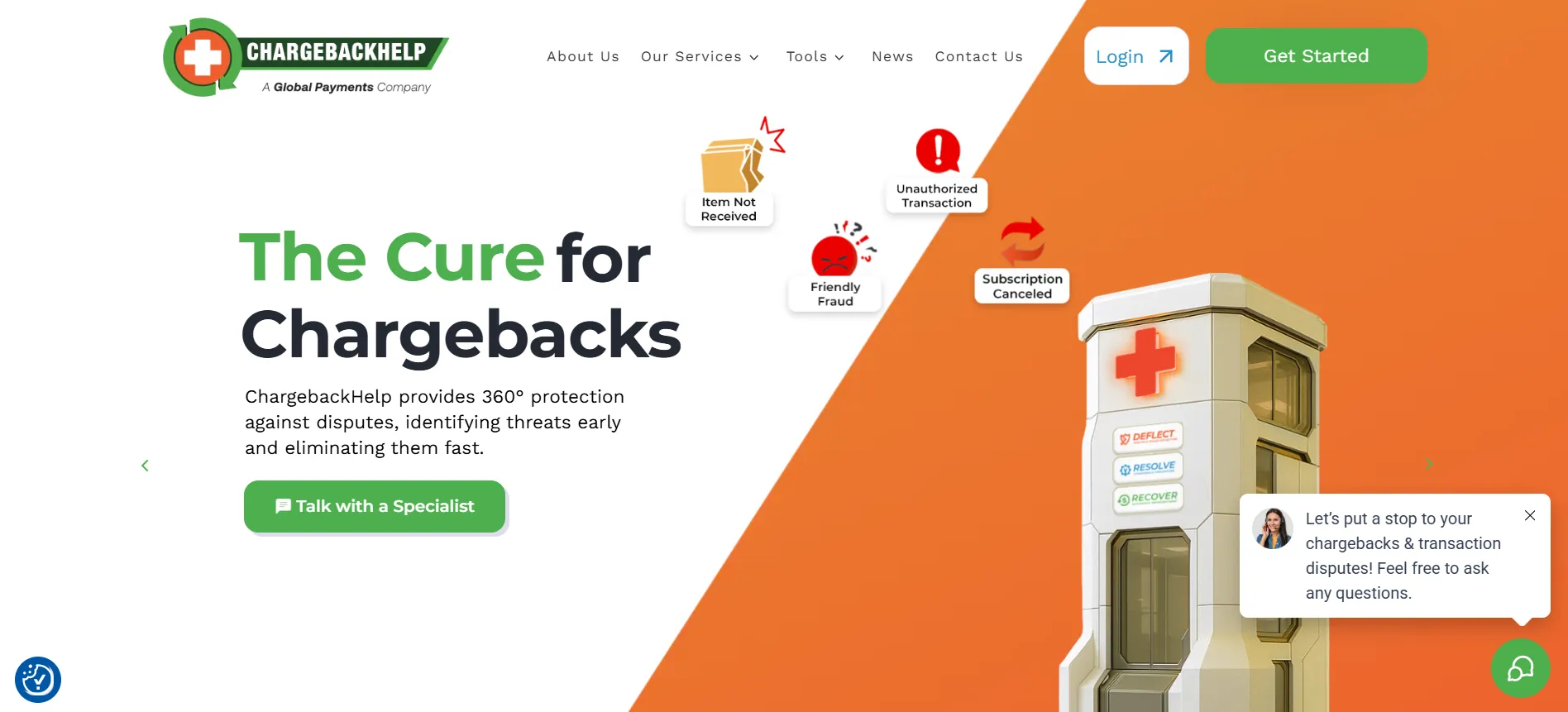
A single portal that unifies Verifi and Ethoca tools across the dispute lifecycle.
Based in Atascadero, California, ChargebackHelp combines leading network programs into one platform. Its DEFLECT module pairs Verifi Order Insight with Ethoca Consumer Clarity to prevent disputes, RESOLVE consolidates Verifi and Ethoca alerts with Visa’s Rapid Dispute Resolution, and RECOVER handles representment. The company manages integrations and network compliance so merchants do not have to juggle multiple portals.
Why we picked it
ChargebackHelp has deep roots serving high-risk merchants and acts as an extension of the team, assigning relationship managers. Besides, merchants often want the benefits of both Verifi and Ethoca without managing each one separately.
- Services offered: Dispute deflection, consolidated chargeback alerts, representment, white-label dispute management (DisputeHelp), the Billapay payment gateway.
- Pros: Unifies Verifi and Ethoca in one card-agnostic portal, hands-on relationship management, strong experience with high-risk businesses.
- Cons: Value depends on enrolling in the underlying network programs. Pricing is not published.
- Industry expertise: Travel, gift cards, online retail, telecom, high-risk merchants.
- Best for: Merchants and service providers that want Verifi and Ethoca managed together.
- Pricing: Custom.
- Year established: 2013.
- Location: Atascadero, California.
9. Disputifier
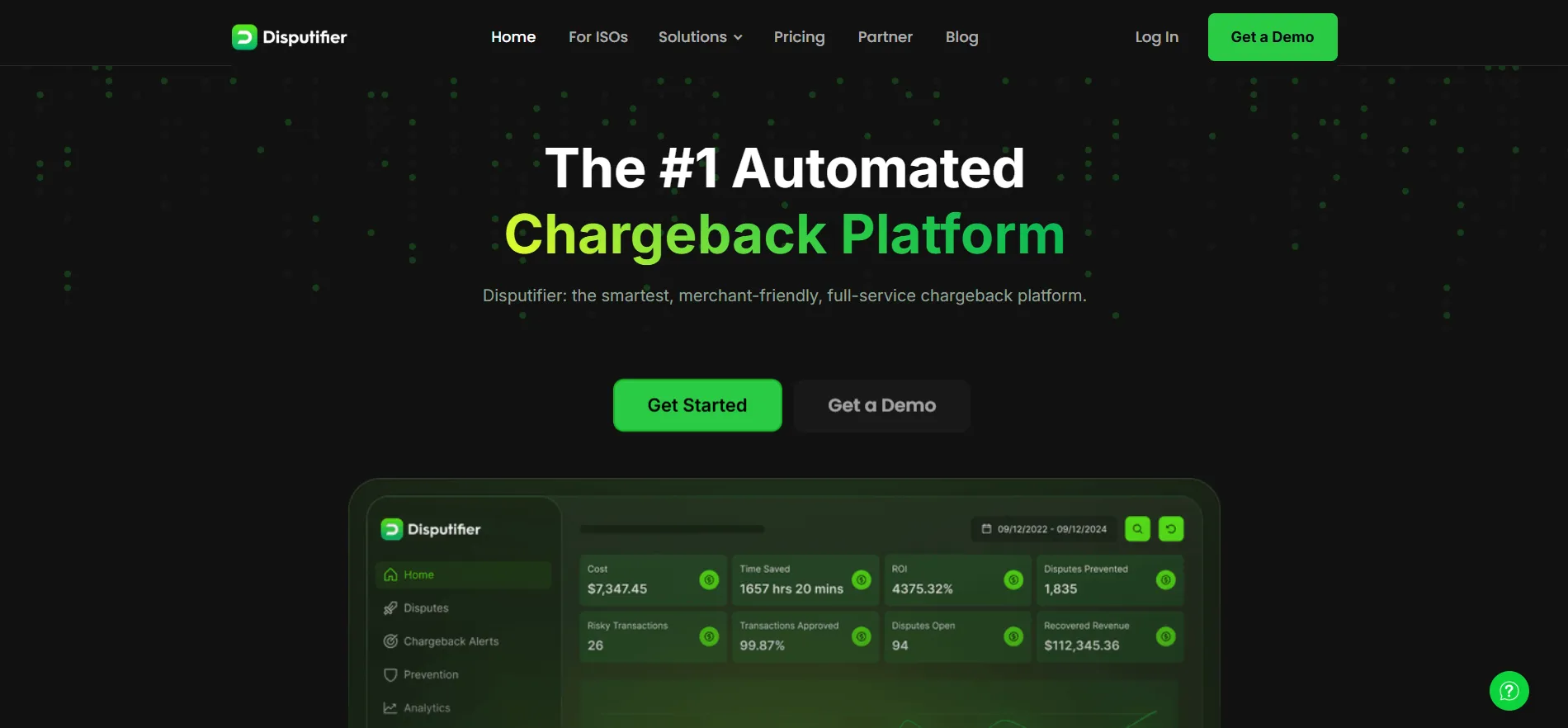
Automated chargeback prevention and recovery built for ecommerce and high-risk merchants.
Disputifier provides an end-to-end chargeback platform for ecommerce businesses and Independent Sales Organizations (ISOs). It supports major prevention programs, including RDR, Ethoca, and Order Insight, automates refunds and cancellations when needed, and prepares chargeback responses using formats refined through ongoing testing. The platform integrates with Shopify and works with all major payment processors.
Why we picked it
Its model is built for operators who want disputes off their plate. Pricing is success-based, at 20% of chargebacks it responds to and wins, backed by a 10x ROI guarantee, which lowers the barrier for high-risk and high-volume stores.
- Services offered: Automated representment, chargeback alerts, fraud prevention, order-not-received prevention, analytics.
- Pros: Hands-off automation, success-based pricing, works with every processor, ISO and high-risk support.
- Cons: Some users report template-style responses and prefer more control. It is a newer, smaller player on the market.
- Industry expertise: Ecommerce and high-risk verticals such as supplements, subscriptions, digital products, and travel.
- Best for: Ecommerce and high-risk merchants that want automated, pay-for-results dispute handling.
- Pricing: 20% of chargebacks responded to and won.
- Year established: 2020.
- Location: United States.
10. Verifi (a Visa company)
Visa’s network-level toolkit for resolving disputes before they become chargebacks.
Founded in 2005 in Los Angeles and acquired by Visa in 2019, Verifi operates directly within the Visa network. Its Order Insight service shares transaction details with issuing banks to reduce customer confusion. Rapid Dispute Resolution can automatically issue refunds for eligible Visa transactions, while the Cardholder Dispute Resolution Network gives merchants up to 72 hours to resolve a dispute before it becomes a chargeback.
Why we picked it
Because it operates at the issuer level, Verifi prevents disputes that downstream tools can only react to. Its US issuer coverage is among the deepest in the market, which is why so many management services build on top of it.
- Services offered: Order Insight pre-dispute data sharing, Rapid Dispute Resolution, the Cardholder Dispute Resolution Network.
- Pros: Visa-owned and issuer-level, automatic refunds via RDR, broad US bank coverage.
- Cons: Centered on Visa, so non-Visa cards have narrower coverage. Many merchants access it through a reseller.
- Industry expertise: Card-accepting merchants, issuers, and acquirers across all sectors.
- Best for: Enterprises and merchants that want issuer-level dispute resolution on Visa transactions.
- Pricing: Per-alert and program-based, via Visa or authorized resellers.
- Year established: 2005.
- Location: Los Angeles, California.
11. Ethoca (a Mastercard company)
Mastercard’s real-time alert network for stopping chargebacks upstream.
Similarly to Visa’s Verifi, Ethoca (founded in 2005 in Toronto and acquired by Mastercard in 2019) connects issuers and merchants so disputes can be settled before they escalate to chargebacks. Ethoca Alerts notify a merchant in real time when an issuer confirms fraud or receives a dispute, while Consumer Clarity provides detailed purchase information through banking apps to reduce customer confusion before a chargeback is filed.
Why we picked it
Ethoca’s network is especially strong across Canadian, European, and Asian banks, complementing Verifi’s US depth. Fiserv reports that 80% of merchant-resolved alerts from one issuer were handled within 24 hours, preventing the chargeback.
- Services offered: Ethoca Alerts, Consumer Clarity, Mastercom collaboration.
- Pros: Mastercard-owned, strong Canadian, European, and Asian issuer coverage, real-time deflection.
- Cons: Per-alert fees apply whether or not you refund. Action is required within 72 hours. Often accessed through a reseller.
- Industry expertise: Ecommerce merchants, issuers, and banks across sectors.
- Best for: Merchants and issuers that want upstream prevention across the Mastercard network.
- Pricing: Per-alert, via Mastercard or authorized resellers.
- Year established: 2005.
- Location: Toronto, Canada.
12. Sutherland
Financial-services BPO with AI-led cards, payments, and fraud dispute operations.
Sutherland, founded in 1986 and headquartered in Rochester, New York, is one of the largest independent BPO firms. Its banking and financial services cover cards and issuer operations, reconciliations, collections, and fraud dispute resolution, supported by the proprietary Robility automation framework and CX360 analytics tools.
Why we picked it
Sutherland handles disputes as part of a broader, AI-enabled operation for banks and issuers. That breadth suits financial institutions that want payments, fraud, and dispute work managed together, not through separate solutions.
- Services offered: Cards and issuer operations, fraud dispute resolution, reconciliations, collections, AML and KYC support, customer experience services.
- Pros: Long-standing independent BPO, AI-led automation and analytics, global delivery footprint.
- Cons: Dispute handling sits within a wide service suite, so it is less specialized than a dedicated chargeback firm. Enterprise focus.
- Industry expertise: Banking and financial services, insurance, healthcare, retail, telecom, travel.
- Best for: Banks and financial firms wanting AI-enabled dispute and cards operations at scale.
- Pricing: Custom.
- Year established: 1986.
- Location: Rochester, New York.
13. WNS

Analytics-led BPM with deep banking and payment operations, now part of Capgemini.
WNS began in 1996 as British Airways’ back-office arm in Mumbai and is now a global business-process management firm with about 62,000 employees and offices in New York, London, and Mumbai. In 2025, it was acquired by Capgemini. Its banking and financial services practice manages finance and accounting, payment operations, reconciliation, and claims and dispute processing for banks, insurers, and fintechs.
Why we picked it
WNS pairs domain depth with analytics, and its claims-handling heritage carries over to payment disputes. For enterprises that want dispute and reconciliation work run alongside wider finance operations, it is a credible, established partner.
- Services offered: Payment and transaction operations, reconciliation, claims and dispute processing, finance and accounting, customer experience services, analytics.
- Pros: Deep banking and financial-services domain expertise, analytics-led delivery, backing of Capgemini.
- Cons: Enterprise focus, so engagements suit larger volumes. Dispute handling is part of a wider operations scope.
- Industry expertise: Banking and financial services, insurance, travel, retail, healthcare, logistics.
- Best for: Banks, insurers, and enterprises outsourcing payment and dispute operations.
- Pricing: Custom.
- Year established: 1996.
- Location: New York, London, and Mumbai.
14. Teleperformance (TP)
Global-scale support partner handling claims, collections, and payment disputes for financial services.
Teleperformance, now trading as TP, was founded in 1978 in Paris and is one of the largest digital business-services companies in the world, with a workforce estimated near 500,000. Its financial-services practice spans customer care, back office, claims management, and collections, with multilingual coverage and AI-assisted operations across dozens of countries.
Why we picked it
TP is one of the largest providers in the market, with extensive multilingual coverage and global delivery. It is well suited for banks, payment companies, and large financial organizations that need to manage high dispute volumes across multiple countries.
- Services offered: Customer care, back office, claims management, collections, multilingual support, AI-assisted operations.
- Pros: Enormous global scale, multilingual and omnichannel, AI integration.
- Cons: A mega-scale generalist and not a chargeback-representment specialist. Best suited to high-volume operations.
- Industry expertise: Banking and financial services, telecom, ecommerce, healthcare, travel, government.
- Best for: Large enterprises needing high-volume, multilingual payment support, claims, and collections.
- Pricing: Custom.
- Year established: 1978.
- Location: Paris, France.
Helpware: Our Top Choice
The right pick of a provider depends on whether you need a tool, a network connection, or people to run the work. Helpware is the strongest fit for the last group. The chargeback specialists win on automation and the card networks win on prevention, whereas Helpware manages the wider operation around disputes: the support queue, the fraud-monitoring desk, the reconciliation team, the compliance reviews.
Helpware’s banking and financial BPO practice and back office teams add dedicated, trained agents to your workflows, with PCI DSS, KYC, AML, and GDPR-aligned processes and coverage in 45+ languages. The proof shows up in the numbers: 90% CSAT, 2.8% monthly attrition against a 6–8% industry norm, and client partnerships that average five years. Helpware costs more than an offshore-only vendor, and onboarding is consultative rather than instant, but for regulated fintechs and banks that treat disputes as part of the customer relationship, that trade is usually worth making.
How to Choose a Payment Dispute Handling Partner
Start by deciding between a tool, a network, and a team. A self-serve platform suits teams that want to keep control and have people to run it. A card-network program like Verifi or Ethoca prevents disputes upstream. A managed service or BPO takes the work off your desk entirely. Many businesses end up combining all three and distributing tasks for the most effective operations.
Match the model to your volume and ticket size. High-volume, lower-ticket ecommerce tends to do well with automated, success-based recovery. High-ticket sellers often want to review evidence before submission. Banks and issuers usually need a managed operation that scales into the hundreds of agents.
Check network coverage and integrations. Verifi leans toward US issuers and Ethoca toward Canadian, European, and Asian banks, so coverage gaps matter. Confirm the provider connects cleanly to your processors, your ecommerce stack, and the alert programs you rely on.
Confirm compliance and reporting. What separates a dependable partner from a risky one is auditability. Look for PCI DSS handling, clear SLA and win-rate reporting, and evidence that the provider keeps pace with network rule changes such as Compelling Evidence 3.0 and the latest monitoring programs.
Final Thoughts
Payment disputes continue to grow, and the costs increase along with them. No single provider is the best choice for every business. Focus on the option that matches your dispute volume, risk level, and internal resources. Compare pricing and recovery rates, but also look at how well the provider fits into your day-to-day operations, how it reports results, and how it handles more complicated cases. The strongest partners become part of your payment operations and continue to add value well beyond individual dispute wins.