




Choosing among healthcare data analytics companies means choosing among three different purchases: a software platform, licensed data, or a team that runs the data work for you. Vendor lists tend to blur them together, and that is how a health system ends up paying for a platform it lacks the staff to run, or licensing data its analysts cannot connect to its own records.
Spending on these tools keeps climbing. MarketsandMarkets projects the global healthcare analytics market will grow from $69.74 billion in 2026 to $213.27 billion by 2031, a 25.1 percent compound annual growth rate.
Execution trails that spending. A recent Deloitte survey of C-suite leaders at large US health systems and health plans found that only one-third of their organizations operate AI at scale, while 49 percent are still experimenting with generative and agentic AI.
For healthcare executives, hospital administrators, and health IT leaders, the challenge is no longer whether data analytics matters. It is knowing which vendor to trust with sensitive patient data, fragmented EHR environments, and an increasingly complex regulatory landscape. What this guide covers is exactly that: a curated comparison of ten leading healthcare data analytics companies, an explanation of what these solutions actually do, and a clear breakdown of vendor risks and pricing models to help you build a credible business case. Whether you are scaling a population health program, preparing for a CMS audit, or building a real-world evidence strategy, the right vendor makes the difference between data that sits idle and data that drives real decisions.
Quick answer: The best healthcare data analytics companies for 2027 are Helpware for HIPAA-compliant data operations and AI annotation teams, Health Catalyst and Innovaccer for enterprise analytics platforms, Merative and Komodo Health for real-world data, Inovalon and Cotiviti for payer analytics at the national scale, Arcadia and MedeAnalytics for value-based care performance, and Veradigm for ambulatory practice data.
How We Selected These Companies
We included companies that each cover a distinct layer of the healthcare data analytics stack: enterprise analytics platforms, proprietary data networks, payer analytics, real-world evidence, and the data operations teams that keep those programs running. We compared them on six factors that decide fit: buyer type served, delivery model, distinctive data assets, AI capability, integration depth, and vendor stability. We checked company facts against each company’s website, regulatory filings, and press releases.
Company details in this guide are based on publicly available information. We recommend verifying the specifics directly with each provider to assess their fit for your business needs.
Top 10 Healthcare Data Analytics Companies for 2027: Comparison
| Company | Best for | Primary buyers | Delivery model | Distinctive asset |
|---|---|---|---|---|
| Helpware | Data operations and AI annotation teams working alongside analytics platforms | Telehealth, digital health, payers, medical device companies | Managed services and dedicated teams | HIPAA-trained teams across 19 locations in 11 countries |
| Health Catalyst | Provider analytics, benchmarking and improvement services | Health systems, academic medical centers, integrated delivery networks | Platform plus professional services | 390+ case studies and $2.8B+ in client-validated outcomes |
| Innovaccer | Enterprise data unification with AI agents | Large health systems, payers, life sciences | Cloud platform with AI agents | 80+ EHR connections; 200+ enterprise customers |
| Merative | Research-grade claims data and clinical decision support | Life sciences, health plans, employers, providers, government | Data licensing plus software products | MarketScan research databases; 12,000+ customers |
| Inovalon | Quality, risk adjustment and pharmacy analytics at national scale | Health plans, providers, pharmacies, life sciences | Cloud platform (Inovalon ONE) plus data | Data on 461M+ unique lives |
| Arcadia | Value-based care and population health data | Provider groups, ACOs, payers, government | Cloud data platform | 2,600+ connected data sources |
| Cotiviti | Payment accuracy and risk adjustment for health plans | Health plans and government payers | Analytics plus review and recovery services | Payment accuracy at scale plus Edifecs interoperability tools |
| Veradigm | Ambulatory EHR data and real-world evidence | Independent practices, payers, life sciences | EHR, data network and analytics | 148M patient records |
| Komodo Health | Patient journey data and AI analytics for life sciences | Life sciences, payers, patient advocacy groups | Data licensing plus AI software (MapLab, Marmot) | 330M+ de-identified US patient journeys |
| MedeAnalytics | Payer and payvider analytics from a healthcare-only vendor | Blues plans, payers, payviders, providers | SaaS platform (Health Fabric) | Partner to almost half of all Blues plans |
What Healthcare Data Analytics Covers
Healthcare data analytics combines clinical, financial, and operational data from EHRs, claims databases, labs, pharmacies, and remote monitoring systems to improve patient outcomes, reduce costs, and support regulatory compliance.
Core types of healthcare data analytics include:
- Clinical analytics: Risk stratification, care gaps, readmission prediction, and population health management.
- Financial analytics: Claims integrity, denial management, healthcare costs, and revenue cycle performance.
- Operational analytics: Workforce planning, patient flow, and resource utilization.
- Quality and compliance analytics: HEDIS measures, CMS Star Ratings, MIPS, and accreditation reporting.
- Predictive analytics: AI-driven risk forecasting and intervention recommendations.
- Real-world evidence: De-identified patient data for clinical research and outcomes studies.
Healthcare analytics vendors provide data integration, analytics platforms, implementation, and ongoing support. Organizations can start with focused solutions, such as claims analytics or population health management, and expand as their needs evolve.
Four Types of Healthcare Data Analytics Companies
The ten healthcare analytics companies below sell different things, so compare them within their type before you compare them across types. Start with what you would buy:
- Enterprise analytics platforms: Software that ingests EHR, claims, and operational data and turns it into registries, dashboards, and predictive models. Health Catalyst, Innovaccer, and Arcadia lead this group. You still need analysts and data engineers to run them.
- Data networks and real-world evidence: Licensed, de-identified patient data for clinical research, commercial strategy, and outcomes research. Merative, Komodo Health, and Veradigm sell access to datasets no single organization could assemble alone.
- Payer analytics and payment accuracy: Analytics tied to health plan economics, including risk adjustment, quality ratings, and improper payment recovery. Inovalon, Cotiviti, and MedeAnalytics focus here, and buyers judge them by measurable dollar impact.
- Data operations partners: Teams that process, annotate, review, and maintain the data that feeds analytics programs and AI models. Helpware covers this layer with healthcare data operations staffed by HIPAA-trained teams.
Many organizations need more than one type. A health plan can run Inovalon for quality measurement, license Merative data for benchmarking, and staff a data operations team to clean and validate the records flowing into both.
Top 10 Healthcare Data Analytics Companies: Overview
#1 Helpware
Helpware brings a distinct approach to healthcare data analytics: rather than selling standalone software, it combines HIPAA-compliant healthcare BPO operations with data operations capabilities that help health systems turn raw data into actionable intelligence. Founded in 2015, Helpware operates across 19 locations in 11 countries with 4,000 team members supporting over 400 clients, including a significant share of healthcare and telehealth organizations. Its healthcare practice spans back-office data processing, AI data annotation for clinical machine learning models, and data science solutions that provide the human operational layer pure software vendors cannot offer.
Key details:
- Services: Healthcare BPO, data operations, AI data annotation, back-office processing, clinical data support, data science solutions
- Best for: Health systems and digital health companies that need both operational support and data science capabilities alongside their analytics platforms
- Locations: USA, Mexico, Philippines, Ukraine, Georgia, Puerto Rico, Guam, Poland, Germany, Albania, Uganda (11 countries)
- Delivery model: Managed services and dedicated teams that plug into the analytics platform you already run, from pilots of five to ten people to programs of 500+ team members.
- Ownership and stability: Private, with Eir Partners as majority recapitalization partner since 2022; clients stay for five years on average, compared with an industry norm of one to two.
- Where it stands out: Healthcare and telehealth clients such as Headspace, HealthComp, NexHealth, and Roche, plus 200+ AI specialists and data scientists for annotation and training data work.
- Trade-offs: Helpware does not sell dashboards, risk models, or licensed claims data, so you pair it with a platform or data vendor from this list.
- Ask in the demo: Which HIPAA controls apply to your data, how the team ramps from pilot to full scale, and which quality metrics you will see each week.
#2 Health Catalyst
Health Catalyst is a healthcare data analytics company headquartered in South Jordan, Utah, with more than 1,200 team members as of year-end 2025. Its Ignite platform unifies clinical, financial, and claims data into a single source of truth, serving more than 1,100 healthcare organizations across academic medical centers, community hospitals, integrated delivery networks, and health insurers. The company’s library of more than 390 case studies documents over $2.8 billion in client-validated outcomes and more than 40 million patient lives positively affected, making it one of the most outcome-verified analytics vendors in the market. In 2026, Health Catalyst went through two CEO transitions, ending with Simeon Kohl in September, and sold its Vitalware revenue cycle unit to Med-Metrix to concentrate on its core data platform.
Key details:
- Services: Data analytics platform, clinical quality improvement, population health management, AI-enabled benchmarking, strategic advisory services
- Best for: Academic medical centers, large hospital systems, and integrated delivery networks seeking a cloud-based analytics ecosystem with deep clinical benchmarking and professional services support
- Locations: USA (headquarters), with international subsidiaries in the UK, India, Singapore, the UAE, and Australia
- Delivery model: Software platform paired with advisory and improvement services, priced as an annual subscription.
- Ownership and stability: Public company (Nasdaq: HCAT); used the $147 million Vitalware sale proceeds to repay its credit facility, while second-quarter 2026 revenue fell 13 percent year over year.
- Where it stands out: A documented outcomes library that lets you check results at organizations like yours before you sign.
- Trade-offs: Leadership turnover and a narrower product line mean roadmap commitments carry more weight than usual in the contract.
- Ask in the demo: Which of your modules stay on the funded roadmap, and who owns your account after the leadership changes.
#3 Innovaccer
Founded in 2014 and headquartered in San Francisco, California, Innovaccer develops an AI cloud platform focused on healthcare data management and analytics for providers, payers, and life sciences companies. With more than 1,200 employees and $675 million in total funding, the company serves more than 200 enterprise customers, including seven of the ten largest US health systems, and its unified data platform covers over 80 million patient records. Innovaccer connects more than 80 EHR systems alongside claims data and deploys AI agents across prior authorization, care management, clinical documentation, and contact center workflows.
Key details:
- Services: AI-powered population health management, care coordination, payer analytics, revenue cycle automation, prior authorization, clinical decision support, patient engagement
- Best for: Large health systems and payers that need enterprise-scale data unification with AI-driven workflow automation across the clinical and administrative continuum
- Locations: USA, India, UAE (3 countries)
- Delivery model: Cloud data platform with AI agents layered on top, sold as an enterprise subscription.
- Ownership and stability: Private and venture-backed; its most recent equity round was a $275 million Series F in January 2025.
- Where it stands out: Breadth, with one data layer feeding population health, revenue cycle, and contact center automation.
- Trade-offs: A fast-expanding product line means some agents are newer than others, so maturity varies by module.
- Ask in the demo: Which agents run in production at organizations of your size, and what results they report.
#4 Merative
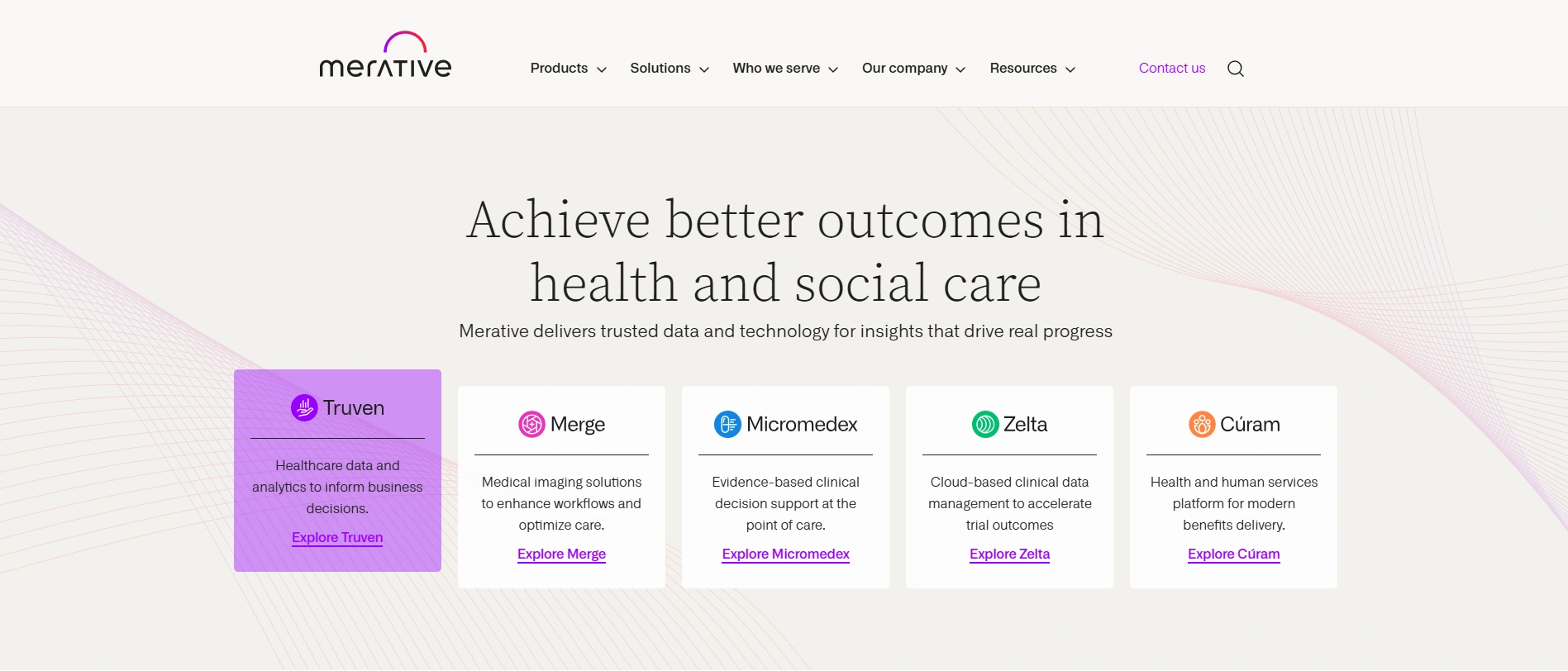
Formerly IBM Watson Health, Merative became a standalone company in 2022 under Francisco Partners’ ownership and is headquartered in Ann Arbor, Michigan, with innovation centers in India. Bringing more than 50 years of health data experience, Merative serves more than 12,000 customers across providers, health plans, employers, life sciences companies, and government agencies through six core product families: MarketScan research databases, Micromedex clinical decision support, Merge imaging solutions, Truven health analytics (including Health Insights), Cúram government social program management, and Zelta clinical development software.
Key details:
- Services: Real-world evidence data, health insights analytics, clinical decision support, clinical development, medical imaging analytics, government health and human services programs
- Best for: Life sciences companies, payers, academic medical centers, and government agencies that require research-grade data assets and clinical decision support infrastructure
- Locations: USA, India (2 countries)
- Delivery model: Licensed research databases plus separate software products, each run as its own product line.
- Ownership and stability: Owned by Francisco Partners since the 2022 carve-out from IBM, with all six product families still in the portfolio.
- Where it stands out: MarketScan’s long-running claims databases, a common reference dataset in outcomes and cost research.
- Trade-offs: The product families work as separate businesses, so a multi-product deal means several implementations.
- Ask in the demo: How data and licensing terms connect across the products you plan to buy.
#5 Inovalon
Founded in 1998 as MedAssurant and headquartered in Bowie, Maryland, Inovalon was taken private in 2021 by a consortium led by Nordic Capital, including Insight Partners and 22C Capital, in a $7.3 billion transaction. With more than 1,700 employees and data covering more than 461 million unique lives across 1.1 million clinicians and 736,000 clinical settings, Inovalon operates one of the largest healthcare data networks in the country. Its Inovalon ONE Platform brings together national-scale connectivity, primary source data access, and advanced analytics to serve payers, providers, pharmacies, and life sciences organizations across quality measurement, risk adjustment, and revenue cycle management.
Key details:
- Services: Quality measurement and reporting, risk adjustment analytics, revenue cycle management, pharmacy operations analytics, clinical trial eligibility screening, data-driven intervention platforms
- Best for: Health plans, pharmacy organizations, and provider groups focused on Medicare Advantage performance, quality scores, and value-based care transitions requiring a national-scale data network
- Locations: USA, India (2 countries)
- Delivery model: Cloud platform with built-in data connectivity, spanning quality, risk adjustment, pharmacy, and revenue cycle modules.
- Ownership and stability: Private since 2021 under a Nordic Capital-led consortium; Adam Kansler became CEO in March 2025.
- Where it stands out: Data scale, with records spanning hundreds of millions of lives that feed benchmarks and quality measures.
- Trade-offs: The platform centers on payer workflows, so provider-only buyers may use a fraction of it.
- Ask in the demo: How Inovalon data compares with your own claims for your member population.
#6 Arcadia
Arcadia operates a cloud-based, HITRUST-certified healthcare data platform serving payers, providers, and government organizations including Aetna, Cigna, Highmark Blue Cross Blue Shield, and the State of California. Majority-owned by Nordic Capital since 2025, Arcadia connects more than 2,600 data sources and manages over 150 million patient records, combining clinical, claims, and operational data to deliver population health management, care management, and risk analytics for organizations managing risk-based contracts.
Key details:
- Services: Data aggregation, population health management, care management, risk analytics, value-based care performance, interoperability solutions, AI-driven benchmarking
- Best for: Provider groups, health systems, and payers managing value-based care contracts or accountable care organizations that need a proven data aggregation and population health platform
- Locations: Not published
- Delivery model: Cloud data platform, sold as a subscription with implementation services.
- Ownership and stability: Nordic Capital took a majority stake in 2025 and also leads the group that owns Inovalon.
- Where it stands out: Data aggregation for risk-based contracts, with ISO 27001, SOC 2, and HITRUST certification.
- Trade-offs: Results depend on how many of your EHR and claims sources the implementation connects.
- Ask in the demo: How long it takes to connect your specific EHRs, and how the platform handles a new source mid-contract.
#7 Cotiviti
Founded in 1979 and headquartered in South Jordan, Utah, Cotiviti is a private analytics company co-owned by KKR and Veritas Capital, with more than 9,000 employees worldwide. It serves health plans and government payers with clinical and financial datasets that power payment accuracy programs, quality improvement initiatives, and risk adjustment analytics. Its 2025 acquisition of Edifecs added data management and interoperability tools, and Ric Sinclair became CEO in March 2026. With roots stretching back more than four decades, Cotiviti brings significant scale to its payment accuracy operations, helping health plans manage claims, recover improper payments, and improve quality scores through a combination of advanced technology and domain expertise.
Key details:
- Services: Payment accuracy analytics, risk adjustment, quality improvement and reporting, data mining, clinical data extraction, consumer engagement analytics, fraud detection
- Best for: Health plans, Medicare Advantage plans, and government payers that prioritize payment accuracy, fraud and abuse detection, and quality measure performance improvement
- Locations: USA, Canada, India, Australia, the Philippines, Mexico (6 countries)
- Delivery model: Analytics combined with clinical review, audit, and recovery services run by Cotiviti teams.
- Ownership and stability: Co-owned by KKR and Veritas Capital since a May 2024 recapitalization.
- Where it stands out: Payment accuracy programs where analytics and human review work under one contract.
- Trade-offs: Cotiviti builds for health plans; provider organizations will find little here for clinical analytics.
- Ask in the demo: How Edifecs tools change your data exchange setup, and how fees are structured for recovery work.
#8 Veradigm
Founded in 1986 as Allscripts and rebranded as Veradigm in January 2023, this Chicago-based healthcare technology company combines EHR infrastructure with data and analytics services for providers, payers, and life sciences companies. Veradigm sold its hospitals and large physician practices business in 2022 and now concentrates on small and mid-size independent practices, with a network holding 148 million patient records. Its Veradigm Network connects providers, payers, and life sciences companies through shared data and analytics infrastructure for market access research, clinical decision support, and payer intelligence applications.
Key details:
- Services: EHR analytics, clinical data services, life sciences data solutions, payer intelligence, revenue cycle management, practice management technology, real-world evidence
- Best for: Physician practices, hospital systems, and life sciences companies that need point-of-care data access combined with analytics, practice management tools, and an established provider network
- Locations: USA, India (2 countries)
- Delivery model: EHR and practice management software, plus licensed data and analytics through the Veradigm Network.
- Ownership and stability: Independent; Nasdaq delisted the company in 2024, it filed its 2023 and 2024 annual reports in May 2026, and it plans to relist once its filings are current. A sale review ended in January 2025 without a deal, and the company had about 2,300 associates as of September 2026.
- Where it stands out: Real-world data drawn from ambulatory care, where many other datasets are thin.
- Trade-offs: Delayed financial reporting and a workforce reduction raise the stakes on contract terms.
- Ask in the demo: Audited financial status, termination rights, and how you would export your data if you leave.
#9 Komodo Health
Komodo Health is a data analytics company that develops AI-powered healthcare intelligence solutions for life sciences companies, payers, providers, and patient advocacy organizations. With $514 million in total funding, Komodo’s Healthcare Map covers more than 330 million de-identified US patient journeys. Its 2025 launches of Marmot, an AI analytical platform, and MapLab Enterprise brought no-code and high-code analytics workflows to the same unified platform, positioning Komodo as one of the fastest-moving AI-first intelligence platforms in the market.
Key details:
- Services: Real-world evidence, patient journey mapping, market access analytics, AI-powered healthcare intelligence, clinical trial site selection, disease insights, life sciences commercial analytics
- Best for: Life sciences companies, payers, and patient advocacy organizations that need research-grade longitudinal patient data and AI-driven insights for commercial strategy or clinical research programs
- Locations: USA, India (2 countries)
- Delivery model: Licensed patient journey data with software for analysis, available through cloud data marketplaces as well as directly.
- Ownership and stability: Private and venture-backed, with no new funding round announced since 2022; co-founder Web Sun became co-CEO in June 2026.
- Where it stands out: Patient-level journeys across payers and care settings, useful for launch planning and site selection.
- Trade-offs: Komodo builds for life sciences and research teams, so hospitals running day-to-day operations get less from it.
- Ask in the demo: Data refresh frequency and coverage in your therapeutic area.
#10 MedeAnalytics
Founded in 1993 and headquartered in Richardson, Texas, MedeAnalytics says it brought the first healthcare-specific analytics SaaS solution to market. With more than 30 years of healthcare-only domain focus, it serves payers, providers, and payvider organizations through its Health Fabric platform, which unifies clinical, claims, financial, and social data into a single, actionable view. Recent partnerships with ZeOmega and Holon Solutions have extended its population health and integrated patient insights capabilities, and the company reports serving almost half of all Blues plans across 22 markets.
Key details:
- Services: Revenue cycle analytics, value-based care performance management, population health management, operational analytics, data interoperability, strategic advisory consulting
- Best for: Payers, providers, and payvider organizations seeking a healthcare-only analytics platform with strong revenue cycle focus, long-term domain expertise, and a configurable SaaS model
- Locations: USA (1 country)
- Delivery model: SaaS platform with advisory consulting, available on Snowflake as well as directly.
- Ownership and stability: Private and independent; its most recent acquisition was SubPop Health in 2024.
- Where it stands out: A deep Blues plan customer base and a healthcare-only focus.
- Trade-offs: A payer-centric product, so provider organizations outside payvider models should test fit early.
- Ask in the demo: Reference clients with your plan type and membership size.
Pricing Models for Healthcare Data Analytics Services
Healthcare data analytics pricing varies significantly depending on whether you are buying software, data, professional services, or a combination of all three. It is worth understanding the four primary models before approaching any vendor.
Common pricing models include:
- Subscription-based (SaaS): Most platform vendors, including Innovaccer, Health Catalyst, Arcadia, and MedeAnalytics, price on an annual subscription basis tied to patient volume, number of users, or data throughput. Contract value depends on module selection, data scale, and service levels, and most vendors quote only after a scoping process.
- Per-patient or per-member pricing: Payer-focused vendors such as Inovalon and Cotiviti frequently price on a per-member-per-month basis for quality measurement and risk adjustment programs, aligning costs directly to the population being managed.
- Data licensing: Real-world evidence providers such as Komodo Health and Merative’s MarketScan license access to de-identified datasets separately from any analytical software, with fees based on therapeutic area, time period, and query volume.
- Implementation and professional services fees: Most enterprise deployments carry onboarding, implementation, and advisory service fees beyond the base platform subscription, so ask every vendor for a first-year total that includes them.
For organizations that need human data operations support alongside their analytics platform, Helpware’s healthcare data operations services start at $8 to $15 per hour depending on service complexity, delivery location, and engagement model, offering a practical complement to software-only analytics investments.
License fees cover only part of what healthcare data analytics solutions cost. Budget for the data engineering work that connects your sources, the analysts who turn dashboards into decisions, and the staff who act on what the analytics surface: care managers working gap lists, medical coding teams reviewing risk adjustment flags, and healthcare back-office teams cleaning incoming records.
Unlock your hidden CX savings with Helpware
Get ROI projection for current support needs.
-40% annually
/monthly costs with Helpware
vs
/internal team costs (approx)
Your requirements fall outside our standard parameters.
Let's discuss your results
Fill in your details to schedule a consultation.
-40% annually
/monthly costs with Helpware
vs
/internal team costs (approx)
Your requirements fall outside our standard parameters.
-40% annually
/monthly costs with Helpware
vs
/internal team costs (approx)
Your requirements fall outside our standard parameters.
Support staff included in the package:
Shared Team Leader
Shared L&D Specalist
Shared QA Specialist
Account Executive by default
Shared Ops Delivery Manager
Admin/Finance/Legal support for the agents by default
1-2 Dedicated Team Leaders
Shared L&D Specialist
Shared to 1 Dedicated QA Specialist
Shared Ops Manager
Account Executive by default
Admin/Finance/Legal support for the agents by default
Shared Real Time Analyst
2-5 Dedicated Team Leaders
0,5 to 1,5 Dedicated L&D Specialists
1-2 Dedicated QA Specialists
Up to half of a dedicated Ops Manager
Account Executive by default
Admin/Finance/Legal support for the agents by default
1 Dedicated Real Time Analyst
Ready to get a personalized estimate for your team?
Contact us for a personalized assessment tailored to your specific needs.
*These projections are estimates for informational purposes only and do not represent a formal offer. Contact us for a personalized quote.
Thank you!
You’ll hear from us within one business day.
Choosing the Right Healthcare Data Analytics Partner
With CMS quality penalties tightening, value-based contracts expanding, and AI adoption accelerating across every care setting, the organizations that win over the next few years are those that convert their data into decisions faster than their peers.
The ten companies reviewed here cover the full spectrum of what the market offers: enterprise cloud platforms with deep clinical benchmarking (Health Catalyst, Innovaccer), real-world evidence data assets for life sciences (Komodo Health, Merative), national-scale payer analytics networks (Inovalon, Cotiviti), point-of-care EHR data integration (Veradigm), and specialized value-based care performance tools (Arcadia, MedeAnalytics). Each solves a distinct problem for a distinct buyer profile.
What none of them fully solve is the operational challenge that sits underneath every analytics program: who processes the data, annotates the training sets, reviews the clinical records, and runs the back-office workflows that make those platforms work in practice. That is where Helpware fills the gap. Across 19 locations in 11 countries, with SOC 2 Type II certification, HIPAA and GDPR compliance, and a 4,000-member team that averages five-year client partnerships, Helpware provides the human data operations layer that turns a software investment into a functioning program.
Start by identifying your primary use case and the data sources you need to connect. Then evaluate vendors on integration depth, compliance credentials, and track record with organizations similar to yours in size and complexity. The right analytics partner is not always the biggest name — it is the one whose capabilities align precisely with the problem you are trying to solve today, and whose operational model can scale as your program matures.
Settle these questions before you sign:
- Data fit: Can the vendor ingest your EHR, claims, and lab feeds with standard connectors, and who maintains those connections when a source system changes?
- Security evidence: Request the SOC 2 Type II report, HITRUST status where relevant, and a signed business associate agreement before any patient data moves.
- Time to first insight: Ask for a phased implementation plan and a reference client that went live at your scale.
- Ownership of outputs: Confirm you keep your data, models, and derived datasets if you leave, and in what format you receive them.
- Staffing model: Decide who runs the program day to day: your own team, the vendor’s services arm, or an operations partner.
- Vendor stability: Review ownership, leadership changes, and financial reporting status, using the vendor shifts above as a starting point.
Helpware: Our Top Choice for Healthcare Data Operations Support
Health Catalyst, Innovaccer, and Merative supply the platforms that generate healthcare insights. Helpware supplies the trained teams that process, label, and maintain the data those platforms depend on. Founded in 2015 and headquartered in Lexington, Kentucky, Helpware provides HIPAA-compliant BPO services to healthcare providers, telehealth companies, and digital health organizations, with 4,000 staff across 19 offices in 11 countries.
Healthcare clients use Helpware for clinical data processing, claims processing and insurance verification, AI training data for diagnostic and NLP models, and back-office data entry that feeds analytics pipelines. Monthly attrition is 2.8%, against a 6–8% industry average. Lower turnover keeps trained people on the account, and in regulated data work that continuity protects data quality.
What sets Helpware apart for healthcare data operations:
- SOC 2 Type II and ISO 27001 certified, with HIPAA- and GDPR-compliant data handling
- 200+ AI specialists and data scientists for clinical data annotation and LLM training
- Healthcare expertise in telehealth, health plan administration, and clinical data processing
- 5-year average client partnerships, compared with a 1–2 year industry norm
Not the right fit if you need a packaged analytics platform with built-in dashboards, risk models, or licensed claims data. Choose a platform from this list first, then add Helpware for data processing, labeling, and upkeep.