







Healthcare revenue cycle management (RCM) is one of the fastest-moving sectors in US healthcare administration. According to Towards Healthcare’s Market Analysis, the US RCM market stands at $72.96 billion in 2026 and is projected to reach $195.92 billion by 2035, expanding at an 11.6% CAGR. With claim denial rates climbing and administrative costs consuming more than 40% of total hospital spending, the stakes of choosing the right RCM partner have never been higher.
Not all RCM vendors are built the same. Some operate at hospital-system scale with proprietary AI platforms. Others specialize in patient-facing billing transparency or compliance-intensive back-office functions. And a growing tier of healthcare BPO providers blends end-to-end RCM with patient support, insurance verification, and HIPAA-compliant operations in a single managed service model.
This guide covers the 10 best healthcare RCM companies in the US in 2026, how they differ, and which operating contexts each one fits best.
Key takeaways
- Helpware ranks first for organizations that want compliance-certified RCM and patient support from one partner.
- R1 and Ensemble lead end-to-end outsourcing for large health systems, and both won 2026 Best in KLAS awards.
- Waystar is the software-first pick: it automates eligibility, claims, and denials, while your team runs the work.
- Seven of the ten companies changed or added owners, or agreed to, between September 2024 and June 2026, so check change-of-control terms before you sign.
Information about healthcare services and medical data processing is based on publicly available sources. Verify each provider’s capabilities, security controls, and compliance requirements for your specific use case.
How We Chose Top RCM Providers
We compared US-focused RCM providers on five criteria, using company filings, announcements, and independent recognition:
- Scope of RCM services: Coverage across patient access and eligibility, mid-cycle coding and CDI, and back-end billing, AR, and denials.
- Delivery model: Managed services, BPO, or software, and the countries where the work happens.
- Compliance and security: HIPAA plus independent attestations such as SOC 2, HITRUST, and ISO 27001.
- Evidence of results: KLAS and analyst recognition, published client outcomes, and client satisfaction data.
- Stability: Ownership changes, major client wins and losses, and breach history from 2024 to 2026.
Overview: Top Healthcare RCM Companies Compared
| Company | Best for | Delivery Model | HQ | Employees | Year Est. |
|---|---|---|---|---|---|
| Helpware | Compliance-certified RCM plus patient support | BPO managed services | Lexington, KY | ~4,000 | 2015 |
| R1 RCM | Large hospital systems | Technology + managed services | Murray, UT | ~30,000 (2023) | 2003 |
| Ensemble Health Partners | End-to-end outsourcing for health systems | Managed services partnership | Cincinnati, OH | ~15,000 | 2014 |
| Waystar | Software-led RCM automation | SaaS platform | Lehi, UT | 1,700+ | 2017 |
| Omega Healthcare | High-volume RCM at lower cost | BPO managed services | Boca Raton, FL | 35,000+ | 2003 |
| AGS Health | Coding and CDI with AI automation | Technology-enabled BPO | Washington, DC | 15,000+ | 2011 |
| GeBBS Healthcare Solutions | Coding quality and HIM at scale | BPO managed services | East Haven, CT | 16,000+ | 2005 |
| Access Healthcare | Automation-heavy RCM outsourcing | BPO + technology | Dallas, TX | 30,000+ | 2011 |
| Conifer Health Solutions | Value-based care and complex payer mixes | Managed services | Dallas, TX | Not published | 2008 |
| Optum (Change Healthcare) | Payer-integrated RCM and analytics | Technology + consulting | Eden Prairie, MN | ~300,000 | 2011 |
#1 Helpware
HIPAA-compliant, SOC 2-certified BPO partner purpose-built for healthcare organizations that treat patient experience and revenue cycle operations as two sides of the same coin
Helpware approaches the revenue cycle from the patient experience layer outward, where telehealth, digital health, and mid-market providers struggle most. Founded in 2015, it combines medical billing and coding, claims processing, insurance verification, patient scheduling, and healthcare data entry in one managed service, delivered from 19 locations in 11 countries in 45+ languages. Clients include Headspace, HealthComp, NexHealth, CompIQ, and Pfizer (Lucira).
Why we picked it
Helpware boasts a rare mix among healthcare BPO services for patient-facing RCM: 90% CSAT, an average client partnership of 5 years, and compliance with SOC 2 Type II, ISO 27001, and HIPAA requirements. It fits organizations that want billing, coding, claims, and multilingual patient support from one accountable partner.
- Services offered: HIPAA-compliant RCM solutions, medical billing and coding, claims processing, insurance verification, call center services, patient support, back-office operations
- Pros: AI-powered quality assurance automation; 90% CSAT; scales from pilot teams to 500+ FTEs in 90 to 120 days
- Cons: Consultative onboarding model requires longer ramp time; not the right fit for organizations whose primary need is standalone high-volume claims software; premium pricing compared to offshore-only providers
- Industry expertise: Telehealth and digital health, healthcare payers, healthcare providers, medical devices, behavioral health, SaaS healthcare platforms
- Best for: Mid-market to enterprise healthcare organizations ($10M-$500M revenue) that need compliant RCM and patient support from one partner
- Pricing: Managed services, staff augmentation, project work, and 30- to 60-day pilots. Contact vendor for quotes
- Certifications: SOC 2 Type II, ISO 27001, ISO 9001, HIPAA, GDPR, PCI DSS
- Recognition: IAOP Global Outsourcing 100, Inc. 5000
- Year established: 2015
- Location: Lexington, Kentucky (HQ); 19 locations on four continents.
#2 R1 RCM
The dominant revenue cycle platform for US hospital systems, processing 270 million payer transactions annually and partnering with 95 of the top 100 US health systems
R1 RCM, founded in 2003 as Accretive Health, is the incumbent at hospital-system scale. It works with about 1,000 providers, including 95 of the top 100 US health systems, and handles over 270 million payer transactions a year. Its Phare OS platform runs from patient intake through billing, denial management, and collections, as point solutions or full outsourcing. R1 acquired Phare Health’s AI coding in 2025 and agreed to acquire Humata Health in 2026.
Why we picked it
R1 is the natural first call for large health systems that need enterprise-scale RCM, though smaller practices and mid-market groups often find it overbuilt.
- Services offered: End-to-end RCM, patient registration and access, medical coding and CDI, billing, denial management, patient financial experience, regulatory navigation, revenue integrity, prior authorization
- Pros: Partners with 95 of top 100 US health systems; 270M+ payer transactions annually; modular platform allowing point-solution or full-cycle deployment; AI-native architecture with Phare Health coding integration
- Cons: Enterprise focus can make it costly and complex for mid-market providers; a 2023 breach affecting about 16,000 patients, disclosed in 2024 and settled in 2025, raised concerns for compliance-sensitive clients; onboarding timelines run long for complex health systems
- Industry expertise: Hospital systems and health networks, physician groups, academic medical centers, specialty providers
- Best for: Large health systems and hospital networks with significant annual NPR requiring enterprise-grade RCM infrastructure
- Pricing: Custom pricing based on NPR and service scope. Contact the vendor for quotes
- Certifications: HITRUST, SOC 1, SOC 2, PCI DSS
- Recognition: 2026 Best in KLAS in three categories: Extended Business Office (small hospitals), Government Reimbursement Services, and Underpayment Recovery Services
- Year established: 2003
- Location: Murray, Utah (last reported HQ), with company announcements issued from Chicago; delivery in the US, India, and the Philippines
#3 Ensemble Health Partners
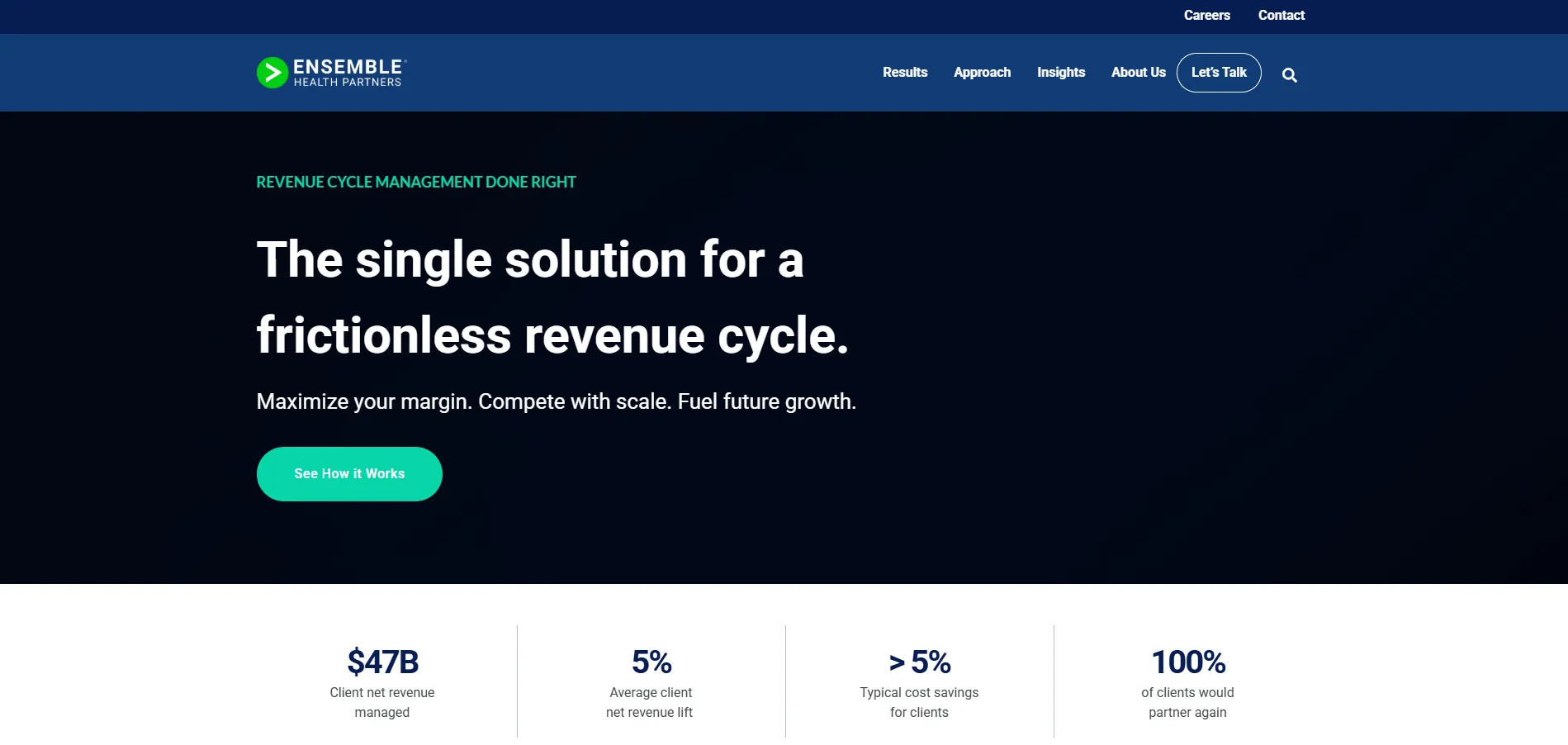
Best-in-KLAS RCM managed services partner for mid-sized to large health systems, managing $55 billion+ in net patient revenue across 200+ hospitals
Founded in 2014 and based in Cincinnati, Ensemble Health Partners runs the full revenue cycle for mid-sized to large health systems as a long-term partner. It manages more than $55 billion in net patient revenue across more than 200 hospitals and charges a percentage of cash collections plus incentive fees, so its pay tracks client results. Ensemble has won Best in KLAS for RCM outsourcing six times, most recently in 2026.
Why we picked it
Ensemble suits health systems that want one accountable partner to own and improve the whole revenue cycle, backed by top KLAS scores and agentic AI built with Cohere.
- Services offered: End-to-end RCM outsourcing, patient access and financial clearance, medical coding and CDI, AR management, business intelligence and analytics, denial management, agentic AI revenue cycle platform
- Pros: Best in KLAS for RCM outsourcing; manages $55B+ in NPR; 102% year-one cash collection performance; shared-risk pricing model; IDC MarketScape Leader 2025
- Cons: Limited focus on solo practices or small physician groups; managed services model requires operational transfer, which can be a significant transition for larger systems; not a standalone software platform
- Industry expertise: Mid-sized to large hospital systems, academic health centers, specialty hospitals, children’s hospitals
- Best for: Health systems and large hospital organizations seeking a long-term strategic managed services partner with performance-linked pricing
- Pricing: Percentage of cash collections plus performance-based incentive fees. Contact vendor for system-specific quotes
- Certifications: HITRUST, SOC 2
- Recognition: 2026 Best in KLAS, End-to-End Revenue Cycle Outsourcing (96.9); Leader, IDC MarketScape US RCM Service Solutions 2025–2026
- Year established: 2014
- Location: Blue Ash, Cincinnati, Ohio (HQ); US delivery (offshore locations not published)
#4 Waystar
Cloud-native RCM software platform processing $2.4 trillion in annual gross claims for 1 million+ providers, with agentic AI built into its platform
Waystar is software first. Formed in 2017 from the merger of Navicure and ZirMed and listed on NASDAQ, it runs a cloud platform for eligibility, prior authorization, claims, denials, patient payments, and analytics. It processes more than 7.5 billion transactions and $2.4 trillion in gross claims a year, covering about 60% of US patients. Waystar added Iodine Software’s clinical AI in 2025 and agentic AI features in 2026.
Why we picked it
Waystar fits teams that want deep automation and EHR integration while keeping RCM operations in-house; clients include Piedmont Healthcare and CHRISTUS Health.
- Services offered: Financial clearance and eligibility verification, prior authorization automation, claims management and clearinghouse, denial and appeals management, patient billing and payment processing, analytics and reporting, agentic AI revenue cycle platform
- Pros: 7.5B+ transactions annually; covers ~60% of US patients; top overall ranking in a 2026 Black Book agentic AI RCM survey; integrates with all major EHR/PM systems; publicly traded with strong market validation
- Cons: Software platform model means clients own operational execution; not a managed services provider; smaller practices may find platform investment overhead relative to their billing volume
- Industry expertise: Hospitals, health systems, ambulatory practices, physician groups, specialty providers
- Best for: Healthcare organizations seeking a technology-first RCM platform with advanced AI automation rather than managed services outsourcing
- Pricing: Subscription and volume-based licensing. Contact the vendor for quotes at waystar.com
- Certifications: HITRUST CSF, SOC 2 Type II, PCI DSS (company-reported)
- Recognition: 2026 Best in KLAS, Patient Access; top overall ranking, Black Book 2026 agentic and generative AI RCM survey
- Ratings: G2 4.4 (119 reviews)
- Year established: 2017 (merger founding)
- Location: Lehi, Utah (principal office) and Louisville, Kentucky; US-based workforce
#5 Omega Healthcare
Large-scale BPO and RCM outsourcer with 35,000+ employees, serving healthcare providers with end-to-end revenue cycle, coding, and analytics from global delivery centers
Founded in 2003, Omega Healthcare runs coding, billing, AR, and denial management for US providers with more than 35,000 employees in the US, India, the Philippines, and Colombia. Its scale brings cost efficiency on high-volume, standardized workflows. Omega won 2026 Best in KLAS for Ambulatory RCM Services (EHR Agnostic), and UnityPoint Health chose it as a strategic revenue cycle partner in September 2026.
Why we picked it
Omega suits organizations with AR backlogs and cost pressure, though its offshore model leaves less room to customize complex, compliance-heavy work.
- Services offered: Medical coding, billing, AR management, denial management, prior authorization, patient payment services, analytics and reporting
- Pros: 35,000+ employees; 2026 Best in KLAS; cost-effective offshore delivery model; broad service coverage from front-end to collections; experience across diverse healthcare settings
- Cons: Offshore-first delivery can be a limitation for compliance-sensitive or patient-facing revenue cycle functions; less personalized engagement model than consultative managed services providers
- Industry expertise: Physician groups, multi-specialty practices, hospital systems, ambulatory surgery centers
- Best for: Healthcare organizations prioritizing cost reduction on high-volume, standardized RCM processes
- Pricing: Custom pricing based on volume and scope. Contact vendor for quotes
- Certifications: HITRUST i1, SOC 1 Type 2, SOC 2 Type 2, ISO 27001, ISO 9001 (company-reported)
- Recognition: 2026 Best in KLAS, Ambulatory RCM Services (EHR Agnostic); Leader and Star Performer, Everest Group RCM PEAK Matrix 2026
- Year established: 2003
- Location: Boca Raton, Florida; delivery in the US, India, the Philippines, and Colombia
#6 AGS Health
Technology-enabled RCM and coding specialist combining AI-powered automation with clinical expertise for hospital systems and large physician groups
Founded in 2011 and based in Washington, DC, AGS Health serves hospitals, health systems, and large physician groups with medical coding, CDI, patient access, and end-to-end RCM. Its 15,000+ employees work alongside the AGS AI Platform, which covers autonomous coding, computer-assisted coding and CDI, intelligent authorization, and compliance auditing.
Why we picked it
AGS Health fits organizations where coding accuracy drives reimbursement, though it offers less patient-facing support than full-service BPO providers.
- Services offered: Medical coding, CDI, patient access, AR management, RCM outsourcing, AI-powered coding automation, prior authorization support
- Pros: Facility, professional fee, and risk adjustment coding expertise; AGS AI Platform for coding automation; 15,000+ trained specialists; strong physician group and health system track record
- Cons: More limited patient-facing capabilities compared to full-service BPO providers; not designed as a primary patient support partner
- Industry expertise: Hospital systems, health systems, large physician groups, specialty practices
- Best for: Health systems and physician organizations where specialty billing accuracy and AI-augmented coding automation are the primary RCM needs
- Pricing: Custom pricing. Contact vendor for quotes
- Certifications: HITRUST i1, SOC 2 Type II, ISO 27001, ISO 22301
- Recognition: 2024 Best in KLAS, Most Improved Services Solution (Extended Business Office); 2021 Best in KLAS, Outsourced Coding
- Year established: 2011
- Location: Washington, DC (HQ); delivery in the US, India, the Philippines, and Mexico
#7 GeBBS Healthcare Solutions
KLAS-recognized RCM and coding specialist with 16,000+ employees serving US health systems from East Haven, Connecticut
Founded in 2005 in East Haven, Connecticut, GeBBS Healthcare Solutions specializes in medical coding, CDI, revenue cycle management, and health information management. Its 16,000+ employees, including more than 4,000 certified coders, work from 16 delivery centers in the US, India, the Philippines, and the Dominican Republic. GeBBS ranked first in Black Book’s 2026 survey of technology-enabled coding-to-cash RCM operations.
Why we picked it
Choose GeBBS when coding quality is your main revenue cycle constraint; you’ll need a second vendor for omnichannel patient support.
- Services offered: Medical coding, CDI, AR management, revenue cycle outsourcing, health information management, compliance auditing, remote staffing for coding
- Pros: #1 in Black Book’s 2026 coding-to-cash RCM survey; 16,000+ RCM specialists; 4,000+ certified coders; 20+ years of healthcare domain expertise; strong physician group and hospital coding capabilities
- Cons: Less focus on patient-facing revenue cycle functions (scheduling, patient billing support); primarily offshore delivery; limited multilingual support compared to global BPO providers
- Industry expertise: Academic medical centers, multi-specialty groups, community hospitals, health systems
- Best for: Organizations whose primary RCM bottleneck is coding quality, CDI, and documentation accuracy at scale
- Pricing: Custom pricing based on coding volume. Contact the vendor for quotes
- Certifications: HITRUST CSF, SOC 2 Type 2
- Recognition: #1, Black Book 2026 technology-enabled coding-to-cash RCM managed operations survey; IAOP Global Outsourcing 100 (2026)
- Ratings: Clutch 4.5 (1 review)
- Year established: 2005
- Location: East Haven, Connecticut (HQ); delivery in the US, India, the Philippines, and the Dominican Republic
#8 Access Healthcare
Technology-enabled RCM BPO serving hospital systems with 30,000+ revenue cycle professionals across the US, India, and the Philippines
Founded in 2011 and based in Dallas, Access Healthcare has 30,000+ revenue cycle professionals across 20 delivery centers in the US, India, and the Philippines. It covers patient access, coding, CDI, and AR management for hospitals, medical groups, billing companies, and health plans, and runs RPA across claims workflows through its echo automation platform.
Why we picked it
Access Healthcare scored 91 out of 100 in KLAS’s 2024 Ambulatory Revenue Cycle Services report and suits high-volume billing environments that need to scale without proportionally scaling headcount.
- Services offered: Medical coding, clinical documentation improvement, patient access, AR management, RCM platform, billing, denial management, health information management
- Pros: 30,000+ specialists; strong RPA automation across billing workflows; HITRUST, SOC 2 Type II, and ISO 27001 certified; 20 global delivery centers
- Cons: India-centric delivery model means patient-facing functions are limited compared to US-first BPO providers; time zone constraints can affect real-time escalation workflows
- Industry expertise: Hospital systems, health systems, medical groups, billing companies, health plans
- Best for: Large healthcare organizations seeking scale-driven RCM outsourcing with high automation density
- Pricing: Custom pricing based on scope and volume. Contact vendor for quotes
- Certifications: HITRUST CSF, SOC 1 and SOC 2 Type II, ISO 27001, ISO 9001, PCI DSS
- Recognition: 91/100 overall, KLAS 2024 Ambulatory Revenue Cycle Services report
- Year established: 2011
- Location: Dallas, Texas (US HQ); delivery in the US, India, and the Philippines
#9 Conifer Health Solutions
A Tenet Healthcare subsidiary serving 600+ clients with end-to-end RCM and value-based care services, in a transition year after its largest client chose to insource
Founded in 2008 as a Tenet Healthcare subsidiary and based in Dallas, Conifer Health Solutions serves more than 600 clients, from hospitals to employers, and reports managing about $32 billion in net patient revenue. Beyond RCM outsourcing, it offers value-based care risk management and population health services. Its largest client, CommonSpirit Health, ends services on October 30, 2026, and Conifer filed notice of 1,037 related layoffs.
Why we picked it
Conifer fits health systems balancing fee-for-service and value-based contracts; ask how its 2026 transition affects staffing on your account.
- Services offered: Revenue cycle outsourcing, front-end patient access and financial clearance, clinical revenue integrity, AR management, financial risk management, population health management
- Pros: Serves 600+ clients; $32B in managed NPR; 35+ years healthcare domain expertise; value-based care financial risk capabilities; Google Cloud AI integration announced 2025
- Cons: Tenet Healthcare parent affiliation can create conflict concerns for competing health systems; transition complexity is high for full-cycle outsourcing engagements; mid-market and smaller providers may find the platform overbuilt for their needs; the loss of its largest client and 2026 layoffs add transition risk
- Industry expertise: Hospitals and health systems, physician groups, employers and unions, value-based care organizations
- Best for: Large health systems and health networks navigating both fee-for-service and value-based care financial complexity
- Pricing: Custom pricing. Contact vendor for quotes
- Certifications: Not published
- Recognition: No Best in KLAS award in 2025 or 2026
- Ratings: G2 5.0 (1 review, from 2019)
- Year established: 2008
- Location: Dallas, Texas (HQ); delivery in the US and the Philippines
#10 Optum (Change Healthcare)
UnitedHealth Group’s health services business, offering RCM technology, payer connectivity, and analytics infrastructure at system-wide scale through its Change Healthcare acquisition
Optum, a UnitedHealth Group subsidiary with about 300,000 employees, added RCM software, payer connectivity, and analytics through its roughly $13 billion Change Healthcare acquisition in 2022. It reports managing about $75 billion in net patient revenue for providers. The February 2024 Change Healthcare cyberattack, which affected about 192.7 million people, disrupted billing for weeks and pushed many providers to reduce single-vendor dependency.
Why we picked it
Optum suits large health systems already in the UnitedHealth Group ecosystem that want payer-integrated RCM and analytics.
- Services offered: Claims management, payer connectivity, RCM software, analytics and reporting, medical coding, population health management, CX consulting, payer-provider engagement
- Pros: Scale across payer and provider data; tight payer integration through Change Healthcare clearinghouse; analytics and population health capabilities beyond typical RCM
- Cons: The February 2024 Change Healthcare cyberattack raised significant systemic risk concerns; size creates a level of institutional complexity that mid-market providers find difficult to navigate; pricing and contracting are not transparent
- Industry expertise: Hospital systems, health systems, physician groups, health plans, payers, government programs
- Best for: Large health systems and payers seeking an integrated RCM and analytics infrastructure with deep UnitedHealth Group ecosystem connectivity
- Pricing: Custom enterprise pricing. Contact the vendor for quotes
- Certifications: Not published on Optum’s RCM pages
- Recognition: Leader, IDC MarketScape US RCM Services 2025–2026; Leader, Everest Group RCM Platforms PEAK Matrix 2025 (company-reported)
- Year established: 2011 (Optum); Change Healthcare acquisition 2022
- Location: Eden Prairie, Minnesota (HQ); national operations
How Healthcare RCM Companies Price Their Services
RCM vendors use four main pricing models, and the model shapes your incentives as much as the rate does.
| Model | How it works | Common with | Watch for |
|---|---|---|---|
| Percentage of collections | The vendor earns a share of the cash it collects, sometimes with performance incentives. | End-to-end outsourcing firms such as Ensemble | How the contract defines “collections” |
| Per claim or per transaction | A fixed fee for each claim, eligibility check, or remittance. | Clearinghouses and RCM software such as Waystar | Volume minimums and spike pricing |
| Per FTE or hourly | You pay for dedicated staff time. | BPO and staff augmentation providers such as Helpware | How quality and productivity are measured |
| Subscription license | A recurring platform fee, often tiered by volume or modules. | RCM software platforms | Your team still runs the work |
Most vendors on this list quote custom pricing after a scoping call. When you compare medical billing outsourcing quotes, ask each vendor to price the same scope, volume, and service levels, then model the expected revenue recovery against the fee.
RCM Market Landscape: Key Changes to Watch
The healthcare RCM market continues to evolve through acquisitions, ownership changes, and investments in AI. These developments can affect vendor capabilities, service delivery, and long-term contract decisions. Understanding the shifts helps healthcare organizations assess vendor stability and prepare the right questions before signing a contract.
| Date | Company | What happened |
|---|---|---|
| Sep 2024 | GeBBS | EQT agreed to acquire a controlling stake |
| Nov 2024 | R1 RCM | TowerBrook and CD&R took R1 private in an $8.9 billion deal |
| Dec 2024 | Omega Healthcare | Ontario Teachers’ joined Goldman Sachs Alternatives as co-lead investor |
| May 2025 | Access Healthcare | New Mountain combined it with SmarterDx and Thoughtful.ai to form Smarter Technologies |
| Aug 2025 | AGS Health | Blackstone acquired AGS Health from EQT |
| Oct 2025 | Waystar | Closed its acquisition of Iodine Software |
| Oct 2025 | R1 RCM | Acquired Phare Health and launched Phare OS |
| Jan 2026 | Conifer | Tenet took 100 percent ownership; CommonSpirit set its exit for 2026 |
| Jun 2026 | Ensemble | Thoreau agreed to a controlling investment, pending approvals |
| Aug 2026 | R1 RCM | Agreed to acquire Humata Health for AI prior authorization |
| Sep 2026 | Omega Healthcare | UnityPoint Health chose Omega as a strategic RCM partner |
These market developments highlight three areas to assess during RCM vendor due diligence:
- Ownership and contractual stability: Clarify how a change in ownership or corporate structure could affect contract terms, pricing, account leadership, staffing, and service delivery.
- AI deployment and performance: Distinguish between AI capabilities available in production and those still in development. Request evidence of performance, accuracy, and measurable operational impact.
- Transition and exit provisions: Define requirements for data portability, knowledge transfer, service continuity, transition support, and termination fees to minimize disruption if the partnership ends.
What to Look for in a Healthcare RCM Partner
The right RCM partner depends on where your revenue cycle operations need the most support. Compare vendors based on the functions you need to outsource, the complexity of your payer mix, your patient access requirements, and the level of operational accountability you expect.
| Primary operational need | What to evaluate | Relevant vendor examples |
|---|---|---|
| Claims automation and prior authorization | Automation coverage, EHR integration, processing accuracy, and exception handling | Waystar, Optum |
| End-to-end revenue cycle management | Scope of services, ownership of performance metrics, integration with internal teams, and transition planning | R1, Ensemble, Conifer |
| Medical coding and clinical documentation improvement | Coder qualifications, specialty coverage, coding accuracy, and audit processes | AGS Health, GeBBS, Omega Healthcare |
| High-volume accounts receivable and denial management | Backlog reduction, denial prevention, appeals expertise, and measurable recovery performance | Omega Healthcare, Access Healthcare, GeBBS |
| Patient-facing billing and multilingual support | Billing inquiry resolution, insurance verification, language coverage, compliance controls, and staff continuity | Helpware |
For narrower needs, specialist comparisons help: see the best denial management companies for appeals work, or compare patient access outsourcing firms for registration and scheduling.
Staff continuity is one of the most underweighted factors in RCM vendor evaluation. When billing and coding specialists turn over often, institutional knowledge resets, and that shows up in coding errors, denial rates, and CSAT. Ask each vendor for agent attrition and average tenure on accounts like yours, and get the answers in writing.
The genuine trade-off is worth stating: Helpware’s consultative onboarding model runs longer than plug-and-play RCM software, and its premium pricing reflects that operational depth. Organizations whose primary need is high-volume claims clearinghouse software will find R1 or Waystar a better fit. But for healthcare organizations that treat patient experience as a clinical differentiator, and need a single compliance-certified partner to manage billing, coding, claims, insurance verification, and patient support across a multilingual operation, Helpware earns the top spot.