







Businesses choose outsourcing destinations for different reasons. Offshore locations can reduce costs and provide access to large talent pools, while nearshore and onshore teams offer closer time zone alignment, easier collaboration, and greater familiarity with local regulations and business practices. The right choice depends on the work you do, the customers you serve, and your operational priorities.
The global business process outsourcing (BPO) market continues to expand. Statista projects the worldwide BPO market will grow from $424.94 billion to $519.75 billion by 2031. The Philippines, one of the leading offshore destinations, also reported IT-BPM export revenue of more than $40 billion, up 5% year over year. As businesses continue to invest in outsourcing, choosing where to place their operations becomes an important decision. Different countries offer different combinations of cost, talent, language skills, time zone coverage, and business risks.
This guide compares 12 of the top BPO outsourcing countries to help you narrow down your options. Explore the advantages and potential drawbacks of each destination, compare the factors that matter most to your business, and find a location that fits your operational needs and budget.
Key takeaways
- The best BPO destination depends on the balance of cost, talent availability, language skills, time-zone alignment, and operational risk.
- The Philippines is a leading destination for large-scale customer experience, voice support, technical support, and back-office operations.
- Mexico, Colombia, and Puerto Rico offer nearshore options for US businesses, with overlapping working hours and access to Spanish-speaking and bilingual talent.
- The United States suits complex, high-value, and certain regulated operations, while Poland, Ukraine, Georgia, Albania, and Germany serve different European language, technical, and business process needs.
- South Africa and Uganda offer emerging opportunities in English-language customer support and back-office services, with different levels of market maturity and infrastructure readiness.
- Labor costs vary considerably by country, but national income indicators such as GNI per capita are only rough proxies for actual outsourcing rates and total operating costs.
- English proficiency rankings, workforce estimates, and service strengths vary in scope and should be considered alongside role-specific requirements and individual provider capabilities.
- Onshore, nearshore, offshore, and hybrid delivery models offer different trade-offs in cost, collaboration, coverage, and resilience. A multi-country setup can extend service hours and diversify operational risk, but adds coordination complexity.
Best Outsourcing Destinations: Selection Criteria
When choosing outsourcing destinations for this guide, we evaluated each country against six criteria, using publicly available data where possible:
- Talent scale: The size of the outsourcing, contact center, or ICT workforce.
- Language: English proficiency based on the EF English Proficiency Index, along with the availability of other languages required by buyers.
- Time zone alignment: The degree of working-hour overlap with major customer markets, taking into account differences across regions.
- Cost: World Bank GNI per capita as a proxy for local wage levels.
- Risk: Political and economic stability, infrastructure, and business continuity.
- Service fit: The types of services each country is best suited to provide.
We grouped the countries according to the needs they are best positioned to meet. For example, a destination well suited to overnight US customer support may be less suitable for German-language operations.
Top Outsourcing Destinations Worth Considering in 2027
Use this comparison to identify the countries that best match your outsourcing needs. The table summarizes each destination’s typical service strengths, time zone alignment with the US Eastern time zone, English proficiency, relative cost, and key considerations. It also indicates whether Helpware has a delivery presence in each country.
| Country | Best for | Time difference vs. US Eastern | English Proficiency (EF EPI Rank) | Relative cost | Main consideration | Helpware delivery presence |
|---|---|---|---|---|---|---|
| Philippines | Voice customer experience (CX), technical support, and back-office operations at scale | +12 to +13 hours | #28, High | Low | Covering US daytime hours typically requires night shifts | Yes |
| Mexico | Nearshore support in Spanish and English | −1 to −2 hours | #103, Very low | Mid | Assess English proficiency for each role | Yes |
| Colombia | Spanish-language and bilingual support aligned with US business hours | 0 to −1 hour | #76, Low | Low | English proficiency varies; screen candidates carefully | Via Mexico |
| United States | Regulated, complex, and high-value work | 0 to −3 hours | Native English | High | Highest labor costs among the countries compared | Yes |
| Puerto Rico | Bilingual operations under US jurisdiction | 0 to +1 hour | Not ranked; bilingual workforce | Mid | Smaller labor pool and seasonal hurricane risk | Yes |
| Poland | Multilingual European customer experience, finance, and IT | +6 hours | #15, Very high | Mid | Higher costs than some other Eastern European destinations | Yes |
| Ukraine | Technical support, software services, and back-office operations | +7 hours | #45, Moderate | Low | War-related business continuity risks | Yes |
| Georgia | Voice and non-voice support aligned with European business hours | +8 to +9 hours | #35, Moderate | Low | Limited talent pool and little overlap with US business hours | Yes |
| Albania | Italian- and English-language customer experience for European markets | +6 hours | #42, Moderate | Mid | Limited talent pool | Yes |
| Germany | German-language support and customer experience involving EU-regulated operations | +6 hours | #4, Very high | High | Labor costs are among the highest on this list. | Yes |
| South Africa | English-language voice customer experience for UK, Australian, and US buyers | +6 to +7 hours | #13, Very high | Low | Power-grid interruptions; verify backup power and continuity plans | Via Uganda |
| Uganda | Low-cost English-language back-office and data services | +7 to +8 hours | #53, Moderate | Lowest | A developing outsourcing market and infrastructure that is still maturing | Yes |
Note: Relative cost is based on World Bank GNI per capita, used here as a proxy for local wage levels: Low is under $10,000, Mid is $10,000–$30,000, and High is above $30,000. This is a broad indicator, not a direct measure of outsourcing rates. Time differences are approximate and account for daylight saving changes where applicable. EF EPI ranks and proficiency bands should be checked against the same edition of the index before publication.
Best Destinations for Large-Scale Offshore Outsourcing in Asia
Asia offers a large English-speaking talent pool and some of the lowest outsourcing costs outside Africa. Its time zone also makes it well suited to overnight support for US businesses.
#1 The Philippines
The Philippines is often called the “BPO capital of the world” and remains a leading offshore destination for customer-facing services.
The country’s IT-BPM sector continues to grow. IBPAP estimates that the industry employs around 1.89 million people and forecasts $42.3 billion in revenue and 1.95 million employees for 2026. Growth is increasingly driven by technical and higher-value services, while demand is also expanding in Gulf markets such as Saudi Arabia, the United Arab Emirates, and Qatar.
Businesses outsource a wide range of services to the Philippines, including AI operations, data services, customer support, technical support, data entry, back-office operations, and finance and accounting. The country’s call center sector remains one of its strongest capabilities, with providers serving global businesses that need high-quality customer experiences and scalable support operations.
“What makes the Philippines special is the care people bring to the work. We listen, connect, take ownership, and treat every customer conversation as something that genuinely matters.”
Glen Hardy, Regional Vice President of Operations, Philippines, Helpware
Philippines overview
- Time zone: UTC+8, with no daylight saving time; 12 to 13 hours ahead of US Eastern time
- English: EF EPI rank #28 out of 123 countries and regions, with high proficiency
- Talent pool: Approximately 1.89 million IT-BPM workers
- Cost position: Low
- Best for: Customer service outsourcing at scale, technical support, back-office operations, and healthcare BPO
- Key consideration: Supporting US business hours typically requires night shifts, while typhoon season makes a tested business continuity plan essential
- Helpware delivery: Yes, in Manila and Cebu
Main reasons to outsource to the Philippines:
- Strong English-language skills: The Philippines stands out in the global outsourcing market for its English proficiency, making it a strong option for businesses serving English-speaking customers.
- Competitive labor costs: The country ranks among the lower-cost destinations on this list. According to the World Bank, its GNI per capita is roughly one-eighteenth of the US level.
- Convenient overnight coverage for US businesses: Manila’s working day overlaps with the US night, allowing BPO companies in the Philippines to handle overnight and 24/7 support queues during regular local business hours.
- Tax incentives for eligible businesses: The Philippine Economic Zone Authority (PEZA) offers registered IT-BPM firms time-bound tax incentives under the CREATE and CREATE MORE laws.
- Support for a range of outsourcing activities: PEZA registration is available for various eligible activities, including software development, BPO services, and IT outsourcing.
Best Nearshore Outsourcing Destinations for North American Buyers
Nearshore outsourcing in Latin America gives businesses access to teams that work in time zones close to those of their US counterparts, with Spanish-language support readily available.
#2 Mexico
Historically known for its manufacturing industry, Mexico has become one of the leading nearshore outsourcing destinations in the Americas. Businesses choose the country for its Spanish-English bilingual talent, business-friendly environment, and working hours that align closely with US time zones, particularly Central time.
Mexico’s IT-BPM sector now spans a broad range of services, including software development, cybersecurity, data operations, AI training, cloud support, and specialized customer experience management. Grand View Research estimates that Mexico’s IT services outsourcing market is worth $13.2 billion and projects it will reach $20.4 billion by 2033. Guadalajara, Monterrey, and Mexico City are major hubs for the industry, helping position Mexico as a bridge between North American businesses and Latin American markets.
Mexico overview
- Time zone: Mexico City is UTC−6 year-round, with no daylight saving time. It is one hour behind US Eastern time in winter and two hours behind in summer.
- English: EF EPI rank #103 out of 123 countries and regions, with very low proficiency
- Talent pool: Approximately 95,200 call center and telephone information workers, according to Mexico’s Secretaría de Economía
- Cost position: Mid-range
- Best for: Bilingual support for US Hispanic customers and call center outsourcing in Mexico
- Key considerations: English proficiency varies considerably, so assess candidates’ skills for every English-facing role.
- Helpware delivery: Yes, in Guadalajara
Main reasons to outsource to Mexico:
- A growing innovation ecosystem: Mexico ranks 65th among 139 economies in the Global Innovation Index, reflecting its position in the global innovation landscape.
- Convenient working-hour overlap: Mexico City’s time zone is close to US Central time. Its one-hour difference from US Eastern time in winter and two-hour difference in summer can allow substantial overlap with US teams, including those based in New York.
- Lower labor costs than the US: Mexico’s GNI per capita is approximately 15% of the US level, according to the World Bank. While this measure is not a direct indicator of outsourcing rates, it provides a broad indication of the country’s cost advantage over onshore operations.
#3 Colombia
Colombia has emerged as a strong nearshore alternative to Mexico, with Bogotá, Medellín, and Barranquilla serving as major hubs for its BPO industry. BPrO, the country’s BPO association, reports 789,687 direct jobs in the sector and $2.9 billion in BPO and KPO exports. Colombia’s time zone also makes it well suited to serving US clients. Bogotá follows US Eastern time in winter and is one hour behind in summer, giving teams substantial overlap with US business hours. This makes call center outsourcing in Latin America a practical option for businesses seeking Spanish-language support without a significant time difference.
Colombia overview
- Time zone: UTC−5 year-round, with no daylight saving time; aligned with US Eastern time in winter and one hour behind in summer
- English: EF EPI rank #76 out of 123 countries and regions, with low proficiency
- Talent pool: 789,687 direct BPO jobs
- Cost position: Low
- Best for: Spanish-language and bilingual customer support aligned with US business hours
- Key considerations: English proficiency varies by city and employer, so screen candidates carefully for English-only support roles.
- Helpware delivery: No local center; Helpware serves Latin American nearshore clients from Mexico
Main reasons to outsource to Colombia:
- Strong time zone alignment: Colombia offers substantial working-hour overlap with US Eastern and Central time zones, making real-time collaboration and customer support easier to manage.
- A large Spanish-speaking talent pool: The country’s established BPO industry provides access to Spanish-speaking professionals, making Colombia a good fit for businesses serving Hispanic customers.
- Competitive labor costs: Colombia’s GNI per capita is approximately 9% of the US level, according to the World Bank. Although this is not a direct measure of outsourcing rates, it indicates a significant potential cost advantage over US-based operations.
Best Destinations for Onshore Support and US-Regulated Operations
Onshore and nearshore teams typically cost more than offshore alternatives, but they offer closer collaboration and strong English-language capabilities while enabling you to operate within the US regulatory framework.
#4 The United States
The United States has a large domestic outsourcing industry, supported by an extensive customer service workforce and a broad range of specialized service providers. The US Bureau of Labor Statistics counts approximately 2.67 million customer service representative jobs, while Statista estimates the US BPO market at $159.34 billion, making it the largest in the world. Onshore outsourcing can be a strong fit for businesses that need native English communication, US-based data handling, or teams with in-depth product knowledge.
Helpware operates its US hub in Lexington, Kentucky, with additional US locations in Virginia. Our domestic teams provide customer service and back-office support for businesses that need US-based operations.
USA overview
- Time zone: Four main time zones across the contiguous US, from UTC−5 (Eastern) to UTC−8 (Pacific) during standard time
- English: Native
- Talent pool: Approximately 2.67 million customer service representative jobs
- Cost position: High
- Best for: Regulated healthcare and financial services, complex technical support, and high-value customer accounts
- Key considerations: Labor costs are among the highest of the countries covered in this guide.
- Helpware delivery: Yes, in Kentucky and Virginia
Main reasons to outsource to the United States:
- Strong data protection and regulatory alignment: US-based teams can be a practical choice for work involving sensitive information or requirements tied to US regulations. However, outsourcing domestically does not automatically ensure compliance; providers must meet the applicable requirements.
- Flexible service options: Businesses can choose from a range of service models and staffing arrangements to match their size, operational needs, and support requirements.
- Strong communication and technical skills: A large, experienced workforce supports customer-facing roles and specialized technical operations, while native English proficiency can be valuable for complex customer interactions.
- Flexible staffing and scalability: Domestic providers can adjust team size and service coverage as business needs change, subject to available talent and budget.
#5 Puerto Rico
Puerto Rico offers US companies a nearshore option that combines a US jurisdiction with access to bilingual talent and potentially lower labor costs. Key industries for outsourced customer service include healthcare, technology, banking, and education. According to the World Bank, Puerto Rico’s GNI per capita is about 31% of the US mainland level. Helpware’s San Juan office provides a US-based operating environment for bilingual customer support.
Puerto Rico overview
- Time zone: Atlantic Standard Time (UTC−4) year-round, matching US Eastern Time during daylight saving time and running one hour ahead during standard time
- English: Bilingual Spanish-English workforce; not ranked by EF
- Talent pool: 20,360 customer service representatives, according to the Puerto Rico Department of Labor
- Cost position: Mid
- Best for: Bilingual Spanish-English support under US jurisdiction
- Key considerations: A smaller labor pool than the mainland, with hurricane season making business continuity planning important
- Helpware delivery: Yes, in San Juan
Main reasons to outsource to Puerto Rico:
- Cultural and operational alignment: Puerto Rico’s close ties to the US make it a practical nearshore option for American companies seeking teams familiar with US business practices.
- Telecommunications infrastructure: The territory has invested in its call center industry, infrastructure, high-speed internet, and telecommunications to support business growth.
- Bilingual customer support: Puerto Rico offers access to Spanish-English bilingual agents. Spanish is widely spoken at home: the US Census Bureau reports that 95.5% of residents speak a language other than English at home. For English-only queues, assess candidates’ English proficiency during hiring.
Best Outsourcing Destinations for European Buyers
Central and Eastern Europe offer Western European businesses strong language skills and substantial overlap in working hours. The right destination depends on the languages required, the services being outsourced, and the budget. Explore our call center outsourcing services in Europe to learn more.
#6 Poland
Poland is one of Europe’s largest business services hubs. According to ABSL, the industry association for Poland’s business services sector, approximately 488,700 people work in 2,081 business services centers across the country. A steady flow of university graduates also helps replenish the talent pool. Warsaw, Kraków, Wrocław, and Poznań are major hubs for international and domestic outsourcing companies.
Poland overview
- Time zone: Central European Time (UTC+1, UTC+2 in summer), typically six hours ahead of US Eastern Time
- English: EF EPI rank #15 of 123, indicating very high proficiency
- Talent pool: Approximately 488,700 business services center employees
- Cost position: Mid
- Best for: Multilingual European customer experience, finance and accounting, IT, and call center outsourcing in Poland
- Key considerations: Labor costs are higher than in the other Eastern European destinations covered in this guide
- Helpware delivery: Yes
Main reasons to outsource to Poland
- A large, skilled talent pool: Poland has an established business services workforce, supported by a steady pipeline of university graduates.
- Competitive costs within Europe: Outsourcing rates can be more cost-effective than in many Western European markets, although Poland is not the lowest-cost option in Central and Eastern Europe.
- A stable business environment: Poland offers established infrastructure, a predictable regulatory framework, and strong English proficiency that supports international operations.
#7 Ukraine
Ukraine is one of Europe’s established technology hubs. Despite the ongoing war, Ukrainian IT and BPO teams continue to serve international clients under difficult conditions. The country has particular strengths in software development, AI, and cybersecurity, while its BPO sector supports customer service and back-office operations. The Lviv IT Cluster counts approximately 303,000 IT specialists, including 245,000 working in Ukraine. Companies such as EPAM, GlobalLogic, Luxoft, and SoftServe rely on Ukrainian teams for critical projects in AI, cybersecurity, and product engineering. Helpware opened its first delivery center in Kyiv in 2016.
Ukraine overview
- Time zone: Eastern European Time (UTC+2, UTC+3 in summer), typically seven hours ahead of US Eastern Time
- English: EF EPI rank #45 of 123, indicating moderate proficiency
- Talent pool: Approximately 245,000 IT specialists working in Ukraine
- Cost position: Low
- Best for: Technical support, software development, back-office operations, and call center services in Ukraine
- Key considerations: The war creates operational and continuity risks. Ask providers about backup power, connectivity, staff safety, and disaster recovery plans.
- Helpware delivery: Yes, in Kyiv
Main reasons to outsource to Ukraine
- Strong technical expertise: Ukraine has an established pool of skilled IT professionals and experienced teams across software development, cybersecurity, and technical support.
- Support for the technology sector: Government initiatives and industry development efforts continue to support Ukraine’s technology ecosystem, including software development outsourcing.
- Convenient European time zones: Ukraine’s working hours overlap with much of Europe, making real-time collaboration and customer support easier for European businesses.
#8 Georgia
Georgia is a cost-effective option for businesses that need support during European working hours. Located at the crossroads of Europe and Asia, the country offers voice and non-voice business process services alongside IT support. Geostat reports that 54,927 people work in the information and communication sector. Georgia also offers tax incentives for eligible IT businesses with Virtual Zone status, including a profit-tax exemption on qualifying IT services supplied abroad. Tbilisi is the main business hub, with additional activity in Kutaisi and Batumi.
Georgia overview
- Time zone: UTC+4 year-round, three hours ahead of Berlin during daylight saving time and four hours ahead during standard time; eight to nine hours ahead of US Eastern Time
- English: EF EPI rank #35 of 123, indicating moderate proficiency
- Talent pool: 54,927 information and communication sector employees
- Cost position: Low
- Best for: Voice and non-voice support aligned with European working hours, including call center services in Tbilisi
- Key considerations: A smaller talent pool than Poland or Ukraine, with limited overlap with US business hours
- Helpware delivery: Yes
Main reasons to outsource to Georgia
- Multilingual talent: Georgia offers a multilingual workforce with technical skills. English proficiency varies, so assess candidates against the language requirements of each role. The country ranks #35 in the EF English Proficiency Index.
- Working-hour alignment with Europe: Tbilisi’s time zone supports substantial overlap with Berlin and other European business centers, making live collaboration easier.
- Business-friendly conditions: Georgia offers a range of measures intended to attract international business, including trade facilitation and tax incentives for eligible IT companies.
#9 Albania
Albania is emerging as a nearshore outsourcing destination for European businesses. The country has opened all six clusters of its EU accession negotiations, while its outsourcing sector serves clients in Italy, the UK, France, Spain, Germany, Austria, and Switzerland. Tirana is the main business hub, followed by Durrës, Shkodër, and Vlorë. The Albanian Investment Development Agency (AIDA) reports more than 13,289 active ICT and BPO companies and 49,000 sector professionals.
Albania overview
- Time zone: Central European Time (UTC+1, UTC+2 in summer), typically six hours ahead of US Eastern Time
- English: EF EPI rank #42 of 123, indicating moderate proficiency
- Talent pool: Approximately 49,000 ICT and BPO professionals
- Cost position: Mid
- Best for: Italian- and English-language customer experience for European brands, including call center services in Albania
- Key considerations: A relatively small talent pool and limited overlap with US business hours
- Helpware delivery: Yes
Main reasons to outsource to Albania
- Competitive operating costs: Lower living costs and competitive salaries can make Albania an attractive alternative to more expensive European markets.
- Multilingual customer support: Albanian professionals offer language skills in Italian, English, Greek, and German, supporting customer service and content operations for European markets. Proficiency varies by candidate and role.
- Incentives for new businesses: Developments such as the TEDA Tirana free economic zone and Durana Tech Park may offer favorable conditions for eligible businesses establishing operations in Albania.
#10 Germany
Germany, the European Union’s most populous country, is a premium option for businesses that prioritize language quality, specialized skills, and EU-based operations over the lowest possible cost. According to the IMF, Germany has the world’s third-largest economy by nominal GDP. Its dual vocational education system combines classroom instruction with practical workplace training, helping develop a skilled workforce. Germany is a strong fit for businesses that need native German-language support and EU-based data handling, though its labor costs are higher than those of lower-cost outsourcing destinations.
Germany overview
- Time zone: Central European Time (UTC+1, UTC+2 in summer), typically six hours ahead of US Eastern Time
- English: EF EPI rank #4 of 123, indicating very high proficiency
- Talent pool: Approximately 1.35 million ICT sector employees, according to Bitkom
- Cost position: High
- Best for: German-language customer experience and operations requiring EU-based handling of regulated data
- Key considerations: Labor costs are among the highest in this guide
- Helpware delivery: Yes, in Berlin
Main reasons to outsource to Germany
- Reliable digital infrastructure: Germany has established telecommunications networks and business infrastructure to support customer service and other outsourced operations.
- A mature business environment: Established institutions and a developed regulatory framework can help businesses manage operations that require clear processes and accountability.
- Access to a skilled workforce: Germany offers experienced professionals across major metropolitan areas, supporting scalable customer service and business process operations.
- Strong German and English skills: Native German speakers and high English proficiency make Germany a useful option for DACH-region support and multilingual European customer service queues.
Best Outsourcing Destinations in Africa
Africa offers access to English-speaking talent at relatively low cost, with time zones that overlap with European working hours.
#11 South Africa
South Africa has developed a fast-growing offshore customer experience (CX) industry, with Cape Town, Durban, and Johannesburg serving as its main hubs. BPESA, the industry body for the global business services sector, reports approximately 150,000 people working in global business services. The UK accounts for 55% of this workforce, while the US accounts for 33%. The sector also added 26,346 jobs in a single year, its highest annual total in seven years. Call center outsourcing in South Africa can be a good fit for businesses seeking strong English-language support at offshore rates.
South Africa overview
- Time zone: UTC+2 year-round, six to seven hours ahead of US Eastern Time and aligned with Berlin during European summer time
- English: EF EPI rank #13 of 123, indicating very high proficiency
- Talent pool: Approximately 150,000 global business services employees
- Cost position: Low
- Best for: English-language voice support for UK, Australian, and US customers
- Key considerations: Power interruptions can affect operations, so confirm that providers have reliable backup power and business continuity plans
- Helpware delivery: Yes, through Uganda
Main reasons to outsource to South Africa
- Strong English-language skills: South Africa ranks highly in English proficiency, and its accents are familiar to many UK and Australian customers.
- Convenient overlap with European working hours: South Africa shares substantial working-hour overlap with Berlin, making real-time collaboration and customer support practical.
- A growing CX workforce: The sector has expanded rapidly, with BPESA outlining plans to grow employment toward 500,000 jobs by 2030.
#12 Uganda
Uganda is an emerging outsourcing destination for businesses seeking cost-effective, English-speaking talent. The country ranks 53rd in the EF English Proficiency Index, providing a starting point for assessing its English-language capabilities, though proficiency can vary by candidate and role. The government has introduced a National Business Process Outsourcing Policy to help establish Uganda as a regional hub for digital services. The Ministry of ICT and National Guidance has set a target of 150,000 BPO jobs by 2030. Kampala and other cities are also developing their digital infrastructure and connectivity.
Uganda overview
- Time zone: East Africa Time (UTC+3) year-round, seven to eight hours ahead of US Eastern Time
- English: EF EPI rank #53 of 123, indicating moderate proficiency
- Talent pool: The government has set a target of 150,000 BPO jobs by 2030; this is a target, not the current workforce size
- Cost position: Lowest on this list
- Best for: Cost-sensitive back-office operations, remote IT support, and data services
- Key considerations: Uganda’s outsourcing sector is still developing, and infrastructure and workforce capabilities should be assessed for each project
- Helpware delivery: Yes, in Kampala
Main reasons to outsource to Uganda
- An emerging outsourcing market: Uganda is not yet an established outsourcing hub, but it offers businesses an opportunity to explore a developing market with potentially lower operating costs.
- Potential for digital service growth: As internet access, infrastructure, and workforce skills develop, Uganda could offer more opportunities in remote IT support, data services, and other technology-enabled operations.
- Room for long-term partnerships: Businesses willing to invest in long-term partnerships may find opportunities to build teams and capabilities as the market matures. Uganda offers access to an emerging talent pool and a potentially cost-effective alternative to more established outsourcing destinations.
Time Zone Fit Across the Best BPO Destinations
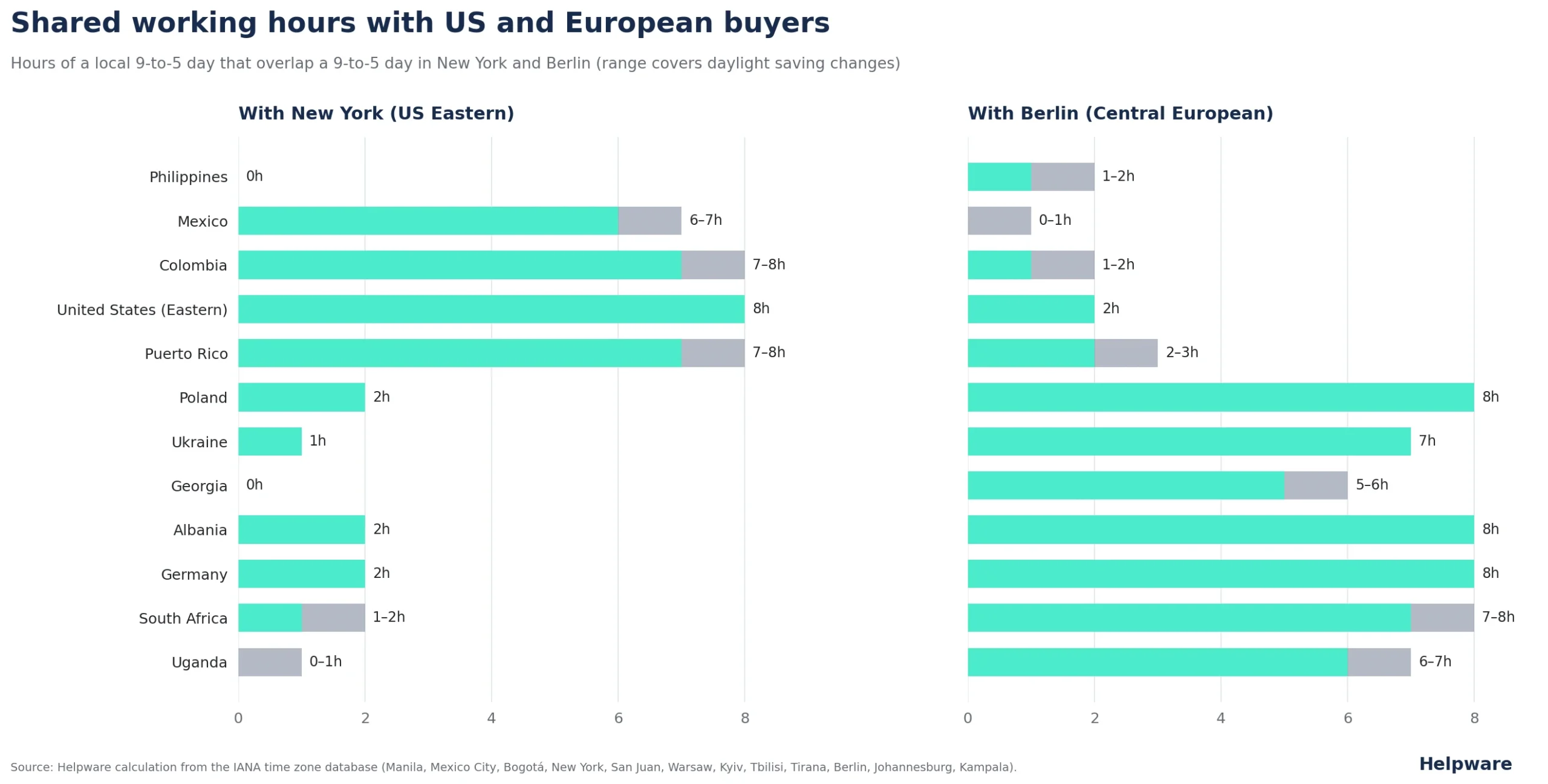
Time zones influence which outsourcing destinations work best for US and European businesses. US companies that need real-time coverage during their business day often choose onshore teams or nearshore locations such as Mexico, Colombia, and Puerto Rico, where working hours overlap with those on the US East Coast. The Philippines is a better fit for overnight support and round-the-clock operations because its business day falls largely outside US working hours. European companies benefit from substantial working-hour overlap with Poland, Albania, and Germany, as well as overlap with Ukraine and South Africa.
Talent Pools Across the Top Outsourcing Countries
A large talent pool makes it easier to scale operations and replace employees who leave. The Philippines, the United States, and Germany each have reported workforces of more than 1 million in relevant outsourcing, contact center, or ICT sectors, while Georgia, Albania, and Puerto Rico have smaller pools numbering in the tens of thousands. However, the underlying figures measure different sectors and use different definitions, so they indicate the relative scale of each market rather than providing a direct, like-for-like comparison.
| Country | Headcount | What it measures | Source |
|---|---|---|---|
| Philippines | 1.89 million | IT-BPM workers, 2025 | IBPAP via Context.ph |
| Mexico | 95,200 | Call center and phone information workers, Q1 2026 | Secretaría de Economía (Data México) |
| Colombia | 789,687 | Direct BPO jobs, 2025 | BPrO via Valora Analitik |
| United States | 2.67 million | Customer service representative jobs, 2025 | US Bureau of Labor Statistics |
| Puerto Rico | 20,360 | Customer service representatives, May 2024 | PR Department of Labor / BLS OEWS |
| Poland | 488,700 | Business services center employees, Q1 2025 | ABSL |
| Ukraine | 245,000 | IT specialists working in Ukraine | Lviv IT Cluster |
| Georgia | 54,927 | Information and communication employees, Q4 2025 | Geostat |
| Albania | 49,000 | ICT-BPO professionals | AIDA |
| Germany | 1.35 million | ICT sector employees, 2025 forecast | Bitkom |
| South Africa | ~150,000 | Global business services employees, 2024 | BPESA |
| Uganda | 150,000 (target) | BPO jobs targeted by 2030 | Ministry of ICT and National Guidance |
Labor Costs Across the Top Outsourcing Countries
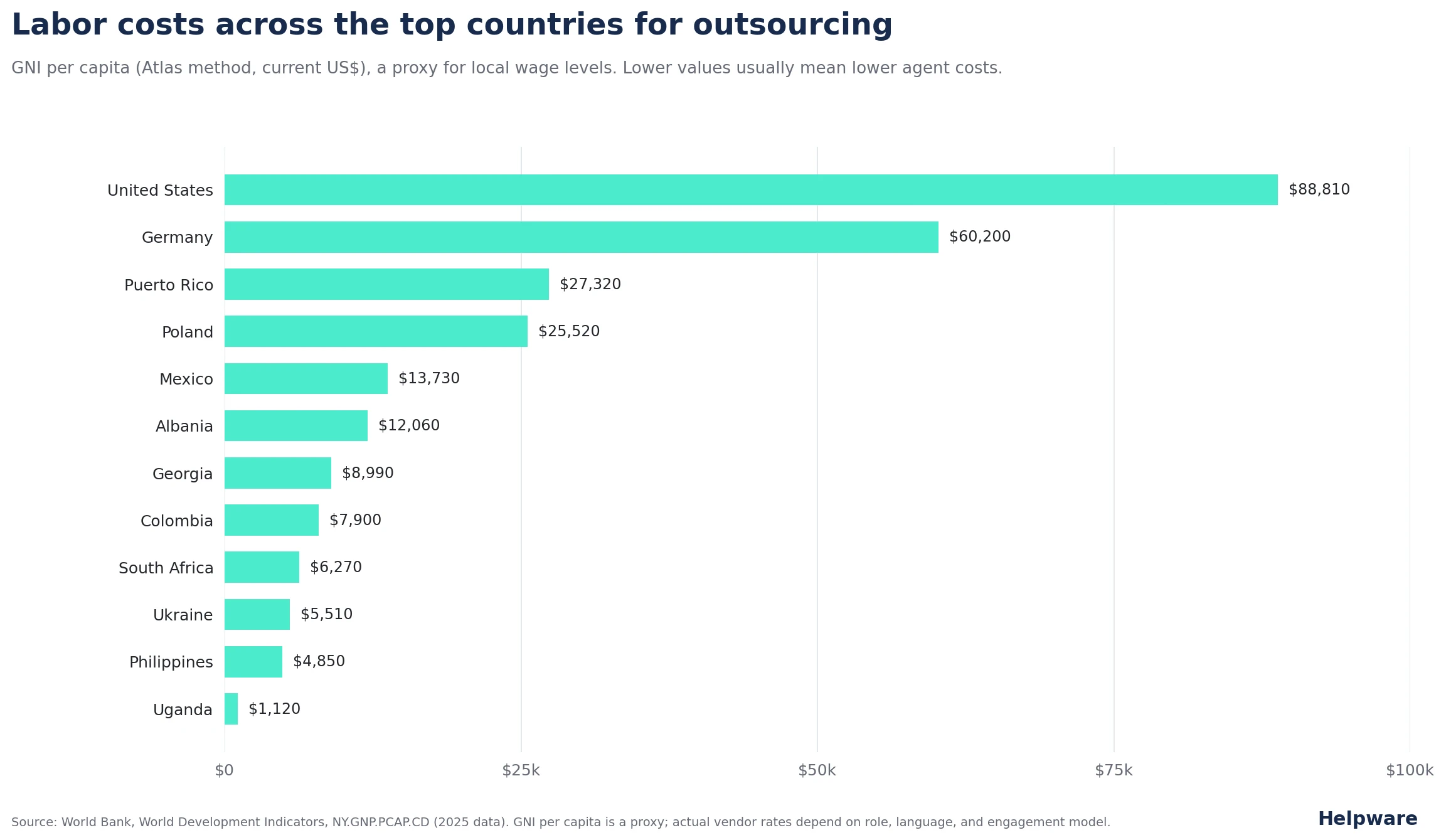
Labor costs vary by location and depend on factors such as local wage levels, the cost of living, labor regulations, and the type of work involved. Published outsourcing rates also vary by role, service scope, and contract terms, making direct comparisons difficult. The chart below uses World Bank GNI per capita as a broad proxy for differences in national income, not as a measure of actual BPO wages or vendor rates. On this basis, Uganda, the Philippines, Ukraine, and South Africa fall toward the lower end of the comparison; Mexico, Poland, and Puerto Rico sit in the middle; and Germany and the United States are at the higher end.
English Proficiency Rankings for the Leading BPO Countries
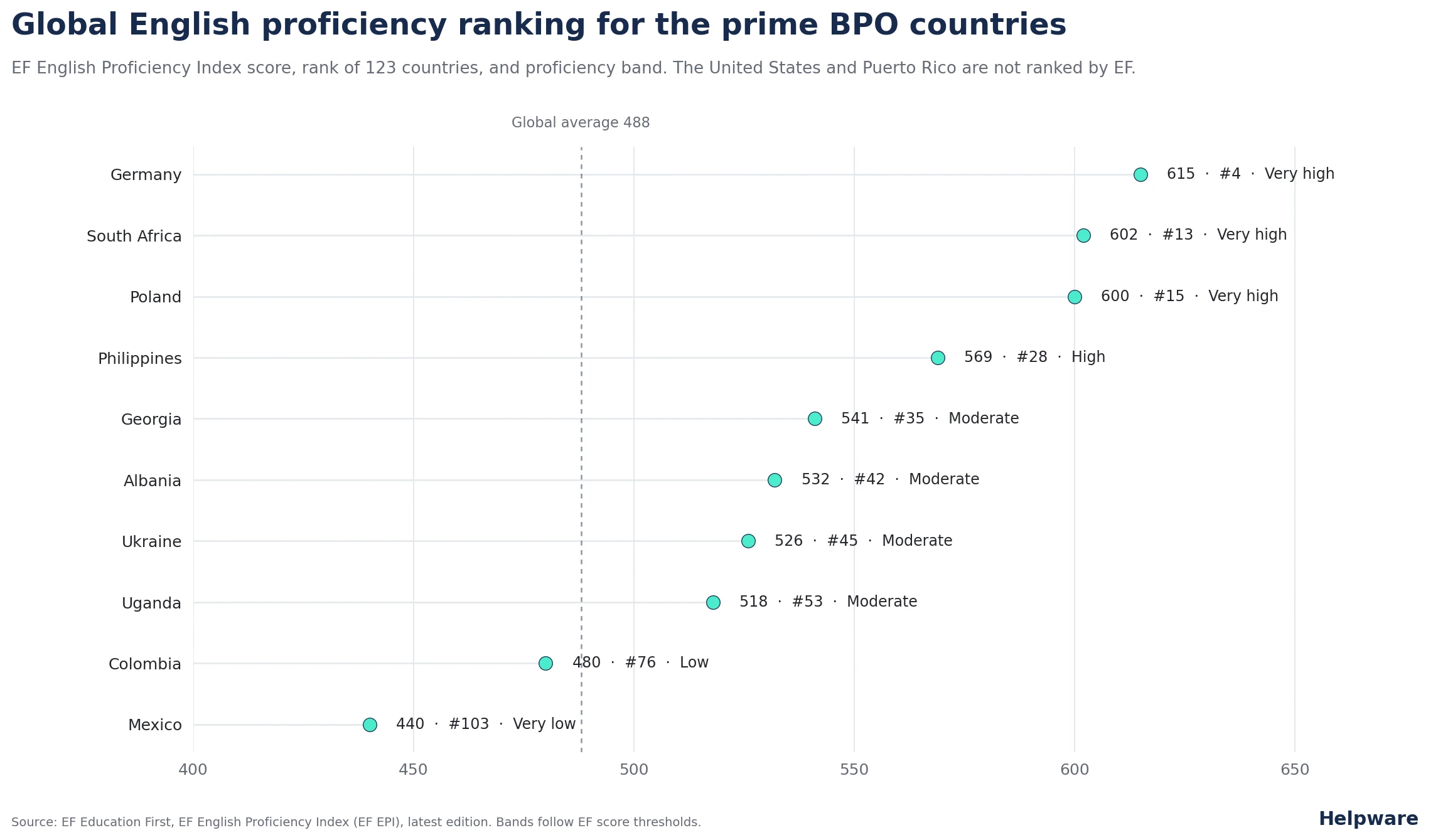
English proficiency is an important consideration when choosing an outsourcing destination because English remains widely used in the global outsourcing industry. Even when a provider supports customers in other languages, many businesses also need English-speaking teams for customer service, back-office operations, and communication with internal stakeholders. A country’s overall proficiency ranking can help with an initial assessment, but it does not guarantee that every candidate has the language skills required for a particular role.
Germany, South Africa, and Poland fall into the EF English Proficiency Index’s very high proficiency band, while the Philippines ranks in the high band. Mexico and Colombia rank lower in the EF English Proficiency Index. Businesses hiring for bilingual support should assess candidates’ English skills directly, especially for roles that require fluent spoken communication.
Onshore, Nearshore, Offshore, or a Hybrid Model?
Many growing support operations use a combination of locations rather than relying on a single outsourcing model. Each approach offers different advantages, depending on your priorities:
- Onshore (United States and Puerto Rico): Best for work that requires a US-based team, close alignment with US regulations, or strong English-language support. Costs are generally higher than in offshore locations.
- Nearshore (Mexico and Colombia for US buyers; Poland, Albania, Ukraine, and Georgia for Western European buyers): Best for teams that need to collaborate in real time during overlapping business hours while keeping costs below those of many onshore options. A nearshore call center in Latin America can provide substantial working-hour overlap with the US East Coast.
- Offshore (the Philippines, South Africa, and Uganda for US buyers): Best for accessing larger talent pools, reducing costs, and extending coverage beyond the local business day. Learn more about the benefits and trade-offs in our guide to offshore outsourcing.
Combining these models can extend coverage across time zones and help balance cost, language, and service needs. For example, a US company could handle daytime queues from Mexico or Colombia and overnight queues from the Philippines, using nearshore teams to manage Spanish-language support when needed. A European company could cover regular business hours with teams in Poland or Albania and use the Philippines for overnight and weekend support.
Helpware supports this approach through its hub-and-spoke model, which connects a central hub with smaller satellite locations to coordinate teams across multiple sites.
How to Choose the Right BPO Country and Provider
Choosing an outsourcing destination is only half the decision. The provider you select will represent your brand in customer interactions, so communication style, cultural fit, and empathy matter alongside cost and time-zone overlap. Evaluate each shortlisted country against the same criteria, then assess individual providers to find the best fit for your operations.
Prioritize your requirements
Start by identifying what matters most to your business: working-hour overlap, language capabilities, cost, regulatory compliance, or the ability to scale. Assign a weight to each factor based on your needs. For example, a US healthcare company may prioritize HIPAA compliance and coverage during US business hours, while a European ecommerce brand may place greater emphasis on multilingual support and cost.
Shortlist two or three countries
Use the comparison table above to narrow your options. For US daytime coverage, consider Mexico, Colombia, or Puerto Rico. For overnight support and large-scale operations, the Philippines may be a strong fit. For European customer support, consider Poland, Albania, or Ukraine, depending on your language requirements, budget, and working-hour needs.
Calculate the total cost
Hourly rates tell only part of the story. When budgeting for a BPO provider, account for recruitment, training, quality assurance, management, technology, and transition costs. Compare proposals based on the full cost of delivering the required service, not just the advertised rate. An unusually low quote deserves closer scrutiny, particularly if it excludes essential services or leaves high employee turnover unaddressed. The goal is to find a sustainable balance between cost, service quality, and operational reliability.
Evaluate the provider’s capabilities
Assess each provider’s service portfolio, industry experience, technology, and ability to support your future growth. A provider with a broader range of services may be able to accommodate additional needs without requiring you to find another partner. Ask how its contact center teams use AI tools and how those tools affect agent performance, quality assurance, and data security.
For regulated operations, verify which standards and requirements apply to your business and ask providers for relevant evidence, such as SOC 2 Type II reports, ISO 27001 certification, HIPAA-related safeguards, or PCI DSS compliance where applicable. Do not assume that a provider’s location or general certifications automatically make your specific operation compliant.
Check reviews and references
Look beyond a provider’s own marketing materials when assessing its reputation. Review feedback on platforms such as Google Reviews and Trustpilot, and look for recurring complaints about billing transparency, service quality, or account management. Employee review platforms such as Indeed, Comparably, and Glassdoor can offer additional context about workplace conditions and management, but employee feedback alone does not establish the quality of customer service. Where possible, ask providers for client references and examples of performance against agreed service-level targets.
Validate your choice before scaling
The right outsourcing destination depends on how well it meets your operational needs in practice, not just on its cost or reputation. Before committing to a large rollout, run a pilot with a small team handling one queue or service line. Agree on success criteria in advance and track metrics such as first-contact resolution, average handle time, customer satisfaction (CSAT), and employee attrition against your existing baseline.
Use the results to identify gaps in training, processes, technology, or staffing before expanding. A successful pilot gives you evidence that the country and provider can deliver the service you need. From there, you can scale with greater confidence, build a more resilient support operation, and decide whether a single location or a multi-country model is the better long-term fit.