







You have already decided to outsource patient access. The hard part is the shortlist.
Search for providers and you get rankings of 15 companies that put a Swiss claims processor, an offshore hiring marketplace, and a consultancy doing copay support for a single drug brand in the same numbered list. Nothing on the page explains why those three sit together, because they do not belong together. The first few sales calls then get spent working out who actually does the job you are hiring for.

“prior auth is frequently raised as a top administrative burden in medicine, but the shape of that burden varies by specialty and payer”
In the American Medical Association’s 2025 survey, 95 percent of physicians said prior authorization delays care for their patients, and only 33 percent thought recent insurer promises would change much. The AMGA 2025 Medical Group Staffing Survey found support-staff turnover between 12 and 26 percent, and patient access roles take months to learn. The 2023 CAQH Index put the cost of routine administrative transactions at $83 billion a year in staff time, with providers paying 97 percent of it.
Seven providers do genuine, verifiable patient access work for US healthcare organizations: Helpware, Optum, R1 RCM, AGS Health, Conifer Health Solutions, Carenet Health, and Sagility. They fall into two groups. Optum, R1 RCM, AGS Health, and Conifer sell front-end revenue cycle operations. Their job is to hand you a financially cleared patient. Helpware, Carenet, and Sagility sell patient contact operations. Their job is to answer the call and book the appointment. Pick from the wrong group and you will get good work on the wrong problem.
Key Takeaways
- Three different services share the name “patient access outsourcing.” Work out which one you are buying before you build a shortlist.
- Front-end RCM vendors focus on financial clearance. Patient contact vendors focus on answer rates and booked appointments. Few are strong at both.
- Compliance certification is the minimum requirement. Engagements usually fail on how exceptions are handled across multiple sites.
- Outsourcing multiplies whatever process it sits on. Standardize first.
Three Different Services Get Called “Patient Access Outsourcing”
This is why vendor research on this topic feels so frustrating. The phrase covers three separate purchases, with three separate buyers, and most published lists mix them together without saying so. Work out which row you are in before you talk to anyone.
| What you are buying | What the vendor does | Who signs the contract | Vendors in this guide |
|---|---|---|---|
| Front-end revenue cycle | Eligibility verification, prior authorization, pre-registration, financial clearance, good faith estimates, pre-service collections | VP Revenue Cycle, CFO | Optum, R1 RCM, AGS Health, Conifer Health |
| Patient contact operations | Inbound scheduling, referral booking, appointment reminders, outbound recall, after-hours coverage, multilingual patient communication | COO, VP Patient Operations, VP Patient Access | Helpware, Carenet Health, Sagility |
| Pharmaceutical hub services | Benefits investigation and copay support for a single drug, prescriber-side reimbursement navigation | Brand or market access lead at a drug manufacturer | Not covered here |
The third row is a different industry. If you run a provider organization and every case study a vendor shows you is about a drug launch, you are in the wrong conversation.
The first two rows overlap at the edges. Optum runs contact centers. Carenet books referrals, which touches financial clearance. The clearest test is what the vendor measures itself on. Ask a front-end RCM provider about pre-verification rate and authorization turnaround time, and you will get numbers. Ask a patient contact provider about speed to answer and call abandonment, and you will get numbers. Ask either one about the other, and the answer gets vague.
How We Compared These Companies
Every provider here, including Helpware, was reviewed against the same six criteria:
- Access functions actually performed, confirmed on the provider’s own service pages, not a directory listing.
- Compliance posture, meaning publicly stated certifications and regulatory alignment.
- Delivery footprint, including geography, language coverage, and hours.
- Scale and flexibility, meaning documented ability to grow or shrink a program.
- Independent recognition, where a third-party benchmark exists.
- Best fit, based on the client types each provider names publicly.
Two notes on method. Every capability listed below comes from the company’s own website or its own newsroom, so nothing here is copied from another vendor’s ranking. Where a fact was not publicly confirmable, it was left out. That is why some profiles are shorter than others.
Patient Access Outsourcing Companies at a Glance
| Provider | Category | Core access functions | Notable footprint |
|---|---|---|---|
| Helpware | Patient contact operations | Scheduling support, insurance verification, prior authorization support, claims processing, omnichannel patient communication | 19 locations, 11 countries, 45+ languages |
| Optum | Front-end revenue cycle | Patient access contact center, real-time and practice scheduling, eligibility and enrollment, authorization management, price transparency | Multilingual staff with access to more than 200 languages |
| R1 RCM | Front-end revenue cycle | Pre-registration, patient registration, insurance verification, real-time eligibility, financial clearance | End-to-end revenue cycle across hospitals and physician groups |
| AGS Health | Front-end revenue cycle | Eligibility and benefits verification, prior authorization, pre-registration, pre-service collections, good faith estimates | Global delivery plus a proprietary authorization automation platform |
| Conifer Health Solutions | Front-end revenue cycle | Scheduling, pre-registration, registration, insurance verification, eligibility and enrollment, financial clearance, referrals | Part of the Tenet Health enterprise |
| Carenet Health | Patient contact operations | Live voice and digital scheduling, referral management, appointment reminders, outbound recall, 24/7 centralized access center | 20+ years serving more than 500 healthcare organizations |
| Sagility | Patient contact operations | Real-time eligibility and benefit verification, pre-authorization and referral coordination, financial clearance and cost estimation | Provider and payer operations at global scale |
The Seven Patient Access Outsourcing Providers
Our rankings are compiled using publicly available information and objective evaluation criteria. We strive to ensure that every ranking is fair, transparent, and based on the same methodology for all companies.
1. Helpware
Helpware runs patient access and back-office operations for healthcare and telehealth organizations, covering scheduling support, insurance eligibility verification, prior authorization, claims processing, and omnichannel patient communication within a wider healthcare BPO practice. Named healthcare clients include Headspace, HealthComp, CompIQ, NexHealth, Pfizer’s Lucira, and Roche.
Delivery runs from 19 locations across 11 countries and four continents, covering more than 45 languages and dialects, with onshore, nearshore, and offshore teams. Certification covers HIPAA, SOC 2 Type II, ISO 27001, ISO 9001, GDPR, and PCI DSS. Programs move from a five to ten FTE pilot to 500 or more FTEs within 90 to 120 days. Client partnerships average more than five years, and CSAT averages 90 percent.
Best fit: Telehealth platforms, digital health companies, and multi-site provider groups needing extended-hours multilingual patient contact coverage, with one partner handling the back-office work behind it.
Trade off: Helpware provides patient-facing support and the back-office operations behind it, not proprietary authorization automation.
2. Optum
Optum sells patient access and call center services to hospitals, health systems, and large physician groups. It structures the service three ways: single-department support for processes that ordinary call centers struggle with, real-time scheduling across multiple departments and practices, or full coverage of all call volume and scheduling for named departments.
The wider patient access line adds eligibility and enrollment services, authorization management, and price transparency tools. Optum states that its eligibility and enrollment quality assurance scores run consistently above 95 percent, and that hospitals and health systems using the service in 2023 received $502 million in reimbursement by enrolling patients in coverage programs. Multilingual staffing reaches more than 200 languages, and after-hours medical answering relays messages or contacts on-call providers.
Best fit: Large health systems bringing access and financial clearance under one enterprise vendor, especially where finding coverage for self-pay patients represents real money.
Trade off: Scale of this kind comes with long procurement cycles and less flexibility for a 40-provider specialty group.
3. R1 RCM
R1 RCM describes itself as the largest independent end-to-end revenue cycle provider, with the longest operating history in the category. Its patient access work runs through a Financial Clearance Center model. Representatives make inbound and outbound calls to pre-register patients, collect the data needed for identification and billing, and explain financial responsibility before services are delivered.
The platform side covers scheduling, registration, insurance verification, and real-time eligibility checks, which then feed charge capture and claims.
Best fit: Hospitals and health systems that want one accountable owner for the whole revenue cycle, from the scheduling call to final payment, instead of several vendors stitched together.
Trade off: Buying access alone from an end-to-end provider rarely gets you the pricing or the attention that a full-cycle engagement attracts.
4. AGS Health
AGS Health builds its patient access line around integrated financial clearance. That covers insurance eligibility and benefits verification, in-network and out-of-network benefit checks, prior authorization across Medicaid, Medicare, managed care, and commercial payers, pre-registration, pre-service collections, and good faith estimates under the No Surprises Act.
The company acquired the offshore patient access BPO unit of Availity, which extended its authorization automation. Its Intelligent Authorization platform works out whether authorization is required, submits requests, checks status, and produces patient out-of-pocket estimates from payer rules that the health system configures. AGS Health reports against patient access denial tracking, days out, and pre-verification rates as contracted service levels.
Best fit: Organizations where prior authorization is the specific bottleneck, particularly service lines with heavy authorization volume such as radiology, oncology, and surgery.
Trade off: Authorization depth is the strength here. Inbound patient scheduling and general patient communication are not the focus of the offering.
5. Conifer Health Solutions
Conifer, part of the Tenet Health enterprise, groups scheduling, pre-registration, registration, insurance verification, eligibility and enrollment, physician referrals, and consumer engagement into one Patient Access and Experience line. Registration runs on a rules-based workflow with real-time status updates. Pre-registration and financial clearance are staffed by dedicated registration specialists, with a flexible staffing model for volume swings and a multilingual direct-to-consumer team scripted to the hospital’s own guidelines.
The operating experience is documented: Conifer patient access teams run scheduling, registration, and financial clearance for 14 CommonSpirit hospitals across the North Dakota and Minnesota region.
Best fit: Hospitals and health systems that want standardized access processes rolled out consistently across many facilities.
Trade off: The orientation is firmly toward hospitals and health systems. Digital health and telehealth workflows appear less often in the public evidence.
6. Carenet Health
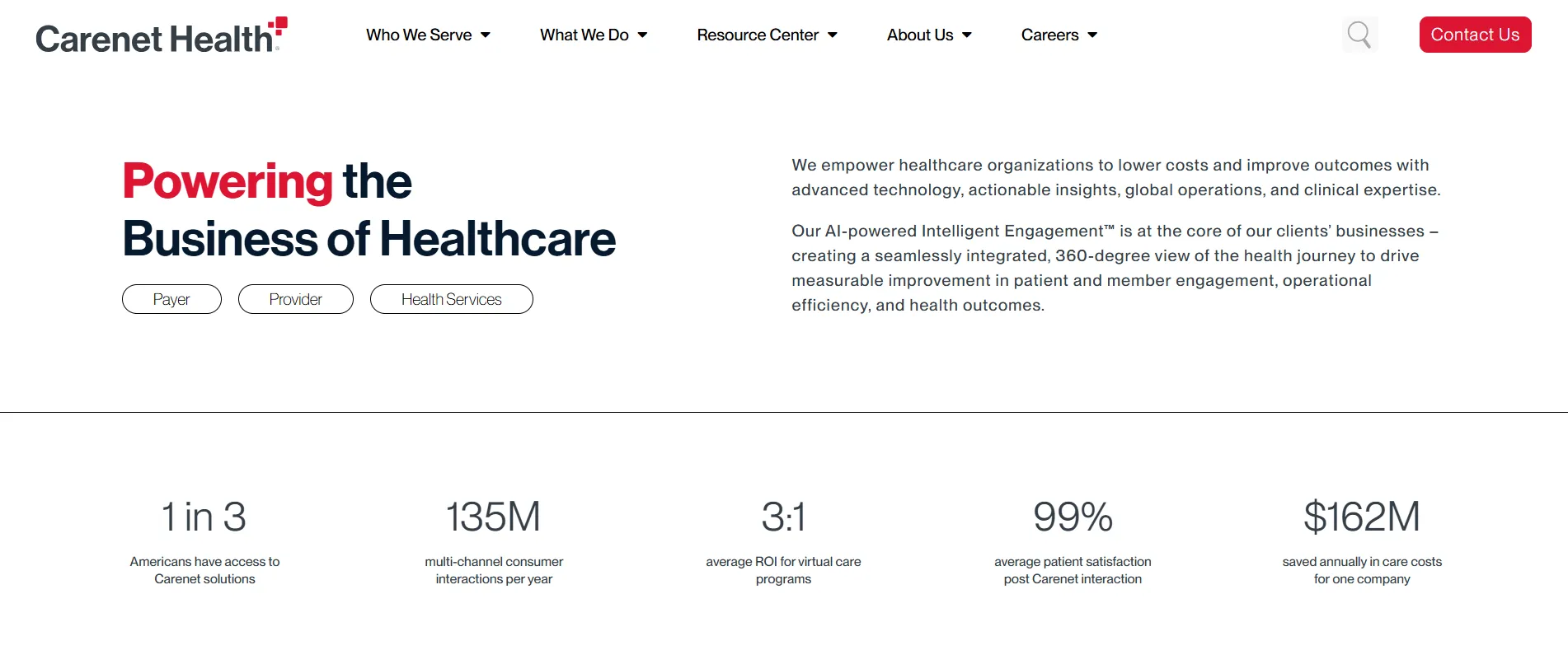
Carenet has worked in healthcare engagement for more than 20 years, across more than 500 healthcare organizations. Its access work covers live voice and digital scheduling, referral management that books follow-up visits and finds primary care for discharged patients, multichannel appointment reminders, outbound calling for referrals that were never scheduled, and a 24/7 centralized access center model.
One Carenet health system case documents centralized inbound call management across 25 radiology locations, alongside an outreach campaign that reached 3,284 patients, run without damaging inbound service levels. In 2025, Black Book Research ranked Carenet first for Patient Scheduling and Appointment Management Outsourcing in a survey of healthcare organizations that assessed vendors across nearly 20 indicators, including client satisfaction, innovation, scalability, and outcomes.
Best fit: Health systems setting up or repairing a centralized access center, particularly where outbound recall and lost referrals are the problem.
Trade off: The depth is in scheduling and engagement, not authorization and financial clearance.
7. Sagility
Sagility works across provider and payer operations. It frames patient access around four components:
- Real-time eligibility and benefit verification confirm coverage immediately.
- Pre-authorization and referral coordination runs on automated workflows and payer-specific knowledge.
- Financial clearance and cost estimation give patients their copays, deductibles, and coverage limits before they arrive.
- Self-service portals handle scheduling, document upload, and coverage checks.
Best fit: Organizations that sit on both sides of the payer and provider relationship, or that want access operations designed alongside member services.
Trade off: The payer heritage runs deep. That is an advantage for health plans, and something to weigh if you only want a provider-side partner.
What Outsourced Patient Access Actually Costs
None of these seven providers publishes rates, and the reason for that is structural. Patient access pricing depends on payer mix, EHR, call volume patterns, authorization complexity by service line, and how much exception work comes back to your own staff. A published rate card would be wrong for almost every buyer.
There are three main types of quotes, and the type changes the incentives:
| Model | How it bills | Pros | Cons |
|---|---|---|---|
| Per FTE, per month | Headcount on your program | Predictable capacity, easy to budget | You pay for hours, not outcomes. Productivity gains go to the vendor unless the contract says otherwise |
| Per transaction | Per verification, per authorization, per call handled | Volume throughput | Rewards activity over resolution. Define in writing what counts as a completed transaction |
| Per verified encounter or outcome | A financially cleared patient, or a share of denial reduction | Tied to the result you want | Hardest to baseline. Needs clean pre-engagement data that both sides trust |
Ask about the pricing model in the first conversation. If a vendor will not discuss structure before a discovery call, that tells you something about how it sells.
Five Questions to Ask Before You Sign
Compliance certification screens vendors out, but it does not tell you which one will work. These five questions do:
- Who owns an exception, and how does it reach us? Centralizing access across sites moves exception work around. Without a defined path, local teams inherit unclear callbacks, and executives get activity counts instead of completion rates.
- What systems do your agents work in? Working directly in your EHR and payer portals produces different quality from working in a separate vendor tool that syncs later.
- What reporting arrives, and does it lead to a decision? Volume dashboards are easy to produce. Pre-verification rate by service line, authorization turnaround by payer, and call abandonment by hour allow you to act armed with concrete data.
- How does location two get onboarded differently from location one? If every new site becomes a fresh exception process, the model has not scaled. It has just been repeated.
- What does the end of the pilot look like? Agree in advance what evidence would justify a wider rollout, a narrower scope, a remediation period, or a different vendor.
When Outsourcing Patient Access Is the Wrong Move
There are two situations where the honest answer is to wait.
You are a single-site practice with stable volume. Local knowledge and direct clinical coordination outweigh what an external team adds, and the coordination effort costs more than the savings.
Your processes are not standardized yet. Outsourcing multiplies the process it sits on. Give a vendor undocumented scripts, inconsistent required fields, and eligibility checks that happen at check-in, and you will get those same failures back faster and in greater volume. This is an issue in outsourcing anything, really, and a lot of people miss this point.
“Outsourcing itself usually isn’t the problem. Handing off chaos is.
A lot of small businesses hire freelancers or remote help hoping to “get time back,” but if the process is unclear, undocumented, or constantly changing, the owner just becomes a full-time manager instead.”
Our guide to patient access services includes a three-stage maturity model for working out where you stand today. Reach stage two before you start shopping.
Fix the Front Door Before You Go Shopping
Patient access determines how quickly patients reach care and how much revenue makes it from scheduling to payment, and the vendor market becomes much clearer once you stop reading it as a single ranking:
- Front-end revenue cycle providers work toward a financially cleared patient
- Patient contact providers work toward an answered call and a filled appointment slot
- Pharmaceutical hub vendors serve a different industry entirely
Name your bottleneck first. Then build a shortlist from the matching row, ask the five questions we offered above, and run a pilot before you commit.
Helpware runs patient access and back-office operations for healthcare and telehealth organizations across 19 locations and more than 45 languages, with HIPAA, SOC 2 Type II, ISO 27001, and ISO 9001 certification. To talk through your access bottleneck, get in touch with our healthcare team.