






The patient engagement market has crossed a threshold that no healthcare administrator can ignore. According to SNS Insider’s 2025 market research, the global remote patient monitoring market was valued at $39.97 billion in 2024 and is projected to reach $103.95 billion by 2032, growing at a 12.69% CAGR. At the same time, 360 Research Reports found that over 68% of healthcare providers globally integrated remote monitoring tools by 2025, with more than 75 million patients actively monitored through digital platforms.
For healthcare operators, this creates a pressing operational question: who handles the patient-facing side of these platforms? Telehealth companies, health systems, and digital health startups have invested heavily in remote monitoring technology, but the support layer that keeps patients engaged, informed, and compliant often lags behind. Appointment scheduling, care gap outreach, medication reminders, benefits verification, and 24/7 inquiry handling are not features a device or software platform can solve on their own.
This guide examines the 10 best remote patient support and engagement solutions for 2026, with particular attention to the operational infrastructure, compliance capabilities, and patient communication depth that separate effective partners from basic call center providers. Whether you run a telehealth platform, a multi-site health system, or a payer organization scaling Medicare Advantage engagement, the right support partner is a clinical variable, not just a cost line.
What Remote Patient Support Covers
Remote patient support is the operational and communication layer that sits between clinical care and the patient experience. It is not the monitoring device or the EHR platform. It is the human and AI-assisted infrastructure that ensures patients understand their care plans, show up for appointments, ask their questions, navigate billing, and stay engaged between visits.
What a strong remote patient support solution typically covers:
- Inbound and outbound patient communication across voice, chat, email, and SMS
- Appointment scheduling, rescheduling, and no-show reduction outreach
- Insurance verification, prior authorization support, and benefits navigation
- Care gap identification and proactive patient outreach programs
- Medication adherence reminders and prescription refill support
- Remote patient monitoring (RPM) data triage and escalation to clinical staff
- Billing inquiries, payment plan management, and financial counseling support
- HIPAA-compliant documentation and interaction logging across all channels
- Multilingual patient communication for diverse populations
- Back-office clinical administration: data entry, referral processing, eligibility checks
The capabilities that separate commodity vendors from genuine partners in this space are compliance depth, multilingual reach, and the ability to customize workflows around specific care pathways. A provider handling simple scheduling reminders for a primary care clinic has very different infrastructure requirements from one supporting a telehealth platform managing thousands of RPM patients with chronic conditions in multiple states. What separates the providers on this list is their ability to operate across that full range without defaulting to a one-size template.
Healthcare organizations that outsource patient support well report three consistent outcomes: reduced no-show rates, improved patient satisfaction scores, and lower administrative burden on clinical staff. None of those outcomes require clinical licensure. They require trained, empathetic people, well-designed workflows, and the compliance infrastructure to protect patient data at every touchpoint.
| Company | Key Services | Locations | Employees | Est. | HIPAA |
|---|---|---|---|---|---|
| Helpware CX | Patient support, omnichannel CX, back office, scheduling, HIPAA BPO | USA, Mexico, Philippines, Ukraine, Georgia, Puerto Rico, Poland, Germany, Albania (19 locations) | ~4,000 | 2015 | Yes |
| Omega Healthcare | RCM, patient access, clinical coding, prior authorization, patient engagement | USA, India, Colombia, Philippines (14 centers) | ~30,000 | 2003 | Yes |
| Teleperformance (TP) | Patient support, payer member services, health tech CX, clinical admin | 90+ countries (global HQ: France) | ~485,000 | 1978 | Yes |
| Conduent | Medicaid admin, patient contact center, claims, government health programs | 24 countries (HQ: Florham Park, NJ) | ~54,000 | 2017 | Yes |
| Working Solutions | Patient scheduling, billing support, benefits verification, HIPAA CX | USA (HQ: Plano, TX; remote) | ~500 | 1996 | Yes |
| ContactPoint360 | Healthcare BPO, RPM support, patient engagement, medication mgmt | USA, Canada, Colombia, India (HQ: Mississauga, ON) | ~2,000 | 2018 | Yes |
| Concentrix | Healthcare CX, payer services, patient support, digital health | 40+ countries (HQ: Fremont, CA) | ~300,000 | 2006 | Yes |
| Accenture | Healthcare transformation, patient ops, AI-enabled CX, payer services | 49+ countries (HQ: Dublin, Ireland) | ~738,000 | 1989 | Yes |
| WNS | Health plan support, claims, billing, patient contact services, analytics | 13+ countries (HQ: Mumbai, India) | ~60,000 | 1996 | Yes |
| TaskUs | Digital health CX, patient support, telehealth BPO, trust & safety | USA, Philippines, India, Mexico (HQ: New Braunfels, TX) | ~45,000 | 2008 | Yes |
Top 10 Remote Patient Support Platforms: Company Overview
#1 Helpware CX
HIPAA-compliant patient support with 19-location global infrastructure and 90% CSAT
Founded in 2015 and headquartered in Lexington, Kentucky, Helpware CX has built a healthcare BPO model purpose-designed for organizations where patient experience and regulatory compliance are both non-negotiable. Operating across 19 locations in 11 countries, the company manages the full patient communication spectrum: inbound scheduling and insurance verification, outbound care gap outreach, multilingual patient engagement in 45 languages, RPM data triage support, prior authorization inquiries, and back-office clinical administration. Healthcare payers, telehealth platforms, and multi-site provider groups are the primary client profiles, including named accounts such as Headspace, HealthComp, NexHealth, and Pfizer’s Lucira division.
What makes Helpware CX distinctive in this category is the intersection of compliance infrastructure and operational flexibility. The company holds SOC 2 Type II, HIPAA, ISO 27001, and GDPR certifications, all third-party audited, and applies AI-assisted quality monitoring across 100% of written interactions and calls, flagging compliance risks in real time. Its healthcare BPO services are designed to handle sensitive protected health information with the same rigor as an internal clinical operations team. The 2.8% monthly attrition rate across delivery centers matters here: in patient-facing support, staff continuity translates directly into protocol adherence and interaction quality.
Why we picked it
Helpware CX earns the top position because it solves the hardest problem in remote patient support: combining HIPAA-grade compliance depth with multilingual reach and genuine customization capability. Its 90% CSAT rate and 5-year average client partnership duration reflect an operating model built for healthcare organizations that treat patient experience as a clinical variable, not just an administrative function. Few BPO providers can scale from 10 to 200 healthcare-trained staff in two weeks while maintaining compliance documentation and quality monitoring at that speed.
- Services offered: HIPAA-compliant patient support (omnichannel, multilingual), inbound scheduling and appointment management, outbound care gap outreach, insurance verification, prior authorization support, RPM triage and data management, billing and claims support, back-office operations, CX consulting, AI-assisted quality monitoring
- Pros: SOC 2 Type II, HIPAA, ISO 27001, and GDPR certified, 45 languages with native-speaker support, 90% CSAT and 2.8% monthly attrition (vs 6-8% industry average), AI quality monitoring across 100% of interactions, scales 10 to 200 staff in two weeks, 5+ year average client partnerships
- Cons: Consultative sales process extends onboarding timeline, premium positioning may be over-engineered for simple single-function scheduling needs
- Industry expertise: Healthcare and telehealth (payers, providers, digital health), SaaS and software, fintech and banking, ecommerce and retail
- Best for: Telehealth platforms, health plans, and multi-site healthcare providers ($50M+ revenue) that need HIPAA-compliant multilingual patient-facing support with compliance depth and operational customization
- Pricing: Starting at $8 to $15 per hour depending on service complexity, delivery location, and engagement model
- Year established: 2015
- Location: Lexington, Kentucky (HQ); USA, Mexico, Philippines, Ukraine, Georgia, Puerto Rico, Poland, Germany, Albania
#2 Omega Healthcare Management Services
AI-driven RCM and patient access leader with 30,000 employees across 14 delivery centers
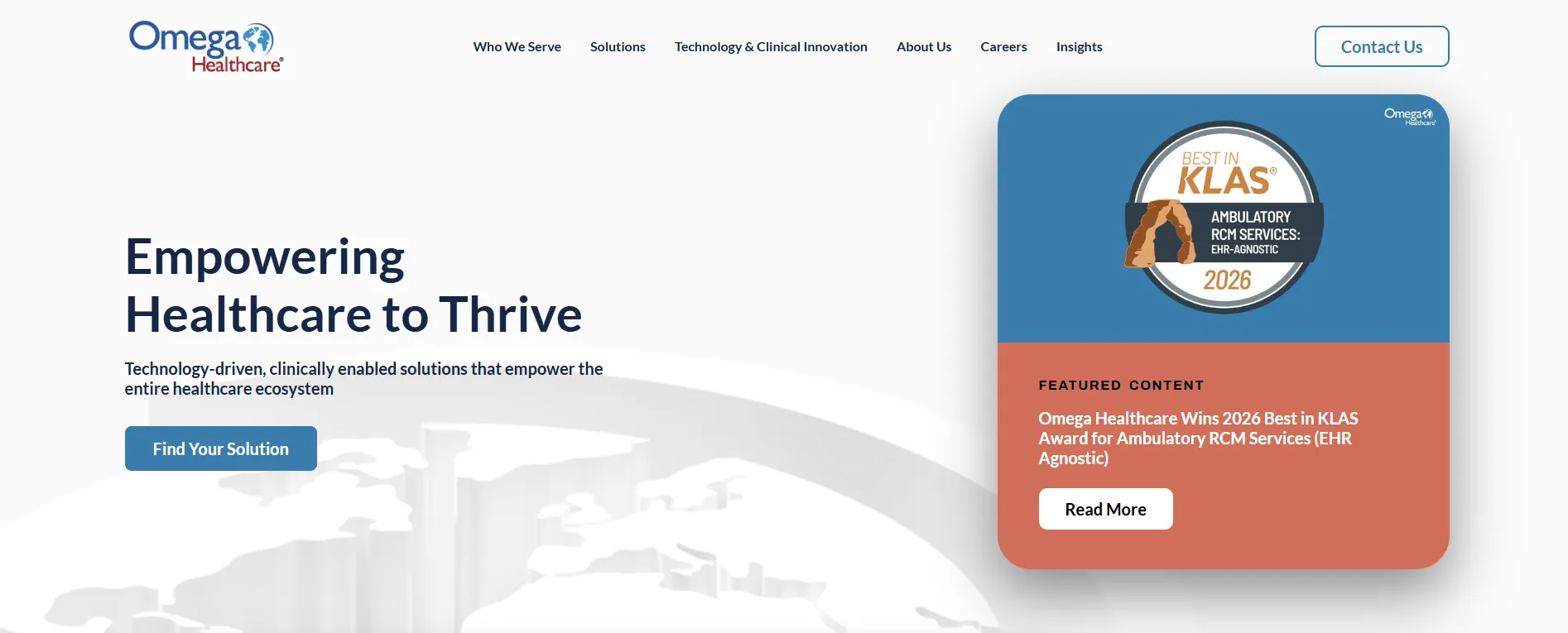
Founded in 2003 and headquartered in Boca Raton, Florida, Omega Healthcare operates as one of the most full-scope independent healthcare BPO providers in the market. With 30,000 employees across 14 delivery centers in the US, India, Colombia, and the Philippines, the company focuses on revenue cycle management, patient access, clinical coding, and prior authorization workflows. Its Omega Digital Platform integrates RPA, machine learning, and NLP to automate billing and documentation tasks at scale. Omega earned the 2026 Best in KLAS award with a 97.8 performance score, validating its operational depth for large health systems and payer organizations.
Key details:
- Services: Revenue cycle management, medical coding, prior authorization, patient access programs, claims processing, CDI, patient engagement workflows, AI-powered coding automation
- Best for: Large health systems and payer organizations with significant coding, billing, and RCM volume that need AI-augmented processing at scale
- Locations: USA, India, Colombia, Philippines (14 delivery centers; HQ Boca Raton, FL)
#3 Teleperformance (TP)
Global digital business services leader with 485,000+ employees across 90+ countries
Now operating under the brand name TP, Teleperformance was founded in 1978 in Paris and has grown into one of the largest BPO operators globally. With 485,000+ employees in 90+ countries and $11.5 billion in trailing revenue, it serves major health plans, pharmaceutical companies, and health technology firms with patient support, payer member services, and clinical administrative outsourcing. Its high-touch, high-tech approach combines AI-powered tools with human empathy, and its healthcare practice in India alone has over 2,400 dedicated specialists with more than two decades of healthcare domain experience.
Key details:
- Services: Patient support, payer member services, health tech CX, clinical administration, pharmacy benefit management calls, healthcare consumer engagement, multilingual patient communications
- Best for: Large commercial health plans, pharmacy benefit managers, and enterprise hospital systems running high-volume multilingual member or patient service operations
- Locations: France, USA, Philippines, India, Mexico, Colombia, UK, Brazil, Egypt, Germany (90+ countries total)
#4 Conduent
Government health program specialist with deep Medicaid and payer-side operations expertise
Spun off from Xerox in 2017 and headquartered in Florham Park, New Jersey, Conduent employs approximately 54,000 people across 24 countries and processes billions of customer service interactions annually. Its healthcare practice centers on government health program administration, particularly Medicaid screening, state health exchange operations, and community health management. Conduent’s commercial healthcare capabilities cover patient contact center services, medical billing, and claims administration. The company’s scale and government contracting depth make it a logical fit for state Medicaid agencies and large commercial payers, though its patient experience differentiation is more transactional than consultative.
Key details:
- Services: Claims processing, Medicaid and government health program administration, patient support, medical billing, benefits administration, healthcare contact center services
- Best for: State Medicaid agencies, government health entities, and large commercial payers requiring high-volume transaction processing with government contracting depth
- Locations: USA, India, Philippines, Malaysia, UK, Mexico, Jamaica, Central and South America (24 countries; HQ Florham Park, NJ)
#5 Working Solutions
US-based remote healthcare CX specialist with HIPAA-certified agent teams
Founded in 1996 and headquartered in Plano, Texas, Working Solutions operates a remote-first model with HIPAA-certified agents handling patient scheduling, claims and billing support, benefits verification, and prescription assistance for providers, payers, and medical-related businesses. All agents are trained and certified to handle protected health information in compliance with HIPAA and HITECH requirements. The company’s model suits organizations seeking on-demand US-based healthcare CX capacity with strong compliance protocols, particularly for functions where domestic delivery is preferred over offshore alternatives.
Key details:
- Services: Patient scheduling, claims and billing support, benefits verification, prescription assistance, healthcare consumer outreach, HIPAA-compliant CX
- Best for: Healthcare providers and payers seeking US-based, HIPAA-certified remote agents for patient-facing CX and administrative support
- Locations: USA (HQ Plano, TX; fully remote delivery model)
#6 ContactPoint360
HIPAA-certified healthcare BPO with RPM support and AI-assisted patient engagement
Founded in 2018 and headquartered in Mississauga, Ontario, ContactPoint360 has built a specialized healthcare BPO practice covering patient engagement, medication management, and remote patient monitoring support. The company operates delivery centers in the USA, Canada, Colombia, and India, offering 24/7 HIPAA-certified support with FTE-based and transaction-based pricing models. What distinguishes it in this list is its explicit RPM services portfolio, including prescription refill support, patient-provider communications, and medication adherence workflows, making it relevant for digital health companies managing chronic care populations.
Key details:
- Services: Patient engagement, RPM support, medication management and refill support, HIPAA-compliant BPO, patient-provider communications, revenue cycle management, A/R support
- Best for: Digital health companies, chronic care management platforms, and healthcare providers scaling RPM programs that need HIPAA-certified operational support
- Locations: USA, Canada, Colombia, India (HQ Mississauga, Ontario)
#7 Concentrix
Global CX leader with a dedicated healthcare practice spanning payers and providers
Established in 2006 and headquartered in Fremont, California, Concentrix employs over 300,000 people across 40+ countries, making it one of the largest dedicated CX outsourcing companies globally. Its healthcare practice supports commercial payers, pharmacy benefit managers, and large provider organizations with patient support, member services, digital health CX, and AI-integrated care navigation. Concentrix’s scale enables rapid deployment of large agent teams, and its investment in AI-augmented agent tools has accelerated time-to-competency for healthcare client programs in recent years.
Key details:
- Services: Healthcare CX, payer member services, patient support, digital health engagement, AI-augmented care navigation, pharmacy benefit management support
- Best for: Large commercial payers and health systems requiring scalable multilingual patient and member support with enterprise CX infrastructure
- Locations: USA, Philippines, India, UK, Germany, Australia, Brazil, Mexico, Japan (40+ countries; HQ Fremont, CA)
#8 Accenture
Healthcare transformation integrator with full-stack clinical operations and AI capabilities
Founded in 1989 and headquartered in Dublin, Ireland, Accenture brings a full-stack healthcare transformation capability that spans clinical process redesign, AI-enabled patient engagement, and payer operations. With 738,000+ employees across 49 countries and over $64 billion in annual revenue, its healthcare practice addresses complex organizational challenges that go well beyond standard BPO scope. Accenture suits large health systems and enterprise payers undertaking strategic transformation programs, though its engagement model is consulting-intensive and better matched to long-cycle transformation projects than to agile, rapid-deployment patient support.
Key details:
- Services: Healthcare transformation consulting, AI-enabled patient engagement, payer operations, clinical process redesign, digital health platform implementation, managed services
- Best for: Large health systems and payer organizations ($500M+ revenue) undertaking multi-year clinical operations transformation programs
- Locations: USA, India, UK, Philippines, Germany, Australia, Canada, France, Brazil (49 countries; HQ Dublin, Ireland)
#9 WNS Global Services

Analytics-led BPO with strong health plan and claims operations capabilities
Founded in 1996 and headquartered in Mumbai, India, WNS Global Services employs over 60,000 people across 13+ countries and operates a dedicated healthcare practice covering health plan member services, claims processing, billing, and patient contact services. Its analytics-led model differentiates it from pure operational BPOs: WNS integrates data science and reporting into its healthcare delivery to surface insights on member engagement, prior authorization bottlenecks, and claims accuracy. The company’s strength is in payer-side operations and high-volume administrative processing, with less emphasis on patient-facing clinical communication workflows.
Key details:
- Services: Health plan member services, claims processing, medical billing, patient contact services, analytics and reporting, prior authorization support
- Best for: Commercial health insurers and pharmacy benefit managers with significant claims and member services volume seeking analytics-integrated BPO support
- Locations: India, Philippines, USA, UK, Romania, Sri Lanka, China (13+ countries; HQ Mumbai, India)
#10 TaskUs
Digital-native BPO serving telehealth and digital health platforms with modern CX operations
Founded in 2008 and headquartered in New Braunfels, Texas, TaskUs built its reputation in digital-first tech companies before expanding into digital health and telehealth CX. With 45,000+ employees across the USA, Philippines, India, and Mexico, it supports patient support, telehealth CX, and trust and safety operations for health technology companies. TaskUs suits digital health startups and growth-stage telehealth platforms that prioritize speed-to-scale and cultural alignment with tech-forward teams, though its healthcare compliance depth is less mature than purpose-built healthcare BPOs.
Key details:
- Services: Digital health CX, patient support, telehealth BPO, trust and safety, content moderation, AI-enabled support operations
- Best for: Digital health startups and growth-stage telehealth platforms that need fast-scaling, tech-forward patient support with a modern CX culture
- Locations: USA, Philippines, India, Mexico (HQ New Braunfels, TX)
Helpware CX: Our Top Choice for Remote Patient Support
Among the 10 companies reviewed, Helpware CX stands apart because it solves the combination problem that most healthcare organizations face: the need for HIPAA-compliant patient engagement that is also genuinely multilingual, genuinely customizable, and genuinely accountable at the quality level. Larger BPOs can match scale. Niche providers can match compliance. What Helpware CX offers is both, with an operating model built around long-term healthcare partnerships rather than standardized templates.
What sets Helpware apart for remote patient support is the quality infrastructure that governs every interaction. Its AI-assisted monitoring system reviews 100% of written interactions and calls for compliance risk in real time, not through sampling. That matters enormously for telehealth and behavioral health clients handling sensitive PHI across multiple channels. Add to that a 45-language delivery model staffed by native speakers, and the result is a patient communication capability that holds up across diverse populations without compromising protocol.
The operational metrics validate the model. A 90% CSAT rate sustained across healthcare clients, 2.8% monthly attrition (against a 6-8% industry average), and 5+ year average client partnerships tell a consistent story: Helpware CX builds healthcare support programs that work over time, not just at launch. For organizations that view patient engagement as a strategic asset rather than a cost center, that stability has direct clinical and financial value.
What sets Helpware apart for remote patient support:
- SOC 2 Type II, HIPAA, ISO 27001, and GDPR certifications, all third-party audited
- AI-assisted quality monitoring across 100% of interactions, not sampling-based
- 45-language delivery with native-speaker support for diverse patient populations
- 19 global delivery locations enabling 24/7 coverage without night-shift penalties
- 2.8% monthly attrition vs 6-8% industry average, producing protocol continuity
- Customizable workflows for specific care pathways: RPM triage, scheduling, care gap outreach
Pricing Models for Remote Patient Support
Remote patient support pricing varies considerably based on the scope of services, compliance requirements, staffing location, and engagement structure. Healthcare organizations should expect complexity here: a straightforward appointment scheduling operation costs very differently from a 24/7 multilingual RPM triage program with prior authorization workflows integrated.
Common pricing models in this space include:
- FTE-based monthly billing: The most common model for managed services engagements. You pay a per-agent monthly rate that covers staffing, training, management, and infrastructure. Helpware CX operates on this model, starting at $8 to $15 per hour. This structure provides cost predictability and aligns vendor incentives with team performance rather than call volume.
- Per-interaction (per-minute or per-ticket): Common for lighter-touch contact center programs where volume fluctuates significantly. Works well for after-hours overflow or single-function scheduling programs. Less suited to complex care coordination workflows requiring agent continuity.
- Hybrid managed service: A base FTE commitment with surge capacity pricing for peak volume periods. Used by health plans and telehealth platforms with seasonal enrollment or care gap outreach campaigns.
- Outcome-based pricing: Tied to specific metrics such as no-show reduction rate, first-call resolution, or patient satisfaction scores. Rare as a primary model but increasingly used as a performance component within larger contracts.
What drives cost upward in healthcare-specific programs: 24/7 coverage requirements, clinical triage integration, multilingual support across diverse populations, EHR and RPM platform integrations, HIPAA audit documentation requirements, and domestic (US) versus offshore delivery preferences. Organizations with simpler administrative needs will find costs at the lower end. Programs requiring full compliance infrastructure, multilingual capability, and clinical workflow integration will sit toward the higher range.
Helpware CX operates on an FTE-based model, starting at $8 to $15 per hour, with engagement structures available as managed service, staff augmentation, or hybrid configurations. For healthcare clients with complex multilingual or compliance requirements, this model provides better cost predictability and workflow control than per-minute billing.
Unlock your hidden CX savings with Helpware
Get ROI projection for current support needs.
-40% annually
/monthly costs with Helpware
vs
/internal team costs (approx)
Your requirements fall outside our standard parameters.
Let's discuss your results
Fill in your details to schedule a consultation.
-40% annually
/monthly costs with Helpware
vs
/internal team costs (approx)
Your requirements fall outside our standard parameters.
-40% annually
/monthly costs with Helpware
vs
/internal team costs (approx)
Your requirements fall outside our standard parameters.
Support staff included in the package:
Shared Team Leader
Shared L&D Specalist
Shared QA Specialist
Account Executive by default
Shared Ops Delivery Manager
Admin/Finance/Legal support for the agents by default
1-2 Dedicated Team Leaders
Shared L&D Specialist
Shared to 1 Dedicated QA Specialist
Shared Ops Manager
Account Executive by default
Admin/Finance/Legal support for the agents by default
Shared Real Time Analyst
2-5 Dedicated Team Leaders
0,5 to 1,5 Dedicated L&D Specialists
1-2 Dedicated QA Specialists
Up to half of a dedicated Ops Manager
Account Executive by default
Admin/Finance/Legal support for the agents by default
1 Dedicated Real Time Analyst
Ready to get a personalized estimate for your team?
Contact us for a personalized assessment tailored to your specific needs.
*These projections are estimates for informational purposes only and do not represent a formal offer. Contact us for a personalized quote.
Thank you!
You’ll hear from us within one business day.
Choosing Your Remote Patient Support Partner
The remote patient engagement market is growing fast, but growth in the technology layer doesn’t automatically solve the operational problem. What patients need between visits, between device readings, and between clinical encounters is human communication that is accurate, empathetic, multilingual, and compliant. No RPM device ships with that capability built in.
The right partner for your organization isn’t necessarily the largest or the most affordable. It’s the one whose compliance infrastructure, language capability, and clinical workflow experience match the actual complexity of your patient population. Spend less time evaluating feature lists and more time asking vendors about attrition rates, audit documentation practices, and how they have handled non-compliance events in healthcare programs. The answers to those questions tell you more about operational maturity than any sales deck will.
For healthcare organizations ready to build a patient support model that holds up at compliance, quality, and scale, Helpware CX’s healthcare outsourcing services represent the most complete combination of HIPAA infrastructure, multilingual reach, and genuine customization available in the BPO market today.