








Customer support staffing gets harder when the work itself is changing. AI is taking more routine contacts out of the queue, but the human work that remains is becoming more complex, with agents taking on new responsibilities that require judgment, product knowledge, and stronger communication skills.
That shift is already showing up in workforce plans. Gartner’s survey of 321 customer service and support leaders found that 85% are expanding human agent responsibilities as AI changes the volume and nature of customer contacts. At the same time, 63% are reducing frontline headcount gradually through attrition rather than layoffs.
Outsourcing remains part of that staffing equation. Deloitte’s 2024 Global Outsourcing Survey, based on responses from more than 500 executives, found that 80% plan to maintain or increase their investment in third-party outsourcing, while 50% use outsourced services for front-office capabilities such as sales, marketing, and R&D.
For customer support leaders, the question is no longer simply where to find remote agents. It’s what kind of staffing model actually fits the work. Some providers recruit people and leave you to manage them. Others provide dedicated staff but leave scheduling and quality management with your team. Managed CX providers take responsibility for the operation itself, while marketplaces and employer of record platforms solve entirely different problems.
This guide compares five remote staffing companies for customer support in 2026. It explains what each model actually includes, where each provider fits best, and what you still have to manage after the contract is signed.
Key Takeaways
- Remote staffing covers several different models. Managed operations, staff augmentation, recruiting and placement, marketplaces, and employer of record services solve different problems and leave different responsibilities with the buyer.
- The biggest difference between staffing and managed support is who owns the operation after hiring. Quality assurance, scheduling, absence coverage, backfill, and service-level performance may stay with your team or shift to the provider.
- 24/7 coverage requires more headcount than the headline seat count suggests. One continuously staffed seat requires 4.2 agents before shrinkage and about six at 30% shrinkage, making coverage requirements more important than the quoted hourly rate alone.
- Compliance can narrow the shortlist before price enters the conversation. HIPAA, PCI DSS, SOC 2, ISO 27001, and GDPR requirements determine what evidence and controls a provider needs when agents handle regulated data.
- The right provider depends on the role and operating model. Helpware fits compliance-gated, always-on support programs; TaskUs and Concentrix fit larger digital CX operations; CrewBloom and Hire With Near fit lean staffing and recruiting models.
How We Chose the Best Remote Staffing Companies: Selection Criteria
The ranking is built around a specific buyer: an operations or customer experience leader who owns a service level and needs customer support seats filled and kept filled. Every provider was assessed against the same six criteria, with greater weight given to the factors that most directly affect ongoing support delivery.
| Criterion | What we measured | Weight |
|---|---|---|
| Service-level ownership | Whether the provider runs quality assurance, scheduling, and performance management, or hands those responsibilities back to you | 25% |
| Coverage capability | Evidence of round-the-clock, multi-time-zone, and multilingual delivery | 20% |
| Vetting and role fit for support | Screening depth for communication, de-escalation, and CRM work specifically | 20% |
| Compliance posture | Published certifications and regulated-industry experience | 15% |
| Continuity | Replacement, backfill, and retention mechanics after the initial hire | 10% |
| Transparency | How much of the model, pricing, and process is visible before a sales call | 10% |
Facts about each provider come from the company’s public pages, filings, or support documentation.
5 Remote Staffing Companies at a Glance
| Provider | Model | Primary talent geography | Best for |
|---|---|---|---|
| Helpware | Managed CX operations + dedicated teams | US, Mexico, the Philippines, Ukraine, Poland, Albania, Georgia, Uganda, Puerto Rico, Germany, Guam | Compliance-gated, always-on support programs |
| TaskUs | Digital outsourcing + CX services | 14 countries, with principal operations in the Philippines | High-growth technology, trust and safety, and content moderation |
| Concentrix | Enterprise CX + digital operations | 74 countries | Global enterprise programs with complex technology requirements |
| CrewBloom | Remote sales + support staffing | The Philippines + Southeast Asia | Lean, process-driven support and back-office teams |
| Near | Nearshore recruiting | Latin America | Non-engineering roles that benefit from US time-zone overlap |
Remote Staffing Models: What Are You Actually Buying?
The term “remote staffing agency” can describe several different services. The model you choose affects both what you pay and how much of the day-to-day work stays with your team. Before comparing providers, it helps to understand what each model actually includes.
| Model | What you pay for | Who employs the worker | Who runs daily operations |
|---|---|---|---|
| Managed operations | An outcome + a staffed team | The provider | The provider |
| Staff augmentation | Dedicated headcount within your workflow | The provider or you | You, with provider assistance |
| Recruiting + placement | A vetted shortlist | You | You |
| Marketplace | Access to a talent pool | Contractor relationship | You |
| Employer of record | Legal employment infrastructure | The employer of record | You |
The distinction matters when you compare the rankings. A recruiter and a managed operations partner solve different problems, so choosing one model while budgeting for another can leave your team responsible for work you expected the provider to handle. If you want a deeper breakdown of rates by region and engagement type, our analysis of what customer service outsourcing costs covers the arithmetic in detail.
Staffing vs Managed Support: Who Is Responsible for CSAT?
The difference between staffing and managed support goes beyond how you find the people. It comes down to who is responsible for running the team once they’re hired. Quality management, scheduling, absences, replacements, and service levels all have to be handled by someone. The contract determines how much of that work stays with you and how much the provider takes on.
| Responsibility | Staffing or recruiting model | Managed support model |
|---|---|---|
| Creating the quality scorecard | Your team | Provider, with your input |
| Reviewing calls, chats, and tickets | Your team leads | Provider’s quality team |
| Building the shift schedule | Your team | Provider’s workforce team |
| Covering an unexpected absence | Your team arranges coverage | Provider arranges coverage |
| Replacing someone who resigns | You restart the hiring process | Provider recruits a replacement |
| Managing the service level | Your team | Shared according to the contract |
There’s a simple way to test the difference when you’re comparing providers. Ask: if support performance starts to decline, who is responsible for fixing it? With a recruiter or staffing provider, the answer is usually your team. With a managed support provider, the provider is responsible for identifying the problem and working with you on a plan to address it. Neither model is inherently better. They simply put different responsibilities, and different costs, on your side of the relationship.
Managed support adds an operating layer around the people doing the work. That can include quality assurance, workforce scheduling, and coaching based on your processes and standards. For example, one telehealth platform cut resolution time by 35% after moving to 24/7 coverage split between frontline teams in the Philippines and US-based agents handling more complex cases. The program used shared quality standards and weekly operational reviews.
Top 5 Remote Staffing Companies for Customer Support
Each entry follows the same basic structure: who the provider is, what it offers, where it fits best, and where its model may be less suitable.
1. Helpware

Best for: Mid-market and enterprise teams running compliance-gated, always-on support programs that want one partner responsible for recruiting, coverage, quality, and backfill.
Helpware is a business process management provider founded in 2015, with 19 locations across four continents, more than 4,000 team members, and delivery in more than 45 languages. Its model combines dedicated support teams with the people and processes needed to run the operation, so clients get more than a team of agents. Programs can scale from a 5- to 10-FTE pilot to more than 500 FTE within 90 to 120 days.
That model can also work for smaller support teams that have outgrown their internal capacity. One SaaS company described its experience with Helpware on Reddit:

“We are a 40-person SaaS business, and ticket volume grew to be about 800 per month. Our 3-person support team couldn’t handle it any more. So, we decided to evaluate BPO options 4 months ago, ended up trailing Helpware for the last 2 months. CSAT score was 87%, which is quite close to our in house numbers. Actually, response times are better than before.”
Helpware is particularly suited to regulated industries. The company holds SOC 2 Type II, ISO 27001, and ISO 9001 certifications and maintains HIPAA, GDPR, and PCI DSS compliance. That supports HIPAA-compliant call center teams for telehealth and PCI-compliant call center operations for payments. It also provides 24/7 contact center solutions across time zones and multilingual customer support in 45+ languages. Its vertical offerings include Tier 1–Tier 3 SaaS technical support and ecommerce customer support for peak-season demand.
Across client programs, Helpware averages 90% CSAT and 86% employee satisfaction, while client partnerships average five years. The company has more than 400 clients, including Headspace, Zendesk, Samsara, NexHealth, and Bittrex Global. Its recognition includes the IAOP Global Outsourcing 100 and Gold Stevie Awards.
Helpware is less suited to companies that need a single short-term placement rather than an ongoing support operation. Similarly, companies that want to hire and manage agents themselves may prefer a recruiting model without an operating layer.
2. TaskUs
Best for: High-growth technology companies that need digital customer experience alongside trust and safety work.
TaskUs launched in 2008 when founders Bryce Maddock and Jaspar Weir opened a single-room office in Bacoor, Cavite, in the Philippines. Blackstone invested in the company in 2018, and TaskUs went public on Nasdaq in 2021 under the ticker TASK. Today, the company operates across 14 countries, with more than 30 languages spoken across its sites.
TaskUs is strongest in digital-first categories. The company has built its reputation serving social media, ecommerce, gaming, streaming, food delivery, ride-sharing, fintech, and health technology clients, while content moderation remains a major part of its offering. That experience makes TaskUs a strong option for companies with volatile customer volumes or significant trust and safety needs.
TaskUs might not be the best fit for very small support teams. Companies hiring only two or three support seats may find a large enterprise provider more involved than a smaller staffing firm. Buyers with strict healthcare workflow requirements may also prefer a provider with deeper clinical and payer experience.
3. Concentrix

Best for: Global enterprises running multi-region programs that combine customer experience with broader digital operations.
Concentrix trades on Nasdaq as CNXC and describes itself as a Fortune 500 technology and services company. Its fiscal 2025 annual report lists revenue of $9,825.8 million and more than 2,000 clients, while its most recent annual filing describes operations across 74 countries.
The company offers a broad range of services spanning customer experience process optimization, technology and design engineering, front-office and back-office automation, analytics, and business transformation. That breadth can be useful for large programs operating across multiple markets and languages, particularly when customer support needs to connect with other technology or business processes.
Concentrix is less naturally suited to very small programs. The company also acknowledges in its filings that employee turnover is high across the industry and that large-scale delivery carries that risk. Smaller buyers may find a mid-market provider more responsive, while a two-seat pilot is unlikely to be the type of engagement this model is designed around.
4. CrewBloom
Best for: Lean support and back-office teams that want vetted Philippine talent without an enterprise contract.
CrewBloom was founded in 2016 and is based in New York. The company connects US and UK businesses with pre-vetted remote professionals from the Philippines and other Southeast Asian markets, with a focus on sales support, customer service, and back-office roles.
Its narrower focus is one of its main strengths. Rather than trying to cover every type of remote role, CrewBloom has built candidate pipelines for positions such as outbound sales representatives, sales development representatives, customer success managers, virtual assistants, and operations coordinators. That focus allows the company to concentrate its screening on skills such as communication and CRM proficiency.
The company is better suited to process-driven, repeatable work than highly strategic or senior-level positions. CrewBloom itself notes those limitations, while companies looking for deep technical talent may prefer an engineering-focused provider. Buyers who need Latin American time-zone coverage would also be better served by a nearshore recruiting provider such as Near.
5. Hire With Near
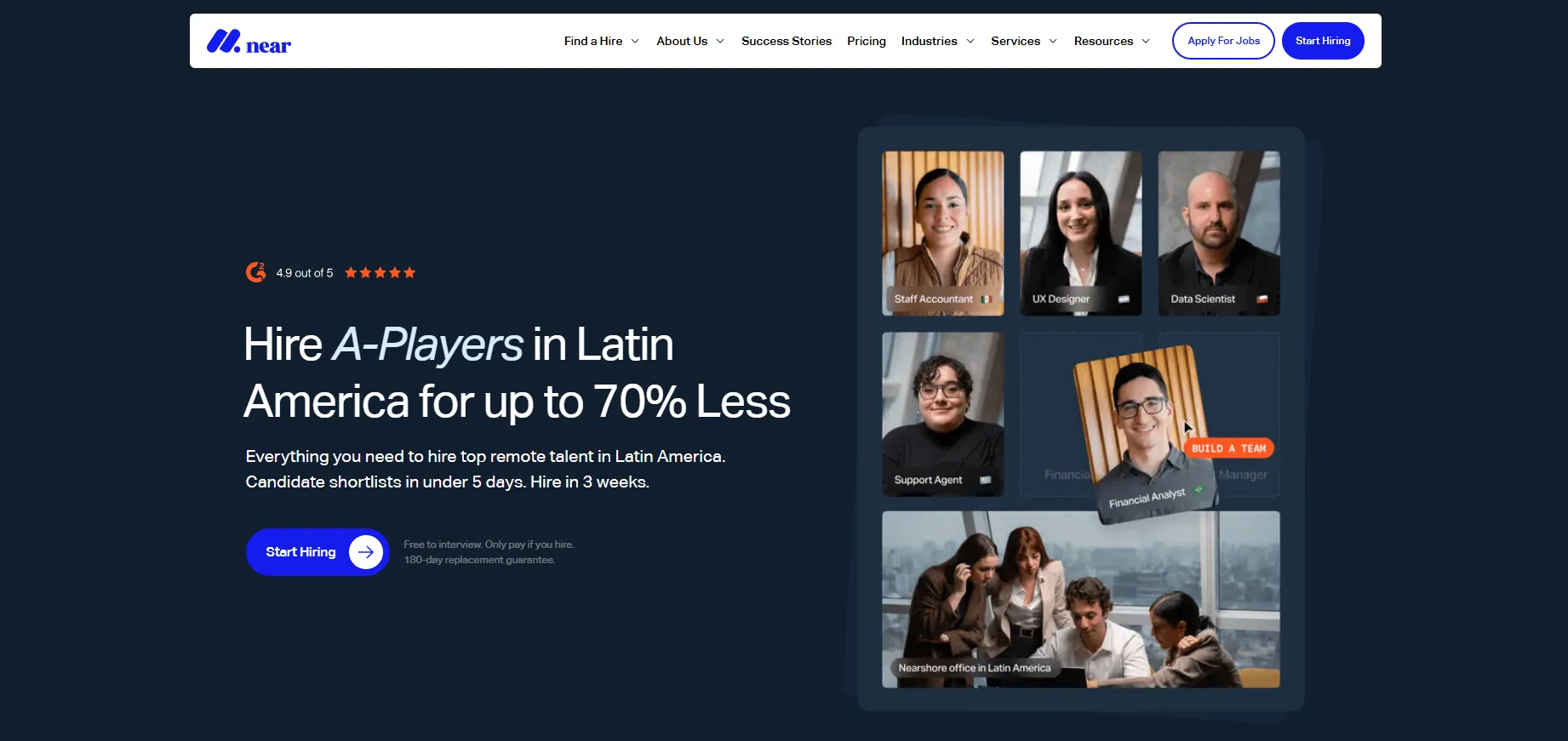
Best for: US companies that want Latin American talent working during the same business hours across non-engineering roles.
Hire With Near recruits remote professionals across Latin America for US companies, covering data and AI, finance, administration and operations, sales, marketing, design, customer support, and engineering. Its recruiters source, screen, and present candidates who match the stated requirements within five days of a kickoff call.
Time-zone overlap is one of Near’s main advantages. Latin American professionals typically work within one to three hours of US business hours, allowing teams to collaborate in real time rather than relying on overnight handoffs. For support teams where quick escalation matters, that overlap can be more important than a small difference in hourly rates.
Near uses a recruiting model, so the company finds and screens the person, but the client then employs, pays, and manages them. Quality assurance and shift coverage remain the client’s responsibility. Companies that want the provider to manage those parts of the operation may be better served by a managed support provider instead. Helpware’s breakdown of offshore outsourcing tradeoffs covers when the additional cost of nearshore delivery may make sense.
The 24/7 Coverage Math for a Remote Support Team
This is where 24/7 support budgets often go wrong. A buyer may think they need six agents, sign a contract, and then discover that the support queue still has gaps in the middle of the night or on weekends. The reason is simple: six agents are not enough to keep six seats staffed around the clock.
Start with the basic requirement. One seat staffed continuously requires 168 hours of coverage each week. A full-time agent works roughly 40 scheduled hours, so you need 4.2 agents to keep one seat covered before accounting for anything else.
Then account for shrinkage, which is the time agents are paid but aren’t available to handle customer contacts. Training, coaching, breaks, meetings, paid leave, and unplanned absences all contribute to shrinkage. Teams commonly plan for 25% to 35%. At 30% shrinkage, the requirement for one continuously staffed seat rises from 4.2 agents to six.
| Concurrent seats needed | Agents before shrinkage | Agents at 30% shrinkage |
|---|---|---|
| 1 | 4.2 | 6.0 |
| 2 | 8.4 | 12.0 |
| 3 | 12.6 | 18.0 |
| 5 | 21.0 | 30.0 |
Three practical consequences follow.
- A six-agent budget covers one seat around the clock, not six seats. When comparing quotes, check whether the provider is quoting the number of concurrent seats you need or the total number of agents required to keep those seats staffed.
- Follow-the-sun coverage can be easier on your team than overnight shifts. Splitting coverage across time zones lets most agents work during their local daytime. A hub and spoke delivery model across multiple regions can therefore be a better option than relying on one offshore site to cover overnight hours.
- Attrition creates coverage gaps unless replacements are ready quickly. When an agent leaves, the team loses part of its available coverage until someone else is hired and fully trained. Replacement and ramp-up timelines should therefore be part of the staffing agreement, not something you figure out after someone resigns.
When you compare providers, ask them to show exactly how they would cover your required hours, including weekends, leave, training, and expected absences. A provider running a managed support operation should be able to show that coverage plan before you sign.
Compliance Requirements for Regulated Support Teams
I If your agents handle protected health information, cardholder data, or other regulated records, compliance should narrow your shortlist before you compare prices. Many staffing companies can find people for you. Fewer can provide the controls, documentation, and secure environment needed to support regulated work.
| Obligation | Applies when | Evidence to request |
|---|---|---|
| HIPAA | Agents view patient records, scheduling information, benefits data, or clinical correspondence | A signed business associate agreement, workforce training records, and access-control documentation |
| PCI DSS | Agents take payments or handle card data on any channel | Attestation of compliance, pause-and-resume call recording, and clean-desk enforcement at each site |
| SOC 2 Type II | You need independent assurance that security controls are operating effectively over time | The current report under NDA, along with its scope and testing period |
| ISO 27001 | Your procurement process requires a certified information security management system | The certificate, its scope statement, and the certifying body |
| GDPR | Agents process personal data belonging to people in the EU or UK | A data processing agreement, transfer mechanism, and named data protection contact |
Two questions can quickly separate providers that are prepared for regulated work from those that aren’t. First, ask which entity signs the business associate agreement. A recruiter that only finds candidates and doesn’t employ or operate the team may not be the entity that can sign one. Second, ask whether the certification or audit scope covers the delivery site where your team will actually work. A certificate covering a provider’s headquarters tells you little about the controls at an offshore delivery center if that site isn’t included in the scope.
For regulated industries, it often makes sense to start with the requirements of the work and then build the provider shortlist around them. Our overview of healthcare BPO services covers the workflows and compliance requirements involved in patient-facing operations.
The Bottom Line
The right remote staffing provider depends on what you need the provider to own. If your team wants to hire people and manage the support operation itself, a staffing or recruiting firm may be enough. If you need someone to handle scheduling, quality, coverage, and replacements alongside the agents, a managed support provider is a better fit.
Before you compare quotes, work out how many seats you actually need, what coverage those seats require, and which compliance requirements apply. Then ask each provider to show exactly what its price includes and which responsibilities remain with your team.
That gives you a more useful comparison than an hourly rate alone. The cheapest provider on paper may not be the cheapest option once you account for overnight coverage, shrinkage, quality management, and the time your own team has to spend running the operation.