






A cloud migration can hit its cutover date and still leave expensive work unfinished. The invoices arrive, engineers may still build environments by hand, and back-office processes can remain as manual as they were on the old servers.
Gartner forecasts the public cloud services market will reach $1.48 trillion by 2029, with ongoing migration and modernization work among the drivers. Managing what happens after that investment matters, too: recent research from the FinOps Foundation, drawn from 1,192 respondents, shows that workload optimization and waste reduction remain a priority for FinOps teams.
A useful cloud migration partner plans the move and helps establish how the new environment will be automated and operated. Our top pick is Helpware for teams seeking cloud engineering alongside AI automation and business operations. Accenture is a fit for enterprise-scale programs, IBM Consulting for hybrid and mainframe estates, and Rackspace Technology for multicloud managed services.
Key takeaways
- Compare cloud migration companies on what happens after go-live, not only on how fast they move servers.
- Automation sits in three layers: infrastructure, operations, and business workflows. Ask which layers your partner will actually deliver.
- Hyperscaler-native specialists (Mission Cloud, SADA) go deepest on one cloud; global integrators (Accenture, IBM) run the largest programs.
- Regulated companies need to establish applicable HIPAA and PCI DSS requirements early and request relevant SOC 2 assurance evidence, instead of treating compliance as a post-migration task.
- Ask every partner who owns cost, monitoring, and incident response in month seven.
Helpware publishes this guide and appears in the ranking. We place Helpware first for buyers seeking cloud engineering, AI automation, and ongoing business operations within one organization; a specialist or global integrator may be a better fit for other projects.
Our rankings are compiled using publicly available information and objective evaluation criteria. We strive to ensure that every ranking is fair, transparent, and based on the same methodology for all companies.
Cloud Migration Partners at a Glance
This table compares the providers using information each publishes. Partner status reflects each company’s own website. A listed service is not a guarantee that it is included in every migration contract. The last column describes cloud operations, not customer experience or back-office process delivery.
| Partner | Best for | Clouds | Published hyperscaler status | Automation tools or methods | Post-migration cloud ops |
|---|---|---|---|---|---|
| Helpware | Migration, AI automation, and operations under one partner | AWS, Azure, Google Cloud | Not published | CI/CD, IaC, DevSecOps, AI and business process automation | 24/7 infrastructure monitoring, cost analysis, CX and back-office teams |
| Accenture | Enterprise-scale programs | AWS, Azure, Google Cloud, mainframe | Partner of the Year awards from AWS, Google Cloud, and Microsoft | myNav, GenWizard | FinOps and operating models |
| IBM Consulting | Hybrid and mainframe estates | AWS, Azure, Google Cloud, Oracle, IBM Cloud | AWS Premier Tier; Google Cloud Premier | IBM Consulting Advantage, Txture | Agentic cloud operations, FinOps |
| Rackspace Technology | Multicloud managed services | AWS, Azure, Google Cloud, VMware, private cloud | Azure Expert MSP | Rackspace Fabric | Managed services, AWS FinOps |
| Hexaware | Large application and data estates | AWS, Azure, Google Cloud | AWS Premier Tier; AWS Migration Competency | Amaze, AI agents | Managed services, FinOps |
| Mission Cloud | AWS-first small and mid-market | AWS only | AWS Premier Tier; AWS Migration Competency | Assess Factory, Mission Control | 24/7 managed operations |
| SADA | Google Cloud and VMware moves | Google Cloud | Google Cloud Premier | POWERSTART assessment | Managed services, FinOps |
| SoftServe | Engineering-led modernization | AWS, Azure, Google Cloud | AWS Premier Tier; Google Cloud Premier | SAMP, Migration Factory with Amazon Q | DevOps, FinOps, platform engineering |
| N-iX | Tested AI-assisted migration | AWS, Azure, Google Cloud | AWS Premier Tier; AWS Migration and Modernization Competency | APEX framework | DevOps managed services, SRE |
| Cloudticity | Healthcare compliance | AWS, Azure, Google Cloud | AWS Premier Consulting Partner; AWS Healthcare Competency | Oxygen | Automated managed cloud, compliance checks |
How We Selected and Compared These Companies
We shortlisted providers with published cloud migration services and compared the evidence available on their own websites and other cited company materials. We used the same five criteria for every entry. This is a qualitative editorial ranking, not a numerical scorecard; the order reflects fit for migration plus automation and ongoing operations, not enterprise size alone.
| Criterion | What we looked for |
|---|---|
| Migration methodology | A documented assessment, wave planning, and a stated approach to rehost, replatform, and refactor decisions |
| Automation depth | Infrastructure as code (IaC), AI-assisted assessment or code conversion, and automation of operations or business workflows |
| Day 2 operations | Managed services, monitoring, cost optimization (FinOps), and security operations after go-live |
| Regulated-industry fit | Published experience and controls for healthcare, financial services, or public sector work |
| Delivery model and scale | Team size, delivery locations, and how the partner engages mid-market versus enterprise buyers |
Hyperscaler partner status appears in the comparison table as context, not as a ranking score. A Premier Tier badge indicates an established relationship with a cloud platform; it does not, on its own, establish the scope of post-migration automation.
Beyond Cutover: The Three Automation Layers
Moving workloads is one stage of cloud modernization. Automation determines how consistently teams provision the new infrastructure, run it, and improve the processes built on top of it. For comparison, it helps to separate three layers.
- Infrastructure automation: IaC templates, landing zones, continuous integration and continuous delivery (CI/CD) pipelines, and policy as code. This layer makes environments repeatable and auditable.
- Operations automation: Monitoring and alerting, autoscaling, patching, automated remediation, and cost rules like rightsizing and tagging. These reduce manual cloud administration and improve visibility.
- Business workflow automation: AI agents, chatbots, document processing, and back-office operations that run on the new platform. These address the work people and systems perform, instead of the infrastructure bill alone.
The 10 Best Cloud Migration Partners in 2027
The profiles use the same structure: ideal fit, published capabilities, automation strengths, and important limitations. We consider all five comparison criteria for Helpware and the other providers, but buyers should weigh them differently according to their own workloads and operating requirements.
1. Helpware
Best for: Mid-market and regulated companies looking to combine cloud engineering with AI and business process automation.
Helpware runs three divisions: customer experience operations, AI solutions, and software engineering. Its Tech division, formed in 2024 through the acquisitions of eTeam and Unicsoft, reports 800+ software engineers and 200+ completed projects. The cloud consulting services cover cloud migration, modernization, cloud-native development, infrastructure optimization, cloud security, and deployment automation across Amazon Web Services (AWS), Microsoft Azure, and Google Cloud, following the AWS Well-Architected Framework.
Automation strengths
- DevOps consulting teams set up CI/CD pipelines and infrastructure as code, run cost analysis, and offer 24/7 infrastructure monitoring.
- DevSecOps services build security checks into the pipeline for GDPR, HIPAA, and PCI DSS workloads.
- The AI division builds chatbots, voice AI, agent assist, and quality assurance (QA) automation. Helpware also reports cost reductions of 20 to 30 percent through AI automation.
For a German fleet-claims company, a Helpware team modernized legacy fleet-claims applications built on PHP, React, and AWS services, and added a continuous integration pipeline. The project illustrates Helpware’s application modernization and deployment automation capabilities.
Helpware holds SOC 2 Type II, ISO 27001, and ISO 9001 certifications and works to HIPAA and GDPR compliance standards.
Where it falls short: Helpware doesn’t publish a hyperscaler partner tier or migration competency, and the Tech division brand dates from 2024. Its published migration methodology is less detailed than the named assessment frameworks in some competitor profiles. For a multicountry mainframe exit, a global integrator offers greater program scale.
2. Accenture
Best for: Large enterprises running multiyear, multiregion programs that need one integrator across AWS, Azure, Google Cloud, and mainframe estates.
Dublin-based Accenture reports about 814,000 employees and clients in more than 120 countries. It doesn’t headline partner tiers on its cloud pages. Instead, it lists recognition from all three hyperscalers, including AWS Global Consulting Partner of the Year and Google Cloud Partner of the Year, plus repeated Microsoft Global SI Partner of the Year awards with Avanade.
Automation strengths
- myNav, its cloud platform, discovers, assesses, designs, and simulates cloud solutions before and during migration.
- GenWizard, its generative AI platform, now includes Gemini-powered tools that speed up mainframe inventory analysis and code conversion.
- Its modernization practice applies full-stack FinOps and operating models to cloud consumption, cost, and performance.
Where it falls short: Accenture’s broad program model may be more than a limited migration requires. Buyers should establish which cloud modernization and business workflow workstreams are included in the proposed scope and not assume they will be delivered as one engagement.
3. IBM Consulting

Best for: Hybrid estates that mix mainframe, VMware, Red Hat OpenShift, and several public clouds.
IBM was founded in 1911 and reports 300,000+ employees across 170+ countries. IBM Consulting migrates workloads to AWS, Azure, Google Cloud, Oracle Cloud, and IBM Cloud, including hybrid setups with IBM Z. It’s an AWS Premier Tier Services Partner and a Google Cloud Premier Partner.
Automation strengths
- IBM Consulting Advantage for Cloud Transformation, a generative AI platform, orchestrates migration tools and uses AI for wave planning, workload analysis, and technical blueprints.
- Txture assesses application portfolios and recommends a 6R migration path, and the Neudesic Cloud Factory adds an automated framework for Azure.
- Managed services include agentic cloud operations and integrated FinOps, built on Instana, Turbonomic, Concert, and watsonx.
Where it falls short: IBM’s cloud portfolio includes tooling from its own and the Red Hat ecosystem. Teams seeking a specific cloud-native toolchain should clarify which platforms, licenses, and managed services the project would require.
4. Rackspace Technology
Best for: Companies that want one managed services provider to migrate and then run AWS, Azure, Google Cloud, VMware, and private cloud.
Rackspace traces its managed hosting roots to 1998 and reports 5,800+ employees and customers in more than 120 countries. It holds Microsoft Azure Expert MSP status and calls itself Google Cloud’s first managed services partner. Its migration practice serves healthcare, financial services, government, education, and other regulated sectors.
Automation strengths
- Assessment work catalogs applications and networks and predicts future cloud consumption to estimate costs.
- Rackspace Fabric unifies governance, ticketing, billing, and tagging across clouds.
- Its AWS practice offers continuous cost monitoring, rightsizing, and usage optimization as a FinOps service.
Where it falls short: Rackspace emphasizes ongoing managed operations. Buyers seeking only a fixed-scope migration, or extensive application refactoring, should check where project delivery ends and recurring operations begin.
5. Hexaware Technologies
Best for: Large application and data estates where an automation platform takes on assessment and migration work at scale.
Hexaware was established in 1990 and is headquartered in Navi Mumbai, India. It’s an AWS Premier Tier Services Partner with the AWS Migration Competency and holds Microsoft Solutions Partner designations, including the Infra and Database Migration to Microsoft Azure specialization. It works across AWS, Azure, and Google Cloud.
Automation strengths
- Amaze, its AI automation platform for cloud and data transformation, takes enterprises from assessment to modernization-led migration and assesses total cost of ownership (TCO) impact in days.
- The company offers AI agents for cloud transformation as a named service.
- Cloud managed services use automation, site reliability engineering, and continuous cost control, with post-cutover FinOps and performance tuning.
Where it falls short: The cloud materials reviewed here give less detail on industry-specific compliance controls than on migration automation. Regulated buyers should request sector-specific references and an explanation of how controls are implemented and monitored.
6. Mission Cloud
Best for: Small and mid-market companies committed to AWS that want migration funding guidance and a managed services team afterward.
Mission was founded in 2017 and is now a CDW company. It works only on AWS, as an AWS Premier Tier Partner with the AWS Migration Competency and 18 AWS competencies. It reports 500+ customers and 300+ team members.
Automation strengths
- The Assess Factory runs discovery and planning on the framework of the AWS Migration Acceleration Program (MAP).
- Mission Control, included with its services, benchmarks and tracks cloud performance and cost in real time, and Mission Cloud Score rates cost, operations, security, reliability, and performance.
- Cloud Operate provides fully managed monitoring and 24/7 alert response.
Where it falls short: AWS is the whole scope, so multicloud or Azure-first teams need another partner. The company publishes few claims about AI-assisted migration or business workflow automation.
7. SADA, an Insight Company
Best for: Organizations moving to Google Cloud, especially VMware estates headed for Google Cloud VMware Engine.
SADA is a Google Cloud Premier Partner and a Google Cloud Global Partner of the Year, with specializations that include Cloud Migration, Infrastructure, and Data Center Modernization. Now part of Insight, SADA reports 4,000+ clients served and 10,000+ workloads migrated.
Automation strengths
- The POWERSTART VM Migration Assessment combines automated tooling with human analysis to produce a workload plan, cost estimates, and architecture diagrams.
- A defined program moves VMware workloads to Google Cloud VMware Engine.
- Managed services cover security, infrastructure, cost optimization, and a 24/7 help desk, and SADA is a premier member of the FinOps Foundation.
Where it falls short: SADA focuses on Google Cloud. Insight covers other clouds, but buyers with AWS or Azure as the main target get less from SADA itself.
8. SoftServe
Best for: Mid-market and enterprise teams that want engineering-led modernization with AI accelerators across all three major clouds.
SoftServe started in Lviv, Ukraine, in 1993 and is now headquartered in Austin, Texas. It’s an AWS Premier Tier Services Partner with the AWS Migration Competency, a Google Cloud Premier Services Partner, and a Microsoft Solutions Partner. Its migration practice serves high tech, financial services, healthcare, life sciences, retail, energy, and manufacturing clients.
Automation strengths
- The SoftServe Adaptive Modernization Platform (SAMP) acts as an accelerator for platform engineering and cloud modernization.
- A Migration Factory built with Amazon Q automates parts of AWS migrations, and a separate offer refactors legacy .NET code with Amazon Q Developer.
- Agent Grid provides agentic AI orchestration for workflows; buyers should confirm whether that work is part of the migration program or a separate engagement.
Where it falls short: SoftServe publishes DevOps, FinOps, and platform engineering services, but its migration page gives little detail on long-term managed operations. Confirm who runs the environment once the modernization project ends.
9. N-iX
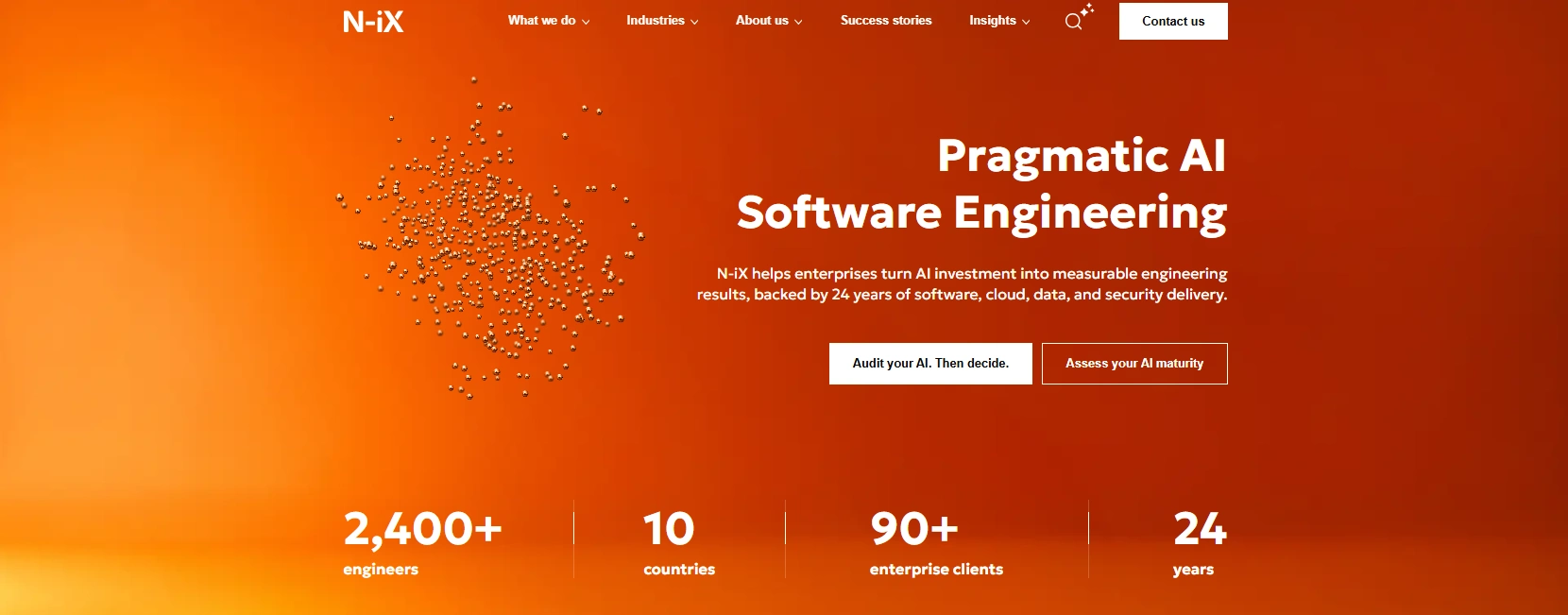
Best for: Companies that want AI-assisted migration tested on their own workloads before it scales, with a large engineering bench behind it.
N-iX began in 2002 as Novellix, a product startup, and now reports 2,400+ software engineers and IT professionals in 25 countries across Europe and the Americas. It’s an AWS Premier Tier Services Partner with the AWS Migration and Modernization Competency, and a Microsoft Solutions Partner for Digital and App Innovation and for Data and AI.
Automation strengths
- The APEX framework (Assess, Pilot, Expand, eXcel) validates AI-assisted migration work on a pilot before the team scales it.
- On AWS, it uses native tooling such as AWS Application Migration Service, Migration Hub, and Database Migration Service.
- The company lists DevOps managed services, site reliability engineering, and cloud infrastructure management as follow-on work.
Where it falls short: The migration pages reviewed here do not describe an explicitly packaged FinOps service. Buyers seeking ongoing cost governance should ask what monitoring, reporting, and optimization are included and who would run them.
10. Cloudticity
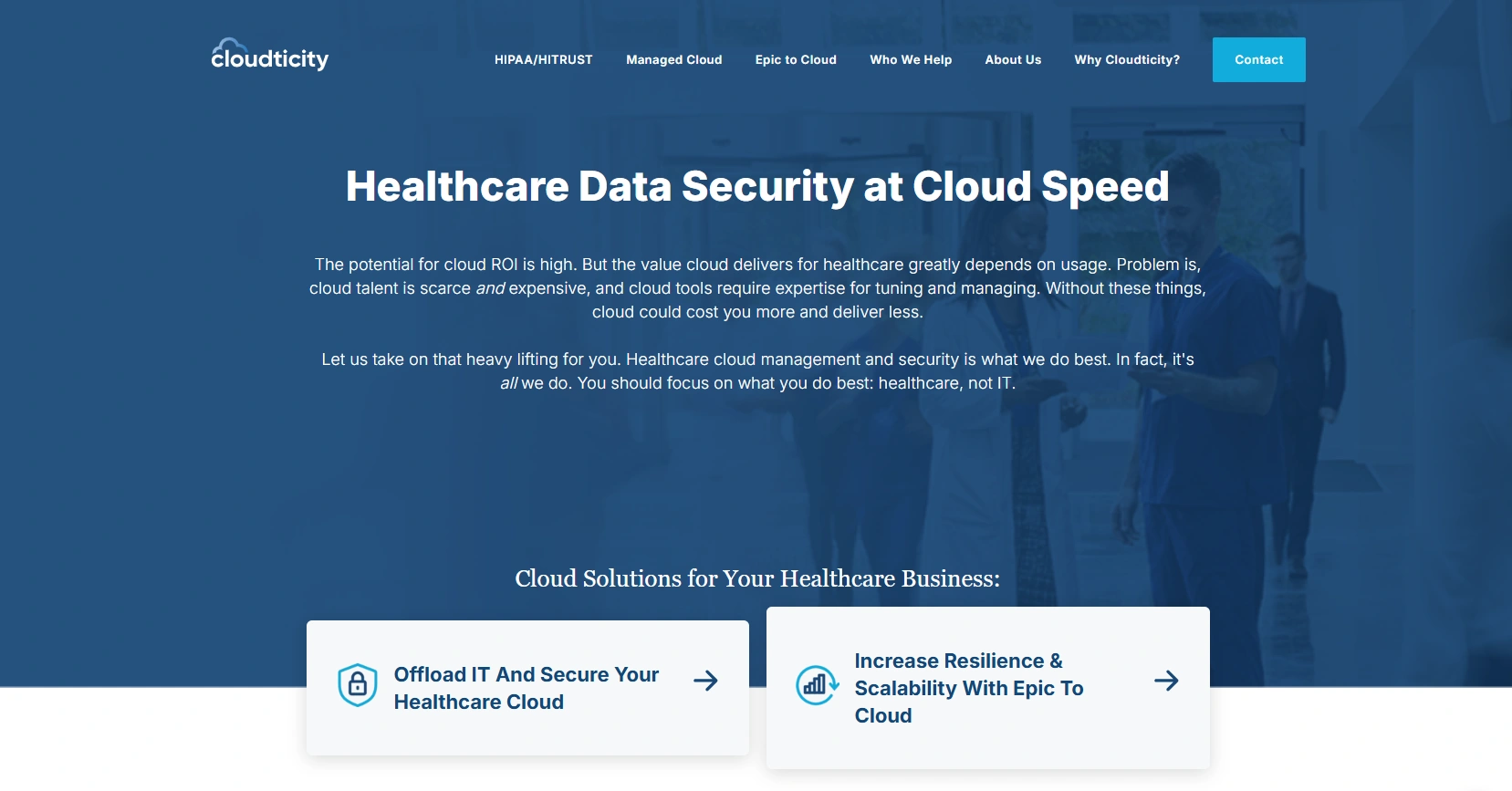
Best for: Healthcare organizations that need HIPAA and HITRUST controls automated from day one, including Epic workloads.
Seattle-based Cloudticity was founded in 2011 and focuses on healthcare cloud. It lists AWS Premier Consulting Partner status, the AWS Healthcare Competency (it says it was the first partner to earn it), and AWS Audited Managed Services Provider status. It also holds HITRUST CSF r2 certification and works across AWS, Microsoft Azure, and Google Cloud.
Automation strengths
- Cloudticity Oxygen, its managed cloud platform, automates configuration, monitoring, and remediation.
- The company says it runs 1,000+ continuous compliance checks mapped to HITRUST CSF controls and HIPAA requirements.
- Managed services include automated backups, disaster recovery, patching, logging, and cost recommendations.
Where it falls short: The healthcare focus is the point, so companies outside healthcare and life sciences gain less from it. Cloudticity doesn’t publish business workflow automation beyond the cloud platform itself.
Automation Coverage by Partner Type
The matrix below summarizes typical strengths by partner type. It is an editorial comparison of the offerings described above, not a separate numerical score; actual coverage depends on project scope and contract terms. You can use this matrix to spot the gaps in a shortlist before you sign.
| Partner type | Infrastructure automation | Operations automation | Business workflow automation | Examples in this list |
|---|---|---|---|---|
| Global systems integrator | Strong | Strong (often through managed services) | Strong, sold as a separate program | Accenture, IBM Consulting |
| Hyperscaler-native specialist | Strong on one cloud | Strong on one cloud | Limited | Mission Cloud, SADA |
| Managed cloud provider | Moderate | Strong | Limited | Rackspace Technology |
| Engineering and modernization company | Strong | Moderate | Moderate, project-based | Hexaware, SoftServe, N-iX |
| Industry compliance specialist | Strong within its vertical | Strong within its vertical | Limited | Cloudticity |
| Integrated BPM provider | Moderate to strong | Moderate | Strong, with human teams to run the workflows | Helpware |
Specialists often focus on a single cloud, while global integrators bring broader transformation capabilities. Neither model guarantees that infrastructure, cloud operations, and business workflows will all be included in one engagement.
Business workflow automation also requires process design and clear ownership beyond cloud infrastructure. Orchestration layers can coordinate AI models and human teams across those workflows, and human-in-the-loop AI provides review for work that needs it. Ask partners to specify the teams and responsibilities involved in any proposed end-to-end program.
Partner Picks by Cloud and Industry
Your target cloud, workload mix, and compliance requirements can narrow the field. This table offers a starting shortlist, and you can use the RFP questions below to test the practical fit.
| If you are… | Start with | Why |
|---|---|---|
| Committed to AWS, small or mid-market | Mission Cloud | AWS-only focus, MAP-based assessment, 24/7 managed operations |
| Moving VMware to Google Cloud | SADA | Google Cloud Premier Partner with a defined VMware Engine program |
| Running mainframe and hybrid estates | IBM Consulting, Accenture | Tooling and scale for IBM Z, Red Hat, and multiyear programs |
| Running several clouds with one operator | Rackspace Technology | Managed services across AWS, Azure, Google Cloud, VMware, and private cloud |
| Modernizing a large application estate | Hexaware, SoftServe | Platform-led assessment and AI-assisted refactoring |
| Testing AI-assisted migration before scaling it | N-iX | APEX pilot-first framework |
| A healthcare organization | Cloudticity, Helpware | Healthcare-focused, HITRUST-mapped cloud controls (Cloudticity); cloud engineering plus patient-facing or back-office operations (Helpware) |
| Looking for migration plus workflow automation from one partner | Helpware | Cloud, DevOps, AI, and business operations practices within one organization (but confirm cross-team delivery scope) |
Healthcare and financial services buyers usually evaluate migration alongside run-state support. When you compare providers of managed IT services for healthcare or IT support for financial services, examine the operational controls alongside migration capabilities; do not assume one implies the other.
How to Choose a Cloud Migration Service Provider
Start with your target cloud and your compliance scope, since those two facts remove half of any long list. Then use these questions to test what each provider will deliver and who will own the environment afterward.
- Ask how the partner decides between rehost, replatform, and refactor. You want a workload-by-workload method, not a default, and a clear path for legacy application modernization where rehosting won’t pay off.
- Ask which assessment and automation tools it brings. Get names, and ask what each one produces.
- Ask for its hyperscaler status and funding eligibility. Programs such as the AWS Migration Acceleration Program (MAP) offset part of the eligible project costs, and partners may apply on your behalf.
- Ask who owns cost, monitoring, and incident response after go-live. Get the answer in the statement of work, with named service levels.
- Ask what it automates in month one versus month six. The plan should explain which infrastructure and operations tasks will be automated, and whether business workflows are in scope at all.
- Ask for reference customers in your industry. Regulated buyers need evidence of applicable HIPAA or PCI DSS safeguards, relevant SOC 2 assurance reports, and a named owner for regulatory compliance after go-live.
- Ask how it hands knowledge back to your team. Runbooks, IaC repositories, and training belong to you.
- Ask what a pilot would demonstrate. Agree on a representative workload, success measures, and handoff criteria before committing to a wider migration; pilot duration depends on complexity.
Choosing the Right Cloud Migration Partner
Choose a partner for the work it will own after cutover. A single-cloud specialist can offer depth on its chosen platform; a global integrator can coordinate larger transformation programs. For broader initiatives, compare digital transformation consulting firms alongside cloud specialists and plan AI implementation consulting for the workflow layer. Helpware is an option when cloud engineering needs to connect with AI-enabled CX and back-office operations, provided those responsibilities are explicitly scoped.
Ready to plan the move? Talk to our cloud team about your workloads, a practical pilot scope, and the automation outcomes to agree on before kickoff.