








According to Deloitte’s 2026 Global Health Care Outlook, 64% of health system executives expect AI to reduce costs by standardizing and automating workflows, yet most organizations still manage fragmented IT environments that drain clinical and administrative capacity. Mordor Intelligence projects healthcare as the fastest-growing vertical in managed services, with an 11.03% compound annual growth rate forecast through 2031, as telehealth proliferation, EHR complexity, and ransomware exposure make in-house IT management increasingly unsustainable.
For hospitals, health systems, and telehealth platforms trying to scale without inflating headcount, managed IT services for healthcare solve a concrete problem: keeping HIPAA-compliant infrastructure running, resolving technical issues before they interrupt patient care, and processing claims accurately, without building expensive internal teams for every function.
What follows is a side-by-side review of 10 leading managed IT services companies for healthcare, selected for their compliance capabilities, service breadth, and proven track record at scale. Whether you run a regional hospital network or a fast-growing telehealth platform, this guide helps you identify the right partner for your cost efficiency and scale goals in 2026.
What Managed IT Services for Healthcare Covers
Managed IT services for healthcare is the practice of contracting a specialized external provider to manage, monitor, and optimize part or all of an organization’s technology environment on an ongoing basis. Unlike a one-time implementation project, managed services run continuously: the provider takes operational responsibility for defined systems, with service-level agreements governing uptime, response time, and compliance standards.
Core components of managed IT services for healthcare typically include:
- EHR and EMR management (implementation, optimization, and ongoing support for Epic, Cerner, MEDITECH, and similar platforms)
- Help desk and technical support (L1, L2, and L3 tiers, available 24/7 for clinical and administrative staff)
- Healthcare cybersecurity (threat monitoring, HIPAA-compliant incident response, ransomware protection)
- Revenue cycle management (claims processing, eligibility verification, prior authorization automation)
- Cloud infrastructure management and disaster recovery planning
- Medical device connectivity and IoT security monitoring
- Data interoperability and HL7/FHIR integration
- Administrative back-office operations (insurance verification, patient data management)
What distinguishes healthcare-specialized managed services from generic IT outsourcing is regulatory depth. Providers that treat healthcare like any other vertical design infrastructure without accounting for HIPAA security rule requirements, HITECH breach notification timelines, or CMS interoperability mandates. The technical consequence is an infrastructure that functions fine until a compliance audit or a ransomware incident arrives.
Most health systems and telehealth operators turn to managed IT services when internal teams face overwhelming EHR upgrade cycles, when staffing gaps leave overnight shifts uncovered, or when scaling operations requires clinical IT expertise that is not cost-effective to build in-house. What organizations typically gain is a 25–45% reduction in IT operating costs, faster ticket resolution, predictable monthly spend, and the ability to redirect clinical staff toward patient care rather than IT troubleshooting. For mid-market health systems running lean IT departments, that shift from reactive firefighting to proactive stability is where managed services pay for themselves.
Top 10 Managed IT Services Companies for Healthcare: Comparison
| Company | Services | Global presence | Employees | Year est. |
|---|---|---|---|---|
| Helpware CX | Technical support (L1–L3), HIPAA help desk, back-office ops, claims processing support, data operations | USA, Mexico, Philippines, Ukraine, Georgia, Puerto Rico, Poland, Germany, Albania (19 locations total) | ~4,000 | 2015 |
| Cognizant | EHR/EMR managed services, claims administration, RCM, cloud and infrastructure services, healthcare analytics | USA, India, UK, Philippines, Canada, Germany, France, Australia, Hungary (88 countries total) | ~340,000 | 1994 |
| Accenture | Managed health operations, cloud infrastructure, EHR modernization, cybersecurity, AI workflow automation | USA, UK, India, Ireland, Germany, France, Australia, Canada, Japan (120+ countries total) | ~774,000 | 1989 |
| DXC Technology | IT infrastructure managed services, cloud migration, application management, cybersecurity, network services | USA, UK, India, Australia, Germany, France, Canada, Brazil, Mexico (70 countries total) | ~90,000 | 2017 |
| Leidos | Health IT managed services, EHR modernization, digital health platforms, cybersecurity, cloud services | USA, UK, Australia, Germany, Canada, New Zealand, Saudi Arabia (30+ countries total) | ~47,000 | 1969 |
| R1 RCM | Revenue cycle management, prior authorization automation, clinical coding, patient access, AI denial management | USA, India (2 countries total) | ~27,200 | 2003 |
| Nordic Global | EHR managed services (Epic/Cerner), cloud migration, strategic IT advisory, data and analytics, ERP services | USA, Canada, UK, Australia, Ireland, Germany (6 countries total) | ~3,300 | 2010 |
| ScienceSoft | Managed IT infrastructure, healthcare app support, HIPAA compliance, cybersecurity, cloud migration, EHR support | USA, Saudi Arabia, UAE, Poland, Latvia, Lithuania, Finland (7 countries total) | ~750 | 1989 |
| Conduent | Healthcare claims administration, benefits eligibility, patient data management, managed BPaaS, gov. health programs | USA, India, UK, Germany, France, Canada, Mexico, Brazil, Australia (40+ countries total) | ~38,128 | 2017 |
| athenahealth | Cloud EHR managed services, revenue cycle management, practice management, patient engagement, clinical documentation | USA (national presence) | ~7,000 est. | 1997 |
Top 10 Managed IT Services Companies for Healthcare: Company Overviews
#1 Helpware CX
Founded in 2015 and headquartered in Lexington, Kentucky, Helpware CX operates 19 locations across 11 countries, delivering HIPAA-compliant technical support, help desk services, and back-office operations to healthcare and telehealth organizations. What makes Helpware CX a strong fit for healthcare IT is the combination of SOC 2, HIPAA, and GDPR compliance infrastructure with a 90% CSAT rate and 2.8% monthly agent attrition, well below the 6–8% industry average. Healthcare and telehealth represent 25–30% of the company’s client base, which means its support teams bring genuine clinical-sector familiarity rather than generalist IT support applied to healthcare settings.
Key details:
- Services: Technical support (L1/L2/L3), HIPAA-compliant help desk, back-office operations, claims processing support, data operations, AI data annotation
- Best for: Telehealth platforms and mid-market health systems ($50M–$500M revenue) needing compliant, scalable IT support operations without building large internal teams
- Locations: USA, Mexico, Philippines, Ukraine, Georgia, Puerto Rico, Poland, Germany, Albania
#2 Cognizant
Cognizant, founded in 1994 and headquartered in Teaneck, New Jersey, fields 80,000 healthcare professionals and manages 4.4 billion payer-provider transactions annually across 350 major health systems. The company’s TriZetto platform covers over 200 million insurance members and connects 875,000 providers, giving Cognizant one of the most deeply embedded IT services footprints in US healthcare. In 2026, Cognizant ranked first in the Best in KLAS report for Claims and Administration Platforms (Payer), reflecting sustained performance across demanding, high-volume healthcare IT environments.
Key details:
- Services: EHR/EMR managed services, claims administration, revenue cycle management, cloud and infrastructure services, healthcare analytics, AI data services
- Best for: Large payers, health systems, and pharmacy benefit managers with complex, high-volume IT environments requiring enterprise-scale managed services
- Locations: USA, India, UK, Philippines, Canada, Germany, France, Australia, Hungary (88 countries total)
#3 Accenture
Accenture, founded in 1989 and headquartered in Dublin, Ireland, brings approximately 774,000 employees to managed services engagements spanning healthcare payers, providers, and life sciences companies across 120 countries. In 2025, Everest Group positioned Accenture as the highest leader on both axes of its Healthcare Provider Digital Services PEAK Matrix assessment. The company’s managed health operations model combines cloud infrastructure, cybersecurity, and AI-powered workflow automation. This combination is particularly relevant for health systems undertaking large-scale EHR migrations or enterprise-wide digital transformation programs.
Key details:
- Services: Managed health operations, cloud infrastructure, EHR modernization, cybersecurity, AI-powered clinical workflow automation, revenue cycle operations
- Best for: Large hospital systems and payers undertaking enterprise-wide digital transformation or multi-year managed services engagements
- Locations: USA, UK, India, Ireland, Germany, France, Australia, Canada, Japan (120+ countries total)
#4 DXC Technology
DXC Technology formed in 2017 through the merger of Hewlett Packard Enterprise Services and Computer Sciences Corporation, creating one of the largest dedicated IT services firms globally with approximately 90,000 employees across 70 countries. DXC provides managed IT infrastructure, application management, cloud migration, and cybersecurity services to healthcare organizations navigating hybrid-cloud environments and legacy system modernization. The company’s global scale enables rapid deployment of large teams across multiple delivery regions, serving multi-site health systems that need consistent IT management across geographically distributed operations.
Key details:
- Services: IT infrastructure managed services, cloud migration, application management, cybersecurity, network managed services, data center operations
- Best for: Multi-site health systems and large payers requiring managed IT services at scale across distributed locations
- Locations: USA, UK, India, Australia, Germany, France, Canada, Brazil, Mexico (70 countries total)
#5 Leidos
Leidos, founded in 1969 and headquartered in Reston, Virginia, reported $17.2 billion in revenue for fiscal year 2026 with a workforce of approximately 47,000 professionals across 150 countries and territories. The company’s dedicated Health division manages digital health programs for the US Department of Defense, the Department of Veterans Affairs, and commercial health systems, conducting 2.8 million medical exams annually and connecting rural communities with clinicians across 50 medical specialties. It is the depth of federal security compliance and clinical IT expertise that sets Leidos apart for organizations operating within government health infrastructure.
Key details:
- Services: Health IT managed services, EHR modernization, digital health platforms, cybersecurity, cloud services, disability evaluation systems
- Best for: Federal agencies, VA-affiliated providers, and large health systems with complex security and compliance requirements
- Locations: USA, UK, Australia, Germany, Canada, New Zealand, Saudi Arabia (30+ countries total)
#6 R1 RCM
R1 RCM, founded in 2003 as Accretive Health and headquartered in Murray, Utah, partners with 95 of the top 100 US health systems and manages over 270 million payer transactions annually. The company’s Healthcare Revenue Operating System, a modular AI-enabled platform, automates patient intake, clinical coding, claims submission, and payment follow-up for more than 1,000 provider clients. In February 2026, R1 received Best in KLAS recognition across multiple revenue cycle management categories, confirming its position as the category leader for healthcare financial operations at scale.
Key details:
- Services: Revenue cycle management, prior authorization automation, clinical coding, patient access and intake, payment processing, AI-driven denial management
- Best for: Hospitals, health systems, and physician groups focused primarily on revenue cycle performance and financial operations
- Locations: USA, India (2 countries total)
#7 Nordic Global

Nordic Global, founded in 2010 and headquartered in Madison, Wisconsin, operates with 3,300 professionals serving more than 700 healthcare client organizations. As a healthcare-only consulting and managed services firm, Nordic’s entire portfolio focuses on clinical IT, primarily EHR optimization for Epic and Cerner, managed services for ongoing system support, cloud migration, and data analytics. In December 2025, Everest Group recognized Nordic as a Major Contender in its Healthcare Specialists IT Services PEAK Matrix, and in February 2025 the company received Best in KLAS designation for Clinical Optimization.
Key details:
- Services: EHR managed services (Epic and Cerner), cloud migration, strategic IT advisory, data and analytics, ERP services, IT staffing
- Best for: Hospitals and health systems that want a healthcare-only managed services partner with deep EHR expertise and a KLAS-recognized performance track record
- Locations: USA, Canada, UK, Australia, Ireland, Germany (6 countries total)
#8 ScienceSoft
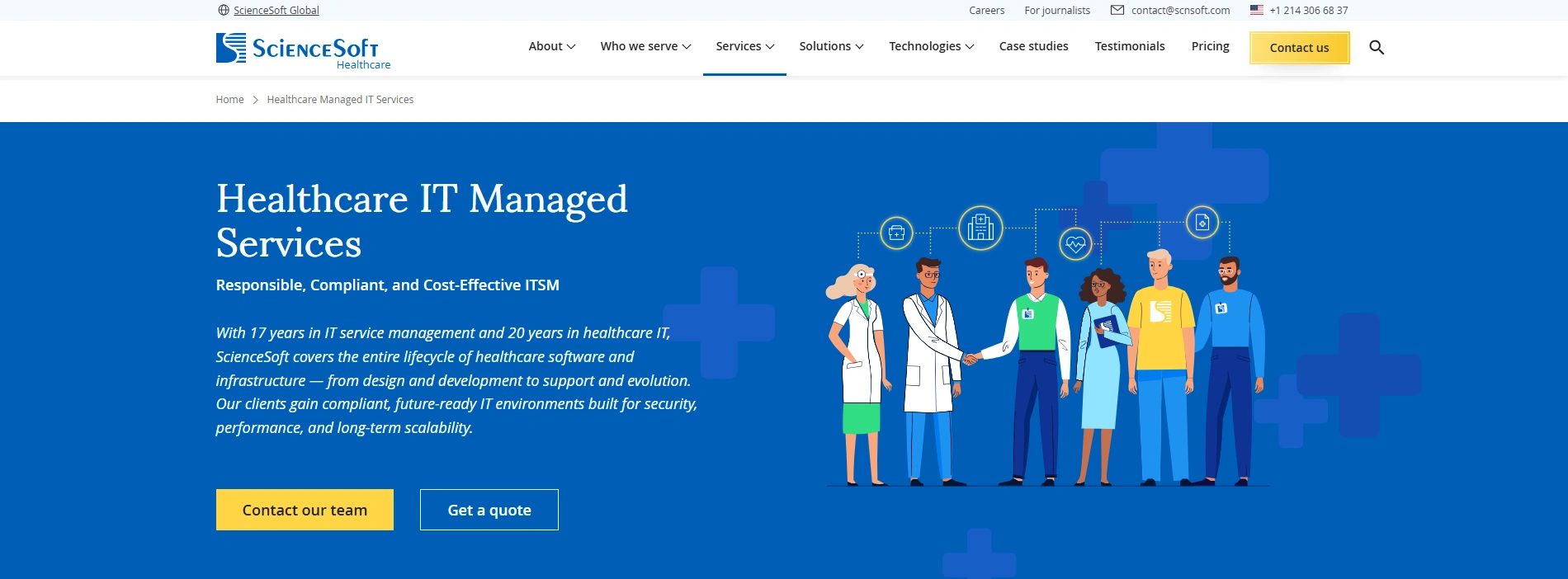
ScienceSoft, founded in 1989 and headquartered in McKinney, Texas, brings 17 years in IT service management and 20 years in healthcare IT to managed services engagements for providers, payers, and medical device companies. With 750-plus engineers and consultants across the US, Saudi Arabia, UAE, Poland, Latvia, Lithuania, and Finland, ScienceSoft holds ISO 13485, ISO 27001, and ISO 9001 certifications alongside HIPAA compliance. Quadrant Knowledge Solutions named ScienceSoft a Healthcare IT Services Market Leader in its 2024 SPARK Matrix, and the company appeared on the Inc. 5000 list from 2023 to 2025.
Key details:
- Services: Managed IT infrastructure, healthcare application support, HIPAA compliance management, cybersecurity, cloud migration, EHR/EMR development and support
- Best for: Mid-market health systems, medical device companies, and digital health startups needing HIPAA-specialized managed IT with deep compliance credentials
- Locations: USA, Saudi Arabia, UAE, Poland, Latvia, Lithuania, Finland (7 countries total)
#9 Conduent
Conduent, founded in 2017 as a spinoff from Xerox and headquartered in Florham Park, New Jersey, employs approximately 38,128 professionals globally and specializes in high-volume business process services. In healthcare, Conduent manages interactions with patients and insured members for a significant portion of the US healthcare industry, focusing on claims administration, benefits eligibility processing, and payer-side managed services. The company’s scale across 40-plus countries enables it to handle large-volume healthcare data processing requirements at competitive cost structures that mid-sized IT providers struggle to match.
Key details:
- Services: Healthcare claims administration, benefits eligibility processing, patient data management, managed BPaaS, customer experience management for payers, government health program administration
- Best for: Large payers, government health agencies, and multi-line insurance organizations needing high-volume claims processing and benefits administration at scale
- Locations: USA, India, UK, Germany, France, Canada, Mexico, Brazil, Australia (40+ countries total)
#10 athenahealth
athenahealth, founded in 1997 and headquartered in Boston, Massachusetts, provides cloud-native EHR, practice management, and revenue cycle services to healthcare practices and health systems across the US. In October 2025, the company launched AI-native enhancements to its athenaOne platform, targeting a 50% reduction in administrative workload for healthcare practices. athenahealth’s managed services model allows practices to offload billing, scheduling, and clinical documentation to a vendor-managed operational layer, giving smaller and mid-sized practices access to managed IT capability without the cost of maintaining large internal IT departments.
Key details:
- Services: Cloud EHR managed services, revenue cycle management, practice management, patient engagement, AI-powered clinical documentation support
- Best for: Ambulatory practices, specialty clinics, and mid-sized health systems seeking cloud-native managed IT services with minimal internal IT overhead
- Locations: USA (national presence)
Helpware: Our Top Choice for Managed IT Services in Healthcare
Among the 10 companies reviewed, Helpware CX stands out for healthcare organizations that need compliant, scalable IT support operations without the cost burden of enterprise-scale implementation programs. What sets Helpware apart is where it focuses: the patient-facing and administrative support functions that run every day, regardless of what the broader IT infrastructure looks like. For telehealth platforms and mid-market health systems, that operational layer is exactly what patients and clinical staff interact with most.
What Helpware CX delivers through its HIPAA-compliant healthcare BPO services is a combination of compliance infrastructure and operational continuity that larger generalist firms rarely achieve at comparable cost. SOC 2, HIPAA, and GDPR certifications across all 19 delivery locations mean healthcare clients inherit a pre-built compliance posture rather than constructing one after signing a contract. That certification layer extends directly to the technical support operations Helpware provides for EHR help desks, patient access support, and back-office claims processing.
It is the 2.8% monthly attrition rate, compared against the 6–8% industry average, that translates most directly into better outcomes for healthcare clients. Teams that stay together build institutional knowledge about a client’s EHR environment, escalation protocols, and patient demographics. That continuity compounds over multi-year engagements in ways that high-turnover support operations simply cannot replicate. Helpware’s 5-year average client partnership, across 400-plus clients including a significant healthcare and telehealth concentration, reflects exactly that dynamic.
What sets Helpware apart for healthcare IT support:
- Compliance infrastructure: SOC 2 Type II, HIPAA, and GDPR certified across all 19 delivery locations; clients inherit a pre-built compliance posture from day one
- Operational continuity: 2.8% monthly attrition rate vs. 6–8% industry average, sustaining institutional EHR knowledge across long-term engagements
- Multilingual coverage: 45-language support serving diverse patient and staff populations without premium language surcharges
- Cost efficiency: $8–$15 per hour, well below US-based clinical IT help desk rates, with flexible hourly pricing that scales to actual usage
Pricing Models for Managed IT Services in Healthcare
Pricing for managed IT services in healthcare varies significantly by scope, specialization, and delivery model. Understanding the main structures before comparing vendors helps you evaluate whether a quoted price reflects genuine cost efficiency or simply cheaper delivery with hidden escalation clauses built into year two.
The four most common pricing models are:
- Per-user, per-month (PUPM): A flat monthly fee per device or user covered under the managed services contract. Basic help desk and infrastructure monitoring typically runs $50–$150 per user per month. Healthcare-specific compliance add-ons commonly increase this by 20–30%, reflecting the cost of HIPAA-aligned tooling and audit-ready documentation.
- Per-ticket or per-incident: A transactional model where each resolved ticket carries a fixed fee, commonly used for supplemental IT support rather than full managed services. Rates typically range from $15–$60 per ticket depending on support tier, with L3 escalations priced separately.
- Outcome-based or percentage-of-revenue: Used primarily by revenue cycle management providers like R1 RCM. Pricing ties to a percentage of net patient revenue collected, aligning the provider’s economic interests with your financial performance and reducing upfront cost risk.
- Hourly staffing model: Common for BPO-style IT support providers like Helpware CX. Rates of $8–$15 per hour provide a predictable, scalable cost structure for organizations that need flexible headcount rather than a fixed infrastructure contract with committed minimums.
The right model depends on your primary need. Infrastructure management favors PUPM for predictable all-inclusive pricing. Revenue cycle performance favors outcome-based for aligned incentives. Flexible clinical IT support operations favor hourly staffing for controllable costs that track actual usage. Most healthcare organizations end up using two or more models across different vendor relationships covering different managed services layers.
Unlock your hidden CX savings with Helpware
Get ROI projection for current support needs.
-40% annually
/monthly costs with Helpware
vs
/internal team costs (approx)
Your requirements fall outside our standard parameters.
Let's discuss your results
Fill in your details to schedule a consultation.
-40% annually
/monthly costs with Helpware
vs
/internal team costs (approx)
Your requirements fall outside our standard parameters.
-40% annually
/monthly costs with Helpware
vs
/internal team costs (approx)
Your requirements fall outside our standard parameters.
Support staff included in the package:
Shared Team Leader
Shared L&D Specalist
Shared QA Specialist
Account Executive by default
Shared Ops Delivery Manager
Admin/Finance/Legal support for the agents by default
1-2 Dedicated Team Leaders
Shared L&D Specialist
Shared to 1 Dedicated QA Specialist
Shared Ops Manager
Account Executive by default
Admin/Finance/Legal support for the agents by default
Shared Real Time Analyst
2-5 Dedicated Team Leaders
0,5 to 1,5 Dedicated L&D Specialists
1-2 Dedicated QA Specialists
Up to half of a dedicated Ops Manager
Account Executive by default
Admin/Finance/Legal support for the agents by default
1 Dedicated Real Time Analyst
Ready to get a personalized estimate for your team?
Contact us for a personalized assessment tailored to your specific needs.
*These projections are estimates for informational purposes only and do not represent a formal offer. Contact us for a personalized quote.
Thank you!
You’ll hear from us within one business day.
Choosing the right managed IT services partner for healthcare
No single provider on this list fits every healthcare organization. A federal agency prioritizes defense-grade security. A community hospital needs EHR-specialist depth and predictable pricing. A telehealth platform needs a partner that scales across time zones without service degradation.
Before any vendor conversation, know your compliance baseline — HIPAA BAA capability and SOC 2 Type II status are non-negotiable. Know your growth trajectory, and know what you are actually buying: shared service pool models and dedicated FTE engagements deliver very different operational experiences.
Helpware earns the top position because it pairs the compliance credentials healthcare demands with a delivery model built around people, not just platforms. A 90% CSAT score, 2.8% monthly attrition, and five-plus year average client partnerships make the track record clear. For organizations that treat IT support as a strategic function rather than a cost to minimize, that combination is the right foundation.