





Technical support teams face growing demands. They need to resolve issues quickly, keep up with increasingly complex products, and provide reliable service while juggling ever-increasing ticket volumes. The solution seems simple: just scale your in-house support team to spread the workload and ensure your customers get the attention they deserve. However, hiring and training additional staff takes time and money, resources that could otherwise go toward growing the business.
That’s why more and more businesses are turning to technical support outsourcing. It allows them to expand support capacity without the time and expense of hiring an entire in-house team, leaving more resources available for other business priorities.
But outsourcing comes with its own challenges. Not every provider offers the same level of technical expertise, support coverage, or flexibility. Some specialize in frontline troubleshooting, while others can handle complex product issues that require deeper technical knowledge. Finding a partner that fits your needs means looking beyond the price tag and understanding what each company actually brings to the table.
To help you narrow down your options, we’ve reviewed ten technical support outsourcing companies operating in the US market for 2027: Helpware, SupportYourApp, TP, Fusion CX, Foundever, Concentrix, Crescendo, Unity Communications, Qualfon, and SupportNinja. We’ll compare their services, support tiers, US presence, language coverage, certifications, pricing models, and client ratings, then take a closer look at each provider’s strengths and limitations. You’ll also find guidance on outsourcing costs and what to consider when choosing a partner, so you can make a more informed decision about which provider fits your business.
What Does Technical Support Involve?
Technical support outsourcing means hiring an external provider to help your customers or users resolve product and technology issues. This can include troubleshooting, account and access problems, software and device configuration, connectivity issues, integration errors, and bug triage.
Why do businesses outsource technical support? There are three main reasons.
- Cost savings. Building an in-house support team takes more than hiring agents. You also need to train them, provide the right tools, and cover workspace and other operating expenses. Outsourcing helps reduce these costs, and experienced agents often bring knowledge gained from supporting similar products.
- Better coverage. Customers expect to get help through phone, email, and live chat, ideally through omnichannel customer service that’s available around the clock. Established outsourcing providers already have the people and tools to support these channels, while building the same capabilities in-house requires additional hires and technology.
- Flexibility as you grow. Ticket volumes change over time, and your support team needs to keep up. An outsourcing partner can add or reduce staffing as demand shifts. Many providers also use AI to automate repetitive requests, helping agents focus on more complex issues and keeping operating costs under control.
Technical support is also organized into tiers based on how complex an issue is and what expertise it requires. Here’s how the four main levels work:
- Tier 0: Self-service support. Users try to solve common issues themselves through FAQs, knowledge bases, chatbots, help center articles, video tutorials, and other resources, without contacting a human agent.
- Tier 1: Frontline support. When users can’t resolve an issue on their own, they reach out by phone, email, or live chat. Frontline agents handle common problems such as password resets, login issues, and software installation.
- Tier 2: Advanced technical support. More complicated problems, including application bugs, network issues, hardware diagnostics, system errors, and configuration problems, require agents with deeper technical knowledge.
- Tier 3: Expert support. The most complex issues go to product specialists, senior engineers, developers, or infrastructure experts. They investigate root causes, address software defects and backend failures, manage escalated incidents, and implement product-level fixes.
A tiered support model helps businesses route issues to the right people instead of sending every request through the same process. That can shorten resolution times, improve SLA performance, and ensure that complex technical problems receive the attention they need.
How We Chose the 10 Best Technical Support Outsourcing Companies
To build this list, we evaluated technical support outsourcing companies against a consistent set of criteria, focusing on their service offerings, operational capabilities, security standards, and publicly available track records:
- Managed support for client companies’ users: The provider manages support for other companies’ customers or employees, offering technical support as a standalone service or as part of a broader customer care operation. Staffing agencies that only place individual hires aren’t included.
- US presence: The company has US headquarters, delivery centers, or work-at-home teams.
- Published information on scale and security: The provider publicly states its operational footprint or headcount and lists security certifications or compliance commitments on its own website.
- Verifiable information: Company figures come from provider websites, filings, or press releases. Client ratings are taken from live Clutch and G2 profiles.
We then compared the technical support outsourcing companies across several factors, including support tiers, delivery locations, language coverage, certifications, pricing models, AI capabilities, and client ratings. When a provider doesn’t publicly share a detail, we mark it as “Not published” rather than fill in the gaps with assumptions.
Top 10 Technical Support Outsourcing Companies in the United States: Side by Side Comparison
| Company | Best for | Support tiers | US presence | Languages | Certifications | Pricing model | Clutch / G2 |
|---|---|---|---|---|---|---|---|
| Helpware | Mid-market and enterprise SaaS, healthtech, and fintech | L1–L3 | US hub in Kentucky plus US teams | 45+ | SOC 2 Type II, ISO 27001, ISO 9001, HIPAA, PCI DSS | Hourly or subscription | 4.8 (47) / 4.9 (30) |
| SupportYourApp | Tech companies wanting AI plus human support | L0–L3 | HQ in Delaware | 60+ | PCI DSS Level 1, ISO 27001 | Custom quote | 4.8 (87) / 4.8 (18) |
| TP | Global enterprises needing very broad language coverage | Not published | Domestic, nearshore, offshore, and work-at-home | 400+ | ISO 27001, PCI DSS, SOC 2, HIPAA/HITRUST | Not published | No reviews / 4.1 (20) |
| Fusion CX | Multi-country help desk coverage | L1–L3 | HQ in Georgia | 28 (help desk) | PCI DSS, ISO 27001 | Not published | 4.6 (16) / No reviews |
| Foundever | Multilingual IT service desks with US capacity | Not published | 10+ US locations | 60+ | ISO 27001, PCI DSS, SOC 1 and 2, HITRUST/HIPAA | Not published | Not found / Not found |
| Concentrix | Large enterprises needing AI-augmented B2B and consumer tech support | Tiered (levels not published) | 11 US cities plus work-at-home | Not published | ISO 27001, SOC 2 Type II, PCI DSS | Not published | 1 review, no score / 4.0 (1) |
| Crescendo | Companies ready for AI-first support with human oversight | Not published | HQ in San Francisco | 50+ | SOC 2 Type II, ISO 27001, HIPAA, GDPR | Pay per resolution | PartnerHero profile 4.9 (6) / No reviews |
| Unity Communications | Small and midsize businesses wanting offshore or nearshore tech support | Tier 1 to Tier 2–3 | HQ and center in Arizona | English, Spanish | ISO 27001 | Published hourly rates | 4.9 (44) / 4.0 (1) |
| Qualfon | Regulated industries needing large-scale contact center support | Not published | HQ in Michigan; sites in 10 US states | Not published | HIPAA, SOC compliant | Not published | No reviews / Not found |
| SupportNinja | Software companies wanting Tier 1–3 product support | Tier 1–3 | HQ in Dallas plus US work-at-home | Not published | SOC 2 Type 2, PCI DSS 4.0, HIPAA, GDPR | Custom quote | 4.5 (1) / No reviews |
Meet the Best Providers: Top 10 Technical Support Outsourcing Companies in the USA
Now that we’ve covered what technical support outsourcing involves and how we evaluated providers, let’s look at the companies themselves. Below, you’ll find an overview of each provider, key facts about its operations, its main features, and any limitations worth considering.
#1 Helpware
Founded in 2015, Helpware is an AI-enabled business process management (BPM) company with more than 4,000 employees across 19 locations in 11 countries, including the USA, Mexico, the Philippines, and Ukraine. It provides L1–L3 technical support for SaaS, fintech, healthcare, ecommerce, and gaming companies, including dedicated SaaS technical support. Its teams operate 24/7 and support customers in more than 45 languages, with pricing options tailored to each program.
Rather than using the same setup for every client, Helpware adapts its support programs to each product and business need. It also upskills agents as requirements change and develops proprietary AI tools, including AI quality assurance (QA), alongside third-party solutions for its outsourced technical support services.

Helpware overview
- Best for: SaaS, healthtech, and fintech companies looking for L1–L3 support, AI tools, and compliance under one partner
- Founded and HQ: Founded in 2015; US operations hub in Kentucky
- Delivery: 19 locations across 11 countries on four continents
- Team size: 4,000+ employees
- Languages: 45+
- Certifications: SOC 2 Type II, ISO 27001, ISO 9001, HIPAA, GDPR, and PCI DSS
- Pricing model: Hourly or subscription billing; custom quotes
- Notable clients: Zendesk, Samsara, Headspace, and NexHealth
- Proof: Helped a healthtech client increase first contact resolution from 61% to 81% in 90 days
- Ratings: Clutch 4.8 (47 reviews); G2 4.9 (30 reviews)
- Limitations: Offers support in 45+ languages, fewer than some of the largest global BPO providers
Main features:
- Uses AI and other tools to support and improve operations, including solutions available through its AI services.
- Provides 24/7 support across multiple channels, including phone, email, and live chat.
- Can scale from a pilot team of five to ten agents to programs with 500+ agents in 90 to 120 days.
- Reports a 90% CSAT and an average client partnership of five years.
What clients say
Helpware has consistently exceeded expectations even when we have special support needs. If improvement was possible, Helpware delivered it up front.
Chris Newton, Project Manager, NIC Virginia
#2 SupportYourApp
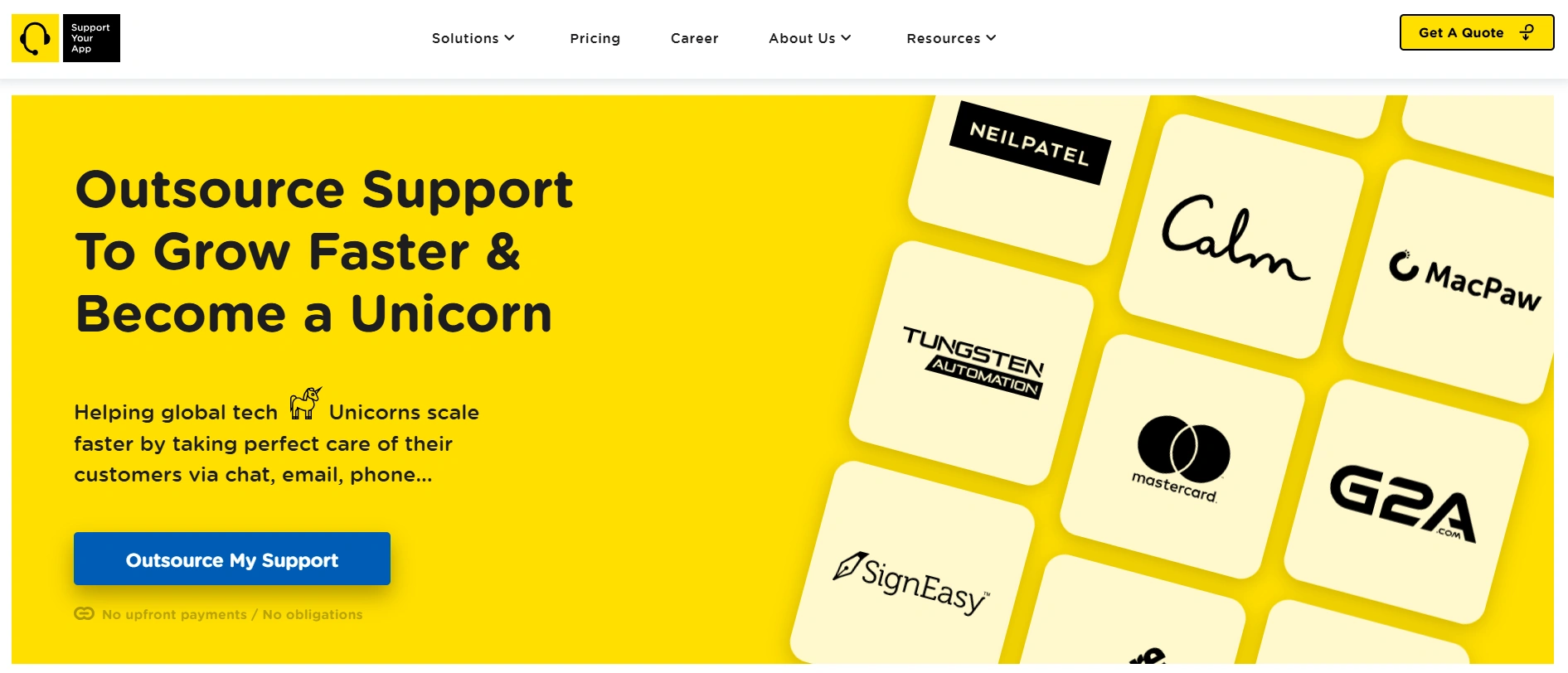
Founded in Kyiv, Ukraine, in 2010, SupportYourApp is a global Intelligent Support-as-a-Service company that provides customer and technical support for SaaS, software, fintech, ecommerce, and other technology-driven businesses. Now headquartered in Wilmington, Delaware, it offers 24/7 assistance in more than 60 languages.
SupportYourApp covers technical support from L0 to L3, handling everything from account and product issues to advanced troubleshooting and escalations. Human agents and AI agents resolve routine L1 requests, while more complex technical issues go to human specialists with the expertise to investigate and resolve them. The company can also scale dedicated or shared support teams to match ticket volumes, business growth, and changing requirements.
Its teams support customers through phone, email, live chat, and other channels, integrating with clients’ existing help desk, CRM, and ticketing systems.
SupportYourApp Overview
- Best for: SaaS and technology companies that want AI agents to handle routine requests and human specialists to resolve complex issues
- Founded and HQ: Founded in 2010 in Kyiv, Ukraine; headquartered in Wilmington, Delaware
- Delivery: Hubs in several countries; serves clients in 30+ countries
- Team size: 1,500+ specialists
- Languages: 60+
- Certifications: PCI DSS Level 1 and ISO 27001
- Pricing model: Custom quotes
- Notable clients: Mastercard, Calm, MacPaw, and Glovo
- Ratings: Clutch 4.8 (87 reviews); G2 4.8 (18 reviews)
- Limitations: Doesn’t publish pricing or list its delivery countries
Main features:
- Provides L0–L3 technical support, from basic troubleshooting to complex product issues and technical escalations.
- Uses voice and text-based AI agents to handle repetitive requests, along with an AI assistant that helps technical support teams resolve issues faster.
- Integrates with existing help desk, CRM, and ticketing systems, and offers help desk integration and migration services.
- Maintains security certifications including PCI DSS Level 1 and ISO/IEC 27001, and states that its operations align with GDPR, CCPA, and HIPAA requirements.
#3 TP (formerly Teleperformance)
TP, formerly known as Teleperformance, is one of the world’s largest customer experience outsourcing providers. Its operations span around 100 countries, with clients in approximately 170 countries and support available in more than 400 languages and dialects. In the US market, TP combines domestic, nearshore, and offshore delivery with work-at-home programs, giving large organizations several options for managing support at scale.
Technical support is part of TP’s broader customer service offering rather than a standalone focus. Its teams help consumers and business users install, operate, and troubleshoot products, and they also provide technical assistance to clients’ own employees. This makes TP an option for companies that want to combine technical support with a wider customer experience operation.
TP Overview
- Best for: Global enterprises that need extensive language and country coverage and want technical support as part of a broader customer experience contract
- Founded and HQ: Nearly five decades in operation; headquartered in Paris, France
- Delivery: Operations in around 100 countries
- Team size: Not published
- Languages: 400+ languages and dialects
- Certifications: ISO 27001, ISO 27701, ISO 42001, PCI DSS, SOC 2 Type I and II, and HIPAA/HITRUST
- Pricing model: Not published
- Notable clients: Not published
- Ratings: Clutch no reviews listed; G2 4.1 (20 reviews)
- Limitations: TP is restructuring and conducting a strategic review of its business portfolio, which may be relevant to companies assessing its longer-term direction
Main features
- AI-powered support: Offers the TP.ai suite, including TP.ai Connect and TP.ai Assist, to support self-service and help agents handle requests more efficiently.
- Omnichannel delivery: Provides customer support across phone, chat, and digital channels.
- Technical support for customers and employees: Helps end users troubleshoot products while also supporting the technology needs of clients’ own workforces.
#4 Fusion CX (formerly Fusion BPO Services)
Fusion CX, formerly known as Fusion BPO Services Group, has provided call center outsourcing services since 2004. Today, it serves more than 200 businesses with a workforce of 17,500+ people across 40+ delivery centers in 13 countries. Its technical support offering covers L1–L3 issues through a 24/7 help desk available in 28 languages, including assistance with platforms and applications.
Fusion CX supports a broad mix of industries, including healthcare, finance, telecommunications, energy and utilities, education technology, IT, travel, and startups. This range of experience, combined with its international delivery network, gives companies options for building support operations across different markets and time zones.

Fusion CX Overview
- Best for: Companies that need multilingual help desk coverage and a choice of nearshore and offshore delivery locations
- Founded and HQ: Founded in 2004; headquarters in Norcross, Georgia, and Kolkata, India
- Delivery: 40+ delivery centers across 13 countries
- Team size: 17,500+ people
- Languages: 28 for help desk coverage
- Certifications: PCI DSS and ISO/IEC 27001
- Pricing model: Not published
- Notable clients: Ameriflex, Leonardo Hotels, and Telaid
- Ratings: Clutch 4.6 (16 reviews); G2 no reviews listed
- Limitations: Its website doesn’t publish information on SOC 2 or HIPAA status, so companies with those specific compliance requirements may need to request further details
Main features
- Large, diverse workforce: Employs more than 17,500 CX professionals and has received Frost & Sullivan’s Best Practices Technology Innovation Leadership Award for North American customer experience management.
- 24/7 multilingual support: Provides round-the-clock technical assistance through multilingual and multichannel service options.
- Global delivery capabilities: Combines technology, infrastructure, and talent from multiple regions to support clients across different markets and operating needs.
#5 Foundever
Foundever, formerly Sitel Group, is a global customer experience company with approximately 130,000 associates across 45 countries. Its technical support practice includes multilingual IT service desks for consumers and businesses, using ITIL and Knowledge-Centered Service (KCS) methods to manage and resolve issues. Support is available through email, live chat, self-service resources, and chatbots. In the US, Foundever operates more than 10 locations with over 11,000 associates, around half of whom work from home.
This combination of onshore delivery and remote staffing gives Foundever options for supporting US customers while drawing on its broader international network. Its IT service desk capabilities also make it relevant to organizations that need structured support processes across multiple languages and channels.
Foundever Overview
- Best for: Enterprises that need a multilingual IT service desk with US-based and work-at-home support capacity
- Founded and HQ: More than 30 years of operations; headquartered in Luxembourg
- Delivery: 45 countries, including 10+ US locations
- Team size: Approximately 130,000 associates globally
- Languages: 60+
- Certifications: ISO 27001, PCI DSS, SOC 1 and SOC 2, and HITRUST/HIPAA
- Pricing model: Not published
- Notable clients: Not published
- Ratings: No verified Clutch or G2 rating found
- Limitations: Foundever recently completed a debt recapitalization and appointed a new CEO. Companies evaluating the provider should clarify account leadership and transition plans during the selection process.
Main features
- AI-powered operations: Uses conversational AI, generative AI, a unified agent desktop, and intelligent automation to support service delivery.
- Support for regulated programs: Offers EverTeam, a HITRUST-certified agent application designed for regulated support operations.
- Structured service desk processes: Applies ITIL and KCS practices to help teams manage knowledge, troubleshoot issues, and deliver consistent IT support.
#6 Concentrix
Concentrix is a Nasdaq-listed customer experience company headquartered in Newark, California. It has approximately 455,000 employees across 483 locations in 74 countries, giving it the scale to support large organizations across markets and time zones. Its technical support practice provides 24/7, tiered assistance for consumer and B2B products, alongside services such as B2B technical support and IT help desk operations. In the US, its listed delivery footprint includes 11 cities, supplemented by work-at-home teams.
Concentrix also incorporates AI into its support offering, with tools designed to handle customer inquiries through self-service and assist agents with more complex interactions. For enterprises managing high support volumes across multiple regions, this combination of global delivery and AI-enabled service options may be useful.
Concentrix Overview
- Best for: Large enterprises that need AI-augmented technical support for consumer and B2B products at global scale
- Founded and HQ: Incorporated in 2009; headquartered in Newark, California
- Delivery: 483 locations in 74 countries, including 11 US cities
- Team size: Approximately 455,000 employees
- Languages: Not published; offers multilingual support
- Certifications: ISO 27001, SOC 2 Type II, and PCI DSS
- Pricing model: Not published
- Notable clients: 2,000+ clients, including 160+ Fortune 500 companies; named clients include MYOB and Nespresso
- Ratings: Clutch 3.0 (1 review); G2 4.0 (1 review). Both ratings are based on very limited review samples.
- Limitations: Concentrix has reported a substantial goodwill impairment and undertaken cost-reduction restructuring. Most of its revenue also comes from outside the US, which may matter to buyers evaluating its geographic exposure and business direction.
Main features
- AI-enabled self-service and agent support: Offers iX Hello for generative AI self-service and iX Hero for agentic AI with human oversight.
- Automated inquiry handling: States that its AI Product Support Agent handles 70% of customer inquiries.
- Global omnichannel support: Provides technical support across channels, regions, and time zones.
#7 Crescendo.ai
Crescendo is a San Francisco-based, AI-native customer experience company that combines AI agents with human specialists. Following its acquisition of PartnerHero, an outsourced support provider with approximately 3,000 CX professionals at the time of the deal, Crescendo expanded its human support capabilities and now offers native-language service in more than 50 languages.
Crescendo’s model puts AI at the front line. Its agents handle customer inquiries around the clock and pass unresolved issues to human specialists, who oversee service quality and outcomes. The company also uses an AI quality agent to score every conversation. Its pricing follows the same outcome-focused approach: clients pay when an issue is resolved, rather than simply when a ticket is routed to an agent.

Crescendo Overview
- Best for: Companies ready to adopt AI-first support with human oversight and outcome-based pricing
- Founded and HQ: Founding year not published; headquartered in San Francisco, California
- Delivery: Not published
- Team size: Not published
- Languages: 50+
- Certifications: SOC 2 Type II, ISO 27001, HIPAA, and GDPR
- Pricing model: Pay per resolution; rates not published
- Notable clients: 150+ customers worldwide
- Ratings: No verified Crescendo profile found on Clutch or G2. PartnerHero’s 4.9 rating from 6 Clutch reviews belongs to the acquired company and shouldn’t be treated as a Crescendo rating.
- Limitations: Doesn’t publish delivery locations or team size. Its AI-first model is best suited to companies comfortable with automation handling most initial customer interactions.
Main features
- 24/7 AI support: Uses AI agents to handle inquiries around the clock and transfers unresolved issues to human specialists.
- AI-powered quality assurance: Scores 100% of conversations using an AI quality agent.
- Outcome-based pricing: Charges for resolved issues rather than tickets routed to human agents.
- Native-language support: Provides human support in 50+ languages without relying on machine translation.
#8 Unity Communications
Unity Communications is a US-headquartered BPO and IT support provider that helps businesses extend their existing teams through outsourced technical support. Founded in 2009 and based in Gilbert, Arizona, the company operates delivery centers in Arizona, the Philippines, and Mexico. Its services are geared toward small and midsize businesses that want to add support capacity without building a larger in-house team, including companies outsourcing for the first time.
Unity Communications provides Tier 1 support alongside Tier 2 and Tier 3 engineering services. Its teams support businesses in the US, Canada, the UK, Australia, and Europe, with English-speaking and bilingual English-Spanish staff. This mix of support tiers and delivery locations gives clients options for balancing technical expertise, coverage, and operating costs.

Unity Communications Overview
- Best for: Small and midsize businesses seeking cost-efficient offshore or nearshore technical support teams
- Founded and HQ: Founded in 2009; headquartered in Gilbert, Arizona
- Delivery: Arizona, the Philippines, and Mexico
- Team size: 350+ agents
- Languages: English and Spanish
- Certifications: ISO 27001
- Pricing model: Publishes starting hourly rates
- Notable clients: AT&T, RingCentral, and Iyuno
- Ratings: Clutch 4.9 (44 reviews); G2 4.0 (1 review)
- Limitations: Has a smaller workforce than the global BPO providers on this list and publishes English and Spanish language coverage only.
Main features
- Proactive IT support: Helps manage different IT environments, drawing on a broad knowledge base to address client requirements and supplement in-house expertise.
- Transparent starting rates: Publishes hourly rates on its website, making it easier for businesses to estimate costs during early planning.
- Broad technical services: Covers network security and maintenance, application support, and omnichannel technical support.
#9 Qualfon
Qualfon is a global business process outsourcing (BPO) company founded in 1995. It provides contact center services and back-office processing, with approximately 12,000 employees supporting international brands across several industries. Its delivery network spans the United States, Mexico, the Philippines, Guyana, Colombia, Costa Rica, and India.
Qualfon has increasingly positioned itself around AI-governed performance programs for regulated industries, emphasizing HIPAA- and SOC-compliant production. Its core offerings include contact center support, revenue growth, and marketing operations. While its global workforce and compliance focus may appeal to organizations in regulated sectors, companies seeking technical support specifically should confirm the provider’s experience and scope of services before moving forward.

Qualfon Overview
- Best for: Regulated industries that need large-scale contact center support with strong compliance controls
- Founded and HQ: Founded in 1995; headquartered in Highland Park, Michigan
- Delivery: The United States, Mexico, the Philippines, Guyana, Colombia, Costa Rica, and India
- Team size: Approximately 12,000 people
- Languages: Not published
- Certifications: States that its production operations are HIPAA- and SOC-compliant
- Pricing model: Not published
- Notable clients: Not published
- Ratings: No Clutch reviews listed; no verified G2 rating found
- Limitations: Doesn’t list technical support as a standalone service, so companies should confirm the available technical scope, expertise, and service levels during selection.
Main features
- Focus on regulated industries: Emphasizes compliance-oriented operations and reports 36 active AI deployments across its programs.
- Global talent pool: Draws on IT professionals and other specialists across multiple delivery locations to support client operations.
#10 SupportNinja
SupportNinja is a Dallas-based outsourcing company founded in 2015 that specializes in customer and technical support for software and technology products. Its teams handle Tier 1, Tier 2, and Tier 3 issues across voice, chat, email, social media, and in-app channels, with 24/7 support availability. The company combines US work-at-home teams with delivery operations in the Philippines, Ireland, and Romania to serve clients across different markets and time zones.
SupportNinja offers more than staffed agents. Its service models range from providing individual team members to managing entire support operations and transformation programs. The company also uses its NinjaAI tools to help agents with tasks such as note-taking, editing, and quality assurance, with the goal of making support workflows more efficient.
SupportNinja Overview
- Best for: Software and technology companies seeking Tier 1–3 product support from a mid-sized outsourcing provider
- Founded and HQ: Founded in 2015; headquartered in Dallas, Texas
- Delivery: US work-at-home teams, the Philippines, Ireland, and Romania
- Team size: Not published
- Languages: Not published; multilingual support available
- Certifications: SOC 2 Type II, PCI DSS 4.0, HIPAA, GDPR, and CCPA
- Pricing model: Custom quotes for Talent-as-a-Service, Management-as-a-Service, and custom plans
- Notable clients: Vidyard, Conga, and Product Madness
- Ratings: Clutch 4.5 (1 review); G2 no reviews listed
- Limitations: Doesn’t publish pricing or supported languages, and its Clutch rating is based on a single review.
Main features
- Tier 1–3 product support: Covers technical issues at all three support levels, from routine troubleshooting to more complex product problems.
- AI-assisted workflows: Uses NinjaAI tools, including note-taking, editing, and QA assistants, to help agents work more efficiently.
- Flexible service models: Offers options ranging from staffed agents to fully managed support operations and transformation-led programs.
How Much Does Technical Support Outsourcing Cost?
Most providers quote after scoping because pricing depends on the support tier, languages, coverage hours, delivery location, and ticket volume. Expect one of four pricing models:
- Per agent hour: You pay for dedicated agents’ working hours. This model suits L1 teams and predictable volumes. .
- Monthly per agent or subscription: You pay a fixed monthly fee per full-time agent or team, often with team leads, QA, and workforce management bundled in or added on.
- Per resolution: You pay for resolved issues rather than hours.
- Managed program: The provider owns strategy, staffing, and technology for a scoped outcome, priced as a custom contract.
L2 and L3 work costs more than L1 because it requires specialists who understand your product’s architecture, integrations, and logs. To compare quotes fairly, ask each provider for the cost per resolved ticket, not just the hourly rate, and include ramp-up, training, and tooling. Helpware’s guide to the cost of outsourcing customer service breaks down the key cost drivers.
Which Provider Fits Your Support Needs?
| If you need | Look for | Providers that support this capability |
|---|---|---|
| L1–L3 coverage under one contract | Stated tiers and a documented escalation path to your engineers | Helpware, SupportYourApp, Fusion CX, Unity Communications, SupportNinja |
| AI-first deflection with human backup | AI agents, human handoff, and outcome reporting | Crescendo, Concentrix, SupportYourApp, TP |
| Very broad language coverage | 50+ languages and multi-country delivery | TP (400+), SupportYourApp (60+), Foundever (60+), Crescendo (50+) |
| Support for health data | HIPAA plus SOC 2 or HITRUST | Helpware, Foundever, TP, Crescendo, SupportNinja, Qualfon |
| An IT service desk for your employees | ITIL processes and device and access support | Foundever, Concentrix, Fusion CX |
The right provider also depends on your industry and the type of support you need. Software companies, for example, benefit from agents who understand APIs, integrations, and product-specific issues. Our roundup of SaaS technical support companies explores providers that serve these needs. For online retailers, the priority may be keeping stores and customer-facing systems running smoothly during seasonal spikes. Our guide to ecommerce technical support outsourcing covers options for handling those demands.
If you’re looking for support for your employees’ devices, accounts, and internal systems rather than help for your customers, an IT service desk may be a better fit. Our list of IT support outsourcing companies focuses on providers that handle those internal IT needs.
What to Look for in a Technical Support Outsourcing Partner
If you have decided to outsource technical support, you should know that it’s very important to choose the right partner because user satisfaction will directly depend on the quality of service. And not only that. Before signing with any vendor, evaluate how well they align with your business needs, growth plans, and service expectations.
Deep technical and industry expertise
Technical expertise is non-negotiable. An outsourced team must be able to handle tickets from Tier 1 requests to Tier 3 escalations involving infrastructure, integrations, and engineering-level troubleshooting. Moreover, agents should have expertise in your domain, whether it’s ecommerce, fintech, healthcare, SaaS, etc. Without specific knowledge related to the specific vertical, it will be difficult for them to provide full-scale assistance to users, as there are many peculiarities that are inherent to each industry.
Scalability and 24/7 coverage
Keep in mind that one day you might decide to expand into new markets, and it’s worth thinking proactively. As the business grows, you acquire more users, and, correspondingly, you must scale your support staff to service all of them without friction. The right partner should be able to scale teams up quickly and maintain a consistently high service quality. Your ideal vendor must have clear staffing plans for peak volumes. It’s hard to impress anyone with 24/7 support these days. Every company claims it on their website. Yet surprisingly, every time you call technical support, it turns out they still have working hours. To avoid this becoming an unpleasant surprise for your users, it’s worth making sure the company truly provides round-the-clock support, and that it’s not just something written in promotional materials.
Multilingual support
The ability to provide multilingual technical support is equally critical. While modern AI tools can translate customer requests in real time with impressive accuracy, they still fall short when it comes to local nuances and linguistic subtleties that agents encounter daily. Effective support requires more than just correct translation — agents need to read between the lines, understand cultural context, pick up on tone, respond with empathy, and even use humor appropriately when the situation allows. They must also adapt their communication style, manage expectations, and build trust across different markets.
Security, compliance, and data protection
Technical support teams often access sensitive systems, customer accounts, and internal tools. Your outsourcing partner must have strong security controls, access management protocols, and compliance readiness. For regulated industries, check for standards such as HIPAA, SOC 2, GDPR, PCI-DSS, or ISO certifications. This is especially important when support teams handle customer data, payment details, or internal infrastructure access.
Technology stack and omnichannel capabilities
The provider should integrate smoothly with your existing tech stack, including CRM, help desk, ticketing, monitoring, and communication tools such as Salesforce, Zendesk, ServiceNow, or Jira. Look for support across phone, email, live chat, SMS, and AI-assisted ticket routing. The best partners do not just solve issues; they improve workflows, automate repetitive tickets, and help reduce future support volume.
Proven metrics and SLAs
Ask shortlisted providers for recent performance data from clients with needs similar to yours. Focus on first contact resolution, average handle time, CSAT, and SLA adherence, and ask for the baseline behind each result. Use those figures to set realistic contractual targets, with weekly reporting and a clear escalation path from L1 support to your engineering team. A well-defined escalation process is especially important during volume spikes, when delays can put SLAs at risk. Helpware’s analysis of why support teams miss SLAs explains the common causes and how teams can address them.
AI with a human handoff
If a provider uses AI to handle support requests, find out exactly what the technology does and when a human steps in. Ask what share of tickets the AI resolves without assistance, whether agents receive the conversation history and troubleshooting steps during handoff, and who trains and maintains the system. You should also understand how the provider checks the quality of AI-generated responses alongside human interactions. Helpware’s quality assurance services cover this area. The goal is to make automation useful without leaving customers stuck when an issue needs human judgment.
Takeaways
The right technical support partner can help you resolve customer issues faster, maintain reliable service, and control support costs as your business grows. To find the right fit, compare providers based on their technical expertise, support tiers, language coverage, certifications, communication channels, and pricing models. Look beyond advertised capabilities, too. Ask shortlisted providers for first contact resolution, CSAT, and SLA adherence results from clients with needs similar to yours, and check how they measure and report those results. A short pilot with clearly defined targets can help you verify a provider’s performance on your own products before committing to a long-term contract.
Choosing a provider that matches your technical requirements, service expectations, and budget can make outsourcing a practical way to expand support capacity without taking on the full cost and complexity of building an in-house team.
Ready to compare quotes? Request a pricing estimate for your technical support team.