







Key takeaways
- Three pricing models dominate SaaS sales outsourcing: monthly retainer, pay-per-meeting, and hybrid, with dedicated-pod programs at the top end.
- The headline fee is not the whole cost. Setup, data, tools, management, and a ramp period all add to the total cost of ownership.
- Outsourcing turns a large fixed cost into a variable one and starts producing meetings much faster than an in-house hire takes to ramp.
Your product is ready and the market is large. Building an in-house sales development team to reach that market is a slow, costly, and fragile process. That’s why most growth-stage software teams reach out for outsourcing. Then they hit a wall at the research stage: nobody will tell them what it actually costs.
The pressure is real. Salesforce reports in its 2026 State of Sales that reps now spend about 60 percent of their time on non-selling work, and 57 percent of sales professionals say the sales cycle is getting longer. The market has grown to match that pressure: Grand View Research projects the sales and marketing business process outsourcing (BPO) market to reach $57.46 billion by 2030 at a 9.4 percent compound annual growth rate.
SaaS sales outsourcing means paying an external team to run part or all of your software sales motion, usually prospecting, outreach, and qualification, sometimes full-cycle closing. In 2026, businesses seeking this type of partnership should expect three pricing models (retainer, pay-per-meeting, and hybrid) and a cost that runs from a few thousand dollars a month for a shared, single-channel program to $15,000 or more for a dedicated pod. Our ranked picks below, matched to different needs: Helpware, Martal Group, SalesRoads, Belkins, CIENCE, Callbox, memoryBlue, and MarketStar.
What SaaS Sales Outsourcing Is
SaaS sales outsourcing is the practice of delegating part or the entirety of your software sales processes to an external team that works under your brand, ideal customer profile (ICP), and messaging. Most engagements cover the top of the funnel: prospecting, list building, cold outreach across email, phone, and LinkedIn, and qualifying prospects into booked meetings. Some extend into demos, negotiation, and closing.
It helps to separate two things buyers mean by the term. One is low-cost appointment setting, where a vendor books meetings on volume. The other is a fully managed program that runs account research, messaging, and coordinated omnichannel outreach against a tight ICP, then reports on pipeline rather than activity. The gap between those two is where most of the disappointment, and most of the success, lives.
SaaS Sales Outsourcing Pricing Models in 2026
Four structures cover almost every quote you will receive. Match the model to your cash flow, your risk tolerance, and how much control you want over meeting quality.
| Pricing model | How you pay | Best fit |
|---|---|---|
| Monthly retainer | A flat monthly fee for a dedicated or shared SDR or pod. Predictable budget. | Ongoing pipeline once you have a proven motion to scale. |
| Pay-per-meeting | A fee for each held, qualified meeting, commonly $150 to $600 per meeting. | Pilots and narrow, well-defined ICPs where you want to pay for output. |
| Hybrid | A lower base retainer plus a per-meeting or per-opportunity bonus. | Aligning incentives when you want the vendor invested in outcomes. |
| Dedicated pod / department | A premium retainer for a team: SDRs plus sales operations, coaching, and success. | Scaled programs with a proven playbook and internal sales leadership. |
One structural note: published pricing is uncommon, which is exactly why cost comparisons are hard. Providers that post rates are the exception. SalesRoads lists roughly $8,000 to $10,000 a month for a high-quality program on its site, and notes that cheaper solutions run about half that. When a quote looks unusually low, chances are one of the cost layers below got cut. Ask which one.
The Real Total Cost of Ownership: Five Cost Layers Most Quotes Hide
The monthly retainer is the number you see. It is rarely the number you pay in reality. A useful vendor quote breaks into five layers. When a provider omits one, you usually pay for it later in bounced lists, thin coaching, or a slow ramp.
| Cost layer | What it covers | Why it matters |
|---|---|---|
| Retainer or base fee | The headline monthly figure for the SDRs or pod. | The only layer most quotes show up front. |
| Setup and onboarding | One-time ICP research, playbook build, list build, domain and inbox setup. Setup fees are common. | A program that skips real onboarding starts dialing before it understands your buyer. |
| Data and tools | Contact data, enrichment, dialer, sequencing, and deliverability infrastructure. | Skip this, and you run outreach against stale lists, with your brand on the bounces. |
| Management and strategy | The strategist, coaching, quality assurance, and weekly reporting. | The first thing cheap quotes cut. Activity dashboards rise while pipeline flatlines. |
| Ramp | The first 30 to 90 days, when cost per meeting runs higher before output stabilizes. | Judge a program too early and you misread a ramp curve as a failure. |
In-house SDR vs Outsourced Program
The build-versus-buy math tips many SaaS teams toward outsourcing once they count the whole picture, not just base salary. An in-house sales development representative means paying for benefits, tools, management time, recruiting, and turnover on top of pay.
| Factor | In-house SDR | Outsourced program |
|---|---|---|
| Time to first meetings | Three to four months to hire and ramp | Two to four weeks to launch outreach |
| Cost structure | Fixed: salary, benefits, tools, management, recruiting, and turnover | Variable: a monthly fee you scale up or down |
| Scaling | A hire-and-fire cycle with severance and recruiting | Typically a 30-day notice with the vendor |
| Institutional knowledge | Stays inside your team | Sits with the vendor unless you require shared recordings and CRM access |
The Bridge Group’s sales development research puts average SDR ramp at roughly three months and average tenure at about 16 to 18 months, so you pay a full quarter before steady output and replace the rep inside two years. An outsourced team arrives already ramped, which is the speed advantage you are buying.
Top SaaS Sales Outsourcing Companies for 2026
Our rankings are compiled using publicly available information and objective evaluation criteria. We strive to ensure every ranking is fair, transparent, and based on the same methodology for all companies.
How we ranked these providers
We scored each provider on five things a typical SaaS buyer cares about:
- Track record selling software.
- Model fit (top-of-funnel SDR work versus full-cycle).
- Pricing transparency.
- Data and quality assurance rigor.
- Delivery footprint including compliance.
We rank ourselves on this page, so instead of asking you to trust the order, we’re handing you the selection and letting you weigh it against your own business needs.
| Provider | Best for | Model | Published starting price | Rating |
|---|---|---|---|---|
| Helpware | Integrated sales, customer success, and AI | Managed teams / staff augmentation | Quote-based, starts at $8–$15 / h | 4.9/5 (G2) |
| Martal Group | North American and EMEA market entry | Fully managed + fractional | Not publicly listed | 4.6/5 (G2) |
| SalesRoads | US-based, phone-first outreach | Dedicated SDR department | ~$8,000–$10,000 / mo (own site) | 4.9/5 (G2) |
| Belkins | Email and LinkedIn appointment setting | Retainer | Not publicly listed | 4.8/5 (G2) |
| CIENCE | Research-driven multichannel outbound | Retainer + setup | Not publicly listed | 3.7/5 (G2) |
| Callbox | Multichannel outreach with nurture | Retainer | Not publicly listed | 4.5/5 (G2) |
| memoryBlue | SaaS and tech SDR across NA and EMEA | Retainer / pod | Not publicly listed | 4.6/5 (G2) |
| MarketStar | Enterprise and channel sales at scale | Managed / pod | Not publicly listed | Unavailable |
1. Helpware—best overall for integrated sales, customer success, and AI
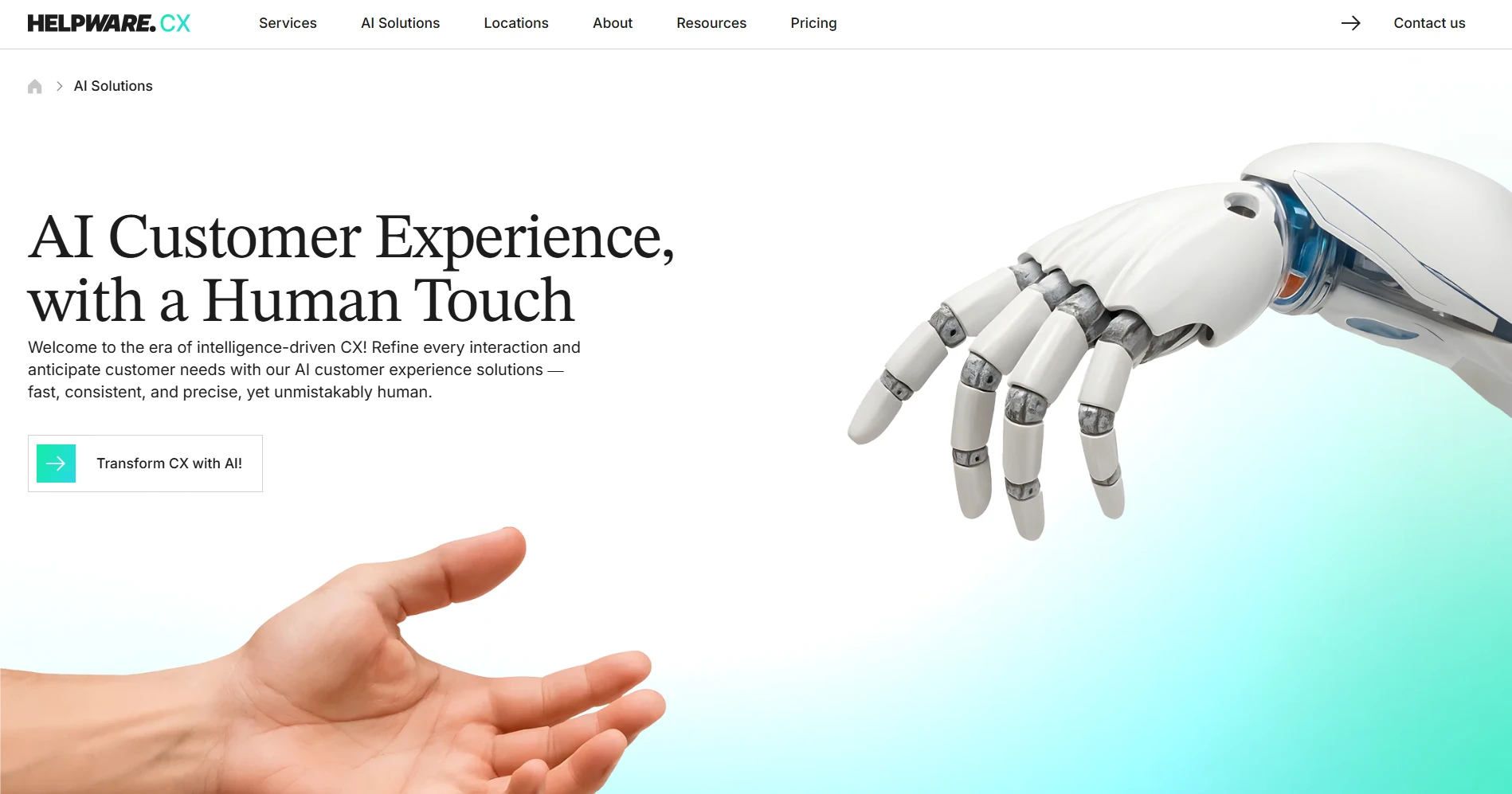
Best for: SaaS teams that want outreach, onboarding, customer success, and support from one partner, with AI-augmented delivery, instead of a standalone cold-calling vendor.
Founded in 2015 and headquartered in the United States, Helpware is an integrated business process management provider spanning four divisions: CX, AI, and Tech. Outsourced sales and customer success sit inside the CX division, covering lead generation and account management. SaaS is among the company’s focus industries, with software clients including Zendesk and Samsara. The delivery footprint runs to 4,000-plus team members across 19 locations in 11 countries on four continents, with 45-plus languages supported.
For software companies, Helpware combines outbound sales with customer success and support to help both win and retain customers. The company also uses AI tools, including agent assist and quality assurance automation. Its compliance program includes SOC 2 Type II, ISO 27001, ISO 9001, HIPAA, and GDPR, and it reports a 90 percent CSAT across client programs.
Where a specialist wins: Helpware is strongest for companies that need support across the full customer journey, from sales to customer retention.
2. Martal Group—best for North American and EMEA market entry
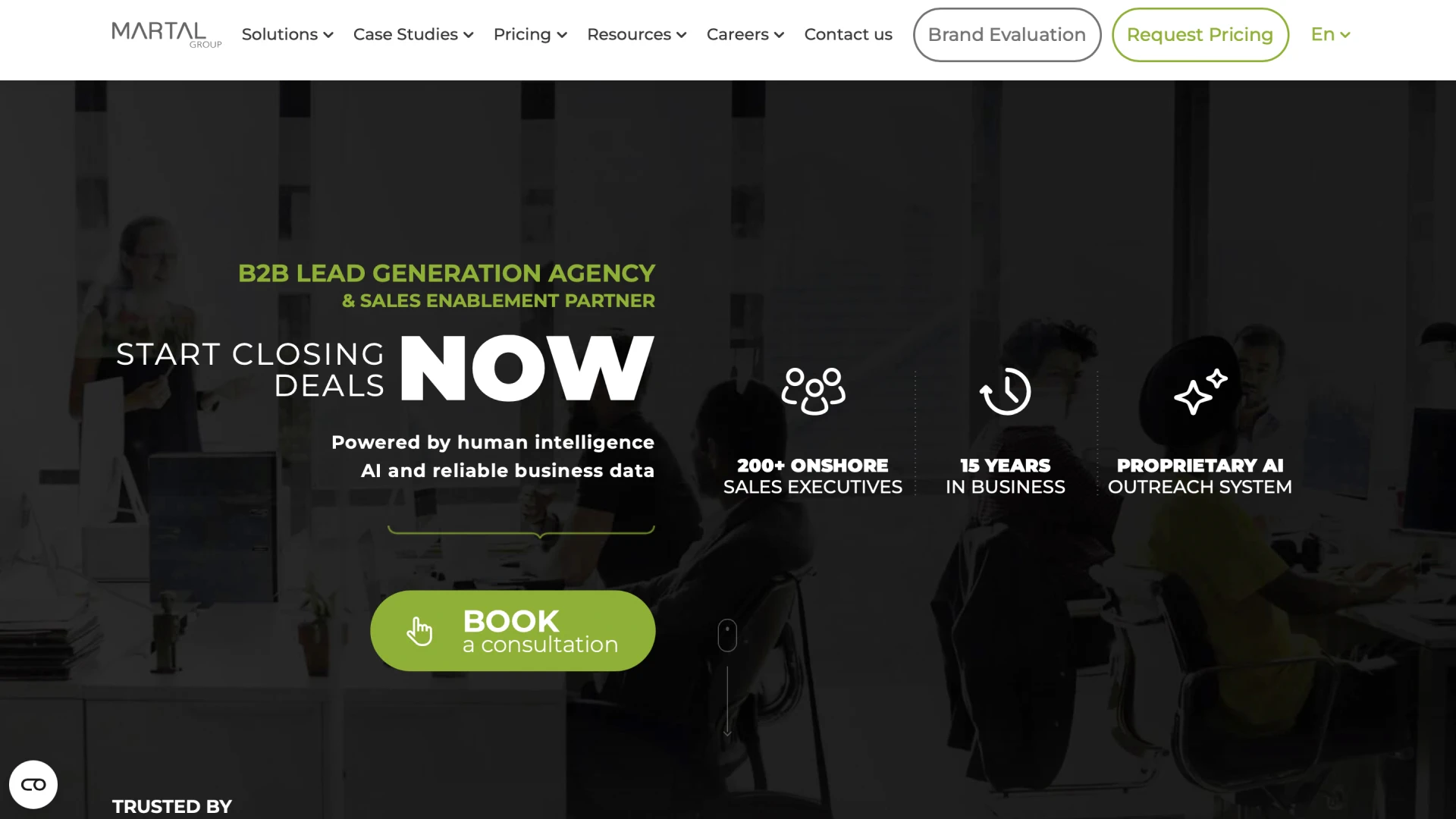
Best for: Software companies with an established product that want to enter North American or EMEA markets without hiring a local sales team.
Martal Group has more than 16 years of B2B outbound sales experience and has worked with over 2,000 companies. It specializes in helping SaaS and technology businesses expand into North America and EMEA. The company offers both fully managed and fractional sales teams, measures success by pipeline contribution instead of activity metrics, and supports SDRs with dedicated sales operations.
Watch for: Martal serves many industries, not just SaaS. Pricing is quote-based, so ask for the expected cost per qualified meeting based on your average contract value.
3. SalesRoads—best for US-based, phone-first outreach
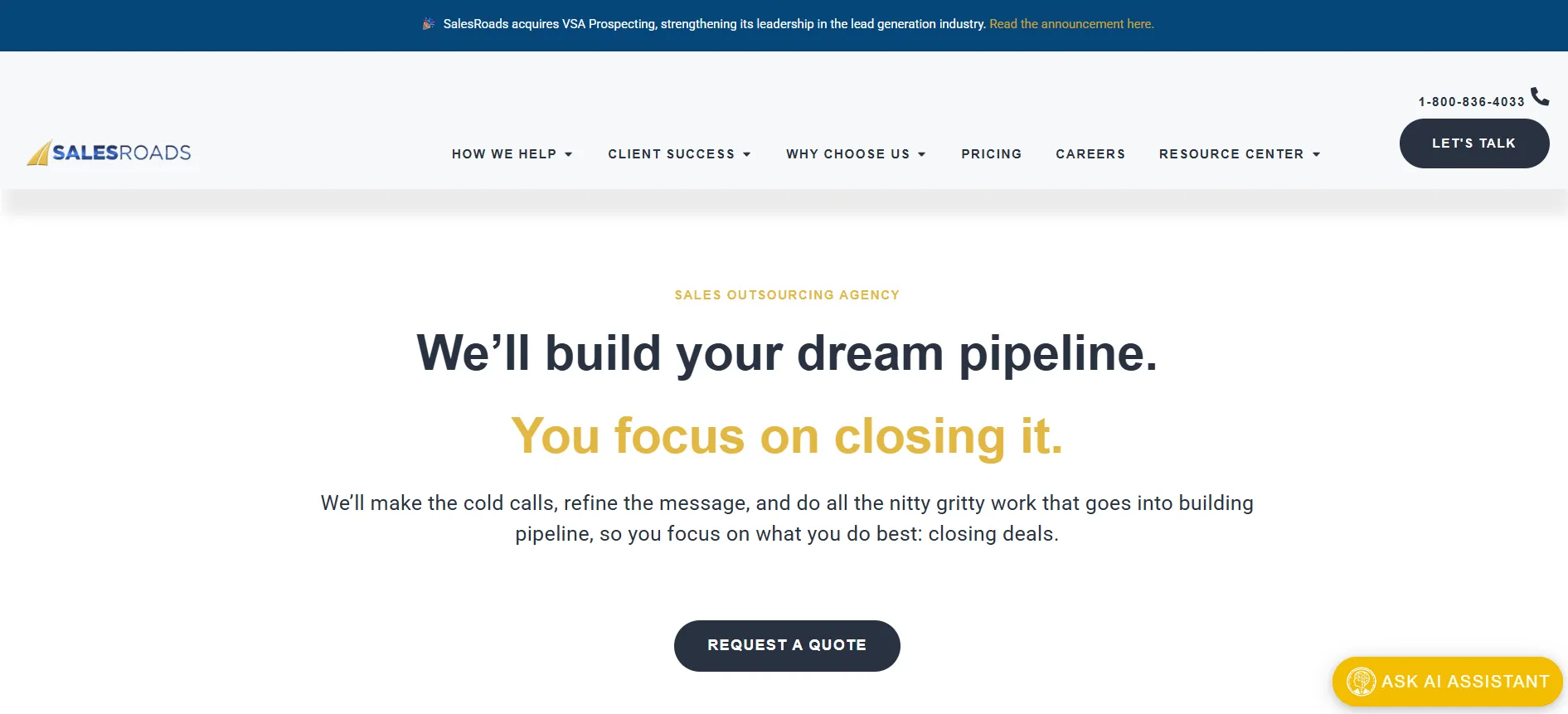
Best for: High-value B2B and SaaS sales that benefit from experienced US-based sales development representatives.
Founded in 2007 and headquartered in Boca Raton, Florida, SalesRoads runs a 100 percent US-based SDR bench and a phone-first model, with more than 500 clients and 100,000-plus appointments set over 17-plus years. Engagements bundle SDRs with sales operations, a client success director, and talent development. It offers cancel-anytime terms and a 28-day satisfaction guarantee, and it acquired VSA Prospecting in 2025.
Pricing: Its own site lists roughly $8,000 to $10,000 a month for a high-quality program, with cheaper options at about half that. One of the few providers that posts a number.
Watch for: The model is phone-led and does not use LinkedIn outreach, and the price sits at the premium end.
4. Belkins—best for email and LinkedIn appointment setting
Best for: Teams that want top-of-funnel reach through email and LinkedIn prospecting with active messaging testing.
Belkins focuses on outbound email and LinkedIn appointment setting for SaaS and technology companies, emphasizing campaign volume and message testing to create early engagement.
Watch for: The focus is top-of-funnel, so you keep the closing motion in-house, and pricing is set by quote.
5. CIENCE—best for research-driven multichannel outbound
Best for: Companies that want data and research at the core of an outbound program run across multiple channels.
CIENCE runs research-led, multichannel outbound (market research, appointment setting, and outreach campaigns) backed by its own technology stack, aimed at identifying and converting high-value prospects.
Watch for: pricing layers up across a base fee, setup, and platform licensing, so itemize the full quote. Pod quality is worth scrutinizing before you sign.
6. Callbox—best for multichannel outreach with nurture
Best for: SaaS teams that want appointment setting plus lead nurturing across email, phone, social, and chat.
Callbox takes a multichannel approach with built-in lead qualification and pipeline progression, and staffs globally. It suits companies that want nurture alongside appointment setting rather than pure top-of-funnel volume.
Watch for: if you want only top-of-funnel appointment setting with no nurture component, the broader model is more than you need. Pricing is by quote.
7. memoryBlue—best for SaaS and tech SDR across NA and EMEA
Best for: Software companies wanting a tech-focused SDR program with North American and European coverage.
memoryBlue is a tech-focused sales development and appointment-setting firm that acquired Operatix in 2023, extending its coverage across North America and EMEA for B2B software.
Watch for: after the acquisition, confirm who staffs your pod and how the two teams are integrated. Pricing is by quote.
8. MarketStar—best for enterprise and channel sales at scale
Best for: larger software organizations running inside sales, channel sales, and global expansion programs.
MarketStar delivers enterprise-level sales outsourcing across inside sales, channel sales, and global expansion, and expanded its revenue-acceleration capabilities by acquiring Regalix and Nytro.ai in 2023. It fits complex environments where scale, regional coverage, and partner coordination matter.
Watch for: this is enterprise-tier scope, not the right fit for a 10-person startup pilot. Pricing is by quote.
How to Choose a SaaS Sales Outsourcing Partner
Choose the partner that owns targeting and reports on pipeline, not the one with the lowest dial-count promise. The recurring red flags are easy to spot with a short checklist you can raise on the first call.
| What to evaluate | Green flag | Red flag |
|---|---|---|
| Targeting and data | Owns ICP research and list building; treats data quality as the core job | Expects you to supply lists; vague on how prospect data is sourced |
| Reporting | Weekly reporting on pipeline contribution and meeting quality | Monthly activity dumps (dials, emails sent) with no quality view |
| Focus | A dedicated or fractional team that owns your account | One rep spread across many clients, so attention is thin |
| SaaS fit | Already sells into SaaS or an adjacent software vertical | Generalist with no software track record |
| Meeting quality | A written definition of a qualified meeting before signing | Volume promises with no definition of qualified |
| Pricing | Publishes or itemizes the full quote | Vague, contact-us-only, with hidden layers |
What real buyers say
Buyer communities are candid about what works and what disappoints. The pattern across threads: outsourcing scales a motion you have already proven, and it stalls when a company hands over both strategy and execution before founder-led sales has cracked the model.

“Before outsourcing, you need to know what messaging converts. handing that problem to an agency before you’ve validated it yourself just means paying someone to figure it out for you.
A good outbound agency asks about your ICP before talking about their process. that’s your filter.”
Another sentiment echoed across buyers is about the importance of personalization in outreach. Generic messages stopped working in outreach a while ago, and this problem deserves attention when you’re outsourcing.
“If you do go with an agency, make sure they’re willing to test different approaches and actually iterate based on what converts, not just what gets opens. Also ask to see their templates before committing, and check if they’re personalising beyond just company name.”
When SaaS Sales Outsourcing Works, And When to Keep It In-house
Outsourcing works best when your sales process is already in place. If you know who your ideal customers are, have a clear sales approach, and can measure results, the right partner can help you grow faster. But if you’re still figuring out how to sell your product or who your target customers are, outsourcing is unlikely to solve those problems.
Outsource when
- You have a repeatable motion, and the bottleneck is simply volume.
- You are entering a new region or testing a new segment and want motion in weeks, not a hiring bet.
- You want to convert a large, fixed cost into a variable one while you validate a market.
Keep it in-house when
- You are pre-product-market-fit and still discovering who buys and why. Close your first 10 to 20 deals through founder-led sales first.
- Sales is your core differentiator, and you have a leader with the bandwidth to coach daily.
The durable pattern for most SaaS teams is a split: keep strategy, ICP, pricing, and late-stage closing in-house, and outsource the repeatable top-of-funnel work of list building, cold outreach, and qualification.
Talk to a partner that runs sales and success together
If you want to pressure-test whether outsourcing fits your stage and motion, the Helpware sales and customer success team will walk through the build-versus-outsource math for your market. Book a consultation to map a pilot to your ICP, pricing, and pipeline targets.