







Your administrative queues keep growing while your clinical staff shrinks. Claims sit in denial loops, patient calls go unanswered after hours, and hiring US-based billing and support specialists gets harder with every year. For many healthcare organizations, the challenge is no longer whether these workflows need more support—it is where that capacity should come from.
The Philippines has become one of the destinations healthcare leaders increasingly evaluate when building outsourced operations. The market combines a large healthcare-trained workforce, decades of experience supporting US businesses, and an outsourcing ecosystem built around regulated industries.
According to the Philippine Department of Trade and Industry’s export promotion arm (CITEM), the country’s healthcare information management sector generated $4.2 billion in revenue in 2024, employed 190,000 full-time professionals, and is projected to grow at a 9% CAGR through 2028. Meanwhile, a time-motion study published in the Annals of Internal Medicine found that US physicians spend 49.2% of their office day on EHR and desk work, compared with 27% on direct clinical face time with patients—highlighting the growing need to shift administrative workloads away from care teams.
But choosing an offshore healthcare BPO partner involves more than comparing labor costs. Organizations need to evaluate talent depth, compliance readiness, service models, operational resilience, and the ability to integrate with existing healthcare workflows. This guide examines why the Philippines has become a leading healthcare BPO destination, what capabilities buyers should look for, and which providers are worth considering in 2026.
Key Takeaways
- The Philippine healthcare BPO sector generated $4.2 billion in revenue in 2024 and employed 190,000 full-time professionals.
- Healthcare organizations evaluate the Philippines for its clinical talent pipeline, English proficiency, cost efficiency, compliance readiness, and ability to support 24/7 operations.
- Providers in the market publicly advertise staffing savings of 50% to 70% compared with equivalent US-based roles, although actual savings depend on scope, complexity, and engagement model.
- HIPAA does not issue an official certification. Healthcare organizations should look for a signed BAA alongside independently audited credentials such as SOC 2 Type II, ISO 27001, or HITRUST CSF.
- This guide compares seven healthcare BPO providers in the Philippines and explains which types of organizations each provider is best suited to support.
What a Healthcare BPO in the Philippines Does
A healthcare BPO (business process outsourcing) company in the Philippines helps healthcare organizations move time-consuming administrative and patient support workloads to specialized teams. These providers handle a wide range of non-clinical functions, including medical billing and coding, claims processing, revenue cycle management (RCM), insurance and eligibility verification, prior authorization, appointment scheduling, telehealth administration, patient support, and back-office data management.
The way those services are delivered depends on the operating model. In a managed services engagement, the BPO provider takes ownership of specific workflows and performance outcomes under agreed service levels. In a dedicated staffing model, the provider recruits trained specialists who work within the healthcare organization’s systems and processes while the vendor manages employment, facilities, and compliance requirements.
Choosing between the two comes down to the level of control, management involvement, and operational ownership an organization wants to maintain. Many providers support both approaches, allowing healthcare organizations to select the model that best fits their workflows and growth plans.
Why the Philippines is a Top Healthcare BPO Hub
The Philippines has become a leading destination for healthcare outsourcing because it solves several challenges healthcare organizations face at the same time: finding qualified administrative talent, maintaining patient service quality, controlling operational costs, and meeting strict data protection requirements. Five factors explain why the country continues to attract healthcare BPO investment.
A clinical talent pipeline built for healthcare work
The Philippines has a large pipeline of healthcare-trained professionals, including nurses and allied health graduates who bring valuable clinical knowledge into administrative roles. That background helps teams better understand healthcare terminology, payer requirements, and patient workflows.
For example, a billing specialist with clinical training may be better equipped to interpret medical documentation, while a healthcare support agent can handle patient conversations with a stronger understanding of care processes. As per a CITEM report mentioned above, the country has more than 400 companies operating in healthcare information management, creating an established ecosystem of specialized talent and experience.
English proficiency and cultural alignment with US healthcare
The Philippines has a long-established advantage in English-based business operations. English is widely used in education, government, and professional settings, making it one of the country’s strongest differentiators for customer-facing healthcare work.
According to the Philippine Statistics Authority’s 2024 Functional Literacy, Education, and Mass Media survey, nine in ten Filipinos have basic literacy and seven in ten have functional literacy. Decades of economic and institutional ties with the US have also created familiarity with American business practices, including healthcare terminology, insurance structures, payer workflows, and patient expectations.
For phone-heavy healthcare operations, that combination of language ability and cultural familiarity can shorten training cycles, improve communication quality, and support stronger first-contact resolution.
Cost economics that change the math
Cost efficiency remains one of the biggest reasons healthcare organizations consider outsourcing to the Philippines. Philippine delivery costs are significantly lower than equivalent US staffing, with providers across the market publicly advertising savings between 50% and 70% per role compared with domestic hires.
At that scale, outsourcing can turn administrative staffing from a fixed cost into a more flexible operating expense, allowing organizations to redirect resources toward clinical teams, technology investments, and growth initiatives. However, buyers should treat advertised savings as a starting point and evaluate fully loaded costs, including setup, licensing, management, and technology fees.
A compliance-mature delivery environment
Healthcare organizations cannot outsource around compliance requirements. HIPAA obligations follow protected health information (PHI), regardless of where the work is performed. Any offshore vendor handling PHI must operate as a business associate and sign a business associate agreement (BAA).
The Philippine healthcare BPO market has matured around these requirements. Leading providers support HIPAA-aligned operations and maintain independent security credentials such as SOC 2 Type II, ISO 27001, and HITRUST CSF. They also operate under local privacy requirements, including the Philippine Data Privacy Act (Republic Act 10173), enforced by the National Privacy Commission.
The right compliance framework matters because outsourcing decisions should be based on verified controls, not vendor claims. The partner selection section below explains what each credential actually demonstrates.
Government backing and round-the-clock coverage
The Philippines’ healthcare outsourcing industry has benefited from active government support. CITEM promotes the sector internationally, while PEZA economic zone incentives help maintain the country’s competitiveness as an outsourcing destination.
The country’s time zone provides another operational advantage for US healthcare organizations. Philippine night shifts align with US business hours, allowing claims teams, authorization specialists, and patient support agents to provide extended coverage without requiring organizations to build large domestic overnight teams.
7 Healthcare BPO Providers in the Philippines to Choose From
The Philippines has no shortage of healthcare BPO providers, but the right choice depends on your operating model, workflows, and priorities. Some providers specialize in patient-facing support and telehealth, while others focus on revenue cycle management, dedicated staffing, or large-scale healthcare operations.
Below are seven healthcare BPO companies worth considering in 2026 and the types of organizations they are best suited for.
| Provider | Model | Healthcare focus | Published compliance credentials | Best for |
|---|---|---|---|---|
| Helpware | Managed CX teams + staff augmentation | Patient support, telehealth ops, back office, technical support | HIPAA, SOC 2 Type II, ISO 27001, ISO 9001, GDPR | Patient-facing CX and telehealth operations |
| Access Healthcare | Managed RCM services | End-to-end revenue cycle, coding, automation | HITRUST, PCI DSS, SOC, ISO 27001, ISO 9001 | Enterprise RCM at hospital-system scale |
| TaskUs | Digital-first managed services | Enrollment, telemedicine support, billing, claims | Third-party HIPAA attestation, SOC 2 reporting | Digital health and HealthTech platforms |
| MicroSourcing | Managed operations + offshore staffing | Coding, billing, EHR management, claims | ISO 27001, ISO 9001; hosts HIPAA and PCI DSS compliant operations | Payers and providers building large offshore teams |
| Connext | Dedicated staffing (co-management, EOR) | Medical billing, eligibility, patient support | HIPAA-compliant, SOC 2 | Groups that want embedded staff under their own control |
| Magellan Solutions | Call center + BPO services | Healthcare call center and medical insurance support | Published on request | Small and midsize practices |
| Outsourced | Dedicated offshore staffing | Medical billing, coding, healthcare admin roles | Published on request | Named full-time specialists at fixed monthly rates |
#1 Helpware
Founded in 2015, Helpware operates delivery centers in Manila and Cebu as part of a global footprint spanning 19 locations across 11 countries. Healthcare and telehealth are among its core verticals, with teams supporting patient scheduling, insurance verification, HIPAA-compliant technical support, medical answering services, and multilingual patient support in 45+ languages.
Helpware works with healthcare organizations including Headspace and NexHealth and maintains HIPAA, SOC 2 Type II, ISO 27001, ISO 9001, and GDPR credentials. The company boasts a 90% customer satisfaction score, an average client partnership length of more than five years, and documented client results including a 44% reduction in average handling time and a 33% improvement in first-contact resolution.
Best for: Healthcare and telehealth organizations looking for patient-facing CX, operational support, and compliance-focused outsourcing.
#2 Access Healthcare
Access Healthcare is one of the largest healthcare revenue cycle management providers on this list. The company operates 19 delivery centers across the US, India, and the Philippines and employs more than 15,000 people globally.
Its services focus heavily on enterprise-scale RCM, including medical coding, claims management, billing operations, and automation. Access Healthcare processes more than $100 billion in accounts receivable annually and codes over 30 million charts each year, supported by more than 3,500 proprietary automation bots.
The company also maintains a broad compliance and certification portfolio, including HITRUST, PCI DSS, SOC, ISO 27001, and ISO 9001 credentials.
Best for: Large hospitals, health systems, and physician groups that need enterprise-level revenue cycle expertise and automation capabilities.
#3 TaskUs
TaskUs is a digital-first outsourcing provider with approximately 45,000 employees across 23 locations in 12 countries, with the Philippines serving as one of its largest delivery hubs.
Its healthcare practice supports a wide range of workflows, including open enrollment, telemedicine support, billing and coding, patient scheduling, medical device support, and claims processing. TaskUs has third-party HIPAA compliance attestation for healthcare campaigns, allowing it to sign BAAs, and provides SOC 2 reporting on its security controls.
The company’s experience working with digital businesses makes it particularly relevant for healthcare technology companies that need flexible, scalable support.
Best for: Digital health companies, HealthTech platforms, and fast-growing healthcare organizations that need to scale operations quickly.
#4 MicroSourcing
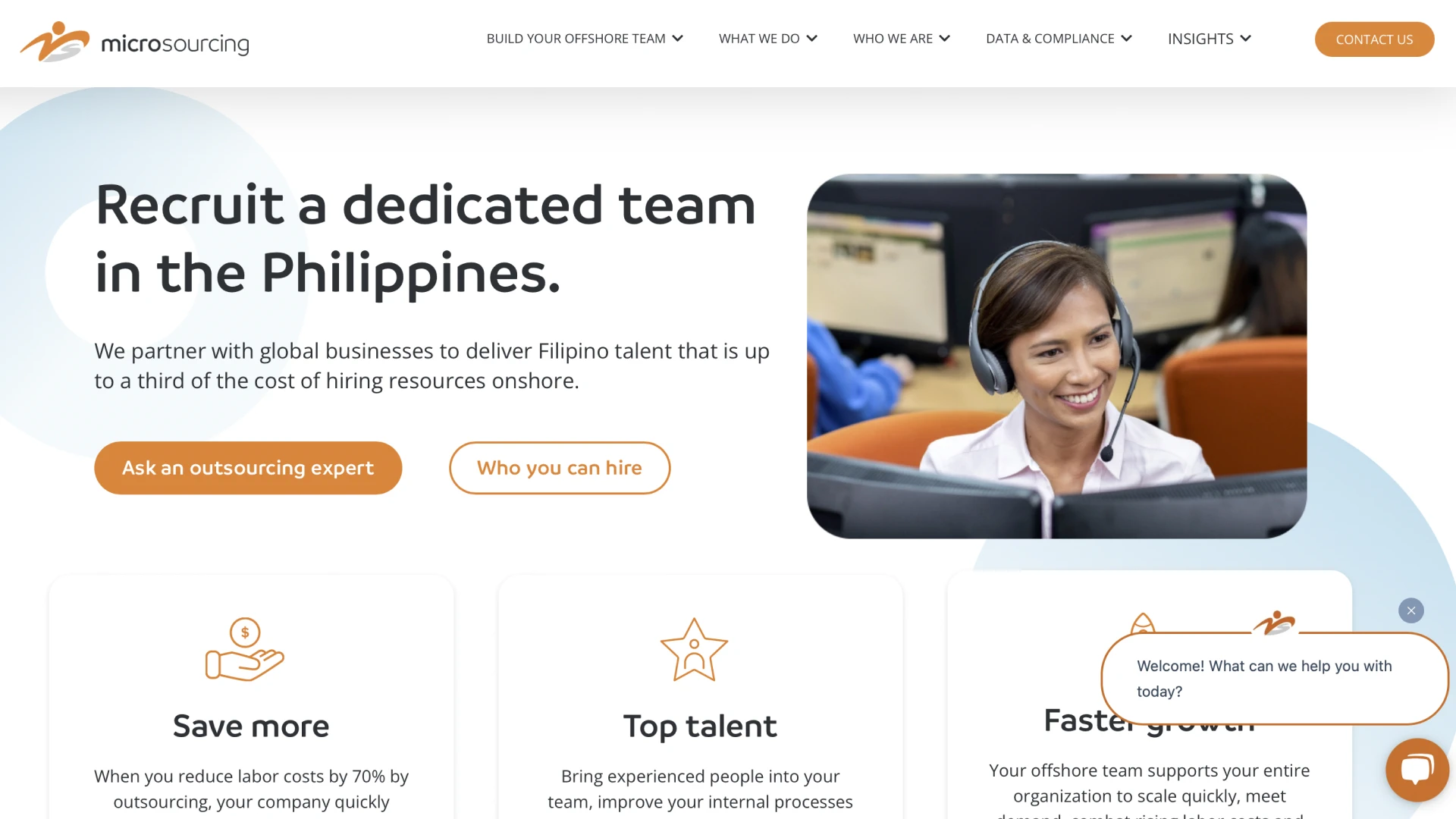
MicroSourcing builds managed offshore teams from delivery centers in Manila and Cebu, helping organizations establish long-term healthcare operations in the Philippines.
Its healthcare capabilities include medical coding, billing, EHR management, transcription, and claims analysis. The company holds ISO 27001 and ISO 9001 certifications, with yearly audits conducted by SGS, and provides HIPAA- and PCI DSS-compliant operations for healthcare, insurance, and financial services clients.
MicroSourcing’s model is designed for organizations that want to build dedicated offshore teams while maintaining closer operational control.
Best for: Payers and provider organizations looking to establish larger, long-term offshore healthcare teams.
#5 Connext
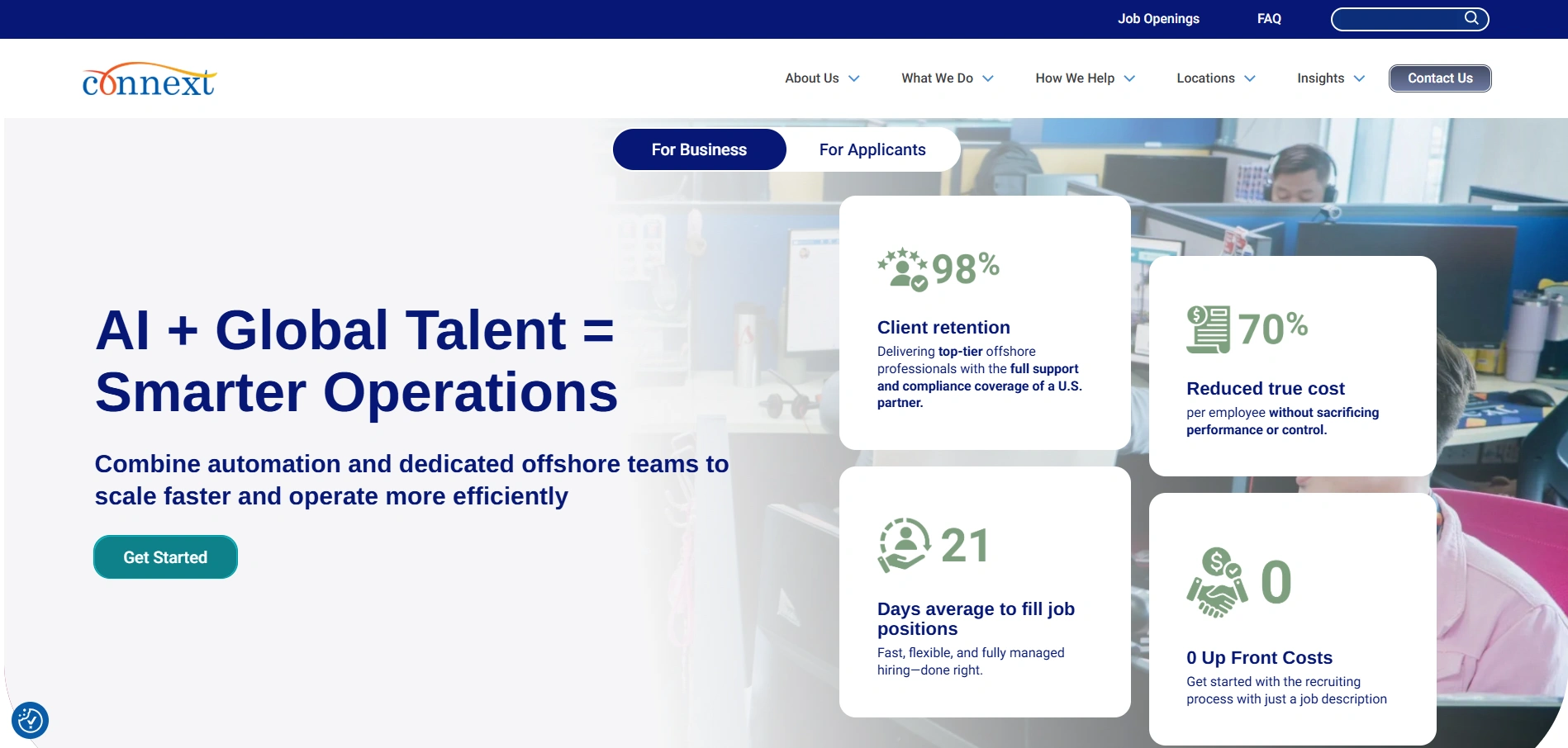
Connext focuses on dedicated staffing rather than fully managed outsourcing. The company recruits specialists who work within your workflows while Connext manages employment-related responsibilities through co-management and employer-of-record models.
Healthcare services include medical billing, eligibility verification, and patient support, supported by HIPAA-compliant operations and SOC 2 certification. The company also publishes an onboarding timeline of 30 to 60 days and targets employee turnover below 20%.
This model works well for healthcare organizations that want offshore talent embedded into their existing teams without handling international hiring, payroll, and compliance themselves.
Best for: Healthcare groups that want dedicated offshore specialists while keeping day-to-day process ownership in-house.
#6 Magellan Solutions
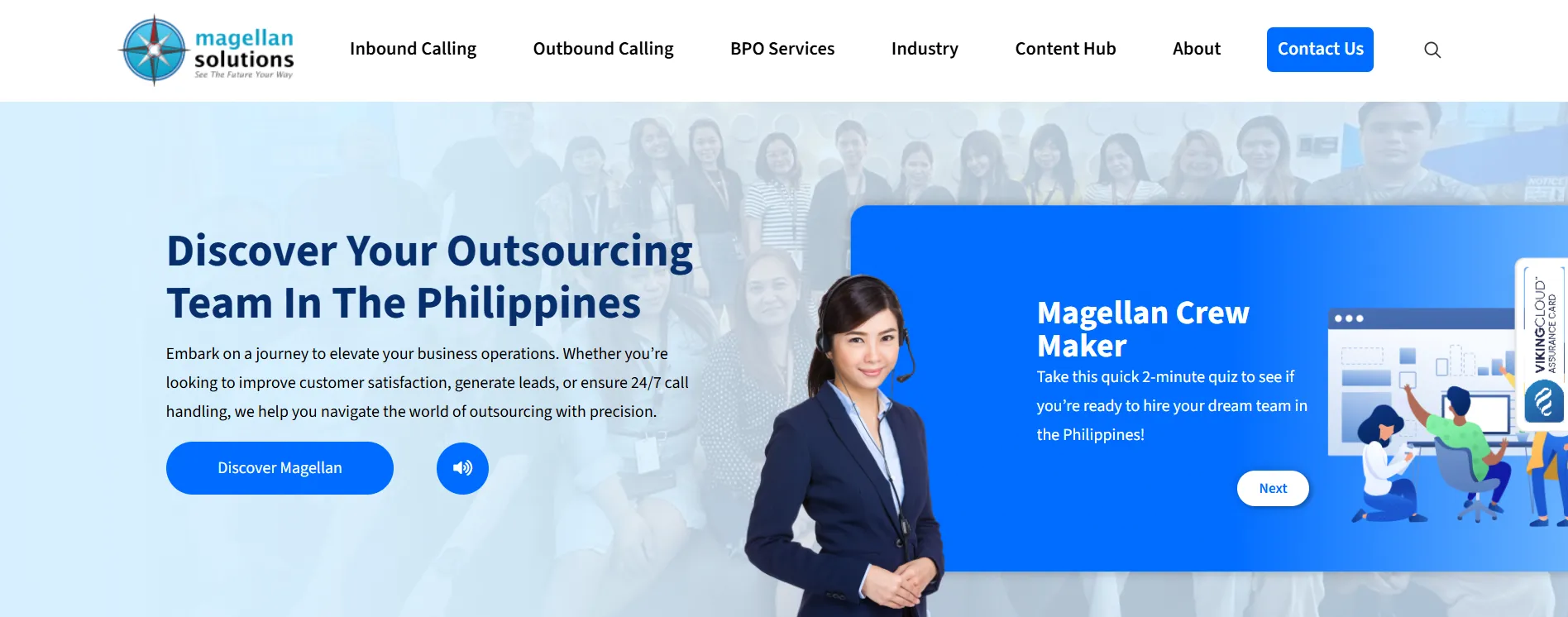
Magellan Solutions is a long-standing Philippine BPO provider serving both small businesses and large enterprises. Its healthcare services focus on medical insurance support, healthcare call center operations, and patient communication programs.
The company offers flexible engagement models that can work well for smaller healthcare organizations testing outsourcing for the first time or looking for a lower-commitment entry point.
Best for: Small and midsize healthcare practices that need healthcare call center support or want to start with a smaller outsourcing engagement.
#7 Outsourced
Outsourced provides dedicated offshore healthcare professionals in the Philippines, including medical billing specialists, claims specialists, and healthcare administrative staff.
Unlike a managed service model, Outsourced focuses on helping organizations build dedicated teams where the client selects and directs the specialists while Outsourced manages recruitment, employment, and local operations.
This approach gives healthcare organizations more direct control over processes while still benefiting from Philippine talent and offshore cost advantages.
Best for: Organizations that want dedicated healthcare specialists working as an extension of their internal team rather than a fully managed outsourcing service.
Beyond Manila: Designing a Resilient Healthcare BPO Footprint
Here’s the part many “top hub” articles miss: although the Philippines remains one of the strongest destinations for healthcare BPO, even the strongest delivery hub needs a resilience strategy. Typhoon season, local infrastructure disruptions, and unexpected volume spikes can challenge any single-location model. Mature healthcare organizations plan for continuity from the start.
Three patterns are becoming more common in resilient healthcare BPO programs:
- Multi-site delivery within the Philippines. Splitting a team across Manila and Cebu (or adding a regional delivery location) helps maintain service continuity when one metro area experiences disruption. Every provider on the shortlist above operates or has access to multiple Philippine delivery locations.
- Blended geography. Offshore Philippine teams handle the majority of operational volume, while nearshore locations (Mexico, for example) provide real-time support during US business hours, and onshore or US-territory teams manage licensed, regulated, or higher-sensitivity interactions. Helpware uses this type of hub-and-spoke model across onshore (US, Puerto Rico), nearshore (Mexico), and offshore locations to support complex healthcare and telehealth programs.
- Follow-the-sun staffing. Distributing work across multiple time zones reduces reliance on permanent night shifts, helping limit fatigue and attrition while ensuring coverage across US operating hours.
The takeaway is not that organizations should look beyond the Philippines. It is that the strongest outsourcing strategies combine the Philippines’ talent depth and cost advantages with a delivery model built for resilience. When evaluating providers, ask how their footprint handles disruptions, whether through multiple Philippine locations, blended geographies, or documented business continuity plans. A provider operating from a single site in a single city should have a clear and proven plan for maintaining service when conditions change.
How to Choose a Healthcare BPO Partner in the Philippines
Choosing a healthcare BPO partner requires more than comparing service offerings and hourly rates. The right provider needs to demonstrate that it can protect patient data, integrate into your workflows, maintain performance standards, and scale when your operational needs change.
Start with the compliance stack. HIPAA does not issue an official certification, so a “HIPAA compliant” claim on a website is not proof by itself. Instead, look for the legal agreements, independent audits, and security frameworks that show how a provider protects healthcare data.
| Credential | What it is | What it proves for you |
|---|---|---|
| BAA (Business Associate Agreement) | A mandatory HIPAA contract for any vendor handling protected health information (PHI) | Defines legal responsibilities, breach notification requirements, and required safeguards |
| SOC 2 Type II | An independent audit of security and availability controls over time | Shows that security processes work in practice, not just on paper |
| ISO 27001 | An international information security management standard | Demonstrates a certified and continuously assessed security management system |
| HITRUST CSF | A certifiable framework that aligns HIPAA, NIST, ISO 27001, and PCI DSS requirements | Provides one of the strongest forms of third-party assurance for US healthcare data protection |
| Philippine Data Privacy Act (RA 10173) | The Philippines’ national privacy law enforced by the National Privacy Commission | Adds a local legal framework for protecting personal data alongside US healthcare requirements |
Then pressure-test the rest of the partnership:
- Healthcare-specific staffing. Look beyond generic outsourcing experience. Ask how much healthcare experience the provider has, how many certified coders (CPC, CCS) and nursing-background agents support similar accounts, and whether the team understands your specialty, workflows, and payer environment.
- KPIs in the contract. Define measurable performance expectations before the engagement begins. Depending on your needs, these may include first-pass claim acceptance, denial recovery rate, days in A/R, first-contact resolution, CSAT, or other workflow-specific metrics. Vague performance language makes it difficult to hold a partner accountable.
- Fully loaded pricing. Compare the full cost of the engagement, not just the advertised hourly rate. Setup, technology, training, management, and transition costs can add 20% to 40% to headline pricing in some cases. Request a complete cost breakdown before signing.
- Continuity plan. A reliable provider should have more than a single delivery location and a clear approach to handling disruptions. Ask about multi-site operations, documented failover procedures, and how the team maintains service during events such as typhoons, internet outages, or sudden volume increases.
Also it’s important to take into account what real users say. Provider case studies show one side of the story. Independent operator communities can offer additional insight into onboarding, communication, workflow management, and the day-to-day reality of running an outsourced operation.
These discussions often highlight a point that applies across outsourcing models: success depends less on the location itself and more on how the partnership is structured—from hiring standards and training to communication practices and team integration.
One Reddit user who discussed outsourcing to the Philippines summarized the experience this way:

“the cost savings are undeniable, and there’s a massive pool of english-speaking talent, but like anything, it depends on how it’s done.
if companies just go for the cheapest hires w/out investing in training or filtering for actual skill, yeah, quality suffers. but if they hire well, pay fairly, and integrate offshore teams properly, it can work just as well as an onshore team.
from what i’ve seen at pearl talent, the biggest issue isn’t location—it’s how companies approach hiring & management. treating offshore teams like disposable labor instead of an actual extension of the company is what leads to bad results.”
The takeaway is consistent with what many outsourcing buyers learn during implementation: lower labor costs alone do not guarantee results. Clear processes, quality hiring, effective onboarding, and treating offshore teams as an extension of the business are what determine whether outsourcing delivers long-term value.
The Bottom Line
The Philippines has become a major healthcare BPO destination because several advantages work together: a deep healthcare talent pipeline, strong English proficiency, US market familiarity, competitive operating costs, a mature compliance environment, and government support for the industry. The sector’s growth—including $4.2 billion in healthcare information management revenue in 2024—reflects the scale the market has reached.
But choosing the Philippines is not just a cost decision. The right partner depends on your workflows, operational goals, compliance requirements, and the level of control you want to maintain. The organizations that see the strongest results are the ones that match the right outsourcing model to the right business need.
If patient experience, telehealth operations, and compliance are central to your priorities, Helpware can help you evaluate whether a Philippines-based model fits your goals. Start with a pilot built around your workflows and scale from there.