






A medical answering service keeps patient calls from going unanswered when your front desk is busy, your practice is closed, or demand exceeds internal capacity. Depending on the provider, the service may take messages, route urgent calls to on-call clinicians, schedule appointments, or complete administrative work directly in your practice’s systems.
The difference matters because answering a call does not necessarily resolve the request. A patient may reach an operator after hours but still need your staff to process a refill request, confirm insurance eligibility, or schedule an appointment the next morning.
According to an MGMA Stat poll, practice leaders identified eligibility and prior authorization as the most time-consuming phone-related work, followed by scheduling. These findings suggest that healthcare organizations should evaluate not only how quickly a service answers calls but also how much work it completes.
Patient expectations reinforce that distinction. In Bandwidth’s patient communication research, 42.2 percent of respondents identified scheduling difficulties as the communication problem most likely to make them switch providers. The same research found that acceptance of AI varied by task, with patients more receptive to appointment reminders than conversations about test results.
The best medical answering service therefore depends on your practice’s workload and the outcome required after each call. This guide compares ten providers across live answering, virtual receptionists, AI-powered systems, and dedicated patient-access teams, with a focus on healthcare compliance, clinical escalation, EHR integration, and pricing.
Quick Comparison of Answering Services Providers
| Your primary requirement | Providers to consider |
|---|---|
| Dedicated patient-access and administrative support | Helpware, MyOutDesk |
| On-call routing across hospitals and large medical groups | PerfectServe, TeleMed |
| Healthcare-focused live operators | MedConnectUSA, TeleMed |
| Flexible live answering and custom scripts | MAP Communications, AnswerFirst |
| Virtual reception for smaller practices | Ruby |
| AI answering with EHR integration | Talkie.ai |
| Lower-cost AI answering for routine calls | Freed Front Desk |
What Is a Medical Answering Service?
A medical answering service handles patient calls when healthcare staff are unavailable or unable to answer promptly. Services may cover overnight and weekend calls, daytime overflow, appointment requests, prescription refill messages, and communication with on-call clinicians.
Traditional answering services focus on receiving and routing information. More advanced arrangements may also support scheduling, intake, eligibility verification, and documentation in the practice’s systems.
A medical answering service can be particularly useful when call demand is unpredictable or when maintaining continuous internal staffing would be expensive. The appropriate model depends on the volume and complexity of requests, the required response time, and whether the vendor must complete tasks rather than simply relay them.
Medical Answering Versus Clinical Triage
An important distinction is the difference between routing a potentially urgent call and making a clinical assessment.
A receptionist or AI system may recognize a request involving symptoms and follow predefined escalation instructions. That does not necessarily mean the service provides clinical triage. Clinical assessment requires appropriately qualified healthcare professionals, while non-clinical operators generally follow rules approved by the practice.
For example, an operator may transfer a caller reporting concerning symptoms to the designated on-call clinician. The clinician remains responsible for assessing the medical situation and determining the appropriate response.
Ask every provider whether it offers non-clinical call classification, licensed nurse triage, or another explicitly defined service. The agreement should identify who owns the urgency criteria, who can change them, and how the service confirms that a potentially urgent message reached the intended clinician.
HIPAA and Business Associate Agreements
Medical answering services that create, receive, maintain, or transmit protected health information on behalf of a HIPAA-covered healthcare organization generally act as business associates. A written Business Associate Agreement (BAA) is required when the business associate relationship falls under HIPAA.
A BAA establishes contractual responsibilities for permitted information use, safeguards, reporting, subcontractors, and other required protections. It does not replace technical controls or define clinical escalation procedures.
Likewise, certifications such as HITRUST or SOC 2 may provide useful security assurance, but neither substitutes for a BAA where one is required.
Before allowing a service to handle patient information, confirm that the agreement covers the specific answering, messaging, AI, and subcontractor activities involved. The US Department of Health and Human Services provides guidance on the necessary contractual provisions.
Four Types of Medical Answering Services
Medical answering services generally fall into four operating models. Each solves a different problem and has a different cost structure.
| Model | What it does | Main advantage | Main limitation |
|---|---|---|---|
| Live-operator answering service | Answers calls, takes messages, and routes requests | Human answering without dedicated staffing | Internal staff may still complete most tasks |
| Virtual receptionist | Handles calls, scheduling, intake, and front-desk tasks | More complete administrative assistance | Clinical capabilities and system access vary |
| AI voice agent | Automates supported calls and administrative workflows | Handles concurrent, repetitive requests | Needs reliable integrations, monitoring, and human escalation |
| Managed patient-access team | Provides dedicated staff working in your systems | Combines call handling with administrative task completion | Requires committed staffing and implementation |
#1 Traditional live-operator answering services
Live-operator services provide human receptionists who answer calls using approved scripts and relay messages to the practice. They can also transfer calls to on-call clinicians based on established schedules and instructions. These services suit organizations that mainly need reliable after-hours coverage or overflow support. They often charge by minute or call, making them practical when contact volumes are limited or unpredictable. Their main limitation is that answering and resolving a request are different activities. If the operator cannot schedule appointments, verify information, or update your systems, internal staff may still need to process those requests later.
Providers in this category include MedConnectUSA, TeleMed, MAP Communications, and AnswerFirst.
#2 Virtual receptionist services
Virtual receptionists provide broader front-desk assistance, including appointment booking, intake information collection, and general administrative questions. They may offer a more personalized caller experience than basic message-taking, but the available functions depend on the provider’s access to the practice’s scheduling and patient information systems.
Ruby is one example of this model.
#3 AI medical answering services
AI voice agents can answer multiple calls, identify request types, retrieve approved information, and complete selected administrative workflows. Some connect directly to an EHR or scheduling platform, while others create messages or summaries for staff to review. An AI medical answering service can reduce repetitive work when the system is integrated with reliable information and authorized to perform the requested action. The main limitations concern unsupported workflows, inaccurate classification, complex patient conversations, and escalation. Practices need to confirm how patients reach a person and how the system handles requests it cannot safely complete.
Talkie.ai and Freed Front Desk illustrate different levels of AI integration.
#4 Managed patient-access teams
A managed patient-access team provides dedicated staff trained on a healthcare organization’s systems, workflows, and policies. In addition to answering calls, the same team may handle patient scheduling, insurance verification, prior authorization, and other administrative tasks. This model is useful when telephone demand forms part of a larger operational workload. Rather than transferring every unresolved request back to internal staff, the dedicated team can complete approved tasks within the practice’s systems. The trade-off is committed staffing capacity. Unlike a shared answering service that charges for calls or minutes, a dedicated team generally costs money even when call volume is low.
Helpware and MyOutDesk offer versions of this model.
What to Look for in a Medical Answering Service
Healthcare practices should evaluate answering services against the work they need completed, the risks associated with that work, and the operational responsibilities that will remain internal.
Seven factors are especially important.
| Evaluation factor | What to ask the provider |
|---|---|
| BAA and security | Will the vendor sign a BAA covering the full service and relevant subcontractors? What controls protect patient information? |
| Clinical escalation | Who defines urgency criteria, who makes clinical decisions, and how is successful message delivery confirmed? |
| EHR and scheduling | Can the provider read and update the required records, or does it only send messages? |
| Operating hours and languages | Is coverage available during the required hours and in the languages patients use? |
| Pricing | Is billing per minute, call, provider, or staffed position? What minimums and overage charges apply? |
| Continuity | How does the provider manage staff turnover, system outages, simultaneous calls, and missed escalations? |
| Performance reporting | Can the provider report answer speed, abandonment, escalation accuracy, and completed tasks? |
Define the outcome before evaluating integrations
An EHR integration can mean several different things. One service may send a message into a work queue, another may retrieve patient information, and another may book appointments or write structured notes directly into the record. These capabilities are not interchangeable. Ask vendors to demonstrate the specific workflow your practice needs, including what happens when the patient cannot be identified, the requested appointment is unavailable, or the system encounters incomplete information.
The same principle applies to service-level reporting. Answer speed matters, but it should be read alongside abandoned calls, successful clinician contact, and the amount of follow-up work returned to internal staff. Research on Veterans Health Administration call centers has linked longer telephone answer times with poorer patient perceptions of urgent-care access. The study is useful evidence for monitoring response time, although its findings should not be treated as a universal performance target for every practice.
10 Best Medical Answering Services Providers
The following providers were selected for their medical answering or patient-access capabilities, publicly described operating models, healthcare-specific controls, and relevance to US healthcare organizations.
The list does not assign numerical quality scores. Public disclosures vary across providers, and different service models cannot be fairly reduced to one universal score. Instead, each profile explains the provider’s main capabilities, pricing evidence, likely fit, and limitations.
#1 Helpware

Helpware provides dedicated healthcare support teams that can handle patient calls and the administrative work associated with them. Its healthcare services include patient scheduling, insurance verification, claims processing, and regulated back-office operations.
Unlike a shared message-taking service, Helpware’s teams work within client systems and follow client-defined procedures. The model is intended for organizations that need ongoing operational capacity across multiple workflows rather than occasional call answering.
- Best for: Multi-location practices, medical groups, telehealth platforms, and healthcare organizations with substantial patient-access or administrative workloads.
- Model: Dedicated support team or managed service.
- Delivery: 19 locations across 11 countries, with support across 45+ languages.
- Security: SOC 2 Type II, ISO 27001, and ISO 9001 certifications; HIPAA-related controls and BAA arrangements for applicable healthcare services.
- Pricing: Scoped staffing or managed-service proposals; no standard medical-answering rate card.
Considerations: Dedicated staffing is generally better suited to recurring operational work than occasional overnight messages. Low-volume practices should compare the total commitment with shared answering or AI alternatives.
#2 PerfectServe
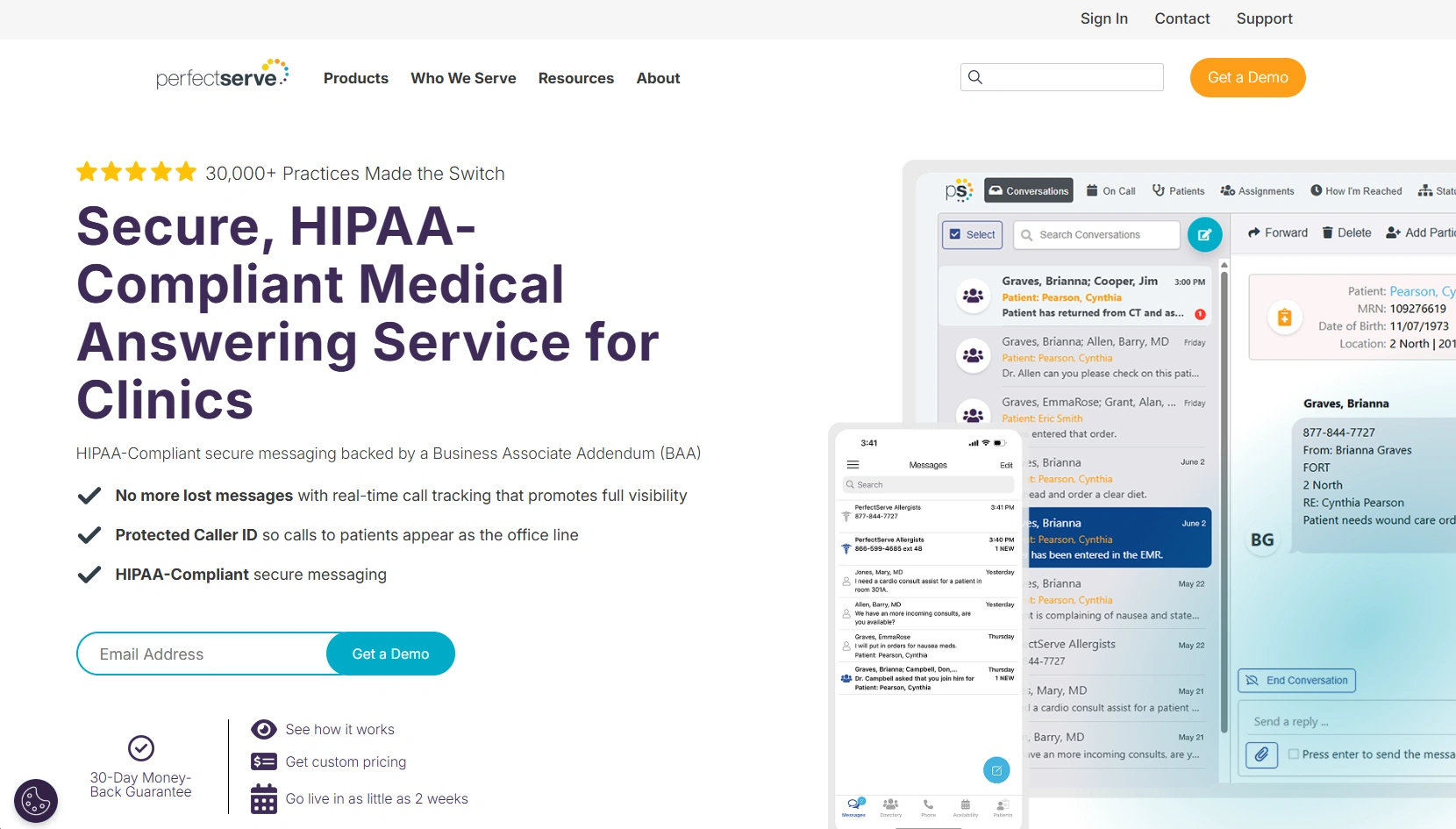
PerfectServe combines medical answering with clinical communication, physician scheduling, and on-call routing tools. Its operators follow predefined routing rules rather than independently assessing symptoms, making the platform relevant to organizations coordinating communication across multiple clinicians and departments.
- Best for: Hospitals, large physician groups, and healthcare networks with complex on-call schedules.
- Model: Enterprise communications platform with live answering and available AI functionality.
- Integration: Published integrations with major healthcare systems and clinical communication workflows.
- Security: HIPAA-oriented controls and BAA arrangements for applicable services.
- Pricing: Typically $89–$119 per doctor monthly, depending on the scope and options.
Considerations: The service offers more communication infrastructure than many small practices require. Clinical assessment remains the responsibility of qualified personnel.
#3 MedConnectUSA

MedConnectUSA specializes in medical answering with US-based operators working from company-operated call centers. Its focus is live handling of patient messages, after-hours calls, and communication with on-call clinicians under practice-specific instructions.
- Best for: Private practices and specialty groups prioritizing healthcare-focused, US-based live operators.
- Model: Live-operator answering service.
- Escalation: Call routing according to practice-approved on-call instructions.
- Security: HIPAA-related service policies and BAA arrangements described by the provider.
- Pricing: Custom quote.
Considerations: Public information about EHR integrations, languages, and exact pricing is limited, so these should be verified during the purchasing process.
#4 
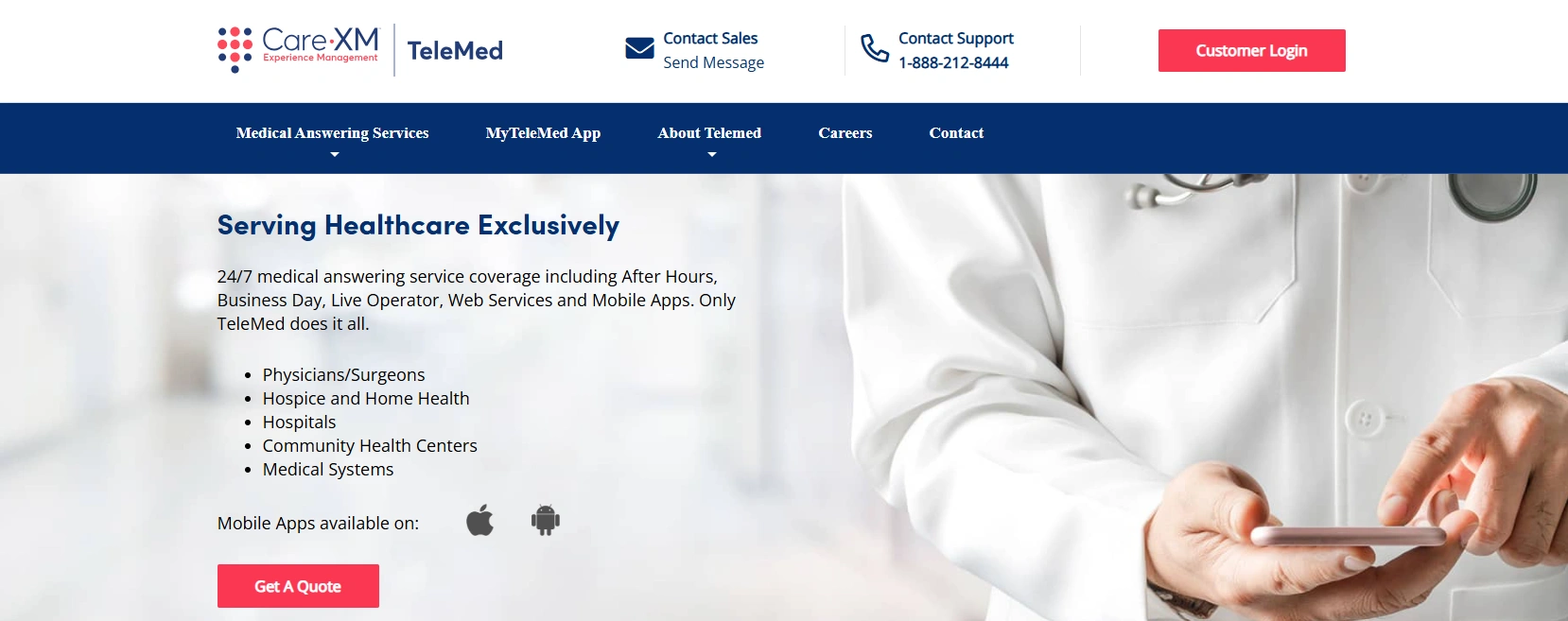
TeleMed provides healthcare-focused live answering, daytime overflow, and after-hours communication for medical groups, hospitals, and other healthcare organizations. MyTeleMed messaging tools allow clinicians to receive and acknowledge messages, supporting documented handoffs and configurable escalation procedures.
- Best for: Hospitals, physician groups, hospice organizations, and practices with ongoing on-call communication needs.
- Model: Live medical answering with secure messaging.
- Coverage: 24/7 service, including English and Spanish support.
- Security: HIPAA-oriented messaging and BAA arrangements referenced through CareXM.
- Pricing: Custom quote; contract commitments should be confirmed.
Considerations: Practices should distinguish secure message delivery and appointment support from direct EHR writeback or licensed clinical triage.
#5 
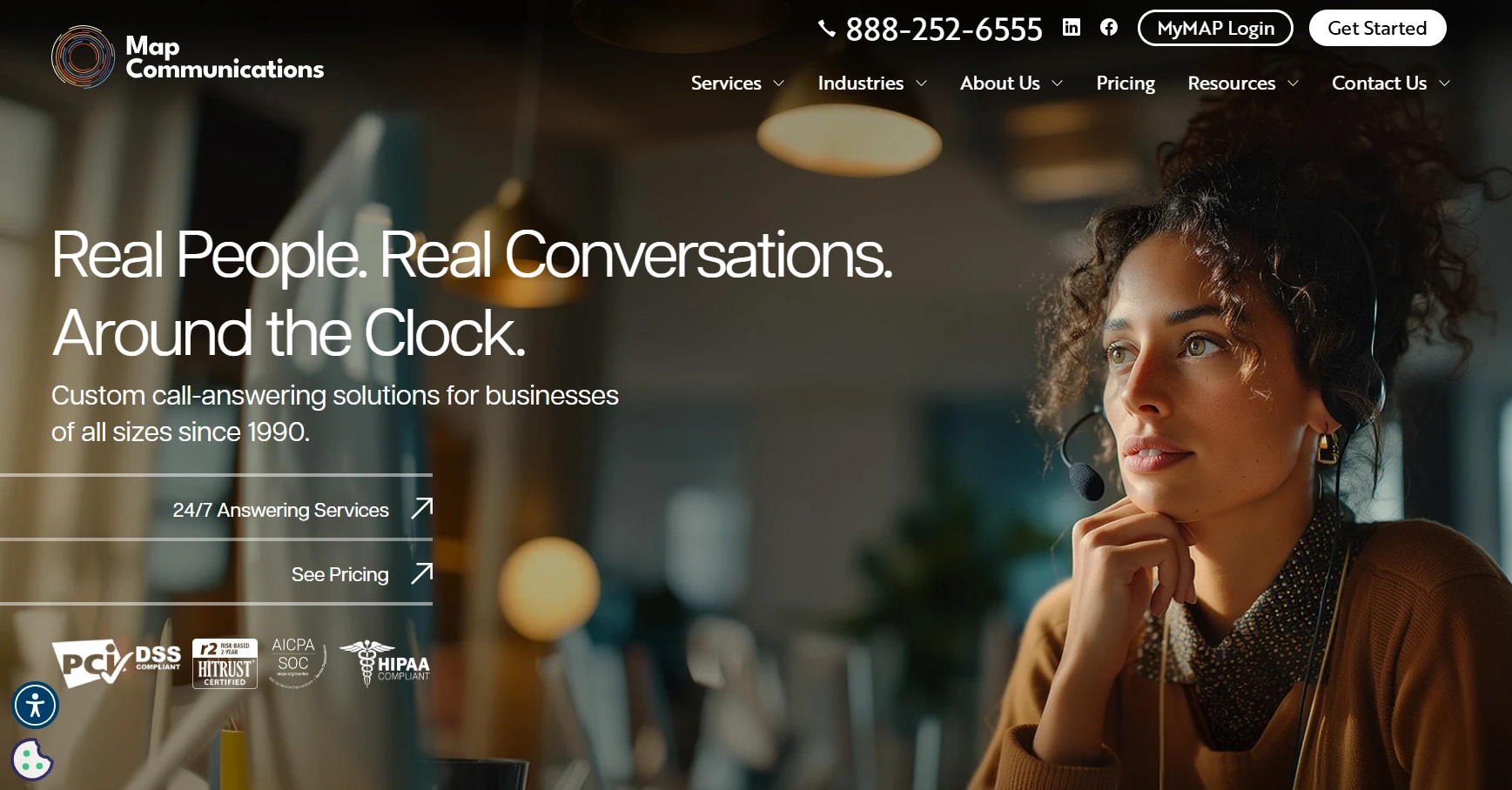
MAP Communications provides US-based answering and virtual receptionist services across several industries, including healthcare. Its medical offering includes customized scripts, on-call messaging, scheduling support, and access to call records through a secure portal.
- Best for: Practices needing flexible call scripts and established live-answering procedures.
- Model: Live operator and virtual receptionist.
- Coverage: 24/7 US-based answering with bilingual options.
- Security: Publishes SOC 2 Type 2 and HITRUST r2 information.
- Pricing: Quote-based, with usage-oriented billing.
Considerations: MAP’s published security information does not itself establish the terms of a BAA. Request a signed agreement covering the proposed services before sharing protected health information.
#6 AnswerFirst

AnswerFirst provides US-based live answering for medical practices and other industries. Its service supports message-taking, call patching, and scheduling-oriented workflows, with a usage-based structure suited to organizations that do not need dedicated staffing.
- Best for: Practices with low or variable call volume.
- Model: Live-operator answering.
- Coverage: US-based agents and after-hours availability.
- Security: Publishes a Business Associate Agreement.
- Pricing: The supplied refresh lists a $30 monthly base and approximately $1.25–$1.70 per minute; current terms should be reconfirmed.
Considerations: Per-minute costs can rise substantially with longer calls or greater volume. Confirm billing increments, minimum charges, and any applicable integration costs.
#7 Ruby
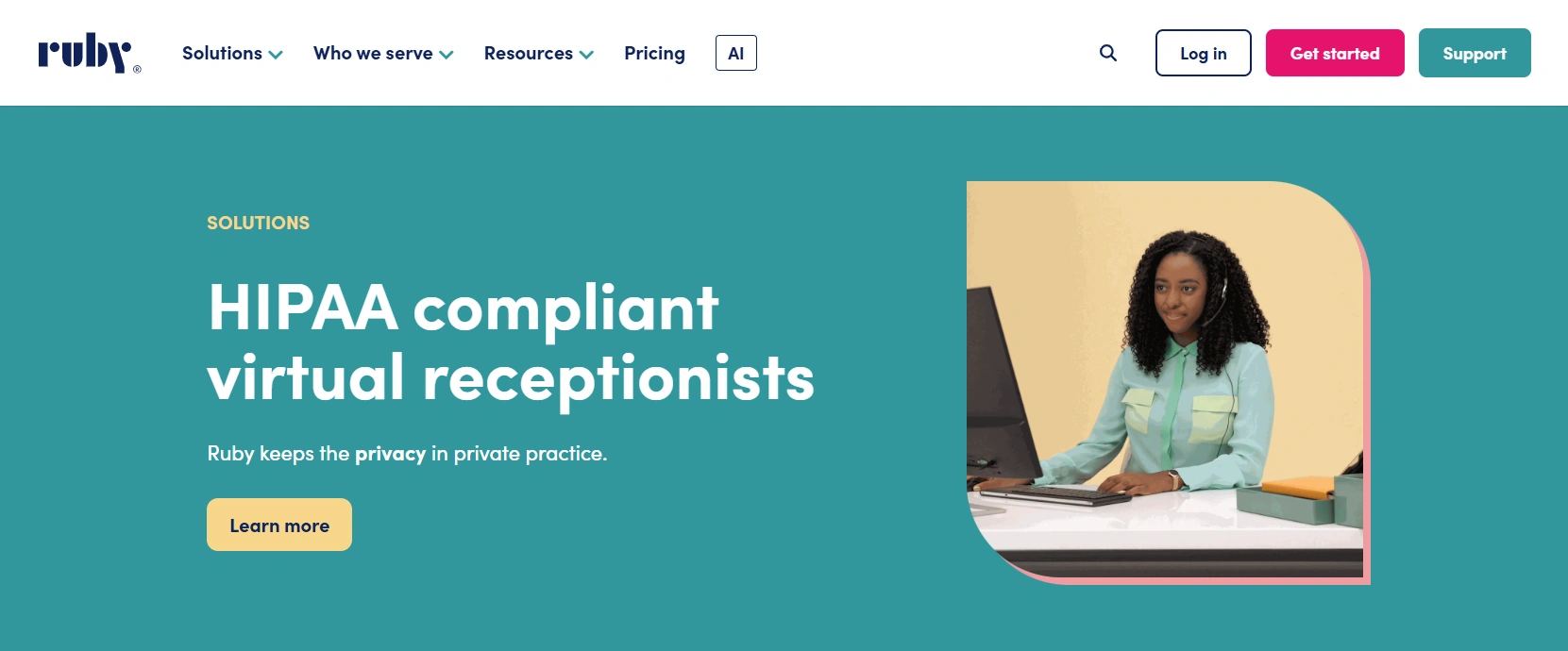
Ruby provides US-based virtual receptionists focused on live answering, caller experience, scheduling support, and administrative communication. Its service is suitable for practices that want a personal front-desk interaction without hiring dedicated receptionists for every shift.
- Best for: Solo providers, smaller medical groups, and practices emphasizing live receptionist service.
- Model: Virtual receptionist.
- Coverage: 24/7 bilingual answering options.
- Security: Offers HIPAA-oriented service and BAA arrangements.
- Pricing: Published plans start at $250 for 50 minutes and reach $1,725 for 500 minutes monthly.
Considerations: Ruby’s receptionists do not replace licensed clinical triage. Scheduling capabilities depend on the tools and access arrangements supported by the practice.
#8 MyOutDesk

MyOutDesk provides dedicated remote medical receptionists who work within a practice’s existing administrative systems. Its receptionists can support scheduling, patient intake, insurance-related tasks, and other recurring front-desk activities.
- Best for: Small and midsize practices requiring a consistent assigned receptionist during defined operating hours.
- Model: Dedicated remote staffing.
- Integration: Works within supported practice management and EHR systems.
- Security: Describes healthcare-oriented training and BAA arrangements.
- Pricing: Flat staffing-based proposal; amounts vary by scope.
Considerations: A dedicated receptionist covers an agreed schedule rather than providing unlimited around-the-clock capacity. Extended coverage may require multiple staffed positions.
#9 Talkie.ai
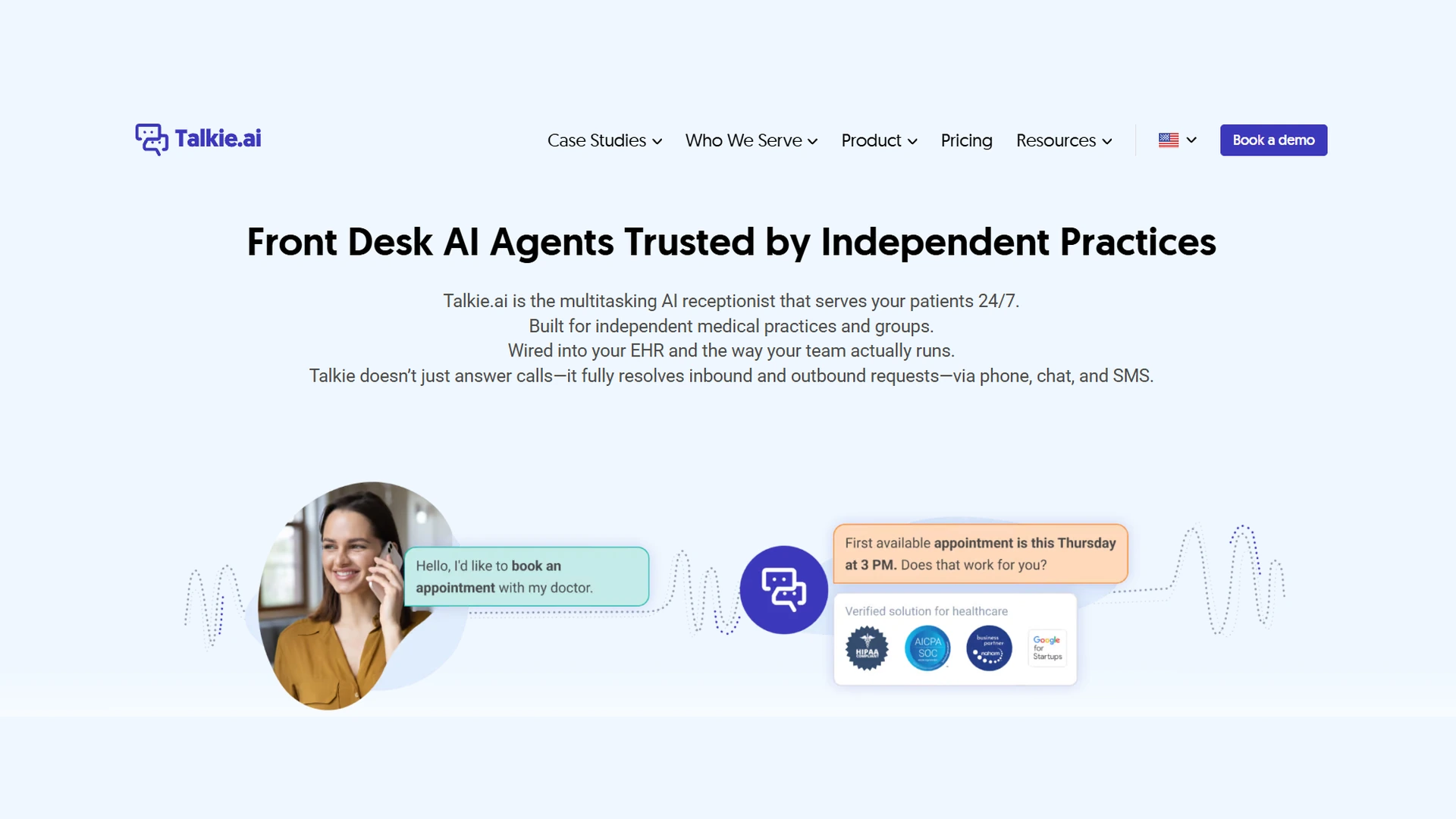
Talkie.ai provides an AI-powered patient access system that handles scheduling, intake, refill requests, and related communications. Its main distinction is direct read-and-write integration with supported EHR platforms, allowing eligible workflows to be completed rather than simply summarized for staff.
- Best for: Practices using compatible EHR systems and seeking to automate routine patient-access work.
- Model: AI voice agent with supported digital channels.
- Integration: Published native integrations with selected EHR platforms.
- Security: Reports SOC 2 Type II and BAA arrangements.
- Pricing: Plans start at $1,000 monthly for approximately 5,000 minutes, with additional use at $0.20 per minute.
Considerations: The value depends on EHR compatibility and the ability to complete your actual workflows. Verify fallback procedures, exception handling, and the path to human support.
#10 Freed Front Desk
Freed Front Desk provides AI answering for smaller practices, including routine call handling, structured message summaries, and two-way SMS. It is designed to reduce missed calls and organize follow-up work without requiring a dedicated receptionist for every incoming request.
- Best for: Small practices with straightforward call-handling needs and limited phone numbers.
- Model: AI receptionist.
- Integration: Structured message inbox and communication tools; direct EHR writeback is not established for the referenced Front Desk plan.
- Security: Freed describes HIPAA-oriented controls and BAA arrangements.
- Pricing: $149 monthly per block of 250 calls.
Considerations: The service may organize requests rather than complete all of the associated administrative work. Confirm what staff must do after a call and how unsupported or urgent requests are escalated.
Compare the 10 Medical Answering Services
The following table summarizes the most important purchasing differences. It focuses on operating model, integration, and pricing rather than assigning a numerical rating across services with different intended purposes.
| Provider | Operating model | Main capability | EHR approach | Pricing |
|---|---|---|---|---|
| Helpware | Dedicated team | Calls plus patient-access operations | Staff work in client systems | Custom staffing quote |
| PerfectServe | Enterprise platform | On-call routing and clinical communication | Published healthcare integrations | Typically $89–$119 per doctor/month |
| MedConnectUSA | Live operator | Healthcare-only answering | Confirm integration requirements | Custom quote |
| TeleMed | Live operator | After-hours coverage and secure escalation | Messaging and scheduling tools | Custom quote |
| MAP Communications | Live operator | Custom scripts and flexible answering | Scheduling and secure portal | Custom quote |
| AnswerFirst | Live operator | Usage-based live answering | Confirm required integration | Base fee plus usage; reconfirm rates |
| Ruby | Virtual receptionist | Live caller experience and administrative help | Supported scheduling access | $250–$1,725/month |
| MyOutDesk | Dedicated remote staff | Recurring medical front-desk workflows | Staff work in practice systems | Custom staffing quote |
| Talkie.ai | AI platform | Automated workflows with EHR writeback | Native integrations with supported EHRs | From $1,000/month |
| Freed Front Desk | AI platform | Routine answering and organized follow-up | No established direct EHR writeback in the referenced plan | $149 per 250 calls |
Before selecting a provider, request written confirmation of the BAA, authorized patient information access, escalation rules, supported integrations, and relevant service-level commitments. A provider’s published capabilities do not guarantee that every feature is included in its base package.
Medical Answering Service Pricing Compared
Medical answering service pricing depends on the billing model and the work performed after the call. A live operator who takes a message, an AI agent that books an appointment, and a dedicated receptionist who handles insurance verification may all answer the same initial call but produce different operational outcomes.
| Pricing model | How costs change | What buyers should check |
|---|---|---|
| Per minute | Cost follows call duration | Billing increments, minimums, transfer time, and surcharges |
| Per call | Cost follows the number of billable calls | Spam exclusions, transferred calls, and repeat interactions |
| Tiered minutes | Monthly fee covers a set allowance | Overage rates and unused-minute rules |
| Per provider | Fee depends on the number of covered clinicians | Part-time providers, scheduling complexity, and add-ons |
| Dedicated FTE | Fee reflects staffing capacity | Coverage hours, shrinkage, training, and minimum commitments |
For a more detailed discussion of usage fees, billing rules, and setup costs, see our medical answering service pricing guide.
When Does a Dedicated Patient-Access Team Make Sense?
A dedicated team becomes worth considering when your practice needs recurring administrative work completed alongside answering calls, or when the combined cost of your answering service and internal follow-up approaches the cost of dedicated staffing. The transition should be evaluated using workload rather than an arbitrary call-volume threshold.
Estimate the cost of a dedicated patient-access team
If your practice needs more than after-hours message-taking, compare the cost of dedicated support with your current answering service and internal staffing expenses. Use the Helpware cost calculator to estimate staffing costs based on your team size and operating requirements.
Unlock your hidden CX savings with Helpware
Get ROI projection for current support needs.
-40% annually
/monthly costs with Helpware
vs
/internal team costs (approx)
Your requirements fall outside our standard parameters.
Let's discuss your results
Fill in your details to schedule a consultation.
-40% annually
/monthly costs with Helpware
vs
/internal team costs (approx)
Your requirements fall outside our standard parameters.
-40% annually
/monthly costs with Helpware
vs
/internal team costs (approx)
Your requirements fall outside our standard parameters.
Support staff included in the package:
Shared Team Leader
Shared L&D Specalist
Shared QA Specialist
Account Executive by default
Shared Ops Delivery Manager
Admin/Finance/Legal support for the agents by default
1-2 Dedicated Team Leaders
Shared L&D Specialist
Shared to 1 Dedicated QA Specialist
Shared Ops Manager
Account Executive by default
Admin/Finance/Legal support for the agents by default
Shared Real Time Analyst
2-5 Dedicated Team Leaders
0,5 to 1,5 Dedicated L&D Specialists
1-2 Dedicated QA Specialists
Up to half of a dedicated Ops Manager
Account Executive by default
Admin/Finance/Legal support for the agents by default
1 Dedicated Real Time Analyst
Ready to get a personalized estimate for your team?
Contact us for a personalized assessment tailored to your specific needs.
*These projections are estimates for informational purposes only and do not represent a formal offer. Contact us for a personalized quote.
Thank you!
You’ll hear from us within one business day.
Measure the work that remains after each call
Start by separating calls that are fully resolved from those that generate follow-up tasks. A traditional service may answer a scheduling request, but your employees may still need to review the message, contact the patient, and book the appointment. The answering service has handled the call, while the practice retains the underlying work.
Measure how much internal staff time is spent on these outstanding tasks each week, including scheduling, refill routing, eligibility checks, and documentation.
Compare total monthly costs
Calculate the combined cost of the answering service and the internal labor required to complete follow-up work. Then compare that with a dedicated team configured to handle the same activities, operating hours, and quality requirements.
Total current cost = Answering service fees + Internal follow-up labor + Additional operating costs
Dedicated-team cost = Committed staffing + Management and QA + Technology and implementation costs
The comparison should also account for patient wait times, unresolved requests, and clinical escalation reliability. A dedicated team may produce greater operational value by completing more tasks, but it will not necessarily cost less when call volume is low.
Consider workload complexity and coverage
Dedicated capacity may be especially relevant when a medical group has multiple locations, recurring eligibility or authorization backlogs, language-specific queues, or frequent handoffs between the front desk and other departments. Smaller practices whose primary need is occasional overnight message-taking may be better served by a usage-based answering service. Practices requiring continuous human coverage should also account for the number of employees needed across shifts.
For organizations with broader support requirements, the delivery model begins to resemble a medical call center rather than a traditional message service.
Choosing the Right Medical Answering Service
The best medical answering service depends on what your practice needs to accomplish beyond answering calls. Shared live-operator services can provide cost-effective after-hours coverage, while virtual receptionists and AI tools can handle selected scheduling and administrative requests. Practices with higher volumes or more complex workflows may benefit from dedicated patient-access teams that work directly in their systems.
Before choosing a provider, compare the total cost of the service with the work your internal staff will still need to complete. Evaluate EHR integration, escalation procedures, HIPAA requirements, and resolution capabilities alongside published prices. A lower cost per call does not necessarily mean a lower cost per completed patient request.
For organizations considering dedicated support, Helpware provides healthcare teams that combine call handling with scheduling, eligibility verification, and other administrative workflows under client-defined procedures.