







Accounting teams need to keep financial records accurate, close the books on time, and meet reporting deadlines, often while working with limited staff and growing workloads. Hiring experienced accountants is difficultl; however, leaving essential tasks uncovered is not an option as it puts pressure on the people already on the team. For many US businesses, outsourcing accounting tasks to the Philippines offers a way to add accounting capacity without building out the entire function in-house.
The Philippines has become a popular destination for accounting outsourcing, with providers offering everything from individual accounting professionals to managed finance and accounting operations. But the options vary in their services, level of CPA expertise, software experience, security controls, and pricing. The challenge is finding a provider that matches your company’s workload, requirements, and budget, rather than choosing based on cost alone.
Hopefully, this guide will help you with that.
In the following paragraphs, we cover 12 accounting outsourcing companies in the Philippines and explain how to compare them before making a decision. You’ll find a practical framework for assessing service scope, credentials, technology, security, delivery locations, pricing models, and client ratings, along with guidance on the costs and trade-offs to consider when outsourcing accounting work.
How We Selected the 12 Best Accounting Outsourcing Companies in the Philippines
We evaluated providers against four criteria to make the comparison consistent and relevant to businesses looking to outsource accounting work to the Philippines:
- Philippine delivery: The provider delivers accounting or finance services from its own sites in the Philippines.
- Accounting scope: The provider lists bookkeeping, accounts payable or receivable, reconciliation, reporting, or tax work among its services.
- Security credentials: The provider has information about its certifications, such as SOC 2 or ISO 27001, or clearly states its compliance status.
- Verifiable information: The partner’s headcount, locations, and services can be confirmed through its website or press releases.
We ranked the providers primarily by accounting expertise, including access to CPAs and specialization in accounting services. We also considered their published security credentials and delivery footprint. Ratings from each provider’s Clutch and G2 profiles, recorded as of the dates shown, offer additional context for comparing providers, but the ranking reflects our assessment of their services and capabilities rather than customer ratings alone.
Top 12 Accounting Outsourcing Firms in the Philippines: Side by Side Comparison
| Company | Best for | Accounting focus | Philippine sites | Certifications | Employees | Clutch rating |
|---|---|---|---|---|---|---|
| Helpware | Regulated mid-market and enterprise companies | Managed finance back office (AR, billing, reconciliation) | Manila, Cebu | SOC 2 Type II, ISO 27001, ISO 9001, PCI DSS | 4,000+ | 4.8 (47) |
| D&V Philippines | CFOs and accounting firms needing CPAs | CPA-led accounting and audit support | Makati | ISO (standard not named), Xero Gold Partner | 1,000+ | No reviews yet |
| TOA Global | Accounting firms | Accounting-firm staffing only | Manila, Clark, Tarlac, Cebu | SOC 2 Type 2 | 4,200+ | Not found |
| Emapta | Mid-market finance teams | Dedicated accounting staff | 16 delivery centers | ISO 27001, ISO 27701, SOC 2 | 13,000+ | 4.7 (3) |
| MicroSourcing | Mid-size to large enterprises | Dedicated F&A teams | Metro Manila, Cebu, Clark, Cagayan de Oro | ISO 27001, ISO 9001 | 10,000+ | No reviews yet |
| Cloudstaff | Firms wanting one all-in rate | Dedicated accounting staff | 14+ sites incl. Clark, Manila, Cebu, Davao | ISO 27001, ISO 9001, PCI-DSS | 7,000+ | 4.7 (3) |
| Connext Global Solutions | US mid-market, healthcare | Co-managed F&A teams | Angeles, Davao, Ortigas, Cebu | SOC 2 Type II | 2,620+ | 5.0 (7) |
| Outsourced.ph | Teams wanting named staff | Finance staffing | Six sites incl. Eastwood, Makati, Cebu | ISO 27001, ISO 9001 | 1,800+ | 4.9 (12) |
| Innovature BPO | Multi-country delivery | Accounting-native BPO | Cebu | ISO 27001, ISO 27701 | 200+ | 4.8 (5) |
| KDCI Outsourcing | Small to mid-size teams | Finance staffing | Ortigas, Pasig | Not published | Not published | No reviews yet |
| Personiv | Corporate finance teams | Managed F&A (R2R, P2P, O2C) | Alabang | ISO 27001, ISO 9001, PCI-DSS | About 3,000 | 5.0 (1) |
| MYCPE ONE | US CPA firms | Accounting-firm staffing | Manila | SOC 2, ISO 27001 | About 3,000 | 4.9 (11 |
Top 12 Accounting Outsourcing Companies in the Philippines
#1 Helpware

Helpware provides finance back-office outsourcing services from Manila and Cebu, helping mid-market and enterprise companies in regulated industries manage finance operations at scale. Its teams support accounts receivable outsourcing, including invoicing and billing, collections, cash application, dispute resolution, account reconciliation, and credit management. They also handle financial documentation processing and data entry.
Founded in 2015 and headquartered in Lexington, Kentucky, Helpware has operated Philippine delivery centers since 2017. Those centers have more than 500 employees and eight training rooms, forming part of a global footprint spanning 19 locations, 11 countries, and four continents. Helpware holds SOC 2 Type II, ISO 27001, ISO 9001, and PCI DSS certifications and runs HIPAA- and GDPR-compliant operations. For finance teams handling payment or patient data, this means finance processes can stay within a consistent set of audited controls.
Why we picked it
Helpware treats finance operations as a managed service, with measurable performance targets. Its accounts receivable teams report more than 99% first-time invoice accuracy and 20% to 40% savings on AR operating costs. Businesses that already use customer support outsourcing can also consolidate billing inquiries, collections, and reconciliation with one partner, under the same compliance controls. That combination makes Helpware a strong fit for companies looking to coordinate finance and customer operations without adding another vendor.
- Services offered: Accounts receivable, including invoicing, collections, cash application, dispute resolution, reconciliation, and credit management; accounts payable and receivable support; financial documentation processing; data entry; customer support; and CX consulting.
- Accounting scope and CPA access: Transactional finance operations. Helpware doesn’t provide CPA-led statutory accounting, tax preparation, or audit services.
- Software: Works within clients’ ERP and CRM environments, with integrations for Salesforce, Zendesk, and HubSpot.
- Certifications: SOC 2 Type II, ISO 27001, ISO 9001, and PCI DSS; HIPAA- and GDPR-compliant operations.
- Headcount: 4,000+ employees globally, including 500+ in the Philippines.
- Pros: 2.8% attrition at its Philippine centers; 99%+ first-time invoice accuracy; 90% CSAT across clients; five-year average client partnerships; finance and customer operations available through one provider.
- Cons: Doesn’t offer CPA-led accounting, tax, or audit services, so companies needing credentialed accountants for close or tax work should also consider CPA-led providers. The consultative scoping process can also mean a longer onboarding cycle.
- Industry expertise: Healthcare and telehealth; SaaS and software; ecommerce and retail; fintech and banking; gaming and entertainment; logistics; and the public sector.
- Best for: Mid-market and enterprise companies with $10 million to $500 million or more in revenue, particularly in healthcare, fintech, and other regulated industries, that need finance back-office operations delivered in a certified environment.
- Pricing: Custom quotes by role. Managed-team pricing covers hiring, training, tools, and day-to-day oversight.
- Minimum team: Pilot engagements typically start with five to ten FTEs.
- Ratings: Clutch: 4.8 (47 reviews); G2: 4.9 (30 reviews).
- Year established: 2015.
- Location: Lexington, Kentucky (headquarters); Manila and Cebu (Philippines); and additional operations in the USA, Puerto Rico, Guam, Mexico, Ukraine, Germany, Poland, Albania, Georgia, and Uganda.
#2 D&V Philippines

Founded in 2012 by Dutch CFO Stefan Vermeulen, D&V Philippines has built a workforce with a strong concentration of accounting credentials. Of its 1,000+ accountants, 90% hold CPA licenses, and 73% have audit experience. That depth of expertise makes the company a strong option for businesses that need more than routine bookkeeping.
Based in Makati City, the financial center of Metro Manila, D&V serves CFOs and professional services firms across Australia, the United States, Canada, the United Kingdom, the Netherlands, and Singapore. Its ESSAP methodology (Eliminate, Simplify, Standardize, Automate Philippines) positions finance and accounting outsourcing as a process transformation engagement, not just a staffing arrangement. Alongside bookkeeping, clients can access management reporting, financial analysis, and strategic advisory support. The company serves 350+ clients and was named a Philippine Growth Champion by the Philippine Daily Inquirer and Statista in two editions.
Why we picked it
D&V Philippines stands out for accounting firms and corporate CFOs that need experienced professionals with verifiable credentials. With 90% of its accounting workforce holding CPA licenses and 73% bringing audit experience, the company can support work that calls for deeper accounting expertise, from complex reporting to audit support and financial analysis.
- Services offered: Bookkeeping, management accounting, financial reporting, statutory and consolidated reporting, payroll, audit support, financial analysis, business analytics, and virtual CFO support.
- Accounting scope and CPA access: Full-cycle accounting through audit support, backed by a workforce in which 90% of accountants hold CPA licenses.
- Software: Xero Gold Partner.
- Certifications: ISO certified (the specific standard isn’t named on its website); registered with the Philippine National Privacy Commission.
- Headcount: 1,000+ accountants.
- Pros: 90% CPA workforce; 73% of accountants with audit experience; 1,000+ accountants; dedicated-team model that gives clients full control.
- Cons: Delivery is primarily Philippines-based. North American clients may have limited nearshore options for time-zone alignment, while night-shift coverage may require a premium.
- Industry expertise: Accounting firms, audit firms, corporate CFOs, professional services, healthcare, and financial services.
- Best for: Accounting firms and corporate finance teams that need credentialed, experienced professionals to manage complex reporting and client-facing financial work.
- Pricing: Custom pricing based on role and engagement scope.
- Minimum team: Not published.
- Ratings: Clutch: No reviews yet; no G2 profile.
- Year established: 2012.
- Location: Makati City, Metro Manila, Philippines.
#3 TOA Global

TOA Global focuses exclusively on accounting and bookkeeping firms, with a service model built around their specific staffing needs. With 4,200+ team members across four Philippine hubs and 1,250+ client firms in the US, Canada, Australia, and New Zealand, it has grown into one of the Philippines’ largest employers in the accounting sector.
Founded in 2013 by Nick Sinclair, an Australian accounting firm owner who first offshored part of his own practice, TOA Global grew out of a model he later developed into a standalone business. Sinclair now chairs Humanverse, the group TOA Global belongs to, while Jeremy Clements has served as TOA Global’s CEO since July 2024. That background shapes the company’s approach: its infrastructure, training programs, and culture are designed specifically for accounting professionals rather than adapted from a general BPO model. Its Ab² Institute of Accounting provides a registered training organization (RTO) through which accountants can earn accredited credentials, helping strengthen retention and build staff capabilities over time. TOA Global also holds a SOC 2 Type 2 attestation and has been recognized as a Great Place to Work.
Why we picked it
TOA Global’s accounting-only focus shapes everything from recruitment to training and management. Its programs and tools are built around the way accounting practices operate, which can reduce the learning curve when adding offshore staff. For accounting firms that want a provider familiar with their workflows from the outset, that specialization may justify the investment.
- Services offered: Financial accountants, tax accountants, SMSF accountants, auditors, management accountants, bookkeepers, payroll officers, paraplanners, and executive assistants.
- Accounting scope and CPA access: Roles across accounting practices, from bookkeeping to auditing; CPA count not published.
- Software: Not published.
- Certifications: SOC 2 Type 2.
- Headcount: 4,200+ team members in the Philippines.
- Pros: Accounting-only specialization; 4,200+ team members; SOC 2 Type 2 attestation; proprietary Ab² Institute training program; Great Place to Work recognition; 1,250+ client firms.
- Cons: Serves accounting and bookkeeping firms only, making it unsuitable for corporate finance teams or businesses seeking accounting support as part of a broader BPO engagement.
- Industry expertise: Public accounting firms, bookkeeping firms, tax practices, financial planning firms, and CPA practices in the US, Canada, Australia, and New Zealand.
- Best for: Accounting firm owners who want a provider built specifically for their industry rather than a general offshore staffing solution adapted for accountants.
- Pricing: Custom pricing.
- Minimum team: Not published.
- Ratings: No Clutch or G2 rating found.
- Year established: 2013.
- Location: Gold Coast, Queensland, Australia (headquarters); Manila, Clark, Tarlac, and Cebu (Philippine offices).
#4 Emapta

Emapta stands out for two commitments that are uncommon in Philippine outsourcing: transparent pricing with no salary markups or hidden fees, and a published turnover rate of just 2.5%. For finance leaders comparing offshore accounting teams, those commitments offer a clearer picture of both costs and workforce stability.
Founded in 2010 by CEO Tim Vorbach, Emapta uses a dedicated offshore team model, with 16 delivery centers in the Philippines and talent hubs in Colombia, North Macedonia, Sri Lanka, Malaysia, India, Vietnam, and the Dominican Republic. Its Emapta Talent Marketplace (ETM) gives clients access to pre-vetted professionals through intelligent search and rapid shortlisting, helping reduce time-to-hire compared with traditional BPO procurement timelines. Emapta serves 1,200+ clients across more than 30 countries. It is B Corp certified and holds ISO 27001, ISO 27701, SOC 2, and HIPAA certifications, with GDPR compliance. Its accounting talent includes staff accountants, bookkeepers, payroll specialists, tax accountants, AP/AR professionals, and financial analysts.
Why we picked it
Emapta’s pricing transparency and 2.5% turnover rate make it worth considering for CFOs concerned about the hidden costs of outsourcing. Low advertised rates can lose their appeal when salary markups, unexpected fees, and frequent staff turnover drive up the total cost. Emapta’s model addresses those concerns while giving clients a dedicated team that can work as an extension of their in-house finance function.
- Services offered: Staff accountants, bookkeepers, payroll officers, tax accountants, AP/AR specialists, financial analysts, controllers, treasurers, and audit support.
- Accounting scope and CPA access: Roles ranging from staff accountants to controllers and FP&A professionals; CPA count not published.
- Software: Not published.
- Certifications: ISO 27001, ISO 27701, SOC 2, and HIPAA; GDPR compliant; B Corp certified.
- Headcount: 13,000+ globally.
- Pros: No salary markups or hidden fees; 2.5% turnover rate; 1,200+ clients; ISO 27001, SOC 2, and HIPAA certifications; B Corp certification; 13,000+ global workforce; ETM pre-vetted talent pool; no headcount minimums.
- Cons: Its multi-country delivery model may not suit buyers who specifically require Philippines-only operations. The dedicated-team model also requires client-side management oversight.
- Industry expertise: Finance and accounting, mortgage, healthcare, technology, retail and ecommerce, and legal.
- Best for: Growing mid-market companies seeking transparent pricing, low attrition, and a dedicated offshore accounting team that functions as an extension of their in-house finance department.
- Pricing: Custom quotes based on role and location, with savings of up to 70% compared with local hiring. No salary markups.
- Minimum team: No headcount minimum.
- Ratings: Clutch: 4.7 (3 reviews); no G2 reviews.
- Year established: 2010.
- Location: Philippines (16 delivery centers), Colombia, North Macedonia, Sri Lanka, Malaysia, India, Vietnam, and the Dominican Republic.
#5 MicroSourcing
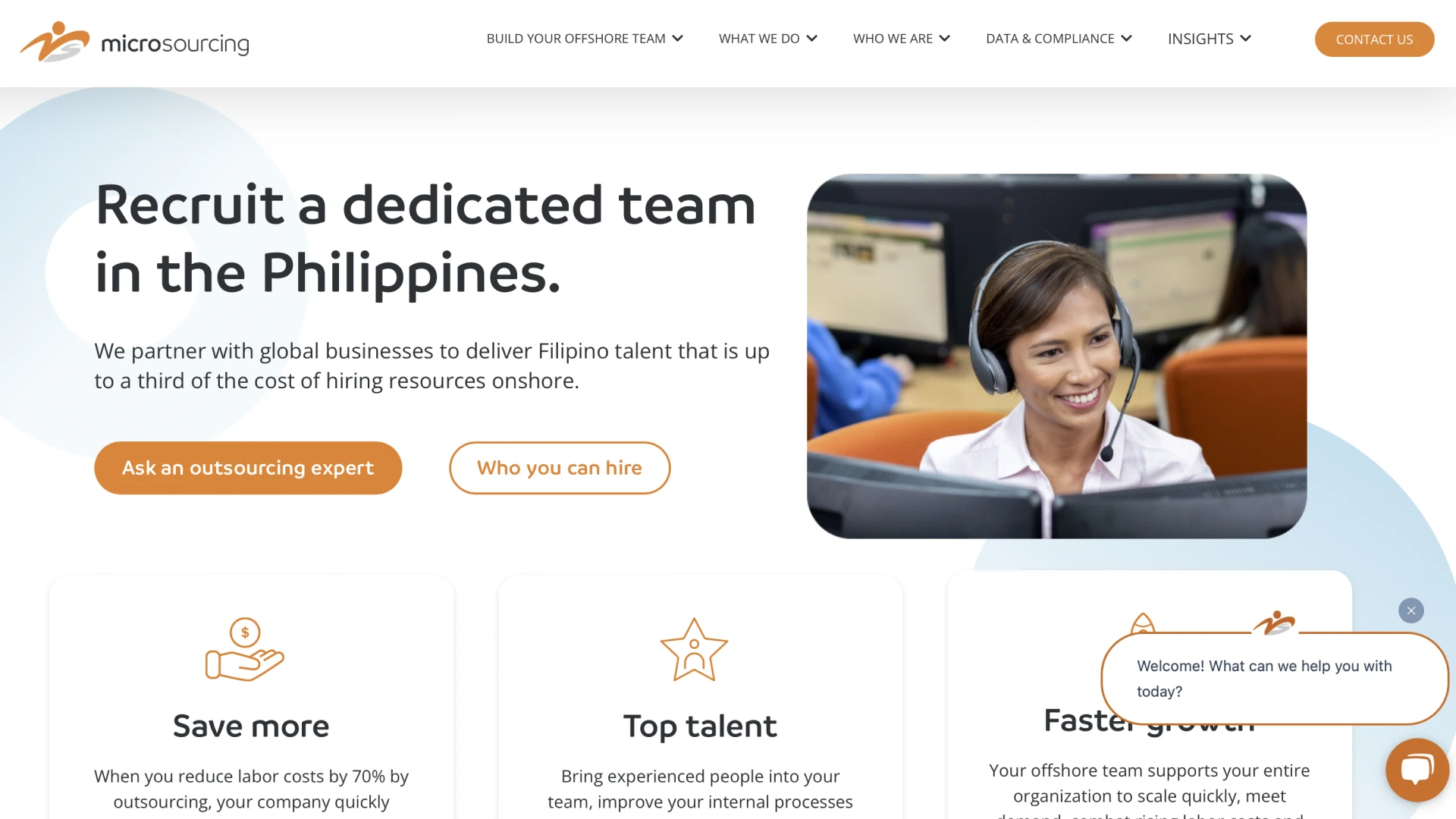
MicroSourcing helped pioneer the client-led dedicated team model in the Philippines, giving businesses operational control over their offshore teams while the provider handles infrastructure, recruitment, and compliance. This setup lets finance leaders direct day-to-day work and shape their teams around changing business needs without managing the underlying delivery infrastructure themselves.
MicroSourcing operates 13 delivery centers across the Philippines, including Metro Manila, Cebu, Clark, and Cagayan de Oro, as well as a location in Bogotá, Colombia. With more than 10,000 professionals serving 1,000+ clients, it offers the scale to support growing finance operations across multiple locations. The company is a subsidiary of Probe Group, an Australian customer experience and BPO provider backed by global investment firm KKR. That backing supports enterprise-grade facility standards, ISO 27001 and ISO 9001 certifications, and business continuity infrastructure that smaller independent providers may struggle to match. MicroSourcing’s accounting services include accounts payable, accounts receivable, bookkeeping, collections, payroll, and financial reporting. Its GAAP-trained talent is familiar with Australian, US, and UK accounting standards.
Why we picked it
MicroSourcing combines a client-controlled team model with a broad delivery footprint. Finance leaders can build an accounting team in Manila and add capacity in Cebu or Clark as transaction volumes grow, while drawing on the provider’s established infrastructure and compliance capabilities.
- Services offered: Accountants, AR and AP specialists, bookkeepers, collection specialists, payroll officers, financial reporting support, and tax compliance.
- Accounting scope and CPA access: Accounts payable, accounts receivable, bookkeeping, payroll, and reporting roles; CPA count not published.
- Software: Not published.
- Certifications: ISO 27001 and ISO 9001.
- Headcount: 10,000+ professionals.
- Pros: Founded in 2006, with deep Philippine market experience; 13 delivery centers across the Philippines and Colombia; ISO 27001 and ISO 9001 certifications; Probe Group backing; 1,000+ clients.
- Cons: Primarily focused on mid-size to large clients. Pricing and minimum team size aren’t published.
- Industry expertise: Finance and accounting, healthcare, technology, professional services, consumer and customer operations, and legal services.
- Best for: Mid-size to large enterprises that need established facilities, compliance infrastructure, and the flexibility to manage a dedicated offshore team directly.
- Pricing: Custom pricing based on role and team size.
- Minimum team: Not published.
- Ratings: Clutch: No reviews yet; no G2 reviews.
- Year established: 2006.
- Location: Metro Manila, Cebu, Clark, and Cagayan de Oro (Philippines); Bogotá, Colombia (opened in 2025).
#6 Cloudstaff
Cloudstaff built its model around a simple idea: traditional BPO infrastructure was designed for call centers, not professional accounting teams. It has invested in premium office environments across its Philippine sites to support dedicated teams handling specialized work.
Founded by Lloyd Ernst, Cloudstaff has 7,000+ staff across 20+ delivery centers in the Philippines, India, Colombia, Kenya, and Sri Lanka, serving 1,000+ businesses in 34 countries. The company holds ISO 9001, ISO 27001, and PCI-DSS certifications and runs HIPAA- and GDPR-compliant operations. Its pricing model uses one monthly rate per staff member, covering recruitment, onboarding, HR, payroll, hardware, and IT support. For accounting teams, Cloudstaff supplies bookkeepers, AP/AR specialists, payroll officers, management accountants, and financial reporting professionals. The company cites 50% to 70% savings compared with local hiring, and its teams routinely work US Eastern and Pacific time-zone schedules.
Why we picked it
Cloudstaff combines all-inclusive monthly pricing with a published monthly staff retention rate of 99.5%. For finance leaders, a single rate makes quotes easier to compare, while staff continuity helps preserve accounting knowledge and reduce disruption.
- Services offered: Accounting, bookkeeping, payroll, accounts payable and receivable, financial reporting, management accounting, software development, and IT support.
- Accounting scope and CPA access: Roles from bookkeeping through management accounting; CPA count not published.
- Software: Not published.
- Certifications: ISO 27001, ISO 9001, and PCI-DSS; HIPAA- and GDPR-compliant operations.
- Headcount: 7,000+.
- Pros: All-inclusive monthly rate with no hidden charges; ISO 9001 and ISO 27001 certifications; PCI-DSS certification; 20+ delivery centers; strong US time-zone coverage.
- Cons: Premium facilities can mean higher costs than more basic provider models. The company primarily serves Australian and North American markets.
- Industry expertise: Accounting and finance, ecommerce, healthcare, legal, real estate, technology, and marketing.
- Best for: Australian and North American businesses seeking a dedicated team in a premium work environment, with transparent all-inclusive pricing and no setup fees.
- Pricing: One monthly rate per staff member, customized by role.
- Minimum team: Not published.
- Ratings: Clutch: 4.7 (3 reviews); no G2 reviews.
- Year established: Not stated consistently; Cloudstaff markets 20 years of operations.
- Location: Clark, Manila, Cebu, Davao, and other Philippine sites, plus India, Colombia, Kenya, and Sri Lanka.
#7 Connext Global Solutions
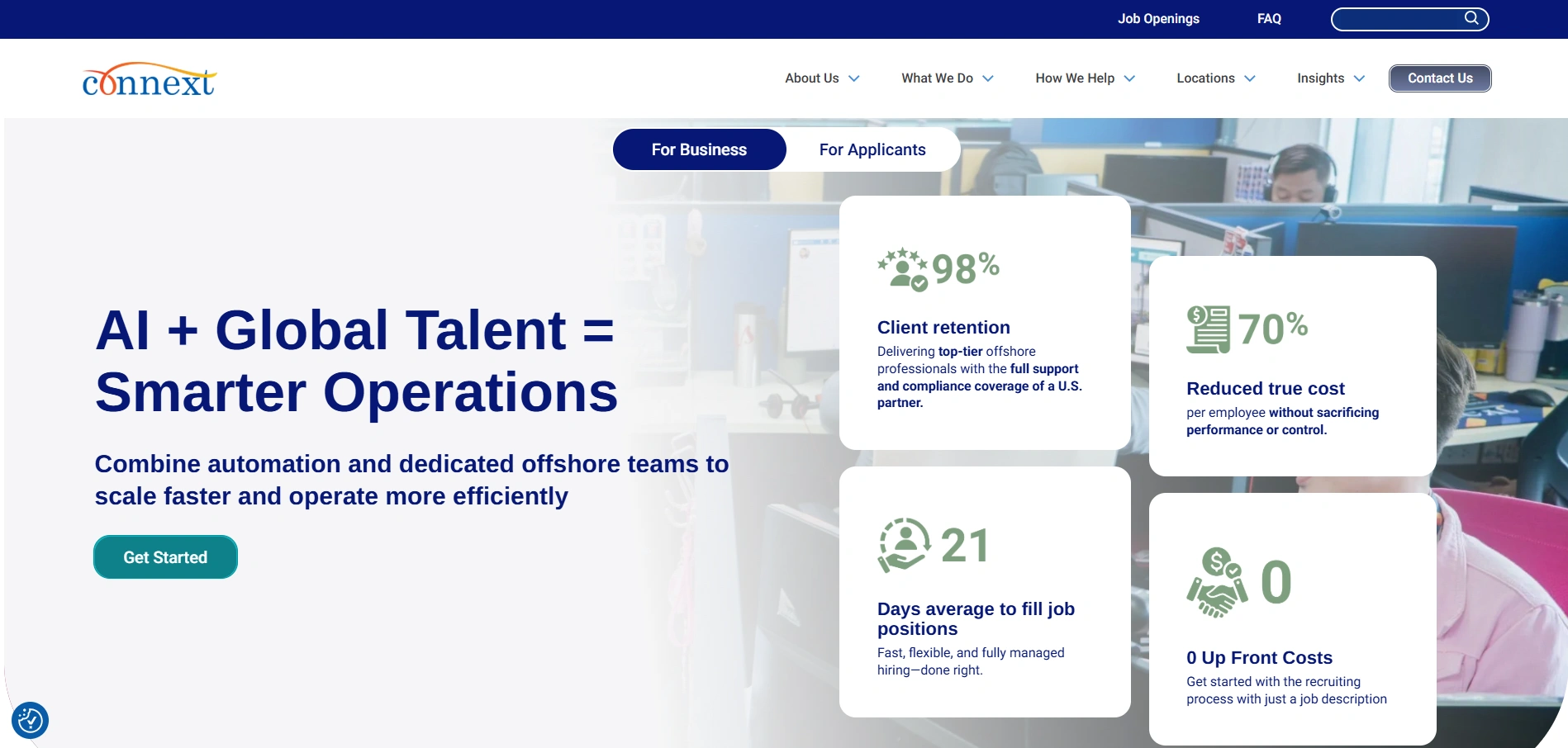
Founded in 2014 by Tim Mobley, a West Point graduate with an MBA from Harvard, Connext Global Solutions combines talent recruitment with management support and employee retention. Its co-managed model is designed for businesses that want to direct their offshore team’s workflows while relying on the provider for the infrastructure and operational support behind the scenes.
Headquartered in Honolulu, Hawaii, Connext has grown to 2,620+ employees across four Philippine offices in Angeles City, Davao, Ortigas, and Cebu, as well as locations in Colombia, India, and Mexico. It has appeared on the Inc. 5000 list of America’s fastest-growing private companies for five consecutive years, from 2022 to 2026. Its finance and accounting teams cover accounts payable and receivable, bookkeeping, payroll, financial reporting, revenue cycle management, and tax support. Clients retain control over workflows, while Connext manages back-end infrastructure, compliance, and employee retention support.
Why we picked it
Connext publishes per-role pricing and allows businesses to start with one full-time equivalent (FTE). That flexibility gives mid-market companies a way to test offshore accounting support before expanding their teams, without committing to a large initial engagement.
- Services offered: Accounts payable and receivable, bookkeeping, payroll, financial reporting, RCM, tax support, balance sheet preparation, financial analysis, and accounting managers.
- Accounting scope and CPA access: Roles from bookkeeping through accounting management, including CPAs.
- Software: Not published.
- Certifications: SOC 2 Type II; HIPAA-compliant operations.
- Headcount: 2,620+.
- Pros: Inc. 5000 recognition for five consecutive years; co-managed model with client workflow control; SOC 2 Type II certification; healthcare accounting expertise; inclusion in the Everest Group FAO PEAK Matrix.
- Cons: Smaller workforce than enterprise providers, which may make it less suitable for large-scale team ramp-ups.
- Industry expertise: Healthcare, fintech, legal, real estate, logistics, and ecommerce.
- Best for: Mid-market US businesses, particularly in healthcare, seeking dedicated offshore accounting teams with strong management infrastructure and a relationship-oriented partnership model.
- Pricing: Monthly plans start at $1,800 per FTE, with accountant roles listed at $2,000 per month on G2.
- Minimum team: One FTE.
- Ratings: Clutch: 5.0 (7 reviews); G2: 4.6 (16 reviews).
- Year established: 2014.
- Location: Honolulu, Hawaii (headquarters); Angeles City, Davao, Ortigas, and Cebu (Philippines); Colombia, India, and Mexico.
#8 Outsourced.ph
Outsourced.ph provides dedicated remote staffing from the Philippines, serving ASX- and NASDAQ-listed organizations as well as growth-stage companies. Its model gives clients named, dedicated team members rather than access to a shared pool of agents, with ISO 27001 and ISO 9001 certifications supporting its security and quality processes.
Founded in 2012, Outsourced.ph operates from six Philippine sites: Eastwood, Makati, SM North EDSA, Alabang, Clark, and Cebu. Its AI-enhanced recruitment process supports placements across roles such as payroll specialists, insurance brokers, accounting managers, loan processors, and bookkeeping professionals. The company cites staff retention of more than 98%. Clients direct day-to-day work while Outsourced.ph handles HR, infrastructure, and compliance, providing an alternative to fully managed services for businesses that want hands-on control without managing every aspect of a direct hire.
Why we picked it
Outsourced.ph combines a reported retention rate above 98% with six Philippine sites. That combination may appeal to finance teams looking for named accountants and stable staffing over a multi-year engagement.
- Services offered: Dedicated offshore staffing, accounting, bookkeeping, payroll, financial reporting, loan processing, insurance broking support, virtual assistants, and back-office services.
- Accounting scope and CPA access: Bookkeeping, tax associate, and financial accountant roles; CPA count not published.
- Software: Not published.
- Certifications: ISO 27001:2022 and ISO 9001:2015.
- Headcount: 1,800+.
- Pros: Reported staff retention above 98%; ISO 27001 and ISO 9001 certifications; AI-enhanced recruitment; client-controlled team management; experience serving ASX- and NASDAQ-listed clients.
- Cons: The staff augmentation model requires more management direction from the client than a fully managed service.
- Industry expertise: Finance, healthcare, ecommerce, digital marketing, IT, and real estate.
- Best for: Ecommerce, financial services, and healthcare businesses that want dedicated, named team members rather than shared staffing pools.
- Pricing: Custom pricing based on role.
- Minimum team: Not published.
- Ratings: Clutch: 4.9 (12 reviews); no G2 reviews.
- Year established: 2012.
- Location: Eastwood, Quezon City (head office), Makati, SM North EDSA, Alabang, Clark, and Cebu, Philippines. Serves clients in Australia, the US, and the UK.
#9 Innovature BPO

Innovature BPO is one of the accounting-oriented providers on this list with multi-country delivery. It operates from Cebu in the Philippines, alongside its headquarters in Ho Chi Minh City, Vietnam, and an office in Austin, Texas. The company serves clients in North America, Australia, and the Asia-Pacific, making its delivery model relevant to organizations that need geographic flexibility or coverage across time zones.
Named to the IAOP Global Outsourcing 100 list in the Rising Star category, Innovature BPO grew from a three-person accounting team into a provider of finance and accounting outsourcing services. Its offering includes bookkeeping, accounts payable and receivable, payroll administration, tax compliance, and financial reporting. The Cebu location gives the company access to a talent market with lower labor costs than Metro Manila, alongside English proficiency and accounting education. Its multi-country model can also give clients delivery redundancy and support for teams operating across multiple time zones.
Why we picked it
Innovature combines accounting-focused roots with ISO 27001 and ISO 27701 certifications. It also offers CPA or ACCA oversight, a notable option for a provider with a workforce of its size.
- Services offered: Bookkeeping, accounts payable and receivable, general ledger and month-end close, payroll administration, tax compliance, financial reporting, management accounting, and data entry.
- Accounting scope and CPA access: Full-cycle bookkeeping through month-end close, with CPA or ACCA oversight available.
- Software: Microsoft Dynamics 365, QuickBooks, and Xero.
- Certifications: ISO 27001:2022 and ISO 27701:2019; HIPAA-compliant operations.
- Headcount: 200+.
- Pros: IAOP Global Outsourcing 100 Rising Star recognition; multi-country delivery from the Philippines and Vietnam; Cebu location typically priced below Metro Manila; US operations to support client proximity.
- Cons: Smaller than major providers, with a workforce of 200+.
- Industry expertise: Healthcare, financial services, ecommerce, professional services, and technology.
- Best for: Mid-market companies seeking multi-country accounting delivery with a cost advantage from Cebu-based talent.
- Pricing: Custom pricing based on scope, with FTE-based or transaction-based models.
- Minimum team: Not published.
- Ratings: Clutch: 4.8 (5 reviews); no G2 profile.
- Year established: 2015.
- Location: Ho Chi Minh City, Vietnam (headquarters); Cebu, Philippines; and Austin, Texas.
#10 KDCI Outsourcing

KDCI Outsourcing was established in 2011 in Pasig City, Metro Manila. It builds dedicated back-office teams for businesses across finance and accounting, creative services, and customer support, with a focus on aligning teams with each client’s culture and operating needs.
Every engagement includes a Client Services Manager, giving clients a designated point of contact as the team works within their business. KDCI’s accounting and finance capabilities cover bookkeeping and reconciliations, general ledger, AP/AR processing, payroll, financial statement preparation, management reporting, budgeting and forecasting, and tax support. Its teams work with QuickBooks, Xero, FreshBooks, Sage 50cloud, Zoho Books, Wave, Microsoft Dynamics 365 Finance, and SAP S/4HANA. The model suits businesses looking for a small-to-mid-size dedicated team with hands-on operational alignment rather than a large-enterprise provider relationship.
Why we picked it
KDCI names the accounting platforms its teams use and lets clients start with a single full-time hire. That low entry point can help smaller finance teams test offshore accounting support before committing to a larger setup.
- Services offered: Finance and accounting, accounts payable and receivable processing, bookkeeping, payroll, financial statement preparation, FP&A, insurance back-office services, creative design, and customer service.
- Accounting scope and CPA access: Bookkeeping through financial statement preparation and FP&A; CPA count not published.
- Software: QuickBooks, Xero, FreshBooks, Sage 50cloud, Zoho Books, Wave, Microsoft Dynamics 365 Finance, and SAP S/4HANA.
- Certifications: Not published.
- Headcount: Not published.
- Pros: Dedicated team model with a focus on cultural alignment; a clearly identified accounting software stack; a Client Services Manager included in every engagement; one-hire minimum; finance and accounting, creative services, and customer support available through one provider.
- Cons: Its smaller scale means less infrastructure breadth than enterprise providers such as MicroSourcing or Emapta. KDCI also doesn’t publish security certifications.
- Industry expertise: Finance and accounting, insurance, healthcare, ecommerce, and technology.
- Best for: Small to mid-size businesses seeking a dedicated Philippine accounting team with hands-on provider support and close operational alignment.
- Pricing: Custom pricing based on role and team configuration.
- Minimum team: One full-time hire.
- Ratings: Clutch: No reviews yet; no G2 reviews.
- Year established: 2011.
- Location: Ortigas Center, Pasig City, Metro Manila, Philippines; Carson, California.
#11 Personiv
Personiv specializes in corporate finance and accounting outsourcing, drawing on nearly 40 years in business. Its Philippine delivery center is in Alabang, Muntinlupa, and the company has been part of India-listed eClerx since 2020.
Headquartered in Austin, Texas, Personiv employs nearly 3,000 people across the US, the Philippines, and Coimbatore, India. Its finance teams manage record-to-report processes, including reconciliations, journals, accruals, close, reporting, procure-to-pay, order-to-cash, and financial planning and analysis. Additional services include tax accounting, payroll, and audit preparation. Personiv holds ISO 27001, ISO 9001, and PCI-DSS credentials and has completed SOC 1 Type 1 and Type 2 reports. In a published case study, an oil and gas logistics client built a team of 18 in under six months and reduced invoice processing time from six days to 24 hours.
Why we picked it
Personiv manages end-to-end corporate finance and accounting processes rather than simply placing individual staff. Teams can start with one professional, giving companies a way to outsource a defined finance function without a large initial staffing commitment.
- Services offered: Record-to-report, procure-to-pay, order-to-cash, FP&A, tax accounting, payroll, and audit preparation.
- Accounting scope and CPA access: Full corporate finance and accounting cycle with GAAP-trained staff; CPA count not published.
- Software: Oracle NetSuite partner; works within client systems.
- Certifications: ISO 27001, ISO 9001, and PCI-DSS; SOC 1 Type 1 and Type 2 reports.
- Headcount: Nearly 3,000.
- Pros: Managed finance and accounting processes; ISO 27001 and PCI-DSS credentials; listed parent company; teams can start with one professional.
- Cons: No published pricing, few third-party reviews, and no named software beyond NetSuite.
- Industry expertise: Logistics, manufacturing, technology, real estate, wealth management, private equity, oil and gas, and nonprofits.
- Best for: US corporate finance teams seeking managed finance and accounting processes with offshore delivery from Manila.
- Pricing: Custom pricing; Personiv cites average savings of about 50%.
- Minimum team: One dedicated professional.
- Ratings: Clutch: 5.0 (1 review); G2: no reviews.
- Year established: 1985.
- Location: Austin, Texas (headquarters); Alabang, Muntinlupa (Philippines); Coimbatore (India).
#12 MYCPE ONE
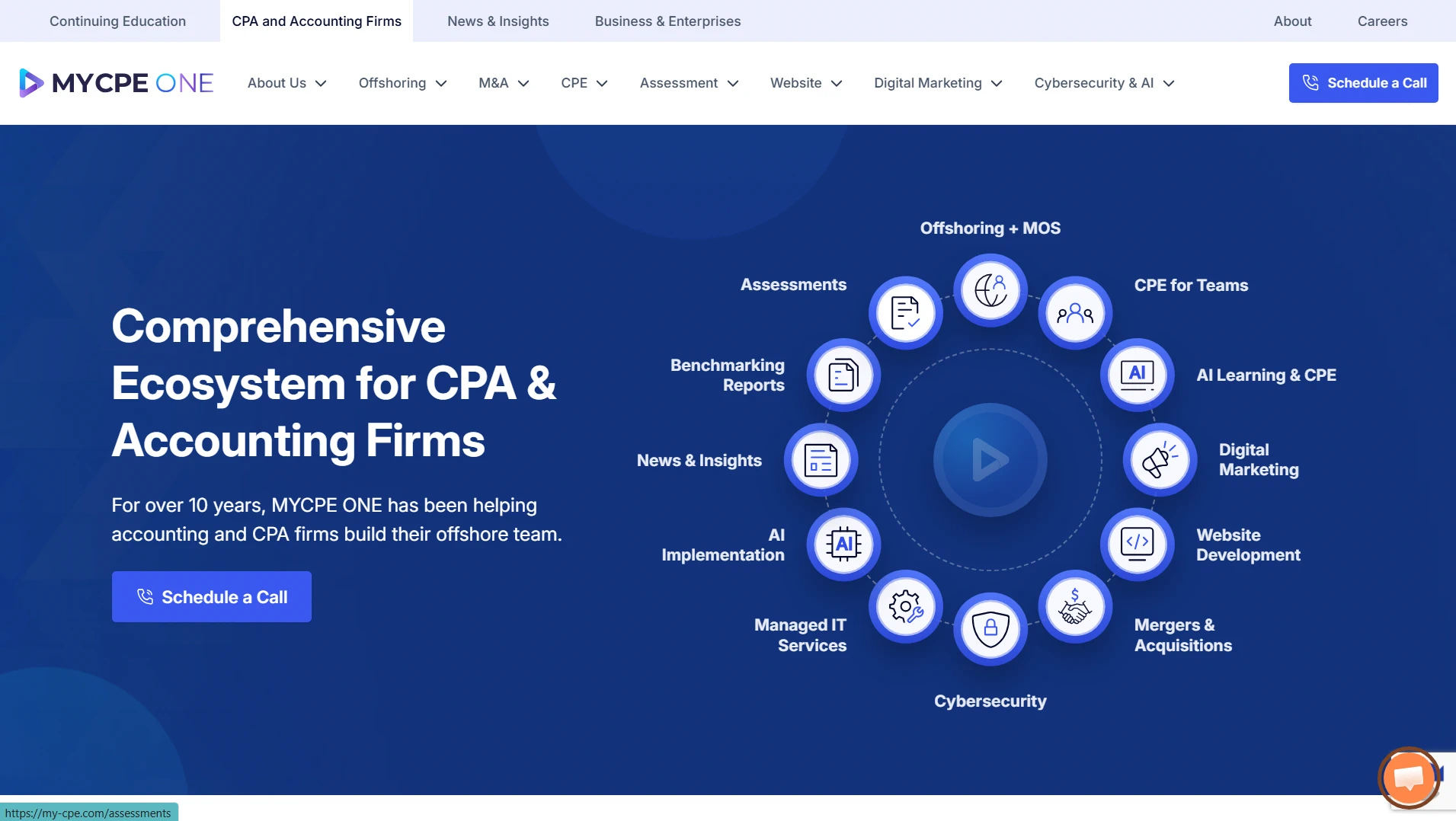
MYCPE ONE, formerly known as Entigrity, supplies dedicated offshore accounting and tax staff to US CPA firms. It has a delivery office in Eastwood, Quezon City, and publishes starting rates of $11 per hour, giving firms a concrete price point when comparing offshore staffing options.
Entigrity merged with MY-CPE and rebranded as MYCPE ONE in October 2024. Co-founder and CEO Shalin “Shawn” Parikh began operations in Ahmedabad, India. The company now employs about 3,000 people across India and the Philippines and serves 1,000+ accounting and CPA firms. Its staff handle bookkeeping and cleanup, AP/AR, reconciliations, month-end close, tax preparation, sales and use tax, payroll, audit support, and FP&A. They work across 100+ tools, including QuickBooks Online, Xero, Sage Intacct, NetSuite, UltraTax CS, CCH, and Caseware.
Why we picked it
MYCPE ONE publishes its starting rate and covers specialized tax and audit roles that general staffing firms may not be equipped to fill. That combination makes it a practical option for US CPA firms looking to add offshore capacity during tax season or support year-round accounting work.
- Services offered: Bookkeeping, accounts payable and receivable, reconciliations, month-end close, tax preparation, sales and use tax, payroll, audit support, and FP&A.
- Accounting scope and CPA access: Tax, audit, and bookkeeping roles for CPA firms; CPA count not published.
- Software: QuickBooks Online, Xero, Sage Intacct, NetSuite, UltraTax CS, Drake, Lacerte, CCH, Caseware, and 100+ other tools.
- Certifications: SOC 2 Type I and Type II, ISO 27001:2022; GDPR compliant.
- Headcount: About 3,000.
- Pros: Published starting rate; broad tax software coverage; specialization in CPA firms; two-week free trial.
- Cons: Most delivery runs from India, with Manila as its one named Philippine site. The service model is designed for CPA firms rather than corporate finance teams.
- Industry expertise: Public accounting, tax practices, and audit firms.
- Best for: US CPA firms seeking offshore tax, audit, and bookkeeping staff with published pricing.
- Pricing: Full-time staff start at $11 per hour, with an additional $1 to $1.50 per hour for US-hours overlap.
- Minimum team: Three months for temporary staff; six months for permanent staff.
- Ratings: Clutch: 4.9 (11 reviews).
- Year established: 2014.
- Location: Sugar Land, Texas (US headquarters); Eastwood, Quezon City (Philippines); India.
Why Choose Helpware as Your Accounting Outsourcing Partner in the Philippines
Helpware isn’t the cheapest provider on this list, and it doesn’t compete on price alone. The real question is what your accounting operations cost over two or three years, once turnover, onboarding, compliance, and service quality enter the equation.
Consider the impact of attrition. A provider with annual attrition of 6% to 8% faces recurring recruitment, onboarding, and productivity costs as team members leave. Each replacement cycle can cost an estimated 30% to 50% of an annual salary in lost productivity, management time, and training. Helpware reports 2.8% attrition at its Philippine centers, potentially reducing those costs over the life of an engagement. Its 90% CSAT score also points to a focus on service quality, while five-year average client partnerships give teams more time to build institutional knowledge and spread onboarding costs over a longer period.
For finance and back-office operations, Helpware’s Manila and Cebu delivery centers handle financial documentation, data entry, account setup, and other transactional processes. These services operate within the compliance infrastructure used to support regulated healthcare and fintech clients, including SOC 2, HIPAA, GDPR, and PCI DSS requirements.
Where does Helpware fit best? Mid-market and enterprise companies, typically with $50 million to $500 million in revenue, that handle sensitive financial data and need strong operational controls. Helpware may not be the right fit for high-volume, purely transactional accounting where the lowest cost per FTE is the main priority. But for organizations dealing with high turnover, compliance concerns, or unclear pricing, it offers a more structured approach to outsourcing.
Why the numbers matter:
- 2.8% attrition vs. a 6% to 8% industry benchmark: Potentially less spending on recruitment, retraining, and ramp-up.
- 90% CSAT: A focus on service quality that may help reduce escalations and repeat work.
- Five-year average client partnerships: Longer relationships that give teams time to build expertise and spread onboarding costs.
- SOC 2, HIPAA, GDPR, and PCI DSS: Established security and compliance frameworks to support regulated operations.
- 45+ languages: Multilingual support for global operations without the need to build a separate team for each market.
Pricing Models for Accounting Outsourcing in the Philippines
The pricing model you choose shapes not just your monthly bill but your operational risk. A model that works for a steady-state AP team will create friction for a team handling seasonal tax peaks. Before comparing vendor quotes, understand which structure you are actually being offered.
Dedicated FTE pricing
The most common model in Philippine accounting outsourcing. You pay a fixed monthly fee per full-time offshore professional. The rate covers the employee’s salary, benefits, and the provider’s management and infrastructure overhead. What the rate excludes varies significantly by vendor, so always confirm whether recruitment, equipment, IT support, payroll compliance, and office facilities are included or billed separately. Best suited for businesses with consistent, ongoing accounting workloads where you need a team that feels like an extension of your in-house function.
Hourly / time and materials pricing
Billed based on actual hours worked, typically in 15-minute or hourly increments. This model offers flexibility for variable-volume work but introduces budget unpredictability for anything other than short-term or project-based engagements. Philippine providers billing hourly for accounting roles typically charge $10 to $25 per hour depending on role level. Best suited for cleanup engagements, catch-up bookkeeping, or ad hoc financial analysis.
Per-function / per-task pricing
The provider charges per completed unit of work. For example, a fixed fee per invoice processed, per payroll run, or per month-end close cycle completed. This model transfers volume risk to the provider and can reward efficiency, but it often comes with volume minimums and service level agreements around turnaround time. Best suited for high-volume, standardized processes like accounts payable processing or payroll administration.
Project-based pricing
A fixed fee scoped against defined deliverables. Common for one-time engagements: financial modeling, audit preparation, system migrations, or setting up a chart of accounts. The risk is scope creep. Best suited for time-bound work with clear inputs and outputs.
Managed services retainer
A monthly flat fee that covers a defined package of accounting outputs, such as monthly financial statements, payroll processing for a stated headcount, and quarterly BAS filing. The provider owns the process, not just the labor. Best suited for small to mid-size businesses that want outsourced accounting to run without day-to-day direction from internal staff.
Hybrid pricing
A base monthly rate for a core dedicated team, plus variable charges for volume spikes, additional services, or after-hours coverage. This model gives operations leaders cost predictability for their baseline while preserving flexibility for seasonal peaks. It is increasingly common among Philippine providers working with accounting firms that have cyclical tax season demand.
Buyers who have been quoted a rate without specifying which model they need almost always end up comparing apples and oranges. Lock down the model first.
Cost Drivers of Accounting Outsourcing in the Philippines
Every vendor quote reflects a combination of factors. Understanding them helps you evaluate proposals, compare costs accurately, and ask the questions that can actually affect the price.
Role seniority and CPA certification
A staff bookkeeper handling data entry and bank reconciliations sits at the lower end of a provider’s rate card. A CPA-certified management accountant who can manage month-end close, prepare consolidated financial statements, and work directly with auditors costs more. Connext, for example, lists accountant plans at $2,000 per month on G2, compared with $1,800 for entry-level roles. Virtual CFO and controller-level engagements typically cost more still.
Credentials also affect pricing. Ask each vendor what percentage of its accounting workforce holds active CPA licenses. D&V Philippines, for instance, reports that 90% of its 1,000+ accountants are CPAs. That mix influences the firm’s ability to fill senior roles and the rates it can quote for them.
Geographic delivery location
Rates in Metro Manila typically run higher than those in provincial cities such as Cebu, Davao, and Angeles City. Providers with multiple Philippine locations may offer more cost-effective placements for roles that allow flexibility in where the team is based. Providers operating exclusively from Manila will price accordingly. Ask where the team assigned to your account will be based, whether in Metro Manila or a secondary city.
Engagement model and management overhead
Dedicated full-time equivalent (FTE) models typically cost more because they assign staff exclusively to your account and allow direct client oversight. Shared-resource or pooled models generally cost less but may offer less continuity. Some providers add a separate management fee, while others include it in the quoted rate.
Two proposals with the same headline price can have very different total costs. One may include HR support, IT helpdesk services, and quality assurance monitoring, while the other charges for these separately. Check exactly what each quote covers before comparing rates.
Attrition rates and their hidden costs
High turnover in an outsourced accounting team creates costs that may not appear in the contract but can affect your bottom line. Whenever an offshore accountant leaves, the replacement needs time to ramp up, during which productivity may be lower, errors may be more frequent, and additional review may be necessary.
Providers report retention and turnover in different ways. Emapta reports a 2.5% turnover rate, Outsourced.ph claims staff retention of more than 98%, Cloudstaff reports 99.5% monthly retention, and Helpware reports 2.8% attrition at its Philippine centers. Ask each provider how it calculates the figure and which period it covers before comparing these metrics.
Compliance certifications required
Requirements involving SOC 2, HIPAA, and PCI DSS can add costs because providers must maintain specific security controls, conduct audits, and operate the required infrastructure. If your industry requires particular safeguards for financial data, as in healthcare, fintech, or insurance, expect rates to differ from those for non-regulated work. Also check how the provider supports your financial services compliance obligations.
Ask for the relevant audit reports or certificates, along with their dates, rather than relying on a general assurance of compliance.
Software platform requirements
Providers with experience in your accounting software, such as QuickBooks Online, NetSuite, Xero, Sage Intacct, or Oracle, may charge more than generalists. However, a team that already knows your platform may need less training and supervision during onboarding. If the provider has to learn your systems from scratch, expect a longer ramp-up period and potentially more errors during the first 60 to 90 days.
Ask which versions of your software the assigned team has hands-on experience with, not just which platforms the provider supports.
Team size and volume commitments
Larger engagements may qualify for volume discounts. A single dedicated accountant can cost more per person than a five-person team. Longer commitments, typically 12 to 24 months, may also secure lower rates, while month-to-month arrangements often carry a premium. Before negotiating, decide how much flexibility you need and how long you can commit.
Understanding the factors behind a quote is more useful than benchmarking against a published rate card alone. A provider with the lowest headline price may cost more over time once attrition, compliance gaps, and additional fees are taken into account.
Next Step: Compare Quotes on the Same Basis
The right accounting outsourcing partner should balance cost with accounting expertise, data security, service continuity, and the level of oversight your team needs. Before making a decision, compare all-in monthly costs, clarify what each proposal includes, review current audit reports, and confirm the team’s experience with your accounting platforms. Check how providers calculate attrition, too, since turnover can add hidden costs through onboarding, training, and additional review.
If you’re looking for a partner to manage finance back-office operations in a certified environment alongside customer operations, contact Helpware for a custom quote tailored to your requirements.