







Building an SDR team in-house can take longer and cost more than expected, especially when you’re trying to create a repeatable outbound motion at the same time. Recruiting, ramping, managing, and replacing reps all take time, while your sales reps still need to focus on closing. That’s why some sales teams turn to an outsourced SDR team when they need to add pipeline without building the entire function themselves.
The numbers show why the decision deserves a closer look. The Bridge Group’s 2025 SDR research, based on 351 B2B companies, puts average SDR ramp at 3 months and median annual attrition at 40%. Median on-target earnings (OTE) are $80,000 before benefits and tools. Those costs and delays can make hiring a few SDRs look very different once you account for recruiting, management, turnover, and the time it takes to reach full productivity. Outsourcing is already part of that shift: in Deloitte’s 2024 Global Outsourcing Survey, 50% of executives said they use outsourced services for front-office capabilities such as sales and marketing.
In this guide, we’ll show you how to decide whether an outsourced SDR team fits your sales motion, how many seats you actually need, and how to structure the pod around clear roles and ownership. We’ll also cover what to put in the contract, how to evaluate potential partners, and which metrics to use during a 90-day pilot. The goal is to help you build an SDR program around your pipeline target and operating needs, rather than simply buying a number of seats from a vendor.
Key Takeaways
- An outsourced SDR team can add pipeline without building the entire sales development function in-house. A partner handles recruiting, training, management, and day-to-day prospecting, while your team stays responsible for the sales strategy and closing.
- The right team size starts with your pipeline target, not a vendor’s meeting promise. Work backward from the pipeline you need, then use benchmarks for pipeline per SDR, opportunity volume, and SDR-to-salesperson ratios to estimate how many seats you need.
- The delivery model matters as much as the number of reps. Dedicated pods give you named reps and more control, while shared teams, staff augmentation, and pay-per-meeting models give you different levels of control, continuity, and cost.
- A strong outsourced pod needs more than SDRs. Team leadership, QA and training, list research, and program management all play a role in keeping outreach consistent and giving your reps the support they need.
- Set clear ownership before the first campaign starts. Your team should define the target accounts, approve messaging, own the CRM and pipeline, and handle closing. The partner should own day-to-day outreach, qualification, coaching, and reporting.
- Treat the first 90 days as a pilot, not a finished program. Use the first month for setup and ramp, the second for early production, and the third to evaluate meetings, opportunity quality, and pipeline against the targets you set.
- Choose a partner based on how it will run your program, not just its sales pitch. Ask who will work your account, how reps are managed and replaced, where your data lives, and how the partner measures call quality and performance.
What an Outsourced SDR Team Is
An outsourced SDR team handles the prospecting work that happens before a sales conversation. The partner recruits, trains, manages, and replaces the reps, while your team sets the target market, approves the messaging, manages the sales process, and closes deals.
Day to day, the reps research potential customers through lead research, make cold calls through cold calling services, and send cold email lead generation sequences. They also prospect on LinkedIn through LinkedIn prospecting. When they find a good fit, they qualify the prospect and book a meeting with one of your salespeople. You can see the full range of channels and roles included in our managed SDR program.
Not every outsourced SDR program works the same way, though. Providers use the same label for several different delivery models, and the differences affect how much control you have, how closely the reps work with your team, and what you’re actually paying for.
| Model | What you get | Your control | Best fit |
|---|---|---|---|
| Dedicated pod | Named SDRs who work only your account, plus a team lead | High | Ongoing outbound against a defined target market |
| Shared pool | Reps split across several clients | Low | Early message testing on a tight budget |
| Staff augmentation | Individual reps who join your team under your manager | Highest | Teams with an experienced sales development manager |
| Pay-per-meeting | Meetings billed per booking | Lowest | Short campaigns where volume matters more than fit |
These models involve different trade-offs. A dedicated pod gives you named reps who focus on your account, while a shared pool spreads reps across multiple clients. Staff augmentation gives you individual reps who work under your manager, and pay-per-meeting programs charge based on the meetings they book.
For an ongoing outbound program with a defined target market, a dedicated pod gives you the team structure and continuity to build knowledge over time. Our analysis of dedicated versus shared teams covers the differences in more detail.
When Outsourcing Beats Hiring SDRs In-House
Outsourcing makes more sense when you need to build prospecting capacity quickly, enter a new market, or keep your pipeline moving without first building an entire sales development function. Hiring in-house makes more sense when you already have a proven process, an experienced manager, and a clear career path for new sales development reps.
Outsourcing may be worth considering if several of these describe your situation:
- Your salespeople spend part of every week prospecting instead of focusing on active deals.
- You need more pipeline this quarter, and a three-month hiring and ramp period is too long.
- You’re entering a new region, market segment, or language and need prospecting capacity quickly.
- Rep turnover keeps interrupting your outbound program.
- Nobody on your team has experience building and managing a sales development function.

“Outsourcing SDR/BDR work can be a solid move if you have a well-defined ICP and messaging — it saves time and helps scale outreach faster. That said, quality can vary a lot, and if the outsourced team doesn’t fully understand your product or market, it can lead to weak leads or brand damage. The best results usually come when you treat the outsourced reps like an extension of your team, with regular training, feedback, and close collaboration.”
The costs and trade-offs also look different. Hiring in-house gives you more direct control, but you also take on recruiting, management, turnover, and the time it takes each new rep to become productive. With an outsourced team, the partner handles those responsibilities, but you give up some control over day-to-day management.
| Factor | In-house SDR team | Outsourced SDR team |
|---|---|---|
| Time to productivity | Recruiting plus an average 3-month ramp | Partner recruits and trains before launch; confirm the stated launch window |
| Attrition | You absorb 40% median annual turnover | Partner backfills seats under contract terms |
| Fixed cost | $80K median OTE per rep, plus benefits, tools, and management | Monthly program fee |
| Control | Full control over hiring and coaching | You approve messaging and goals; partner manages day-to-day execution |
| Career path | Reps can grow into future sales roles | Reps remain employees of the partner |
| Scaling | A new hiring cycle for each seat | Seats can be added or removed according to contract terms |
The cost of hiring SDRs in-house versus outsourcing depends on your seat count, hours, location, and management needs. Model your own scenario with our outsourcing cost calculator, and see our roundup of inside sales outsourcing providers if you need help comparing providers that also handle later-stage sales.
Size Your Outsourced SDR Team From the Pipeline Number Back
Instead of asking a vendor how many meetings it can book, start with the amount of pipeline you need to generate. Then use independent benchmarks to work backward to the number of SDRs required. The Bridge Group study cited above provides several useful planning benchmarks: $3.78 million in median pipeline sourced per SDR each year, six converted Stage 1 opportunities per SDR per month at quota, one SDR for every 2.4 salespeople, and 6.4 SDRs per first-line manager.
Here’s what that calculation looks like for a team targeting $2.5 million in new pipeline per quarter.
| Step | What you’re calculating | Benchmark / input | Calculation | Planning result |
|---|---|---|---|---|
| 1. Set the target | Quarterly pipeline needed | Your target | Given | $2.5M per quarter |
| 2. Estimate pipeline per SDR | Annual pipeline per SDR | $3.78M per SDR per year | $3.78M ÷ 4 | About $945K per quarter |
| 3. Estimate SDR seats | SDRs needed for the pipeline target | Steps 1 and 2 | $2.5M ÷ $945K | 2.6, rounded up to 3 SDRs |
| 4. Estimate opportunity volume | Stage 1 opportunities generated | 6 per SDR per month at quota; 60% reach quota | 3 × 6 × 80% × 3 months | About 43 opportunities per quarter |
| 5. Check salesperson coverage | Salespeople supported by 3 SDRs | 1 SDR per 2.4 salespeople | 3 × 2.4 | About 7 salespeople |
| 6. Plan management | Manager coverage | 6.4 SDRs per manager | 3 ÷ 6.4 | Plan for one shared team lead |
Two assumptions are important here. First, Step 4 uses 80% of the monthly opportunity quota as a conservative planning assumption. The Bridge Group found that only 60% of SDRs reach quota, so planning below the full quota gives you some room for uneven performance. Second, the sales capacity check makes sure your team can handle the opportunities the SDRs generate. If you have only four salespeople, for example, three SDRs may create more opportunities than the team can work effectively. You may need to add sales capacity, lower the pipeline target, or dedicate one SDR to inbound qualification.
The benchmarks are useful for planning, but they aren’t universal. The Bridge Group sample was 83% B2B SaaS companies, with a $50,000 median selling price. If your deals are larger or your sales cycles are longer, the amount of pipeline and number of opportunities each SDR can generate may look very different. Ask each partner to run the same calculation using its own performance data so you can compare the assumptions behind each proposal.
Plan for lower output in the first quarter. Even a trained outsourced rep needs time to learn your product, understand your buyers, and handle the objections that come up in real conversations.
How to Structure an Outsourced SDR Team: Roles and Reporting Lines
An outsourced SDR team needs clear roles from the start. The reps should focus on prospecting and qualification, while other team members handle coaching, list research, quality checks, and program management. When those responsibilities fall on the same person, it becomes harder to maintain consistent outreach and quality.
| Role | Who provides it | Main responsibility | Coverage guidance |
|---|---|---|---|
| SDRs | Partner | Prospecting, qualification, and meeting booking | Sized from the pipeline calculation above |
| Team lead | Partner | Daily activity, call coaching, and weekly reporting | One per pod; can be shared for pods under 6 seats |
| QA and training specialist | Partner | Call reviews, quality checks, and messaging certification | Shared across smaller pods |
| List researcher | Partner | Target-account lists, contact verification, and record accuracy | Shared or dedicated based on volume |
| Program manager | Partner | Program scope, service levels, and business reviews | One per account |
| Program owner | Your team | Target accounts, messaging approval, sales feedback, and final qualification decisions | One named sales leader |
Ask each partner how its quality assurance program evaluates SDR calls and who is responsible for keeping your customer records accurate. Some partners include CRM management and appointment management in the program, while others expect your operations team to handle them.
Inbound, outbound, or both
Keep inbound qualification and outbound prospecting in separate workflows so new leads don’t wait behind cold outreach. For inbound, set a response-time target and route leads accordingly.
Who the pod reports to
Give the partner one clear point of contact on your side: the person responsible for the pipeline target. The Bridge Group reports that 60% of SDR teams report to sales and 26% report to marketing. Whichever structure you use, the outsourced team should have one internal owner who can set priorities and resolve questions quickly.
Where the team is located
Choose an onshore, nearshore, or offshore team based on your customers’ language needs, working hours, and communication requirements, not just the hourly rate. Our guide to outsourcing destinations by region compares the common options.
Who Handles What in an Outsourced SDR Program
An outsourced SDR program works better when both sides know exactly what they’re responsible for. Agree on those responsibilities before outreach begins so there’s no confusion about who makes decisions, manages the day-to-day work, or handles the handoff to your sales team.
| Area | Your team | Partner |
|---|---|---|
| Target accounts | Defines and approves the accounts to pursue | Builds and updates target lists based on campaign results |
| Messaging and sequences | Approves messaging within an agreed timeframe | Writes, tests, and updates outreach sequences |
| Outreach and qualification | Defines what makes a lead qualified | Handles daily outreach and initial qualification |
| Meeting handoff | Reviews meetings and gives sales feedback within an agreed timeframe | Books and confirms meetings and provides the relevant prospect information |
| CRM data | Owns the records and data | Logs all outreach and activity in your CRM |
| Reporting | Reviews performance weekly and quarterly | Provides reports, dashboards, and call reviews |
| Closing | Handles the sales process and closes deals | No role |
Contract terms to agree on before launch
The contract should also answer a few practical questions before the team starts contacting prospects:
- Data ownership: Every account, contact, and activity should be stored in your CRM and remain yours when the contract ends.
- Sending domains: Use secondary domains that you own for outreach rather than sending cold email from your primary domain.
- Named reps: Name the people assigned to your account and require advance notice if the partner plans to replace them.
- Backfill: Set a clear timeframe for replacing a rep who leaves and require the replacement to be trained before taking over the account.
- Exit terms: Define the notice period, data handoff, and what happens to your prospects and contacts after the program ends.
- Compliance: Include the data protection requirements that apply to your contacts, including GDPR where relevant, along with any industry-specific requirements.
Set response times and quality standards in a service level agreement, and review our guide to common outsourcing risks before the contract goes through legal review.
How to Hire an Outsourced SDR Partner in 7 Steps
1. Write the brief. Document your target market, your top three to five buyer personas, your qualification criteria, and what you consider a good meeting.
2. Shortlist three partners. Compare their delivery model, industry experience, and team location against your requirements.
3. Scope a pilot. Set a 90-day term, choose the number of seats based on your pipeline target, and define the results you need to see by the end of the pilot.
4. Meet the people who will run the program. Talk to the team lead and at least one SDR who would work on your account. Give them a chance to role-play a cold call so you can see how they handle your product and messaging.
5. Certify the team before launch. Have each SDR complete a messaging and objection-handling role-play that your team reviews and approves.
6. Set up a regular feedback loop. Hold a weekly review, create a shared Slack or Teams channel, and agree on how quickly your sales team will respond to qualified prospects.
7. Review the program at 30, 60, and 90 days. Use the results you agreed on in Step 3 to decide whether to scale the program, make changes, or end it.
5 Best Outsourced SDR Providers in 2026
How we chose: We looked at four factors that matter when evaluating an outsourced SDR partner: whether the provider offers dedicated teams, how the reps are managed and supported, how clearly it handles data and reporting, and whether its services fit mid-market B2B sales teams. Company information below comes from each provider’s website or, in Helpware’s case, our published company profile.
| Provider | Best for | Standout | Footprint |
|---|---|---|---|
| Helpware | Mid-market and enterprise B2B sellers in regulated or multilingual markets | SOC 2 Type II, ISO 27001, HIPAA, and PCI DSS compliance; 45+ languages | 19 locations in 11 countries |
| memoryBlue | B2B and public-sector technology sellers | Recruits and trains its own SDR talent | Headquarters in Tysons, Virginia, with offices in the US, Europe, and Singapore |
| Callbox | Multi-channel, multi-region campaigns | SDRs work with data analysts and content specialists | Offices in six countries; clients in 50+ countries |
| Sales Focus | Buyers who want employed, vetted reps | W-2, background-checked SDRs; 45-day launch guarantee | 35M+ company B2B database |
| SalesHive | Teams that want month-to-month flexibility | Proprietary outreach platform; founded in 2016 | US-based SDR option |
1. Helpware

Best for: Mid-market and enterprise B2B sellers in regulated or multilingual markets.
Helpware combines outsourced SDRs with the infrastructure of a larger CX operation. Its teams operate across 19 locations in 11 countries and can support outreach in 45+ languages, making it a practical option for companies selling across multiple markets or operating in regulated industries. Its hub-and-spoke delivery model gives clients access to a broader delivery network without forcing the SDR program into a one-size-fits-all setup.
Compliance is another part of the offering. Helpware maintains SOC 2 Type II, ISO 27001, HIPAA, GDPR, and PCI DSS certifications, which matters when SDR teams handle customer or prospect data in regulated environments.
The result is an SDR program backed by a broader operation covering technology, quality, compliance, and multilingual delivery. Helpware has also been recognized through industry awards, including the IAOP Global Outsourcing 100.
Keep in mind: Helpware is a large CX provider, so buyers should ask to meet the specific SDR team and leadership that would manage their program before signing.
2. memoryBlue
Best for: Technology and public-sector sellers running enterprise outbound.
memoryBlue has run sales development programs for more than 20 years and specializes in B2B and B2G technology companies. The company recruits and trains its own sales talent before assigning reps to client programs. Headquartered in Tysons, Virginia, it has several offices across the United States, Europe, and Singapore. Its SDR services cover North America, EMEA, and APAC, with a focus on technical sales cycles and enterprise buying committees.
Keep in mind: memoryBlue focuses heavily on technology and government markets, so companies in other industries should ask for references from similar clients.
3. Callbox
Best for: Companies running campaigns across several channels and regions at once.
Founded in 2004, Callbox runs outreach across voice, email, social, chat, and digital channels through its Pipeline platform. It has office presence in the US, Australia, Singapore, Malaysia, Colombia, and the Philippines, serving clients in more than 50 countries. Callbox SDRs work alongside client success managers, data analysts, digital marketers, and content specialists, and the company integrates campaign activity with the client’s CRM.
Keep in mind: Callbox offers a broad lead generation service, so if you want dedicated SDR seats and named reps, make sure those expectations are spelled out in the contract.
4. Sales Focus
Best for: Buyers who want employed, vetted reps assigned to their account.
Sales Focus employs its outsourced SDRs as W-2 employees, and each rep completes a background check and drug test before working with a client. The company positions its reps as dedicated to one client rather than part of a shared pool. It also guarantees a live SDR team within 45 days and maintains a B2B database with more than 35 million companies and 60 million contacts.
Keep in mind: A 45-day launch guarantee gives you a defined maximum launch window, but other providers may quote shorter timelines. Compare the launch process as well as the timeline itself.
5. SalesHive
Best for: Teams that want flexible terms and an all-in-one outreach platform.
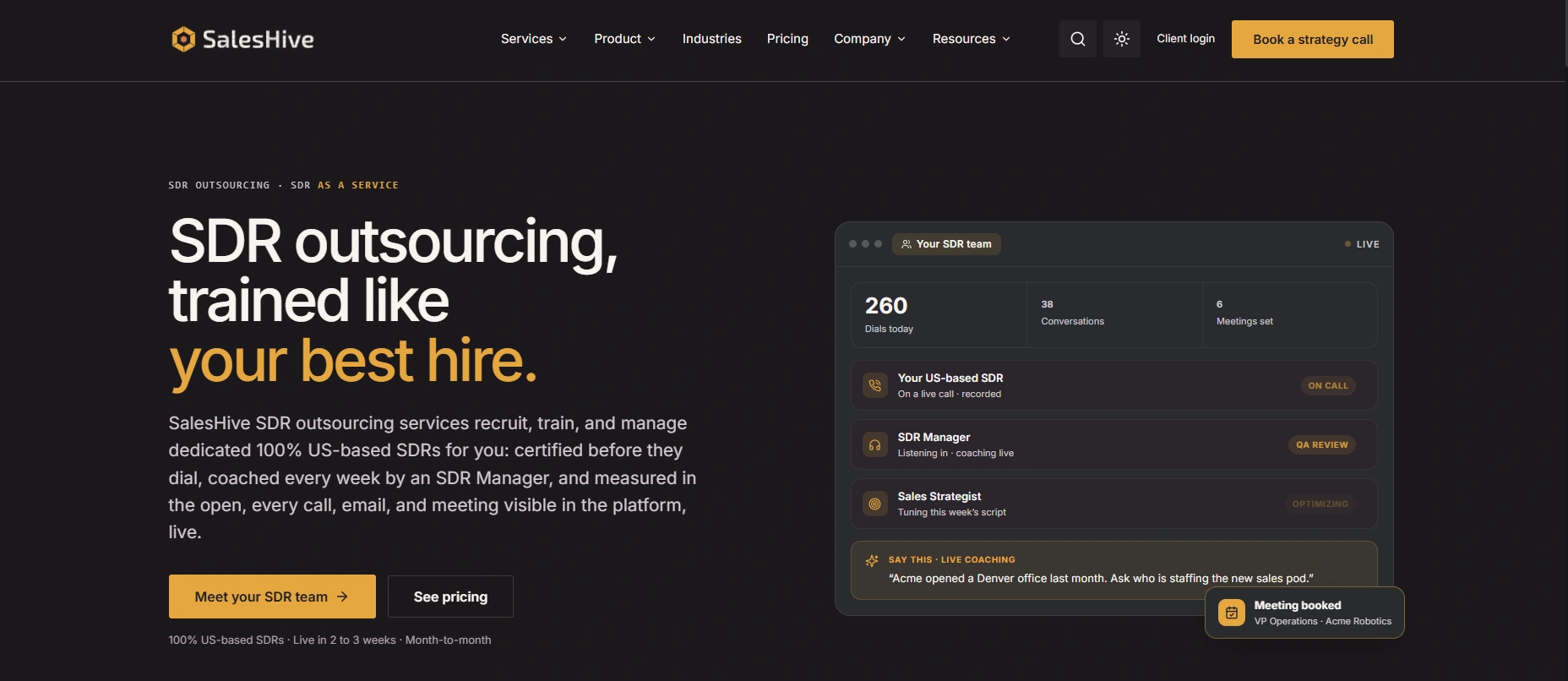
SalesHive was founded in 2016 and offers SDR programs on month-to-month contracts. Its proprietary platform includes CRM integration, AI-powered personalization, auto-dialers, email deliverability tools, and real-time analytics. The company offers US-based SDRs, with most programs launching within two to three weeks of kickoff. US-based strategists and SDR managers handle coaching and script optimization.
Keep in mind: Campaigns run through the SalesHive platform and sync with your CRM, so confirm how you can access and export your campaign data and what happens to that data when the contract ends.
For a wider view of the market, see our comparison of sales outsourcing companies, or our guide to SaaS sales outsourcing for software-specific trade-offs.
Build the Pod Before You Buy the Seats
An outsourced SDR program works best when you treat it as an extension of your sales team, not a fixed number of seats. Start with the pipeline you need to generate, use that target to determine team size, and make sure the pod has the leadership, training, and support needed to keep quality consistent. Clear responsibilities between your team and the partner matter just as much. When everyone knows who sets the strategy, manages outreach, handles qualification, and follows up on meetings, the program has a much better foundation to build on.
From there, use a 90-day pilot to see how the team performs with your market, messaging, and sales process. Set clear expectations before launch, review results at 30, 60, and 90 days, and use what you learn to decide what needs to change before you scale.
Helpware can provide that structure with sales development teams operating across 19 locations and 45+ languages, backed by broader CX, technology, quality, and compliance capabilities. To discuss what an outsourced SDR program could look like for your team, talk to the Helpware sales development team.