








Today, AI agents are no longer just “chatbots” on a website as they’ve become full-fledged service participants, analyzing data, anticipating customer needs, and sometimes making decisions faster than a human could. They learn from experience, adapt to conversational tone, and act as the invisible thread connecting customers and companies. According to Gartner’s March 2025 research, agentic AI will autonomously resolve 80 percent of common customer service issues without human intervention by 2029, cutting operational costs by 30 percent. The AI for customer service market, valued at $13 billion in 2024 is projected to reach $83.8 billion by 2033 at a 23.2 percent compound annual growth rate. For operations leaders evaluating their next move, the shift from basic chatbots to autonomous AI agents isn’t theoretical anymore. It’s the central question behind every vendor’s decision. This guide breaks down where the agentic customer support market is heading, compares 10 platforms built for this new category, and walks through how to choose the right fit for your operation.
Main Trends of Agentic Customer Support
Trend 1: Resolution-based pricing is replacing seat-based models
The economics of customer support software is changing. Platforms like Intercom and Decagon now charge per successful resolution rather than per agent seat, which fundamentally shifts how companies budget for support. Goldman Sachs Research projects the customer service software market could expand by an additional 20 to 45 percent by 2030 as AI agents become embedded in standard operations. For buyers, this means evaluating total cost of ownership differently. A platform charging $0.99 per resolution that handles 60 percent of your volume can deliver better unit economics than a $150-per-seat helpdesk, but only if resolution quality holds. The metric to watch isn’t just price per resolution. It’s what counts as “resolved.”
Trend 2: Human-AI collaboration is outperforming full automation
Early predictions that AI would eliminate human agents haven’t materialized the way many expected. A Gartner survey of 321 customer service leaders conducted in October 2025 found that only 20 percent have reduced agent staffing due to AI, while 55 percent report stable staffing levels handling higher customer volumes. What’s working is augmentation: AI agents resolving routine queries end to end while human agents focus on complex, emotionally charged, or compliance-sensitive interactions. Providers building structured handoff protocols between AI and human teams are seeing better outcomes than those investing into full automation. For buyers evaluating AI-augmented customer support solutions, the question has shifted from “how much can we automate?” to “where does the human-AI boundary produce the best CSAT?”
Trend 3: Agentic AI is moving from single-task bots to multi-step workflow execution
The real differentiator between current AI agents and previous-generation chatbots is action-taking. Modern agentic customer support tools don’t just answer questions. They process refunds, update subscriptions, cancel orders, verify accounts, and coordinate across backend systems. A Gartner survey of 265 service leaders found that 77 percent feel pressure from senior executives to deploy AI, and 75 percent report increased budgets for AI initiatives compared to last year. The four highest-impact use cases Gartner identified are agent enablement, self-service, operations automation, and agentic AI across the stack. For vendor evaluation, this means asking not just whether a platform can answer FAQ-level questions, but whether it can execute multi-step workflows in your CRM, billing, and order management systems.
Trend 4: Enterprise governance is becoming the deployment bottleneck
Deploying a prototype AI agent is easy. Deploying thousands of reliable, governed agents across regulated industries is where most organizations stall. Concerns about data privacy (affecting 30 percent of organizations), cybersecurity risks (35 percent), and regulatory compliance are the leading barriers to scaling agentic AI, according to Landbase’s 2026 analysis of enterprise adoption data. The operational implication is significant: platforms that include audit trails, policy enforcement, escalation controls, and compliance certifications (SOC 2, HIPAA, GDPR) will win enterprise deals over technically impressive but ungoverned competitors. What separates a demo-ready agent from a production-ready one is almost entirely a governance question.
Top 10 Agentic Customer Support Tools for 2026: At a Glance
| Company | Services | Global presence | Employees | Year est. |
|---|---|---|---|---|
| Helpware | AI customer experience, AI agent assist, voice AI, chat AI, AI QA, accent neutralization, noise cancellation, CX consulting | USA, Mexico, Philippines, Ukraine, Georgia, Puerto Rico, Poland, Germany, Albania (19 locations) | ~ 4,000 | 2015 |
| Intercom | Fin AI Agent, AI Copilot, helpdesk, ticketing, proactive support | USA, Ireland, UK, Australia (4 locations) | ~ 1,000 | 2011 |
| Zendesk | AI agents, ticketing, knowledge base, workforce management, quality assurance | USA, Ireland, UK, Australia, Philippines, Singapore, India, Denmark, Germany, Japan (20 locations) | ~ 5,800 | 2007 |
| Salesforce | Agentforce, Service Cloud, CRM, Einstein AI, workflow automation | USA, UK, India, Japan, Australia, Ireland, Singapore, France, Germany, Canada (70 locations) | ~ 72,000 | 1999 |
| Ada | AI agent, chat automation, email automation, voice automation, multilingual support | Canada, USA (2 locations) | ~ 500 | 2016 |
| Sierra | Conversational AI agents, enterprise governance, multi-channel automation | USA (1 location) | ~ 200 | 2023 |
| Forethought | AI triage, AI agent (Solve), AI Copilot (Assist), workflow automation | USA (1 location) | ~ 200 | 2017 |
| Cognigy | Conversational AI, voice AI, agentic AI, contact center automation | Germany, USA, UK, Australia (4 locations) | ~ 300 | 2016 |
| Kore.ai | Multi-agent orchestration, XO Platform, AI agent management, contact center AI | USA, India, UK, Germany, Japan (5 locations) | ~ 1,200 | 2013 |
| Freshdesk | Freddy AI Agent, ticketing, self-service, omnichannel support, analytics | USA, India, UK, Australia, Germany (5 locations) | ~ 5,300 | 2010 |
Top 10 Agentic Customer Support Tools: Overview
#1 Helpware
AI-powered customer experience platform combining autonomous AI agents with human expertise across 19 global locations
Helpware’s AI division delivers a full suite of AI customer experience solutions designed around a principle most platforms overlook: AI agents work best when paired with trained human teams, not deployed as replacements. The platform includes AI Agent Assist for real-time intent detection, sentiment analysis, and intelligent routing; Voice AI that handles hundreds of concurrent calls end to end; Chat AI with natural language processing that maintains conversational context; AI-powered quality assurance that reviews every interaction against defined standards, saving up to 80 percent of QA time; and accent neutralization and noise cancellation tools that remove friction from voice interactions. What makes the platform distinct is the five-stage integration methodology, from scoping AI impact areas through continuous monitoring and feedback loops, backed by the operational depth of a 4,000-person global team.
Why we picked it
Helpware bridges the gap between pure-play AI agent platforms and managed service providers. The combination of ready-to-deploy AI modules, a structured human-AI collaboration framework, and compliance infrastructure (SOC 2, HIPAA, GDPR, PCI-DSS) across regulated industries positions it for organizations that need both autonomous resolution and human backup at scale.
- Services offered: AI Agent Assist, Voice AI, Chat AI, AI-powered quality assurance, accent neutralization, background noise cancellation, AI analytics, AI knowledge base, CX consulting, technical support.
- Pros: 90 percent CSAT with 2.8 percent monthly attrition (vs 6-8 percent industry average); 70 percent of conversations resolved automatically; 25 million hours of human labor saved; native-speaker support in 45 languages; five-stage AI integration methodology; human-AI collaboration model, not pure automation.
- Cons: Consultative onboarding process takes longer than self-serve platforms; best suited for mid-market to enterprise operations, not lightweight single-channel use cases.
- Industry expertise: Healthcare and HealthTech, SaaS and Software, Ecommerce and Retail, Fintech, Gaming and Entertainment, Automotive and Logistics, Public Sector.
- Best for: Mid-market to enterprise companies ($50M-$500M revenue) that need AI-powered customer support with human oversight, compliance depth, and multilingual coverage across regulated industries.
- Pricing: Starting at $8-$15 per hour depending on service complexity and engagement model.
- Rating: 4.8 ★ (Clutch)
- Year established: 2015
- Location: Lexington, Kentucky (HQ); USA, Mexico, Philippines, Ukraine, Georgia, Puerto Rico, Poland, Germany, Albania
#2 Intercom
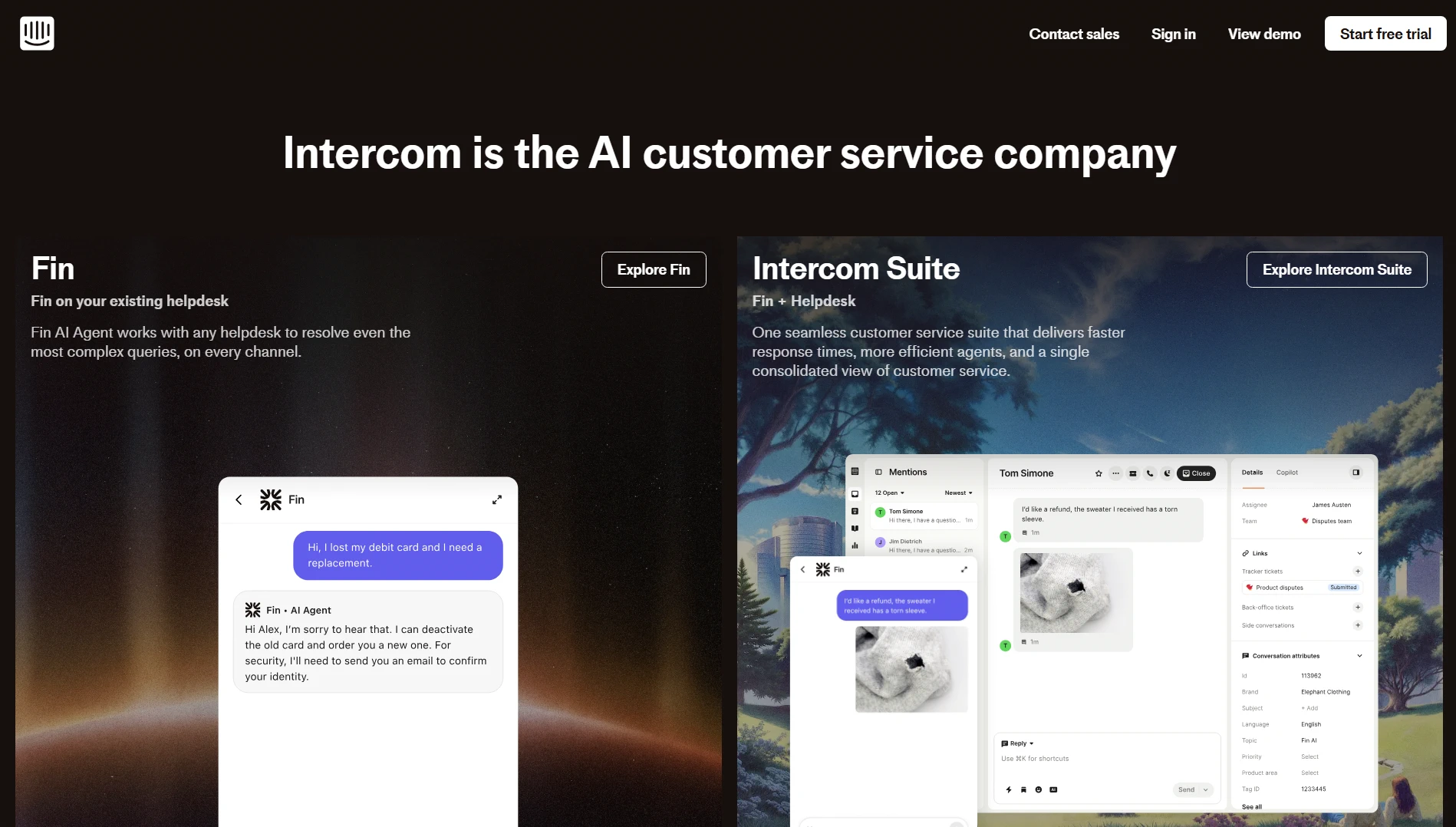
Pioneer of the AI-first customer service model with Fin AI Agent achieving 66 percent average resolution rate across 6,000 customers
Intercom built the first dedicated AI agent for customer service and continues to iterate aggressively. Fin 3, launched in late 2025, introduced Procedures for training AI on complex multi-step workflows, simulation testing against historical tickets, and expanded voice capabilities. The patented Fin AI Engine uses a multi-layer architecture optimized for accuracy, speed, and reliability, with custom guidance controls that enforce brand tone and behavior. Over 20 percent of Intercom customers now see resolution rates above 80 percent.
Why we picked it
Fin’s $0.99-per-resolution pricing model aligns cost directly with outcomes. The platform’s speed of iteration, with over 20 major feature upgrades since launch, signals strong product momentum. Resolution rates climbing from 41 to 66 percent across the customer base show real-world performance improvement, not just marketing claims.
- Services offered: Fin AI Agent (chat, email, voice, SMS, WhatsApp, social), AI Copilot for agents, helpdesk, ticketing, proactive support, product tours.
- Pros: 66 percent average resolution rate growing 1 percent monthly; pay-per-resolution pricing ($0.99); works with existing helpdesks (Zendesk, Salesforce); 45-language support; simulation testing before live deployment.
- Cons: Per-resolution costs can scale quickly at high volumes; advanced features require Expert plan; enterprise phone support pricing requires sales conversation.
- Industry expertise: SaaS, Fintech, Ecommerce, Technology, Media.
- Best for: Growth-stage to enterprise SaaS companies that want fast AI deployment with transparent per-resolution pricing and strong product iteration.
- Pricing: $0.99 per resolution + seat-based plans starting at $29/month (Essential). Contact sales for enterprise pricing.
- Rating: 4.5 ★ (G2)
- Year established: 2011
- Location: San Francisco, California (HQ); Dublin, London, Sydney
#3 Zendesk AI
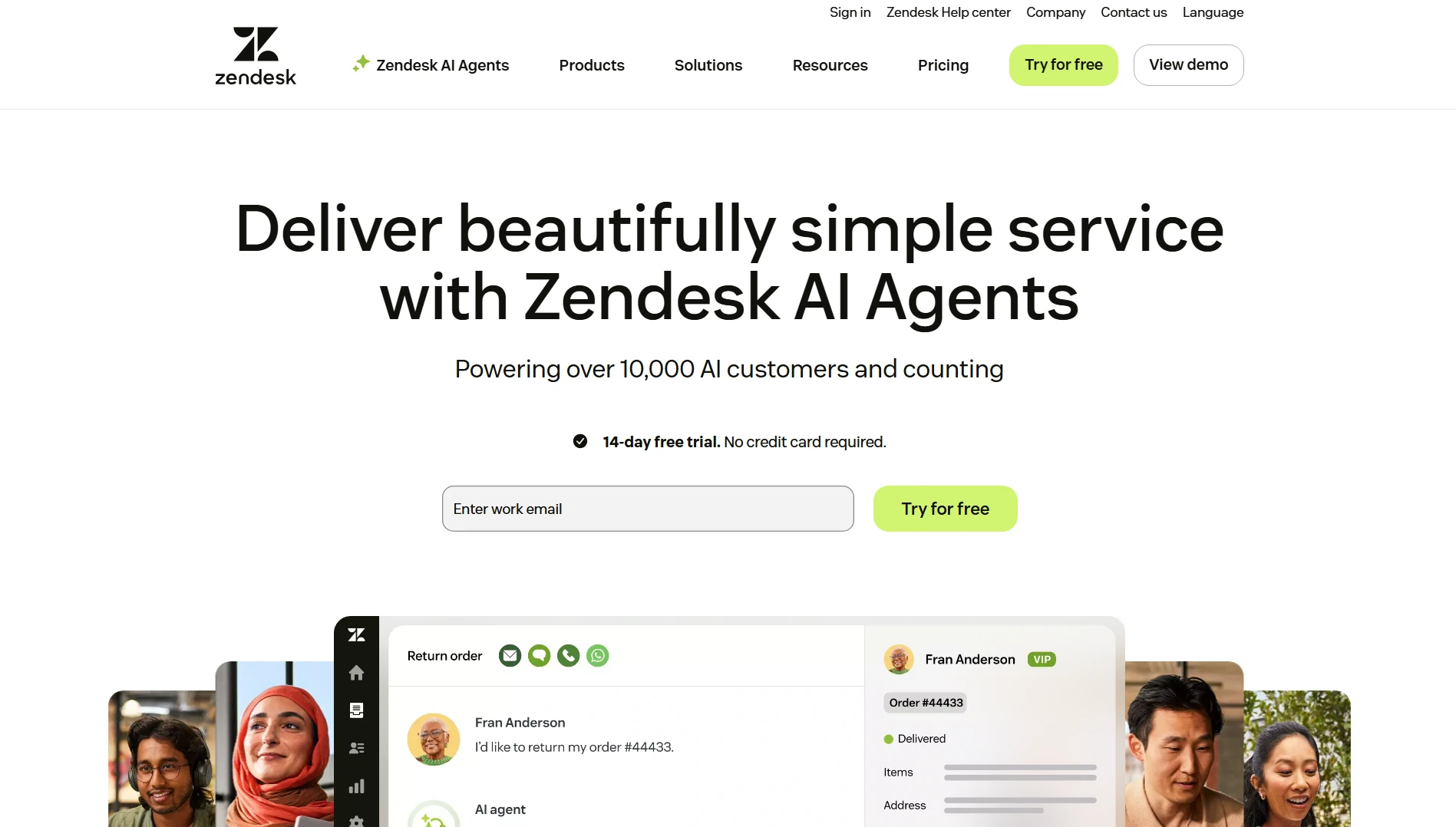
Enterprise-grade AI agents natively embedded in the most widely deployed customer service platform
Zendesk brings AI agents to an installed base of over 100,000 paying customers, which gives it an integration advantage few startups can match. The AI layer handles automated triage, suggested replies, generative assistance, and increasingly autonomous resolution across the full Zendesk Suite. Its strength lies in the depth of existing ticketing, knowledge base, and workforce management infrastructure that AI agents can tap into natively.
Why we picked it
For organizations already running Zendesk, the native AI integration eliminates the friction of connecting a third-party agent platform. The breadth of the ecosystem, from quality assurance to workforce management, means AI-driven insights flow across the entire support operation rather than sitting in a silo.
- Services offered: AI agents, automated triage, intelligent routing, generative replies, knowledge base, workforce management, quality assurance, analytics.
- Pros: Native integration with existing Zendesk ecosystem; enterprise compliance (SOC 2, HIPAA, GDPR); massive app marketplace; strong workforce management tools.
- Cons: AI capabilities are add-on costs above base plans; resolution depth trails specialized AI-first platforms; pricing complexity with credit-based AI model.
- Industry expertise: Retail, Technology, Financial Services, Healthcare, Media, Education.
- Best for: Enterprise and mid-market organizations already on Zendesk that want native AI without platform migration.
- Pricing: $500 per 100,000 AI credits (approximately $2 per conversation). Suite plans from $55/agent/month.
- Rating: 4.3 ★ (G2)
- Year established: 2007
- Location: San Francisco, California (HQ); offices in 20 countries
#4 Salesforce Agentforce
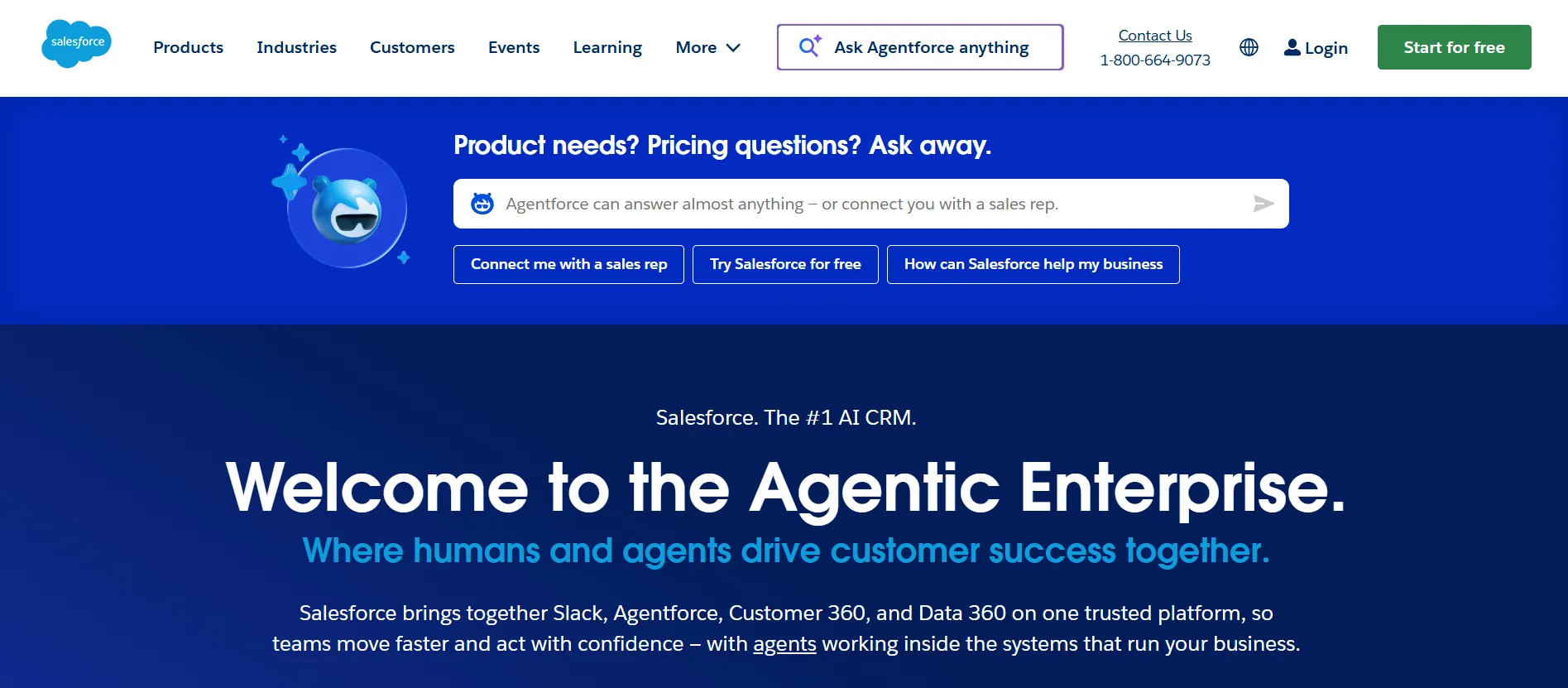
CRM-native AI agents with the deepest enterprise data access in the market
Salesforce launched Agentforce as the AI agent layer for Service Cloud, giving AI agents direct access to CRM records, case history, customer profiles, and workflow automation through Salesforce Flows. The platform integrates Google Gemini models for multimodal capabilities and real-time voice translation. What makes it structurally different is that AI agents operate on the same data model as human agents, which eliminates the context fragmentation that plagues bolt-on AI tools.
- Services offered: Agentforce AI agents, Service Cloud, Einstein AI, workflow automation, case management, knowledge base, omnichannel routing.
- Pros: Full CRM data access for contextual resolution; enterprise-grade security and compliance; deep integration with Salesforce ecosystem; real-time voice translation through Google partnership.
- Cons: Requires Salesforce as CRM (vendor lock-in); complex implementation for organizations not already on the platform; premium pricing at scale.
- Industry expertise: Financial Services, Healthcare, Manufacturing, Retail, Technology, Government.
- Best for: Enterprise organizations on Salesforce that want AI agents operating directly within their CRM workflow rather than through a separate platform.
- Pricing: $2 per conversation (Agentforce). Service Cloud Enterprise from $165/user/month.
- Rating: 4.4 ★ (G2)
- Year established: 1999
- Location: San Francisco, California (HQ); offices in 30 countries
#5 Ada
No-code AI agent platform built for high-volume autonomous resolution across 50 languages
Ada enables teams to build and deploy AI agents without engineering resources, using a visual builder that connects to CRM, billing, and order management systems. The platform focuses squarely on resolution rather than deflection, meaning its AI agents are designed to complete actions (process refunds, update accounts, cancel subscriptions) rather than just surface knowledge articles.
- Services offered: AI agent (chat, email, voice), no-code agent builder, multilingual automation, action-taking integrations, analytics.
- Pros: No-code deployment reduces time to launch; action-taking across backend systems; 50-language support; enterprise compliance (SOC 2, GDPR).
- Cons: Voice capabilities are newer and less mature than chat; pricing scales with resolution volume; limited agent-assist features compared to full helpdesk platforms.
- Industry expertise: Ecommerce, Fintech, SaaS, Telecom, Gaming.
- Best for: Growth-stage companies with high ticket volumes that want autonomous resolution without building an engineering team around their AI agent.
- Pricing: Per-resolution pricing. Contact sales for custom quote.
- Rating: 4.6 ★ (G2)
- Year established: 2016
- Location: Toronto, Canada (HQ); New York
#6 Sierra
Enterprise-focused AI agent platform founded by former Salesforce co-CEO Bret Taylor, built for governance-first deployment
Sierra entered the market in 2023 with a clear thesis: enterprise customers need AI agents with supervision layers, policy enforcement, and governance controls built in from day one. The platform uses persistent agents that maintain context across interactions and channels, with enterprise-grade audit trails and escalation rules designed for regulated industries.
- Services offered: Conversational AI agents, enterprise governance controls, multi-channel deployment, policy-driven escalation, audit trails.
- Pros: Built for enterprise governance requirements; founded by Bret Taylor and Clay Bavor (ex-Google); strong fundraising trajectory ($100M+ ARR); policy-driven agent behavior.
- Cons: Newer platform with smaller customer base than incumbents; custom pricing only; limited public documentation on integration depth.
- Industry expertise: Retail, Financial Services, Technology, Healthcare.
- Best for: Enterprise organizations in regulated industries that prioritize governance, compliance, and controlled AI behavior over time-to-deploy.
- Pricing: Custom enterprise pricing. Contact sales.
- Rating: Not yet rated on major platforms
- Year established: 2023
- Location: San Francisco, California
#7 Forethought
AI-driven triage and agent assist platform that augments existing helpdesks rather than replacing them
Forethought takes a different approach than standalone AI agent platforms. It plugs into existing helpdesks (Zendesk, Salesforce, Freshdesk) and layers AI on top for triage, routing, summarization, and agent assistance. Its Solve product handles customer-facing resolution, while Assist provides real-time AI copilot capabilities for human agents. The platform learns from historical tickets to deliver accurate responses from day one.
- Services offered: AI triage and routing (Triage), customer-facing AI agent (Solve), agent copilot (Assist), knowledge gap detection, analytics.
- Pros: Plugs into existing helpdesks without platform migration; learns from historical tickets for fast accuracy; strong triage and routing intelligence; 80 percent deflection rates reported by customers.
- Cons: Not a standalone helpdesk; resolution depth for complex multi-step actions trails newer agentic platforms; smaller company with acquisition risk.
- Industry expertise: SaaS, Ecommerce, Fintech, Education.
- Best for: Organizations that want to add AI capabilities to their existing helpdesk (Zendesk, Salesforce, Freshdesk) without a full platform swap.
- Pricing: Custom usage-based pricing. Contact sales.
- Rating: 4.3 ★ (G2)
- Year established: 2017
- Location: San Francisco, California
#8 Cognigy
Multichannel conversational AI platform with strong voice capabilities, recently acquired by NICE
Cognigy provides an intuitive interface for designing and deploying customer-facing AI agents across voice and digital channels. Its flow-based architecture makes it straightforward to build agents that handle complex conversational trees, though this approach can feel less flexible for highly dynamic agent behaviors. The 2025 acquisition by NICE brings contact center scale but introduces roadmap uncertainty.
- Services offered: Conversational AI agents, voice AI, contact center automation, agent assist, multi-channel deployment, analytics.
- Pros: Strong voice AI capabilities; intuitive visual agent builder; recognized in Gartner Magic Quadrant for conversational AI; enterprise contact center integrations.
- Cons: NICE acquisition creates roadmap uncertainty; flow-based architecture less flexible for dynamic agent behaviors; pricing not publicly available.
- Industry expertise: Insurance, Banking, Telecom, Healthcare, Retail.
- Best for: Contact center operations that need strong voice AI and visual agent design tools, particularly in regulated industries.
- Pricing: Custom enterprise pricing. Contact sales.
- Rating: 4.6 ★ (G2)
- Year established: 2016
- Location: Dusseldorf, Germany (HQ); San Francisco, London, Sydney
#9 Kore.ai
Enterprise multi-agent orchestration platform for organizations deploying AI agents across departments
Kore.ai’s XO Platform enables enterprises to design, deploy, and manage AI agents across customer service, employee support, and process automation from a single control layer (Kore.ai). Its multi-agent orchestration engine coordinates agents that collaborate, hand off context, and execute tasks with varying levels of autonomy, from simple copilots to fully autonomous task executors. It’s one of the few platforms generating over $100M in ARR.
- Services offered: XO Platform, multi-agent orchestration, customer service AI, employee AI, process AI, contact center AI, analytics.
- Pros: Multi-agent orchestration engine for cross-department deployment; $100M+ ARR signals enterprise traction; supports both customer-facing and internal AI agents; recognized by Gartner and Forrester.
- Cons: Complexity of multi-agent setup requires dedicated implementation resources; less suited for single-use-case deployments; steep learning curve.
- Industry expertise: Banking, Healthcare, Insurance, Telecom, Retail.
- Best for: Large enterprises deploying AI agents across multiple departments (customer service, IT, HR, operations) that need coordinated multi-agent management.
- Pricing: Custom enterprise pricing. Contact sales.
- Rating: 4.7 ★ (G2)
- Year established: 2013
- Location: Orlando, Florida (HQ); offices in India, UK, Germany, Japan
#10 Freshdesk (Freddy AI)
AI-enhanced helpdesk for mid-market teams that want automation without enterprise complexity
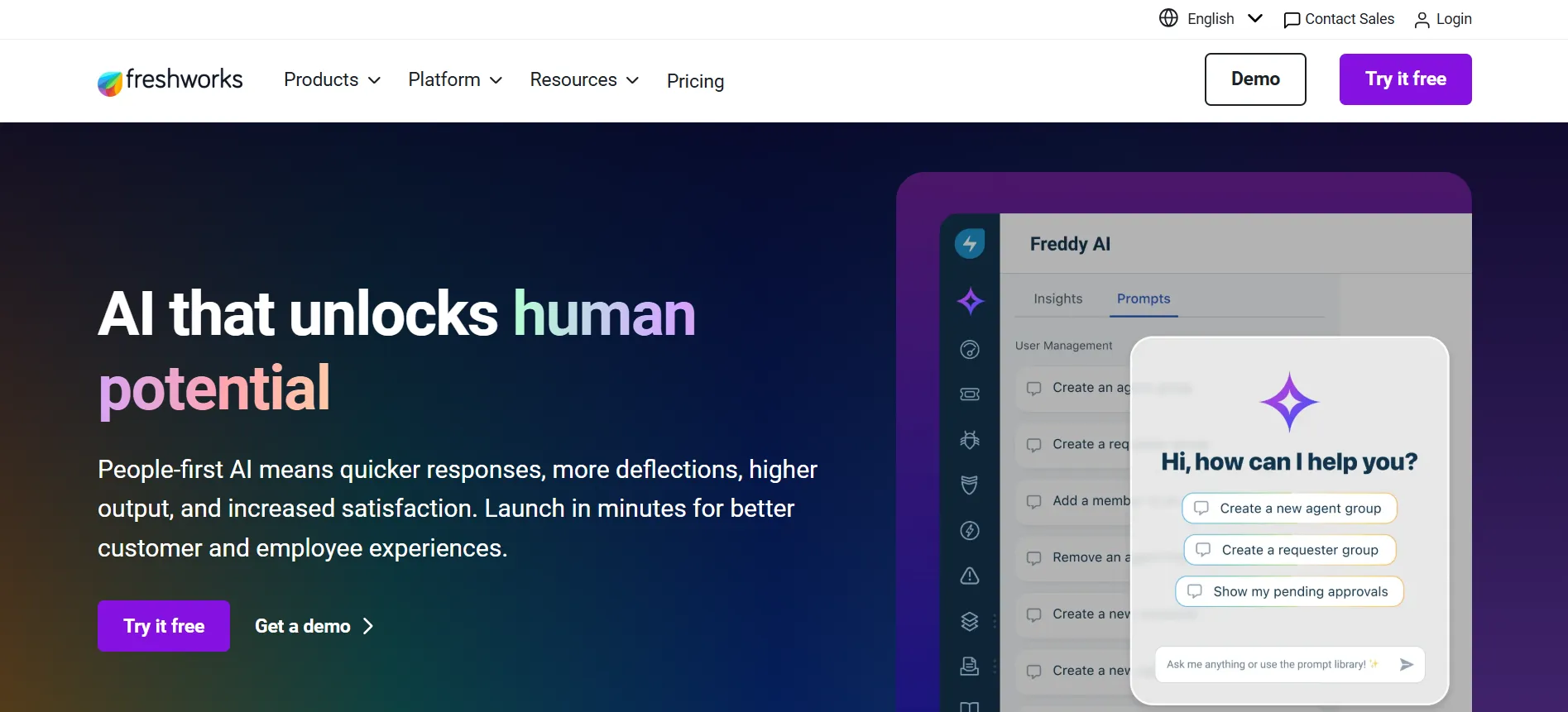
Freshdesk’s Freddy AI adds intelligent automation, triage, and agent assist capabilities to a well-established helpdesk platform (Freshworks). Freddy handles ticket classification, suggested responses, knowledge article generation, and increasingly autonomous customer interactions. It’s a practical choice for mid-market teams that need AI augmentation within a clean, usable interface.
- Services offered: Freddy AI Agent, ticketing, omnichannel support, self-service portal, knowledge base, analytics, workforce management.
- Pros: Clean interface with lower learning curve than enterprise platforms; competitive pricing for mid-market; good balance of AI and human agent tools; omnichannel coverage.
- Cons: AI agent capabilities less advanced than specialized platforms like Intercom or Ada; enterprise-grade governance features are limited; voice AI not as mature.
- Industry expertise: Ecommerce, SaaS, Education, Healthcare, Financial Services.
- Best for: Mid-market organizations (100-1,000 employees) that want AI-enhanced customer support without the complexity or cost of enterprise platforms.
- Pricing: Plans from $15/agent/month (Growth). Freddy AI add-on pricing varies. Contact sales for AI agent details.
- Rating: 4.4 ★ (G2)
- Year established: 2010
- Location: San Mateo, California (HQ); offices in India, UK, Australia, Germany
Helpware is Our Top Choice for the Best AI + Human Touch Combination
Among the 10 platforms compared, Helpware occupies a unique position in the agentic customer support market. Where most platforms on this list are pure technical solutions, Helpware has found the right balance between AI and humans to achieve maximum effect. That distinction matters operationally. When an AI agent hits its limit on complex questions related to healthcare compliance or financial issues, trained agents take over to provide expert assistance.
This approach aligns directly with the trends reshaping this market. The data shows human-AI collaboration outperforming full automation (only 20 percent of organizations have reduced headcount through AI), and governance is becoming the deployment bottleneck in regulated industries. Helpware’s SOC 2, HIPAA, GDPR, and PCI-DSS certifications, combined with its five-stage AI integration methodology, address both of those concerns.
The trade-offs are real. Helpware’s consultative onboarding takes longer than spinning up a self-serve chatbot, and the platform isn’t built for organizations that just want a lightweight FAQ bot on their website. Companies that treat customer experience as a strategic investment and need AI agents operating within compliance-heavy, multilingual environments tend to find the model worth it, as reflected in 5-year average client partnerships and 90 percent CSAT across the client base.
How to Choose Agentic Customer Support Tools
The right platform isn’t the one with the highest resolution rate on a demo. It’s the one whose architecture matches how your support operation actually works and where it needs to go.
- Start with integration depth. An AI agent that can’t execute actions in your CRM, billing system, or order management platform is just a smarter FAQ page. Ask specifically which backend systems the agent connects to natively and what workflows it can complete end to end. The difference between “we integrate with Salesforce” and “our agent can process a refund in Salesforce, update the customer record, and send a confirmation email without human involvement” is the difference between a chatbot and an agentic platform.
- Then evaluate the escalation model. Every AI agent will hit cases it can’t resolve. What matters is how gracefully it hands off. Does the human agent receive full conversation context, customer history, and AI-generated summaries? Or does the customer start over? Providers with structured human-AI collaboration frameworks consistently outperform those that treat escalation as a failure state.
- Pressure-test governance infrastructure. If your industry touches healthcare, financial services, or regulated data, audit trails, policy enforcement, and compliance certifications aren’t differentiators. They’re requirements. Ask for SOC 2 reports, not just badge logos.
- Look at resolution quality, not just resolution rate. A platform claiming 80 percent resolution rates might be counting FAQ deflections the same as multi-step workflow completions. Ask how resolutions are defined, what percentage involve backend actions, and what the CSAT looks like on AI-resolved conversations specifically.
- Finally, consider total cost at scale. Per-resolution pricing is transparent, but it scales linearly with volume. Seat-based pricing caps costs but hides AI limitations. Run the math against your actual ticket volumes and complexity distribution before committing.