








Order processing outsourcing covers more ground than most operations leaders expect before they issue their first RFP. Per-order rates, hourly agent fees, per-seat contracts, and outcome-based structures all exist in this market simultaneously, and a quote that looks cheap on paper can carry hidden costs that erode margin within the first two quarters. Mordor Intelligence’s 2026 market analysis projects the global BPO market at USD 436.37 billion this year and growing to USD 623.26 billion by 2031, with customer services holding a 32.14% share of 2025 revenue. Somewhere inside that market, dozens of providers are quoting your competitors right now.
This guide is for operations leaders, finance executives, and procurement teams evaluating order processing outsourcing for the first time or renegotiating an existing contract. You’ll find a breakdown of the five most common pricing models, six verified cost drivers that move quotes up or down, and a compared overview of 10 companies actively operating in this space in 2026.
Pricing Models for Order Processing Outsourcing
Before you request a single quote, knowing how order processing BPO is priced tells you what each vendor is optimizing for. The model they lead with reveals as much about fit as the rate itself.
Per-order pricing
The vendor charges a flat fee per order processed, typically in the $2 to $8 range depending on complexity, validation steps, and channel mix. This model works well for ecommerce and retail businesses with high, predictable order volumes and standardized workflows. The risk is that complex orders or exception handling often carry surcharges that are not visible in the headline rate.
Hourly rate pricing
Agents are billed by the productive hour, with rates ranging from $6 to $15 per hour offshore, $14 to $22 nearshore, and $25 to $45 onshore for comparable roles. This is the most transparent pricing model because you are paying for time rather than output. What the hourly rate does not reveal is how productively those hours are used, which is why agent attrition and onboarding quality matter more than the rate itself.
Per-seat (monthly) pricing
A fixed monthly fee per dedicated agent, regardless of order volume. This model suits operations with consistent, predictable workloads and benefits buyers who want stable monthly costs without fluctuation. The trade-off is visibility: you pay the same amount whether your team is at 60% or 95% utilization.
Outcome-based pricing
The vendor is compensated based on a performance metric, such as order accuracy rate, cycle time, or first-contact resolution. It is the outcome-based model that is gaining the most traction in 2026, particularly in contracts with sophisticated SLAs. Buyers benefit from aligned incentives; the risk is that poorly defined KPIs allow vendors to optimize for the metric rather than the underlying business outcome.
Hybrid (base plus variable) pricing
A base monthly fee covers a committed volume of orders or agent hours, with variable rates applied above a defined threshold. This model is increasingly common for ecommerce businesses with seasonal peaks because it provides cost predictability at baseline volume while accommodating scale-up without renegotiating the entire contract.
High-volume, transactional businesses with stable workflows tend to perform best on per-order or per-seat models. Companies with complex order workflows, multilingual requirements, or tight compliance obligations typically get better total value from hourly or outcome-based structures that build service quality into the contract.
Cost Drivers of Order Processing Outsourcing
Every order processing quote reflects a combination of variables that the headline rate rarely makes explicit. Understanding what drives cost makes it possible to evaluate any provider’s quote on its actual components.
Delivery location
Onshore, nearshore, and offshore delivery can vary by $15 to $30 per agent hour for comparable skill levels. Philippine and Eastern European agents, for example, are typically priced at $6 to $15 per hour for back-office roles, while US-based agents for the same functions often run $25 to $40. Location choice involves trade-offs across time zone coverage, language fluency, data sovereignty, and turnaround speed. Ask any vendor to separate the labor cost from the service fee so you understand what you are actually buying.
Agent attrition rate
What most buyers miss when comparing quotes is the hidden cost of agent attrition. High-turnover teams require constant retraining, quality suffers during transition periods, and the operational learning curve for complex order workflows resets with every replacement hire. The industry average monthly attrition rate runs between 6% and 8%; providers that operate at 2.8% attrition, as Helpware does, reduce hidden retraining costs that erode per-agent pricing benchmarks over time.
Order complexity and exception handling
A straightforward ecommerce order with a single SKU, known payment method, and standard shipping is priced very differently from a B2B order with custom line items, credit approval workflows, and inventory allocation logic. The more exception types your orders generate, the higher the per-agent cost and the more important process mapping quality becomes before go-live.
Channel and system mix
Agents processing orders across a single integrated system cost less to deploy than those navigating disconnected ERP, OMS, and CRM platforms simultaneously. Every additional system an agent must access adds training time, increases error risk, and slows cycle time. Vendors that offer technology integration as part of onboarding, rather than billing for it separately, reduce this cost driver significantly.
Language and market coverage
Multilingual order processing for cross-border ecommerce carries a meaningful premium over single-language operations. Native-speaker support in less common languages is significantly more expensive than English-only delivery, and quality differences between native speakers and bilingual agents are material for B2B order workflows where precision in communication affects order accuracy.
Coverage hours and scale requirements
24/7 coverage across time zones costs more than business-hours-only delivery, primarily because of shift differentials and the staffing overhead required to maintain service level consistency across all shifts. Seasonal peaks add another dimension: vendors without established flex staffing models may propose surge rates at three to four times the baseline rate. Where this matters most is in seasonal ecommerce businesses, where peak pricing can flip a favorable annual cost comparison into an unfavorable one.
Only when you understand these six variables can you evaluate any quote intelligently, whether it arrives as a per-order rate, an hourly figure, or a monthly seat fee.
Calculate Your Order Processing Costs
Now that you know what drives pricing, you can put real numbers to your situation.
Use Helpware’s cost calculator to get a personalized estimate based on your order volume, channel mix, language requirements, and coverage hours. Or speak with our team for a custom quote that reflects your specific workflow complexity.
Unlock your hidden CX savings with Helpware
Get ROI projection for current support needs.
-40% annually
/monthly costs with Helpware
vs
/internal team costs (approx)
Your requirements fall outside our standard parameters.
Let's discuss your results
Fill in your details to schedule a consultation.
-40% annually
/monthly costs with Helpware
vs
/internal team costs (approx)
Your requirements fall outside our standard parameters.
-40% annually
/monthly costs with Helpware
vs
/internal team costs (approx)
Your requirements fall outside our standard parameters.
Support staff included in the package:
Shared Team Leader
Shared L&D Specalist
Shared QA Specialist
Account Executive by default
Shared Ops Delivery Manager
Admin/Finance/Legal support for the agents by default
1-2 Dedicated Team Leaders
Shared L&D Specialist
Shared to 1 Dedicated QA Specialist
Shared Ops Manager
Account Executive by default
Admin/Finance/Legal support for the agents by default
Shared Real Time Analyst
2-5 Dedicated Team Leaders
0,5 to 1,5 Dedicated L&D Specialists
1-2 Dedicated QA Specialists
Up to half of a dedicated Ops Manager
Account Executive by default
Admin/Finance/Legal support for the agents by default
1 Dedicated Real Time Analyst
Ready to get a personalized estimate for your team?
Contact us for a personalized assessment tailored to your specific needs.
*These projections are estimates for informational purposes only and do not represent a formal offer. Contact us for a personalized quote.
Thank you!
You’ll hear from us within one business day.
Top 10 Order Processing Outsourcing Companies for 2026
| Company | Services | Global presence | Employees | Year est. |
|---|---|---|---|---|
| Helpware CX | Back office, order processing, customer support, technical support, CX consulting | USA, Mexico, Philippines, Ukraine, Georgia, Puerto Rico, Poland, Germany, Albania (19 locations) | ~4,000 | 2015 |
| Concentrix | CX management, back-office processing, analytics, digital transformation | 70 countries, 6 continents | ~300,000 | 1983 |
| TP (Teleperformance) | CX management, back-office processing, trust & safety, translation | 95 countries | ~485,000 | 1978 |
| Genpact | Order management, finance & accounting, supply chain, AI services | 30+ countries, 66+ delivery centers | ~78,000 | 1997 |
| WNS Global Services | Back-office BPO, customer experience, finance & accounting, analytics | India, Philippines, US, UK, South Africa (13+ countries) | ~60,000 | 1996 |
| TaskUs | Digital CX, back office, trust & safety, AI services | 13 countries, 30 locations | ~61,400 | 2008 |
| Sutherland | Back office, CX management, digital transformation, automation | 40+ operation centers | ~40,000 | 1986 |
| TTEC | Customer care BPO, tech support, back office, AI operations | 21 countries | ~52,000 | 1982 |
| SupportNinja | Customer support, back office, data processing, finance & accounting | 5 continents, US/Philippines | ~2,000 | 2015 |
| Conduent | Business process services, transaction processing, HR services, government services | 24 countries | ~54,000 | 2017 |
Top 10 Order Processing Outsourcing Companies: Overview
#1 Helpware CX

Founded in 2015 and operating across 19 locations on four continents, Helpware CX delivers back-office support services including order processing, order taking, invoice processing, and returns management for ecommerce, retail, and healthcare clients, backed by a 90% CSAT score and a 2.8% monthly attrition rate.
Helpware CX is a specialized BPO provider whose back-office operations handle the full order lifecycle: receipt, validation, payment verification, fulfillment coordination, and returns processing. The company’s ecommerce and retail BPO practice serves marketplaces, direct-to-consumer brands, and retailers that need omnichannel order support in multiple languages, with dispute and chargeback management, product catalog operations, and invoice processing built into the same team. With 4,000+ team members supporting 45+ languages across 19 global offices, Helpware CX runs order processing programs that scale to seasonal peaks without the surge pricing common in transactional BPO contracts.
Why we picked it
Helpware’s 2.8% monthly attrition rate directly reduces the hidden retraining costs that erode order accuracy in high-turnover back-office teams. Its 5-year average client partnerships, 90% CSAT, and SOC 2, HIPAA, and GDPR compliance certifications signal operational depth that cost-play providers typically cannot match.
- Services offered: Back-office operations (order processing, order taking, invoice processing, returns management), omnichannel customer support, technical support, CX consulting (strategy, technology, operational transformation), data operations
- Pros: 2.8% monthly attrition vs. 6-8% industry average; 45+ languages with native-speaker model; SOC 2, HIPAA, GDPR, PCI-DSS certified; 90% CSAT consistently maintained; 5-year average client partnership longevity
- Cons: Consultative sales process adds timeline before go-live; may be over-engineered for high-volume, low-complexity transactional programs
- Industry expertise: Ecommerce & Retail, Healthcare & Telehealth, SaaS & Software, Banking & Fintech, Gaming & Entertainment, Logistics, Public Sector
- Best for: Mid-market to enterprise companies ($50M-$500M revenue) where order accuracy, compliance, and customer experience quality are competitive differentiators
- Pricing: Starting at $8-$15 per hour depending on service complexity, location, and engagement model.
- Rating: 4.8 ★ (Clutch)
- Year established: 2015
- Location: Lexington, Kentucky (HQ); USA, Mexico, Philippines, Ukraine, Georgia, Puerto Rico, Poland, Germany, Albania
#2 Concentrix
Operating across 70 countries on six continents, Concentrix is one of the largest business process outsourcing companies in the world, with 2,000+ clients across major industries and a back-office processing practice built on AI-enhanced workflows and analytics.
Founded in 1983 and taken public in 2020 before merging with Webhelp in 2023, Concentrix has built a broad back-office capability alongside its customer experience management operations. Its back-office practice covers order processing and fulfillment support, finance and accounting, HR administration, and supply chain coordination, delivered at the scale only a 300,000+ employee organization can sustain. The company serves sectors including retail and ecommerce, healthcare, technology, financial services, and automotive, typically for enterprise clients requiring complex, multi-geography programs.
Why we picked it
Concentrix brings enterprise-grade infrastructure, 150+ languages, and a proven track record with Fortune Global 500 brands. Its AI-enhanced back-office workflows are well suited to high-volume order environments where throughput and accuracy at scale are the primary buying criteria.
- Services offered: Back-office processing (order management, finance & accounting, data management), customer experience management, CX analytics, AI operations, digital transformation consulting
- Pros: 70-country footprint for 24/7 order coverage; 150+ languages; strong analytics and reporting infrastructure; handles enterprise-scale volume
- Cons: Minimum engagement sizes favor large enterprises; pricing typically reflects enterprise contract requirements in the $22-$45/hour range per industry benchmarks
- Industry expertise: Retail & ecommerce, banking & financial services, healthcare, technology, automotive, travel
- Best for: Enterprise companies with high order volumes across multiple geographies that need a single, large-scale BPO partner with compliance depth
- Pricing: Custom pricing; contact vendor directly
- Rating: Not publicly rated on Clutch
- Year established: 1983
- Location: Fremont, California (HQ); 70 countries
#3 TP (Teleperformance)
Now operating as TP after shortening its name from Teleperformance in 2025, this French-headquartered company is among the world’s largest back-office and customer experience outsourcing providers, with 485,000+ employees across 95 countries serving clients in 300+ languages.
Established in Paris in 1978, TP has spent more than four decades building one of the most geographically distributed delivery networks in BPO. Its back-office processing practice sits alongside customer experience, trust and safety, and translation services. Back-office processing comprises the core of the group’s revenue, covering order management, payment support, claims handling, and document processing for clients in retail, ecommerce, healthcare, and financial services. TP’s 2023 acquisition of Majorel expanded its European and African delivery footprint and added specialized capabilities in the luxury and automotive sectors.
Why we picked it
TP’s global scale provides meaningful resilience for buyers with cross-border order processing programs spanning multiple time zones and regulatory environments. Its combination of 300+ language coverage and deep vertical expertise makes it a strong candidate for multinational ecommerce operations.
- Services offered: Back-office processing, customer experience management, trust and safety, translation services (LanguageLine), digital transformation consulting, AI operations (TP.ai)
- Pros: 95-country presence; 300+ languages; enterprise-scale delivery; AI orchestration platform for automated order processing workflows
- Cons: Large-enterprise focus; pricing reflects scale requirements; program quality consistency across 95 countries requires active oversight
- Industry expertise: Retail & ecommerce, financial services, healthcare, technology, travel & hospitality, telecommunications
- Best for: Global enterprises managing order processing across multiple regions, languages, and regulatory frameworks
- Pricing: Custom pricing; contact vendor directly
- Rating: Not publicly rated on Clutch
- Year established: 1978
- Location: Paris, France (HQ); 95 countries
#4 Genpact
Originating as a GE Capital back-office unit in 1997 before spinning off as an independent company in 2005 and going public on the NYSE in 2007, Genpact has built a specific order management practice with AI-driven automation that raises order automation rates from 30% to 75% for complex programs, according to published case studies on its website.
With 78,000+ professionals across 30+ countries, Genpact serves hundreds of Fortune 500 companies across finance and accounting, supply chain, customer experience, and AI services. What distinguishes Genpact from generalist BPO providers is the depth of its order management methodology: the company applies process mining, digital twins, and AI-powered exception management to systematically remove friction from order-to-cash workflows. Its published order management case studies include programs with expected outcomes of $80M in value unlocked over three years and sixfold return on investment.
Why we picked it
Genpact is the right choice for companies whose order management complexity exceeds what a standard back-office team can handle. Its analytics and transformation methodology adds value in environments with high exception rates, fragmented systems, and significant revenue leakage from order inaccuracies.
- Services offered: Order management and automation, finance and accounting BPO, supply chain operations, AI and analytics services, customer experience operations
- Pros: Deep order-to-cash methodology with measurable outcomes; AI automation raises touchless processing rates significantly; Fortune 500 client base demonstrates enterprise delivery capability
- Cons: Consulting-led engagement model adds timeline and cost; better suited to transformation programs than lift-and-shift outsourcing
- Industry expertise: Banking & financial services, life sciences, healthcare, manufacturing, retail, insurance
- Best for: Enterprise companies seeking operational transformation of complex order management workflows alongside outsourcing
- Pricing: Custom pricing; contact vendor directly
- Rating: Not publicly rated on Clutch
- Year established: 1997
- Location: New York, NY (HQ); 30+ countries
#5 WNS Global Services

Founded in 1996 as a British Airways back-office unit to manage the airline’s revenue accounting and operational processes, WNS built a publicly traded BPM company with 60,000+ professionals across 66 delivery centers. In October 2025, Capgemini completed its $3.3 billion acquisition of WNS, integrating its back-office expertise into Capgemini’s broader consulting and engineering organization.
WNS now operates as part of Capgemini, bringing domain expertise in finance and accounting, customer experience, procurement, and analytics to a broader technology and consulting network. Its back-office BPO practice covers order processing, claims management, accounts payable and receivable, and research and analytics for clients in travel, insurance, retail, healthcare, and logistics. The company’s 600+ global clients include Fortune 500 brands that have maintained long-term BPM relationships averaging multiple years.
Why we picked it
WNS’s origins in back-office operations give it genuine domain depth in structured, transaction-intensive workflows where process accuracy and turnaround speed directly affect customer experience. The Capgemini acquisition adds technology and consulting capability to what was already a strong back-office delivery operation.
- Services offered: Back-office BPO (order processing, claims management, AP/AR), customer experience management, finance and accounting outsourcing, research and analytics, procurement services
- Pros: Purpose-built BPM methodology with measurable outcome focus; 600+ global clients; 66 delivery centers for geographic redundancy; part of Capgemini’s broader capabilities
- Cons: Ongoing Capgemini integration may affect program continuity during transition; pricing is enterprise-tier
- Industry expertise: Travel & logistics, insurance, healthcare, retail, banking & financial services
- Best for: Enterprise companies seeking structured, analytics-driven BPM with deep domain expertise across order and finance operations
- Pricing: Custom pricing; contact vendor directly
- Rating: Not publicly rated on Clutch
- Year established: 1996
- Location: New York, NY and Mumbai, India (HQ); 13+ countries
#6 TaskUs
TaskUs serves ecommerce, social media, fintech, healthcare, and AI companies from 30 locations across 13 countries, with approximately 61,400 employees as of mid-2025.
TaskUs built its name supporting high-growth technology brands, and its back-office capabilities grew alongside its digital customer experience and trust and safety practices. The company offers back-office support including data processing, order operations, catalog management, and content tagging, delivered through cloud-based infrastructure. Its ecommerce back-office work includes order processing, inventory management support, and catalog data entry. That said, the majority of TaskUs revenue comes from digital CX and trust and safety programs, making back-office a secondary rather than primary capability.
- Services offered: Digital customer experience, back office (order ops, data entry, catalog management), trust and safety, AI services (data labeling, LLM support)
- Pros: Strong ecommerce vertical experience; 13-country delivery network; AI-enhanced workflow management
- Cons: Back office is a secondary capability; primary reputation is in content moderation and digital CX
- Industry expertise: Ecommerce, social media, fintech, healthcare, food delivery, gaming
- Best for: High-growth ecommerce and tech companies that want back-office support alongside digital CX and trust and safety from a single provider
- Pricing: Custom pricing; contact vendor directly
- Rating: Not publicly rated on Clutch
- Year established: 2008
- Location: New Braunfels, Texas (HQ); 13 countries, 30 locations
#7 Sutherland Global Services
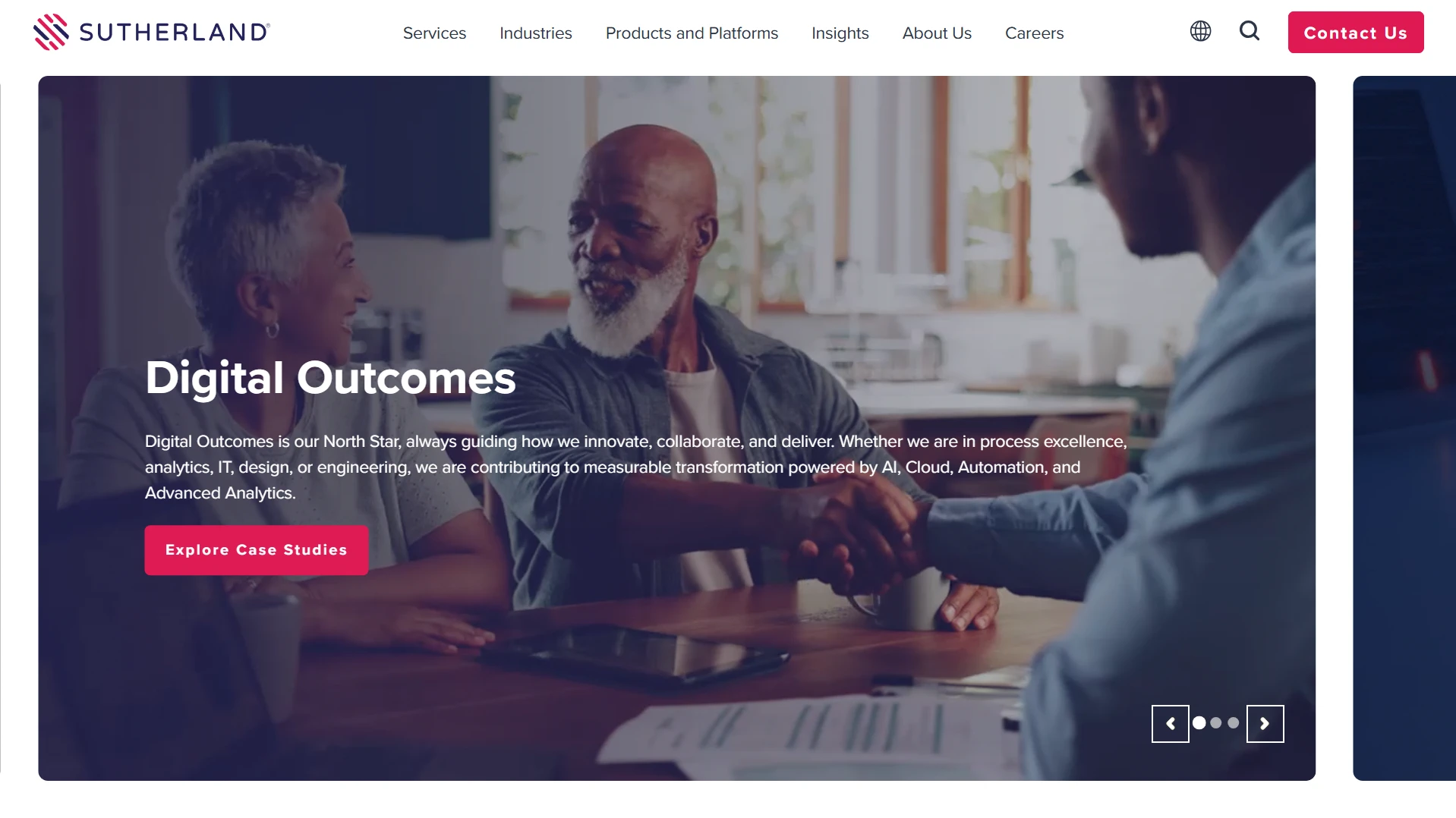
Founded in 1986 and headquartered in Pittsford, New York, Sutherland is an independent BPO and digital transformation company with 40,000+ professionals across 40+ operation centers, serving clients in retail, healthcare, insurance, technology, and banking.
Sutherland positions itself as a process transformation company that rebuilds workflows for the digital age by combining design thinking with data analytics. Its back-office practice covers front-office to back-office services across the customer lifecycle, with capabilities in order management, claims processing, finance and accounting, and robotic process automation. The company processes more than 43 million transactions per month across its client base, and its three-decade track record gives it established delivery methodology in regulated industries where order accuracy and audit trails are non-negotiable.
- Services offered: Back-office and front-office BPO, order management, robotic process automation, supply chain support, digital transformation services
- Pros: 40-year delivery track record; strong in regulated industries; RPA and automation capabilities reduce manual processing costs
- Cons: Less visibility in pure ecommerce order processing; enterprise engagement sizes typically required
- Industry expertise: Insurance, retail, healthcare, technology, banking & financial services
- Best for: Companies in regulated sectors that need order management integrated with compliance and process transformation
- Pricing: Custom pricing; contact vendor directly
- Rating: Not publicly rated on Clutch
- Year established: 1986
- Location: Pittsford, New York (HQ); 40+ operation centers globally
#8 TTEC
Founded in 1982 as TeleTech by Kenneth Tuchman and rebranded as TTEC in 2018, TTEC operates through two divisions: TTEC Digital (CX technology and consulting) and TTEC Engage (operational delivery), serving approximately 660 clients across 21 countries with 52,000+ employees.
TTEC Engage’s back-office solutions include order management, fraud prevention, data annotation, and claims processing, delivered alongside customer care and technical support programs. What sets TTEC apart from most BPO providers is its dual operating model: TTEC Digital designs CX technology roadmaps, and TTEC Engage runs operational programs against them, creating an integrated technology-plus-delivery capability that pure BPO providers cannot replicate. TTEC has earned Gartner Magic Quadrant Leader recognition for customer service BPO, reflecting its position as a consultative partner as well as an operational provider.
- Services offered: Customer care BPO, back-office operations (order management, fraud prevention), tech support, AI operations, CX technology consulting
- Pros: Dual model combining technology design with operational delivery; Gartner Magic Quadrant Leader for CX BPO; strong in healthcare and financial services compliance
- Cons: Higher pricing than pure BPO providers; better suited to transformation programs than transactional outsourcing
- Industry expertise: Healthcare, financial services, retail, technology, government, communications, travel
- Best for: Companies seeking a CX technology strategy alongside back-office operations, particularly in regulated industries
- Pricing: Custom pricing; contact vendor directly
- Rating: Not publicly rated on Clutch
- Year established: 1982
- Location: Austin, Texas (HQ); 21 countries
#9 SupportNinja
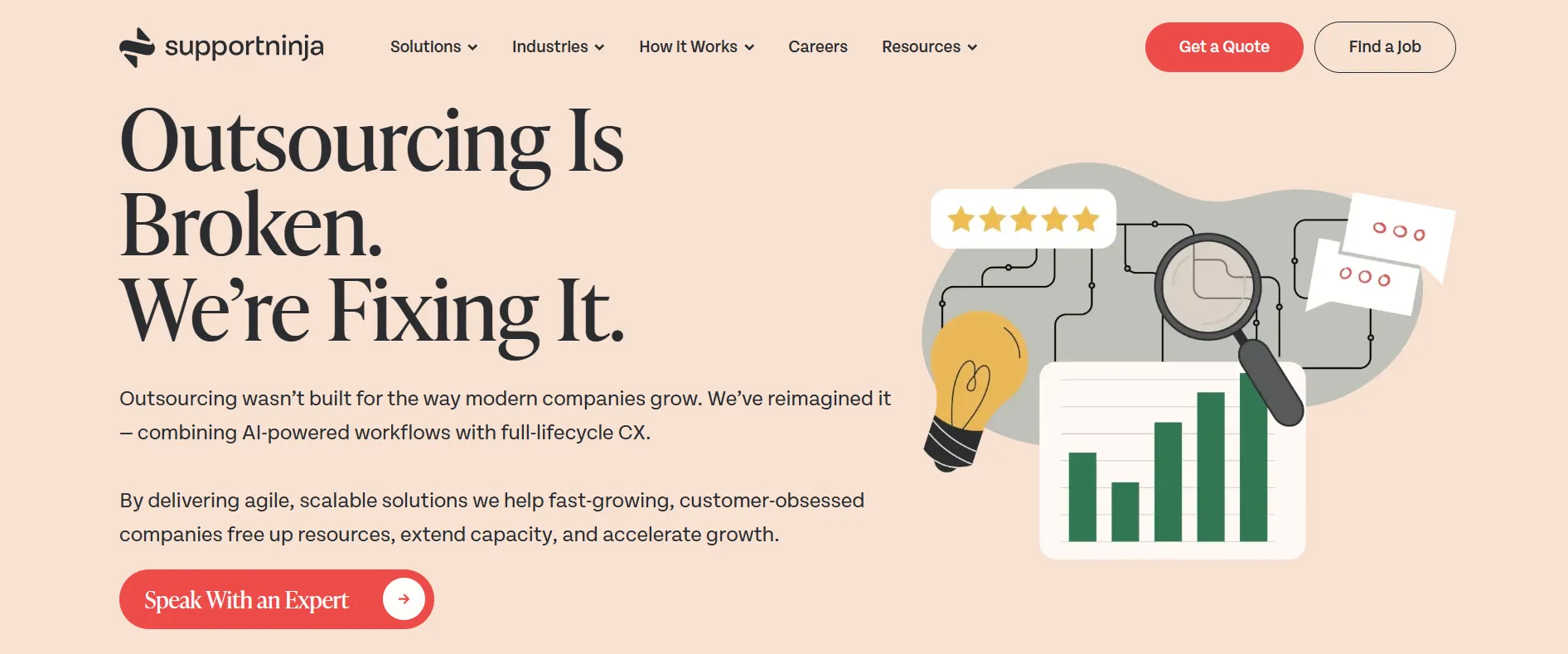
Founded in 2015 and headquartered in Austin, Texas, with delivery operations in the Philippines and across five continents, SupportNinja is a mid-market BPO provider serving ecommerce, SaaS, AI, healthcare, and fintech companies with approximately 2,000 employees.
SupportNinja’s back-office capability covers data processing, finance and accounting support, data entry, and customer support, delivered at a scale and pricing structure that suits mid-market buyers who need more customization than large BPOs typically offer but do not need 100+ agent programs. The company holds SOC 2 Type 2 and HIPAA certification, which extends its relevance to ecommerce businesses handling payment data and healthcare-adjacent order operations. It has appeared on the Inc. 5000 list for consecutive years, reflecting consistent revenue growth.
- Services offered: Customer support, back-office operations (data entry, data processing, finance & accounting), content moderation, technical support
- Pros: Mid-market pricing; SOC 2 Type 2 and HIPAA certified; faster implementation timelines than enterprise BPOs; growing ecommerce back-office capability
- Cons: Smaller team limits 24/7 coverage hours and language breadth compared to enterprise providers
- Industry expertise: SaaS, AI, ecommerce, healthcare, fintech, supply chain & logistics
- Best for: Growth-stage ecommerce and SaaS companies that need flexible, compliance-ready back-office support at mid-market pricing
- Pricing: Custom pricing; contact vendor directly
- Rating: Limited public reviews on Clutch
- Year established: 2015
- Location: Austin, Texas (HQ); Philippines, Europe (5 continents)
#10 Conduent
Spun off from Xerox in January 2017 and headquartered in Florham Park, New Jersey, Conduent is a publicly traded business process services company with 54,000+ employees across 24 countries, managing approximately 2.3 billion customer service interactions and 10 billion document and claims transactions annually.
Conduent’s commercial segment covers front-office to back-office processes for retail, healthcare, pharmaceutical, and financial services clients. Its transaction processing capability includes order management, payment processing, claims handling, and HR services, delivered through a combination of digital platforms and managed services. The company’s scale in transaction processing makes it a credible option for businesses with high-volume, compliance-driven order operations, particularly where regulated-sector experience matters. Note that Conduent disclosed strategic review activities in 2025, a factor worth addressing in any long-term contract negotiation.
- Services offered: Transaction processing, back-office BPO (order management, claims, payment processing), HR services, customer experience management, government services
- Pros: 2.3 billion annual interactions demonstrates transaction processing scale; strong compliance posture across regulated sectors; digital platform delivery model
- Cons: Ongoing strategic review may affect long-term program continuity; limited visibility in pure ecommerce order processing relative to competitors
- Industry expertise: Healthcare, pharmaceutical, retail, financial services, government
- Best for: Enterprise companies in regulated sectors that need high-volume transaction processing with audit-ready compliance infrastructure
- Pricing: Custom pricing; contact vendor directly
- Rating: Not publicly rated on Clutch
- Year established: 2017
- Location: Florham Park, New Jersey (HQ); 24 countries
Why Choose Helpware As Your Order Processing Outsourcing Partner
Helpware’s $8-$15 per hour pricing range sits below the enterprise BPO tier and above the lowest-cost offshore providers. What the math looks like in practice depends on total cost of ownership, not the hourly rate in isolation.
It’s not the sticker price but the total cost of ownership that determines real value in order processing outsourcing. The two hidden cost drivers that most back-office comparisons ignore are attrition and quality. A provider billing $7 per hour with 12% monthly attrition retrains its order processing team roughly every eight months, resetting accuracy, speed, and system familiarity with each cohort. Helpware’s 2.8% monthly attrition rate means the team learning your order workflows, exception patterns, and ERP quirks stays long enough to become genuinely fast and accurate. The 90% CSAT maintained consistently across clients reflects the downstream effect: fewer customer contacts about order errors, fewer escalations, and fewer returns tied to processing mistakes.
For ecommerce and retail clients specifically, Helpware’s back-office outsourcing practice covers order processing, returns management, invoice processing, and dispute and chargeback support alongside product catalog management for platforms including Shopify, Amazon, and Magento. The ecommerce and retail BPO practice integrates omnichannel customer support with back-office operations, which matters when order-related customer contacts and processing workflows run through the same team rather than separate vendors with separate onboarding and SLA management.
Helpware is the right fit for mid-market to enterprise companies that view order accuracy and customer experience as revenue-generating functions rather than cost centers. It is not the right fit for pure high-volume transactional programs that optimize for the lowest possible cost per order without regard for quality metrics or compliance depth.
Why the numbers work:
- 2.8% monthly attrition vs. 6-8% industry average — lower hidden retraining costs over the contract period
- 90% CSAT — fewer customer contacts about order errors and fewer escalations
- 5-year average client partnerships — onboarding investment amortizes across a longer program lifecycle
- SOC 2, HIPAA, GDPR, PCI-DSS certified — no compliance remediation costs for regulated order data