







Prior authorization follow-ups, refill coordination, and benefits questions appear on no clinician’s job description, yet they fill clinical hours every day. When no one owns that work, it falls to whoever picks up the phone, and sometimes that’s no one. In the end, patients absorb the delay.

“I had a patient contact me thru LinkedIn because they couldn’t get thru on the phone.”
In the 2025 AMA Prior Authorization Physician Survey, released on May 13, 2026, 95 percent of physicians said prior authorization delays access to necessary care. Another 79 percent said patients abandon treatment because of authorization problems. Cost stops many of them before the clinical question is even reached: KFF’s Health Tracking Poll, fielded February 24 to March 2, 2026, found that 43 percent of US adults did not take medication as prescribed in the past year because of cost, up from 31 percent three years earlier. Researchers Watanabe, McInnis, and Hirsch measured the cost of the resulting harm in the Annals of Pharmacotherapy in March 2018: $528.4 billion a year in illness and death caused by medication therapy that was not optimized, equal to 16 percent of all US health spending in 2016.
That’s where patient support services come into play.
Patient support services are non-clinical services that help patients start a treatment and stay on it. The category covers nine functions: enrollment and onboarding, insurance verification and prior authorization, financial assistance, scheduling and intake, adherence outreach, disease education, nurse triage routing, billing questions, and post-discharge follow-up.
Different organizations use different names for the same work. Pharmaceutical companies call it a patient support program. Hospitals and telehealth platforms call it patient access. Health plans call it member services. The tasks overlap, but the buyer, the rules, and the right vendor are different in each case.
This guide covers the nine types, what each one returns, how in-house and outsourced models compare on cost and risk, and six providers measured against one set of criteria.
Key Takeaways
- Patient support services cover nine functions across four delivery models: pharma hub, provider patient access, payer member services, and telehealth patient operations.
- Many companies look for partners in the wrong category. Identify your model before you build a shortlist.
- Compliance and security, not price per seat, separate good partners from costly mistakes.
- Hybrid models are now common. Organizations keep clinical judgment in house and outsource verification, intake, and outreach.
- Six providers compared here: Helpware, Teleperformance, TTEC, Optum, Conduent, and Horatio.
What Are Patient Support Services?
Patient support services are non-clinical services that remove access, cost, and paperwork barriers between a patient and their prescribed care. This work sits outside the medical appointment and around it.
Four types of organizations fund and run this work:
- Pharmaceutical and biotech manufacturers fund patient support programs, often called hubs. The work covers benefits investigation, prior authorization, copay assistance, patient assistance programs, injection training, and adherence.
- Hospitals, health systems, and physician groups run patient access. The work covers scheduling, referral management, eligibility verification, pre-registration, and financial clearance.
- Health plans and payers run member services. The work covers benefits navigation, open enrollment, claims questions, and care management outreach.
- Telehealth and digital health platforms run patient operations. The work covers intake, platform troubleshooting, refill coordination, multi-state coverage, and retention outreach.
The naming confusion causes real problems. Search the term and the first page of results includes a Wikipedia entry about the UK’s Patient Advice and Liaison Service, a hospital patient-relations department, a nonprofit that gives grants to cancer patients, and a pharma hub vendor. Buyers then arrive at vendor calls describing a problem that vendor does not solve.
Which Kind of Patient Support Do You Need?
Start here. The four models share job titles, but little else.
| Model | Who funds it | Core work | Main regulations |
|---|---|---|---|
| Pharma patient support program (hub) | Manufacturer, brand team | Benefits investigation, prior authorization, copay and PAP adjudication, nurse educators, adherence | HIPAA, the federal Anti-Kickback Statute, FDA promotional rules, state pharmacy law |
| Provider patient access | Hospital, health system, physician group | Scheduling, referrals, eligibility, pre-registration, financial clearance, denial prevention | HIPAA, EMTALA, payer contracts, revenue cycle compliance |
| Payer member services | Health plan | Benefits navigation, enrollment, claims and eligibility questions, redeterminations | HIPAA, CMS marketing and call recording rules, state insurance regulators |
| Telehealth and digital health patient operations | Platform or virtual care company | Intake, platform support, refill coordination, multi-state routing, retention | HIPAA, multi-state licensing, telehealth policy, privacy rules |
How to identify your model quickly:
- If a drug brand pays for the program, you run a hub.
- If your revenue depends on filling a clinic schedule, you run patient access.
- If you owe CMS a call recording, you run member services.
- If your patients reach you through an app before they reach a clinician, you run telehealth patient operations.
A vendor that is strong in one row is often weak in the next. A hub operator that manages copay cards well rarely staffs a 24/7 multilingual app support queue. A CX provider that launches app support in three weeks does not want to handle patient assistance program eligibility.
This table tells you which program you run. It does not tell you which category of vendor serves it. For the provider patient access model specifically, our guide to patient access services covers the six front-end functions and the KPIs behind them, and patient access outsourcing companies sorts the vendor landscape for that model.
The Nine Types of Patient Support Services
| Type | What it covers | Clinical license required |
|---|---|---|
| Enrollment and onboarding | Program enrollment forms, consent capture, welcome outreach, start of benefits verification | No |
| Insurance verification and prior authorization | Benefits investigation, PA submission and follow-up, appeals support, denial tracking | No |
| Financial assistance | Copay cards, patient assistance program eligibility, foundation referrals, income validation | No |
| Scheduling, intake, and pre-registration | Appointment booking, reschedules, referral coordination, demographic and insurance capture | No |
| Adherence outreach and refill coordination | Refill reminders, lapse outreach, pharmacy coordination, check-in calls | No, unless the agent gives counseling |
| Disease education and treatment literacy | Condition and device education, injection training, caregiver materials, multilingual content | Sometimes; injection training usually requires a nurse |
| Nurse triage and clinical escalation | Symptom triage, adverse event intake and routing, urgent escalation | Yes, RN or higher |
| Billing and payment support | Statement questions, payment plans, balance resolution, financial counseling | No |
| Post-discharge and follow-up outreach | Discharge calls, readmission-risk outreach, satisfaction surveys, care plan check-ins | Sometimes, depending on the protocol |
Six of the nine functions need no clinical license. That difference shapes your cost model more than location does: licensed clinical staff cost several times what trained non-clinical agents cost, and US-licensed clinical work cannot move offshore.
What Patient Support Services Return
| Outcome | What produces it | Evidence to measure against |
|---|---|---|
| Fewer abandoned treatments | One team owns the prior authorization from submission through appeal, instead of leaving it to a patient on hold | 79 percent of physicians report patients abandoning treatment over authorization problems (AMA, 2025 survey) |
| More clinical hours returned to care | Verification, scheduling, and refill coordination move off nurses and front-desk staff | 95 percent of physicians report prior authorization delaying access to care (AMA, 2025 survey) |
| Lower cost per interaction | Non-clinical volume moves to trained agents and AI-assisted workflows instead of clinical staff | Check against your own cost-per-contact baseline |
| Better adherence | Copay and assistance navigation before cost stops the fill, plus structured outreach at refill and lapse points | 43 percent of US adults skipped medication over cost in the past year (KFF, March 2026) |
| Less avoidable spending | Fewer treatment failures and fewer new medical problems caused by medication therapy that was not optimized | $528.4 billion a year, 16 percent of 2016 US health spending (Watanabe et al., 2018) |
| Stronger compliance position | Documented BAAs, access logging, audit trails, and recorded QA on every patient interaction | Your BAA and your vendor’s SOC 2 Type II report |
Why it matters: these outcomes depend on ownership, not on headcount. A queue with more agents but no named owner for a stalled prior authorization produces the same abandonment rate at a higher cost.
In-House, Outsourced, Or Hybrid: Differences
| Dimension | In-house | Fully outsourced | Hybrid |
|---|---|---|---|
| Time to full operation | Six to twelve months to hire, train, and license | Two to twelve weeks, depending on scope | Four to eight weeks for the outsourced part |
| Cost structure | Fixed. You pay for seats through the low season | Variable. You pay per FTE or per interaction | Fixed core, variable overflow |
| Clinical judgment | Stays with your staff | Contracted, usually at higher rates | Stays with your staff |
| 24/7 and multilingual coverage | Expensive to build twice over | Included in the price | The vendor covers nights, weekends, and second languages |
| Compliance responsibility | Yours alone | Shared under a BAA, but accountability stays with you | Shared, with the highest-risk work kept in-house |
| Where it works best | Small volumes, one state, one language, highly specialized therapy | Seasonal peaks, open enrollment, fast scale-up, after-hours cover | Most mid-market and enterprise programs |
Guidehouse’s 2026 patient support program trends analysis describes how organizations are moving to technology-enabled hybrid models, keeping some services in house and using partners for scale, speed, and AI capability.
A hybrid split that works in practice: keep nurse triage, clinical escalation, and adverse event review in-house. Move benefits investigation, prior authorization follow-up, scheduling, intake, refill coordination, and after-hours coverage to a partner. Name one internal owner per workflow and have that person read the vendor’s QA scorecard every week.
The Criteria We Applied
We describe every provider against the same six criteria, Helpware included. We do not score or rank them. The right provider depends on which of the four models you run, so a single ranked order would be misleading.
| Criterion | What we looked for |
|---|---|
| Compliance and security | Named certifications (SOC 2 Type II, ISO 27001, HIPAA, GDPR), BAA readiness, access logging, audit trails |
| Healthcare workflow experience | EHR and CRM integration, clinical roles on staff, evidence of patient-facing programs |
| Coverage | Hours, languages, geographies, multi-state and multi-time-zone capability |
| Scale and launch speed | A documented path from pilot to enterprise, and stated launch timelines |
| AI and automation | Automation applied to verification, QA, and routing, not a chatbot listed as a feature |
| Published proof | Named clients, published metrics, third-party recognition that a reader can verify |
We left pricing out. No provider on this list publishes rate cards, and comparing custom quotes on partial information would mislead you.
Our rankings are compiled using publicly available information and objective evaluation criteria. We strive to ensure that every ranking is fair, transparent, and based on the same methodology for all companies.
Six Patient Support Services Providers
| Provider | Best for | Delivery model | Strength | Watch-out |
|---|---|---|---|---|
| Helpware | Mid-market healthcare and telehealth patient operations | Global: onshore, nearshore, offshore | CX, AI, and software teams under one contract | Does not operate pharma hubs |
| Teleperformance | Enterprise benefits navigation and health advocacy | Global, very large scale | Health Advocate advocacy and care coordination | Mid-market programs compete for attention |
| TTEC | Payer member services and pharma medical information | Global delivery centers | Experience across payer, provider, and pharmaceutical programs | Built around enterprise contracts |
| Optum | Hospital and health system patient access | US-focused, payer-owned | Real-time eligibility and preauthorization tied to financial clearance | Owned by UnitedHealth Group, which some payers review carefully |
| Conduent | Pharma hub and patient assistance operations | US-focused | Purpose-built hub and PAP infrastructure | Narrower fit outside manufacturer-funded programs |
| Horatio | Early-stage telehealth needing a virtual front desk | Nearshore, Latin America | HIPAA workflows and revenue cycle work in one team | Smaller language and geographic footprint |
Helpware
Best for: mid-market healthcare and telehealth companies that need patient-facing teams built around clinical workflow.
Helpware holds SOC 2 Type II, ISO 27001, HIPAA, GDPR, and PCI DSS, and staffs programs with HIPAA-trained support specialists, clinical scribes, and credentialing specialists. Delivery spans 19 locations and more than 45 languages. Named healthcare clients include Headspace, NexHealth, Pfizer’s Lucira, and Roche.
Where it wins: CX operations, AI products, and software engineering sit under one contract, so EHR integration and agent-assist automation come from the partner that runs the queue. Programs scale from pilot to more than 500 FTE in 90 to 120 days, at a published 90 percent CSAT. Client relationships average five years, against an industry norm of one to two.
Limitation: Helpware does not operate manufacturer-funded hubs. Copay adjudication, patient assistance program eligibility, and specialty pharmacy coordination fall outside its scope. Its headcount is smaller than Teleperformance’s or Optum’s.
Verdict: The strongest fit when patients reach you through a platform and your team must understand the clinical workflow and the product.
Teleperformance
Best for: enterprise health plans, employers, and health programs that need benefits navigation and advocacy at very large scale.
Teleperformance delivers healthcare support through TP and Health Advocate, covering health advocacy, benefits navigation, clinical care coordination, mental and behavioral health access, wellness coaching, and screening programs. The model combines live agents with data and digital tools, and it sits between the patient, the employer, the health plan, and the provider.
Where it wins: The advocacy and care coordination assets are genuinely different from the rest of the market. Few competitors own a business built specifically around helping a member understand coverage and complete a health task. Global scale means almost any language or volume requirement is achievable.
Limitation: A mid-market program of 30 to 60 seats competes for attention inside an organization built around enterprise accounts. Expect a longer buying cycle and less flexibility on workflow customization.
Verdict: The reference choice when population size, not workflow detail, is your main constraint.
TTEC
Best for: payers and pharmaceutical brands running member care and medical information programs.
TTEC works across payer, provider, telehealth, pharmacy, Medicare, Medicaid, population health, pharmaceutical, and health-tech settings. Programs cover member care, patient engagement, payer services, provider services, and pharmaceutical medical information, where routine requests go to automation and complex interactions go to live teams.
Where it wins: Breadth across all three sides of the market. TTEC handles open enrollment peaks, member engagement campaigns, and pharma medical information under one roof, which suits organizations that sit in more than one category.
Limitation: The commercial model favors enterprise contracts. Smaller telehealth and digital health teams often find the structure heavier than their problem requires.
Verdict: A safe choice for payer-side patient support with a pharmaceutical program alongside it.
Optum
Best for: hospitals, health systems, and large physician groups fixing patient access.
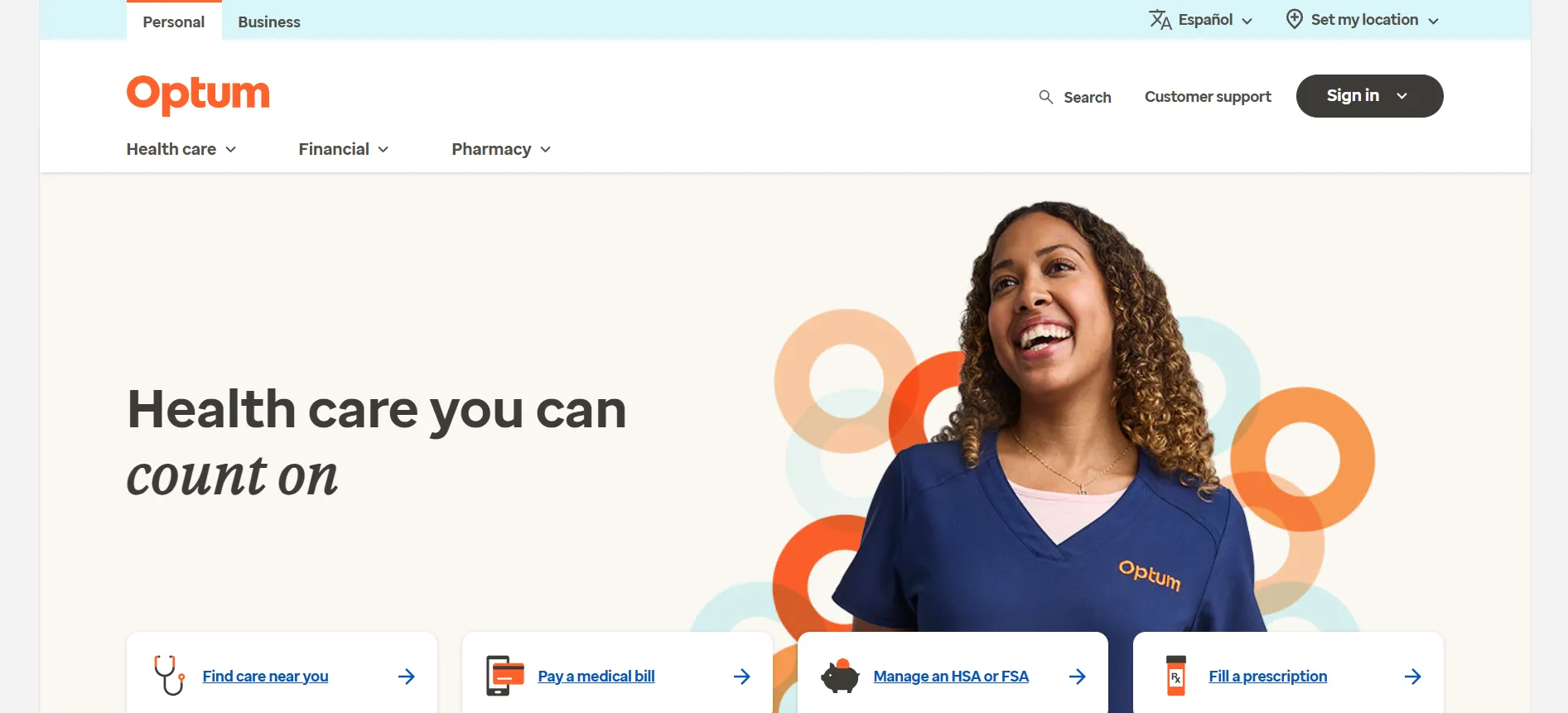
Optum runs patient access contact centers focused on the front end of care: call routing, scheduling, eligibility, authorization, and connecting patients to the right provider or department. Engagements cover one department, several departments, practice scheduling, or a full call center, with reporting on call center activity.
Where it wins: Real-time eligibility verification and preauthorization connect patient access directly to financial clearance and fewer denials. That connection is where health systems most often lose revenue, and few competitors close the loop as tightly.
Limitation: Optum is part of UnitedHealth Group. Some payers and provider systems review that ownership carefully before signing. The scope also leans toward US provider organizations instead of digital health or manufacturer programs.
Verdict: A default shortlist entry for health system patient access, with an ownership question to settle first.
Conduent
Best for: pharmaceutical manufacturers building or replacing a hub.
Conduent delivers hub and patient assistance program support built around reimbursement and affordability. Capabilities include automated real-time coverage checks that show insurance coverage, average time to approval, and patient out-of-pocket cost, plus paperless income validation against program thresholds.
Where it wins: Purpose-built hub infrastructure. The self-service and eligibility automation targets the affordability workflow directly, which general CX providers only approximate.
Limitation: That strength narrows outside manufacturer-funded programs. A telehealth platform that needs app support and multi-state intake would be buying the wrong type of vendor.
Verdict: Shortlist Conduent when a brand team funds the program and reimbursement is the bottleneck.
Horatio
Best for: early-stage and growth-stage telehealth companies replacing an overloaded front desk.
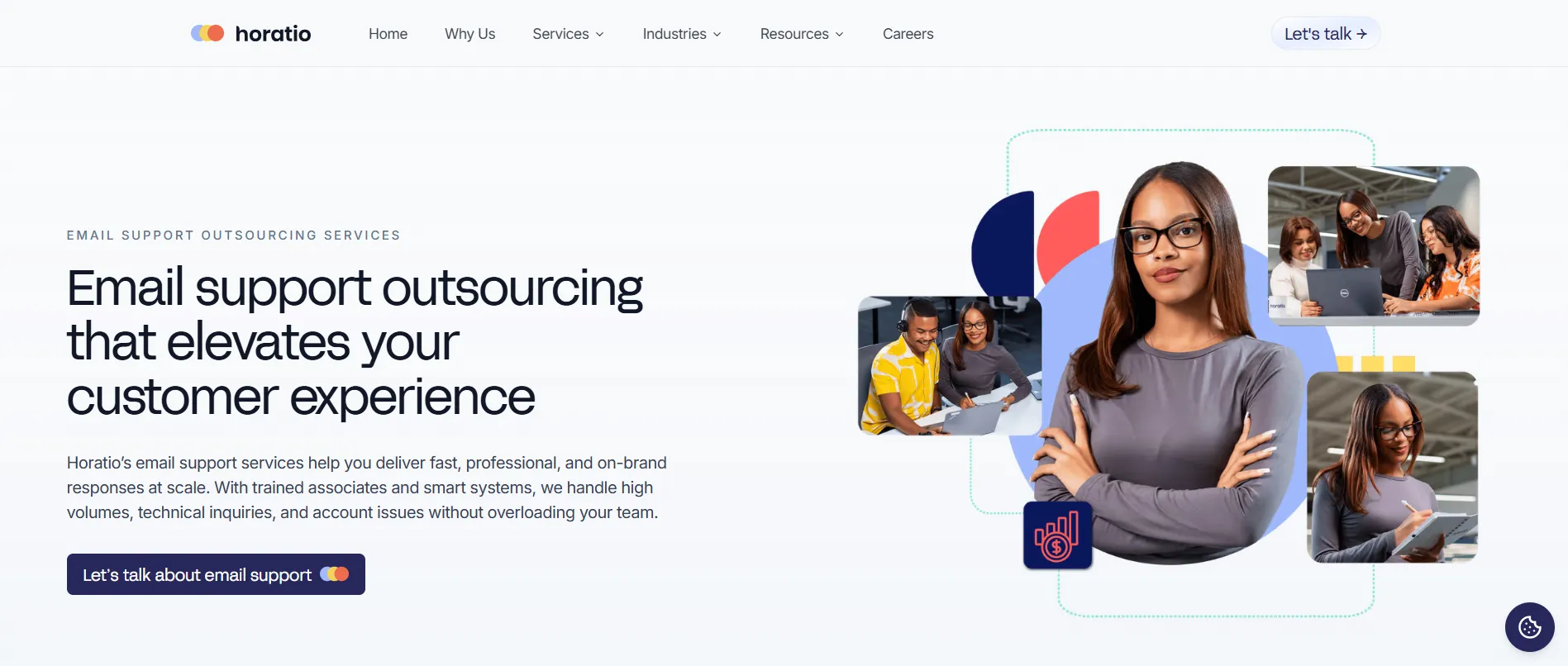
Horatio staffs patient support, intake, scheduling, and healthcare CX through HIPAA-compliant workflows and dedicated healthcare-trained teams across phone, chat, email, and SMS. The scope extends to virtual medical receptionist work, care coordination, insurance eligibility, benefits navigation, follow-up workflows, back-office support, and revenue cycle services.
Where it wins: Nearshore delivery from Colombia puts teams in US time zones with strong English and Spanish coverage, and the revenue cycle work means billing questions do not need a second vendor.
Limitation: The language and geographic footprint is narrower than that of the global providers on this list. Programs that need coverage beyond English and Spanish, or delivery outside the Americas, will outgrow the model.
Verdict: A strong first outsourcing partner for a telehealth company with fewer than 100 support seats.
What Real Users Say
People describe the challenge to reach a person to ask their question as one of the most prominent in healthcare. Even doctors themselves, when checking the effectiveness of their systems, describe spending sometimes hours to receive an actual answer:
“This is insane what we’re putting patients through. And this is why our on-call (glorified weekend/off-hours secretary duty) is so horrible.”
“These are customer interfaces and they are straight up garbage. Administration either purposely makes them impossible to navigate or they are impossible to navigate because of incompetence. Either way, it’s shameful. Catastrophically bad customer service. It’s just firewalls in front of patients and they can’t penetrate through to the right people.”
Not every practice can afford or finds it sensible to have in-house staff dedicated to patient support, so it usually falls upon nurses and doctors to do between seeing patients. A flexible outsourced team, however, can help tremendously with this at a fraction of full in-house cost.
How to Choose: A Scorecard for Any Vendor
Ask every shortlisted provider these ten questions. Score each answer from one to three. Below 20 out of 30, keep looking.
- Which of the four models do you staff most often, and can you name three clients in mine?
- Will you sign a BAA, and what security infrastructure sits behind it? Ask for the SOC 2 Type II report, not the badge.
- Who accesses PHI, from which locations, and how is that access logged and audited?
- Which of the nine functions do you staff with licensed clinical personnel, and where are they licensed?
- How do your agents work inside my EHR or platform, and who pays for the integration?
- How long from signature to first live call, and what happens in week one?
- What is your agent attrition rate on healthcare accounts, and how do you retrain replacements?
- Show me a QA scorecard from a live healthcare program, with the client name removed.
- Where does AI touch the workflow, and what does a person review before it reaches a patient?
- What are the exit terms, and who owns the call recordings, dispositions, and documentation?
Question seven tells you more than price does. When attrition is high on a patient support program, your workflow knowledge leaves every few months, and patients end up explaining their situation twice.
Next Step
If your patients reach you through a platform and your support team needs to understand both the clinical workflow and the product, book a consultation with the Helpware healthcare CX team. Tell us which of the four models you run and which of the nine functions are breaking, and we will scope from there.
For a wider vendor comparison that includes revenue cycle specialists, read our guide to the top healthcare BPO companies and our roundup of healthcare call center companies.