







Your new physician signed her offer letter in March. It is now September, she has been seeing patients since June, and you still cannot bill a commercial plan for a single visit. Nobody made a mistake. The file went out on time, the payer confirmed it, and then it sat.

“I found out last week that the clinic I have been working at for eight months never actually credentialed me with half our payers. So all this time my visits have been going out under a supervising physician’s NPI without anyone telling me, and now there is a mess with a couple of claims that do not match who actually saw the patient.”
That is what provider credentialing services sell. Not paperwork, but billable days you would otherwise lose.
The costs add up quickly. CAQH reports that the US medical industry spends about $83 billion a year on staff time for routine administrative work between providers and health plans, and that providers carry 97 percent of that cost. The rules also tightened recently. Since July 1, 2025, NCQA requires most credentialing verifications to be no more than 180 calendar days old when the credentialing decision is made, and it requires recredentialing every 36 months with no grace period. The delays are large enough that state lawmakers have looked at them. A Texas House committee analysis noted that credentialing for physician assistants and advanced practice nurses is often long and may take up to a year in some cases, and that those clinicians count as out-of-network the entire time.
Provider credentialing services verify a clinician’s qualifications against primary sources and enroll that clinician with payers so your practice can bill. Expect 90 to 120 days for a clean commercial file, and $200 to $500 per payer application from an outsourced vendor. The vendor fee is small compared to unbillable days. Eight vendors worth a shortlist: Helpware, Verisys, symplr, VerityStream, Medallion, Verifiable, Andros, and Medversant. Each one suits a different kind of buyer, and all eight are compared below.
Key Takeaways
- Credentialing, payer enrollment, and privileging are three different things. A credentialed provider still cannot bill until enrollment and contract loading are finished.
- A clean commercial file takes 90 to 120 days. Telehealth and Medicare files often move faster. Medicaid varies by state.
- Most delays start with your own data, not with the payer. That is the stage you control.
- Multi-state and telehealth credentialing is a different job from single-state credentialing. Buy accordingly.
What Provider Credentialing Services Cover
Three terms get used as if they mean the same thing. They do not.
| Process | What it establishes | Who performs it | Can you bill after it? |
|---|---|---|---|
| Credentialing | The clinician’s qualifications are real, checked with the source that issued them | Health plan, hospital, or a credentials verification organization (CVO) | No |
| Payer enrollment | The verified clinician joins a plan’s network under a signed contract with an effective date | Your practice or its vendor, with the payer | Yes, from the effective date, once loaded |
| Privileging | The clinician is approved to perform specific procedures at a specific facility | The facility’s medical staff office | Not applicable |
Primary source verification is what makes credentialing slow. A diploma is confirmed with the medical school, a license is confirmed with the state board, and a board certification is confirmed with the certifying body. A copy supplied by the provider is not enough.
A full-service credentialing vendor usually handles provider data collection and CAQH profile management, primary source verification, applications to several payers at once, Medicare enrollment through PECOS, state Medicaid enrollment, contract follow-up to a confirmed effective date, tracking of documents that expire, and recredentialing on the 36-month cycle. Some vendors sell only the verification step. Others sell software, and you supply the staff. Know which one you are buying.
The Credentialing Process, Stage by Stage
There are seven stages to the credentialing process, and each one fails in a specific and predictable way.
| Stage | Realistic duration | Where it breaks |
|---|---|---|
| Collect and check provider data | 1 to 3 weeks | Gaps in work history with no explanation, addresses that do not match across the W-9, CAQH, and PECOS, expired malpractice certificates, a lapsed CAQH attestation |
| Submit applications | Days, once the packet is clean | Sending applications one payer at a time; no confirmation number or named contact recorded |
| Primary source verification | 30 to 60 days | A slow reply from the provider forces re-verification of items already checked |
| Credentialing committee review | 15 to 45 days | Committees meet monthly, so missing a meeting by two days costs a month |
| Decision and notification | Days | Teams read approval as permission to bill. It is not |
| Contracting and effective date | 15 to 60 days | Booking patients against the approval date instead of the effective date; the provider is not yet loaded into the claims system |
| Ongoing monitoring and recredentialing | Continuous | License and DEA expirations, and address changes that break payer directories |
Two stages deserve extra attention.
Stage 1 is where you can save time. Verification and committee review follow schedules you cannot change, but data collection follows your schedule. Every correction cycle at this stage adds two to six weeks.
Stage 6 is where money is lost. Approval is a checkpoint, not the finish line. Ask every plan, in writing, whether it will backdate the effective date to the application or approval date. Most will not. Then ask how long loading takes after signing, because a provider who is contracted but not yet loaded still gets denied as out-of-network.
How Long Credentialing Takes
The planning number for a clean commercial file is 90 to 120 days, and the range depends more on the type of organization than most buyers expect.
| Credentialing body | Typical timeline |
|---|---|
| Commercial payers | 90 to 120 days |
| Hospitals and health systems | 60 to 120 days |
| Medicare (through PECOS) | 60 to 90 days |
| Medicaid | 45 to 90 days, with wide variation by state |
| Telehealth organizations | 15 to 45 days |
A few things decide where you land inside those ranges:
- Incomplete or inconsistent provider data adds two to six weeks per correction cycle.
- An expired CAQH attestation blocks the file until you fix it.
- A history that needs full committee review adds one or two committee cycles.
- Sending applications one payer at a time multiplies your total onboarding time.
- A delegated credentialing agreement shortens payer-side review by a lot.
- A payer backlog adds 30 days or more, and you cannot control it.
Plan a full quarter between the signed offer and full billable participation. If you promise a clinician a faster start, you will be managing the budget and morale fallout for the rest of the year.
What a 120-Day Credentialing Gap Actually Costs
The total cost of credentialing has three parts:
Total cost = vendor fee + unbillable days + rework
Take average daily collections per provider from your practice management system. If you are modeling a hire you have not made yet, use the expected annual collections from your pro forma and divide by your clinic days. Subscribers can pull a specialty benchmark from MGMA DataDive Provider Compensation.
| Line item | How to calculate it | Your number |
|---|---|---|
| Vendor fee, initial | Fee per payer application × number of payers | |
| Vendor fee, ongoing | Annual maintenance and recredentialing | |
| Unbillable days | Average daily collections per provider × days from start date to effective date | |
| Internal labor | Hours your office manager or billing coordinator spends × loaded hourly rate | |
| Rework | Correction cycles × 2 to 6 more weeks of unbillable days | |
| Total |
Two things usually come out of this worksheet.
First, the vendor fee is rarely what decides the outcome. At $200 to $500 per payer application, credentialing with eight payers costs $1,600 to $4,000. One provider sitting idle for a quarter costs several times that, and the gap grows with the specialty’s collections.
Second, internal labor is real money that never appears on an invoice. Every hour your billing coordinator spends chasing a payer representative is an hour not spent on unpaid claims. That trade-off is easy to miss and expensive to keep.
So the question to ask a vendor is not “what do you charge.” Ask three questions instead:
- What is your median number of days to the effective date, by payer?
- What share of your applications are accepted on the first try?
- Will you put either number in writing?
The Complexity Tiers: Where Credentialing Gets Harder
Saying that credentialing is complicated does not help you buy. Credentialing is really four different jobs, and the cost of getting it wrong rises sharply across them. Find your tier before you shop.
Tier 1: One state, one specialty, few payers. One license, one CAQH profile, a handful of commercial plans plus Medicare. A well-run practice handles this in-house. A vendor here buys you convenience, not new capability.
Tier 2: Group practice, several specialties, full payer mix. Now you are running applications to a dozen plans at once, managing several taxonomy codes, handling group and individual enrollment, and keeping a recredentialing calendar that never empties. This is the tier where in-house teams quietly fall behind, and nobody notices until denials rise.
Tier 3: Multi-state and telehealth. This is the hard one. Every state adds a license, a Medicaid enrollment, and its own rules. Interstate compacts help where they apply. NCQA accepts compact licensure when the home-state license was verified at the primary source and the compact agreement shows the other state accepts it. Telehealth has its own complication, since NCQA treats telemedicine practitioners separately and assesses a telehealth organization differently when it does not credential under the standard requirements. At this tier, buy specialist help. Otherwise, the work falls behind.
Tier 4: Delegated credentialing. You credential on the payer’s behalf and submit rosters instead of individual applications. This shortens enrollment a great deal, and it asks a lot in return: policies aligned to NCQA, a working credentialing committee, files ready for audit, continuous monitoring, and the ability to pass a pre-delegation audit. This is an operating model, not a service you simply buy.
Most buyers shop as if they are in Tier 1 while they actually work in Tier 2 or Tier 3. That mismatch is the most common reason these projects disappoint.
In-House, CVO, or Outsourced Team
There are three models. The right one follows your provider volume and complexity, not your preference.
| In-house team | CVO or platform | Outsourced operations team | |
|---|---|---|---|
| What you get | Full control and in-house knowledge | Verification and compliance infrastructure, often NCQA-certified | Trained staff running your process end to end |
| Cost shape | Fixed salary and benefits | Per verification or per seat, plus your own labor | Per FTE or per application |
| Scales with volume | Poorly, since it needs headcount | Well | Well |
| Main risk | One resignation stalls the pipeline | You still supply the coordination work | Vendor quality varies widely |
| Best fit | Steady volume, one state, Tier 1 to 2 | Payers, health systems, delegated arrangements | Growing groups, multi-state, Tier 2 to 3 |
The risk in the in-house model is worth repeating. When one or two people hold every payer relationship and every tracking spreadsheet, one resignation can stop onboarding for months.
What to Look for in a Credentialing Partner
These are the criteria used to build the comparison below. Take them into your own vendor search.
- Median days to the effective date, by payer. Not turnaround time. The date you can bill.
- First-pass acceptance rate. How often applications go through without a correction cycle.
- Accreditation. NCQA Credentialing Accreditation covers full-scope credentialing, including committee review. NCQA Credentialing Certification covers verification only. URAC and Joint Commission recognition matter for delegated arrangements. Ask which one each potential vendor holds, because they are not interchangeable.
- Multi-state and telehealth depth. Licensing support, compact handling, and experience with state Medicaid programs.
- Data security. HIPAA, SOC 2 Type II, and ISO 27001 for anyone handling provider data.
- Scope of coverage. Verification only, enrollment included, or the full lifecycle with monitoring and recredentialing.
- Clear pricing. Per payer, per provider, per seat, or a percentage of collections, plus what triggers an extra charge.
- Escalation path. A named contact who calls the payer when a file goes quiet on day 60.
Our rankings are compiled using publicly available information and objective evaluation criteria. We strive to ensure that every ranking is fair, transparent, and based on the same methodology for all companies.
Eight Provider Credentialing Services Compared
| Provider | Model | Best for | Accreditation |
|---|---|---|---|
| Helpware | Outsourced operations team | Growing multi-state and telehealth groups that need credentialing inside broader back-office work | SOC 2 Type II, ISO 27001, ISO 9001, HIPAA, GDPR; no NCQA CVO certification |
| Verisys | CVO and data services | High-volume verification and sanctions monitoring | NCQA-accredited CVO |
| symplr | Enterprise platform and CVO | Large health systems consolidating provider tools | NCQA-certified and accredited services |
| VerityStream | Enterprise platform and CVO | Multi-facility hospital systems using Epic | NCQA-certified CVO, HITRUST r2 |
| Medallion | Automation platform and services | Digital health companies and provider groups wanting one system | NCQA-certified CVO |
| Verifiable | API-first platform and CVO | Salesforce-based teams and hybrid in-house models | NCQA-certified CVO |
| Andros | Network lifecycle platform and CVO | Health plans building multi-state networks | NCQA-certified CVO |
| Medversant | CVO and platform | Payers needing committee support and network adequacy tools | NCQA-certified, URAC-accredited |
1. Helpware

Best for: Growing provider groups and telehealth companies where credentialing is one part of a wider back-office workload.
Helpware staffs HIPAA-trained credentialing specialists inside dedicated healthcare operations teams that also handle insurance verification, claims processing, and patient support, so provider data stays consistent across enrollment, billing, and directory updates. Healthcare and telehealth clients include Headspace, HealthComp, NexHealth, and Roche. Multi-state licensing support, SOC 2 Type II, ISO 27001, and HIPAA controls apply.
Where Helpware wins outright: multi-state and telehealth depth inside a single operations team.
Trade-off: Helpware provides credentialing within broader healthcare operations, not NCQA-certified CVO services. Organizations that require delegated credentialing, along with payers, typically work with a certified CVO.
2. Verisys
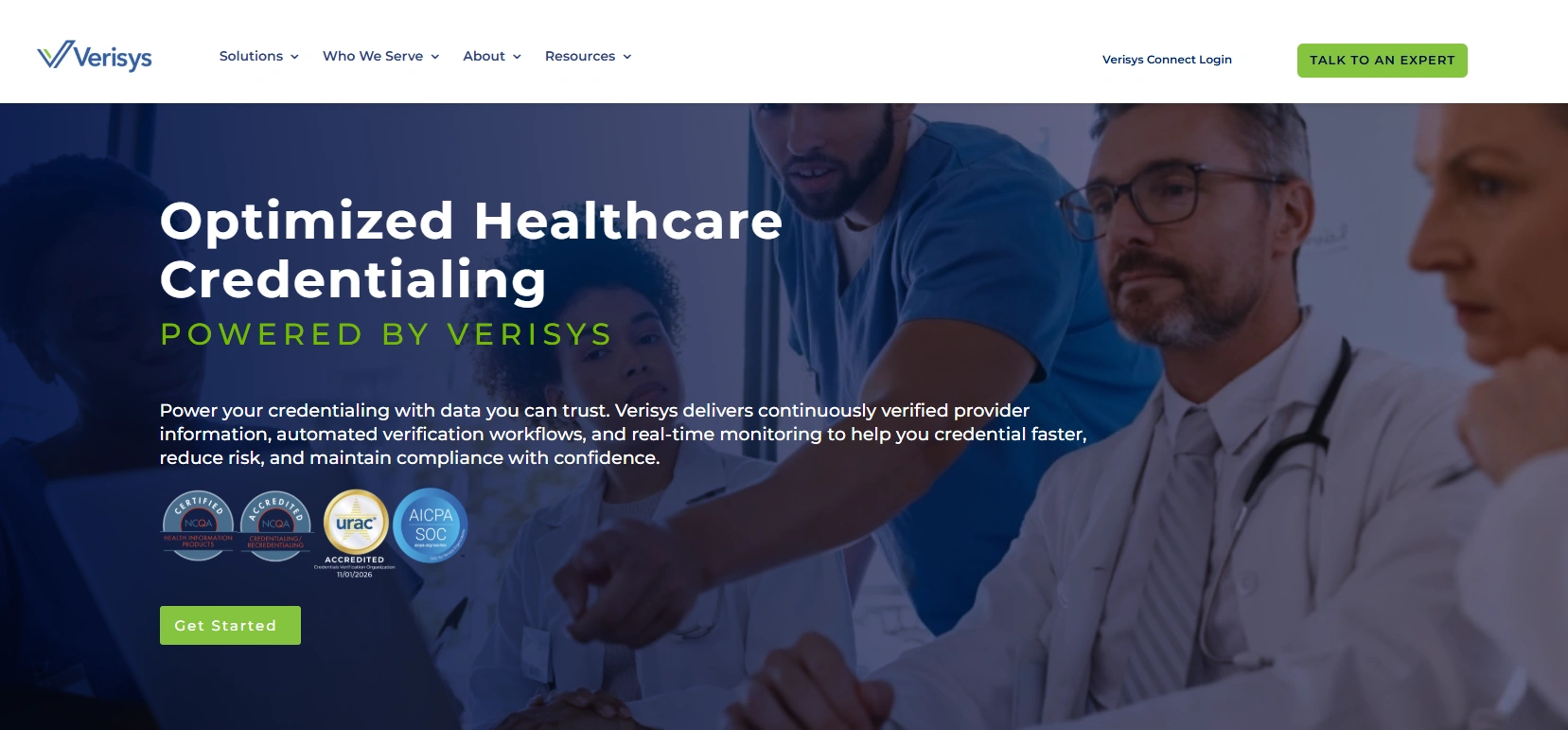
Reference for design: verisys.com/solutions/healthcare-credentialing
Best for: Organizations that need verified data at volume and continuous sanctions monitoring.
Verisys has worked in credentialing for more than 30 years. It runs primary source verification, sanctions screening through FACIS, licensure tracking through LicenseCheck, committee support, and ongoing monitoring, and it reports working with all 50 state medical boards. Health systems that value data breadth and exclusion monitoring over workflow tools get the most from it.
Where Verisys wins outright: the depth and freshness of its verification data, plus NCQA-accredited CVO status for delegated arrangements.
Trade-off: fewer day-to-day workflow features than platform-first competitors.
3. symplr
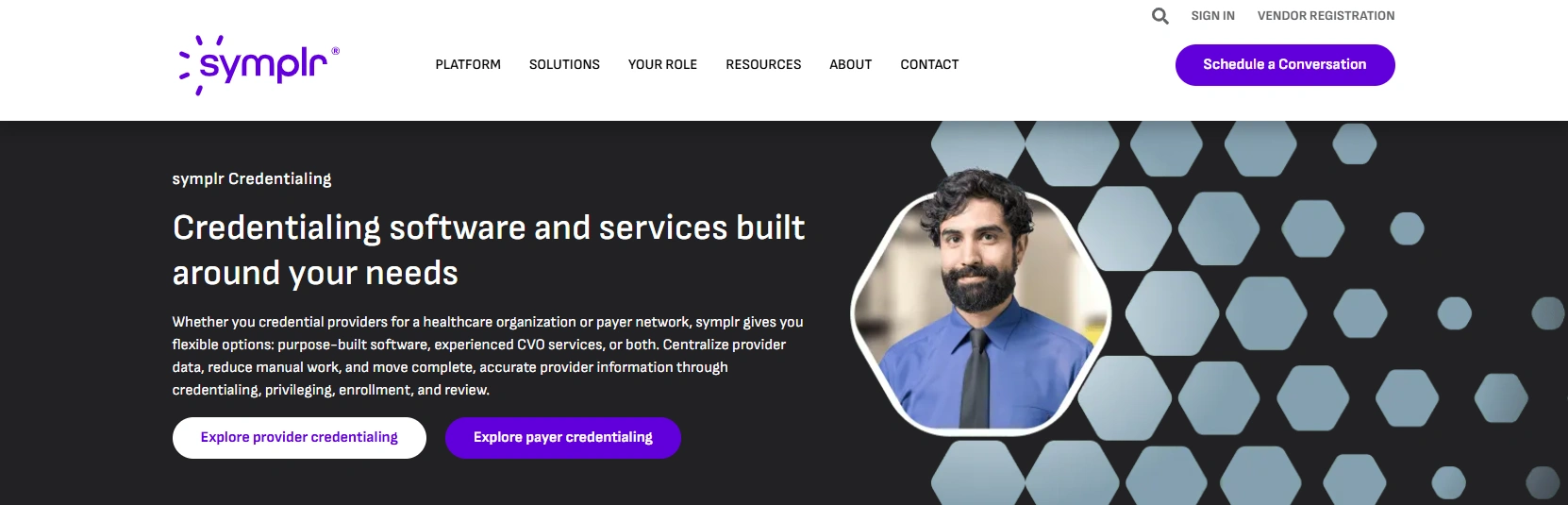
Best for: Large health systems that want credentialing inside a wider healthcare operations suite.
Symplr covers verification, credentialing, privileging, payer enrollment, and contracting, with CVO services available when demand spikes. The value is consolidation, since credentialing data connects to provider data management, directory services, workforce, and compliance modules under one vendor.
Where symplr wins outright: breadth across the provider lifecycle for organizations already standardizing on one operations vendor.
Trade-off: reviewers describe the interface as dated and reporting as hard to customize, and setup asks a lot of your internal team.
4. VerityStream (CredentialStream by HealthStream)
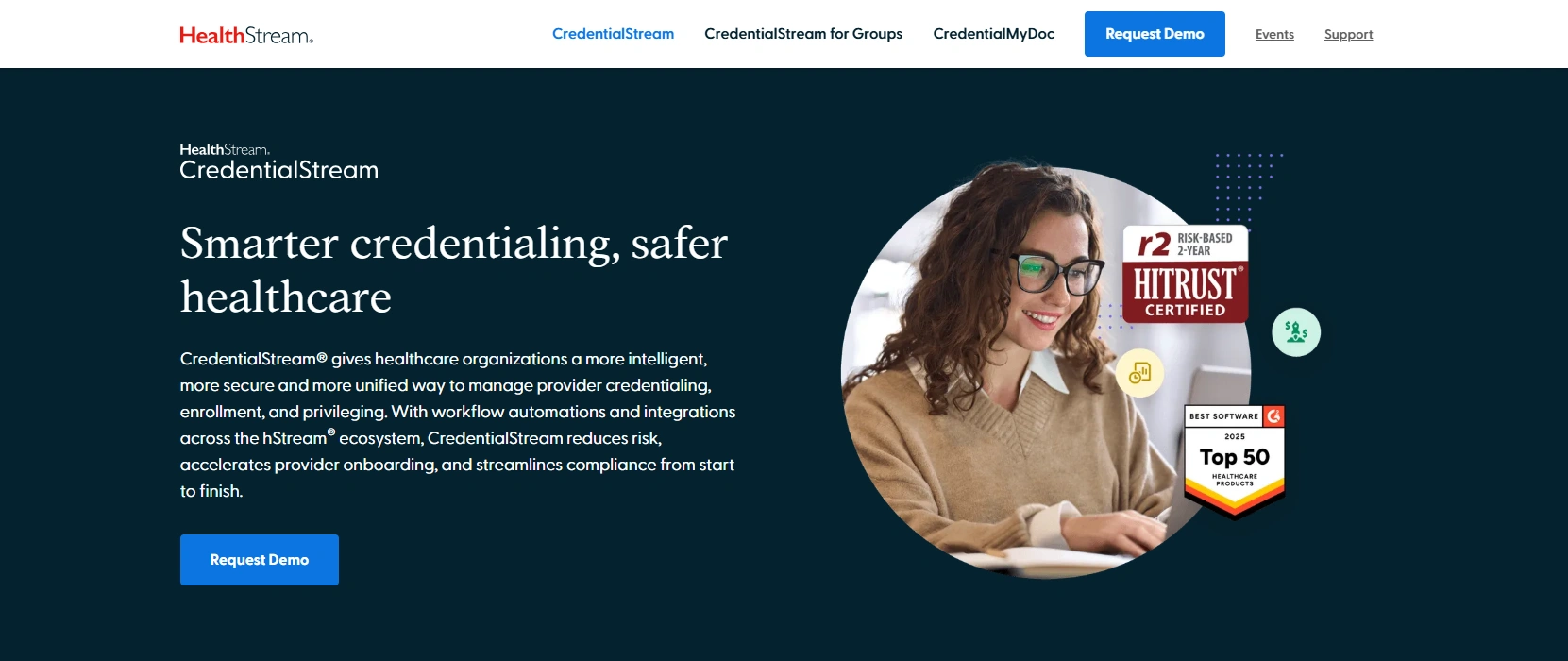
Best for: Multi-facility hospital systems, especially those running Epic.
VerityStream handles credentialing, enrollment, privileging, and provider data management, with an NCQA-certified CVO available for outsourced primary source verification. APIs for Epic and HR systems connect it to clinical and HR workflows, and HITRUST r2 certification addresses security review.
Where VerityStream wins outright: hospital privileging and payer enrollment in one system, with a certified CVO attached.
Trade-off: a large modular system with a steep setup curve, and more than most single-site groups need.
5. Medallion
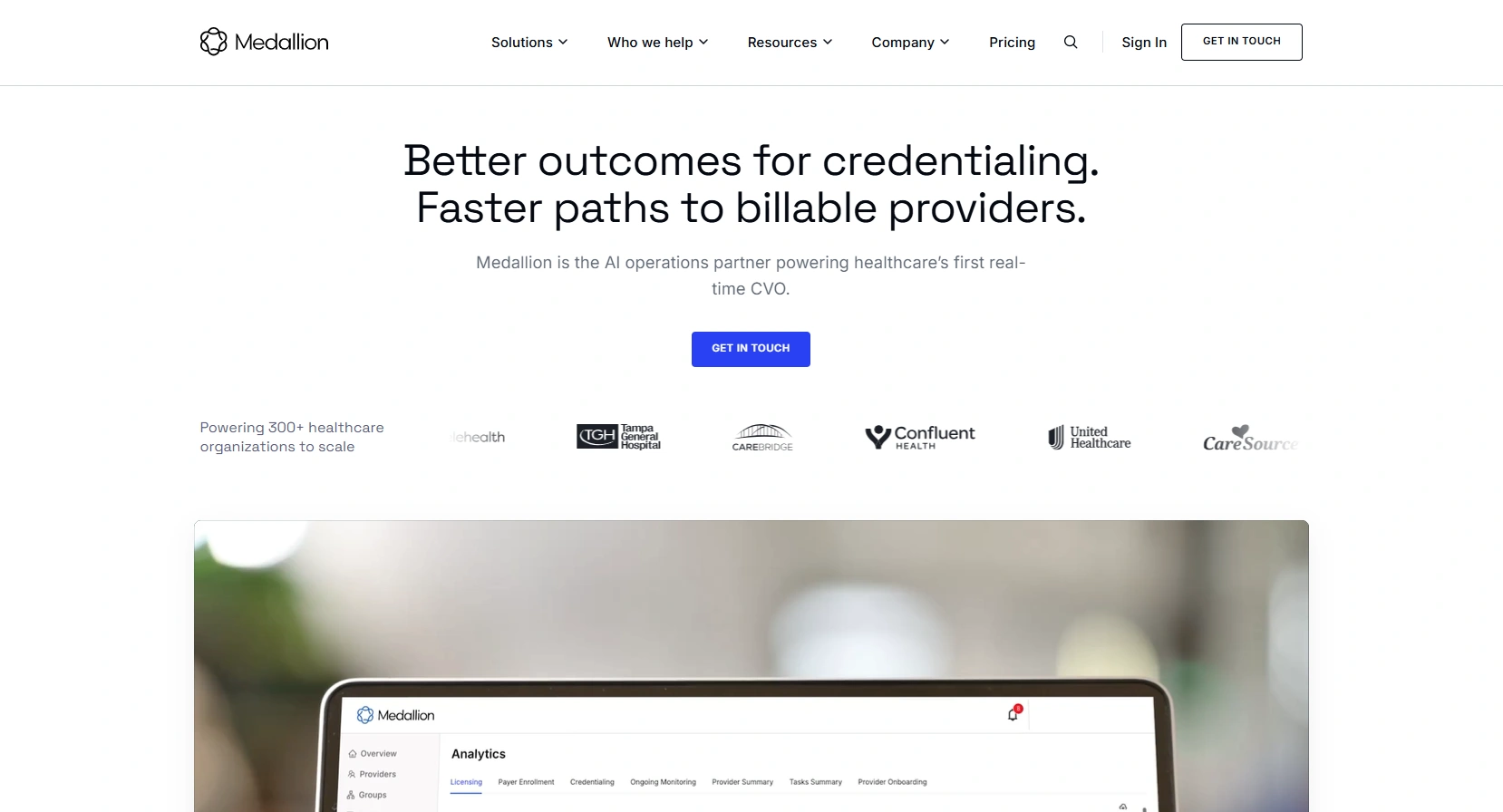
Best for: Digital health companies and provider groups that want credentialing, licensing, and enrollment in one automated platform.
Medallion covers CVO credentialing, direct and delegated payer enrollment, state licensing, privileging, and ongoing monitoring of sanctions and licenses, with SOC 2 Type II certification and CAQH integration. It positions itself as an all-in-one provider operations platform instead of a verification service alone.
Where Medallion wins outright: licensing and enrollment automation for fast-growing, multi-state digital health organizations.
Trade-off: reviewers report limits in reporting and uneven support experiences.
6. Verifiable
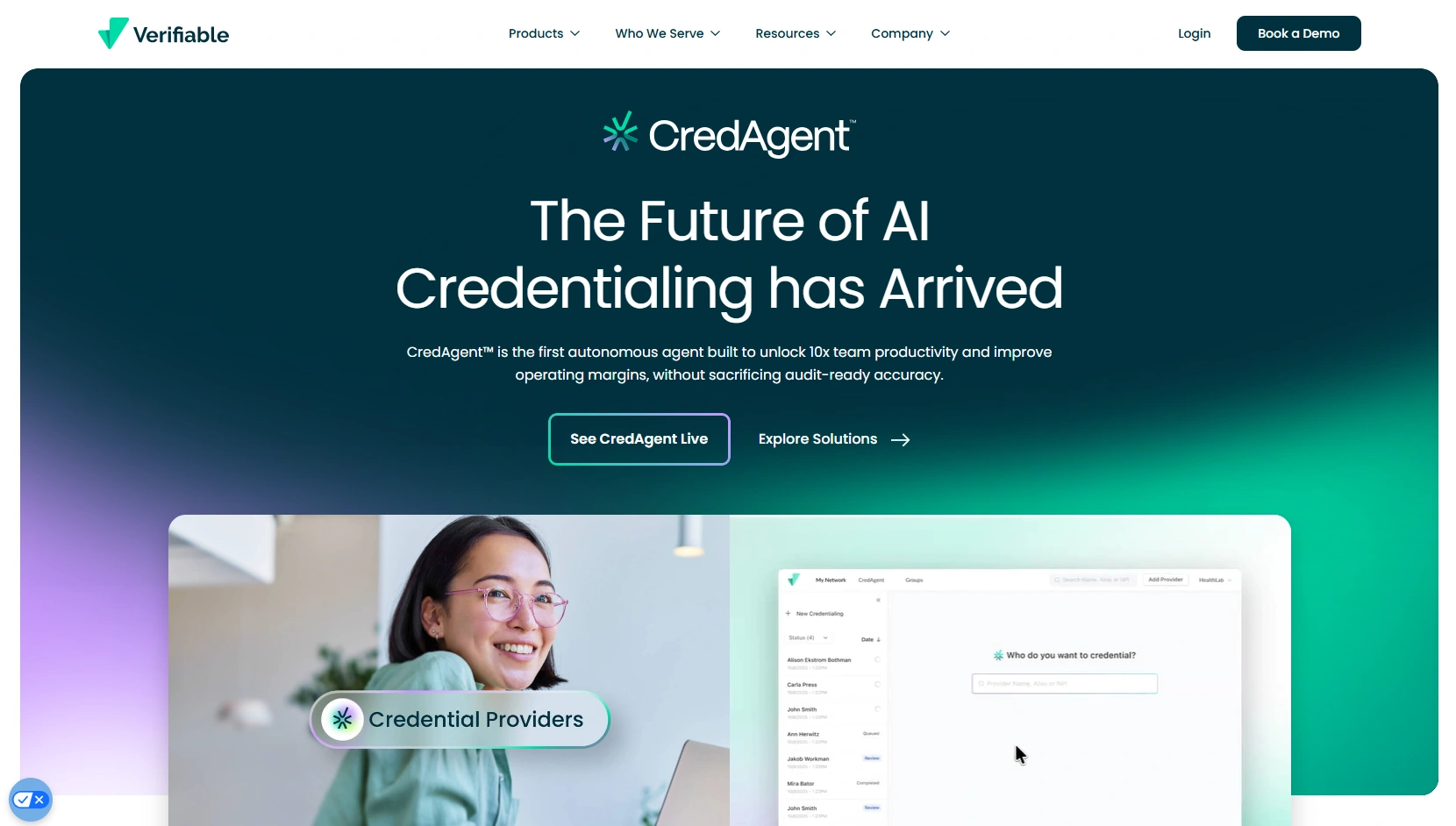
Best for: Teams working in Salesforce, or organizations that want a mix of in-house and outsourced credentialing.
Verifiable pairs real-time primary source verification with an NCQA-certified CVO. You can run credentialing in-house on the software, outsource it fully, or split the two. Native Salesforce integration puts credentialing status inside a system your operations team already uses.
Where Verifiable wins outright: verification speed and flexibility of model.
Trade-off: reviewers cite limits on admin accounts, gaps in roster reporting, and occasional stalls that need manual intervention.
7. Andros
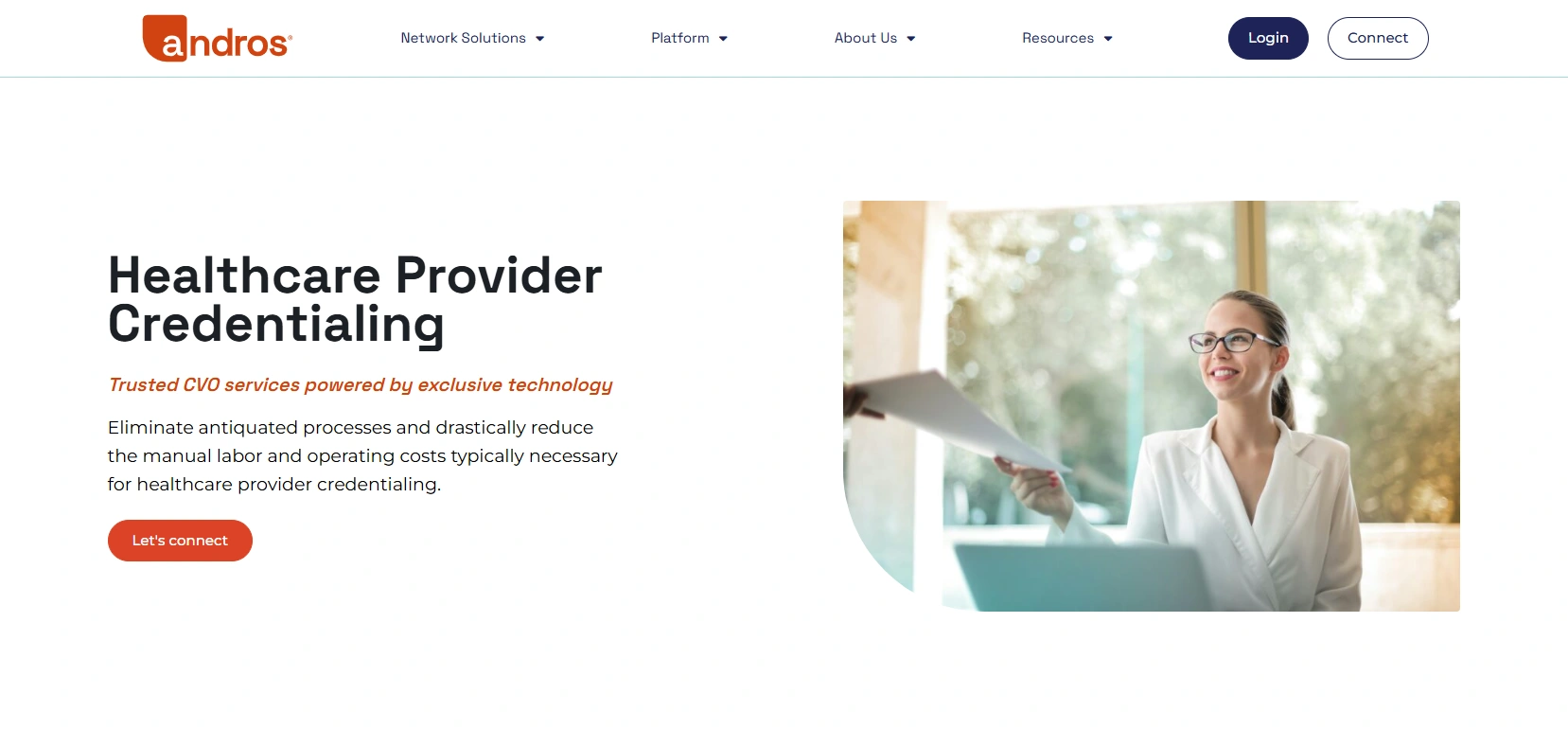
Best for: Health plans and networks that treat credentialing as part of network strategy.
The Andros Arc platform combines provider data management, credentialing, contracting, and monitoring. An NCQA-certified CVO handles automated verification and licensure checks, and credentialing staff resolves the exceptions. State license verification and committee management support multi-state network builds.
Where Andros wins outright: credentialing tied to network adequacy and recruitment for health plans.
Trade-off: enterprise scope that is larger than a single-site practice needs.
8. Medversant

Best for: Payers and large systems that need committee workflow and network adequacy tools alongside verification.
Medversant operates as an NCQA-certified and URAC-accredited CVO. Its ProviderIQ platform runs primary source credentialing, provider data management, and continuous monitoring, and it can pre-fill applications from CAQH or health plan databases. A Virtual Review Committee supports peer review, and a network adequacy module addresses federal and state compliance.
Where Medversant wins outright: both NCQA and URAC recognition, plus committee tools.
Trade-off: enterprise complexity, with less attention to everyday ease of use.
What Real Users Say
Online forums are where staff share the pain: how credentialing takes time, which payers backdate, which vendors go quiet, and how long a Medicaid enrollment really took in each state.
“This happened to me. Turns out the credentialing lady was working a second remote job at her job and hadn’t credentialed 7 different providers hired over 4 years. She was billing in-kind inappropriately. I did discover the problem through persistence (“why has it been 6 months and I still can’t refer this patient due to being out of network?”).”
“I run a small telehealth mental health practice, and credentialing has become the most exhausting part of growth.
Each state has different Medicaid requirements. Commercial insurers all use separate portals. Some want additional attestations, others want updated malpractice documents every few months. And keeping CAQH current feels like a full-time administrative job.”
The solution offered most often is outsourcing the credentialing work so that the staff in your clinic or hospital can focus their efforts on operations and patient care. This is why companies like Helpware and others on the list above exist, and where we can help.
Which Option Fits Your Situation
| Your situation | Start here |
|---|---|
| Solo or small practice, one state, fewer than six payers | Credential in-house, and buy per-application help only for Medicare and Medicaid |
| Growing group, several specialties, full payer mix | An outsourced operations team, or a platform with services attached |
| Multi-state telehealth adding clinicians every month | An outsourced team with licensing depth, or a licensing-first platform |
| Hospital or health system with privileging needs | An enterprise platform with a certified CVO |
| Health plan or network builder | An NCQA-certified CVO with committee and network adequacy tools |
| Pursuing delegated credentialing | An NCQA-accredited or certified CVO, plus your own committee infrastructure |
Get Credentialing Off Your Team’s Calendar
If credentialing is one symptom of a wider back-office problem, and insurance verification is piling up while your billing coordinator spends half the week on payer follow-up, another tool will not fix it. A team will.
Helpware builds dedicated healthcare operations teams that handle credentialing, insurance verification, claims processing, and patient support together, under HIPAA, SOC 2 Type II, and ISO 27001 controls. Talk to us about your payer mix, your states, and the timeline you are working against.