







Customer support demand rarely stays predictable. A product launch, seasonal rush, unexpected spike in contacts, or staffing gap can push ticket volumes beyond what your permanent team can handle. Hiring full-time agents takes time, but leaving customers waiting while you recruit isn’t an easy option either.

“Call volume can be unpredictable and erratic, and it can be difficult to be properly staffed to handle any situation with minimal hold times.”
That makes flexible staffing an increasingly practical part of support planning. The US Bureau of Labor Statistics projects about 289,500 openings for customer service representatives each year from 2025 to 2035, largely because people leave these roles or the workforce. At the same time, support leaders are under pressure to do more with limited budgets. A Gartner survey of 199 service leaders conducted in April and May 2026 found that AI spending had increased 38%, while total service budgets grew just 2%. In another Gartner survey, 55% of customer service leaders said staffing levels had remained flat even as customer volumes increased.
On-demand staffing can help close that gap, but not every flexible staffing platform works the same way. Some providers build and manage a flex team, some connect you with independent contractors who choose short shifts, and others help you hire temporary or permanent staff that you manage yourself. This guide compares eight on-demand staffing platforms for customer support in 2027, explains how the models differ, and shows what to look for in ramp time, training, QA, compliance, pricing, and flexibility so you can identify the right fit for your support operation.
Key Takeaways
- On-demand staffing comes in three models: managed flex teams, GigCX contractor networks, and hiring marketplaces. The right model depends on how predictable your volume is, how much control you need, and who is responsible for training and QA.
- Define your staffing requirements before comparing providers. Map your expected volume, peak periods, support channels, hours, languages, and technical or compliance requirements so every provider is evaluated against the same needs.
- Ramp time matters as much as price. A lower hourly rate doesn’t help if agents take weeks to train and go live. Look at published ramp timelines, training requirements, and how quickly each model can scale up or down.
- Training, QA, security, and billing determine the real value of flexible staffing. Compare who trains and manages agents, how quality is measured, what controls protect customer data, and how pricing changes when volume rises or falls.
- The 8 on-demand staffing platforms covered here are Helpware, Liveops, Working Solutions, ShyftOff, Arise, Influx, Hugo, and AccountMakers. They serve different support models, staffing needs, and operating scales.
- Test providers on more than their published claims. Ask for a clear ramp plan, training and QA details, compliance documentation, and evidence of how the provider handles real support scenarios before committing.
- Match the model to your volume pattern. Short, unpredictable spikes may call for a GigCX network, while steady demand with seasonal peaks may fit a managed flex team. A hiring marketplace makes more sense when you already have the training and management infrastructure in-house.
- Flexible staffing doesn’t have to replace a dedicated team. Many support operations can combine a stable core team with flexible capacity for launches, seasonal demand, after-hours coverage, or unexpected spikes.
On-Demand Support Staffing: 3 Main Models
On-demand support staffing can mean different things depending on who employs the agents and who manages the work. The three models below differ mainly in how much control you keep over training and QA, and how quickly you can adjust capacity.
| Model | How it works | Who manages training and QA | Best fit |
|---|---|---|---|
| Managed flex team | A provider builds and manages a support team, then adjusts its size as your volume changes | Provider | Complex products, regulated data, and steady demand with seasonal peaks |
| GigCX contractor network | Independent agents complete your program training and pick up short shifts as needed | Shared: provider certifies agents, you set support standards | Short volume spikes, after-hours coverage, and voice-heavy queues |
| Hiring marketplace | A platform finds vetted candidates for you to interview and hire | You | Teams with strong internal training, QA, and supervision |
We’ve focused this guide on platforms designed specifically for customer support. That’s why we left out general shift apps such as Instawork and Wonolo.
If you’re looking for a provider to manage the flexible operation for you, our managed on-demand customer service explains how a core team and surge capacity can work together. If you’re weighing different team structures, our analysis of dedicated versus shared support teams provides more context.
How We Scored the On-Demand Staffing Platforms for Customer Support
Because this guide compares providers that use different staffing models, we evaluated them against the same five criteria. The weights reflect what matters when you need to add support capacity quickly without losing control of quality, security, or cost.
| Criterion | Weight | What we looked for |
|---|---|---|
| Speed to live agents | 25% | Published ramp timelines and how quickly capacity can be added |
| Training and QA | 25% | Who certifies agents, how quality is measured, and who manages performance |
| Security and compliance | 20% | Named certifications and controls relevant to HIPAA, PCI DSS, SOC 2, and GDPR |
| Billing flexibility | 15% | Contract length, billing unit, and terms for scaling down |
| Channel and language coverage | 15% | Voice, chat, email, social, and language coverage |
We used information published by each provider or available from a primary source. When a provider didn’t publish a specific detail, we left it out rather than making an assumption.
From Signed Contract to First Live Ticket: Ramp Time by Model
Ramp time is an important part of the cost of flexible support. A low hourly rate means little if agents need weeks of training before they can handle live contacts. The table below includes only ramp timelines that providers publish publicly.
| Provider | Ramp detail |
|---|---|
| Helpware | Pilots run 30–60 days; scaling from 5–10 FTE to 500+ FTE takes 90–120 days |
| ShyftOff | Most programs go live within 30 days after the client provides training assets |
| Working Solutions | Launches in days or weeks; one program trained and activated 300+ agents in under eight weeks |
| Influx | New plans start with a two-week training period |
We couldn’t find a published ramp timeline for Liveops, Arise, Hugo, or AccountMakers. Ask each provider to give you a timeline in writing, including what needs to happen before agents can take live contacts.
Several operational details can slow a ramp even when the provider’s published timeline looks short. An outdated knowledge base, delayed tool access or security provisioning, and certification requirements that haven’t been documented can all push back the first live contact. Resolve those requirements before training starts so the ramp stays on schedule.
For a closer look at how seasonal demand affects support planning, our ecommerce BPO services comparison covers the peak-season playbook in more depth.
8 Best On-Demand Staffing Platforms for Customer Support
1. Helpware

Best for: Mid-market and enterprise companies that need flexible capacity without giving up quality, compliance, or product knowledge.
Helpware runs managed teams across 19 locations in 11 countries, using a hub-and-spoke delivery model to combine onshore, nearshore, and offshore coverage. Engagements can start with a 30- to 60-day pilot and scale from five to ten FTE to 500+ FTE in 90 to 120 days. Across its client engagement, Helpware consistently delivers tangible business benefits. In one example, a furniture brand doubled its support headcount in three weeks while QA scores increased from 85% to 90%.
Standout strengths:
- Security and compliance: SOC 2 Type II, ISO 27001, and ISO 9001 certifications, with programs and safeguards that support HIPAA, GDPR, and PCI DSS requirements.
- Coverage: Multilingual customer support across 45+ languages, with 24/7 coverage.
- Quality: 90% CSAT, supported by CX quality assurance programs and AI agent assist.
What to consider: Helpware builds and manages dedicated teams rather than offering a self-serve marketplace for individual shifts. If you only need one agent for a short period, this isn’t the model you’re looking for.
Bottom line: A strong fit when flexible staffing needs to meet demanding quality, security, and compliance requirements.
2. Liveops
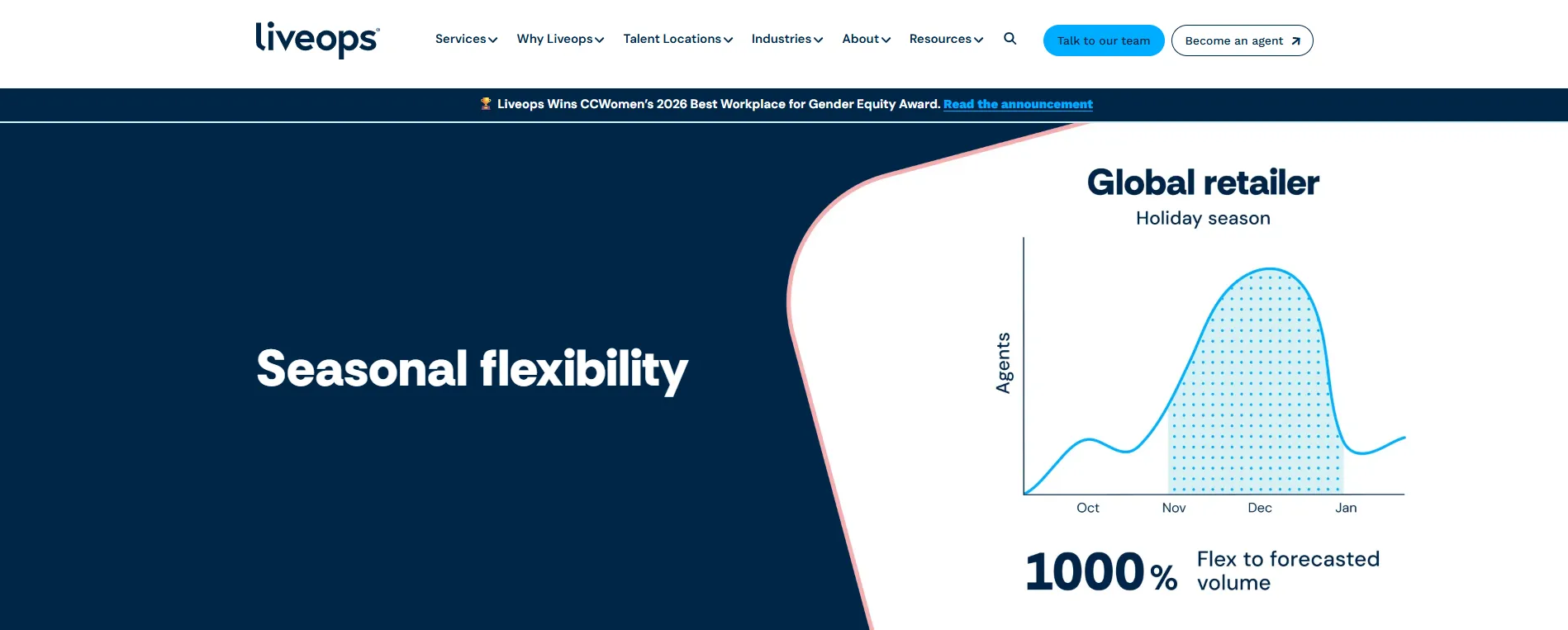
Best for: Enterprise brands dealing with seasonal peaks across voice and digital support.
Liveops draws on a remote agent community across the US, Mexico, and the Philippines and schedules coverage in 30-minute increments through its customer service outsourcing model. Agents complete brand-specific certification before handling customer contacts.
Standout strengths:
- Experience: More than 25 years of flexible, remote-first delivery.
- Channels: Voice, chat, email, SMS, social, and back-office support.
- Technology: LiveNexus provides AI orchestration, agent assist, and QA insights.
What to consider: Liveops primarily targets enterprise programs, so smaller teams should confirm minimum program sizes and requirements before moving forward.
Bottom line: A practical option for enterprise teams where 30-minute scheduling can make it easier to match coverage with demand.
3. Working Solutions
Best for: Surge and crisis coverage with North American agents.
Working Solutions operates an on-demand network of independent contractors in the US and Canada and says programs can launch in days or weeks through its on-demand contact center service. During one winter storm, for example, it deployed more than 900 agents for an airline program within days.
Standout strengths:
- Surge capacity: Published results include 300+ agents trained and activated in under eight weeks.
- Seasonal support: Dedicated offerings for seasonal and unexpected volume increases.
- Technology: AI-enabled tools work alongside human agents.
What to consider: The core agent pool is in the US and Canada, so teams looking specifically for offshore delivery or broader multilingual coverage should look elsewhere.
Bottom line: Well suited to North American brands that need to add a large number of agents quickly during unexpected volume spikes.
4. ShyftOff
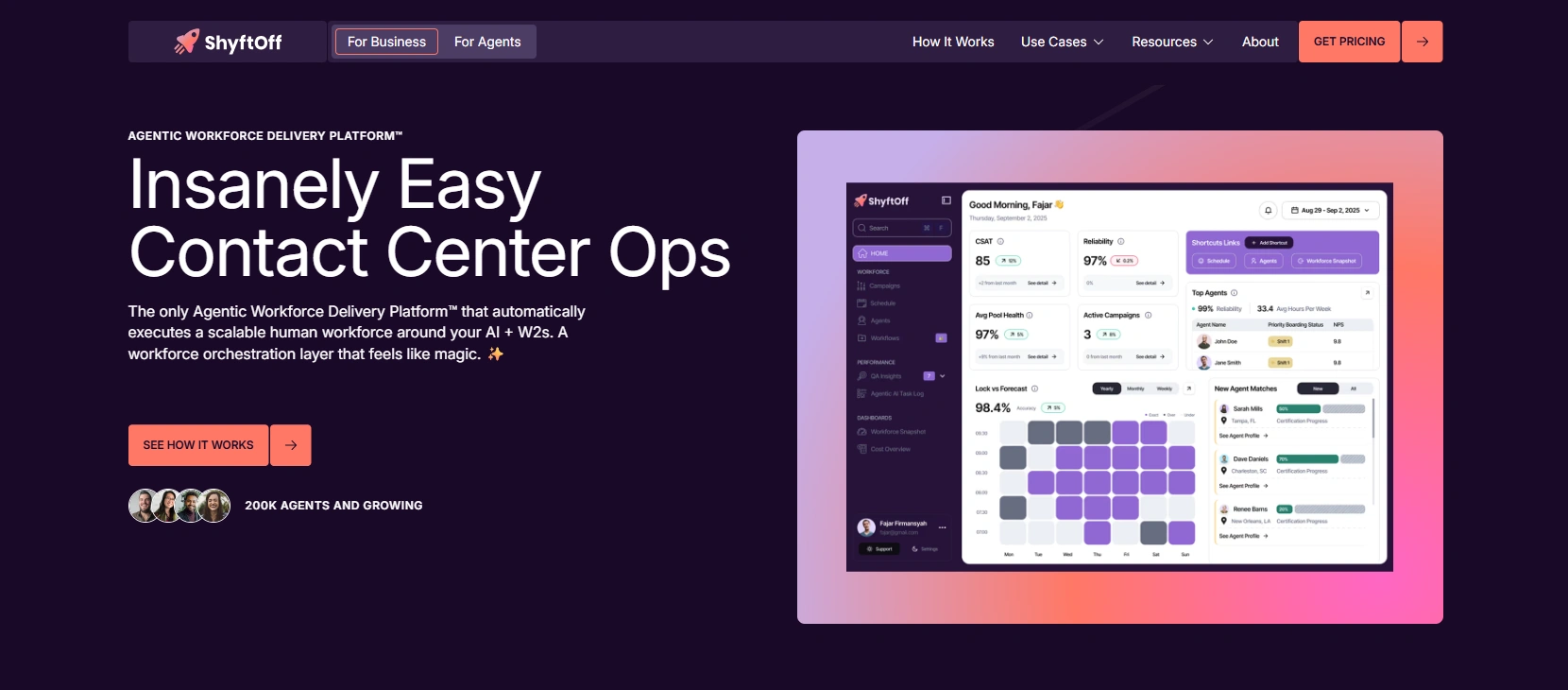
Best for: Voice queues where you want to pay for productive agent time.
How the flex model works: ShyftOff bills for productive hours, including time spent queued, on calls, and completing after-call work. It builds schedules in 30-minute intervals and lists PCI DSS, HIPAA, SOC 2, and GDPR-related safeguards on its website. The company offers coverage across the US, LATAM, and other markets.
Standout strengths:
- Flexible scheduling: Coverage can be adjusted within hours once the program is onboarded.
- Quality monitoring: AI-based QA monitors 100% of calls, chats, and tickets.
- Ramp speed: Most programs go live within 30 days after training assets are delivered.
What to consider: The 30-day launch timeline starts after the client provides the required training assets. Its productive-hour billing model is also particularly relevant to voice operations, so make sure the pricing structure matches your channels.
Bottom line: A useful option for support teams with highly variable voice demand and a need to adjust coverage quickly.
5. Arise
Best for: Large enterprise programs that need scale and broad language coverage.
The Arise Platform connects enterprises with a network of independent businesses and micro-enterprises. Arise boasts 150,000 experts and service partners, 56+ languages, and 30-minute scheduling through its platform.
Standout strengths:
- Sourcing: Credential and background validation during the sourcing process.
- Specialized programs: Custom sourcing for specialized or regulated support requirements.
- Matching: Automated matching across its network of service partners.
What to consider: Agents work through independent service partners rather than as one centrally managed team. Before signing, ask how those partners are monitored and how your QA requirements are enforced across the network.
Bottom line: A good fit for enterprise programs that need a large talent network and broad language coverage.
6. Influx
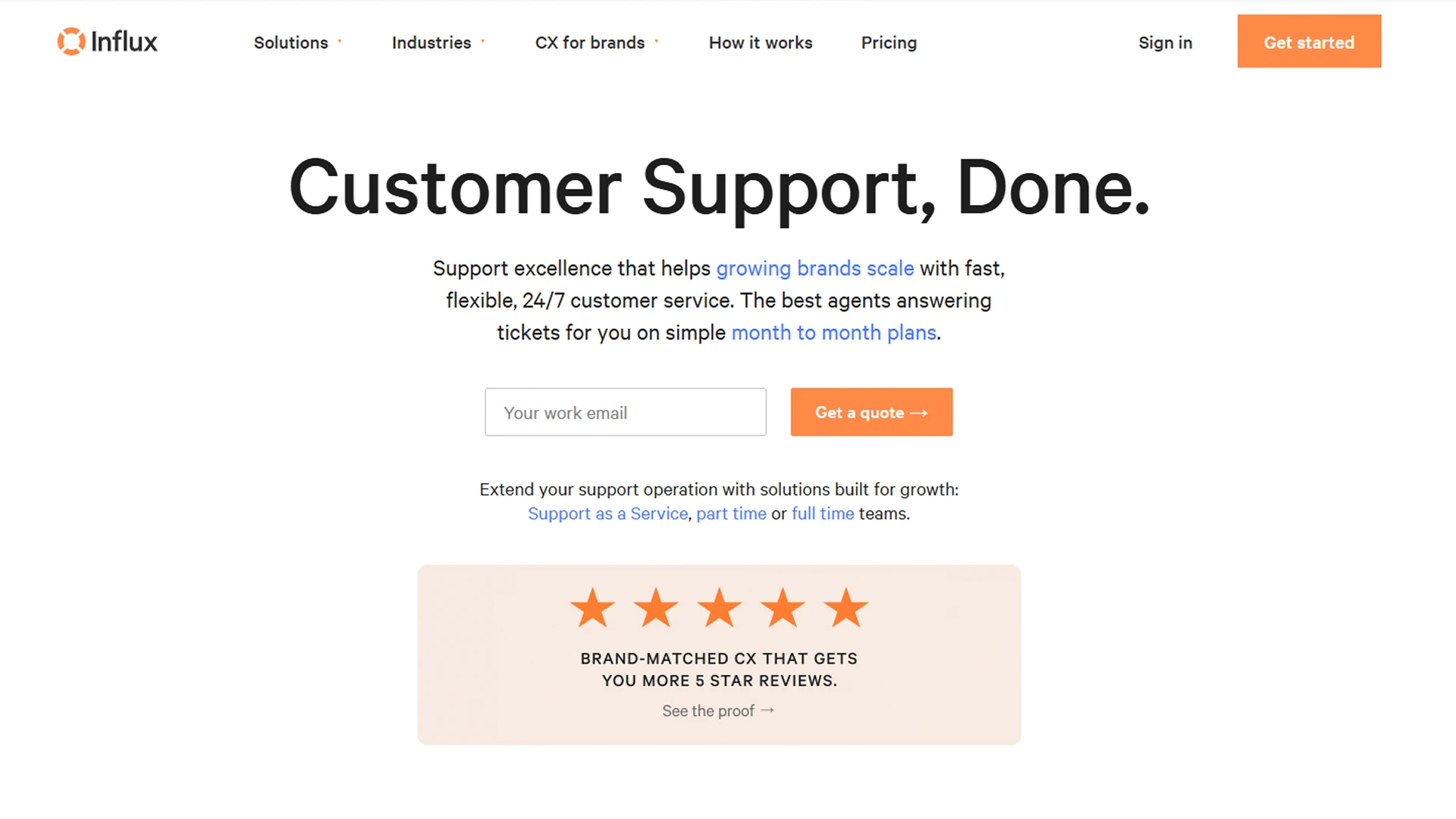
Best for: Startups and scaleups that need 24/7 digital coverage without a long-term commitment.
Influx offers month-to-month plans with pay-per-agent or pay-per-ticket options, ranging from a fractional agent to dedicated teams. New plans start with a two-week training period.
Standout strengths:
- Global coverage: Follow-the-sun support across multiple time zones.
- Digital flexibility: A pay-per-response tier covers tier 1 email, chat, and social support.
- Management: Influx managers handle training, QA, and performance management.
What to consider: The pay-per-response option is designed for tier 1 digital support. Multi-tier and multi-channel programs use a dedicated team instead. See how Helpware compares with Influx for a closer comparison.
Bottom line: A flexible option for digital-first brands that want month-to-month terms and the ability to start with a smaller support footprint.
7. Hugo
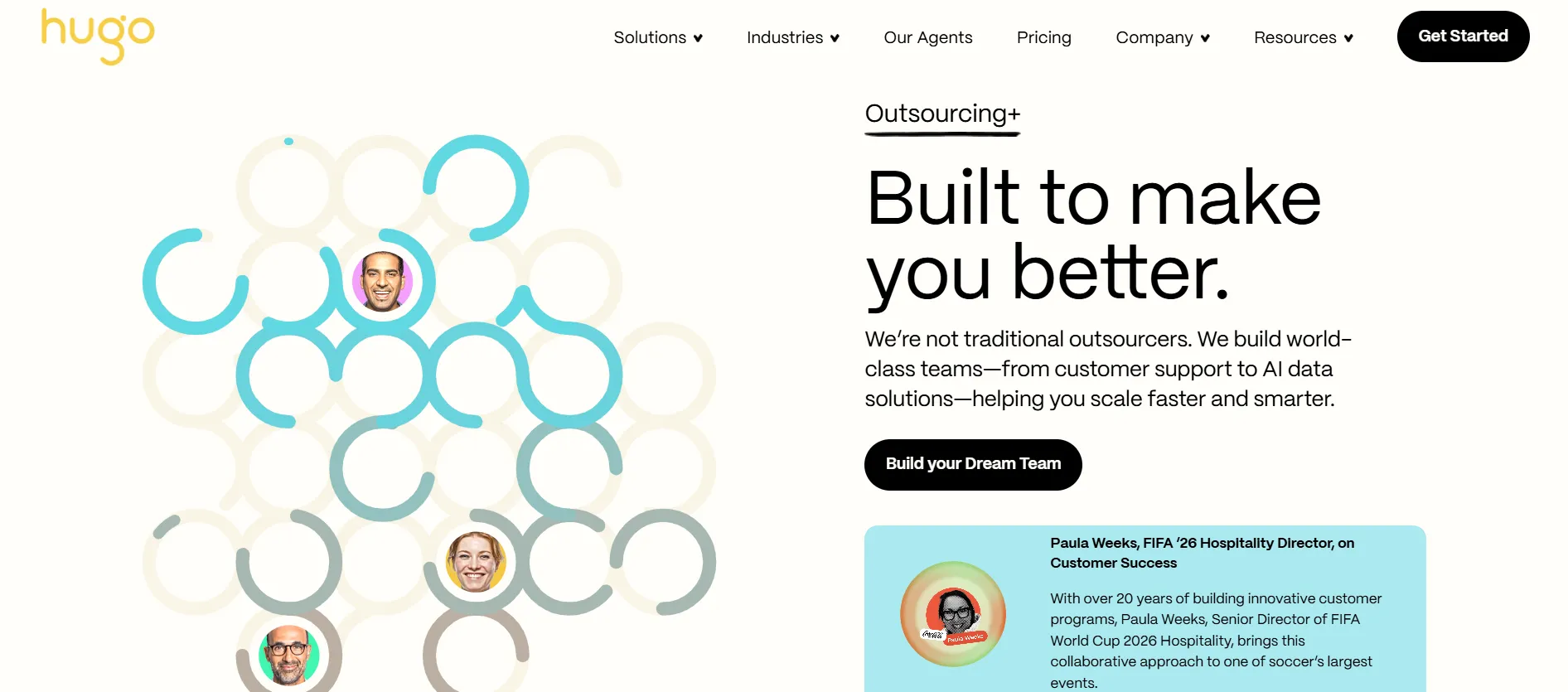
Best for: Fast-growing brands that want dedicated agents with flexible contract terms.
Hugo scales teams from five agents to hundreds or thousands, with coverage across the US, UK, Africa, the Philippines, and India.
Standout strengths:
- Security: ISO 27001-certified information security, with controls aligned with SOC 2 requirements.
- Regulated support: HIPAA-focused workflows alongside GDPR and CCPA processes.
- Global delivery: Onshore and offshore options for follow-the-sun coverage.
What to consider: Hugo’s published model starts at five agents, so it is better suited to sustained team capacity than a small number of individual overflow hours. See Helpware and Hugo compared for more detail.
Bottom line: A fit for companies that want dedicated support teams but need more flexibility in contract size and location.
8. AccountMakers
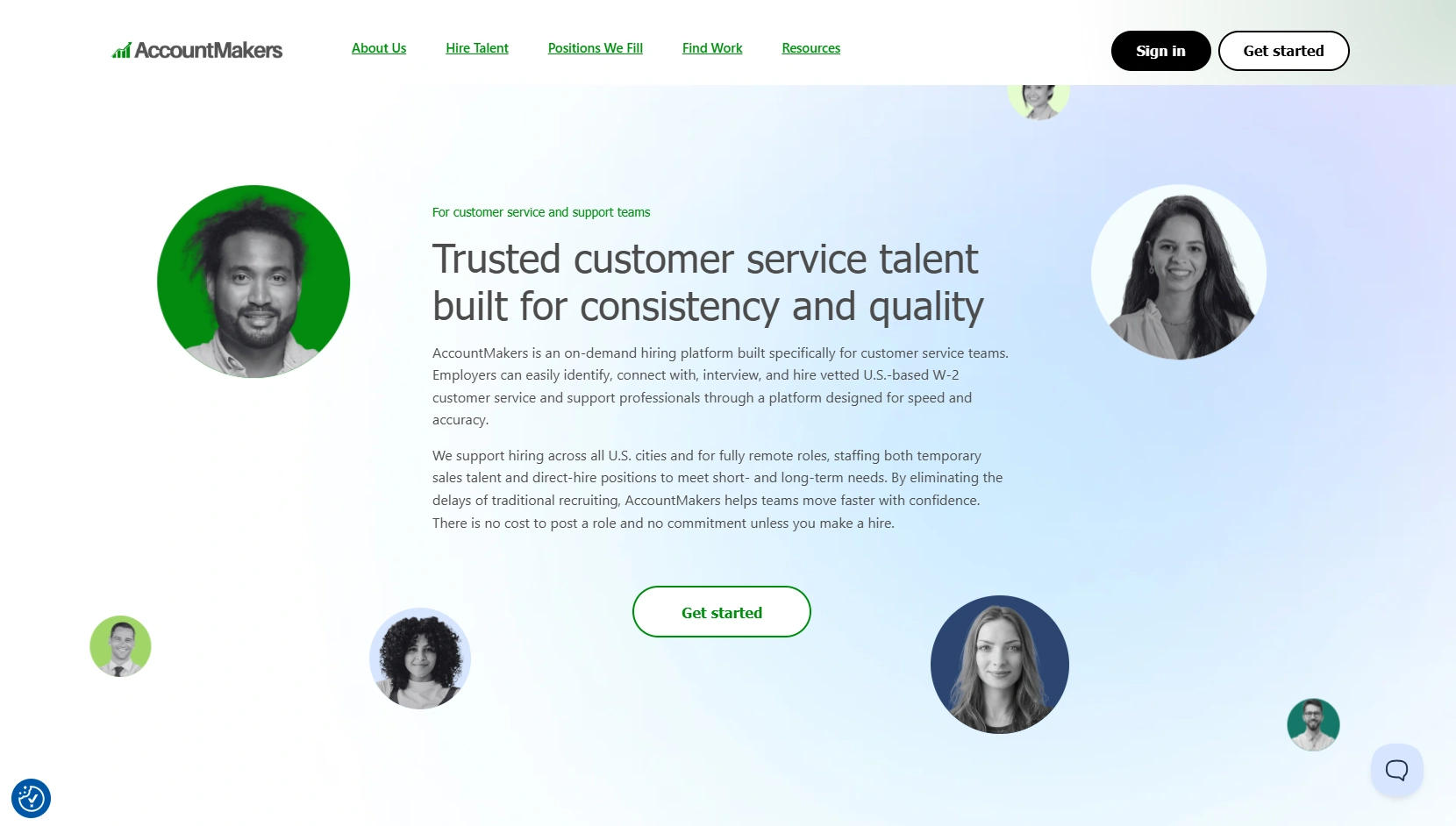
Best for: Teams that want to hire US-based W-2 support staff quickly and manage the team themselves.
AccountMakers is an on-demand hiring platform for customer service teams. You can find, interview, and hire vetted US-based W-2 professionals for temporary or direct-hire roles, with no fee to post a position through its customer service hiring platform.
Standout strengths:
- Employment model: W-2 employment removes the contractor classification issues that come with GigCX networks.
- Coverage: US-based and remote roles.
- Hiring flexibility: There is no commitment unless you make a hire.
What to consider: You remain responsible for training, scheduling, QA, and day-to-day supervision. That makes AccountMakers more suitable for teams that already have the internal management and support infrastructure to run the operation.
Bottom line: A straightforward way to add flexible US-based headcount when you want to keep training and management in-house.
The Fine Print: Employment Status, Data Access, Compliance
Flexible staffing can change more than your costs. It can also affect who manages agents, how customer data is handled, and what happens when you need to scale the team back. Before signing with a provider, get clear answers to these five questions.
| What to ask | What to look for | Why it matters |
|---|---|---|
| Who employs the agent? | W-2 employee, provider employee, or independent contractor, clearly stated in the contract | Employment status affects supervision, liability, and how quickly agents can be added or removed |
| Where does customer data live? | Virtual desktops, locked-down devices, and no local storage where appropriate | Home-based agents using personal equipment can increase your security exposure |
| Which certifications and controls cover your program? | SOC 2 Type II, ISO 27001, HIPAA, or PCI DSS controls that apply to the delivery sites you’ll use | A certification or control framework covering one location may not cover other delivery locations or home-based workers |
| Who manages QA? | Named QA staff, scoring against your standards, and a clear coaching process | Quality management becomes especially important when you ramp up quickly |
| How does scaling down work? | Notice periods, minimum commitments, and billing units stated in writing | A staffing model isn’t very flexible if reducing capacity takes months |
Regulated support needs another layer of scrutiny. If your team handles patient or payment data, look closely at the controls that apply to the specific delivery model and locations you’ll use. Our HIPAA-compliant call center and PCI-compliant call center services provide examples of how those requirements can be built into a support operation.
Determine Which Model Fits Your Volume Pattern
The right staffing model depends largely on when you need extra capacity and how much of the operation you want to manage yourself. Use the table below as a starting point, then compare the providers based on their actual coverage, ramp time, and management requirements.
| Your situation | Best-fit model | Providers to shortlist |
|---|---|---|
| Holiday or launch spike lasting days | GigCX network | ShyftOff, Liveops, Working Solutions |
| Predictable seasonal peak on top of steady volume | Managed flex team | Helpware, Hugo |
| After-hours and weekend gaps | Managed flex team or GigCX | Influx, Helpware, Liveops |
| 24/7 multilingual coverage | Managed flex team or large network | Helpware, Arise |
| Regulated data (HIPAA or PCI) | Managed flex team with scoped certifications | Helpware, Hugo, ShyftOff |
| Strong in-house training, need bodies fast | Hiring marketplace | AccountMakers |
If you’re planning for the fourth quarter, our guide to holiday shopping surge planning covers the preparation work in more detail. For the cost side, our breakdown of customer service outsourcing costs compares rates by region and staffing model.
Wrapping Up
On-demand staffing gives you more ways to match support capacity to demand, but the right setup depends on what your operation actually needs. GigCX networks can add coverage in short increments, hiring marketplaces give you more control when you already have training and management in place, and managed flex teams take more of the day-to-day work off your plate.
The key is to look beyond hourly rates. Ramp time, training, QA, security, compliance, channel coverage, and the ability to scale up or down can all affect the real cost and effectiveness of a flexible staffing model.
This is where Helpware can help. We provide dedicated customer service teams that can scale with your volume, add 24/7 contact center coverage, and use AI agent assist alongside human support. Our work has earned 30+ industry awards, and our client partnerships average five years.
If you’re considering flexible support capacity, use our support cost calculator to model the numbers, then contact our support team. We can talk through your volume, coverage requirements, and staffing model and help you determine what kind of support operation makes sense for your business.