








For years, the debate between dedicated and shared support teams was mostly about cost. AI is changing that. As automation handles more routine interactions, companies are facing a different set of challenges: maintaining quality, meeting customer needs, and determining how much human support is still needed in the first place.
How AI Is Reshaping Expectations Around Customer Support
As an individual working within Customer Support for over 10 years, I have experienced my fair share of different working models. Something that stood out though, was that I am weekly approached (at least seven times) by companies looking to hire shared resources for their customer support teams. This trend tends to spike whenever leadership realizes an uncomfortable truth: their core business isn’t customer support.
Outsourced support teams bring deep experience from the providers who specialize in this work. And the demand for outsourced support isn’t decreasing because of AI—if anything, it’s accelerating. A McKinsey 2024 survey found that 55% of companies already outsource part of their customer care operations, and 47% plan to increase outsourcing over the next two years.
AI has raised the service bar
At the same time, since the launch of LLMs and the “new” era of AI, companies now expect lower costs and higher service quality simultaneously. AI has raised the bar: 68% of support teams report that AI has increased customer expectations, while 77% say it has increased demand for faster response times (Intercom). Many companies replace human cost with AI cost and consider that a win—and in many ways, it is. When it’s implemented correctly, it absolutely can be.
But the pressure has never been higher.
Customers (and businesses) now expect response times in seconds, regardless of workload. They want answers that are accurate, precise, and resolved quickly. Problems that used to take 10+ minutes should now be solved almost instantly. This is possible when the setup is good. With a bad setup, however, it becomes a nightmare: customers get stuck, never reach a live agent, never receive meaningful support, and brands quickly lose trust—all in the name of “keeping up with technology.”
The new operational challenge
This shift changes the entire discussion around shared and dedicated teams. Historically, the conversation was mostly about cost. Now, it’s also about the reality that many companies expect a future where ticket and interaction volumes shrink dramatically.
If a company automates 80% of its interactions, a brand that previously managed 10,000 inquiries per month may only need to handle 2,000. On paper, the math seems straightforward: if you had 10 agents before, now you “only need” two. But operational reality isn’t that simple.
- How do two people cover 24-hour support?
- What happens to coverage, language needs, escalations, and peak hours?
- What do you do with idle time when AI suppresses ticket volume—but the business still needs capability and readiness?
This is where the shared vs. dedicated model becomes less of a cost discussion and more of an operational one.
Explore our recent article on how AI is transforming the call center industry.
Dedicated Teams vs Shared Teams: Operational Differences
There are core differences in ownership, accountability, and customer experience when support agents are shared across multiple projects.
Ownership
When someone works on two projects at the same time, you can argue they are immediately less productive—simply because humans need time to focus, build context, and stay in a flow state.
Switching between topics and tools isn’t free. A pause between tasks can require up to 40 minutes to fully get back on track. Even if that context-switching happens only once per day, you can still lose a meaningful portion of productive time just “catching up.”
Accountability
Accountability becomes messy when follow-ups are required.
If a customer contacts you twice in the same day with a different problem, what happens?
- Do you wait over 24 hours so the same agent can maintain ownership—risking SLA breaches and contractual issues?
- Or do you prioritize SLA speed, hand it to another agent, and sacrifice continuity (and potentially the agent experience) by making someone else relearn the same customer context?
Once you look closely at day-to-day operations, this is often where shared models start to break down.
Customer experience
Most people have had a clunky support experience and thought: “Maybe I should buy somewhere else next time.” That moment matters—and it usually happens when customers have to repeat themselves again and again.
That was frustrating with humans. With bots, it’s often even worse.
Imagine spending 15 minutes navigating a bot, finally reaching a human, and then realizing the human has no idea what happened before. That is a typical failure mode in shared-agent models: continuity gets lost, and customers feel like they’re starting over every time.
Worth reading: 15 best practices on how to improve customer experience in 2026.
Helpware’s Perspective: Why We Prefer Dedicated Teams
At Helpware, we pride ourselves on dedicated team members—and on quality. We’ve experimented with shared resources to see if we could make it work, and the results weren’t as strong as they should have been.
In technical projects especially, shared models created operational challenges:
- attrition risk
- retraining overhead
- weaker knowledge retention
- slower ramp-up times
- inconsistent performance due to split focus
The cost wasn’t just financial—it was the cost of having only “half a team” mentally present on any single project.
Am I saying shared models are impossible? Not at all. But I don’t believe we’re at a point where AI is strong enough—and implementations are mature enough—to allow shared resources to operate seamlessly without trade-offs.
A 2024 BCG study found that less than half (41%) of companies believe shared services create real value. Even among organizations with mature shared-service models, this challenge is well-known. Shared resources often look efficient on paper, but they create hidden operational complexity.
You may think you’re paying for four shared agents. In reality, the complexity can feel closer to managing eight:
- more coaching needs
- more tools and systems
- more procedures and variation
- more coordination overhead across multiple workflows
Where This Might Be Heading
Nader Gammoudi’s SupportYourApp article, “Shared vs Dedicated Customer Support: How to Choose,” offers a more unbiased perspective than mine. Historically, shared support was mainly attractive to small businesses. With AI, that’s expanded—larger brands and more complex operations are now exploring shared models too.
Expectations have shifted, and BPO services are increasingly being viewed like staffing agencies: pick from an existing pool, dial headcount up or down, and treat support like a flexible resource. Maybe that’s where the market is going. But it can be a sad place for customers if the model prioritizes flexibility and cost over continuity and experience.
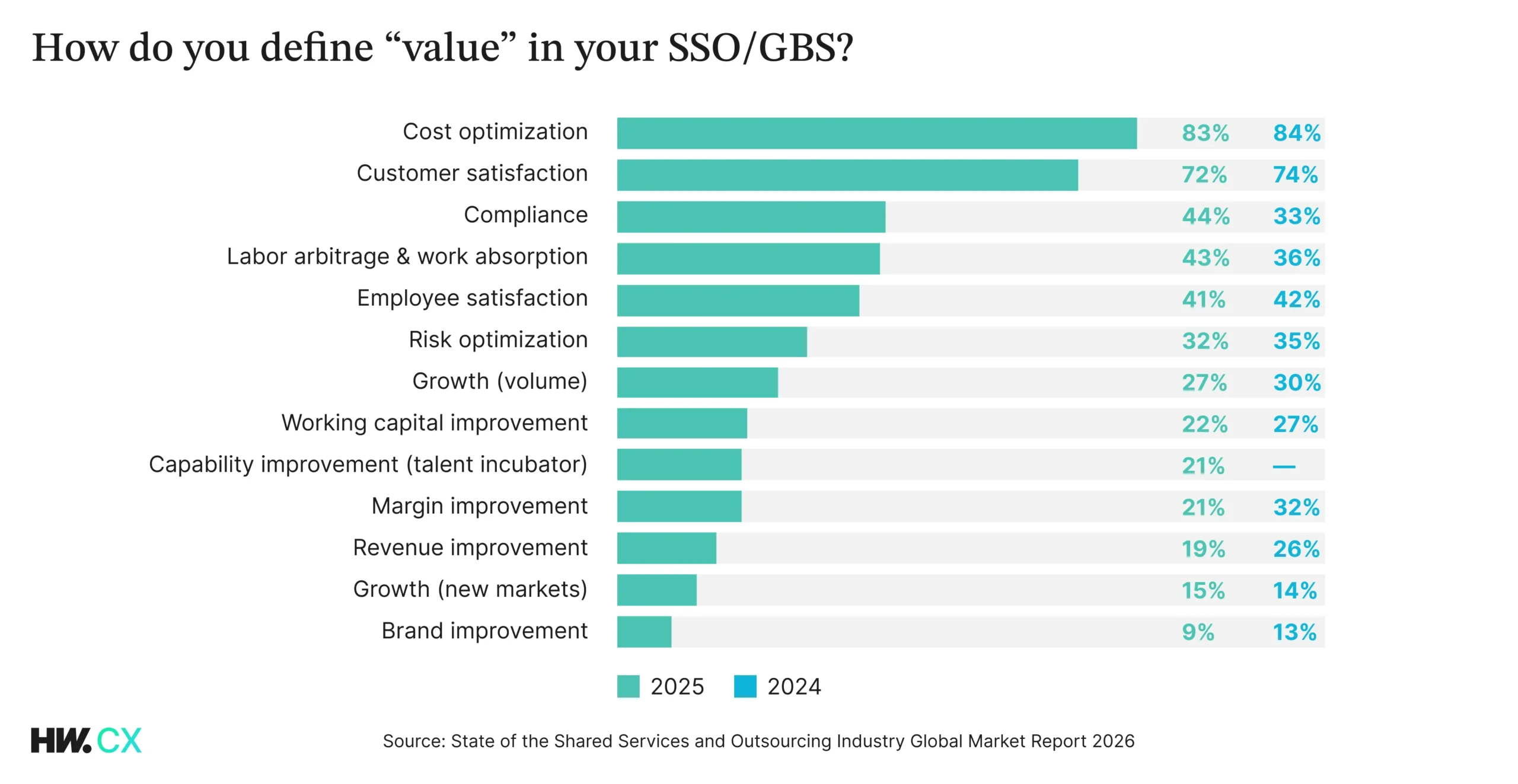
In broader terms, Auxis’ 2026 article, “10 Shared Services Trends Shaping the GBS Industry,” aligns with this direction as well, particularly on global workforce dynamics. The shift is increasingly lopsided toward cost reduction.
The AI Effect on Support Expectations
This shift creates an interesting paradox. While AI is reducing the volume of human interactions, it is simultaneously raising the standard for every conversation that reaches a live agent.
Why customers now expect faster responses AND more personalized service
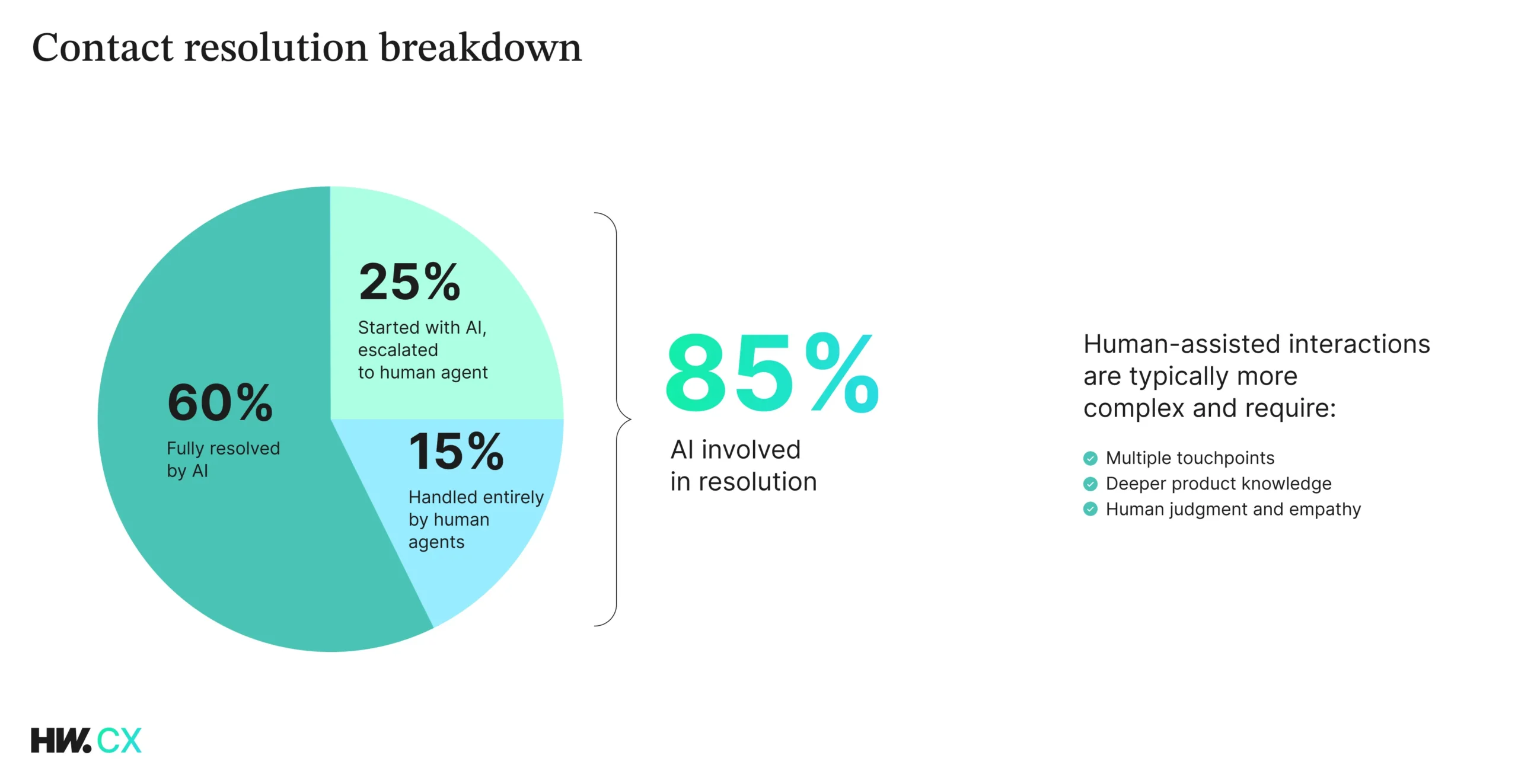
I enjoy reading blogs around the customer service topic, and an article from Gleap mentioned a relevant stat: AI now handles 85% of first-touch support contacts, which is up from just 15% in 2024. Every human interaction that remains is therefore higher stakes.
It has become the norm for customers to expect some form of chatbot or AI from the very first interaction. Frustrated customers, myself included, sometimes try to bypass the bot entirely by typing “agent,” “person,” or “human,” and in most cases, the AI hallucinates a transfer or claims to be a live agent. A bad experience cannot start from the first interaction. You cannot lose the trust of your customer before the conversation has even begun.
How AI increased expectations for human agents instead of lowering them
Human preference still remains the number one desire. A study by SurveyMonkey states that 79% of Americans still prefer interacting with a human over an AI agent for customer support—and this is not referencing the clunky chatbots of 2015, but a recent study conducted while models like GPT-4o were already highly capable and empathic. As it turns out, humans are imperfect in ways that actually make interactions better.
Which support interactions still require dedicated human expertise
Is a mixture of AI and humans the future? As someone who genuinely loves technology, I think we are still not pushing the boundaries of what customer support can be. In the future, specific AI models will handle each step of the interaction, and each will assist the customer with one particular task. Humans will provide oversight and jump in based on triggers, flags, or workflow exceptions where AI cannot perform adequately. The emerging norm will be: the AI does the work, the human provides the oversight.
I recognize this is an unpopular opinion. Some will say “if there will be errors, why doesn’t the human just do the work to begin with?” Others will say “you can use AI to evaluate AI.” Both are fair points. Humans make mistakes. LLMs also make mistakes. The future will combine both to reduce errors and do more with less.
Is it possible to run a 24/7 operation with only bots? For roughly 60% of inquiries, I believe yes. For another 25%, a mix is best. For the remaining 15%, only a human can rationalize a situation without being mechanical. A clear example: do bots grant exceptions? Only if explicitly programmed to, or prompt-injected. Otherwise, they cannot distinguish a genuinely difficult situation from a standard one.
Cost Reduction vs Quality Tradeoffs
Every support operation is balancing the same question: how much quality are you willing to trade for lower costs? The answer depends on the business, the customers, and the complexity of the work. What looks efficient in a spreadsheet does not always play out the same way in practice.
Why companies optimize for short-term efficiency
While traveling in Brazil, I was meeting with a colleague who works in the contact center industry. He told me: “Wow, the cost per agent at your company is 60% of what we offer here.” He was not far off. Our costs, including global overhead and technology, far exceeded those of the local BPO. That provider served the local market well but operated with outdated programs, procedures, and equipment. This also reflected in candidate quality, agents’ ability to perform their roles, and how they connected with the brands they represented. It made sense that the type of service was generally different. Fewer languages, fewer requirements, restricted talent.
As we traded experiences, he admitted that not even his best on-site team would be able to handle some of the customers Helpware supports. It is not just price; it is the agents’ background, both culturally and professionally. The other side of the coin is equally true: some projects only require a lower-cost profile, where not all skills are needed, and I would gladly refer his services when there is a good fit. The point is that fit matters. A mismatch in expectations will eventually lead to disappointment.
Hidden costs of fragmented/shared support models
Let’s look at turnover as a mathematical equation. From what we have observed in shared teams, attrition is significantly higher in the long run. Agents do not feel ownership of the project and therefore have less incentive to remain loyal. This has nothing to do with culture. It comes down to a straightforward consequence of divided attention.
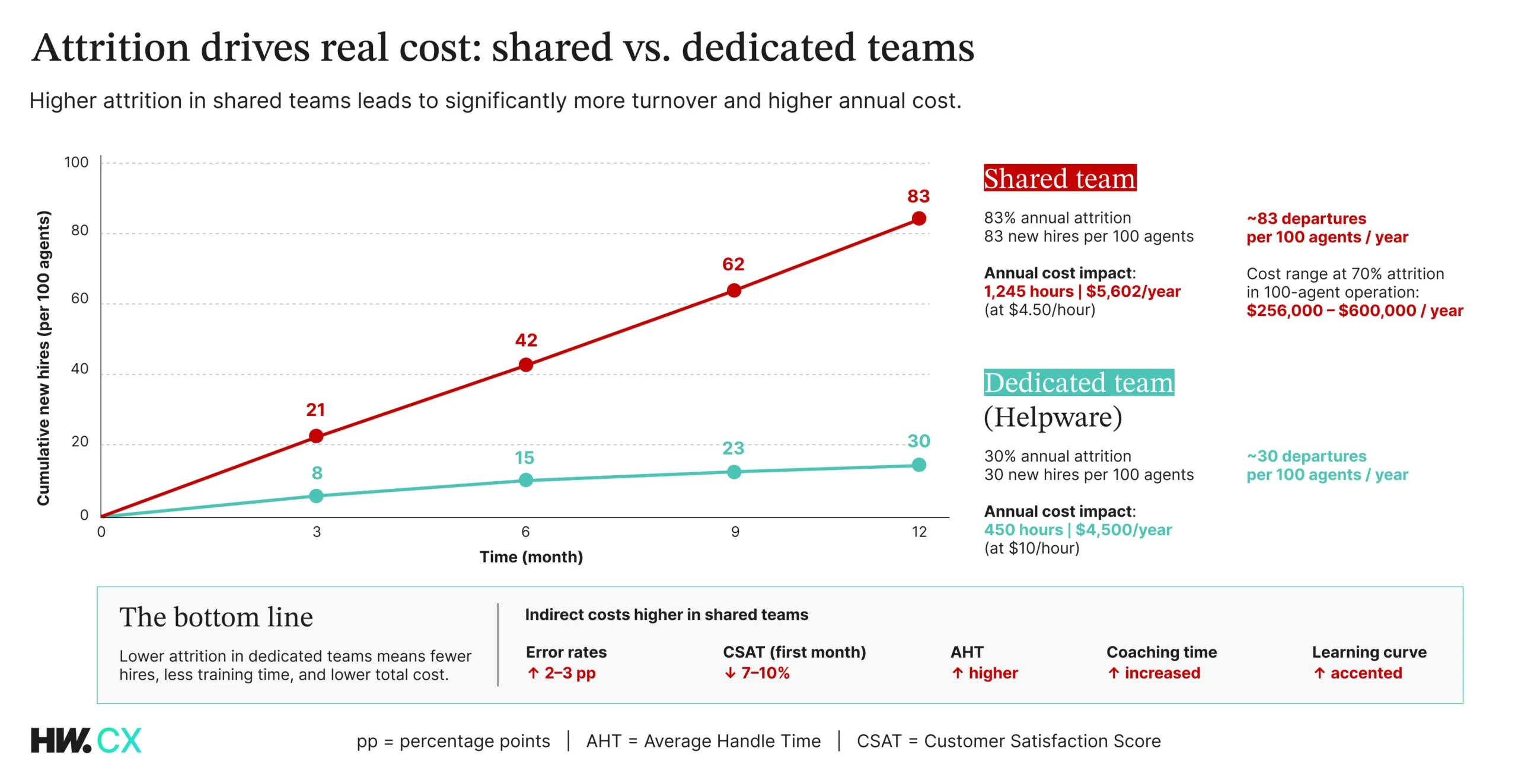
At 70% annual attrition in a 100-agent operation, that is approximately 70 departures per year, costing between $256,000 and $600,000 in recruiting, ramp-up, and lost productivity. Shared projects cost the BPO a larger share of indirect costs, and partners typically expect to pay less per hour since agents work “fewer hours across fewer responsibilities.” But when one of those agents leaves, they affect two accounts, which means two extra trainings, two extra coaching cycles, and two extra software seats.
To bring this to life with real numbers: if my team costs $10/hour and my colleague’s team in Brazil costs $4.50/hour, the math on attrition quickly closes that gap. His attrition on a specific project was running at 83% annualized: 83 new agents for every 100 hired. Assuming just one day of training (8 hours) plus 7 hours of offline onboarding per hire, that is 1,245 hours, or $5,602/year at $4.50/hour—and that is without accounting for quality degradation, ramp-up time, error rates, or any other downstream costs.
At Helpware’s 30% annualized attrition, we are looking at 30 new hires per 100. Using the same calculation, that comes to 450 hours, or $4,500 per year. A 20% cost reduction, and these are just the straightforward numbers. Error rates are typically 2 to 3 percentage points higher between shared resources and dedicated hires. CSAT is usually 7 to 10% lower in the first month for both brackets. AHT is higher, and coaching time and effort are both increased, with learning curves more pronounced for shared resources. All these indirect costs affect pricing and purchasing decisions downstream.
Operational Challenges: Helpware Perspective
What looks theoretically manageable behaves differently in practice once shared teams are running at scale. That is where the real operational complexity becomes visible.
Here comes the hard part about shared teams: they are genuinely difficult to manage. While the work may seem lighter on paper, for the people running these teams, it is five times harder, not twice as hard. Why five? Have you ever been deep in focus on one topic, then done a complete 180 turn and switched to something entirely different? That is the daily reality. You lose the ability to focus on a single product, SLA adherence becomes enormously complex, and spikes in volume create confusion around team sizes and priorities.
Think of it like Google Ads: agents naturally gravitate toward what is familiar or easiest, giving more attention to the account that flows. And it is not the agents’ fault. As research by David E. Meyer and David E. Kieras suggests, even brief mental blocks created by shifting between tasks can cost as much as 40% of someone’s productive time.
Training and onboarding complexity
Training times for staff across multiple shared accounts are substantially longer, and they require more frequent updates, especially for lean, fast-growing startups, which are precisely the type of companies most likely to pursue shared resources in the first place.
Onboarding adds another layer: multiple NDAs, varying system restrictions, different customer data protocols, and separate bonus and incentive structures for each account.
QA consistency challenges
Quality analysts experienced in multiple projects can grade and score agents accurately. The challenge is when an agent must consistently apply the right standards to the right account in real time. “Open with a warm welcome” and “open with a regulatory statement” are very different instructions, and agents who have internalized one will occasionally slip into it on the wrong account. It is not impossible to manage, but it is one of the most common failure points.
A phrase I hear frequently from prospects: “We only need a couple of hours of an agent—there’s no need for deep training, they can just follow a script.” With technology like our own AI Agent Assist, we can now guide agents without requiring memorization. But not all client projects allow its use, and that remains a barrier we must actively address.
Where shared models worked well
Not everything about shared models is a failure. Far from it. One of our most successful shared projects at Helpware was outbound in nature, with clear targets and processes, well-documented procedures, and simple to run. It was a testament that the model can work when conditions are right.
The key was consistency. The work was similar across accounts, the tools and incentive structures were aligned, and we gave agents meaningful time to disconnect between accounts, including genuinely unplugging with downtime in our break rooms.
Since SLA was not a constraint, only outbound volume and call targets, the model worked well. No calls in one account? Jump to the other and keep moving. Need to do back-office documentation work? Fill in the gaps between tasks in the calendar.
Where the model breaks down
For the most instructive failures, I will highlight the clearest example I have seen. It has not been in my time at Helpware, but it was in healthcare and adjacent healthcare product accounts. I am not even referring to agents working across different companies. These agents were simply shared between departments within the same organization. Over time, they began applying regulatory steps where none were required, and omitting them where they were. The IVR had a distinguishing message and the system looked visually different, but after doing this for four to five months, eight hours a day, the brain begins to slip. Sanctions, performance terminations, and stress levels were the highest we observed across any account type. Pay was substantially above average, and still nobody wanted to transfer there. “It’s not worth it,” was the consistent response. It is simply not a model that works for everyone, or for every type of work.
Scaling, QA, and retention observations
When a shared team client has a product launch, the question becomes: do we hire full-time for a short duration, or staff additional shared resources? My honest recommendation is always dedicated temporary resources. The time invested in proper training and onboarding is completely lost when you fold new hires into a shared model.
From a talent perspective, candidates willing to work four hours daily, five to six days a week, are extremely difficult to find. Ramping 100 of them in four weeks requires sacrificing quality. Ramping up 50 full-time candidates gives you a wider talent pool and better outcomes.
There is another reality about shared teams that rarely gets discussed: if an account goes quiet, agents in that model may only be working 50–60% of their contracted time. When you are competing for workers willing to accept irregular hours, you are drawing from a much narrower segment of the workforce: typically younger, less experienced, and less adaptable to schedule changes.
Past, Present, and Future of Support Operations
The current changes in support operations did not appear out of nowhere. They are the result of a long evolution that is now being accelerated by AI and automation.
What support teams looked like before large-scale AI adoption
How is AI influencing this shift? More broadly, how is increased productivity and automation pushing us to rethink operations from the ground up?
In the past, shared accounts were mostly limited to sales, back-office processing, and content moderation. These functions did not require responding to customers within strict time windows or where response lead times were measured in days or weeks.
Now we are in the age of automation, where 1,000 inbound queries have become 200. Budgets are being reallocated toward AI investment, and the deflection race has been running at full speed. According to BCG AI Radar 2026 , corporations expect to double their spending on AI in 2026, from 0.8% to about 1.7% of revenues. Employment of customer service representatives is projected to decline 5% over the next decade, but new roles focused on managing AI and handling complex customer relationships will emerge to replace them.
How support operations are changing during the current AI transition
The transition is underway, but unevenly. Tools are being built, adoption is growing, and expectations on both sides, customers and operators, are shifting faster than most organizations can keep pace with.
What the future support model may realistically look like in the next few years
I expect things to normalize over time. New agent profiles and job categories will emerge, and with them, new complexities. For support representatives specifically, AI will eventually mean humans are hired only for the interactions where human judgment is genuinely required. We will adapt to that need, and shared resources may become more common as a result. That said, I believe this transition will be slow and uncomfortable, marked by errors, false starts, and institutional resistance. We are realistically 10 to 20 years from a stable new equilibrium.
For the next three years, the winning operating model looks like this: an AI handling entry-level contact and triage, a human overseeing the AI, and a human managing all cases the AI cannot resolve.
By 2029, agentic AI workforces will have matured in cost, token efficiency, and reliability. Organizations will be able to deploy AI workers (similar to today’s emerging autonomous agent platforms) to handle the majority of customer service volume. Agentic oversight will be mandatory, with guardrails and human contingencies built in. Human service will remain essential for most mid-to-large companies. Only large-scale enterprise clients will be positioned to invest in cutting-edge fully agentic support. Startups and SMBs will be served by simpler, more affordable agentic systems.
Conclusion
It is important to acknowledge that while this article is grounded in real experience and data, it may look quite different in two years. The market is moving fast. Expectations are rising, and frustrations are real on every side. We can see the promise of AI and want to capture everything it can deliver, but much of what is being said is exaggerated. AI is genuinely powerful, but unless you are in an extremely small percentage of advanced users, most organizations are barely scratching the surface of what it can actually do for them.
Will hybrid operating models become the new standard? Most probably. Is it worth pursuing aggressively right now? Not yet. While the enabling tools are still being built and AI is still gaining adoption and trust, the transition will be gradual. Unless you are willing to accept a temporary quality sacrifice, the right move is a Human + AI model: where AI serves as a point of contact and an efficiency layer, not a replacement for human judgment. If ticket volume has decreased, use that as an opportunity to create new roles, compensate fairly, and grow the workforce alongside the technology.
Just as data is the foundational resource for LLMs, knowledge will be the foundation for every agent. As complexity increases, the agents who stay, who learn, and who are dedicated to a single account will become the key differentiators between BPOs. Agents trained natively in AI workflows versus agents hired simply to fill a seat will be the ones who define what great support looks like next.
Helpware is here to provide the workforce of the future. We are going AI-native operationally, building our foundational tools together with our agents, and we understand that the future is a collaboration, not a competition.
Unlock your hidden CX savings with Helpware
Get ROI projection for current support needs.
-40% annually
/monthly costs with Helpware
vs
/internal team costs (approx)
Your requirements fall outside our standard parameters.
Let's discuss your results
Fill in your details to schedule a consultation.
-40% annually
/monthly costs with Helpware
vs
/internal team costs (approx)
Your requirements fall outside our standard parameters.
-40% annually
/monthly costs with Helpware
vs
/internal team costs (approx)
Your requirements fall outside our standard parameters.
Support staff included in the package:
Shared Team Leader
Shared L&D Specalist
Shared QA Specialist
Account Executive by default
Shared Ops Delivery Manager
Admin/Finance/Legal support for the agents by default
1-2 Dedicated Team Leaders
Shared L&D Specialist
Shared to 1 Dedicated QA Specialist
Shared Ops Manager
Account Executive by default
Admin/Finance/Legal support for the agents by default
Shared Real Time Analyst
2-5 Dedicated Team Leaders
0,5 to 1,5 Dedicated L&D Specialists
1-2 Dedicated QA Specialists
Up to half of a dedicated Ops Manager
Account Executive by default
Admin/Finance/Legal support for the agents by default
1 Dedicated Real Time Analyst
Ready to get a personalized estimate for your team?
Contact us for a personalized assessment tailored to your specific needs.
*These projections are estimates for informational purposes only and do not represent a formal offer. Contact us for a personalized quote.
Thank you!
You’ll hear from us within one business day.