






Healthcare organizations generate large volumes of clinical documentation, from operative reports and radiology findings to discharge summaries and consultation letters. Converting physician dictations into accurate, properly formatted records takes time and requires specialists familiar with medical terminology. As documentation volumes grow, maintaining an in-house transcription team becomes increasingly demanding, particularly when hospitals and practices need fast turnaround without compromising accuracy or patient data security.
Medical transcription outsourcing offers a way to manage these workloads without continually expanding internal staffing. Specialized providers combine trained medical transcriptionists with speech recognition technology and quality assurance processes to produce clinical documents that can be delivered directly into electronic health record (EHR) systems. This allows healthcare organizations to adjust capacity as documentation needs change while maintaining agreed standards for accuracy and turnaround times.
At the same time, the growing use of AI is changing how healthcare organizations approach clinical documentation. Ambient AI tools can draft notes from patient conversations, while traditional transcription remains important for dictated reports. A study published in The American Journal of Managed Care found that 62.6% of US hospitals using Epic as their primary inpatient EHR had adopted or were implementing at least one ambient AI tool by June 2025. With more documentation options available, healthcare leaders need to determine which workflows still require transcription and which can benefit from alternative approaches.
Choosing an outsourcing partner adds another challenge. Providers differ in their medical specialties, turnaround commitments, EHR integration capabilities, security standards, and pricing structures. In this guide, we compare 10 medical transcription outsourcing companies for 2027, examining their services, published performance claims, and limitations. We’ll also explore the differences between traditional transcription, virtual scribes, and ambient AI, explain common pricing models, and outline what to look for in an outsourcing contract so you can find a provider that meets your organization’s documentation and compliance requirements.
What Does Medical Transcription Outsourcing Include?
Medical transcription outsourcing involves hiring a specialized third-party provider to convert physician dictations and audio recordings into accurate, properly formatted clinical documents. These records are then delivered to the healthcare organization’s electronic health record (EHR) or health information management (HIM) system.
Modern medical transcription services go beyond manually converting speech into text. Many providers use speech recognition technology to generate initial drafts, which trained medical transcriptionists review and correct before the documents are finalized. Depending on the provider, services may also include quality assurance, EHR integration, and related clinical documentation support.
Common services covered by medical transcription outsourcing include:
- Clinical notes and progress reports, including SOAP notes, chart notes, and follow-up documentation
- Discharge summaries and inpatient hospital records
- Operative and procedure reports across surgical specialties
- Radiology and pathology transcription
- Consultation and referral letters
- History and physical (H&P) examination reports
- AI-assisted speech recognition editing and quality assurance
- EHR integration and delivery of completed documents to clinical systems
- Virtual medical scribing for real-time or post-encounter documentation
While these services cover different documentation needs, the accuracy of the final records depends heavily on how the provider reviews and verifies its work. Many medical transcription companies use a multistage quality assurance process. An initial draft is produced by a transcriptionist or speech recognition software, then checked against the original recording by an editor. A second reviewer may verify medical terminology and formatting before the document is delivered.
For example, MOS Medical Transcription Services uses a three-level review process involving a transcriptionist, proofreader, and quality control specialist. IKS Health also reports that every completed document is checked against its original voice recording.
Turnaround times are another important consideration, particularly when clinical documents are needed for ongoing patient care. There is no universal turnaround standard for medical transcription, so providers establish delivery deadlines through individual service-level agreements (SLAs). Among the companies reviewed in this article, TransDyne offers a 24-hour turnaround for standard reports and four to 12 hours for urgent STAT requests, while IKS Health reports an average turnaround of approximately three hours for acute-care documentation.
Beyond accuracy and turnaround times, outsourcing also requires clear responsibilities for managing the documentation process. For instance, audio recordings may be submitted through phone dictation, mobile applications, or the provider’s own platform. Your organization and the outsourcing partner also need to agree on who maintains report templates and physician preferences, how accuracy is measured and audited, and how completed documents are delivered.
Some providers can enter finalized reports directly into your EHR, while others return the documents for your internal staff to upload. Establishing which tasks the provider handles and which remain with your HIM team helps prevent delays and ensures that documentation moves through the appropriate review and approval process.
Medical Transcription vs. Virtual Scribes vs. Ambient AI: Which Is Right for Your Organization?
Medical transcription is no longer the only option for handling clinical documentation. Healthcare organizations can also use virtual medical scribes or ambient AI tools to reduce the time physicians spend preparing patient records. While all three approaches support clinical documentation, they work differently and are suited to different types of medical reports.
Traditional transcription remains important for physicians who dictate reports, while virtual scribes and ambient AI can help document patient encounters without requiring clinicians to dictate their notes afterward. Some medical transcription outsourcing providers offer all three services, allowing healthcare organizations to choose different approaches depending on their documentation needs.
The table below compares how each model works, where it is most useful, and what responsibilities remain with the clinician.
| Documentation model | How it works | Best suited for | Clinician responsibilities |
|---|---|---|---|
| Dictation and transcription | The clinician dictates a report, which is transcribed manually or produced using speech recognition software and reviewed by an editor | Radiology, pathology, operative reports, discharge summaries, consultation letters, and clinicians who prefer dictation | Dictates the report, reviews the completed document, and signs it |
| Virtual medical scribe | A remote medical scribe listens to a patient encounter live or reviews a recording and prepares the clinical note in the EHR | High-volume outpatient practices and emergency departments where clinicians want to reduce manual documentation and dictation | Reviews the scribe’s note, makes any necessary corrections, and signs it |
| Ambient AI | AI software processes the conversation between the clinician and patient and automatically generates a draft clinical note | Patient visits where documentation can be generated from the clinical conversation | Checks the AI-generated note for inaccuracies or missing information, makes corrections, and signs it |
Ambient AI has attracted considerable interest because it can reduce the need for physicians to dictate or manually prepare notes after appointments. However, research into its effectiveness shows that the benefits vary depending on the technology and how it is implemented.
For example, a randomized trial conducted at UCLA Health and published in NEJM AI evaluated two ambient AI tools across approximately 72,000 patient encounters involving 238 physicians from 14 specialties. Physicians using Nabla spent approximately 9.5% less time writing each note compared with the control group, while the improvement observed with Microsoft DAX was not statistically significant. The study also identified occasional clinically significant inaccuracies, primarily missing information, and one mild patient-safety event.
These findings suggest that ambient AI can reduce documentation time, but the results aren’t consistent across different tools. Its effectiveness also depends on whether clinicians actually adopt the technology in their daily workflows.
A review by the Peterson Health Technology Institute examined early ambient AI deployments across eight health systems. In organizations where the tools were widely available, only 20–50% of clinicians used them. The review also found that ambient AI had not yet demonstrated consistent efficiency gains. Much of the available evidence came from technology developers or short-term pilot programs, limiting conclusions about long-term performance.
For healthcare organizations, these findings reinforce the importance of matching documentation technology to the work being performed rather than assuming that AI can replace every transcription process.
Ambient AI is designed primarily to generate notes from patient conversations. It doesn’t replace traditional transcription for dictated reports that are created independently of those conversations, such as radiology interpretations and operative reports. These documents still require transcription or speech recognition followed by editing.
Human review also remains essential when AI is involved. The 2025 documentation quality best practices from AHDI and AHIMA emphasize that speech recognition alone doesn’t guarantee accurate clinical documentation and that human oversight is necessary to identify and correct errors.
For organizations considering a combination of these approaches, contract flexibility is another important factor. If some physicians move from dictation to virtual scribing or ambient AI, the volume of traditional transcription work may decrease. Choosing a provider that allows documentation volumes to shift between service models without renegotiating rates can make it easier to adopt new technologies while maintaining control over outsourcing costs.
Top 10 Medical Transcription Outsourcing Companies for 2027: Side-by-Side Comparison
Medical transcription outsourcing companies differ in the services they provide, where their teams operate, and how they handle documentation quality. Some specialize in traditional transcription, while others combine it with AI-assisted documentation, virtual scribing, or broader healthcare back-office services.
To help you compare your options, the table below provides an overview of 10 medical transcription outsourcing companies, including their delivery models, turnaround times, accuracy claims, and available pricing information.
| Company | Delivery Model | Staff Locations | Turnaround Time | Published Accuracy | Pricing |
|---|---|---|---|---|---|
| Helpware | AI-assisted transcription with human editing and dedicated healthcare BPO teams | 19 locations across 11 countries and territories | Defined in individual service-level agreements (SLAs) | No published rate; second-pass quality review against source audio | Custom quotes |
| IKS Health (formerly AQuity Solutions) | Medical transcription, virtual scribing, ambient AI, and medical coding | USA, India, Australia, Canada | Average of 3 hours for acute care, 8.7 hours for ambulatory reports, and 2.2 hours for radiology and pathology | 99.7% or higher | Not published |
| ZyDoc | US-based transcription combining AI-generated drafts with human quality assurance | USA | Under 1 hour for dictations shorter than 15 minutes | 99.6% or higher | From $0.14 per line; monthly plans available |
| Ditto Transcripts | Medical transcription performed exclusively by US-based staff | USA | 24 hours for standard reports; 4 hours for urgent STAT requests | 99% | $0.10–$0.14 per line for standard reports; $0.16 per line for STAT |
| iMedX | Medical transcription, coding, clinical documentation improvement (CDI), and ambient AI through a partner | Not fully published; Australia and New Zealand operations confirmed | Not published | Not published | Not published |
| Outsource2india | Offshore medical transcription through Flatworld Solutions, a multi-service outsourcing provider | USA, UK, Bolivia, Colombia, Kenya, India, Philippines | Not published | Not published | Custom quotes |
| Athreon | AI-assisted transcription with human review and AI medical scribe technology | USA, Canada | Agreed individually with clients | Not published | Not published |
| TransDyne | Cost-focused medical transcription, virtual scribing, and revenue cycle management (RCM) | Not disclosed | 24 hours for standard reports; 4–12 hours for STAT requests | Not published | Not published; free trial available |
| MOS Medical Transcription Services | Multi-specialty transcription with a three-stage quality assurance process | USA or offshore, depending on client requirements | From urgent STAT turnaround to 24 hours | 99% | Not published; no long-term contract required |
| Keystrokes Transcription Service | US-only medical transcription using its proprietary ChartNet platform | USA (no offshore transcription) | Not published | Not published | Not published |
The accuracy and turnaround figures shown above are based on information published by the providers themselves. Accuracy percentages aren’t necessarily directly comparable because companies may use different measurement methods. When evaluating potential partners, ask how each provider calculates accuracy, what quality checks it performs, and whether its reported turnaround times are contractual commitments or historical averages.
How we selected these companies
To identify the best medical transcription outsourcing companies for 2027, we reviewed providers with established medical transcription services and evidence of active operations. Our evaluation focused on their ability to handle clinical documentation accurately, meet healthcare compliance requirements, and integrate with existing workflows.
We reviewed company websites and publicly available information, comparing providers against the following criteria:
- Medical transcription expertise: Experience handling clinical documentation across different medical specialties, including operative reports, radiology findings, and discharge summaries.
- Accuracy and quality assurance: Published accuracy rates, transcription review procedures, and the methods providers use to identify and correct documentation errors.
- Turnaround times: Standard and urgent (STAT) delivery commitments, including whether providers offer defined service-level agreements (SLAs).
- Security and compliance: HIPAA compliance measures, independent security certifications, and safeguards for protecting sensitive patient information.
- EHR integration: Compatibility with electronic health record systems and the ability to deliver completed documents directly into clinical workflows.
- Delivery capabilities: Transcriptionist locations, staffing models, and the availability of AI-assisted transcription or related documentation services.
- Pricing and contract flexibility: Available pricing models, minimum commitments, and options for adjusting services as documentation volumes change.
We also considered publicly available customer ratings and reviews where available. Since many medical transcription providers have limited independent customer feedback, these ratings were treated as supplementary information rather than the primary basis for comparison.
Top 10 Medical Transcription Outsourcing Companies for 2027: Overview
#1 Helpware
Healthcare BPO combining AI-assisted transcription with human review and broader back-office support
Founded in 2015 and headquartered in Lexington, Kentucky, Helpware employs more than 4,000 people across 19 locations in 11 countries. The company provides medical transcription services for clinical visit notes, operative reports, radiology findings, discharge summaries, and consultation letters.
Helpware combines speech recognition technology with human editing and quality assurance. Editors review AI-generated drafts against the original audio and perform a second quality check before finalizing the documents. Completed reports can also be entered directly into the client’s electronic health record system. Turnaround times and accuracy requirements are established through service-level agreements before the engagement begins.
For healthcare organizations looking to outsource more than clinical documentation, Helpware also provides healthcare back-office outsourcing. This allows hospitals and practices to manage transcription alongside other administrative processes through one provider.
Key details:
- Services: Medical transcription, EHR chart entry, healthcare claims processing, scheduling, patient support
- EHR integration: Epic, Oracle Health (Cerner), and athenahealth listed as integration partners
- Security: SOC 2 Type II, ISO 27001, and ISO 9001 certifications; HIPAA, GDPR, and PCI DSS compliance
- Pricing: Custom quotes based on engagement requirements; pilot programs lasting 30–60 days
- Best for: Healthcare organizations seeking one outsourcing partner for medical transcription and related back-office operations
- Locations: USA, Puerto Rico, Guam, Mexico, Ukraine, Germany, Poland, Albania, Georgia, Philippines, Uganda
- What to check: Helpware does not publish transcription rates or have a KLAS transcription assessment. Most delivery locations are outside the US, so confirm which location will process your organization’s clinical documentation
- Rating: 4.8 ★ (Clutch)
#2 IKS Health (formerly AQuity Solutions)

Enterprise medical documentation provider with seven consecutive Best in KLAS transcription awards from 2019 to 2025
IKS Health expanded its clinical documentation capabilities through the acquisition of AQuity Solutions in October 2023. The company now offers medical transcription under the Scribble Transcribe brand, alongside virtual scribing and ambient AI documentation.
IKS Health has a strong record of independent industry recognition. AQuity Solutions, followed by IKS Health, received the Best in KLAS award for transcription services every year from 2019 through 2025. KLAS did not award a transcription category in 2026, but IKS Health received the Best in KLAS award for virtual scribing services that year.
The company’s transcription operation processes approximately 10 million medical records annually for more than 3,000 healthcare organizations. IKS Health checks every completed document against its original voice recording and reports an accuracy rate of at least 99.7%.
Its published turnaround figures also provide useful detail for comparing documentation workflows. Average delivery times are approximately three hours for acute-care reports, 8.7 hours for ambulatory documentation, and 2.2 hours for radiology and pathology reports. IKS Health reports meeting turnaround commitments in at least 99% of cases across these categories.
Key details:
- Services: Medical transcription, virtual scribing, ambient AI documentation (Scribble Now), medical coding, revenue cycle management
- Delivery model: Enterprise clinical documentation services; Scribble Now is listed in Epic’s Connection Hub
- Accuracy: 99.7% or higher (company-reported)
- Best for: Large healthcare systems seeking transcription, virtual scribing, and ambient AI from one provider with independently recognized transcription performance
- Locations: USA, India, Australia, Canada
- What to check: IKS Health does not specify EHR integrations, security certifications, or pricing on its transcription service page. These details should be confirmed through a request for proposal (RFP)
- Rating: No Clutch or G2 rating found
#3 ZyDoc
US-based medical transcription with fast turnaround, published pricing, and multiple EHR integrations
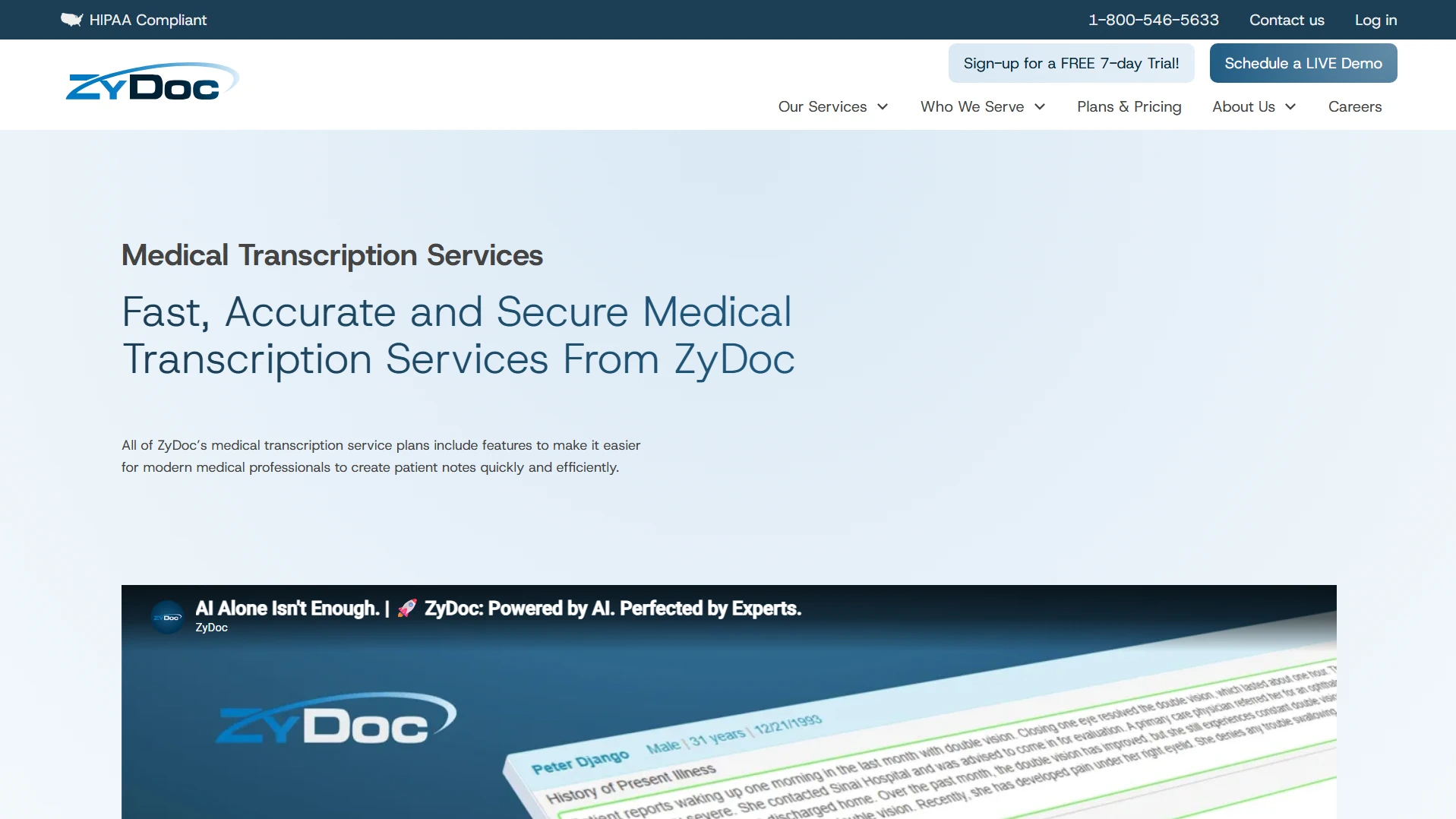
ZyDoc is a medical transcription provider based in Islandia, New York, with a service history dating back to 1993. Its transcription staff work in the United States, and client data is stored and processed domestically using Microsoft Azure hosting with HITRUST certification.
The company combines AI-generated transcription drafts with human quality assurance. For dictations shorter than 15 minutes, ZyDoc advertises turnaround times of less than one hour, making it an option for healthcare teams that need short clinical reports returned quickly.
ZyDoc also provides more pricing transparency than many medical transcription providers. Its published rates start at $0.14 per line, while monthly plans include approximately $350 for 100 edited documents and $1,800 for around 40 documents per day. These options allow practices to compare per-line and subscription costs against their expected documentation volumes.
Key details:
- Services: Medical transcription, AI-assisted documentation with human quality assurance, EHR document delivery
- EHR integration: Epic, Oracle Health (Cerner), MEDITECH, athenahealth, eClinicalWorks, and Allscripts through its TrackDoc Connect interface
- Accuracy: 99.6% or higher (company-reported)
- Pricing and contract: Published per-line rates and monthly plans; seven-day free trial and 30-day money-back guarantee
- Best for: Medical practices and hospital departments requiring US-based transcription staff, fast delivery of short dictations, and predictable monthly pricing
- Locations: USA (Islandia, New York)
- What to check: The HITRUST certification applies to ZyDoc’s hosting provider, not ZyDoc itself. Request independent security audit evidence covering ZyDoc’s own operations
- Rating: 4.8 ★ (Capterra)
#4 Ditto Transcripts
US-only medical transcription with transparent per-line pricing and urgent report delivery
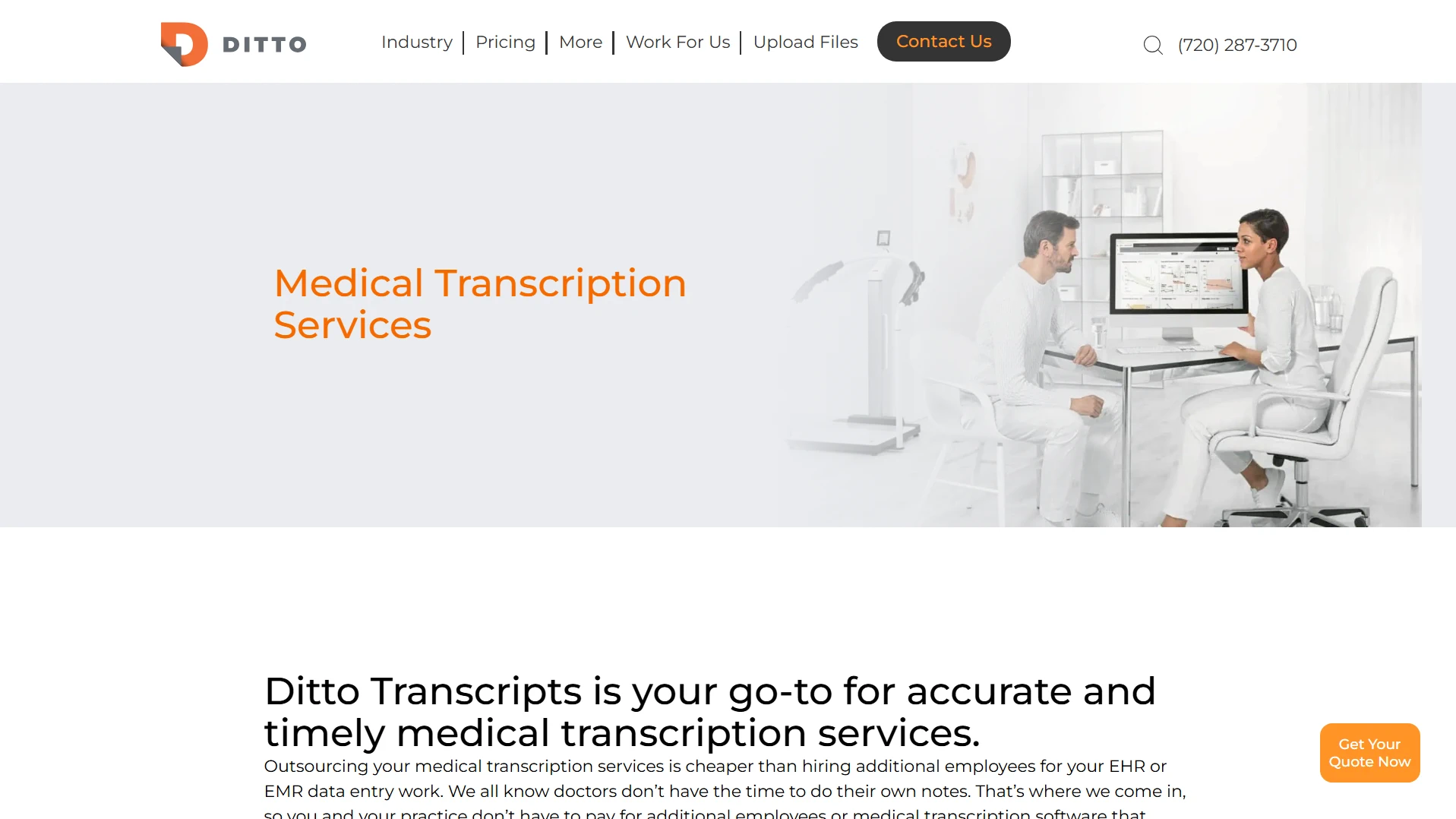
Ditto Transcripts is a Denver-based transcription company that has served healthcare organizations since 2010. The company uses background-checked transcriptionists who are US citizens, making it relevant to practices and departments that require domestic staffing.
Ditto is also one of the few providers in this ranking with a publicly available rate card. Standard transcription costs $0.10 per 65-character line for Category A work and $0.14 for Category B, with a 24-hour turnaround. Urgent STAT reports cost $0.16 per line and have a four-hour delivery commitment.
Healthcare organizations that need completed reports transferred directly into their EHR should also account for integration expenses. Ditto charges a $1,500 setup fee for an HL7 interface, and additional charges may apply from the EHR vendor. Including these fees in the cost comparison provides a more accurate picture of the total engagement cost.
Key details:
- Services: Medical transcription, EHR-ready document formatting for Epic, Oracle Health, and Allscripts, HL7 interface delivery
- Accuracy: 99% (company-stated guarantee)
- Security: HIPAA and CJIS compliance; cyber liability insurance
- Pricing and contract: Published per-line rates; no long-term contract required; free trial available
- Best for: Clinics, medical practices, and hospital departments requiring US-only transcription staff and transparent pricing
- Locations: USA (Denver, Colorado)
- What to check: EHR integration depends on the availability of a suitable interface or API. Additional fees charged by the EHR vendor are not included in Ditto’s published pricing
- Rating: 4.9 ★ (Google)
#5 iMedX (Rapid Care)

Clinical documentation and medical coding services with ambient AI capabilities in Australia and New Zealand
iMedX was founded in 2002 and acquired by Rapid Care in 2023. The company’s services extend beyond medical transcription to include coding, coding audits, data abstraction, and broader clinical documentation support. In January 2026, Rapid Care further expanded its capabilities by acquiring DeepDoc, a medical record summarization company.
iMedX has also been expanding into AI-assisted healthcare documentation. Its website now places particular emphasis on AI-assisted medical coding, while its Australia and New Zealand operations offer InstaNote, an ambient AI scribing solution developed by DeliverHealth through an exclusive partnership.
In July 2025, Health New Zealand selected InstaNote as one of two ambient AI scribing tools approved for trials in public health services. This gives iMedX a broader documentation offering for healthcare organizations considering a combination of transcription, coding, and AI-assisted clinical note creation.
Key details:
- Services: Medical transcription, medical coding, coding audits, data abstraction, clinical documentation, ambient AI scribing through InstaNote in Australia and New Zealand
- Security: SOC 2 and ISO credentials displayed on the company’s website; their scope is not specified
- Best for: Healthcare systems seeking medical transcription and coding services from one clinical documentation provider
- Locations: USA, Australia, New Zealand; other delivery locations not published
- What to check: The transcription service page does not publish accuracy or turnaround figures or identify supported EHR systems. Request written SLAs and confirmation of the scope of its SOC 2 and ISO credentials
- Rating: No Clutch or G2 rating found
#6 Outsource2india

Offshore medical transcription from a multi-service outsourcing provider
Outsource2india was established in 1999 and operates as a brand of Flatworld Solutions, which has corporate operations in New Jersey and Bengaluru, India. Medical transcription is part of a wider outsourcing portfolio that also includes medical coding and other healthcare administrative services.
The company reports serving more than 18,000 clients, although that figure represents Flatworld Solutions’ entire service portfolio rather than medical transcription or healthcare alone.
Outsource2india lists delivery centers in the USA, UK, Bolivia, Colombia, Kenya, India, and the Philippines. It also cites ISO/IEC 27001:2022 certification and describes its medical transcription services as HIPAA compliant. With multiple offshore delivery locations and a broad range of healthcare services, the company is an option for practices seeking to reduce documentation costs through international outsourcing.
Key details:
- Services: Medical transcription, medical coding, teleradiology, EMR data services, claims adjudication, medical billing
- Best for: Clinics and group practices seeking offshore transcription services that permit protected health information (PHI) to be processed outside the United States
- Locations: USA, UK, Bolivia, Colombia, Kenya, India, Philippines
- What to check: Turnaround times, accuracy requirements, and pricing are established per project. Confirm which delivery center will handle clinical documentation and whether it meets the organization’s data handling requirements
- Rating: 5.0 ★ (Clutch)
#7 Athreon

AI-assisted medical transcription with US and Canadian staff and extensive EHR integration capabilities
Athreon has operated since 1988, originally under the name Second Opinion, before adopting its current name in 2012. The company provides AI-assisted medical transcription, combining automatically generated drafts with human review. It also offers AI medical scribe technology to support clinical documentation.
Athreon’s healthcare transcription staff work in the United States and Canada. In addition to healthcare, the company serves medical-legal, insurance, law enforcement, government, and legal organizations. These industries often involve sensitive information, so Athreon maintains HIPAA and Criminal Justice Information Services (CJIS) compliance programs and signs Business Associate Agreements (BAAs). Its broader portfolio also includes dark web monitoring and other cybersecurity services.
For healthcare buyers, Athreon’s EHR integration capabilities are another consideration. The company lists support for athenahealth, Epic, Oracle Health (Cerner), eClinicalWorks, NextGen, MEDITECH, and Allscripts through HL7, API, and FHIR connections. These options allow completed transcription documents to be integrated into existing clinical systems.
Key details:
- Services: AI-assisted transcription, AI medical scribe technology, EHR/EMR integration, cybersecurity services, dark web monitoring
- Best for: Healthcare practices seeking transcription from US and Canadian staff, as well as organizations requiring CJIS-compliant transcription for non-clinical work
- Locations: USA and Canada; postal address in Indianapolis, Indiana
- What to check: Turnaround commitments are established individually for clients, while accuracy rates and pricing are not publicly disclosed
- Rating: No Clutch or G2 rating found
#8 TransDyne

Cost-focused medical transcription with virtual scribing and defined turnaround times for urgent reports
TransDyne is headquartered in San Diego, California, and provides medical transcription alongside virtual scribing and related healthcare documentation services. The company reports a workforce of more than 1,200 transcriptionists and a client base exceeding 5,000 organizations across its service portfolio.
TransDyne also supports revenue cycle management, telemedicine documentation, and medical-legal record reviews, making it relevant to practices that need transcription alongside other documentation-related services.
Cost is a central part of the company’s offering. TransDyne claims that its services can reduce client documentation expenses by 20–50%, although actual savings depend on the organization’s existing costs and requirements. It also publishes turnaround commitments of 24 hours for routine reports and four to 12 hours for urgent STAT requests. A one-week free trial allows prospective clients to evaluate the service before committing.
Key details:
- Services: Medical transcription, AI-assisted virtual scribing, medical record review, revenue cycle management, EMR and telemedicine documentation
- Best for: Independent practices and growing clinic networks seeking cost-focused medical transcription with the option to add virtual scribing
- Locations: USA (San Diego headquarters); transcription delivery locations not published
- What to check: TransDyne does not publish an accuracy rate, specific security certifications, or named EHR integrations. The 20–50% savings figure is company-reported, and the location of transcription staff should be confirmed before engagement
- Rating: 5.0 ★ (G2)
#9 MOS Medical Transcription Services

Multi-specialty medical transcription with three-stage quality assurance and flexible contract terms
MOS Medical Transcription Services was founded in 2002 and is headquartered in Tulsa, Oklahoma. It operates as the medical transcription division of Managed Outsource Solutions and provides documentation support across a wide range of specialties, including radiology, orthopedics, neurology, family practice, and physical therapy.
The company places particular emphasis on quality assurance. Its transcription workflow includes three review stages involving a transcriptionist, proofreader, and quality control specialist. MOS reports a 99% accuracy rate and offers turnaround options ranging from urgent STAT delivery to 24 hours for standard reports.
MOS also offers flexible engagement terms, with no long-term contract requirement or setup fees. Transcription work can be performed in the United States or offshore, depending on the client’s requirements. This allows practices to choose a delivery arrangement that better matches their operational preferences and data handling policies.
Key details:
- Services: Multi-specialty medical transcription, HIPAA-compliant documentation, EHR/EMR integration, medical billing, data conversion
- Best for: Physician practices and multi-specialty clinics seeking transcription services without long-term contractual commitments
- Locations: USA (Tulsa, Oklahoma headquarters); domestic or offshore delivery depending on the client
- What to check: Confirm whether clinical files will be processed in the USA or offshore. The company does not publish specific pricing or identify supported EHR systems
- Rating: No Clutch or G2 rating found
#10 Keystrokes Transcription Service

US-only medical transcription supported by its own ChartNet dictation and transcription platform
Keystrokes Transcription Service was founded in 1997 and is headquartered in Yorkville, Illinois. The company employs more than 500 transcription professionals and maintains a policy against offshore transcription, making it relevant to US healthcare organizations that require domestic staff to process their clinical documentation.
Keystrokes serves hospitals and medical practices across specialties such as acute care, radiology, pathology, and orthopedics. Its services also include broader health information management (HIM) support and automatic speech recognition (ASR) editing.
The company’s technology capabilities are supported by ChartNet Technologies, its sister company. ChartNet provides a dictation and transcription platform that can operate independently or connect with a healthcare facility’s electronic medical record (EMR) or radiology information system. This gives organizations the option to integrate transcription into their existing documentation workflows.
Key details:
- Services: Medical transcription for acute care, HIM, radiology, pathology, orthopedics, and other specialties; HIM services, ChartNet platform, ASR editing
- Best for: US hospitals and large medical practices requiring domestic transcription staff and a dedicated dictation and transcription platform
- Locations: USA (Yorkville, Illinois headquarters); US-only remote transcription delivery
- What to check: Keystrokes does not publicly disclose turnaround commitments, accuracy rates, pricing, or security certifications. These should be confirmed before engagement
- Rating: No Clutch or G2 rating found
Why Choose Helpware for Medical Transcription Outsourcing?
Accurate medical documentation is essential to patient care, but managing growing transcription workloads shouldn’t mean constantly hiring more staff or increasing the administrative burden on your clinical teams. At Helpware, we help healthcare organizations scale their documentation operations while maintaining control over accuracy, turnaround times, and patient data security.
Unlike providers focused exclusively on transcription, we deliver medical documentation as part of our broader healthcare BPO services. Our teams handle medical transcription and EHR chart entry alongside claims processing, patient scheduling, and prior authorization support. We also support EHR and CRM automation. This allows healthcare organizations to outsource multiple administrative functions through one partner rather than managing separate vendors for each process.
We combine AI-assisted transcription with experienced medical editors who review drafts against the original audio and perform a second quality check before documents reach the patient record. Before launching a program, we work with your team to establish report templates, accuracy standards, and turnaround commitments. We then recruit editors familiar with your medical specialties and calibrate their work against actual dictation samples to ensure they meet your requirements.
Our engagement model is designed to support changing documentation volumes. Programs typically begin with a 30- to 60-day pilot, allowing us to refine workflows before expanding. Depending on operational requirements, we can scale teams from an initial five to 10 specialists to more than 500 within 90–120 days. This flexibility is particularly valuable during EHR migrations, new clinic openings, or periods of increased documentation demand.
Consistency also depends on retaining experienced staff. We maintain an average monthly employee attrition rate of 2.8%, a 90% customer satisfaction score, and client partnerships averaging five years. For context, a NiCE survey of 400 North American contact center leaders, conducted between December 2024 and January 2025, reported annual attrition rates of 36% for contact center agents and 32% for back-office staff, approximately 3% and 2.7% per month, respectively. While these figures cover broader support operations rather than medical transcription specifically, they illustrate the challenge of retaining experienced outsourcing personnel.
For medical transcription, staffing continuity matters because editors become familiar with physician preferences, specialty terminology, and client-specific documentation requirements. Retaining that knowledge reduces repeated training and helps maintain consistent quality as programs grow.
Our operations are backed by SOC 2 Type II, ISO 27001, and ISO 9001 certifications, along with HIPAA, GDPR, and PCI DSS compliance. These safeguards support our work with sensitive healthcare information across back-office operations and clinical documentation services.
What Makes Helpware a Strong Medical Transcription Partner?
- Security and compliance: SOC 2 Type II, ISO 27001, and ISO 9001 certifications, with HIPAA, GDPR, and PCI DSS compliance.
- Human-reviewed AI transcription: Medical editors verify AI-generated drafts against source audio, followed by a second quality audit before the documents enter the EHR.
- Scalable delivery: 30- to 60-day pilot programs, with the capacity to grow teams from five to 10 specialists to more than 500 within 90–120 days.
- Staffing stability: 2.8% average monthly attrition helps retain experienced editors who understand client-specific documentation requirements.
- Long-term partnerships: Average client relationships of more than five years, compared with the stated industry norm of one to two years.
- Multilingual capabilities: Support in more than 45 languages for healthcare organizations serving diverse patient populations across urban and rural markets.
Whether you’re looking to reduce documentation backlogs, expand transcription capacity, or bring several healthcare administrative processes under one provider, Helpware can build a team around your operational requirements.
Ready to improve your medical transcription operations? Talk to our healthcare outsourcing team to discuss your documentation volumes, compliance needs, and turnaround requirements.
How Much Does Medical Transcription Outsourcing Cost?
Medical transcription outsourcing costs depend on the volume and complexity of your documentation, turnaround requirements, and how the provider charges for its services. The pricing model also affects your total expenses, particularly when transcription volumes fluctuate or your organization requires urgent reports.
Most medical transcription providers use one of five pricing models, each suited to different documentation needs.
- Per-line pricing: You pay for each line of transcribed text, typically defined as 65 characters, including spaces. Published rates include $0.09 per line for standard transcription and $0.125 for urgent STAT reports from Revele, $0.10–$0.14 for standard reports and $0.16 for STAT work from Ditto Transcripts, and rates starting at $0.14 from ZyDoc. Because providers may calculate line counts differently, it’s important to confirm their billing method and request a sample invoice based on your own documentation. This model works particularly well for hospitals processing large, predictable volumes of clinical reports.
- Per-minute pricing: Charges are based on the duration of the audio recording rather than the length of the completed document. Human transcription typically costs $1–$3 per audio minute, while specialized legal and medical transcription ranges from $1.50 to $3. This approach suits practices with varying dictation lengths, particularly when per-line charges would make costs harder to predict. When comparing quotes, confirm whether the rate includes human editing and quality assurance or covers automated transcription alone.
- Per-report pricing: You pay a fixed amount for each completed clinical report, regardless of its length. This model is commonly used for radiology and pathology documentation, where reports often follow standardized formats. Few providers publish per-report rates, so pricing is usually determined after reviewing sample documents and assessing the work involved.
- Monthly plans: A fixed monthly fee covers an agreed volume of transcription work, making expenses easier to forecast. For example, ZyDoc offers plans starting at approximately $350 per month for around 100 edited documents, while a higher-volume plan costs about $1,800 per month for roughly 40 documents per day. Monthly plans are particularly suitable for practices with stable documentation volumes that want predictable expenses.
- Dedicated teams: Your organization pays a monthly fee for each full-time medical transcription editor assigned to its account. This model is commonly offered by healthcare BPO providers such as Helpware. It works well for large healthcare organizations or multi-specialty practices with ongoing transcription needs, as dedicated editors become familiar with physician preferences and client-specific documentation requirements.
Beyond the pricing model, several factors influence how much your organization ultimately pays. Urgent STAT requests typically cost more because they require faster turnaround, while complex medical terminology or poor-quality audio can increase the time needed to produce accurate documents. Lower transcription volumes may also limit access to bulk discounts.
EHR integration can introduce additional expenses, especially when the provider needs to establish a connection with your existing clinical systems. For example, Ditto Transcripts charges a one-time fee of $1,500 to set up an HL7 interface, and the EHR vendor may charge separately for its part of the integration.
To compare outsourcing costs accurately, request quotes based on your actual documentation volumes and report types. Make sure they account for turnaround requirements and any additional charges for EHR integration or quality assurance. This provides a more reliable estimate of total costs than comparing advertised transcription rates alone.
Unlock your hidden CX savings with Helpware
Get ROI projection for current support needs.
-40% annually
/monthly costs with Helpware
vs
/internal team costs (approx)
Your requirements fall outside our standard parameters.
Let's discuss your results
Fill in your details to schedule a consultation.
-40% annually
/monthly costs with Helpware
vs
/internal team costs (approx)
Your requirements fall outside our standard parameters.
-40% annually
/monthly costs with Helpware
vs
/internal team costs (approx)
Your requirements fall outside our standard parameters.
Support staff included in the package:
Shared Team Leader
Shared L&D Specalist
Shared QA Specialist
Account Executive by default
Shared Ops Delivery Manager
Admin/Finance/Legal support for the agents by default
1-2 Dedicated Team Leaders
Shared L&D Specialist
Shared to 1 Dedicated QA Specialist
Shared Ops Manager
Account Executive by default
Admin/Finance/Legal support for the agents by default
Shared Real Time Analyst
2-5 Dedicated Team Leaders
0,5 to 1,5 Dedicated L&D Specialists
1-2 Dedicated QA Specialists
Up to half of a dedicated Ops Manager
Account Executive by default
Admin/Finance/Legal support for the agents by default
1 Dedicated Real Time Analyst
Ready to get a personalized estimate for your team?
Contact us for a personalized assessment tailored to your specific needs.
*These projections are estimates for informational purposes only and do not represent a formal offer. Contact us for a personalized quote.
Thank you!
You’ll hear from us within one business day.
What to Check Before Signing a Medical Transcription Outsourcing Contract
Choosing a medical transcription provider involves more than comparing prices and advertised accuracy rates. Your organization needs to know whether the provider can deliver accurate clinical records on time, protect sensitive patient information, and meet the requirements of your documentation workflows. Before signing an agreement, make sure these expectations are clearly defined and supported by measurable commitments.
Accuracy and quality assurance
Several providers in this ranking advertise transcription accuracy rates between 99% and 99.7%. However, these figures aren’t necessarily comparable because companies don’t always explain how they calculate accuracy or which types of errors they include.
For medical documentation, an incorrect medication dosage or missing clinical detail can have more serious consequences than a minor formatting mistake. That’s why accuracy needs to be evaluated using clear criteria rather than a single percentage.
The Association for Healthcare Documentation Integrity (AHDI) and the American Health Information Management Association (AHIMA) describe methods for classifying and assessing transcription errors in their documentation quality best practices.
When evaluating providers, establish how they classify and weight errors, how many completed reports they audit each month, and who performs these reviews. Your organization should also have access to the audit results so it can monitor documentation quality throughout the engagement.
Turnaround times and SLA commitments
Accurate clinical documentation is only useful if it reaches the care team when needed. Delays in completing medical reports can interfere with clinical workflows, particularly when physicians need documentation for ongoing patient care.
Turnaround requirements should therefore be established separately for routine reports and urgent STAT requests. The service-level agreement (SLA) should specify when the turnaround clock starts, whether at file upload or confirmed receipt, and what percentage of reports must meet the agreed deadline. It should also define what happens if the provider fails to deliver on time.
Some providers publish detailed performance information that can serve as a reference when establishing these requirements. For example, IKS Health reports average turnaround times and the percentage of reports delivered within the agreed timeframe for different care settings. Requesting the same level of detail from prospective partners makes it easier to assess whether their commitments match your clinical needs.
Data security and HIPAA compliance
Medical transcription providers handle protected health information (PHI), making data security a critical part of the outsourcing agreement. Before sharing patient recordings or clinical documents, your organization must have a signed Business Associate Agreement (BAA) with the provider.
It’s also important to distinguish regulatory compliance from independent security certification. The US Department of Health and Human Services (HHS) does not issue or officially recognize HIPAA certifications. Instead of relying on claims of being “HIPAA certified,” request independent evidence of security practices, such as a SOC 2 Type II audit report or an ISO 27001 certificate. Confirm that these documents cover the provider’s relevant operations and systems, rather than only those of a hosting partner.
Security reviews should also establish where transcriptionists and other employees with access to patient records are located, whether subcontractors are involved, and what safeguards apply to their work. The contract should specify how quickly the provider must notify your organization of a data breach and how patient information will be returned or securely destroyed when the agreement ends.
These precautions address real risks. In 2023, a data breach at medical transcription provider Perry Johnson & Associates affected multiple healthcare systems, demonstrating how a security incident involving an external documentation vendor can expose patient information across several organizations.
The location of transcription staff also deserves attention, especially when your organization has restrictions on processing patient information outside the United States. For a closer look at the operational differences between domestic and international outsourcing, our comparison of onshore, nearshore, and offshore delivery explains the trade-offs involved.
Choosing the Right Medical Transcription Outsourcing Partner
Choosing a medical transcription outsourcing provider comes down to finding a company that can meet your documentation requirements while maintaining accuracy, timely delivery, and patient data security. The providers in this ranking offer different capabilities, so the best choice depends on your organization’s size, medical specialties, and documentation volumes.
Before narrowing down your options, determine which clinical documents still require traditional transcription and which could be handled through virtual scribes or ambient AI. You’ll also need to establish whether your organization permits protected health information (PHI) to be processed outside the United States, as this will influence which delivery models are suitable.
Once you’ve defined these requirements, prioritize compliance. Any provider handling PHI must be able to sign a Business Associate Agreement (BAA) and demonstrate appropriate HIPAA safeguards. From there, compare accuracy standards, turnaround commitments, and EHR integration capabilities before evaluating pricing.
The companies in this guide serve different needs. Large health systems looking to combine transcription, virtual scribing, and ambient AI can consider IKS Health, while iMedX also offers medical coding services. Organizations requiring US-only transcription staff have options such as Keystrokes, ZyDoc, and Ditto Transcripts, with Athreon serving those that also permit Canadian staff. For practices focused on competitive pricing and flexible commitments, TransDyne, MOS, and Outsource2india offer alternatives. Healthcare organizations seeking to manage transcription alongside other back-office and patient-support functions can consider Helpware.
Ultimately, successful medical transcription outsourcing isn’t simply about reducing documentation costs. It’s about ensuring that clinical records are accurate, available when needed, and handled securely without placing unnecessary demands on your internal teams.
At Helpware, we combine experienced medical documentation specialists with AI-assisted workflows and established quality assurance processes to support healthcare organizations as their needs evolve. If you’re considering outsourcing your transcription operations, contact our team for a custom quote based on your documentation volumes, turnaround expectations, and compliance requirements.