








Health plans are under growing pressure to deliver faster member service while keeping administrative costs under control. Coverage changes, enrollment cycles, claims inquiries, and regulatory requirements create operational peaks that are difficult to manage with a fixed internal team alone.
The challenge is becoming more complex. The Congressional Budget Office projects the US uninsured rate will rise from an all-time low of 7.2% in 2023 to 8.9% by 2034 as pandemic-era Medicaid rules end and enhanced marketplace subsidies expire (CBO, 2024). Each shift in coverage creates new demand for enrollment support, eligibility checks, and appeals. At the same time, McKinsey estimates payers that adopt available AI and automation could achieve 13% to 25% net savings in administrative costs.
Health plans facing these pressures are increasingly rethinking how they structure operational support. Rather than building every capability internally, many organizations evaluate specialized partners to handle high-volume workflows while keeping strategic and clinical decisions in-house.
This guide explains how health insurance BPO works, which services payers typically outsource, the benefits and trade-offs of partnering with an external provider, and how seven leading providers compare: Helpware, Optum, Concentrix, Carenet Health, Peak Support, ClearSource, and HelpSquad.
Key Takeaways
- Health insurance BPO covers payer-side operations such as member support, claims intake and adjudication support, appeals and grievances, enrollment, eligibility, and billing.
- Health insurance BPO differs from healthcare BPO: the buyers, workflows, and regulatory requirements vary because one serves payers while the other serves providers.
- Payers that adopt available AI and automation can achieve 13% to 25% net savings in administrative costs.
- When evaluating a BPO partner, look for HIPAA compliance, a signed BAA, SOC 2 Type II or ISO 27001 certification, and proven capacity to handle enrollment surges.
- In our provider comparison, Helpware ranks first based on the combination of CX operations, AI implementation, and software engineering capabilities within a HIPAA-compliant environment.
What Is Health Insurance BPO?
Health insurance BPO (business process outsourcing) is when a payer organization outsources specific operational workflows to an external partner that manages them with trained teams, documented processes, and defined service levels. Typical buyers include national and regional carriers, health plans, third-party administrators (TPAs), Medicare Advantage and Medicaid plans, and digital health companies that administer benefits.
The scope ranges from front-line member support to back-office operations such as claims data entry and eligibility verification. Some payers outsource a single function, while others rely on a partner to manage an entire operational area and keep strategic functions such as underwriting and final claims decisions in-house.
Health Insurance BPO vs Healthcare BPO: What’s the Difference?
The terms health insurance BPO and healthcare BPO are often used interchangeably, but they serve different parts of the healthcare ecosystem. Health insurance BPO supports organizations that pay for care, while healthcare BPO supports organizations that deliver care. The distinction affects buyers, workflows, compliance requirements, and success metrics.
If you manage hospital revenue cycle operations or other provider-side workflows, see our blog post on the best healthcare BPO companies. If you manage a health plan, insurer, TPA, or insurtech company, health insurance BPO is the model covered here.
| Dimension | Health insurance BPO (payer side) | Healthcare BPO (provider side) |
|---|---|---|
| Who buys it | Carriers, health plans, TPAs, insurtech | Hospitals, clinics, telehealth, medical groups |
| Core workflows | Member support, claims adjudication support, appeals and grievances, enrollment, billing | Patient scheduling, medical coding and billing, revenue cycle, transcription |
| Key regulators and frameworks | HIPAA, CMS, state departments and regulators | HIPAA, HITECH, payer contract terms |
| Success metrics | CSAT, first-call resolution, claims cycle time, grievance turnaround | Denial rate, days in AR, patient satisfaction |
One workflow overlaps between both areas: eligibility and insurance verification. Payers verify member status, while providers verify coverage before care. A partner that understands both sides can reduce rework and improve coordination across the healthcare ecosystem.
Health Insurance BPO Services: Front, Middle, and Back Office
Health insurance BPO services typically fall into three operational areas: front office, middle office, and back office. Each area covers different workflows and has different performance goals.
| Lane | What it includes | Typical goals |
|---|---|---|
| Front office | Omnichannel member support, provider lookup, enrollment lines, multilingual service | CSAT, first-call resolution, answer speed |
| Middle office | Claims intake, adjudication support, appeals and grievances coordination, prior authorization support | Claims cycle time, accuracy, grievance turnaround |
| Back office | Eligibility verification, billing and payment posting, data entry and management, reporting | Error rate, throughput, cost per transaction |
Member support and enrollment
Members expect fast, accurate, and empathetic answers across phone, chat, and email, regardless of when they reach out or which language they speak. Outsourced teams follow plan-specific procedures, handle benefit explanations and provider lookups, and provide additional staffing during annual and special enrollment periods when demand increases.
Claims intake, adjudication support, and appeals
Trained non-licensed teams handle claims intake, data verification, documentation, and status updates, while licensed staff and internal reviewers retain final decision authority. Structured appeals and grievances coordination helps health plans meet regulatory timelines while protecting member trust during sensitive interactions.
Billing, eligibility, and back-office operations
Eligibility checks, billing, payment posting, reconciliation, and records management require accuracy and consistent process execution. These high-volume workflows benefit from combining automation with human quality control to maintain efficiency without sacrificing accuracy.
Benefits of Health Insurance BPO for Payers
- Lower administrative costs. Specialized teams in global delivery locations reduce cost per interaction while maintaining quality standards. Mature partners also introduce automation into workflows instead of simply adding more outsourced headcount.
- Elastic capacity for open enrollment. Partners can ramp trained agents within weeks for enrollment season, then scale capacity back when demand returns to normal. This prevents health plans from maintaining year-round staffing levels built only for peak periods.
- Compliance support from day one. Mature providers come with established HIPAA programs, SOC 2 Type II attestations, ISO 27001 certification, and signed business associate agreements (BAAs), reducing the operational burden of building these capabilities internally.
- Better member experience. Around-the-clock, multilingual coverage helps health plans serve diverse populations across Medicare Advantage, Medicaid, and commercial plans with faster and more accessible support.
- More focus for internal teams. Actuarial work, network strategy, and product design remain in-house while a partner manages high-volume operational workflows.
Why it matters: The Congressional Budget Office (CBO) projects coverage churn through 2034. Every coverage change creates operational demand in the form of enrollment questions, eligibility checks, and appeals. Elastic, specialized capacity turns that volatility into a more manageable operational cost.
How We Chose Health Insurance BPO Providers for Our List
We evaluated providers against five weighted criteria designed to reflect what health plans need from an outsourcing partner. Every factual claim in the comparison comes from official provider materials, regulatory filings, or our verified company information. Any detail we could not confirm was excluded.
| Criterion | Weight |
|---|---|
| Healthcare and payer specialization | 30% |
| Compliance and security posture | 25% |
| Scale and language coverage | 20% |
| Service breadth across the member lifecycle | 15% |
| Evidence from long-term client relationships | 10% |
Helpware publishes this guide. We ranked ourselves first based on the same criteria applied to every provider and aimed to present each company fairly. Verify provider capabilities against your specific requirements before making a decision.
7 Top Health Insurance BPO Providers in 2026
| Provider | Best for | Standout strength |
|---|---|---|
| Helpware | Payers wanting CX, AI, and software from one partner | Four integrated divisions, HIPAA + SOC 2 Type II + ISO 27001, 45+ languages |
| Optum | Large national plans | Claims lifecycle and payment integrity at maximum scale |
| Concentrix | Enterprise member-lifecycle programs | Licensed sales through appeals in one operation |
| Carenet Health | US member engagement programs | Payer-first heritage since 1988 |
| Peak Support | Mid-market member support | Dedicated healthcare and insurance practices |
| ClearSource | Claims-centric support teams | Trained non-licensed claims workflows |
| HelpSquad | Smaller organizations | US-managed, HIPAA-trained verification and intake |
#1 Helpware
Best for: Payers looking for member support, AI implementation, and custom software capabilities from one HIPAA-compliant partner.
Helpware works with healthcare and digital health organizations on customer support, technical support, and back-office operations, including claims processing and insurance verification. Its healthcare clients include Headspace, NexHealth, and HealthComp.
The company brings four capabilities together: CX operations, AI products and implementation, software engineering, and growth marketing. For health plans, that means they can improve member operations, introduce automation, or build new digital solutions without managing multiple vendors.
Helpware operates under HIPAA, SOC 2 Type II, ISO 27001, ISO 9001, and GDPR-compliant frameworks. Its teams work across 19 locations on four continents and support customers in 45+ languages. Organizations can start with a pilot and scale to 500+ full-time equivalents (FTEs) within 90 to 120 days. Helpware reports 90% CSAT across its client programs, with average client partnerships lasting five years.
#2 Optum
Best for: Large national plans looking for technology-driven payer operations at enterprise scale.
Optum is the health services business within UnitedHealth Group and provides payer solutions across the claims lifecycle, including payment integrity, utilization management operations, pharmacy claims, and payment delivery.
The company combines managed services with extensive data, analytics, and technology capabilities. Everest Group positions Optum as a Leader in its utilization management operations and payment integrity assessments, reflecting its scale and operational depth.
The main consideration for buyers is its structure: Optum operates within the largest US health insurer, which some competing plans may evaluate carefully when considering data-sharing and vendor relationships. For enterprise health plans focused on improving claims accuracy and reducing administrative costs through technology, Optum remains one of the largest-scale options in the market.
#3 Concentrix
Best for: Enterprise member lifecycle programs covering everything from licensed sales to grievances and appeals.
Concentrix supports health plans across the member journey, including marketing and lead generation, licensed insurance sales, enrollment and onboarding, member support, AI-powered claims processing, grievances and appeals, and overpayment recovery.
The company also focuses on helping Medicare plans improve CMS Star Ratings, an important consideration for organizations tied to quality-based reimbursement programs. Its broad service portfolio makes it a strong fit for large plans looking to consolidate multiple member operations under one provider.
However, healthcare is one of several industries served by Concentrix. Organizations looking specifically for a healthcare-focused or payer-specialist partner may compare it with providers that concentrate more heavily on health insurance operations.
#4 Carenet Health
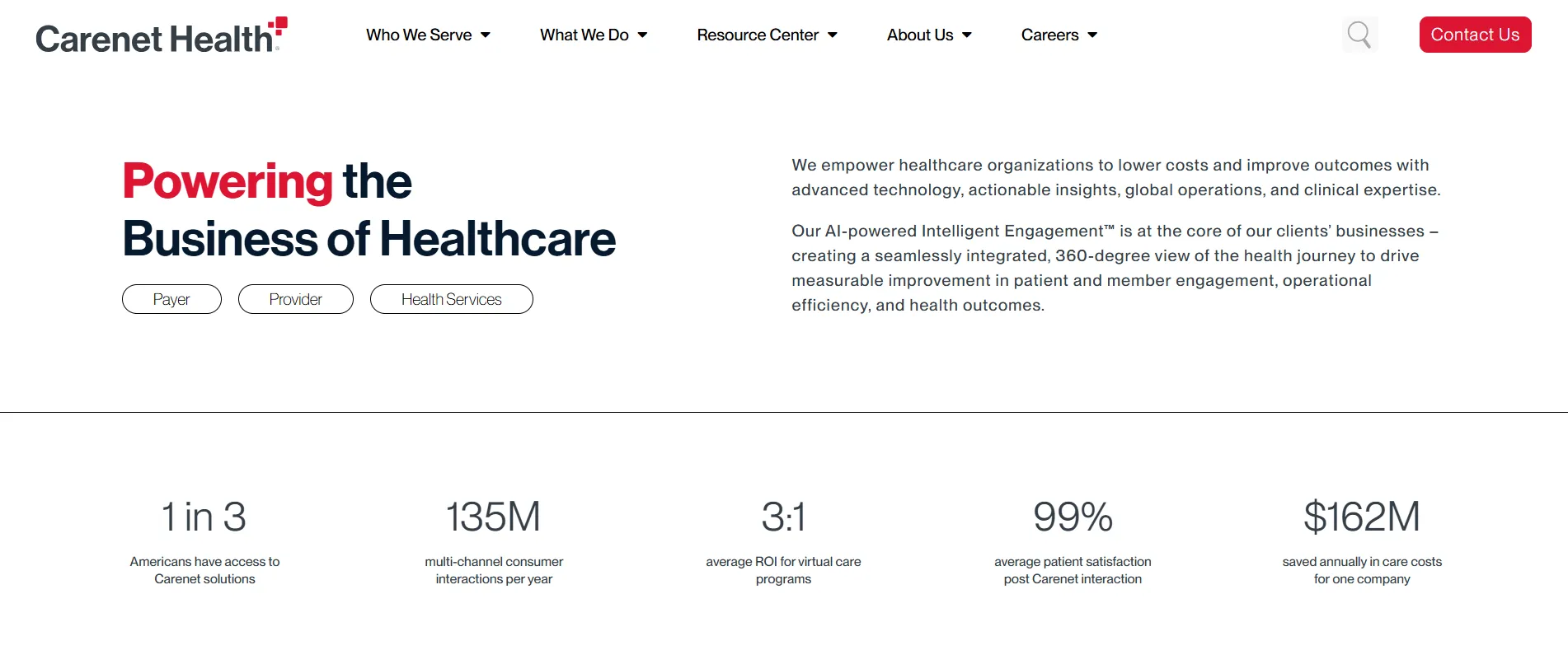
Best for: Member engagement and healthcare navigation programs for US health plans and government-sponsored populations.
Founded in 1988 and headquartered in San Antonio, Texas, Carenet Health focuses on healthcare engagement programs, including medical contact center services, healthcare navigation, care management, and consumer outreach.
The company works with health plans, hospital systems, employer groups, pharmacy benefit managers, and government-sponsored programs such as Medicare and Medicaid. Its payer-focused background is reflected in programs built around member guidance and navigation rather than general contact center support.
Carenet’s US-based delivery model is a strong fit for organizations prioritizing onshore operations. Health plans looking for multilingual, follow-the-sun coverage may compare it with providers that operate larger global delivery networks.
#5 Peak Support
Best for: Mid-market member support teams looking for a dedicated healthcare and insurance practice.
Peak Support provides customer experience, technical support, back-office, and accounting services through teams located in the Philippines, the United States, Colombia, and Eastern Europe.
The company maintains dedicated healthcare and insurance practices, with its health insurance BPO work focused on improving member support quality and claims-related efficiency. It also supports multilingual delivery and 24/7 coverage models for organizations that need broader availability.
Peak Support serves multiple industries rather than focusing exclusively on payer operations. Health plans with complex claims adjudication requirements may compare it with providers that specialize more deeply in claims workflows.
#6 ClearSource
Best for: Claims-focused member and provider support using trained non-licensed teams.
ClearSource provides customer care, technical support, revenue generation, and consulting analytics services, including a dedicated healthcare practice.
For health insurance workflows, the company uses trained non-licensed teams to handle claims intake, data verification, member communication, case coordination, and documentation management, while licensed professionals remain responsible for specialized decisions.
This approach helps health plans manage high-volume claims processes while keeping decision-making with qualified staff. ClearSource also serves industries outside healthcare, including renewable energy, gaming, and consumer services, so healthcare represents one area of expertise rather than the company’s entire focus.
#7 HelpSquad
Best for: Smaller organizations that need HIPAA-trained teams for verification, intake, and billing support.
HelpSquad Health provides US-managed, HIPAA-compliant support for workflows such as scheduling, insurance verification, intake, billing, accounts receivable follow-up, and patient communication.
The company signs business associate agreements at the organizational level, uses encrypted channels, and provides HIPAA training records for agents along with audit-ready reporting. Account leadership is based in Doylestown, Pennsylvania.
Its primary focus is provider and practice operations, making eligibility and insurance verification the strongest overlap with payer-side workflows. Health plans with large claims adjudication needs may require a more specialized claims partner alongside this type of support.
How to Choose a Health Insurance BPO Partner
Choosing a health insurance BPO partner requires more than comparing service lists or hourly rates. The right provider needs to understand payer workflows, meet compliance requirements, handle demand fluctuations, and provide clear visibility into performance. Before signing an agreement, evaluate potential partners across these areas:
- Verify the compliance stack first. Request the SOC 2 Type II report, ISO 27001 certificate, HIPAA training evidence, and a company-level BAA before any pilot begins.
- Confirm payer-side experience. Adjudication support, grievance and appeals turnaround standards, and CMS communication requirements differ significantly from provider-side healthcare operations.
- Test surge capacity with specifics. Ask for a real example of how the partner scaled operations during open enrollment, including ramp time and quality results.
- Demand KPI transparency. Look for real-time dashboards covering CSAT, first-call resolution, claims cycle time, and grievance turnaround, with performance expectations defined in the agreement.
- Check licensed-agent escalation paths. Some member interactions require licensed professionals, so the workflow must route those cases correctly every time.
- Start with a bounded pilot. A 30-to-60-day pilot helps validate service quality, operational fit, and reporting processes before committing to a larger rollout.
Where Health Insurance BPO Goes Next
The next generation of health insurance BPO will combine human expertise with AI-powered tools built directly into everyday workflows. In a McKinsey survey, 72% of the 25 largest US payers identified claims processing as the area where automation has the greatest potential impact.
The shift is already moving beyond simple task automation. Health plans are adopting AI-driven error detection for claims workflows, agent-assist tools that provide real-time information during member conversations, and automated quality assurance systems that review every interaction instead of relying on small samples.
Providers that develop and integrate these technologies themselves have an advantage over those that simply resell third-party tools. This approach is the foundation of Helpware AI, which combines AI implementation with healthcare operations expertise.
The Bottom Line for Health Plans
Coverage changes, administrative pressure, and rising member expectations are becoming a long-term operating reality for health plans. CBO projections through 2034 highlight the continued need for flexible, efficient operations that can adapt to shifting demand.
The strongest payer operations will combine specialized teams with practical automation to improve both cost efficiency and member experience. Outsourcing alone is not the goal; the advantage comes from building a model where people, technology, and processes work together.
If you manage member operations at a health plan, TPA, or digital health company, the Helpware healthcare CX team can help you evaluate a focused pilot based on your workflows, goals, and operational needs.