







Two kinds of companies take part in a telehealth prescription refill. Patient-facing platforms such as Teladoc Health, GoodRx Care, and Hims & Hers employ or contract the clinicians who review a refill request and send the prescription. Operational support providers such as Helpware run the administrative work around that clinical decision for telehealth companies, pharmacies, and health plans: taking requests by phone, portal, and fax, checking coverage, preparing each request for the prescriber, and following up with the pharmacy and the patient. This guide profiles 11 companies across both models, compares what each one provides, and explains how to choose between them.
For patients, the practical differences are price, insurance, and refill rules. Published cash prices for a refill visit start at $34 on Sesame and $49 on GoodRx Care, while a first PlushCare visit without insurance costs $129 plus a $19.99 monthly membership. Members whose health plan or employer includes a Teladoc or MDLIVE benefit may pay nothing for the visit. Refill rules differ more than prices: GoodRx Care renews up to a 90-day supply once every 12 months, and Teladoc’s 24/7 General Medical service refills only a limited number of maintenance medications and no GLP-1 drugs.
IBISWorld’s latest estimate puts US telehealth services revenue at $36.1 billion, 3.5 percent above the previous year. For organizations that process refill requests, a second finding is more relevant. A study published in *JAMA* of Epic Cosmos records from 2,067 hospitals and 47,100 clinics found that patient-written portal messages rose from 0.99 to 2.50 per patient per year between 2020 and 2025, an increase of 153 percent. The study counts all patient messages, not refill requests alone, but refill and renewal requests arrive through the same inboxes and compete for the same staff time.
Types of Telehealth Prescription Refill Services
The companies in this guide fall into four service models. The first supports the organizations that run refill programs; the other three serve patients directly.
| Service model | Who pays | Role in a refill | Companies in this guide |
|---|---|---|---|
| Operational support (BPO) | Telehealth companies, pharmacies, health plans, provider groups | Takes and documents requests, checks coverage, routes requests to the client’s prescriber, follows up with pharmacies and patients. Does not prescribe | Helpware |
| Insurance-integrated virtual care | Health plans and employers, or the patient through a copay or cash price | Clinicians review the request and send the prescription to the patient’s pharmacy | Teladoc Health, MDLIVE, PlushCare |
| Pay-per-visit | The patient, per visit | One-time online visit; prescription sent to a pharmacy | Sesame, GoodRx Care, Amazon One Medical |
| Condition-based subscription | The patient, monthly or per treatment | Ongoing treatment for specific conditions; medication often shipped | Hims & Hers, Ro, Nurx, Wisp |
The distinction matters for both readers. A patient who needs a medication renewed today needs a platform with clinicians licensed in their state. A telehealth company or pharmacy that already employs prescribers but cannot keep up with refill intake, coverage checks, and pharmacy follow-up needs an operational partner, and the prescriber remains responsible for every approval.
Pricing Models for Telehealth Prescription Refill Services
Patient-facing platforms charge for refills in five ways, and the model decides how predictable the cost is over a year. Operational support providers price separately, by the hour or by managed service.
Per-visit pricing. You pay a flat fee each time, with no membership. Sesame refill visits start at $34, GoodRx Care charges $49 for a refill visit ($19 for GoodRx Companion members), and Amazon One Medical Pay-per-visit charges from $29 for a message visit and $49 for a video visit. The medication is billed separately at the pharmacy, where you can still use insurance.
Membership plus visit fee. PlushCare charges $19.99 a month (the first month is free) on top of each visit. With in-network insurance, most patients pay $30 or less per visit; without insurance, an initial visit costs $129. This model favors patients who need several visits a year.
Subscription with medication delivery. Hims & Hers and Ro charge a program membership and ship the medication. For weight management, Hims charges $39 for the first month and then $149 a month; Ro charges $39 for the first month and then $149 a month, or the equivalent of $74 a month on a prepaid annual plan. In both cases the medication is billed on top of the membership.
Insurance-integrated pricing. Teladoc Health and MDLIVE are sold mainly through health plans and employers. Under a qualifying benefit, a visit can cost $0. Without one, a Teladoc General Medical visit costs $89 and an MDLIVE urgent care visit up to $82.
Per-service consultation fee. Nurx charges a fee per service line that it does not bill to insurance, from $15 for emergency contraception, plus monthly fees for ongoing programs such as mental health ($59 initially, then $69 a month) and weight management ($79, then $79 a month). Wisp charges a one-time consultation fee per condition and charges up to $25 instead if no treatment can be prescribed.
Managed service pricing for refill operations. For telehealth companies and pharmacies, the cost of the support team behind a prescription refill service is usually priced per agent hour or as a managed service. Helpware’s rates are $8 to $15 per hour for offshore and nearshore delivery. This cost sits alongside, not inside, any patient-facing price above.
Insured patients with a chronic condition usually pay least on a platform their plan covers, such as Teladoc, MDLIVE, or PlushCare. Cash-pay patients who need a one-off renewal pay least on a per-visit service. Subscriptions suit patients on a stable, ongoing treatment who want the medication shipped.
Cost Drivers of Telehealth Prescription Refill Services
The visit fee is usually the smaller part of what a patient pays over a year. These factors decide the total.
Insurance for the visit versus insurance for the medication. They are separate questions. Teladoc, MDLIVE, and PlushCare bill insurance for visits. GoodRx Care, Sesame, Amazon One Medical Pay-per-visit, Hims & Hers, and Wisp do not, although a prescription sent to a local pharmacy can still be filled under your pharmacy benefit. Nurx bills insurance for medication but not for its consultation fees.
Medication type. A generic maintenance drug and a brand-name GLP-1 differ by hundreds of dollars a month. Sesame advertises $1 generic medications under its Everyday Rx plan. Brand-name Wegovy bought without insurance through Novo Nordisk’s NovoCare Pharmacy costs $149 to $299 a month for the pill and $199 to $399 a month for the injection, depending on dose and introductory offers.
Recurring fees. PlushCare’s $19.99 monthly membership and the Hims and Ro weight-management memberships continue until cancelled. Calculate the 12-month total, including memberships, visit fees, and typical medication costs, before choosing a subscription.
Prescription delivery model. Platforms that ship medication directly to your door charge for that convenience, either through higher subscription fees or medication premiums. Platforms that route prescriptions to a local pharmacy let you use your insurance for the medication, which can dramatically lower out-of-pocket costs for covered drugs. If your refill is for a medication covered by your insurance, a platform that sends the prescription to a local pharmacy is usually cheaper than one that bundles delivery.
Refill rules and renewal visits. Supply limits and renewal frequency decide how often you pay for another visit. GoodRx Care allows one refill of up to a 90-day supply per visit, once every 12 months. Nurx requires a new annual consultation, with its fee, when a prescription comes up for renewal.
State availability. Telehealth prescribing follows state licensing. Teladoc, GoodRx Care, and Wisp serve all 50 states; Nurx serves 33; Hims says its GLP-1 medications are not yet available in every state.
Controlled substances. Most platforms in this guide do not prescribe controlled substances by their own policy, including PlushCare, Sesame, and GoodRx Care. That is a company decision, not a federal ban. The DEA has extended its telemedicine flexibilities through December 31, 2026, so DEA-registered practitioners can still prescribe Schedule II to V medications by audio-video telemedicine without a prior in-person exam.
Calculate Your Telehealth Support Costs
Now that you understand what drives pricing, you can put real numbers to your specific situation. If you are a telehealth operator evaluating BPO partners for patient support around prescription refill workflows, use the Helpware cost calculator to get a personalized estimate based on your support volume, coverage hours, language requirements, and service complexity.
Use Helpware’s cost calculator to estimate your operational support investment. Or speak with our team for a custom quote on HIPAA-compliant patient support services for telehealth prescription programs.
Unlock your hidden CX savings with Helpware
Get ROI projection for current support needs.
-40% annually
/monthly costs with Helpware
vs
/internal team costs (approx)
Your requirements fall outside our standard parameters.
Let's discuss your results
Fill in your details to schedule a consultation.
-40% annually
/monthly costs with Helpware
vs
/internal team costs (approx)
Your requirements fall outside our standard parameters.
-40% annually
/monthly costs with Helpware
vs
/internal team costs (approx)
Your requirements fall outside our standard parameters.
Support staff included in the package:
Shared Team Leader
Shared L&D Specalist
Shared QA Specialist
Account Executive by default
Shared Ops Delivery Manager
Admin/Finance/Legal support for the agents by default
1-2 Dedicated Team Leaders
Shared L&D Specialist
Shared to 1 Dedicated QA Specialist
Shared Ops Manager
Account Executive by default
Admin/Finance/Legal support for the agents by default
Shared Real Time Analyst
2-5 Dedicated Team Leaders
0,5 to 1,5 Dedicated L&D Specialists
1-2 Dedicated QA Specialists
Up to half of a dedicated Ops Manager
Account Executive by default
Admin/Finance/Legal support for the agents by default
1 Dedicated Real Time Analyst
Ready to get a personalized estimate for your team?
Contact us for a personalized assessment tailored to your specific needs.
*These projections are estimates for informational purposes only and do not represent a formal offer. Contact us for a personalized quote.
Thank you!
You’ll hear from us within one business day.
Telehealth Prescription Refill Service Providers at a Glance
| Company | Service model | What it provides for refills | Primary customers |
|---|---|---|---|
| Helpware | Operational support (BPO) | Refill request intake, renewal coordination, insurance and prior authorization checks, pharmacy coordination, refill reminders | Telehealth companies, digital and mail-order pharmacies, health plans, provider groups |
| Teladoc Health | Insurance-integrated virtual care | Visits that can renew limited maintenance prescriptions; primary care for insured members | Patients, employers, health plans |
| MDLIVE | Insurance-integrated virtual care | Urgent and primary care visits, including prescription refills | Health plan members, patients |
| PlushCare | Membership virtual primary care | Physician visits and prescription management | Patients, with or without insurance |
| Sesame | Pay-per-visit marketplace | Refill visits with providers patients choose | Cash-pay patients |
| GoodRx Care | Pay-per-visit | Refill visits for existing prescriptions | Cash-pay patients |
| Amazon One Medical | Pay-per-visit (membership optional) | One-time visits for 30+ conditions; refill and renewal requests for members | Cash-pay patients, Prime members |
| Hims & Hers | Condition-based subscription | Ongoing treatment with medication shipped | Cash-pay patients |
| Ro | Condition-based subscription | Weight management and other programs with medication shipped | Cash-pay patients, with an insurance check for GLP-1 coverage |
| Nurx | Condition-based subscription | Birth control and other women’s health prescriptions with automatic refills | Patients in 33 states, insured or cash-pay |
| Wisp | Condition-based subscription | Sexual and reproductive health prescriptions, sent to a pharmacy or shipped | Cash-pay patients; health systems through its TBD Health unit |
Top 11 Telehealth Prescription Refill Service Providers by Service Model
Helpware publishes this guide and appears in it as an operational support provider. Companies are grouped by service model: operational support first, then insurance-integrated virtual care, pay-per-visit services, and condition-based subscriptions. The order is not a ranking. Patient-facing platforms are included if they refill or renew existing prescriptions online, publish their prices, and operate nationally or in most states. Prices and policies come from each company’s own pages and change often, so confirm them before you book or sign.
#1 Helpware

Helpware is a business process outsourcing company that runs patient support and back-office work for telehealth companies, pharmacies, health plans, and provider groups. It does not see patients or prescribe. Its prescription refill service handles the work around the prescriber’s decision: requests from calls, portal messages, and faxes go into one queue, agents verify and document each request, route it to the client’s prescriber for review, track expiring prescriptions, check coverage and prior authorization needs, and resolve pharmacy rejections. Agents work in the client’s EHR and follow the client’s protocols.
Founded in 2015, Helpware has more than 4,000 team members in 19 locations across 11 countries. In a published case for a healthtech client serving Medicare Advantage members, an AI assistant verified callers’ name, date of birth, and account ID before handing them to an agent, which cut 40 seconds (23 percent) from each call and let the client staff its peak season with 390 agents instead of 450.
- Service model: Operational support (BPO) for refill programs
- Services offered: Refill request intake, renewal coordination, insurance and prior authorization checks, pharmacy coordination, refill reminders, omnichannel patient support, back-office documentation
- Primary customers: Telehealth companies, digital and mail-order pharmacies, health plans, provider groups
- Pricing: $8 to $15 per hour for offshore and nearshore delivery, depending on service complexity and engagement model
- Insurance: Not applicable; Helpware does not bill patients or insurers. Agents check patients’ coverage, copays, and prior authorization requirements for clients
- Where prescriptions go: Not applicable; the client’s prescriber approves and sends each prescription, and agents track transmission and fills
- Refill limits: Set by the client’s prescribing protocols
- Controlled substances: Not applicable; Helpware does not prescribe
- Pros: SOC 2 Type II and ISO 27001 certified, HIPAA compliant; support in 45+ languages and dialects; 24/7 coverage across onshore, nearshore, and offshore sites; 2.8 percent monthly agent attrition (Helpware data), against an average of about 3.3 percent a month (39 percent a year) for contact center agents in a NiCE survey; 90 percent CSAT and a five-year average client partnership (Helpware data)
- Cons: Longer sales cycle due to consultative onboarding. Needs access to the client’s EHR, pharmacy systems, and written refill protocols before it can start. Not a fit for organizations whose refill volume a small in-house team already handles within business hours
- Best for: Telehealth companies, pharmacies, and health plans with $10 million to $500 million in revenue whose refill intake, coverage checks, or pharmacy follow-up has outgrown in-house staff
- Year established: 2015
- Location: Lexington, Kentucky (HQ). Delivery from the US (Kentucky, Virginia), Puerto Rico, Guam, Mexico, the Philippines, Ukraine, Georgia, Poland, Germany, Albania, and Uganda.
#2 Teladoc Health

Teladoc Health is among the largest telehealth networks in the United States, with board-certified providers licensed to practice in all 50 states and available 24 hours a day, 7 days a week for general medical visits, dermatology, mental health, and primary care, including prescription refills for non-controlled maintenance medications.
Founded in 2002 and now headquartered in New York City, Teladoc Health operates in more than 175 countries and is offered through employers, insurers, and health systems, so visits can cost $0 under some benefits. Without insurance, a General Medical visit costs $89. Refill scope depends on the service. General Medical clinicians do not start treatment for chronic conditions, but they may refill a limited number of existing maintenance prescriptions when no dose change is needed, and they do not prescribe or refill GLP-1 medications. Teladoc Primary Care can prescribe maintenance medications for up to a year but is available only through insurance or an employer benefit. Prescriptions go to the pharmacy the patient chooses.
- Service model: Insurance-integrated virtual care
- Services offered: Urgent care, primary care, dermatology, mental health (therapy and psychiatry), nutrition, back and joint care
- Primary customers: Employers, health plans, and their members; cash-pay patients for General Medical, dermatology, and mental health
- Pricing: $0 with some insurance and employer benefits. General Medical $89 per visit without insurance; mental health from $119
- Insurance: Accepted for visits through participating health plans and employers
- Where prescriptions go: The patient’s chosen pharmacy
- Refill limits: General Medical refills a limited number of maintenance medications with no dose change and no GLP-1s; Primary Care prescribes maintenance medications for up to a year (insured members only)
- Controlled substances: Not available
- Pros: $0 visits under many benefits, 24/7 access, operates in 175+ countries, year-long maintenance prescriptions through Primary Care
- Cons: Without insurance, Primary Care is not available and refills are limited to General Medical’s short-term scope. The $89 cash price is above per-visit services such as Sesame and GoodRx Care
- Best for: Patients with employer-sponsored or plan-provided telehealth benefits seeking covered prescription refills for maintenance medications
- Year established: 2002
- Location: New York, New York (HQ). Operates in 175+ countries
#3 MDLIVE
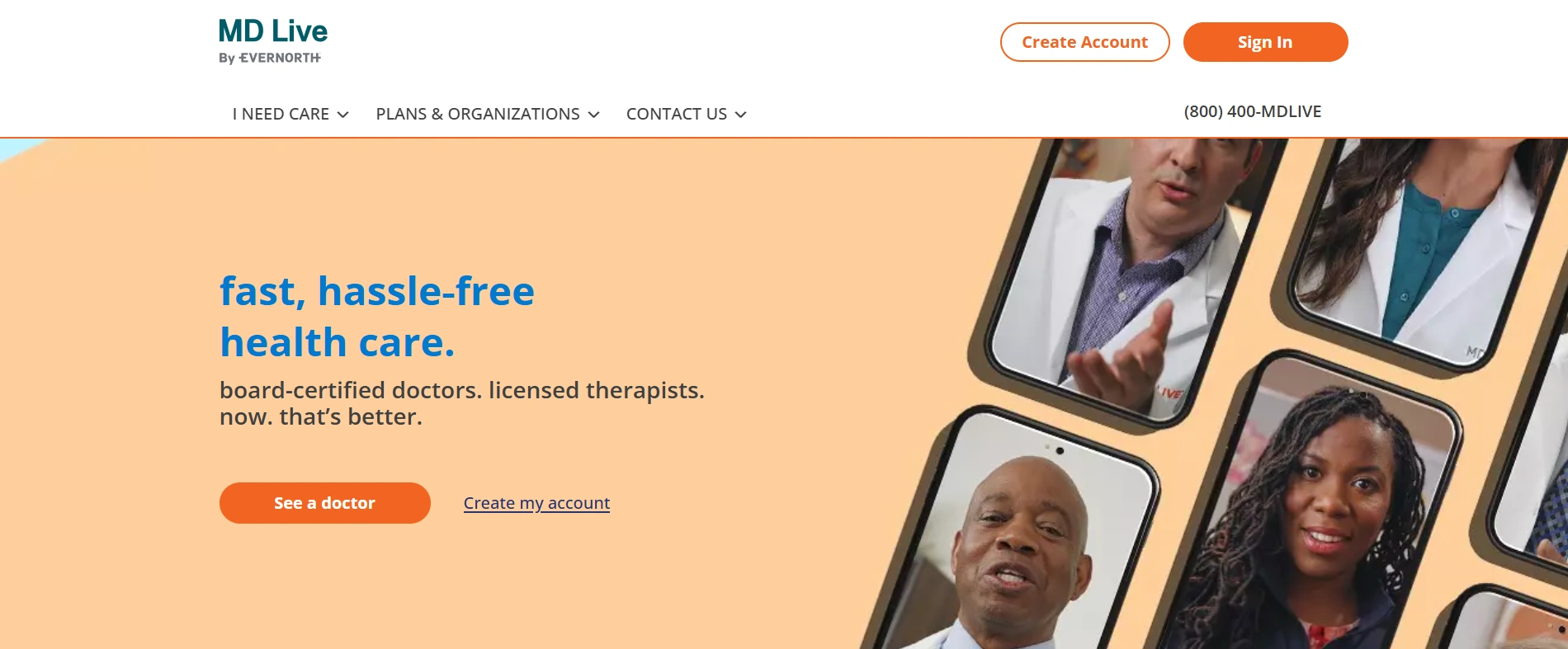
MDLIVE is a virtual care company owned by Evernorth, the health services business of Cigna, which completed its acquisition in April 2021. Its network of more than 2,000 board-certified doctors and licensed therapists treats urgent care, primary care, dermatology, and mental health conditions by phone or video, including prescription refills for non-controlled medications. Many patients can use MDLIVE through a health plan or employer benefit, where a visit can cost $0. Without coverage, an urgent care visit costs up to $82.
MDLIVE says its clinicians usually limit any prescription to a supply of no more than 30 days and refer patients with chronic illnesses to their primary care or specialist doctors for longer-term management. That makes it better suited to bridging a gap until your regular doctor can renew a prescription than to managing one indefinitely.
- Service model: Insurance-integrated virtual care
- Services offered: Urgent care, primary care, dermatology, mental health (therapy and psychiatry), wellness screenings
- Primary customers: Health plan members, especially Cigna; employers; cash-pay patients
- Pricing: $0 to $82 for urgent care visits depending on coverage. Initial psychiatric visits up to $299. Therapy up to $179 for the first session and $140 for follow-ups before insurance
- Insurance: Accepted through participating health plans and employers
- Where prescriptions go: The patient’s chosen pharmacy
- Refill limits: Usually no more than a 30-day supply
- Controlled substances: Not prescribed
- Pros: Low or $0 visit cost under many health plans, 24/7 availability, clinicians with an average of 10+ years of experience
- Cons: Short supply limits make it a bridge rather than a long-term refill source. No controlled substance prescriptions
- Best for: Patients insured through Cigna, Humana, or Aetna plans with MDLIVE telehealth benefits
- Year established: 2009
- Location: Miramar, Florida (HQ). Operates across the USA
#4 PlushCare
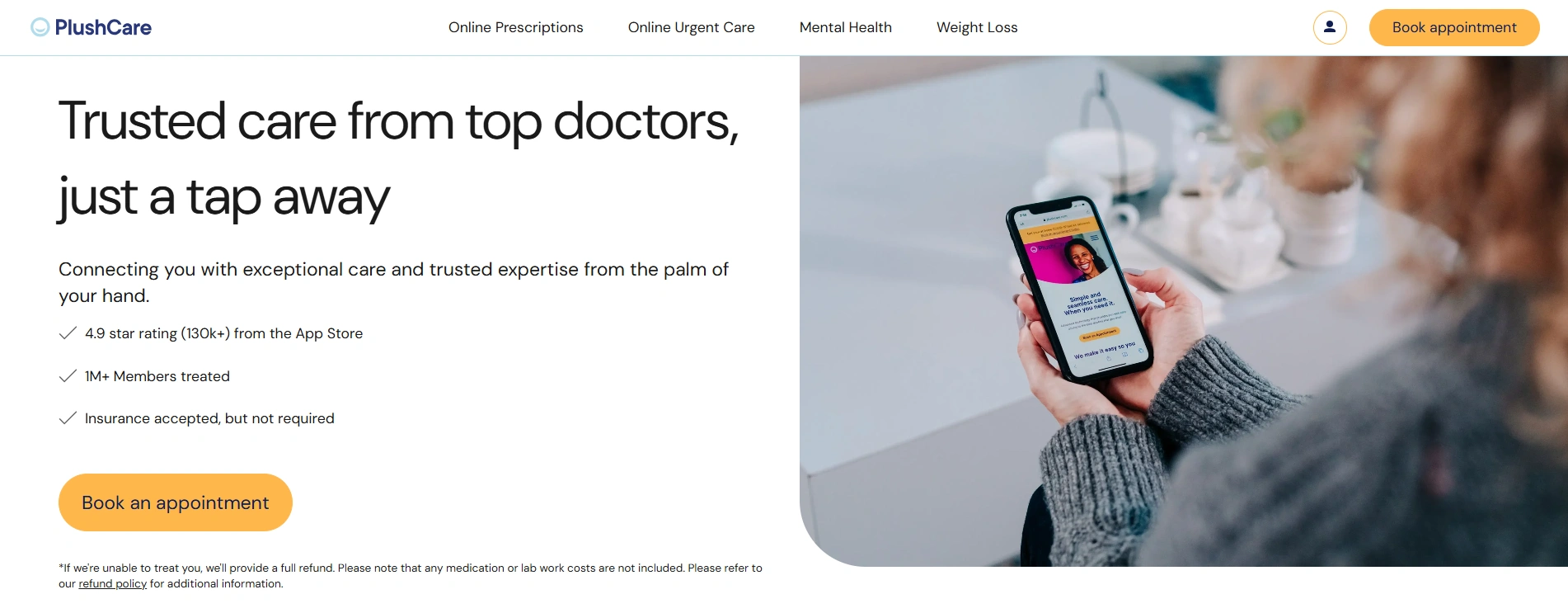
PlushCare is a virtual primary care service founded in 2015 and now part of Transcarent, which completed its acquisition of PlushCare’s parent company, Accolade, in April 2025. It uses physicians rather than nurse practitioners and accepts many major insurance plans, including Aetna, Cigna, Humana, and UnitedHealthcare. Most patients with in-network insurance pay $30 or less per visit; without insurance, an initial visit costs $129. Every patient also pays a $19.99 monthly membership after a free first month.
PlushCare offers same-day appointments in all 50 states and covers urgent care, chronic conditions, mental health, weight loss, dermatology, and primary care. It does not prescribe controlled substances. For ADHD, its physicians prescribe only non-stimulant medications, so patients on Adderall, Ritalin, or similar drugs need another provider.
- Service model: Membership virtual primary care
- Services offered: Urgent care, primary care, mental health, weight loss (GLP-1), chronic disease management, sexual health, dermatology, prescription refills
- Primary customers: Patients with or without insurance
- Pricing: $19.99 per month membership (first month free); most in-network copays $30 or less; $129 initial visit without insurance; medication billed separately through the pharmacy
- Insurance: Accepted for visits
- Where prescriptions go: The patient’s chosen pharmacy
- Refill limits: Not published
- Controlled substances: Not prescribed; non-stimulant ADHD medications only
- Pros: Physicians only, accepts major insurance plans, same-day appointments, covers all 50 states, membership includes family members
- Cons: Membership fee required on top of visit fees. $129 cash visit is above per-visit services. No stimulant or other controlled substance prescriptions
- Best for: Insured patients seeking broad primary care with prescription coverage who want to use their insurance for both the visit and the medication
- Year established: 2015
- Location: San Francisco, California (HQ). Operates in all 50 states. Part of Transcarent
#5 Sesame Care
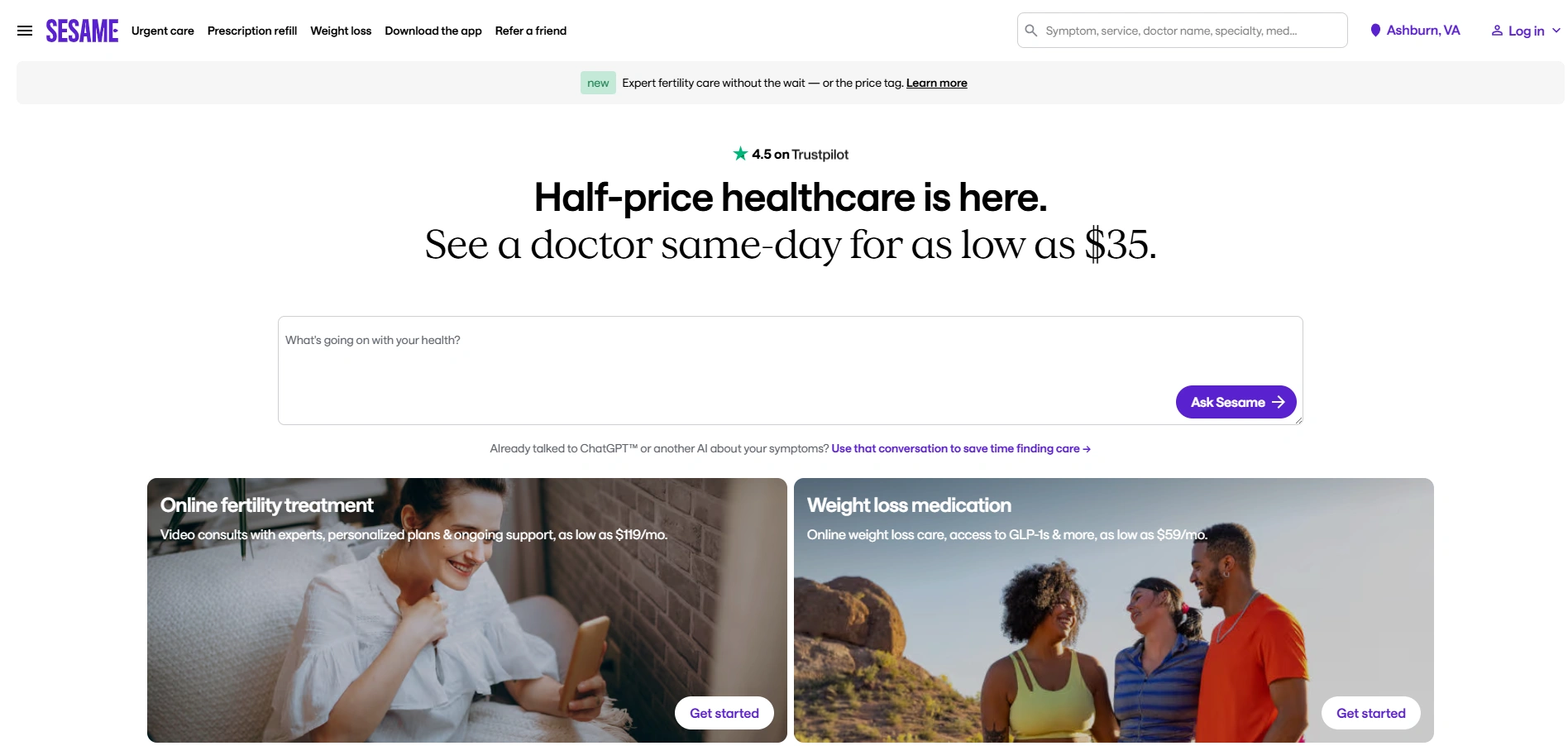
Sesame is a healthcare marketplace founded in 2019 where patients choose a provider and pay a posted cash price, without insurance billing. Online refill visits start at $34. Providers send prescriptions to the patient’s local pharmacy, and Sesame’s Everyday Rx plan advertises generic medications from $1 with no markup. Sesame providers do not prescribe controlled substances.
Because patients pick their provider, they can return to the same clinician for later renewals, which platforms that assign providers randomly do not offer.
- Service model: Pay-per-visit marketplace
- Services offered: Primary care, urgent care, mental health, dermatology, weight loss, women’s health, chronic disease management, prescription refills, lab work
- Primary customers: Cash-pay patients
- Pricing: Refill visits from $34; generic medications from $1 under the Everyday Rx plan
- Insurance: Not accepted for visits
- Where prescriptions go: The patient’s local pharmacy
- Refill limits: Not published
- Controlled substances: Not prescribed
- Pros: Low published price, no membership required, provider choice, upfront pricing
- Cons: Does not accept insurance for visits. No controlled substance prescriptions. No medication delivery
- Best for: Cash-pay patients seeking affordable one-off prescription refills who want price transparency and provider choice without a subscription commitment
- Year established: 2019
- Location: New York, New York (HQ). Operates in all 50 states
#6 GoodRx Care
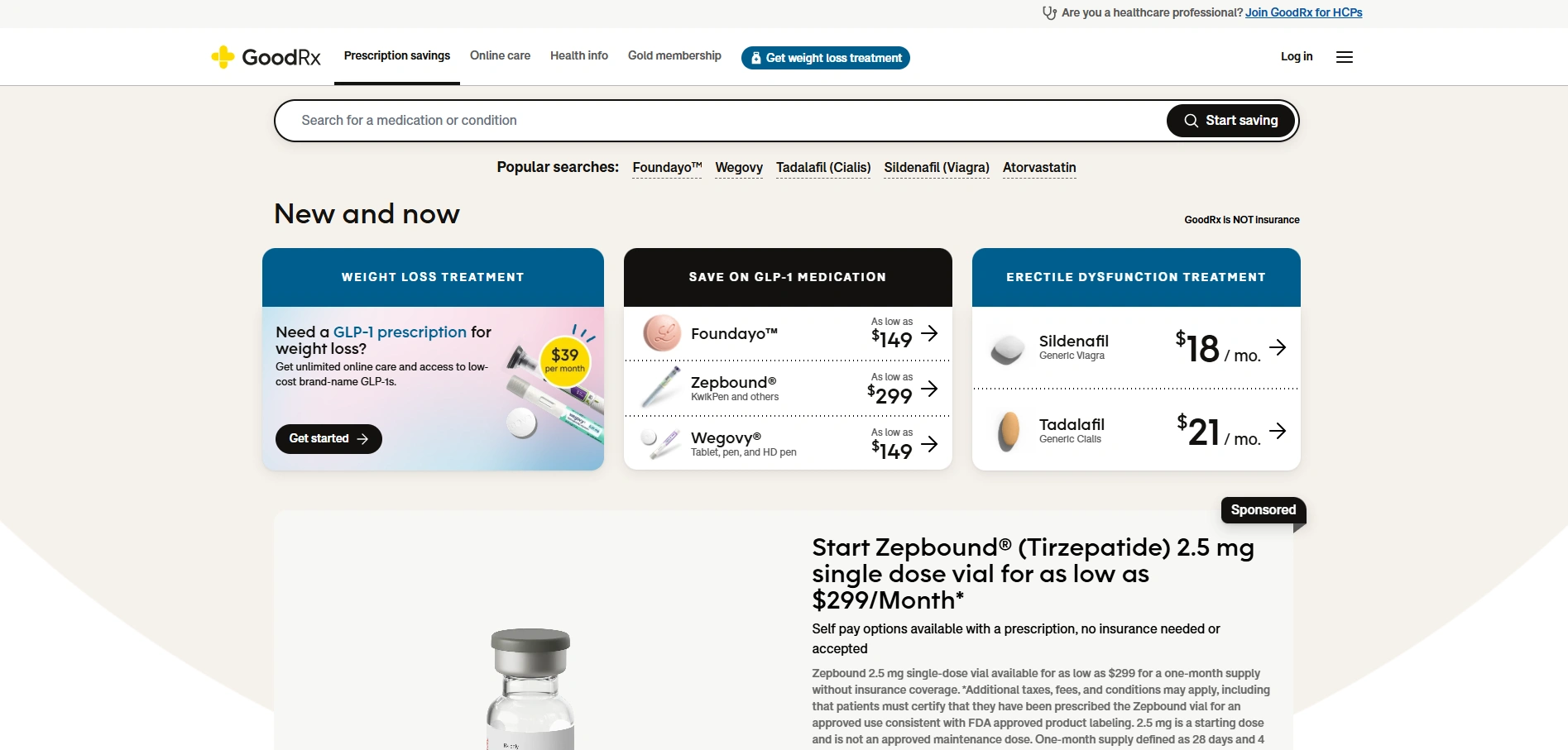
GoodRx Care is the telehealth service of GoodRx, the prescription savings company founded in 2011. Its refill service renews existing prescriptions a provider considers appropriate, such as birth control and antidepressants, but does not write new prescriptions or refill controlled substances. A refill visit costs $49, or $19 for GoodRx Companion members, and the service does not accept insurance for visits. Prescriptions go to the pharmacy the patient chooses, where GoodRx coupons or insurance can lower the medication price.
GoodRx Care is one of the few services that publishes both its refill limits and its turnaround. It refills up to a 90-day supply, one refill per visit, once every 12 months, for patients aged 18 to 65. Visits during weekday hours (9 a.m. to 7 p.m. Pacific) usually result in a prescription sent to the pharmacy within four hours; weekend visits take up to six hours.
- Service model: Pay-per-visit
- Services offered: Prescription refills, primary care, urgent care, dermatology, mental health, sexual health, weight management
- Primary customers: Cash-pay patients, including GoodRx coupon users
- Pricing: $49 per refill visit; $19 for GoodRx Companion members
- Insurance: Not accepted for visits; usable at the pharmacy for the medication
- Where prescriptions go: The patient’s chosen pharmacy
- Refill limits: Up to a 90-day supply, one refill per visit, once every 12 months; existing prescriptions only
- Controlled substances: Not refilled
- Pros: Published turnaround, low flat price, integrated with the GoodRx pharmacy discount tool
- Cons: No medication delivery (prescriptions sent to pharmacy only). One refill a year per prescription. No insurance for visits. Ages 18 to 65 only
- Best for: Patients who already use GoodRx for pharmacy savings and want a telehealth option that integrates with their existing medication cost management
- Year established: 2011 (GoodRx). GoodRx Care telehealth added subsequently
- Location: Santa Monica, California (HQ). Operates in all 50 states
#7 Amazon One Medical
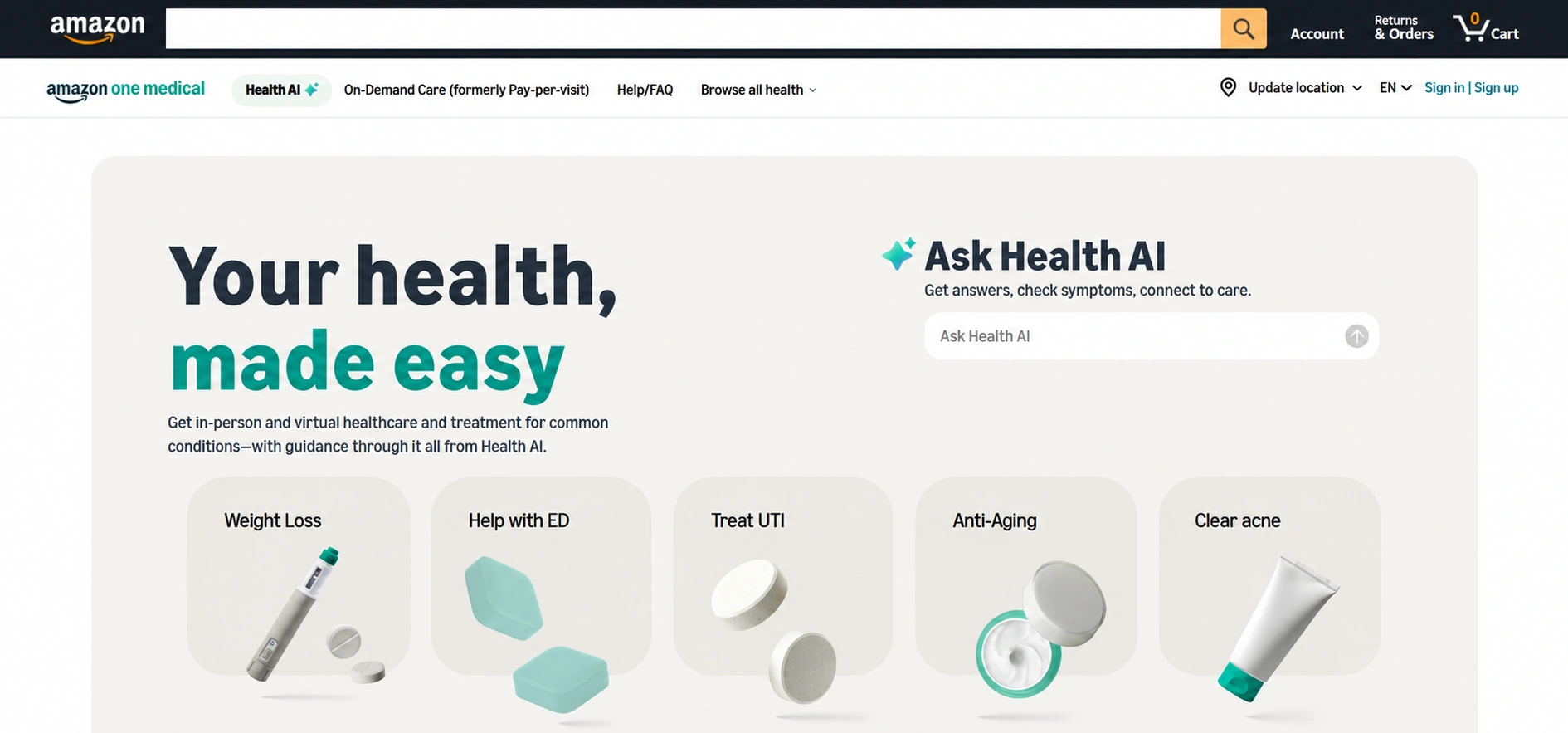
Amazon One Medical, the primary care company Amazon acquired in 2022, sells one-time virtual visits through its Pay-per-visit service, which replaced Amazon Clinic in 2024. A message visit costs from $29 (not available in all states for all conditions) and a video visit $49. Visits cover more than 30 common conditions, including birth control, hair loss, acne, and urinary tract infections, and providers send prescriptions to the pharmacy the patient chooses. Insurance is not accepted, and the service is limited to patients aged 18 to 64 who are not Medicare or Medicaid beneficiaries.
For ongoing medications, the distinction between Amazon’s two services matters. Refill and renewal requests are a feature of One Medical Membership, which costs $9 a month for Prime members or $199 a year for non-members and includes primary care, rather than of Pay-per-visit.
- Service model: Pay-per-visit, with an optional primary care membership
- Services offered: One-time message or video visits for 30+ conditions; refill and renewal requests for members
- Primary customers: Cash-pay patients and Prime members
- Pricing: From $29 per message visit, $49 per video visit; membership $9 a month for Prime members or $199 a year
- Insurance: Not accepted for Pay-per-visit
- Where prescriptions go: The patient’s chosen pharmacy, including Amazon Pharmacy
- Refill limits: Not published
- Controlled substances: Not published
- Pros: Low published visit prices, available 24/7 without an appointment, FSA and HSA eligible
- Cons: Pay-per-visit is not designed for ongoing refills. Message visits are not available everywhere. Not for Medicare or Medicaid beneficiaries or patients 65 and older
- Best for: Prime members and cash-pay patients who want a low-cost visit for a common condition, or a membership for ongoing renewals
- Year established: Acquired by Amazon in 2022; Pay-per-visit launched in 2024
- Location: Seattle, Washington (Amazon). Operates nationwide
#8 Hims & Hers
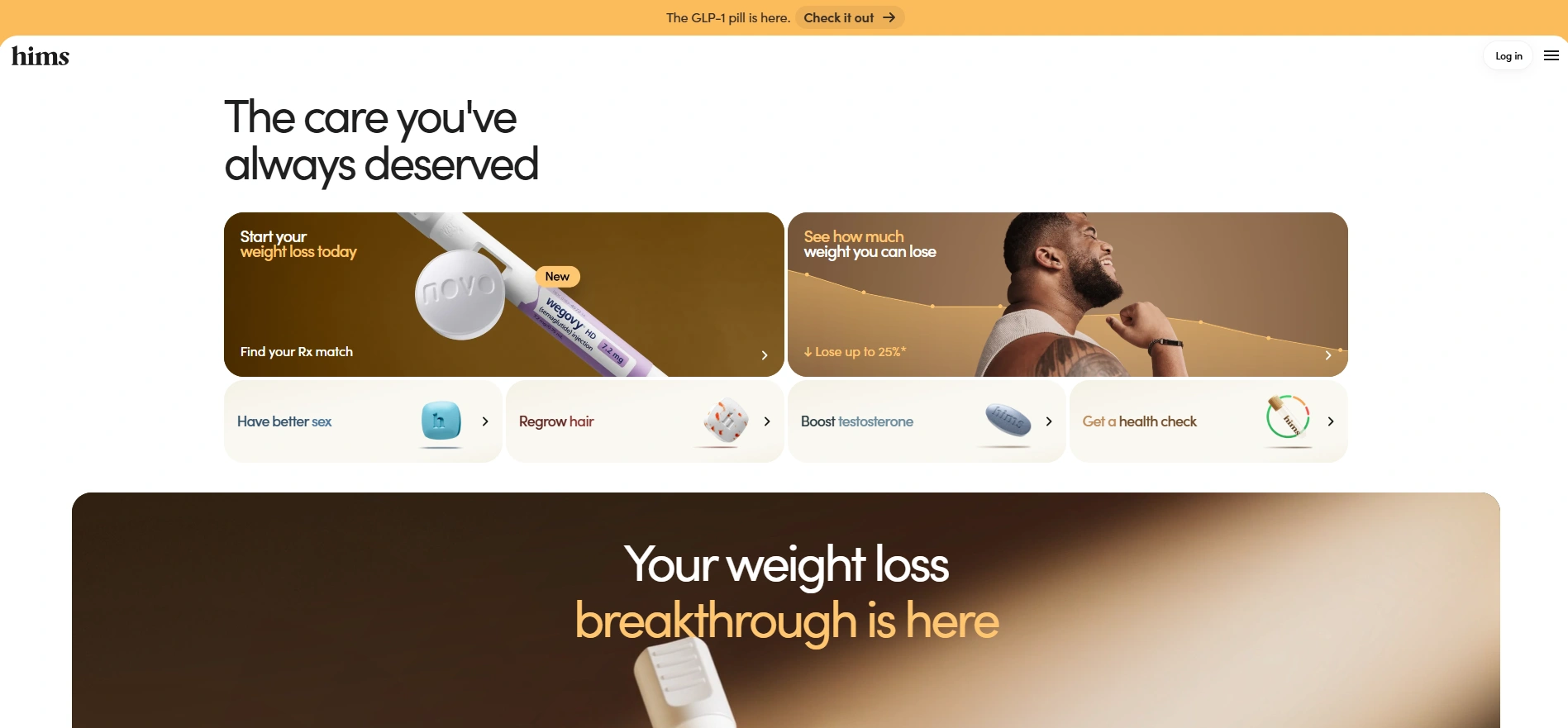
Hims & Hers is a direct-to-consumer telehealth company operating two distinct platforms for men and women. Founded in 2017 and publicly traded (NYSE: HIMS), the company focuses on specific condition categories including sexual health, dermatology, mental health, hair loss, and weight management. What sets Hims & Hers apart is the subscription model: treatment is prescribed online and the medication is shipped to the patient’s door with automatic refills, which eliminates the separate pharmacy trip that most telehealth platforms require.
Prices vary by treatment. Weight management requires a membership of $39 for the first month and $149 a month after that, with medication billed separately, and Hims says its GLP-1 medications are not yet available in all 50 states. Hims does not bill insurance. In September 2025 the FDA sent warning letters to Hims and Hers stating that their website claims about compounded semaglutide, such as “same active ingredient as Ozempic and Wegovy,” were false or misleading. In March 2026 the company reached an agreement with Novo Nordisk to offer Wegovy and Ozempic on its platform and to stop advertising compounded semaglutide.
- Service model: Condition-based subscription
- Services offered: Sexual health (ED, birth control, STI), dermatology (acne, anti-aging), mental health (anxiety, depression), hair loss, weight loss (GLP-1), primary care
- Primary customers: Cash-pay patients
- Pricing: Varies by treatment. Weight management membership $39 for the first month, then $149 a month, plus medication
- Insurance: Not billed
- Where prescriptions go: Shipped to the patient
- Refill limits: Automatic refills while the subscription is active
- Controlled substances: Not prescribed
- Pros: Subscription includes medication shipping, automatic refills, provider messaging, no insurance paperwork
- Cons: Does not accept insurance. GLP-1s not available in every state. FDA warning letters in September 2025 over compounded semaglutide marketing. Subscription pricing can be higher than insurance-covered alternatives
- Best for: Patients without insurance or with high deductibles who want a single predictable monthly cost for ongoing prescriptions in the supported condition categories
- Year established: 2017
- Location: San Francisco, California (HQ). Operates in all 50 states
#9 Ro Health
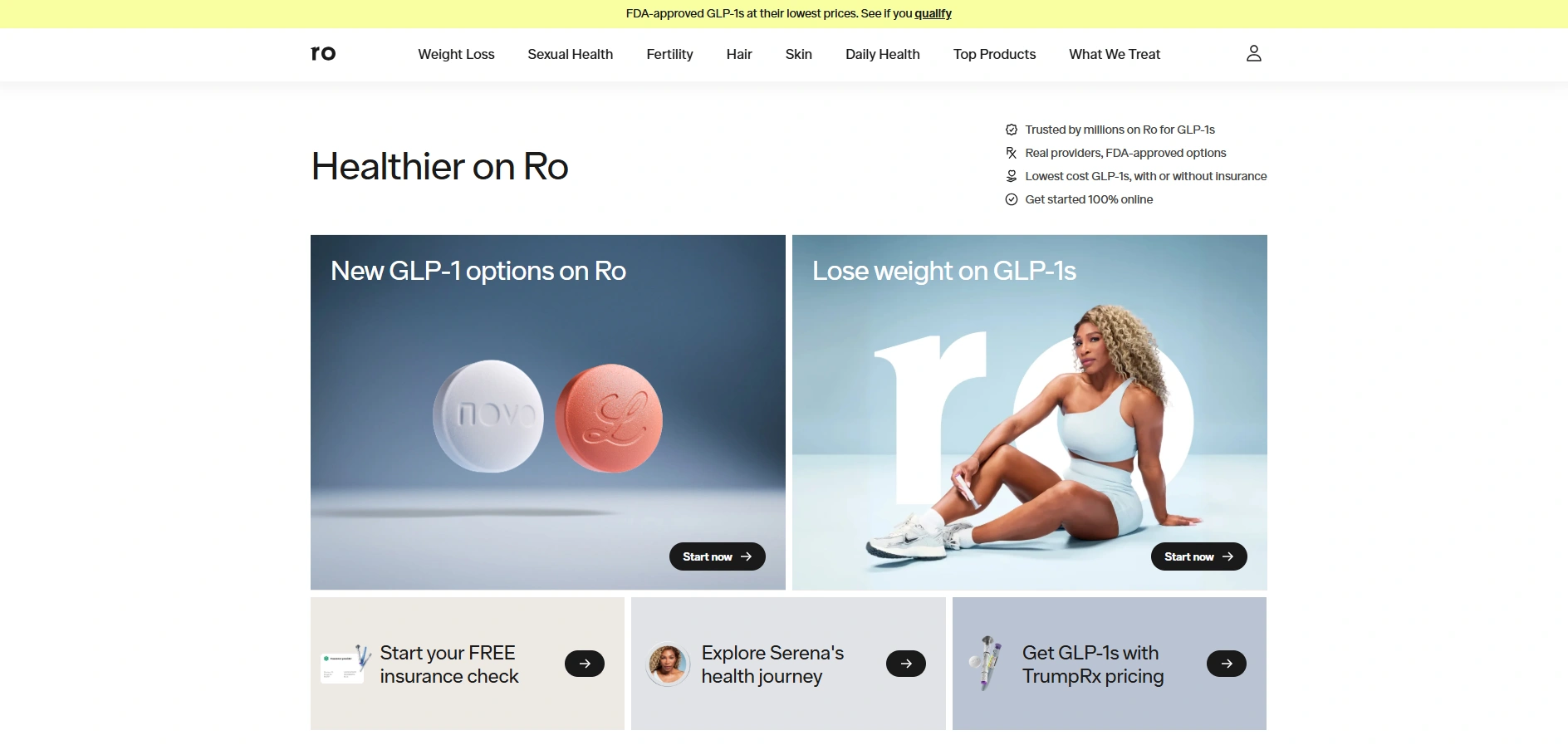
Ro (formerly Roman) is a direct-to-patient telehealth company founded in 2017 and headquartered in New York City. It offers weight management, sexual health, fertility, hair loss, and dermatology treatments, with medications shipped in discreet packaging.
Ro’s weight management program, Ro Body, costs $39 for the first month and then $149 a month, or the equivalent of $74 a month on a prepaid annual plan. Medication is billed separately; Ro lists the Wegovy pill from $149 a month. The membership does not bill insurance, but Ro offers a free insurance check and an insurance concierge to help patients find out whether their plan covers a GLP-1.
- Service model: Condition-based subscription
- Services offered: Weight management (GLP-1, coaching), sexual health (ED, birth control, fertility), hair loss, dermatology, primary care
- Primary customers: Cash-pay patients; insured patients seeking GLP-1 coverage
- Pricing: Ro Body membership $39 for the first month, then $149 a month or $74 a month on an annual plan; medication billed separately
- Insurance: Not billed for the membership; insurance check and concierge for GLP-1 medication coverage
- Where prescriptions go: Shipped to the patient
- Refill limits: Not published
- Controlled substances: Not published
- Pros: Lower monthly cost on the annual plan, insurance concierge for GLP-1 coverage, medication shipped
- Cons: Program memberships are cash-pay only. Medication is an additional monthly cost. Limited condition scope compared to full-service platforms
- Best for: Cash-pay patients seeking GLP-1 weight management or sexual health prescriptions with home delivery, especially in areas with limited in-person provider access
- Year established: 2017
- Location: New York, New York (HQ). Operates in all 50 US states
#10 Nurx
Nurx is a specialty telehealth platform founded in 2016 and based in San Francisco, focused on birth control, sexual health, and women’s health. It became part of Thirty Madison in 2022, and in September 2025 Remedy Meds agreed to acquire Thirty Madison, including Nurx, in an all-stock deal valued at about $500 million. Nurx bills insurance for medication, so many insured patients pay nothing for birth control under the ACA contraceptive coverage requirement, but it does not bill insurance for its consultation fees.
Consultation fees vary by service line, from $15 for emergency contraception to $79 for weight management, which also carries a $79 monthly fee. The fee includes unlimited messaging with the medical team until the prescription is due for renewal, and patients must complete a new annual consultation to renew. Nurx ships medication with automatic refills and operates in 33 states.
- Service model: Condition-based subscription
- Services offered: Birth control (50+ types), emergency contraception, sexual health (STI testing, PrEP, herpes treatment), dermatology (acne, rosacea), mental health, migraine management, weight management
- Primary customers: Patients in 33 states, insured or cash-pay
- Pricing: Consultation fees from $15 (emergency contraception) to $79 (weight management, plus $79 a month); mental health $59, then $69 a month; medication often $0 with insurance
- Insurance: Billed for medication; not billed for consultation fees
- Where prescriptions go: Shipped to the patient
- Refill limits: Automatic refills until renewal; new consultation required each year
- Controlled substances: Not published
- Pros: Bills insurance for medication, $0 copay possible for covered birth control, home delivery with automatic refills, unlimited provider messaging until renewal
- Cons: Only available in 33 states. Consultation fees are not covered by insurance. Ownership is changing under the Remedy Meds agreement
- Best for: Patients in covered states seeking insured birth control and women’s health prescriptions with home delivery and ongoing provider access
- Year established: 2016
- Location: San Francisco, California (HQ). Available in 33 states
#11 Wisp
Wisp is a women’s telehealth company founded in 2018 that treats sexual and reproductive health conditions such as urinary tract infections, bacterial vaginosis, herpes, and birth control, and reports serving 1.8 million patients. WELL Health Technologies acquired a majority stake (about 53 percent) for $41 million in 2021 and has since reported an active sale process for Wisp. In January 2026 Wisp acquired TBD Health, adding PrEP and sexual health services sold to health systems and public health organizations.
Wisp’s one-time consultation fee covers the visit and unlimited messaging with its care team; if no treatment can be prescribed, it charges up to $25 instead. Prescriptions are sent to a local pharmacy the same day or shipped free in discreet packaging. Wisp does not bill insurance for the consultation, but patients who pick up at a pharmacy can apply their insurance to the medication.
- Service model: Condition-based subscription
- Services offered: Birth control, UTI treatment, bacterial vaginosis, herpes treatment, STI prevention (PrEP), vaginal health, menopause, women’s reproductive health
- Primary customers: Cash-pay patients; health systems and public health organizations through TBD Health
- Pricing: One-time consultation fee by condition; up to $25 if no treatment is prescribed; medication billed separately
- Insurance: Not accepted for consultations; usable at the pharmacy
- Where prescriptions go: Local pharmacy the same day, or free shipping
- Refill limits: Not published
- Controlled substances: Not published
- Pros: Available in all 50 states, same-day pharmacy option, discreet delivery, reduced fee if no treatment is prescribed
- Cons: Consultation fee not covered by insurance. Narrower condition scope than full-service competitors. Ownership may change under WELL’s sale process
- Best for: Patients seeking fast, private access to women’s health and sexual health prescriptions without an in-person visit or long wait times
- Year established: 2018
- Location: Headquarters not published. Operates in all 50 states
Comparing Prescription Refill Capabilities
The ten patient-facing platforms differ most on the points below. Helpware is not included because it does not see patients; its refill capabilities are described in the next two sections.
| Platform | Visit price without insurance | Insurance for the visit | Where the prescription goes | Published refill limits | Controlled substances |
|---|---|---|---|---|---|
| Teladoc Health | $89 (General Medical) | Yes, through plans and employers | Patient’s pharmacy | General Medical: limited maintenance refills, no GLP-1s; Primary Care: up to one year (insured only) | Not available |
| MDLIVE | Up to $82 (urgent care) | Yes, through plans and employers | Patient’s pharmacy | Usually no more than 30 days | Not prescribed |
| PlushCare | $129 initial visit + $19.99/month | Yes | Patient’s pharmacy | Not published | Not prescribed |
| Sesame | From $34 | No | Local pharmacy | Not published | Not prescribed |
| GoodRx Care | $49 ($19 for members) | No | Patient’s pharmacy | 90-day supply, one refill per visit, once every 12 months | Not refilled |
| Amazon One Medical | From $29 (message), $49 (video) | No | Patient’s pharmacy | Renewals through membership only | Not published |
| Hims & Hers | Varies by treatment; weight management $149/month after month one | No | Shipped | Automatic refills while subscribed | Not prescribed |
| Ro | Ro Body $149/month or $74/month annual, after a $39 first month | No (insurance check for GLP-1s) | Shipped | Not published | Not published |
| Nurx | $15–$79 by service line | No (medication billed to insurance) | Shipped | Annual renewal consultation | Not published |
| Wisp | Fee by condition; up to $25 if not prescribed | No | Pharmacy same day or shipped | Not published | Not published |
How fast is a telehealth refill?
A refill takes three steps: getting seen, getting the prescription sent, and getting the medication. Few platforms publish the second step. GoodRx Care says weekday visits usually result in a prescription within four hours and weekend visits within six. Wisp says it sends prescriptions to a local pharmacy the same day. Teladoc says patients can connect to a doctor in minutes, and Amazon One Medical Pay-per-visit and MDLIVE are available 24/7, but none of the three publishes a time from visit to prescription. The rest of the platforms in this guide publish no turnaround figure.
Delivery adds time. A prescription sent to a local pharmacy can be picked up once the pharmacy fills it, often the same day. Services that ship (Hims & Hers, Ro, Nurx, and Wisp’s delivery option) add shipping time, which none of them states as a guaranteed number of days. If you will run out within a day or two, a pharmacy-based service is the safer choice.
What Telehealth Prescription Refill Operations Involve
Behind every patient-facing refill is a sequence of administrative steps that someone has to staff, whether the platform does it in-house or outsources it. For a telehealth company, digital pharmacy, or provider group, the work usually includes:
Intake. Requests arrive by phone, patient portal, fax, app, and pharmacy electronic renewal request, and need to land in one queue.
Verification and documentation. Staff confirm the patient’s identity, the medication and dose, the date of the last visit, and whether the request meets the prescriber’s refill protocol, for example whether labs or a new visit are due.
Coverage checks. Staff confirm insurance coverage and copay and identify prior authorization requirements before the prescription reaches the pharmacy.
Prescriber review. A licensed clinician approves, denies, or asks for a visit. Support staff prepare the request but do not make this decision.
Pharmacy follow-up. Staff confirm that the prescription was transmitted and filled, and resolve rejections such as coverage denials or out-of-stock medications.
Patient communication. Staff tell the patient the outcome, schedule any required visit, and send reminders before the next refill or renewal is due.
Coverage work is often the slowest part. In an MGMA Stat poll of 294 medical practice leaders, 45 percent named eligibility and prior authorization as their most time-consuming phone task, compared with 6 percent who named refills. The poll measures which task leaders named, not the hours each takes, but it suggests that an organization outsourcing refill support should scope the coverage and prior authorization work explicitly rather than treating refills as simple call handling.
What to Consider When Choosing a Provider
For patients
Your medication. Check that the service refills your specific drug. Controlled substances, GLP-1s, and medications that need lab monitoring are the most common exclusions.
Supply and renewal rules. A 30-day bridge (MDLIVE) and a 90-day supply once a year (GoodRx Care) suit different needs.
Total cost. Add the visit fee, any membership, and the medication price, and check whether insurance applies to the visit, the medication, or neither.
Pharmacy or delivery. Pharmacy pickup is faster when you are about to run out; delivery is easier for stable, long-term medications.
State and age limits. Nurx serves 33 states; GoodRx Care’s refill service is for patients aged 18 to 65; Amazon One Medical Pay-per-visit excludes Medicare and Medicaid beneficiaries.
For healthcare organizations
Scope boundary. Write down which steps the partner owns and where any clinical question goes to your licensed staff. The partner should never approve, deny, or change a prescription.
System access. Confirm the partner can work in your EHR, pharmacy, and phone systems with role-based access, and who provisions and removes accounts.
Business associate agreement. Under HHS guidance, a BAA should cover permitted uses of PHI, safeguards, breach reporting (without unreasonable delay and no later than 60 days), subcontractor obligations, and return or destruction of PHI at termination. A proposed update to the HIPAA Security Rule would require business associates to verify their safeguards in writing; the proposal has not been finalized.
Security evidence. Ask for the current SOC 2 Type II report and ISO 27001 certificate rather than a logo on a website. See our guide to HIPAA-compliant customer support outsourcing for the full checklist.
Turnaround definitions. Agree on what the clock measures: receipt to prescriber queue, receipt to approval, or receipt to fill. Each gives a different number.
Quality against protocol. Ask how many requests are audited each month, what the scorecard checks, and how errors are fed back to agents.
Staffing stability. Ask for agent attrition with the period stated (monthly or annual). For reference, contact center agent attrition averaged 39 percent a year in a NiCE survey of 400 contact center leaders.
Pricing model. Compare per-hour, per-FTE, and per-transaction quotes on the same monthly volume, and ask what supervision, QA, and workforce management are included.
Which Provider Model Fits Which Requirement
| Requirement | Best-fit model | Examples in this guide |
|---|---|---|
| Insured patient needing a covered renewal | Insurance-integrated virtual care | Teladoc Health, MDLIVE, PlushCare |
| Cash-pay patient needing a one-time renewal | Pay-per-visit | Sesame, GoodRx Care, Amazon One Medical |
| Stable, ongoing treatment shipped monthly | Condition-based subscription | Hims & Hers, Ro, Nurx, Wisp |
| Telehealth company or pharmacy needing refill intake, coverage checks, and pharmacy follow-up at scale | Operational support (BPO) | Helpware |
How Helpware Supports Prescription Refill Operations
Helpware runs refill support as a dedicated team inside the client’s own systems. Agents with pharmacy or clinic experience, background-checked and trained on HIPAA, work in the client’s EHR and follow its scripts and refill protocols. The team is sized to the client’s weekly refill volume, and coverage can extend to 24/7 across Helpware’s onshore, nearshore, and offshore sites.
The healthcare BPO team covers the steps listed above except the prescriber’s decision: one queue for calls, portal messages, and faxes; verification and documentation of each request; tracking of expiring prescriptions and overdue follow-ups; coverage, copay, and prior authorization checks; pharmacy follow-up on transmissions, rejections, and fills; and patient outreach and refill reminders in 45+ languages. Each request is scored against the client’s protocol, and the results feed agent coaching.
Helpware fits telehealth companies, pharmacies, and health plans whose refill volume or language mix has outgrown an in-house team, and that want one partner accountable for intake through pharmacy follow-up. It is not the right fit for organizations that need only simple call routing, without verification, coverage checks, or multilingual support. For those use cases, a lower-cost answering service will perform adequately.