








Key takeaways
- Five core areas: Fintech regulatory compliance in 2026 spans anti-money laundering and identity (AML/KYC), data protection, payments, licensing and consumer protection, and information security.
- The frameworks that matter most: AML/KYC programs, GDPR and CCPA, the EU Digital Operational Resilience Act (DORA), PCI DSS and PSD2, SOC 2 and ISO 27001, and MiCA for crypto.
- Regulation is moving: A May 2026 White House executive order pushes US regulators toward faster fintech and digital-asset integration, so expect more bank-partnership and charter activity.
- Build vs. outsource: Most early-stage fintechs outsource compliance operations first, then build an in-house core as transaction volume grows.
- Top providers in this guide: Helpware, InnReg, ACA Group, AML RightSource, TaskUs, IS Partners, Baker Tilly, and cSquare GRC.
Fintech Regulatory Compliance in 2026, Explained
Fintech regulatory compliance is the slow, expensive part of building a financial product, and in 2026 it is harder to ignore than ever. You did not start a fintech to write compliance policies. Yet regulators and bank partners now judge you on whether your controls work in practice, not on paper.
The global regulatory technology (RegTech) market reached $24.3 billion in 2025 and is forecast to grow to $112.1 billion by 2033, a compound annual growth rate of 21.1 percent, according to Grand View Research. Regulation is moving fast too. In May 2026, a White House executive order, Integrating Financial Technology Innovation into Regulatory Frameworks, directed federal regulators to streamline how fintech and digital-asset firms plug into the banking system.
Fintech regulatory compliance in 2026 rests on five core areas: anti-money laundering and customer identity (AML/KYC), data protection, payments, licensing and consumer protection, and information security. The frameworks you meet most often are AML/KYC programs, GDPR and CCPA, PCI DSS and PSD2, SOC 2 and ISO 27001, and MiCA for crypto. If you want a partner to run or build that program, the providers we rank below, led by Helpware, cover the full range from financial-crime operations to outsourced compliance leadership.
What Is Fintech Regulatory Compliance?
Fintech regulatory compliance is the set of rules, controls, and evidence that financial technology companies must meet to operate legally and keep the trust of regulators, banks, and customers. It governs how you verify users, move and store money, protect personal data, disclose terms, and report suspicious activity.
The fintech version differs from traditional bank compliance in one important way: speed. Banks built their programs over decades around stable products. Fintechs often launch with no compliance staff, then add controls while shipping features weekly and relying on external APIs for payments, identity, and data. That build-as-you-go reality forces tight coordination between engineers, legal, and product from day one.
Five areas form the foundation of a fintech compliance program:
- AML and KYC: Verify every customer, monitor activity, screen against sanctions lists, and file suspicious activity reports.
- Data protection: Collect, store, and transfer personal data lawfully and honor user rights to access and deletion.
- Payments: Secure cardholder data and meet the rules for moving and safeguarding funds.
- Licensing and consumer protection: Hold the right licenses for your activity, price transparently, and avoid consumer harm.
- Information security: Prove your controls through recognized standards such as SOC 2 and ISO 27001.
The United States does not have a single fintech regulator. Instead of a single entity, there are several. The Consumer Financial Protection Bureau (CFPB) protects consumers, the Securities and Exchange Commission (SEC) oversees securities, and the Financial Crimes Enforcement Network (FinCEN) enforces anti-money laundering rules. In the United Kingdom, the Financial Conduct Authority (FCA) handles conduct and the Prudential Regulation Authority (PRA) covers prudential matters.
The Core Fintech Compliance Frameworks for 2026
Most fintech products fall under more than one regulatory framework. A single product that stores value, moves payments, and extends credit falls under several frameworks at once, and they stack. The table below maps the frameworks that apply to most fintechs in 2026.
| Framework | What it governs | Who it applies to | Region |
|---|---|---|---|
| AML/KYC (BSA in the US) | Money laundering, identity, monitoring, sanctions | Anyone handling funds or onboarding customers | Global |
| GDPR | Personal data protection and user rights | Firms processing EU and UK customer data | EU and UK |
| CCPA | Consumer data privacy | Firms handling California consumer data | US (California) |
| DORA | ICT and operational resilience | EU financial entities and their tech vendors | EU |
| PCI DSS | Cardholder data security | Anyone who stores or transmits card data | Global |
| PSD2 / Open Banking | Payment services and account access | Payment and account providers | EU and UK |
| SOC 2 | Security controls attestation | Fintechs selling to enterprises | Global (US-led) |
| ISO 27001 | Information security management | Firms expanding internationally | Global |
| MiCA | Crypto-asset issuance, custody, exchange | Crypto firms operating in the EU | EU |
AML and KYC: the foundation
Anti-money laundering (AML) and know your customer (KYC) requirements are the foundation of fintech compliance. Regulators now expect companies to use risk-based programs supported by technology instead of relying on occasional manual checks. Customer onboarding typically includes digital identity verification, often with biometric checks. After onboarding, ongoing monitoring assigns risk levels to customers and flags suspicious activity for review and reporting.
Data protection: GDPR, CCPA, and DORA
Handling personal data is a core part of fintech compliance. GDPR sets the rules for collecting and processing personal data in the EU and UK, while giving users the right to access, correct, and delete their information. CCPA provides similar protections for consumers in California. DORA adds requirements for operational resilience and technology risk management across EU financial organizations, including many third-party vendors.
Payments and security: PCI DSS, PSD2, SOC 2, and ISO 27001
If your business handles cardholder data, PCI DSS applies. Companies providing payment services in Europe must also follow PSD2 and Open Banking requirements for account access and customer authentication. On the security side, SOC 2 helps demonstrate strong internal controls to U.S. enterprise customers, while ISO 27001 is widely recognized by international organizations. Many of the required security controls overlap, so a well-designed security program can support both standards.
US vs. UK vs. EU: how the map differs
Compliance requirements vary by region. In the EU, companies can often use a license issued in one member state across other member countries under frameworks such as PSD2 and MiCA. They must also comply with GDPR and DORA. The U.S. follows a different approach, with federal oversight and separate licensing requirements in each state where a company operates. The UK has its own regulatory system through the FCA and PRA, although many of its standards remain similar to those used in the EU.
What’s Changing in Fintech Compliance in 2026
Three shifts define the 2026 landscape.
The U.S. government is moving toward a more coordinated regulatory approach. In May 2026, the White House issued an executive order, Integrating Financial Technology Innovation into Regulatory Frameworks, directing federal regulators to review and simplify rules that affect fintech and digital asset companies in partnering with banks and obtaining charters. The order signals more bank-partnership and charter activity ahead. Supporters see this as a step toward greater innovation, while consumer advocates argue it could weaken existing protections.
Enforcement now tests how controls actually work. Across jurisdictions, regulators increasingly check live systems: how you verify users, control data access, and report suspicious activity in real time. A polished policy binder no longer counts for much if the controls behind it fail in production.
Bank-partnership oversight is tightening. Sponsor banks are expected to monitor the fintech companies they support, especially in banking-as-a-service arrangements. Regulators and banking partners want clear responsibilities, complete audit trails, and human oversight for automated decisions.
Build vs. Outsource Your Fintech Compliance Program
Once you know which frameworks apply, the next decision is make-or-buy. Both approaches have advantages and challenges.
Building in-house gives you a team that lives inside your product and culture. The cost is more than a salary, though. Hiring a seasoned chief compliance officer (CCO) takes months, and a small team creates key-person risk: if your lead leaves, your program might become fragile. Developing internal monitoring systems and identity verification tools also takes engineering time away from product development.
Outsourcing gives you fractional expertise and operational scale that most early-stage fintechs cannot staff alone. A specialist partner brings trained analysts, audit-readiness, and multi-jurisdiction coverage on day one. However, your company remains responsible for meeting regulatory requirements. If an outsourcing partner makes a mistake, regulators will hold your business accountable. If you choose this option, look for providers with strong controls, detailed audit trails, and human oversight for automated processes.
A hybrid, co-sourced model is what many growing companies end up using. Internal teams define compliance policies and manage risk, while external partners handle operational work such as KYC reviews, transaction monitoring, and audit preparation. The table below shows how this approach often changes as a company grows.
| Stage | Typical compliance model |
|---|---|
| Pre-seed and seed | Outsourced CCO plus outsourced operations |
| Series A and B | Hybrid: in-house lead, outsourced execution |
| Scale and enterprise | In-house core plus outsourced surge capacity |
Best Fintech Regulatory Compliance Companies in 2026
Our rankings focus on experience in regulated financial services instead of company size or pricing. We evaluated each provider based on its work with banks, lenders, and fintech companies, coverage across AML, KYC, data protection, payment security, and information security, recognized certifications such as SOC 2, ISO 27001, HIPAA, and GDPR, service model, global delivery capabilities, and the types of companies it serves. We applied the same evaluation standards to every provider, including Helpware.
| # | Company | Best for | Core compliance services | Model | HQ / reach | Founded |
|---|---|---|---|---|---|---|
| 1 | Helpware | Compliance ops at scale | KYC, onboarding, AML monitoring, card services, back office | Managed services, staff aug | Lexington, KY; 19 locations | 2015 |
| 2 | InnReg | Outsourced CCO | Fractional CCO, SEC/FINRA programs, AML, infosec | Consulting, managed services | US; global | 2013 |
| 3 | ACA Group | Regulated investment fintechs | GRC technology, advisory, managed services | Advisory, platform | US; global | ~2002 |
| 4 | AML RightSource | Financial-crime operations | AML/BSA, monitoring, KYC, EDD, sanctions, TPRM | Managed services, advisory | Cleveland, OH; global | 2004 |
| 5 | TaskUs | Hypergrowth platforms | KYC/KYB, AML, screening, fraud, trust and safety | Managed services | New Braunfels, TX; global | 2008 |
| 6 | IS Partners | Audit and attestation | SOC 2, PCI DSS, ISO 27001, GLBA, BSA/AML audits | Audit, advisory | US | ~1996 |
| 7 | Baker Tilly | Early-stage finance + compliance | Compliance+ (BSA, AML, KYC, sanctions), back office | Advisory, accounting | US; global network | n/a |
| 8 | cSquare GRC | Multi-framework automation | SOC 2, ISO 27001, GDPR, PCI DSS, AML/KYC automation | Software platform | n/a | n/a |
1. Helpware, best overall for fintech compliance operations

Helpware is a customer experience and business process outsourcing (BPO) provider for banks, lenders, and fintechs. Through its banking and financial services practice, it runs KYC and client onboarding, anti-money laundering monitoring, card services, loan and mortgage processing, back office, and customer and technical support, with every process built around strict compliance requirements. Founded in 2015 and headquartered in Lexington, Kentucky, it combines trained agents with AI-powered tools across 19 locations, four continents, and 45+ languages.
- Best for: Fintech startups and scaleups that want trained, compliant operations teams (KYC, AML, onboarding, support) that scale fast.
- Strengths: Full-range regulated operations; SOC 2 Type II, ISO 27001, HIPAA, and GDPR aligned; AI-powered quality assurance; rapid scaling from pilot to enterprise; 90 percent customer satisfaction and a five-year average client partnership.
- Limitations: Operations and managed services focus, not a law firm or licensed regulatory advisor. Founders who need a registered CCO or legal filings pair us with an advisory firm.
- Pricing: Custom, based on scope and volume.
2. InnReg, best for an outsourced chief compliance officer
InnReg is a global regulatory compliance and operations consulting team serving financial services companies since 2013, with a strong focus on launching and scaling fintechs. It provides outsourced CCO services and program buildouts for SEC-registered and FINRA-regulated firms, covering AML processes, information security, vendor management, registration, and reporting, assisted by proprietary RegTech.
- Best for: US-regulated fintechs that need a fractional CCO and an SEC or FINRA program built from scratch.
- Strengths: Deep fintech regulatory expertise; outsourced CCO services since 2013; startup-tailored engagements.
- Limitations: Consulting and advisory model rather than a large operational team for high-volume KYC and AML processing.
- Pricing: Custom.
3. ACA Group, best for regulated investment and advisory fintechs
ACA Group is a governance, risk, and compliance (GRC) provider serving 6,350+ clients across asset management, banking, insurance, and fintech. With more than 20 years in the market and a team that includes former regulators, it pairs technology with advisory and fintech managed services for a full view of a compliance program.
- Best for: Investment advisers, funds, and fintechs that need GRC depth at scale.
- Strengths: Former-regulator expertise; combined technology, advisory, and managed services; large client base.
- Limitations: Oriented to investment and advisory companies and larger programs, which means it’s heavier than a pre-seed startup needs.
- Pricing: Custom.
4. AML RightSource, best for financial-crime operations at scale
AML RightSource is a managed services firm dedicated to financial crime compliance. Founded in 2004, headquartered in Cleveland, Ohio, and backed by one of the industry’s largest teams of full-time analysts, it covers AML and Bank Secrecy Act (BSA) programs, transaction monitoring, KYC, enhanced due diligence, sanctions screening, and third-party risk management. Everest Group named it a leader in financial-crime compliance operations in 2025.
- Best for: Fintechs that need large-scale AML and transaction-monitoring operations plus advisory.
- Strengths: Financial-crime specialist; very large analyst workforce; advisory and technology alongside operations.
- Limitations: Focused on financial crime, not broader customer support or audit attestation.
- Pricing: Custom.
5. TaskUs, best for hypergrowth digital platforms
TaskUs is a digital-first outsourcer founded in 2008 and headquartered in New Braunfels, Texas, and publicly listed on Nasdaq. Alongside its trust-and-safety roots, it runs risk and response operations covering KYC and KYB identity verification, AML, screening and monitoring, and fraud detection for fintech, crypto, and marketplace clients.
- Best for: High-growth fintech and crypto platforms that need to scale onboarding and review fast.
- Strengths: Rapid scaling; fintech and crypto fluency; deep trust-and-safety capability.
- Limitations: Roots in customer experience and content moderation mean compliance is a growing line rather than a founding focus.
- Pricing: Custom.
6. IS Partners, best for audit and attestation readiness
IS Partners is a security and compliance firm with nearly 30 years of experience. It helps organizations prepare for SOC 2, PCI DSS, ISO 27001, GLBA, and BSA/AML audits. The company also provides PCI assessments through Qualified Security Assessors and combines compliance reviews with penetration testing.
- Best for: Fintechs preparing for SOC 2, PCI DSS, or ISO 27001 audits.
- Strengths: QSA-led audits; cybersecurity and compliance under one roof; broad framework coverage.
- Limitations: Audit and assessment focus rather than ongoing AML operations or an outsourced CCO.
- Pricing: Custom.
7. Baker Tilly, best for early-stage finance plus compliance advisory
Baker Tilly is an advisory and accounting company that runs back-office outsourcing for early-stage fintechs, covering accounting, tax, human resources, and payroll. Its Compliance+ suite addresses BSA, AML, KYC, sanctions, and related controls, and it adds initial public offering (IPO) readiness and risk assessments for companies preparing to scale.
- Best for: Early-stage fintechs that want finance, tax, and compliance under one advisor.
- Strengths: Full lifecycle advisory; AML, KYC, and sanctions coverage; IPO and risk readiness.
- Limitations: Advisory and accounting led, not a high-volume KYC or AML operations vendor.
- Pricing: Custom.
8. cSquare GRC, best for automating multi-framework compliance
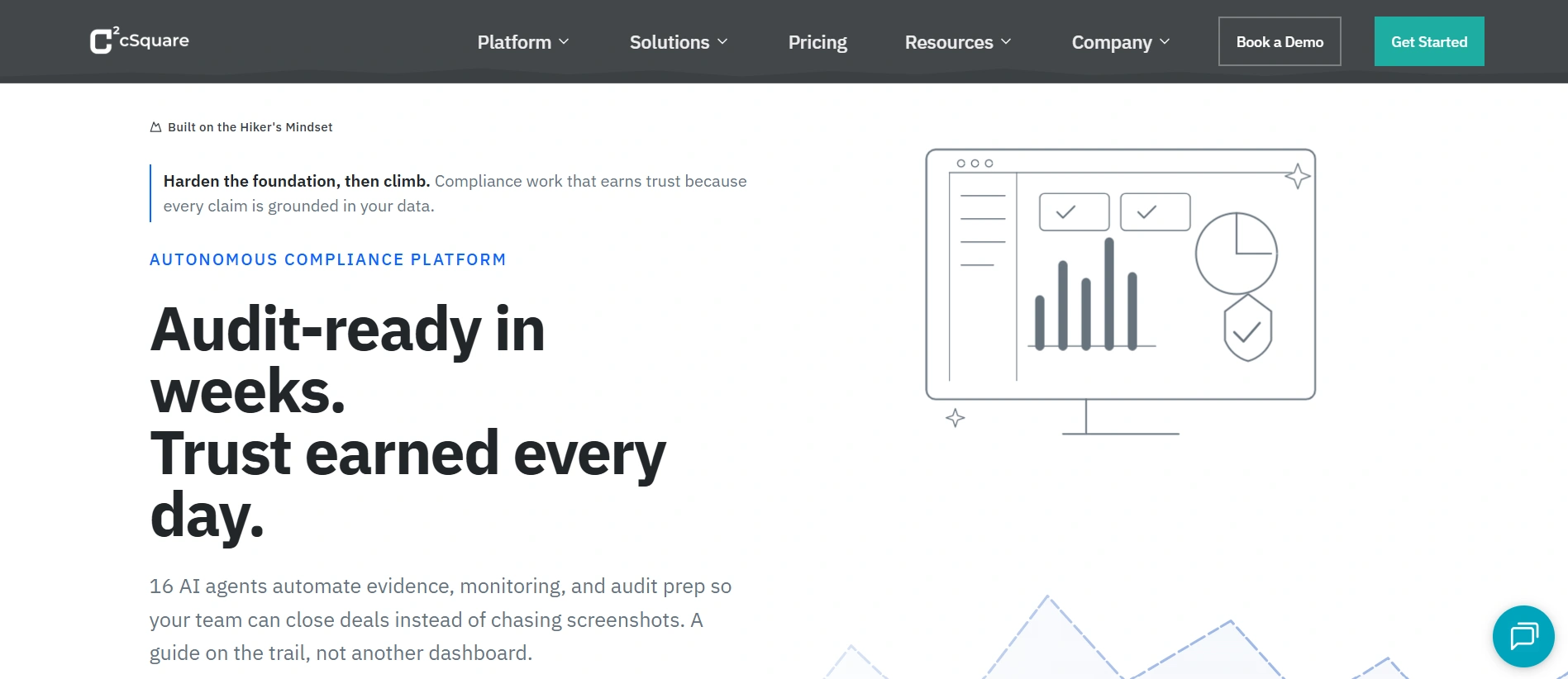
cSquare GRC is an AI compliance automation platform that covers SOC 2, ISO 27001, GDPR, PCI DSS, and AML/KYC. Its control mapping helps organizations use the same evidence across multiple frameworks. In May 2026, the company partnered with RegGenome to add machine-readable regulatory content for AML requirements across different jurisdictions. The platform is available through a web interface, API, and MCP server.
- Best for: Fintechs that want to automate evidence collection and continuous assurance across several frameworks.
- Strengths: Cross-framework control mapping; continuous monitoring; AI-driven evidence collection.
- Limitations: A platform, not a managed operations team, so you still run the program around it.
- Pricing: Custom.
How to Choose a Fintech Compliance Partner
Use these criteria to shortlist, in the order that matters for a regulated, fast-moving fintech:
- Regulated-fintech track record: Ask for named work with banks, lenders, or fintechs at your stage.
- The exact frameworks you need: Match the partner to your reality, whether that is AML/KYC, SOC 2, PCI DSS, GDPR, or MiCA.
- Delivery model fit: Decide whether you need advisory, hands-on operations, a platform, or a blend.
- Accountability and audit trails: Confirm mature controls, documentation, and human review of automated decisions.
- Ramp speed and jurisdiction coverage: Check how fast the team scales and which regions and languages it covers.
- References and quality metrics: Look past the headline rate to error rates, audit outcomes, and ramp speed.
What Customers Think About Compliance in Fintech
The majority within the industry has a consensus about involving compliance personnel from the get-go.

“Get compliance in the room early, not after BD says yes. Ask specifically what customer types, geographies, or transaction patterns would be disqualifying. Get written confirmation of risk appetite before building.”
As for the best ways to choose a partner for compliance tasks, users agree that it is important for the team to know the workings of your business and your product.
“Make sure whoever you hire understands your product and transaction flows—otherwise their manual will be useless when an auditor or regulator shows up.”
Turn Compliance from a Roadblock into a Growth Lever
Fintech regulatory compliance in 2026 rewards teams that build controls early and prove they work in production. Whether you outsource the whole program or extend your team, choose a partner with real regulated-fintech experience and a delivery model that fits your stage.
Want trained, compliant operations behind your KYC, AML, and customer support? Talk to Helpware about your fintech program, or explore our banking and financial services BPO. For a wider provider comparison, see our guide to the best financial services compliance companies.