








Your clinicians went into medicine to treat patients. Yet an increasing share of healthcare spending goes toward the administrative work that surrounds care: verifying insurance, obtaining prior authorizations, processing claims, answering patient inquiries, and collecting payments. The workload keeps growing while hiring remains difficult and operating margins stay under pressure.
The scale of that burden is hard to ignore. Administrative staff and technology now account for an estimated 25% to 35% of all US healthcare spending, according to a June 2026 American Hospital Association (AHA) report. Hospitals spent $43 billion in 2025 collecting payments from insurers for care already delivered, while the average hospital employed 64 administrative and billing staff in 2024, as per an AHA, 2026 Costs of Caring report. At the same time, the 2025 CAQH Index found that electronic transactions saved US healthcare an estimated $258 billion in administrative costs in 2024, with another $21 billion in potential savings still available.
As organizations look for ways to control costs without compromising patient care, many are rethinking how administrative work gets done. Healthcare business process outsourcing (healthcare BPO) is one approach. It involves partnering with a specialized third party to manage non-clinical functions such as patient access, revenue cycle operations, back-office processing, and technical support under strict compliance and security requirements.
This guide explains what healthcare BPO includes, which functions organizations outsource most often, what services cost in 2026, how to evaluate vendors, and what compliance standards to require before signing a contract.
Key Takeaways
- Healthcare BPO transfers non-clinical work (billing, scheduling, claims processing, patient support) to a specialized partner; clinical care and decision-making remain in-house.
- Outsourced patient support and back-office operations typically cost about $8–$15 per hour offshore and $28–$45 per hour onshore in the US.
- The true in-house comparison is fully loaded cost: salary, benefits, recruiting, training, software licenses, management overhead, and turnover-related costs.
- “HIPAA compliant” is a claim, not a certification. Require a signed business associate agreement (BAA), documented security controls, and independent audits such as SOC 2 Type II.
- Match the vendor to the problem. Revenue cycle specialists, enterprise outsourcing firms, and integrated CX and back-office providers each serve different operational needs.
What Is Healthcare Business Process Outsourcing?
Healthcare business process outsourcing (BPO) is the practice of partnering with an external provider to manage administrative, operational, and patient-facing functions that fall outside direct clinical care. The provider recruits, trains, and manages the team, while your organization defines performance standards, retains control of the data, and measures results against agreed service levels.
Three characteristics distinguish healthcare BPO from generic outsourcing:
- Regulated data. Most workflows involve protected health information (PHI), making compliance a core requirement. Engagements are governed by HIPAA and typically formalized through a signed business associate agreement (BAA).
- Clinical proximity. Teams may schedule oncology follow-ups, verify insurance for surgical procedures, or route symptom-related calls to nurse lines. The work is administrative, but it directly affects patient access, care continuity, and revenue outcomes.
- A clear boundary. Clinical care remains with licensed healthcare professionals. BPO providers support the operations around care, not diagnosis, treatment decisions, or medical judgment.
Healthcare BPO buyers span the industry, including hospitals and health systems, physician groups, health plans and payers, telehealth and digital health companies, pharmacies, and medical device manufacturers.
What Healthcare Organizations Outsource: The Full Service Map
Most guides divide healthcare outsourcing into “clinical” and “non-clinical” services. In practice, buyers evaluate providers based on the operational challenges they need to solve. The service map below is organized by function rather than category.
| Function area | What the vendor runs | Typical buyer trigger |
|---|---|---|
| Patient access and support | Omnichannel patient support, appointment scheduling, insurance verification, telehealth troubleshooting, member services, after-hours coverage | Missed calls, long hold times, front-desk burnout |
| Revenue cycle | Medical billing and coding, claims submission, denial management, accounts receivable follow-up, payment posting | Rising denial rates, growing A/R balances, coder shortages |
| Back-office and data operations | Data entry, medical records processing, claims processing, credentialing, medical transcription, eligibility verification | Backlogs, high error rates, seasonal volume spikes |
| Technology and clinical support | Tier 1-3 technical support, EHR help desk services, AI data annotation, clinical documentation support, care coordination logistics | Platform launches, EHR migrations, AI initiatives |
Two observations are worth noting.
First, most healthcare BPO engagements start with a single function or workflow and expand over time as the provider demonstrates performance.
Second, technology-related services are among the fastest-growing segments of the market. Telehealth and digital health companies now outsource technical support, platform operations, and AI data services just as readily as hospitals outsource billing and revenue cycle functions.
Healthcare BPO Pricing: What Outsourcing Costs in 2026
Pricing varies by service type, delivery location, and contract structure, but the ranges are relatively predictable. Based on our 2026 comparison of leading healthcare BPO providers, patient support and back-office services typically cost $8–$15 per hour for offshore delivery, $15–$24 per hour for nearshore delivery in Latin America, and $28–$45 per hour for onshore US delivery.
| Pricing model | How it works | Best suited to |
|---|---|---|
| Hourly rate | Pay per productive agent hour; pricing varies by location and skill level | Variable-volume patient support and back-office operations |
| Per FTE (dedicated team) | Flat monthly fee for a dedicated full-time employee; the vendor manages recruiting, infrastructure, and supervision | Ongoing programs where continuity and institutional knowledge matter |
| Per transaction | Pay per claim, record, or call handled | High-volume, standardized workflows such as claims processing or data entry |
| Percent of collections | Revenue cycle vendors receive a percentage of collected revenue | End-to-end medical billing and revenue cycle engagements |
Four factors have the biggest impact on where pricing falls within these ranges:
- Delivery location. Onshore, nearshore, and offshore teams have significantly different cost structures. Many organizations use hybrid models to balance cost, coverage, and language requirements.
- Skill level. Certified coders, clinical documentation specialists, and other specialized roles command higher rates than general patient support staff.
- Compliance requirements. HIPAA training, security controls, audit logging, and compliant infrastructure are built into healthcare outsourcing costs and should be evaluated alongside pricing.
- Quality and performance. A lower hourly rate does not necessarily mean a lower total cost. Teams with higher error rates often generate additional work through denial reprocessing, repeat contacts, and escalations. Evaluate cost alongside outcomes such as resolution rates, accuracy, and productivity.
The In-House vs. Outsourced Math
Comparing a vendor’s hourly rate to an employee’s salary rarely tells the full story. A salary is only one part of what an employee costs. The more useful comparison is fully loaded cost per productive hour, yet many organizations never calculate it. Walk through the columns below for a patient access coordinator role using your own numbers.
| Cost line | In-house team | Outsourced team |
|---|---|---|
| Base compensation | Salary based on your market | Included in the rate |
| Benefits and payroll load | Typically adds a substantial percentage on top of salary | Included in the rate |
| Recruiting and backfill | Job advertising, recruiter time, interview hours, repeated with each departure | Vendor absorbs |
| Training and ramp | Weeks of paid onboarding and reduced productivity | Included in the engagement; vendor manages onboarding |
| Software and seats | Telephony, licenses, QA tools, workstation, equipment | Included in the rate |
| Supervision and QA | Supervisor and QA analyst time allocated per employee | Included in the rate |
| Turnover costs | Each resignation restarts recruiting, training, and ramp-up | Vendor carries replacement risk |
| Coverage gaps | Nights, weekends, and volume spikes require overtime or additional hiring | Larger staffing pools make extended coverage easier to manage |
Looking beyond salary often changes the economics of the comparison. The AHA found that the average hospital employed 64 administrative and billing staff in 2024, and each of those positions carries costs that extend well beyond compensation alone.
When in-house still makes sense. Keep the work internal when a role requires deep institutional knowledge that changes frequently, when staffing volumes are too small to justify a dedicated outsourced team, or when employees regularly move between administrative and clinical responsibilities. Outsourcing is not the right answer for every function, and a realistic evaluation should consider both operational fit and cost.
Healthcare BPO Benefits and Risks, Weighed Honestly
Most articles emphasize the benefits of outsourcing and give less attention to the risks. In practice, both matter. Nearly every advantage has a corresponding failure mode when an engagement is poorly designed, staffed, or managed.
| Benefit, when done well | Risk, when done poorly | How to reduce the risk |
|---|---|---|
| Lower and more predictable operating costs | Hidden fees, scope creep, and rework reduce expected savings | Transparent pricing, clearly defined scope, and service-level agreements (SLAs) tied to performance |
| Flexible capacity for growth and seasonal demand | Quality declines during rapid hiring and onboarding | Phased ramp plans with quality checkpoints at each stage |
| Access to specialized expertise in coding, payer requirements, and healthcare workflows | Generalist teams lack healthcare-specific knowledge | Healthcare-focused training, documented processes, and role-specific certification requirements |
| More clinician and staff time available for patient care | Patients experience inconsistent service or repeated handoffs | Dedicated teams, organization-specific workflows, and defined escalation paths |
| Mature compliance and security programs | A vendor-side incident becomes your compliance issue | Signed BAA, independent audits, access controls, and documented incident-response procedures |
| Extended coverage across channels and time zones | Inconsistent experiences across channels, teams, or shifts | Unified quality standards, reporting, and operational oversight |
The pattern is consistent: most outsourcing risks stem from vendor selection, governance, and contract design rather than the outsourcing model itself. The next two sections focus on how to evaluate providers and what compliance evidence to require before signing an agreement.
Where AI Fits in Healthcare BPO Today
AI has moved from pilot programs into everyday administrative workflows. The 2025 CAQH Index found that more than 50% of health plans and 25% of provider organizations now use AI in administrative operations, and many healthcare BPO providers have incorporated AI into service delivery, staffing models, and workflow design.
In practice, the most effective model in 2026 combines automation with human expertise rather than replacing one with the other. AI handles high-volume, rules-based work such as intent routing, FAQ resolution, agent-assist prompts, automated quality monitoring, and first-pass claims review. Human teams handle the exceptions: complex eligibility questions, escalations, sensitive patient interactions, and decisions that require judgment.
When evaluating vendors, focus on two questions. First, which workflows currently use AI, and what performance metrics support its effectiveness? Second, how are those efficiency gains reflected in service quality, productivity, or pricing? The strongest providers can point to specific use cases, measurable outcomes, and a clear operating model rather than broad claims about AI capabilities.
The Compliance Decoder: HIPAA, BAA, SOC 2, HITRUST, and ISO 27001
Every healthcare BPO provider claims to be compliant, but different frameworks verify different things. Understanding what each standard covers — and what evidence to request — helps separate marketing claims from verifiable controls.
| Framework | What it covers | Evidence to request |
|---|---|---|
| HIPAA | US federal requirements governing PHI privacy, security, and breach notification. There is no official HIPAA certification; compliance is a legal obligation. | HIPAA training documentation, security risk assessments, written policies, and confirmation that the vendor will sign a BAA |
| BAA (Business Associate Agreement) | The contract that defines how a vendor protects and handles PHI on your behalf. In most cases, a BAA is required before PHI is shared. | A signed BAA, including breach-notification timelines and subcontractor provisions |
| SOC 2 Type II | Independent assessment of whether security controls operated effectively over a defined period of time. | The most recent SOC 2 Type II report under NDA, including the audit period and any exceptions noted |
| HITRUST | A certifiable security and compliance framework widely used in healthcare and designed to align with HIPAA and other standards. | Current certification documentation, scope details, and expiration date |
| ISO 27001 | International standard for information security management systems (ISMS). | The certificate, certifying body, and scope statement covering the teams and locations serving your account |
Three questions can quickly clarify a vendor’s compliance posture:
- How quickly can the vendor execute a BAA?
- Which delivery sites and teams are covered by the audits and certifications presented?
- When was the most recent independent audit completed, and what period did it cover?
Strong vendors should be able to answer these questions clearly and provide supporting documentation when appropriate.
How to Choose a Healthcare BPO Vendor
Vendor selection often determines the success or failure of the engagement. Evaluate every candidate against the same criteria, then focus on the factors that matter most to your organization.
Healthcare expertise, not healthcare branding. Ask for healthcare references, average client tenure, and workflow-specific experience. Which EHRs do they support? Which payer portals do they work in? Which healthcare functions do they run today?
Compliance evidence. Review the compliance documentation discussed above before commercial discussions advance too far. Security and compliance should be verified, not assumed.
Ramp-up capability. Ask how quickly the vendor can scale from a pilot to full production and what training, quality assurance, and supervision processes support that timeline.
Dedicated versus shared staffing. Dedicated teams build institutional knowledge and continuity. Shared teams may lower costs but often provide less consistency. Understand which model is being proposed and why.
Technology and automation. Ask where AI and automation are used today, how performance is measured, and whether efficiency gains translate into improved service levels, lower costs, or both.
Cultural and communication fit. Patients and members experience the outsourced team as an extension of your organization. Review training materials, listen to sample interactions, and evaluate communication style alongside operational metrics.
Contract and exit terms. Pay attention to data ownership, transition support, termination provisions, and non-solicitation clauses before signing. These terms become most important if the relationship needs to change or end.
This evaluation process reflects a broader shift in how organizations approach outsourcing. Healthcare BPO should not be viewed as a simple cost-reduction exercise. The most successful engagements treat the vendor as a strategic partner responsible for improving operations, accessing specialized expertise, and supporting long-term growth.
This perspective is also reflected in discussions among outsourcing and operations leaders. In one Reddit discussion about outsourcing strategy, a commenter argued:

“Leadership needs to treat outsourcing as a strategic partnership for transformation and technology access, not as a simple budget line-item cut. If the decision is purely based on the lowest bid for labor, you are almost guaranteed to face quality issues and long-term financial pain down the road.”
That perspective aligns with what successful healthcare outsourcing programs tend to have in common. Organizations that focus exclusively on hourly rates often overlook factors such as compliance, workflow expertise, quality management, and scalability, which ultimately have a greater impact on long-term outcomes than labor cost alone.
Top Healthcare BPO Vendors: A 2026 Shortlist
Helpware publishes this guide and is included in the shortlist below. The rankings reflect our assessment of each provider’s strengths, but organizations should evaluate vendors against their own requirements, budget, and compliance needs.
No healthcare BPO provider is the best fit for every organization. The vendors below serve different needs, from enterprise revenue cycle transformation to patient support, coding, and member engagement.
For a deeper comparison, including pricing details and service breakdowns, see our Top 10 Healthcare BPO Companies guide.
#1 Helpware CX

Best for mid-market and enterprise healthcare organizations seeking patient support, back-office operations, AI services, and technology support under one partner.
Helpware CX provides HIPAA-compliant patient and member support, telehealth technical support, back-office operations, and AI data services through a single operating model. Key credentials include SOC 2 Type II, ISO 27001, ISO 9001, HIPAA, and GDPR compliance, alongside a 90% customer satisfaction (CSAT) score and experience supporting more than 400 clients, including healthcare organizations such as Headspace and NexHealth. The company operates across 19 locations in 11 countries and supports more than 45 languages, with programs scaling from pilot teams to 500+ agents within 90 to 120 days.
Helpware CX is not the strongest choice for organizations seeking highly specialized, large-scale revenue cycle management or medical coding services. Providers focused exclusively on those areas may be a better fit.
#2 R1 RCM

Best for health systems outsourcing the revenue cycle end to end.
R1 RCM focuses exclusively on revenue cycle management for hospitals and health systems, combining technology platforms with large operational teams across eligibility, coding, billing, denials, and collections. It is best suited to organizations focused on revenue cycle performance and financial transformation rather than patient support or customer experience operations.
#3 Cognizant
Best for large payers and health systems combining outsourcing with enterprise technology transformation.
Founded in 1994 and headquartered in Teaneck, New Jersey, Cognizant employs approximately 300,000 people across more than 40 countries and operates one of the industry’s largest healthcare IT and BPO practices. Services span member support, claims processing, digital operations, and AI-driven administrative automation. Its scale is a significant advantage for large organizations, though engagement sizes and implementation requirements are generally geared toward enterprise buyers.
#4 GeBBS Healthcare Solutions

Best for medical coding and health information management.
GeBBS specializes in medical coding, health information management (HIM), and revenue cycle support for providers and payers. The company is particularly well suited to organizations whose primary need is coding capacity, coding accuracy, audit readiness, or HIM support at scale.
#5 Carenet Health
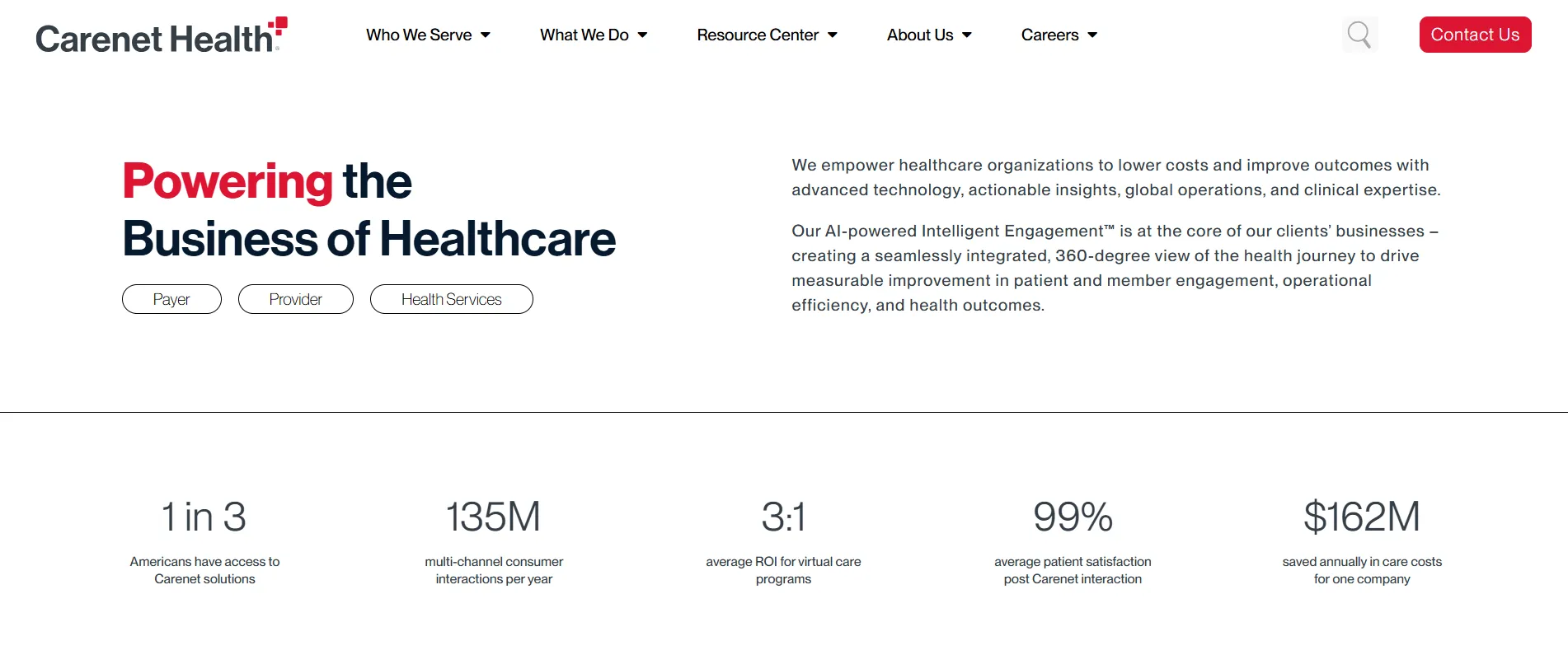
Best for patient engagement and clinically focused outreach.
Carenet Health specializes in patient and member engagement programs for providers and payers and was ranked first in Clinical Call Center Services by Black Book Research in 2025. It is a strong fit for organizations seeking appointment scheduling, care coordination, patient outreach, and engagement programs that require close alignment with clinical workflows.
Move Administrative Work Off Your Clinicians’ Desks
Healthcare business process outsourcing is no longer just a cost-reduction strategy. Done well, it gives clinicians more time for patient care, helps organizations manage staffing challenges, and turns administrative work into a measurable, scalable operation. The framework in this guide is straightforward: identify the functions that create the most operational strain, compare outsourcing against fully loaded in-house costs, verify compliance credentials, and start with a controlled pilot before expanding.
For some organizations, that process confirms the work should remain in-house. For others, it highlights specific functions where an external partner can add capacity, expertise, or flexibility. The goal is the same either way: reduce administrative friction so teams can focus more of their time on patients and less on process.
If you’re evaluating healthcare BPO providers, contact our team to discuss your requirements and determine whether outsourcing makes sense for your organization.