






As customer expectations for fast, convenient support grow, live chat can help businesses respond to more inquiries without making customers wait on hold or search for answers themselves. But keeping up with demand is difficult when your in-house team only covers business hours or lacks the capacity to handle every conversation.
Automation can help manage routine questions, but it can’t replace human support in every situation. In a recent survey, Gartner found that 87% of customers believe companies using generative AI for customer service must offer an option to reach a human agent. That makes the ability to combine automation with responsive human support an important consideration when expanding your chat operation.
Live chat outsourcing can help fill that gap, but choosing a provider takes more than comparing promises of 24/7 coverage. You need to know whether a company can maintain service quality as volumes change, support your customers in the right languages, integrate with your existing tools, and meet your security requirements within budget. The stakes are likely to grow: Gartner expects self-service, live chat, and knowledge management to surpass phone and email as the service technologies leaders consider most valuable by 2027.
That’s why you should consider finding a reliable live chat outsourcing partner and scale your operations. This blog post will help you with that.
This guide compares 10 live chat outsourcing companies to help you evaluate their service models, capabilities, and pricing. You’ll learn what distinguishes each provider, which factors matter when comparing vendors, and what to consider before signing a contract.
Key takeaways
- Top providers: Helpware, SupportYourApp, Peak Support, Influx, and Boldr offer flexible, specialist support for mid-market companies. TaskUs, TP, Concentrix, TTEC, and Alorica bring the scale large enterprise programs need.
- Fit beats size: Chat specialization, team flexibility, language coverage, compliance, and pricing transparency separate providers more than scale does.
- Hybrid support is rising: AI chatbots handle routine questions and triage, while human agents take complex, sensitive, and judgment-heavy conversations.
- Pricing follows the operating model: Location, coverage hours, languages, compliance scope, and staffing commitments drive the total cost.
- Published rates are a starting point: Helpware lists $8–$15 per agent hour, and Influx starts at $1,000 per agent per month. Most others quote custom pricing.
- Quality shapes true cost: Attrition, onboarding, management overhead, and customer satisfaction often make a cheaper rate cost more over a contract.
- Compliance needs documented proof: Certifications, audit reports, data-handling agreements, and clear security procedures matter most in healthcare, fintech, and payments.
- Contract terms set your flexibility: Seat minimums, ramp-up timelines, SLAs, escalation paths, and exit terms decide how easily your program adapts.
How We Selected and Ranked the Live Chat Outsourcing Providers
Helpware publishes this guide and ranks first in the comparison. To make the selection process transparent, we evaluated the other nine providers using five criteria designed to reflect what matters when choosing a live chat outsourcing partner. Our research draws on company websites, investor filings, and customer review profiles. The rankings reflect the criteria below, although the best fit ultimately depends on each company’s requirements.
- Chat specialization: Whether live chat is offered as a dedicated service or bundled into a broader customer care contract.
- Mid-market fit: Whether team sizes, contract terms, and onboarding processes accommodate companies without enterprise-scale volumes.
- Coverage and languages: Whether the provider offers 24/7 staffing and supports the languages required for its clients’ customer bases.
- Security and compliance: Whether the provider publishes information about certifications and compliance standards relevant to regulated industries.
- Pricing transparency: Whether rates or pricing models are available before a sales call.
These criteria favor providers with dedicated chat services, flexible engagement models, and transparent pricing. As a result, large BPOs rank lower on specialization, mid-market fit, and pricing transparency, even though they often offer greater scale, broader language coverage, and more extensive global delivery networks.
Top 10 Live Chat Outsourcing Companies for 2027
| Company | Best for | Chat delivery model | Coverage and languages | Compliance (published) | Pricing | Ratings (Clutch / G2) |
|---|---|---|---|---|---|---|
| Helpware | Mid-market and enterprise teams needing multilingual, compliance-aware chat | Dedicated, brand-trained agents with AI-assisted triage and QA | 24/7 from 19 locations in 11 countries; 45+ languages | SOC 2 Type II, ISO 27001, ISO 9001, HIPAA, GDPR, PCI DSS | From $8–$15 per agent hour | 4.8 (47) / 4.9 (30) |
| SupportYourApp | Tech and SaaS companies scaling into new markets | Dedicated or pay-as-you-go human teams; AI and human plans | 24/7; 60+ languages | PCI DSS Level 1, ISO 27001 | Custom (per seat or pay-as-you-go) | 4.8 (87) / 4.8 (18) |
| Peak Support | Ecommerce and SaaS brands that want real-time reporting | Remote-first teams with live client dashboards | US, Philippines, Colombia, Eastern Europe, India | PCI and SOC 2 (stated by Peak) | Custom | 4.9 (10) / 4.8 (49) |
| Influx | Startups with variable volume | Month-to-month remote teams, follow-the-sun shifts | 24/7 across 15+ countries | SOC 2 Type 1 | From $1,000 per agent per month | No profile / 3.5 (3) |
| Boldr | Buyers with ESG or ethical-sourcing criteria | Dedicated omnichannel teams | Five countries; 10+ languages | Certified B Corp; SOC 2 Type II, ISO 27001, PCI DSS | Custom | 4.8 (10) / 5.0 (1) |
| TaskUs | Fast-growing tech platforms | Digital CX teams (chat, email, voice) | 30+ sites in 13+ countries; 30+ languages | SOC 2 Type 2, ISO 27001, HITRUST, PCI DSS | Custom | No profile / 4.0 (11) |
| TP | Global enterprises with multi-market volume | Chat within omnichannel customer care | Nearly 100 countries; 400+ languages and dialects | ISO 27001-based security, PCI DSS, SOC 2 Type 2 audits, HIPAA | Custom | Not yet reviewed / 4.1 (20) |
| Concentrix | Enterprises wanting chat plus analytics | Chat, messaging, and digital channels in managed CX programs | 74 countries, about 483 locations | PCI DSS, ISO 27001, SOC 2 Type II, HITRUST | Custom | No rating yet / 4.0 (1) |
| TTEC | Enterprises pairing outsourced chat with CX technology | Chat within omnichannel care (TTEC Engage) | 54 delivery centers in 22 countries; 50+ languages | FedRAMP authorized | Custom | Not yet reviewed / 3.6 (14) |
| Alorica | Enterprises adding conversational AI to chat | Web chat, messaging, and SMS with AI support | 16 countries; 75+ languages | SOC 2, ISO 27001, PCI DSS | Custom | No profile / 3.9 (4) |
Top 10 Live Chat Outsourcing Companies: Overview
#1 Helpware
Helpware provides dedicated live chat teams for mid-market and enterprise brands, with 90% CSAT, 24/7 coverage across 19 global locations, and support in 45+ languages.
Founded in 2015 and headquartered in Lexington, Kentucky, Helpware’s live chat support services help companies deliver consistent customer experiences that support retention. Its agents receive training in each client’s brand voice and products, then work within the tools the company already uses, including Zendesk, Salesforce, and HubSpot.
The results speak for themselves. For a custom apparel brand, Helpware launched a new chat channel with AI-powered intent detection and automated triage. The team reached the client’s target of 12 chats per agent per day, and QA scores increased to 98% within 90 days.
Why we picked it
Helpware meets all five selection criteria: dedicated live chat services, team sizes suited to mid-market companies, 24/7 coverage in 45+ languages, published certifications, and transparent starting rates.
- Best for: Mid-market to enterprise companies with $10M–$500M in revenue that need multilingual, compliance-aware live chat.
- Chat delivery: Dedicated agents trained on each client’s brand, with AI chatbots, agent assist, and QA automation available.
- Services offered: Live chat, technical support, back-office services, call center support, CX consulting, and data operations.
- Industries: Healthcare and telehealth, SaaS, ecommerce, fintech, gaming, logistics, and the public sector.
- Team size: 4,000+ employees.
- Locations: Lexington, Kentucky (headquarters); the United States, Puerto Rico, Guam, Mexico, the Philippines, Ukraine, Georgia, Poland, Germany, Albania, and Uganda.
- Languages: 45+.
- Compliance: SOC 2 Type II, ISO 27001, ISO 9001, HIPAA, GDPR, and PCI DSS.
- Pricing: $8–$15 per agent hour, depending on coverage hours, languages, and chat complexity.
- Founded: 2015.
- Ratings: Clutch: 4.8 (47 reviews); G2: 4.9 (30 reviews).
- Pros: Native-speaker support in 45+ languages; 19 locations supporting 24/7 coverage; 90% CSAT; five-year average client partnerships; published starting rates.
- Cons: The consultative sales process can mean longer quote turnaround times than with plug-and-play providers. The service may also be more comprehensive than necessary for basic, high-volume transactional chat without compliance requirements.
#2 SupportYourApp
SupportYourApp provides tech-focused live chat outsourcing in 60+ languages, backed by PCI DSS Level 1 certification and service plans that combine human agents with AI.
Founded in Kyiv, Ukraine, in 2010, SupportYourApp has built its services around the needs of technology companies. Its live chat teams handle front-line inquiries, L1–L3 technical escalations, social media responses, and back-office tasks. With 1,500+ specialists serving 250+ client companies across 30+ countries, it offers mid-market tech businesses multilingual support without the procurement complexity often associated with large BPO providers.
Clients can choose dedicated human teams, pay-as-you-go support, or plans that combine AI with human agents and are priced by conversation volume. Its experience with product troubleshooting also makes SupportYourApp a potential option for software companies exploring SaaS live chat outsourcing.
Why we picked it
SupportYourApp combines a strong technology focus with 60+ language coverage and established security credentials. This makes it relevant to product-led companies expanding internationally, particularly those that need to manage both language requirements and regulatory obligations.
- Best for: Mid-market technology and SaaS companies that need compliant, multilingual chat support.
- Chat delivery: Dedicated or pay-as-you-go human teams, with AI-plus-human plans also available.
- Services offered: Live chat, L1–L3 technical support, email support, social media support, and back-office services.
- Industries: SaaS, fintech, ecommerce, healthtech, and gaming.
- Team size: 1,500+ specialists.
- Locations: US office in Wilmington, Delaware, and eight hubs worldwide.
- Languages: 60+.
- Compliance: PCI DSS Level 1 and ISO 27001:2022 certified; aligned with GDPR, CCPA, and HIPAA requirements.
- Pricing: Custom pricing, with per-seat and pay-as-you-go options.
- Founded: 2010.
- Ratings: Clutch: 4.8 (87 reviews); G2: 4.8 (18 reviews).
- Pros: Support in 60+ languages; PCI DSS Level 1 and ISO 27001 certifications; technology-sector expertise across 250+ client companies; flexible pay-as-you-go option.
- Cons: Primarily focused on technology and SaaS; no published rates.
#3 Peak Support (a Ubiquity company)
Peak Support offers remote-first live chat outsourcing for high-growth brands, combining real-time client dashboards with a 2,000-person team. It is now part of Ubiquity Global Services but continues to operate under its own brand.
Peak Support built its reputation on remote delivery, real-time visibility into support queues, and a people-first culture. The company also cites having the highest Glassdoor rating in its industry. Its acquisition by Ubiquity brought Peak’s technology-led, remote-first approach together with Ubiquity’s operational infrastructure. Its 2,000-person workforce operates across the US, the Philippines, Colombia, Eastern Europe, and India.
Live client dashboards remain one of Peak Support’s main differentiators, giving clients direct visibility into queue activity instead of requiring them to rely solely on periodic reports.
Why we picked it
Peak Support stands out for ecommerce and SaaS companies that value operational transparency. Its remote-first model, live reporting tools, and documented quality outcomes make it an option for businesses that want greater visibility into day-to-day support performance.
- Best for: High-growth technology and ecommerce companies seeking remote-first chat support with transparent performance data.
- Chat delivery: Remote teams handling live chat, email, phone, SMS, in-app messaging, and social support, with live client dashboards.
- Services offered: Live chat, email support, voice support, sales operations, and back-office services.
- Industries: SaaS, ecommerce, fintech, social media, and financial services.
- Team size: 2,000 people.
- Locations: Cambridge, Massachusetts (headquarters); US, Philippines, Colombia, Eastern Europe, and India.
- Languages: Multilingual support; specific languages are not listed.
- Compliance: PCI, SOC 2, and HIPAA, as stated by Peak Support.
- Pricing: Custom.
- Founded: 2015.
- Ratings: Clutch: 4.9 (10 reviews); G2: 4.8 (49 reviews).
- Pros: Fully remote delivery with live client dashboards; five consecutive years on the Inc. 5000 list; strong SaaS and ecommerce expertise.
- Cons: Integration into Ubiquity may lead to changes in account teams or delivery locations; less capacity than large BPOs for programs focused primarily on handling very high volumes.
#4 Influx
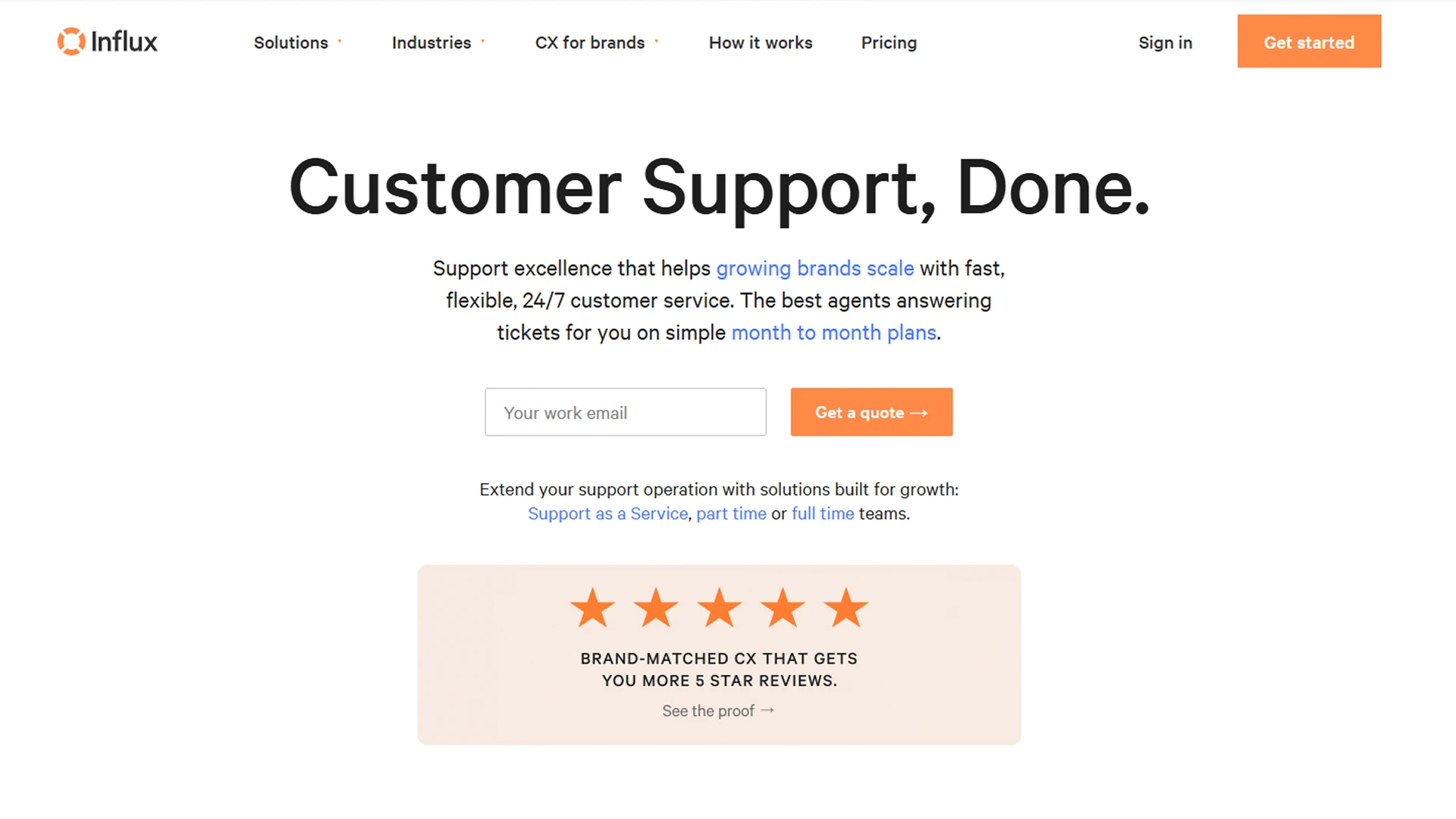
Influx offers on-demand live chat and customer support outsourcing with published monthly rates, 24/7 follow-the-sun coverage, and month-to-month contracts designed for growing ecommerce and SaaS companies.
Influx built its service model around common frustrations with traditional BPO contracts, including minimum commitments, slow onboarding, and costs that remain high when support volumes fall. Today, it operates as a fully remote company, with 1,000+ support experts across 123+ cities in 15+ countries. This distributed workforce allows Influx to provide round-the-clock coverage across time zones rather than relying on a single location for overnight shifts.
Influx also publishes its pricing, making costs easier to assess before speaking with sales. Dedicated agents start at $1,000 per agent per month, while managed operations with a team leader start at $2,000. Support in languages beyond standard English costs an additional 10%. Contracts run month to month, require one month’s notice to terminate, and have no minimum spend.
Why we picked it
Influx combines published pricing with flexible contracts and no minimum spend, giving companies more room to adjust support capacity as demand changes. This model can be particularly useful for businesses with seasonal peaks or fluctuating chat volumes that don’t want to commit to a fixed team year-round.
- Best for: Growing ecommerce and SaaS companies that need flexible chat coverage without minimum volume commitments.
- Chat delivery: Remote teams on month-to-month terms, with on-demand 24/7 coverage.
- Services offered: Live chat, email support, phone support, and AI management.
- Industries: SaaS, ecommerce, startups, and consumer brands.
- Team size: 1,000+ support experts.
- Locations: Fully remote, with a US legal address in West Hollywood, California, and a workforce across 123+ cities in 15+ countries.
- Languages: English, Spanish, German, French, and others.
- Compliance: SOC 2 Type 1.
- Pricing: Dedicated agents from $1,000 per agent per month; managed operations from $2,000.
- Founded: 2013.
- Ratings: No Clutch profile; G2: 3.5 (3 reviews).
- Pros: Published pricing; month-to-month contracts with no minimum spend; follow-the-sun 24/7 coverage; fast onboarding.
- Cons: Smaller team capacity may limit its suitability for complex, enterprise-scale programs; SOC 2 Type 1 may not meet the requirements of some regulated buyers.
#5 Boldr

Boldr provides live chat, email, and social media support through an ethical outsourcing model spanning five countries. It is the world’s largest B Corp Certified BPO, making it a potential fit for companies that prioritize responsible business practices when choosing an outsourcing partner.
Founded in 2017 and headquartered in Santa Monica, California, Boldr was the first B Corp BPO in the Philippines. Its operating model, which it calls “Boldr Economics,” focuses on clients, careers, and communities. The company also states that it pays all team members a living wage. Its 1,500+ team members across the US, the Philippines, Mexico, South Africa, and Canada support more than 100 client partners in 10+ languages, primarily serving ecommerce and SaaS businesses. However, its team size may be a limitation for high-volume enterprise programs.
Why we picked it
Boldr stands out for buyers who include ESG commitments and ethical sourcing in their vendor selection criteria. Its B Corp certification and stated community-focused operating model distinguish it from the other providers in this comparison. Its size makes it more suitable for mid-market programs than for operations that require very high support volumes.
- Best for: Mid-market companies with ESG requirements or values-aligned vendor criteria
- Chat delivery: Dedicated omnichannel teams; no chat-specific service page
- Services offered: Live chat, email support, social media customer service, data operations, back office, global recruiting
- Industries: Ecommerce, SaaS, consumer goods, technology
- Team size: 1,500+ team members
- Locations: Santa Monica, California (HQ); US, Philippines, Mexico, South Africa, Canada
- Languages: 10+
- Compliance: Certified B Corporation; SOC 2 Type II, ISO 27001, PCI DSS
- Pricing: Custom
- Founded: 2017
- Ratings: Clutch: 4.8 (10 reviews); G2: 5.0 (1 review).
- Pros: World’s largest B Corp Certified BPO; living-wage commitment; 10+ languages; five-country operations
- Cons: Smaller team limits capacity for high-volume enterprise programs; some clients report longer hiring timelines than larger BPO providers
#6 TaskUs
TaskUs is a digital-first BPO serving high-growth technology companies, with about 63,200 employees and a top-three position in Frost & Sullivan’s North American CX management outsourcing ranking.
TaskUs opened its first office in the Philippines in 2008, trades on the Nasdaq, and is headquartered in New Braunfels, Texas. It reported $1.18 billion in annual revenue for its latest fiscal year. The company focuses on digital-native brands in ecommerce, fintech, gaming, AI, social media, and food delivery. Its live chat offering is part of a broader digital CX operation spanning chat, email, and voice, with AI operations services integrated into client workflows. TaskUs also invests in employee culture and reported an employee NPS of 60 in its annual filing.
Why we picked it
TaskUs is suited to venture-backed and publicly traded technology companies that need to scale digital support as they grow. Its focus on digital-native brands makes it relevant for businesses that expect their outsourcing partner to understand product-led growth metrics alongside customer satisfaction scores.
- Best for: High-growth tech companies needing scalable, digital-channel-first chat
- Chat delivery: Digital CX teams covering chat, email, and voice
- Services offered: Live chat and digital CX, technical support, trust and safety, AI operations, back office
- Industries: SaaS, ecommerce, AI, gaming, fintech, social media, food delivery, ride-sharing
- Team size: About 63,200 employees
- Locations: New Braunfels, Texas (HQ); 30+ sites in 13+ countries
- Languages: 30+
- Compliance: SOC 2 Type 2, ISO 27001, HITRUST, PCI DSS
- Pricing: Custom
- Founded: 2008
- Ratings: No Clutch profile; G2: 4.0 (11 reviews).
- Pros: About 63,200 employees across 30+ sites; top-three position in Frost & Sullivan’s North American CXM outsourcing ranking; employee NPS of 60; built for digital-native clients
- Cons: Pricing skews premium for its tech-focused service model; less depth for highly regulated industries like healthcare
#7 TP (Teleperformance)
TP is the world’s largest outsourced customer experience provider by revenue, delivering omnichannel support in more than 400 languages and dialects across nearly 100 countries.
Founded in Paris in 1978, the company adopted TP as its brand name while retaining Teleperformance SE as its legal name. Its services span chat, voice, email, social media, and content moderation. TP.ai FAB, its proprietary AI orchestration platform, supports routing, agent assistance, and escalations. With nearly 490,000 employees worldwide, TP offers a global delivery infrastructure few providers can match.
That scale comes with trade-offs. Procurement can be complex, contracts often require significant volume commitments, and mid-market buyers may find account management less personal than with smaller specialists. TP also has a new CEO and is reviewing its strategic portfolio, so buyers should confirm delivery locations and account teams in the contract.
Why we picked it
TP combines global delivery capacity with proprietary AI infrastructure, making it an option for Fortune 500 companies that need high-volume omnichannel live chat across hundreds of languages and multiple markets.
- Best for: Large enterprises managing multi-market, multilingual chat at high volume
- Chat delivery: Chat within omnichannel customer care contracts; no standalone chat service
- Services offered: Customer care, technical support, trust and safety, sales support, back office
- Industries: Financial services, healthcare, telecommunications, retail, technology, gaming, government
- Team size: Nearly 490,000 employees
- Locations: Paris, France (HQ); nearly 100 countries
- Languages: 400+ languages and dialects
- Compliance: ISO 27001-based security management (audited annually), PCI DSS, SOC 2 Type 2 audits, HIPAA
- Pricing: Custom
- Founded: 1978
- Ratings: Clutch: not yet reviewed; G2: 4.1 (20 reviews).
- Pros: Global leader by revenue; nearly 100 countries and 400+ languages; proprietary AI orchestration (TP.ai FAB); deep industry specialization
- Cons: Complex procurement cycle; contracts typically require significant volume commitments; less suited for mid-market buyers needing agile ramp timelines
#8 Concentrix
Concentrix is a Fortune 500 customer experience management company with about 455,000 employees across 74 countries. Its average client tenure of 16 years among its top 30 clients reflects a strong track record of long-term partnerships.
Headquartered in Newark, California, Concentrix traces its roots to 2004, when it began as a unit of SYNNEX, before becoming an independent public company. It provides chat, messaging, and other digital support channels through managed CX programs, supported by workforce optimization and quality management tools. Beyond day-to-day service delivery, its analytics capabilities help brands use voice-of-customer data to understand performance and identify areas for improvement.
Why we picked it
Concentrix suits enterprise buyers looking for a partner that combines high-volume CX operations with data-driven performance management. Its analytics capabilities, broad delivery footprint, and long-standing client relationships make it a relevant option for companies seeking a stable, long-term outsourcing partner.
- Best for: Enterprise and large mid-market buyers needing data-driven, high-volume chat
- Chat delivery: Chat, messaging, and digital channels within managed CX programs
- Services offered: Omnichannel CX, analytics and workforce optimization, technical support, back office, digital transformation consulting
- Industries: Technology, retail, financial services, healthcare, communications, travel, automotive
- Team size: About 455,000 employees
- Locations: Newark, California (HQ); about 483 locations in 74 countries
- Languages: Not published
- Compliance: PCI DSS, ISO 27001, SOC 2 Type II, HITRUST
- Pricing: Custom
- Founded: 2004 (as a SYNNEX unit)
- Ratings: Clutch: no overall rating yet; G2: 4.0 (1 review).
- Pros: About 455,000 employees across 74 countries; 16-year average tenure with top clients; strong analytics and CX management capabilities
- Cons: Complex procurement; smaller clients may receive less personalized account management; less suitable for companies needing rapid, flexible ramp timelines
#9 TTEC
TTEC combines customer experience technology and outsourcing services, with 54 delivery centers in 22 countries. Its two-segment structure pairs outsourced live chat and customer care with in-house CX technology and consulting.
Founded in 1982 and headquartered in Austin, Texas, TTEC serves clients on six continents and employs about 51,000 people. TTEC Engage handles outsourced chat, voice, and omnichannel CX outsourcing, while TTEC Digital provides CX consulting and technology. This structure allows clients to manage service delivery and technology strategy through one vendor. TTEC Digital’s AI Gateway also connects modern AI tools to legacy contact center systems without requiring a full platform replacement.
TTEC’s board is reviewing strategic alternatives for its TTEC Digital segment. Buyers considering a combined outsourcing and technology contract should clarify how any potential changes could affect service delivery and account management.
Why we picked it
TTEC is a relevant option for enterprise buyers who want outsourced live chat and technology advisory under one roof. Combining operational delivery with consulting can reduce the vendor management overhead of coordinating separate outsourcing and transformation partners.
- Best for: Enterprise buyers needing integrated CX outsourcing and technology strategy from one partner
- Chat delivery: Chat within omnichannel care through TTEC Engage; AI Gateway through TTEC Digital
- Services offered: Omnichannel customer care, CX consulting and AI implementation, technical support, sales
- Industries: Financial services, healthcare, government, retail, technology, automotive, travel
- Team size: About 51,000 employees
- Locations: Austin, Texas (HQ); 54 delivery centers in 22 countries
- Languages: 50+
- Compliance: FedRAMP authorized; other certifications not published company-wide
- Pricing: Custom
- Founded: 1982
- Ratings: Clutch: not yet reviewed; G2: 3.6 (14 reviews).
- Pros: 54 delivery centers across six continents; AI Gateway for legacy system integration; combined outsourcing and consulting; 50+ languages
- Cons: Primarily enterprise-focused, with significant minimum engagements; the strategic review of TTEC Digital adds uncertainty for combined contracts
#10 Alorica
Alorica is an enterprise CX provider with more than 100,000 employees across 16 countries. It supports multilingual customer service in 75+ languages and integrates AI into chat and other customer support channels through its evoAI platform.
Headquartered in Irvine, California, Alorica serves more than 250 clients across healthcare, communications, retail, financial services, and technology. Its omnichannel services include web chat, messaging, and SMS, with evoAI helping agents handle inquiries and automate routine conversations. For voice programs, its ReVoLT tool provides real-time translation across 75 languages.
Alorica has also received industry recognition for its AI and CX capabilities. It was named an Innovative Organization winner in the BIG Innovation Awards for scaling AI through its Alorica IQ practice and evoAI. NelsonHall also named the company a Leader for CX services in travel, transportation, and hospitality.
Why we picked it
Alorica is worth considering for enterprise buyers that want to combine high-volume customer support with AI-driven automation. Its conversational AI for chat and real-time voice translation can support multilingual service programs across multiple markets.
- Best for: Enterprise companies needing AI-supported chat at high volume across multiple markets
- Chat delivery: Web chat, messaging, and SMS supported by evoAI conversational AI
- Services offered: Omnichannel customer service, technical support, trust and safety, conversational AI, back office
- Industries: Healthcare, communications, financial services, retail, technology, travel and hospitality
- Team size: 100,000+ employees
- Locations: Irvine, California (HQ); 16 countries
- Languages: 75+
- Compliance: SOC 2, ISO 27001, PCI DSS
- Pricing: Custom
- Founded: 1999
- Ratings: No Clutch profile; G2: 3.9 (4 reviews).
- Pros: 100,000+ employees across 16 countries; proprietary conversational AI (evoAI); 75+ languages; NelsonHall Leader recognition
- Cons: Less focused on smaller and mid-market clients; procurement complexity at enterprise scale
AI Chatbots, Human Agents, or Hybrid Live Chat
Most businesses choose from three live chat models: AI chatbots, human agents, or a hybrid that combines both. The right approach depends on conversation complexity, support requirements, and inquiry volume.
| Model | What It Handles Well | Where It Falls Short | Best Fit |
|---|---|---|---|
| AI Chatbot Only | Order status, password resets, store hours, and FAQ answers | Complaints, billing disputes, and multi-step troubleshooting | High-volume queues with straightforward inquiries |
| Human Agents Only | Complex or sensitive conversations, high-value customer issues, and sales chats | Higher costs at scale and limited overnight availability without 24/7 staffing | Regulated industries and high-touch support |
| Hybrid (AI + Human Handoff) | Bots resolve routine questions and triage inquiries; agents handle complex cases with the conversation context | Poor handoffs that force customers to repeat information | Most mid-market and enterprise support programs |
Customers still value access to human support. Gartner research shows that 54% of US customers trust human agents more than AI for product or service recommendations, while 85% of service leaders are expanding human agent responsibilities. Gartner also predicts that by 2027, 50% of companies that cut customer service staff because of AI will rehire for similar roles.
When evaluating a live chat provider, ask how it transfers conversations from bots to agents, whether agents can review the full bot transcript, and who updates the bot when it gives incorrect answers. Providers that combine AI customer service with trained human agents can manage both under one service-level agreement (SLA), keeping accountability with a single partner.
Look for a human-in-the-loop approach, too. Human reviewers should monitor bot responses, identify recurring errors, and help correct the system before inaccurate answers affect more customers. Automation can handle routine inquiries at scale, while clear escalation paths ensure customers can reach a person when they need one.
What Live Chat Outsourcing Costs
Most providers on this list offer custom quotes after a scoping call. Two publish starting prices: Helpware lists rates of $8–$15 per agent hour on its live chat service page, while Influx starts at $1,000 per agent per month for dedicated agents. Your final quote depends on the pricing model and the cost drivers outlined below. These are similar to the factors that determine customer service outsourcing costs for phone and email support.
Pricing Models for Live Chat Outsourcing
Hourly Rate (Per Agent Hour)
This is one of the most common pricing models for outsourced live chat. You pay for the hours your dedicated agents are available, whether chat volume is high or low. Offshore teams typically have the lowest hourly rates, nearshore teams fall in the middle, and US-based onshore agents cost the most. This model works well for companies with predictable chat volumes that need dedicated agents trained on their products.
Per-Contact Pricing
You pay a fixed fee for each chat handled, regardless of how long the conversation takes. This model makes costs easier to calculate per interaction, but it can incentivize providers to close chats quickly rather than resolve issues thoroughly. It is best suited to high-volume, transactional support involving straightforward, well-documented inquiries.
Monthly Seat (Per Agent per Month)
You pay a flat monthly rate for each dedicated customer service agent, with pricing based on location and service tier. Influx, for example, publishes starting rates of $1,000 per agent per month. This model makes costs predictable and gives agents a consistent focus on your account. It works best for companies with established, steady support operations that want to budget for live chat like headcount rather than variable spending.
Pay-per-resolution (outcome-based)
Charges only for tickets fully resolved by the outsourced team, without volume commitments. It aligns vendor incentives directly with customer outcomes, but requires clean resolution tracking and clearly defined handoff criteria between what the outsourced team owns versus escalations. Best suited for SaaS and ecommerce companies with well-documented support processes and measurable first-contact resolution targets.
Hybrid (base plus variable)
A monthly base fee covers core team capacity, while a variable rate activates for volume spikes above a defined threshold. It gives buyers budget predictability with genuine flexibility for seasonal peaks. Best suited for companies with cyclical demand patterns, such as ecommerce brands managing Black Friday ramp-ups alongside normal support volume.
Managed service (fixed monthly)
An all-inclusive monthly fee covering agents, management, QA, and reporting. The most hands-off model for buyers, it tends to cost more in absolute terms but delivers the lowest operational burden. Best suited for mid-market and enterprise companies that want full outsourcing without managing agent-level performance metrics themselves.
Your volume predictability, budget structure, and operational maturity determine which model actually fits your situation. Cost-conscious buyers with high, steady chat volume tend to prefer per-agent-per-month. Fast-growing ecommerce companies with variable demand often prefer pay-per-resolution or hybrid structures where cost scales with actual activity rather than committed headcount.
Cost Drivers of Live Chat Outsourcing
A quote from a live chat outsourcing vendor is the starting point of a negotiation, not the end of one. What moves the price in every proposal you receive comes down to a consistent set of variables.
Delivery location
Location is one of the biggest factors in live chat outsourcing costs. US-based onshore teams charge the highest hourly rates, while nearshore teams in Mexico or Colombia typically cost less and offer close time zone overlap. Offshore teams in the Philippines, Ukraine, or East Africa generally have the lowest rates. Location also affects time zone coverage, language proficiency, and cultural fit with your customers. When reviewing proposals, ask vendors to break down agent locations by site rather than listing only a broad delivery region.
Agent Attrition Rate
High attrition creates hidden costs that buyers often underestimate. When agents leave, you pay for retraining, lose product knowledge, and risk lower CSAT during transitions. Ask each vendor for monthly attrition rates on comparable accounts, how those rates are calculated, and how much notice you’ll receive before an agent assigned to your team is replaced. Review these figures before signing a contract.
Language Requirements
Multilingual customer support typically costs more than English-only coverage. Influx, for example, adds 10% for languages beyond standard English, while native-speaker programs in less common languages may cost more. If your customers are spread across multiple countries, include language costs as a separate line item in your budget before comparing vendor proposals.
Channel Mix and Concurrency
Unlike voice agents, who generally handle one call at a time, chat agents can manage several conversations simultaneously. This concurrency is one reason live chat often costs less per interaction than phone support. Set a concurrency limit in your SLA, since handling too many chats at once can slow response times. Bundling chat with email, social media, and voice in an omnichannel service will also cost more than chat-only coverage.
Coverage Hours
Round-the-clock and after-hours live chat requires either three-shift staffing or a follow-the-sun model across time zones, so it typically costs more than business-hours coverage. Customer expectations are rising: Zendesk’s CX Trends research found that 74% of consumers expect 24/7 service because of AI. Providers with teams in multiple time zones can deliver 24/7 support at a lower total cost than single-site operations that rely on overnight shifts.
Compliance Requirements
Meeting requirements such as HIPAA, PCI DSS, SOC 2, and GDPR involves investments in infrastructure, agent training, and ongoing audits. Vendors factor these costs into their rates. Healthcare and fintech buyers should account for potential compliance-related costs and treat documentation of relevant controls, such as a PCI-compliant contact center setup, as a non-negotiable part of the procurement process.
Volume and ramp speed
The more committed volume you bring, the better your per-unit rate. Vendors price risk differently for companies committing to 50 agents versus five. Rapid ramp-up requests during product launches or seasonal peaks also carry their own premiums. Negotiate ramp rates upfront, not after the surge starts.
With a clear picture of what drives cost, you can read every vendor quote more accurately and ask better questions before you make a decision.
Worth exploring: the best ecommerce live chat support companies in 2027
Calculate Your Live Chat Outsourcing Costs
Now that you understand what drives pricing, you can put real numbers to your situation. Use Helpware’s cost calculator to get a personalized estimate based on your support volume, coverage hours, language requirements, and service complexity. Or speak with our team for a custom quote. The calculator takes about two minutes and gives you a baseline to pressure-test against other vendor proposals you receive.
Unlock your hidden CX savings with Helpware
Get ROI projection for current support needs.
-40% annually
/monthly costs with Helpware
vs
/internal team costs (approx)
Your requirements fall outside our standard parameters.
Let's discuss your results
Fill in your details to schedule a consultation.
-40% annually
/monthly costs with Helpware
vs
/internal team costs (approx)
Your requirements fall outside our standard parameters.
-40% annually
/monthly costs with Helpware
vs
/internal team costs (approx)
Your requirements fall outside our standard parameters.
Support staff included in the package:
Shared Team Leader
Shared L&D Specalist
Shared QA Specialist
Account Executive by default
Shared Ops Delivery Manager
Admin/Finance/Legal support for the agents by default
1-2 Dedicated Team Leaders
Shared L&D Specialist
Shared to 1 Dedicated QA Specialist
Shared Ops Manager
Account Executive by default
Admin/Finance/Legal support for the agents by default
Shared Real Time Analyst
2-5 Dedicated Team Leaders
0,5 to 1,5 Dedicated L&D Specialists
1-2 Dedicated QA Specialists
Up to half of a dedicated Ops Manager
Account Executive by default
Admin/Finance/Legal support for the agents by default
1 Dedicated Real Time Analyst
Ready to get a personalized estimate for your team?
Contact us for a personalized assessment tailored to your specific needs.
*These projections are estimates for informational purposes only and do not represent a formal offer. Contact us for a personalized quote.
Thank you!
You’ll hear from us within one business day.
How to Choose a Live Chat Outsourcing Partner
Choosing a live chat outsourcing provider involves more than comparing hourly rates. A low-cost team may create additional expenses if agents lack product knowledge, response times slip, or customers have to repeat themselves after a bot handoff. Evaluate providers on service quality, accountability, security, and contract flexibility alongside price. The following checklist covers the key questions to ask before signing an agreement.
- Chat track record: Ask for a live chat-specific case study with measurable before-and-after results, rather than a general BPO reference.
- SLA terms: Define first response time, concurrent chats per agent, resolution targets, CSAT measurement, and escalation rules. At premium price points, ask for financial penalties for missed targets, not just remediation plans. Make sure each commitment is tracked in monthly SLA compliance reports that you can audit.
- Quality program: Ask how frequently the vendor reviews chats, who evaluates them, and how it uses quality assurance results to coach agents and improve performance.
- AI handoff: Request a live demonstration of a bot-to-agent handoff and confirm that the agent receives the full conversation transcript and context.
- Compliance evidence: Request the latest SOC 2 Type II report or ISO 27001 certification documentation. If the vendor will handle health data, ask for a HIPAA Business Associate Agreement.
- Exit terms: Review notice periods, minimum seat commitments, and ownership of your knowledge base and chat transcripts if you end the contract.
Why Choose Helpware as Your Live Chat Outsourcing Partner
Live chat can do more than answer customer questions. When handled well, it helps resolve issues before they lead to lost sales or churn. Helpware builds dedicated live chat teams around that goal, combining brand-trained agents with AI-assisted triage and quality assurance. Rates start at $8–$15 per agent hour, but the value lies in the service behind that rate: consistent teams, structured quality control, and client partnerships that average five years. That continuity helps preserve product knowledge and makes the investment in onboarding pay off over time.
Helpware supports 24/7 live chat operations in 45+ languages across 19 locations. Agents work within your existing help desk and CRM, including Zendesk, Salesforce, and HubSpot, so you can add dedicated support without migrating platforms. This setup gives businesses a way to expand coverage while keeping customer conversations connected to their established workflows.
Helpware is best suited to mid-market and enterprise companies that view live chat as part of their customer retention strategy, not simply a channel for clearing queues. Its experience across healthcare, SaaS, ecommerce, fintech, and gaming makes it a fit for businesses that need multilingual support, consistent service quality, and established compliance controls. Its certifications and frameworks include SOC 2 Type II, ISO 27001, HIPAA, GDPR, and PCI DSS.