







Introduction: The Scaling Paradox
I have been working with Customer service for many years, including heading the agent’s quality department for a billion-dollar tech company, and have a couple of thoughts about this topic. It has been a guiding principle to me that “Quality beats quantity”. I might have changed my mentality a bit regarding this as soon as I launched my own business, but most of the principles remain.
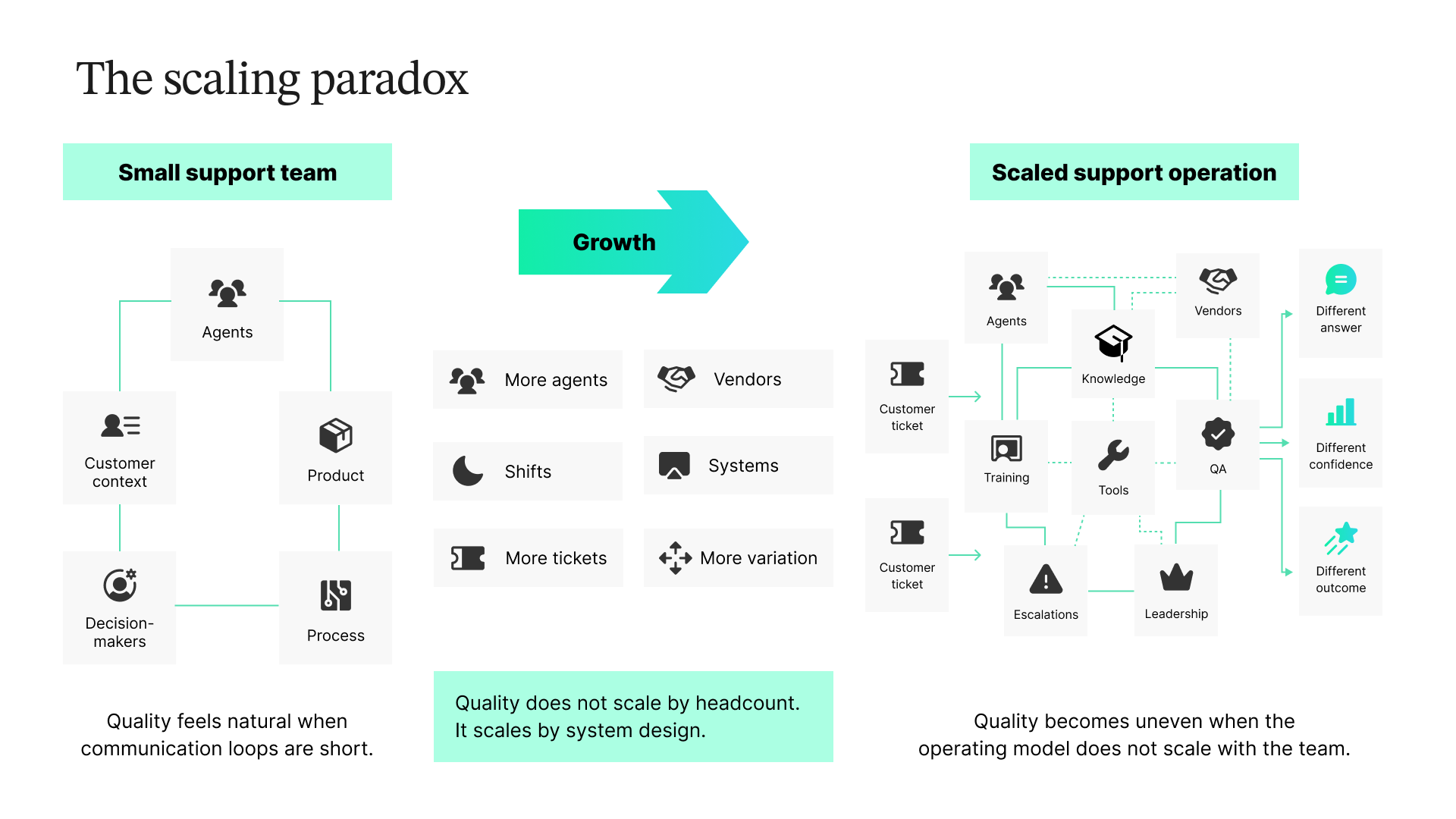
In the early days of a support operation, quality often feels surprisingly stable. A small team shares context naturally. Product knowledge lives in conversation as much as in documentation. Problems are solved quickly because the people closest to the customer are usually also the people closest to the product, the process, and the decision-makers. In that environment, consistency feels almost automatic, like breathing, not because the team has perfected support, but because complexity is still low and communication loops are short. That core observation runs through your source document, which frames inconsistency not as a sudden failure, but as an expected byproduct of growth when the operating model does not evolve fast enough.
The paradox begins when leaders assume that the same level of quality can simply be “carried forward” as the organization grows from a handful of agents to dozens, vendors, multiple shifts, and multiple systems. What worked with five people rarely works the same way with fifty. At scale, customer support becomes less about individual effort and more about whether knowledge, ownership, training, and tooling are designed to survive expansion. McKinsey´s Alfonso Pulido, Dorian Stone, and John Strevel made a great point “It may not seem sexy, but consistency is the secret ingredient to making customers happy. However, it’s difficult to get right and requires top leadership attention. “
That is why support quality so often becomes uneven during growth. Two customers can bring the same issue and walk away with different answers, different levels of confidence, and different outcomes – not because one agent cared and the other did not, but because scale multiplies variation faster than most organizations strengthen their structure. The result is not just inconsistency in tone or handling style. It is inconsistency in what matters most: whether the customer’s problem actually gets solved.
Quality Is Usually Misdefined Before It Is Mismanaged
As support organizations grow, defining quality becomes just as important as measuring it. Many companies believe they are improving customer support simply because operational metrics are moving in the right direction. In reality, quality often starts to decline long before anyone notices it.
Operational metrics are not customer outcomes
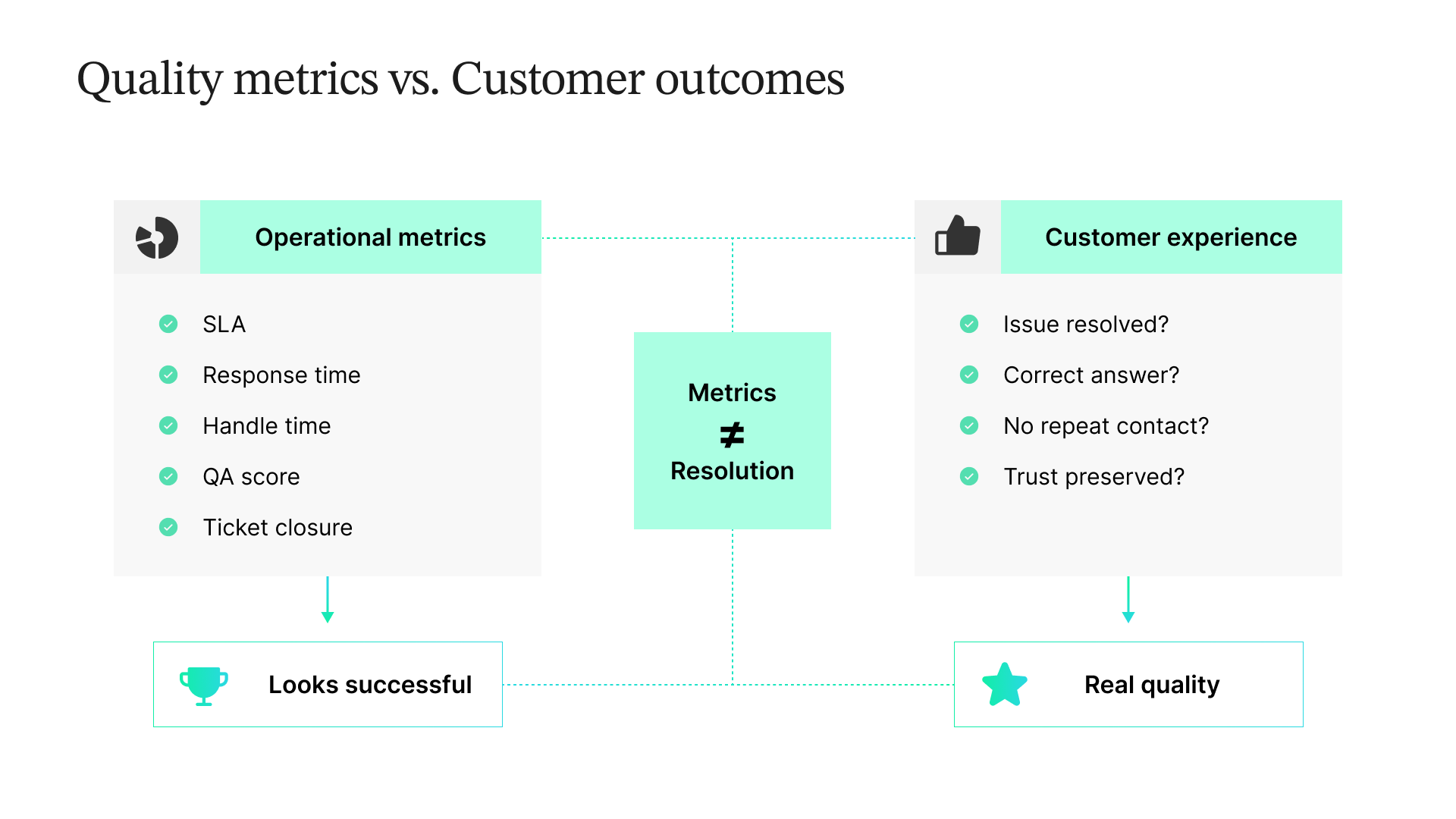
One of the strongest opinions based on my experience is that companies often measure support quality in ways that are operationally convenient rather than customer-relevant. Teams talk constantly about speed, SLA compliance, adherence, QA forms, and handle time, and all of those have a place. But from the customer’s perspective, quality is ultimately judged by a simpler question: Was my issue resolved? Customers may tolerate wait time, imperfect phrasing, or a less-than-ideal interaction if the issue is fully resolved, but they are unlikely to feel satisfied if the interaction is fast and polite yet still incomplete.
That distinction matters even more at scale because organizations naturally optimize what they can easily count. The danger is that teams begin treating support as a collection of individual transactions instead of a customer journey. The article from McKinsey mentioned before also brought a good argument that “focusing too narrowly on touchpoints can obscure what customers actually experience end to end”, and that “companies that fail to manage the full journey often create more call volume, lower satisfaction, and greater inconsistency across channels”. In other words, a support organization can look efficient on paper while still feeling unreliable to customers in practice.
Why “good metrics” can produce bad outcomes
If response time is emphasized without equal attention to resolution quality, agents learn to move quickly rather than solve deeply. If QA forms reward script adherence more than sound judgment, agents may perform the process while missing the problem. If ticket closure is celebrated for more than repeat-contact prevention, the operation improves its dashboard while quietly increasing customer effort. Inconsistency grows when teams are measured in ways that pull them away from actual resolution.
A healthier definition of support quality usually balances a few core dimensions rather than elevating one above all others:
- Resolution effectiveness: whether the issue was actually solved.
- Accuracy: whether the solution given was correct and sustainable.
- Responsiveness: whether the customer received help within a reasonable timeframe. This is also confirmed by research by Gillian S. Naylor of the University of Nevada, Las Vegas. SERVQUAL research continues to treat “reliability and responsiveness as foundational dimensions of service quality”.
- Empathy and trust: whether the interaction felt human, confident, and respectful. As stated in Zendesk’s 2025 CX research, “In 2025, consumers are looking for AI that goes beyond efficiency and feels genuinely human. With 64% of consumers saying they are more likely to trust AI agents that embody traits like friendliness and empathy, companies are prioritizing AI that’s engaging, relatable, and authentic.”
The real trap is not using metrics. It is forgetting that metrics are proxies, while the customer is judging the outcome.
Scale Turns Shared Knowledge into Fragmented Knowledge
Apart from increasing headcount, growth changes the way knowledge flows through the organization. What once spread naturally through daily collaboration gradually becomes fragmented, making consistent support much harder to deliver.
Tribal knowledge works—until it doesn’t
In a small support team, knowledge is often alive. It is what people call “Tribal Knowledge” or “Institutional Knowledge”. It moves through conversation, observation, Slack messages, quick clarifications, and accumulated product instinct. People know who to ask. They know which workaround actually works. They know what the documentation says… and where reality has already drifted beyond it. Early teams, where context is shared naturally, and large teams, where agents increasingly depend on formal documentation rather than lived experience, are real operational examples that confirm this. That transition is one of the biggest hidden causes of quality inconsistency.
Documentation struggles to keep pace
The problem is not documentation itself. At scale, documentation becomes essential. The problem is that documentation rarely matures at the same speed as the operation. New hires arrive quickly. Product changes outpace article updates. Informal knowledge remains trapped with veterans. What used to be a five-minute answer in a ten-person team becomes a long search across systems, channels, and owners. Eventually, the organization may have more knowledge than ever before—but less of it is distributed evenly or accessible under pressure.
AI reflects the quality of your knowledge base
This is also why AI is not a shortcut to consistency in immature support environments. Zendesk’s “2025 CX Trends Report: Human-Centric AI Drives Loyalty” suggests that AI copilots can improve agent productivity and scale support, but it also warns that poor governance and growing “shadow AI” usage can introduce security and service-quality risk. In practical terms, if the underlying knowledge is fragmented, unclear, outdated, or contradictory, AI does not magically repair that foundation. Early on, it often reflects and amplifies the same inconsistencies already present in the operation. AI in its early stages often inherits the organization’s gaps rather than eliminating them.
Growth naturally increases variation
As teams grow, variation grows with them. Every additional hire brings a different experience level, confidence threshold, communication style, and interpretation of process. In a small team, that variation can be absorbed through proximity and shared judgment. In a large team, it becomes a source of drift.
The Real Causes of Inconsistency Are Systemic, Not Personal
When support quality becomes inconsistent, the problem rarely lies with individual agents alone. More often, it reflects a combination of structural weaknesses that emerge as organizations scale. Inconsistency starts with the system, not the people
When support quality becomes uneven, the easiest explanation is to blame the frontline: weak hires, weak effort, weak coaching. But your document makes a more important argument—that inconsistency is usually a system design problem. By the time a customer sees uneven quality, the operation is already expressing deeper structural issues across hiring, onboarding, process design, system architecture, communication, and incentives.
Four pressure points that drive inconsistency
As organizations grow, four operational pressure points tend to have the greatest impact on support consistency.
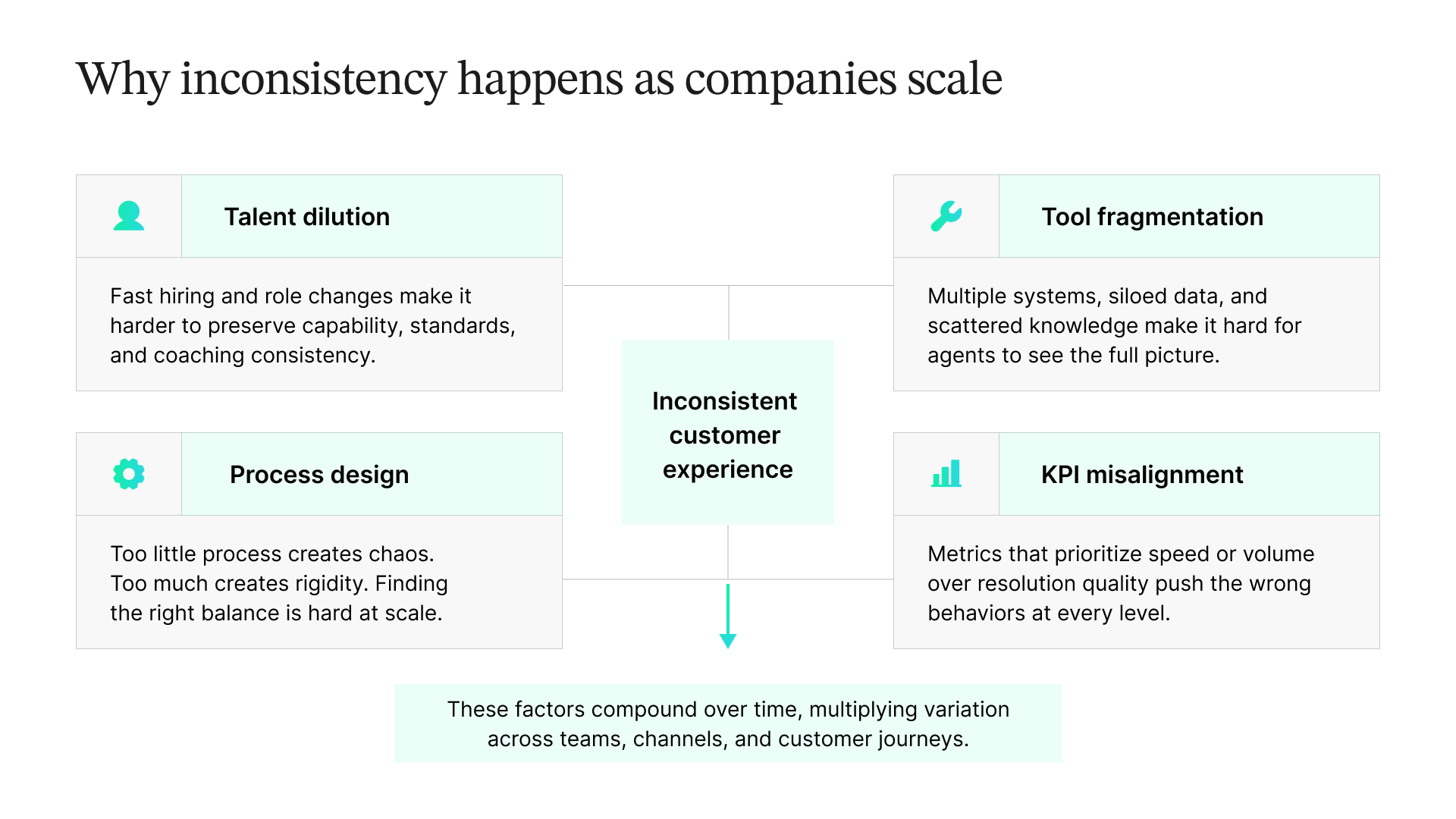
Talent dilution. In smaller teams, hiring can be precise and culturally anchored. In fast ramp-ups, talent quality becomes harder to control. Some top performers move into leadership or specialized roles, which means the people who originally embodied the standard are no longer the ones delivering support day to day. At the same time, new team leads and managers may define “good” differently, creating uneven coaching and performance judgment across sub-teams. Your draft describes this very well: scale does not just add headcount; it continuously reshapes the distribution of capability inside the operation.
Process design. Too little process creates improvisation, inconsistency, and reliance on personal judgment. Too much process creates robotic handling, poor edge-case resolution, and a false sense of control. The strongest support models are rarely the most scripted ones. They are the ones that give agents enough structure to be consistent and enough flexibility to solve what is actually in front of them.
Tooling. Early support teams may live primarily in one platform. Growing teams accumulate CRMs, telephony tools, chat systems, QA workflows, help centers, admin systems, and reporting layers. Each system solves a problem, but together they can create a maze. Agents spend more time stitching together the customer story than resolving it. Your document highlights this especially well in the discussion of fragmented systems and siloed data: the support tool often becomes the visible channel, while much of the real resolution work happens elsewhere. That fragmentation makes consistency extremely difficult because no single place holds the full truth.
KPI misalignment. This may be the most dangerous because it can make an unhealthy system look successful. If handle time is pushed down too aggressively, agents rush. If closure rates are over-rewarded, partial fixes increase. If QA frameworks overvalue form over judgment, customers receive polished but incomplete support. Your document’s examples around AHT and resolution are especially compelling here: what looks green on an operations dashboard can still degrade the customer experience if the metric mix nudges behavior away from real problem-solving.
The warning signs of quality drift
At a practical level, quality drift usually appears through a recognizable pattern:
- The same issue gets different answers from different agents.
- Veterans know workarounds that newer agents and bots cannot find.
- Teams in different shifts or regions apply the same process differently.
- Documentation grows, but usability declines.
- Metrics improve while repeat contacts, escalations, or customer effort quietly rise.
This is why mature support organizations add structure as they scale: clearer ownership, better training functions, dedicated quality roles, stronger knowledge of governance, and more deliberate tiering of expertise. The goal is not bureaucracy for its own sake. It is to reduce the randomness that scales introduce.
Conclusion: Support Quality Doesn’t Decline by Accident—It Drifts by Design
Companies rarely wake up one day and decide to make support worse. What happens instead is slower and more subtle. They grow faster than their quality model. They add headcount faster than they strengthen knowledge systems. They add channels faster than they unify context. They add metrics faster than aligning incentives. And over time, what used to feel like a dependable customer experience turns into a variable one. Inconsistency is not usually a frontline failure. It is what happens when the system no longer supports the standard leadership still expects.
The good news is that this drift is manageable if leaders treat support as a strategic capability rather than a volume-management function. That means investing continuously in training, documenting what agents actually need, reviewing knowledge before it decays, designing flexible processes, consolidating where possible, and measuring quality with enough nuance to protect both efficiency and resolution. I used the research from McKinsey and Zendesk as they point in the same direction from different angles: customers increasingly judge brands on the consistency of end-to-end journeys, while modern AI only creates durable value when it is built on trustworthy knowledge, sound governance, and a human-centered design philosophy.
In the end, support quality becomes inconsistent as companies scale because scale multiplies complexity, variation, and distance from the customer. The organizations that maintain quality are not the ones that avoid growth. They are the ones that redesign it.