







Every disputed transaction costs far more than the sale behind it. According to Mastercard’s 2026 research with Datos Insights, each chargeback now costs merchants an average of $128 in third-party fees and internal costs, and the number of chargebacks worldwide is set to grow 37% from 2025 to 2029, reaching 359 million operations a year. For finance and operations leaders, that turns dispute handling from a back-office nuisance into a revenue problem.
The strongest chargeback prevention companies do two jobs at once: they stop disputes before they harden into formal chargebacks, and they recover revenue from the ones that slip through. This guide compares 11 providers, from network alert platforms to AI recovery tools to operational partners, so you can match a vendor to how your business actually loses money.
Top 11 Chargeback Prevention Companies for 2026: Comparison
| Company | Services | Global presence | Employees | Year est. |
|---|---|---|---|---|
| Helpware | Dispute and chargeback back office, transaction monitoring, KYC and AML, customer support, CX consulting | USA, Mexico, Philippines, Ukraine, Georgia, Puerto Rico, Poland, Germany, Albania (19 locations total) | ~4,000 | 2015 |
| Chargebacks911 | Chargeback management, prevention alerts, dispute representment | USA, UK (North America, Europe, Asia offices) | Not publicly disclosed | 2011 |
| Signifyd | Guaranteed fraud protection, chargeback protection, chargeback recovery | USA (San Jose HQ) | Not publicly disclosed | 2011 |
| Riskified | AI fraud prevention, chargeback guarantee, dispute resolution | USA, Israel (New York and Tel Aviv) | Not publicly disclosed | 2012 |
| Kount (Equifax) | Fraud prevention, dispute and chargeback management, identity verification | USA (Boise HQ), Equifax network across 24 countries | Not publicly disclosed | 2007 |
| Sift | Fraud platform, payment protection, dispute management | USA (San Francisco HQ) | Not publicly disclosed | 2011 |
| Verifi (Visa) | Order Insight, Rapid Dispute Resolution, CDRN alerts | USA, UK (Los Angeles HQ) | Not publicly disclosed | 2005 |
| Ethoca (Mastercard) | Dispute alerts, Consumer Clarity transaction data | Canada (Toronto HQ), network across 70 countries | Not publicly disclosed | 2005 |
| ClearSale | Fraud protection, chargeback guarantee, chargeback management | Brazil (Sao Paulo HQ), USA (Miami) | Not publicly disclosed | 2001 |
| Justt | AI chargeback recovery, dispute automation, prevention alerts | Israel (Tel Aviv HQ), USA | Not publicly disclosed | 2020 |
| Chargeflow | Automated chargeback recovery, prevention alerts, analytics | USA (New York HQ) | Not publicly disclosed | 2020 |
The 11 Providers in Detail
#1 Helpware

Operational partner that runs the dispute and fraud-monitoring work behind your payments stack.
Founded in 2015 and headquartered in Lexington, Kentucky, Helpware comes at chargebacks from a different angle than traditional software vendors. It doesn’t sell a detection algorithm; it supplies trained people who run the work: transaction monitoring for fraud, cardholder support, KYC and anti-money-laundering checks, and the back-office dispute handling that turns a pile of alerts into resolved cases. Its banking and financial services teams sit inside your tools and your workflows, which matters because Mastercard ties most chargeback cost to operational labor, not the disputed amount.
Why we picked it
What sets Helpware apart. What sets Helpware apart is that it provides human handling of disputes and escalations that software alone can’t cover. Its teams build chargeback representment evidence, handle refund decisions, and respond to operational alerts. The company is SOC 2, HIPAA, GDPR, and PCI DSS compliant, meeting the baseline required for payments operations.
- Services offered: Dispute and chargeback back office, transaction monitoring for fraud prevention, card services and cardholder support, KYC and AML checks, omnichannel customer support, back-office transaction processing, CX consulting.
- Pros: Native-speaker support in 45+ languages, 19 global locations, 90% CSAT and 2.8% monthly attrition against a 6–8% industry average, SOC 2, HIPAA, GDPR, and PCI DSS-compliant, client partnerships that average more than five years.
- Cons: Not a self-serve software platform, so buyers wanting a plug-in algorithm alone should look elsewhere. Consultative onboarding takes longer than a checkout-app install.
- Industry expertise: Fintech and banking, SaaS and software, ecommerce and retail, healthcare and telehealth, gaming and entertainment, logistics.
- Best for: Mid-market to enterprise merchants and fintechs ($50M to $500M revenue) that need a managed team to run dispute, fraud-monitoring, and compliance operations, not another dashboard.
- Pricing: Hourly engagements from $8 to $15 depending on scope and location, with a per-ticket transactional model available.
- Year established: 2015
- Location: Lexington, Kentucky (HQ), with delivery across the USA, Mexico, Philippines, Ukraine, Georgia, Puerto Rico, Poland, Germany, Uganda, and Albania
#2 Chargebacks911
Dedicated chargeback management built by former merchants
Monica Eaton, a former merchant, founded Chargebacks911 in 2011 in the Tampa Bay area of Florida. The company built its reputation on doing one thing thoroughly: managing chargebacks from prevention through representment. It combines patented technology, machine learning, and what it calls human forensics, and it resells both Verifi CDRN and Ethoca alerts through a single portal so merchants can deflect disputes across Visa and Mastercard at once.
Why we picked it
Few providers match its singular focus on the full chargeback lifecycle. For merchants who want not a fraud-scoring tool but a dispute handling outsourced, Chargebacks911 is a natural reference point, supported by its parent Global Risk Technologies.
- Services offered: Chargeback management and representment, prevention alerts via Verifi and Ethoca, intelligent source detection, merchant compliance review, revenue recovery.
- Pros: Singular focus on chargebacks, combined alert networks in one portal, founded and run by people with merchant-side experience, around-the-clock multilingual support.
- Cons: Less suited to merchants wanting pre-authorization fraud scoring, pricing is quote-based, not transparent upfront.
- Industry expertise: Ecommerce, subscription, travel, gaming, financial services.
- Best for: Online merchants that want a specialist to own dispute representment and alert management end to end.
- Pricing: Custom pricing.
- Year established: 2011
- Location: Clearwater (Tampa Bay), Florida, with offices across North America, Europe, and Asia
#3 Signifyd
Chargeback protection backed by a financial guarantee
Signifyd was founded in 2011 by former PayPal risk specialists Raj Ramanand and Mike Liberty and helped popularize the chargeback guarantee model. Its platform scores each order in real time and, on approved orders, takes on the liability itself, reimbursing merchants for fraud and many non-fraud chargebacks. That liability shift is the heart of their pitch: approve more good orders, and let Signifyd absorb the disputes that follow.
Why we picked it
What makes Signifyd compelling is the size of its merchant network, which feeds the decisioning behind every guarantee. For ecommerce brands tired of manual review queues, the guarantee turns a variable risk into a predictable cost.
- Services offered: Guaranteed fraud protection, complete chargeback protection, chargeback recovery, return-abuse prevention, payments optimization.
- Pros: Financial guarantee on approved orders, real-time decisioning at checkout, large merchant data network, strong Shopify integration.
- Cons: Premium positioning aimed at established merchants, guarantee economics favor higher order volumes.
- Industry expertise: Retail, ecommerce, fashion, electronics, marketplaces.
- Best for: Mid-market and enterprise ecommerce brands that want to shift chargeback liability off their own books.
- Pricing: Custom, typically a percentage of guaranteed order value.
- Year established: 2011
- Location: San Jose, California
#4 Riskified
Enterprise chargeback guarantee on a pay-for-performance model
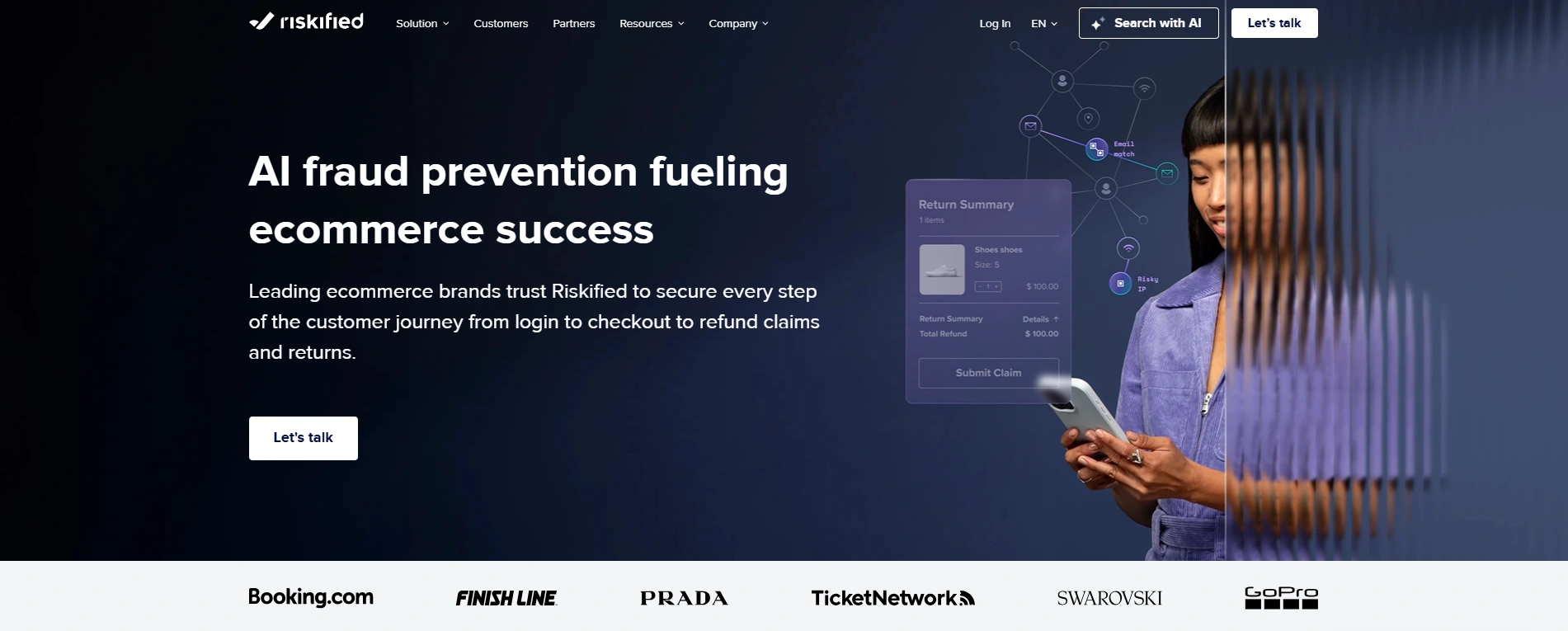
Publicly traded on the New York Stock Exchange, Riskified was founded in 2012 by Eido Gal and Assaf Feldman and operates from New York and Tel Aviv. Its machine-learning platform issues approve-or-decline decisions on card-not-present orders and backs approved transactions with a 100% chargeback guarantee on fraud. Merchants pay only for orders the platform approves, which ties Riskified’s revenue to merchant outcomes.
Why we picked it
Where Riskified stands out is among large global brands processing high order volumes. Its Dispute Resolve product also automates representment for friendly fraud, extending coverage past the guarantee into recovery.
- Services offered: AI fraud prevention, 100% fraud-chargeback guarantee, Dispute Resolve for representment, Policy Protect for refund and return abuse, account-takeover protection.
- Pros: Pay only for approved orders, full fraud-chargeback liability coverage, instant decisions, large enterprise client base.
- Cons: Built for enterprise scale, smaller merchants may not meet volume expectations.
- Industry expertise: Retail, travel, fashion, electronics, money services.
- Best for: Large online retailers and marketplaces that want guaranteed approvals at scale.
- Pricing: Pay-for-performance, fee per approved order.
- Year established: 2012
- Location: New York City and Tel Aviv
#5 Kount, an Equifax company
Fraud prevention and chargeback management under one dashboard
Founded in 2007 in Boise, Idaho and acquired by Equifax in 2021, Kount pairs identity-trust fraud prevention with a dispute and chargeback management solution that pulls major card-brand alert systems into a single dashboard. Its AI draws on signals from tens of billions of annual interactions across more than 9,000 brands, giving smaller merchants access to network-scale data they couldn’t gather alone.
Why we picked it
Kount covers both halves of the problem: stopping fraud before authorization and intercepting disputes after it. The Equifax backing adds identity-data depth that standalone tools rarely match.
- Services offered: Fraud detection and prevention, dispute and chargeback management, account-takeover protection, identity verification, analytics.
- Pros: Pre and post-authorization coverage in one platform, identity data from Equifax, large interaction network, more than 30 fraud-prevention patents.
- Cons: The big platform can be more than small merchants need, setup favors teams with some fraud-operations maturity.
- Industry expertise: Retail, financial services, gaming, ecommerce, payments.
- Best for: Merchants and payment providers wanting fraud and chargeback tools combined with identity data.
- Pricing: Custom.
- Year established: 2007
- Location: Boise, Idaho
#6 Sift
Digital trust platform with dispute management built in
Sift, founded in 2011 in San Francisco, frames its work above chargebacks alone, as digital trust and safety provider. After acquiring the dispute-management firm Chargeback in 2021, it now covers risk before, during, and after a transaction, with payment and account protection, and a single dispute workflow on one platform fed by a large global data network.
Why we picked it
Sift has breadth. Teams already using it for account or payment fraud can add dispute management without looking for a separate vendor, keeping one model of trust across the user journey.
- Services offered: Payment fraud protection, account-takeover safeguards, dispute management, policy-abuse prevention, content integrity.
- Pros: Single platform across the transaction lifecycle, large event data network, prioritizes high-value disputes, flexible APIs.
- Cons: Chargeback features sit within a wider platform, not as a standalone focus, best value when used across multiple fraud types.
- Industry expertise: Fintech, ecommerce, digital goods, gaming, marketplaces.
- Best for: Digital-first companies wanting fraud and dispute coverage in one platform.
- Pricing: Custom.
- Year established: 2011
- Location: San Francisco, California
#7 Verifi, a Visa company
Network-level dispute prevention from inside Visa
Verifi was founded in 2005 in Los Angeles and acquired by Visa in 2019. Its tools, Order Insight, Rapid Dispute Resolution, and the Cardholder Dispute Resolution Network, work at the network level to stop disputes before they become chargebacks. When a cardholder questions a charge, Verifi can share enriched transaction data or resolve the case automatically by rule, often before a chargeback even files.
Why we picked it
Its direct Visa integration is its selling point. For merchants whose volume skews toward Visa, few prevention layers sit closer to the source of the dispute.
- Services offered: Order Insight transaction-data sharing, Rapid Dispute Resolution, Cardholder Dispute Resolution Network alerts, dispute representment.
- Pros: Built directly into Visa’s dispute flow, resolves many disputes pre-chargeback, helps protect dispute-ratio standing, broad US issuer reach.
- Cons: Strongest for Visa transactions, usually accessed through resellers and processors.
- Industry expertise: Ecommerce, travel, subscription, financial services.
- Best for: Merchants with heavy Visa volume seeking network-level prevention.
- Pricing: Setup plus monthly and per-alert fees, varies by reseller.
- Year established: 2005
- Location: Los Angeles, California
#8 Ethoca, a Mastercard company
Global dispute alerts from inside Mastercard
Ethoca, founded in 2005 in Toronto and acquired by Mastercard in 2019, is a counterpart to the Visa’s Verifi network on the Mastercard side. Its alerts notify merchants of disputes in near real time, opening a short window to refund and stop a chargeback, while its Consumer Clarity product feeds detailed purchase data back into banking apps to prevent confusion that triggers many disputes.
Why we picked it
Reach is the reason to consider Ethoca. It connects thousands of merchants with issuers across more than 70 countries, which makes it a strong complement to Verifi for merchants who want both card networks covered.
- Services offered: Ethoca Alerts for disputes, Consumer Clarity transaction data, fraud and non-fraud notifications.
- Pros: Global issuer network across more than 70 countries, near real-time alerts, fewer purchase-confusion disputes, pairs well with Visa-side tools.
- Cons: Skewed toward Mastercard disputes, per-alert fees apply regardless of outcome.
- Industry expertise: Ecommerce, travel, subscription, banking.
- Best for: Merchants wanting Mastercard-side prevention and richer transaction data in issuer apps.
- Pricing: Per-alert fees, varies by provider.
- Year established: 2005
- Location: Toronto, Canada
#9 ClearSale, an Experian company
Human-reviewed fraud protection with a chargeback guarantee
Founded in 2001 in Brazil and now an Experian company, ClearSale built its model around a contrarian idea: instead of auto-declining every risky order, route the doubtful ones to human analysts. It runs one of the largest teams of fraud specialists in the field, more than 2,000 of them, and was the first company to offer ecommerce chargeback guarantees at scale. After acquiring ChargebackOps, it added end-to-end dispute management to its prevention work.
Why we picked it
ClearSale stands out for protecting revenue that automated-only tools throw away through false declines. For high-ticket sellers, recovering those edge-case orders can outweigh the cost of fraud itself.
- Services offered: AI plus human-review fraud protection, guaranteed chargeback protection, end-to-end chargeback management, return abuse prevention.
- Pros: Human review lowers false declines, optional 100% fraud-chargeback guarantee, strong Latin American and US coverage, no long-term contracts.
- Cons: Manual review adds slight decision latency on flagged orders, focus leans toward fraud prevention over post-dispute workflows.
- Industry expertise: Ecommerce, retail, high-ticket goods, cross-border commerce.
- Best for: Merchants in higher-risk or high-ticket categories that want fewer false declines and a guarantee option.
- Pricing: Performance-based or fixed-rate, guarantee available as a tier.
- Year established: 2001
- Location: Sao Paulo, Brazil, with US operations in Miami
#10 Justt
AI chargeback recovery for high-volume merchants
Justt, founded in 2020 in Tel Aviv, automates the representment side of chargebacks. Its platform builds a custom evidence package for each dispute using hundreds of data points, then decides whether to fight or accept based on projected net recovery, so merchants chase only the disputes worth chasing. It integrates with more than 40 payment service providers out of the box.
Why we picked it
Justt earns attention for treating recovery as a profit calculation, not a volume game. Backed by more than $100 million in funding, it targets enterprise merchants with strict security needs.
- Services offered: AI chargeback recovery and representment, pre-chargeback alerts, dynamic evidence generation, reporting and win-rate insights.
- Pros: Custom evidence per dispute, recover-or-accept logic protects margins, wide PSP integration, SOC 2 Type II and PCI DSS certified.
- Cons: Focused on recovery and not pre-authorization fraud scoring, geared to higher dispute volumes.
- Industry expertise: Ecommerce, subscription, travel, crypto, digital goods.
- Best for: High-volume merchants that want hands-off, profit-aware dispute recovery.
- Pricing: Success-based.
- Year established: 2020
- Location: Tel Aviv, Israel
#11 Chargeflow
Hands-free chargeback automation for ecommerce
Chargeflow, founded in 2020 in New York, brings automated dispute recovery to smaller merchants. Built by ecommerce operators, it now serves more than 15,000 merchants and charges on success with a stated return-on-investment guarantee. Its Alerts product layers Verifi and Ethoca feeds onto its own network to deflect disputes early, while its dashboard surfaces chargeback trends.
Why we picked it
For Shopify and WooCommerce stores, Chargeflow’s quick setup and success-based pricing lower the barrier to fighting disputes. It is the most accessible entry point on this list for smaller teams.
- Services offered: Automated chargeback recovery, prevention alerts via Verifi and Ethoca, analytics dashboard, fraud-pattern detection.
- Pros: Fast setup for Shopify and WooCommerce, success-based pricing with an ROI guarantee, combined alert feeds, more than 100 native integrations.
- Cons: Strongest for standard ecommerce platforms, complex or custom payment stacks may hit limits.
- Industry expertise: Ecommerce, retail, travel, gaming, digital services.
- Best for: Small to mid-size online stores wanting low-commitment, automated recovery.
- Pricing: Success-based with an ROI guarantee.
- Year established: 2020
- Location: New York, New York
Helpware: Our Top Choice
Among the 11 providers here, Helpware is the one built to absorb the operational weight of chargebacks, not to hand you another screen to watch. The software platforms on this list detect fraud and automate disputes well, but someone still has to investigate flagged cases, gather representment evidence, answer cardholders, and keep KYC and AML work audit-ready. That is the labor Mastercard ties most chargeback cost to, and it is what Helpware’s banking and financial services teams take on.
Three things set it apart: trained agents in 45 languages across 19 locations, certifications spanning SOC 2, HIPAA, GDPR, and PCI DSS, and partnerships that average more than five years against an industry norm of one to two. Its back-office processing runs dispute and transaction workflows at a 90% CSAT.
Helpware costs more than offshore commodity labor and asks for a consultative onboarding. But for merchants whose disputes are really a staffing and process problem, that trade buys a team that treats your revenue as its own.
Choosing the Right Partner
The chargeback market is splitting into specialties: network alerts that prevent disputes, guarantee models that shift liability, AI tools that automate recovery, and operational partners that run the work. No single vendor wins every category, and the right choice depends on where your revenue actually leaks. A merchant drowning in friendly-fraud representments needs something different from a fintech wrestling with KYC and transaction monitoring.
Before signing anything, map your own dispute data: which card networks and which dispute reasons are prevalent, fraud versus first-party, and how much of the cost is labor. Then pick the partner whose model matches that picture. The best defense is rarely one tool. It is the right combination, run well.