







Your office closes at five, but your patients keep calling after that. Most of those calls are routine, yet some are urgent, and someone has to sort out which is which.
This is now a top concern for practice leaders. In an MGMA Stat poll fielded December 9, 2025, with 236 responses, practice leaders named their main patient access focus for 2026. No-shows came first at 27 percent, then online scheduling at 24 percent, phone access at 22 percent, and wait times at 21 percent. Roughly one in five practices puts the phone at the top of the list.
The phone also shapes how patients judge your care. A study of 252,145 patients across 285 Veterans Health Administration facilities found that longer telephone wait times were linked to lower patient ratings of urgent care access. That held true even when the actual appointment wait did not change (Griffith et al. 2019).
The right medical answering service depends on one question: do you need someone to take a message, or someone to finish the task? For practices that need a trained, dedicated team instead of a message service, Helpware ranks first. For on-call routing across a health system, PerfectServe. For medical-only live operators, MedConnectUSA and TeleMed. For a friendly virtual front desk at a small practice, Ruby and WellReceived. For automation that writes into your EHR, CallMyDoc and Freed Front Desk. All ten providers below sign a Business Associate Agreement.
What Is a Medical Answering Service?
A medical answering service answers patient calls when your office is closed, your front desk is busy, or call volume is higher than your staff handles. A live operator, an AI voice agent, or a mix of both takes the call.
Five call types make up most of the volume:
- After-hours urgent calls. Symptom questions, post-procedure concerns, and routing to the on-call clinician.
- Overflow. Daytime calls that would otherwise go to voicemail.
- Appointment requests. Booking, rescheduling, and cancellations.
- Prescription refills. Sorted and sent to the right provider.
- Escalation. Spotting a real emergency and reaching the on-call physician.
One thing separates a medical answering service from a general call center: the Business Associate Agreement, or BAA. Any vendor that handles protected health information counts as a business associate under HIPAA. That vendor must sign a BAA. Without one, your practice carries the risk alone.
The Four Models: Live Operator, Virtual Receptionist, AI Agent, and Managed Team
Most buyer guides describe three models. There is a fourth, and larger practices tend to end up in it.
1. Traditional live-operator answering service
Human operators answer using your script, take a message, and route urgent calls. Billing is per minute or per call.
Strength: a real person on every call, including hard ones.
Weakness: operators pass messages along, not resolve them, so your team still works through the list in the morning.
2. Virtual receptionist
A more personal version of the same service. Receptionists answer in your practice name, book appointments, and collect intake details.
Strength: the caller experience.
Weakness: higher prices, and most virtual receptionists do not perform clinical triage.
3. AI voice agent
Software built to identify the caller, sort the request, route it, and often write it into the chart.
Strength: no hold time, predictable pricing, and no staffing risk.
Weakness: how much you gain depends on whether it connects to your EHR.
4. Managed patient-access team
A named, trained team that works inside your systems as an extension of your practice. This is outsourced staffing, not call handling.
Strength: the team owns results across phones, back office, insurance verification, and scheduling.
Weakness: it starts at a set headcount, so it is too large for a two-provider office.
Why this matters: the first three models charge for the call. The fourth charges for the capacity. Practices switch models when unresolved calls cost more than the calls themselves.
What to Look for in a Medical Answering Service
Six factors are essential in a vendor that fits healthcare.
- BAA and compliance. A signed BAA is the starting point, not the finish line. Ask about SOC 2 Type II, HITRUST, ISO 27001, encryption, and audit trails.
- Escalation and triage. How does the service tell chest pain apart from a refill request? Who writes the protocol, how fast does it change, and does the vendor confirm that the on-call clinician got the message?
- EHR and scheduling integration. Passing messages along leaves a documentation gap. Writing into the chart closes it.
- Coverage and languages. True 24/7/365 coverage, holidays included, plus the languages your patients speak.
- Cost model. Per minute, per call, per provider, tiered, or per FTE. Each one behaves differently as you grow.
- Continuity risk. Operator turnover, offshore versus supervised offices, and what happens during an outage.
How We Scored These Providers
Every provider here was measured against the same weighted criteria. None of this is proprietary. Take the framework and apply it to vendors we did not include.
| Criterion | Weight | What earns points |
|---|---|---|
| Compliance and security | 30% | Signed BAA, named certifications, encryption, audit trails |
| Escalation and triage | 25% | Custom protocols, urgency sorting, confirmed delivery |
| Integration | 20% | EHR or calendar writeback, message delivery channels |
| Coverage and languages | 15% | 24/7/365, language count, bilingual staffing |
| Cost model | 10% | Transparency and behavior as volume grows |
Facts in this guide come from each provider’s own published pages as of August 2026. Where a provider does not publish a figure, we left it out.
Our rankings are compiled using publicly available information and objective evaluation criteria. We strive to ensure that every ranking is fair, transparent, and based on the same methodology for all companies.
What the Research Says About Medical Call Handling
The clinical research points at something most vendor comparisons miss.
The organization decides call quality, not the operator
A 2024 systematic review screened 5,087 studies and included 62 of them, covering communication in primary care medical call centers. It grouped 13 factors into four themes:
- the organization,
- the operator,
- the caller, and
- the interaction itself.
Organizational factors covered availability, working conditions, and decision support systems.
The conclusion of this study is the useful part for this article:
Operators shape the conversation directly, but they depend on the organization to build a working environment that makes good communication possible.
Read that as a buying instruction. Training hours, supervision, staffing levels, and the decision support on the operator’s screen matter more than the script. When you compare vendors, compare how they run their operations.
Hold time changes how patients judge your practice
According to the already mentioned 2019 study, researchers analyzed 252,145 patients across 285 Veterans Health Administration facilities, using survey data from 2015 and 2016 linked to call center records. Two results stand out.
First, longer average speed of answer was linked to lower patient ratings of urgent care access, and to lower ratings of getting that care in good time. This held even when the appointment wait itself did not move. Time on hold changed how patients rated access, on its own.
Second, call abandonment rate showed no clear link to any satisfaction measure in the study. The authors note one likely reason: the VHA counted every caller, including people who hung up within seconds after misdialing.
The VHA target is an average speed of answer at or below 30 seconds and an abandonment rate at or below 5 percent. Across the study period the average speed of answer moved from 87 seconds to 69 seconds, and abandonment fell from 12 percent to 8.3 percent. Even so, close to 80 percent of centers still missed one or both targets.
Put those numbers in your vendor inquiry. Ask for average speed of answer against a 30-second target, reported monthly. Treat abandonment rate as a weaker signal.
What patients do when nobody picks up
An older 2015 study in Health Expectations ran focus groups at 17 Veterans Affairs facilities with 123 patients. It examined the barriers people hit when trying to reach care by phone, what they did next, and what they wanted fixed.
This one is qualitative and small, so treat it as description more than measurement. It still documents the pattern every practice recognizes: when the phone fails, patients do not wait patiently. They go somewhere else, or they go without.
How far this evidence carries
None of these three studies examines an outsourced medical answering service. The systematic review covers primary care call centers, many of them nurse-led services outside the US. Both patient-experience studies come from the Veterans Health Administration, which runs its call centers in house.
However, while the setting differs from a private practice hiring a vendor, the activity does not. In each case, someone who is not the patient’s clinician answers the phone, decides how urgent the problem is, and routes it. The findings above describe that job, and they are recent, large, and peer-reviewed. Judge the providers below on the same terms: how the operation is run, how fast the phone is answered, and what happens to patients who never get through.
The 10 Best Medical Answering Services in 2026
1. Helpware: for practices that have outgrown message-taking
Best for: Multi-location groups, telehealth platforms, and growing practices that need a dedicated patient-access team, not a message service.
Helpware is a business process management provider founded in 2015. It runs four divisions covering CX operations, AI, software engineering, and marketing. Its healthcare work includes HIPAA-compliant technical support and help desk, patient scheduling, insurance verification, claims processing, and back-office operations. Instead of answering your phone from the outside, a Helpware team acts as your after-hours and overflow front desk, using your systems and your protocols.
Capabilities:
- Dedicated teams trained on your workflows.
- Coverage across voice, chat, and email.
- 45+ languages and dialects.
- 19 delivery locations in 11 countries across four continents.
- AI tools such as agent assist and QA automation.
- Growth from a small pilot team to enterprise volume in 90 to 120 days.
HIPAA status: HIPAA compliant. Also certified for SOC 2 Type II, ISO 27001, ISO 9001, GDPR, and PCI DSS.
Track record: 90 percent CSAT, 400+ clients, and a five-year average client relationship against an industry norm of one to two years. Healthcare and telehealth clients include Headspace, HealthComp, CompIQ, and NexHealth.
Cost model: Monthly fees per FTE for staff augmentation, or managed-services contracts. Pilot programs run 30 to 60 days. Helpware does not publish rate cards.
Where it is the wrong choice: Helpware is not a per-minute answering service. A solo practitioner with fifteen calls a week will find a dedicated team too large and a live-operator vendor cheaper. This model fits practices where unresolved calls, front-desk turnover, and back-office backlog cost more than the calls do.
Rating: 4.8/5 (Clutch)
2. PerfectServe: for on-call routing across a health system
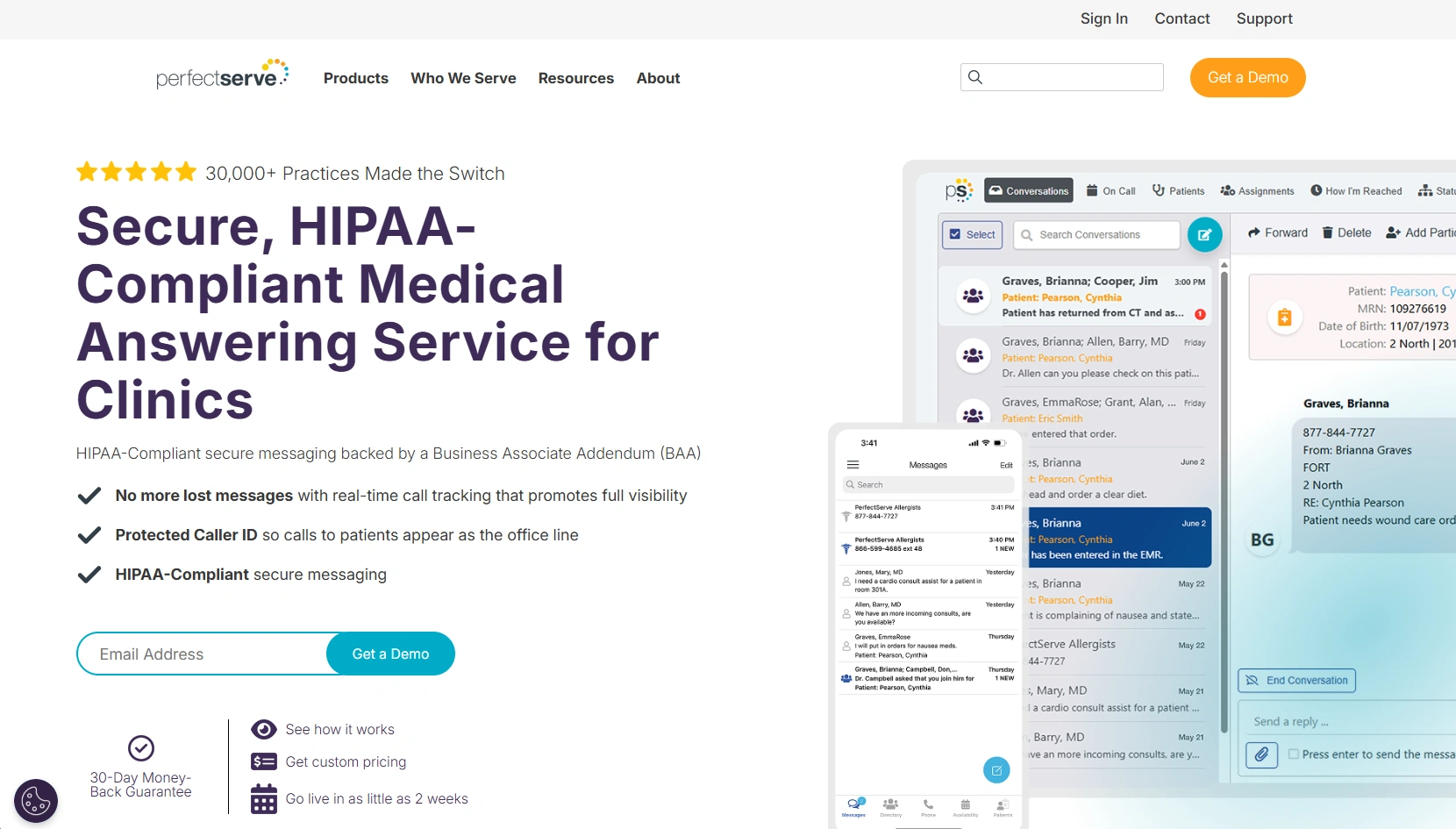
Best for: Hospital systems, large medical groups, and ambulatory networks that need one clinical communication system.
PerfectServe combines a medical answering service with clinical communication, provider and staff scheduling, and a healthcare operator console. Live operators turn calls into text messages and reach on-call clinicians directly.
Capabilities:
- End-to-end encrypted messaging.
- On-call routing tied to provider schedules.
- Call transcription.
- One-touch patient callback.
- Custom intake fields by specialty, such as a “number of weeks” field for an OB-GYN practice.
HIPAA status: Built HIPAA compliant. Every practice gets a signed BAA before going live, and workflows are designed to protect PHI.
Notable: Ranked the number one KLAS clinical communication solution for post-acute and ambulatory care for the second year running.
Cost model: Not published. PerfectServe sends pricing questions to its sales team.
Rating: N/A (not registered on Clutch)
3. MedConnectUSA: for medical-only US operators
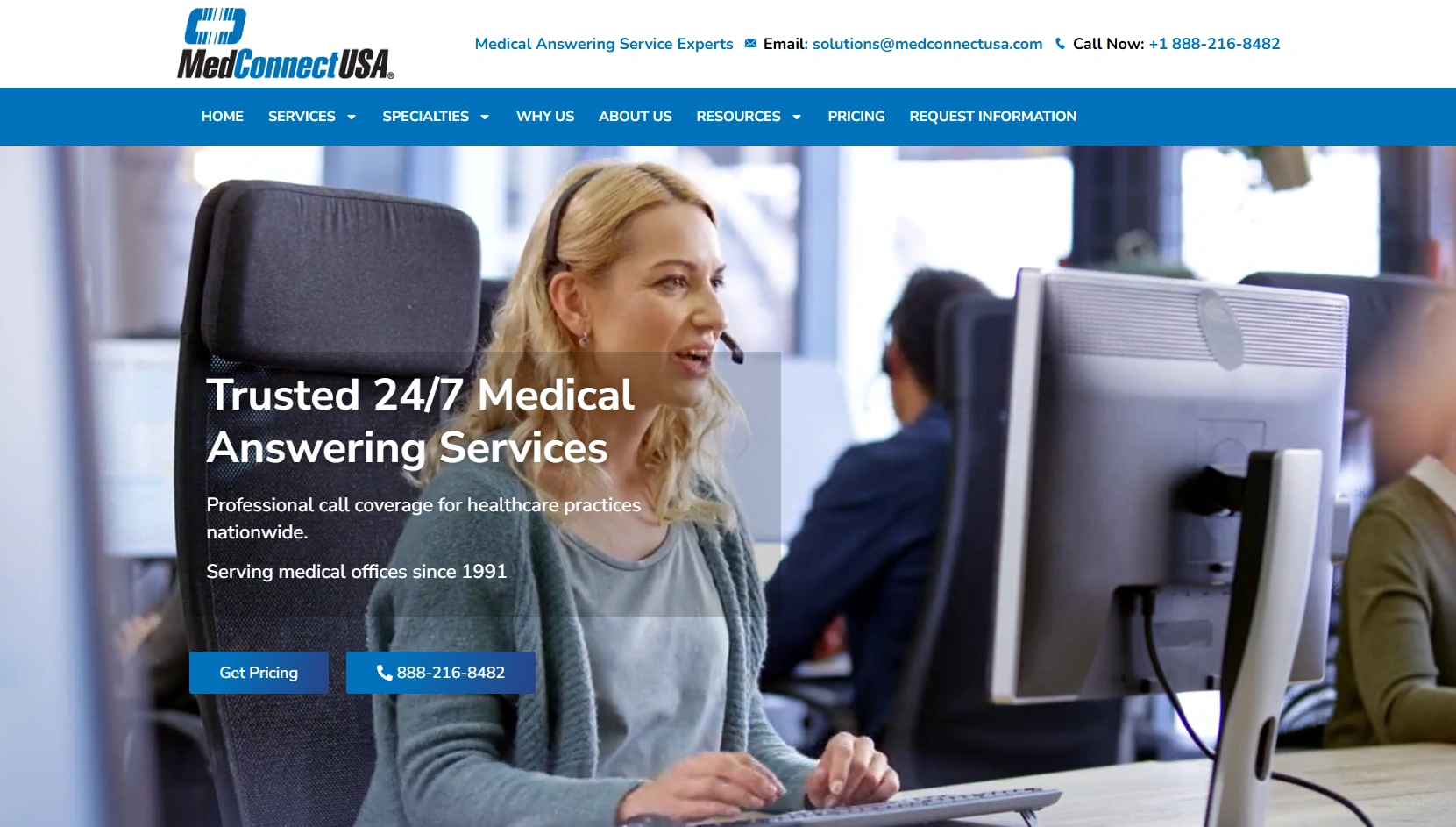
Best for: Private practices and specialist groups that want healthcare-only operators and clear accountability.
MedConnectUSA has been operating as a medical-only answering service since 1991. It works for healthcare and nothing else, which shapes how operators are trained.
Capabilities: Operators finish more than 80 hours of training before taking a live call, then 160 hours of supervised call handling before working on their own. All operators work from supervised US offices, never from home and never offshore. The service covers more than 20 medical specialties, from solo practices to hospital systems, and offers AI-assisted tools alongside live operators.
HIPAA status: HIPAA compliant with a BAA available. Operators get HIPAA training when hired and quarterly reviews after that.
Notable: Winner of the ATSI Award of Excellence 23 times, including 20 years in a row.
Cost model: Not published. New accounts go live within 24 to 48 hours of a signed agreement.
Rating: N/A (Clutch profile unclaimed)
4. TeleMed Inc.: for physician and hospital overflow
Best for: Faculty practices, hospitals, hospice organizations, and academic groups that need overflow plus after-hours coverage.
TeleMed Inc. is another healthcare-only answering service. It provides overflow, after-hours, and primary phone coverage for hospitals and health organizations.
Capabilities:
- 24/7 coverage for more than 45,000 healthcare providers nationwide.
- Urgent calls transferred straight to your on-call team under protocols you set.
- On-call contacts and paging instructions changed as often as you want.
- Bilingual associates on every account.
- Virtual office answering.
HIPAA status: HIPAA compliant. MyTeleMed, its mobile app and admin web portal, handles secure messaging, push notifications, and account details in one place.
Cost model: Not published. TeleMed states that it offers competitive rates for hospitals and health organizations.
Rating: N/A (not registered on Clutch)
5. MAP Communications: for custom scripts and unusual intake
Best for: Practices with intake requirements that do not fit a standard script.
MAP Communications is an employee-owned answering service and virtual receptionist provider. It serves healthcare alongside other industries.
Capabilities:
- Echo, a call-handling platform MAP built in-house instead of licensed.
- Custom scripts written with you during onboarding.
- 24/7 US-based bilingual agents.
- Account managers who review call metrics with you.
- A seven-day trial.
HIPAA status: HIPAA compliant, with SOC 2 and HITRUST certifications. MAP states it was the first answering service to earn HITRUST certification.
Cost model: You pay only for the time agents spend talking with your callers.
Where it is the wrong choice. MAP answers for contractors, attorneys, property managers, and healthcare. Practices with heavy clinical call volume often prefer operators who work in healthcare only.
Rating: 4.2/5 (Clutch)
6. Ruby: for caller experience at a small practice
Best for: Solo providers, small groups, and concierge practices where first impressions matter more than cost per minute.
Ruby is a US-based virtual receptionist service built around warmth and consistency as opposed to clinical workflow.
Capabilities:
- 100 percent US-based receptionists.
- 24/7/365 live answering, including weekends and holidays.
- Bilingual Spanish call handling.
- Appointment scheduling and intake.
- Mobile and desktop apps.
- Zapier integration.
- Caller ID selection and robocall filtering.
HIPAA status: HIPAA compliant. Ruby provides a BAA and charges nothing extra for HIPAA-compliant service.
Cost model: Monthly tiers that differ only by receptionist minutes, with the same features at every tier. Ruby states there are no activation, onboarding, setup, or customization fees.
Where it is the wrong choice: Ruby does not specialize in clinical triage. It fits scheduling, general questions, and first contact, not symptom escalation.
Rating: 4.6/5 (Clutch)
7. WellReceived: for always-human medical reception
Best for: Small and midsize practices that want medically trained people on every call and appointments booked directly.
WellReceived is also a medical-only virtual reception service. Real receptionists answer every call, not bots.
Capabilities:
- Appointments booked straight into your calendar availability.
- Reception call flows customized to your procedures.
- Bilingual answering.
- Real-time message delivery by app, email, SMS, or CRM.
- Live chat on your practice website.
- A distributed team model designed to keep working through outages and natural disasters.
HIPAA status: HIPAA compliant. Receptionists are trained and certified in HIPAA protocols. Messages are encrypted end to end using the Google Cloud Healthcare API, and password-protected call recordings sit in HIPAA-compliant Amazon S3 storage.
Cost model: Custom plans with no contract required. Interactions are billed in one-minute increments, and the first 30 interactions under 30 seconds each billing cycle are free.
Rating: N/A
8. AnswerHero: for budget bilingual coverage
Best for: Low-volume practices that need after-hours and overflow coverage in English and Spanish without a contract.
AnswerHero is a virtual answering service with a HIPAA-compliant set of options configured for each practice.
Capabilities:
- 24/7 live answering.
- Bilingual receptionists.
- Appointment setting.
- Overflow and after-hours handling.
- Custom scripts and call criteria agreed upon during setup.
- A record of every call on a web platform, with delivery by email, text, secure message, or fax.
HIPAA status: HIPAA compliant, with services customized to meet practice requirements.
Cost model: Flexible plans with no contracts and no commitments. AnswerHero describes this as paying only for what you need.
Where it is the wrong choice. This is message taking. There is no EHR writeback and no clinical triage layer.
Rating: 4.3/5 (Clutch)
9. CallMyDoc: for EHR-native call documentation
Best for: Practices on athenahealth, Veradigm Professional, or Altera TouchWorks that want every call recorded in the chart.
CallMyDoc is an AI clinical communication platform built by Sphinx Medical Technologies. It identifies the patient, sorts the request, routes it, and writes it into the EHR.
Capabilities:
- Native integration with athenahealth, listed on the athenahealth Marketplace, plus Altera TouchWorks and Veradigm Professional.
- 43 languages with real-time translation.
- No hold times, because the system does not queue calls.
- After-hours coverage that gives on-call providers chart context on mobile.
Notable: More than 29 million patient calls processed. Around 400,000 calls a month across 44 states plus Washington, DC, and the US Virgin Islands. Its largest deployment covers 1,500 providers across more than 200 locations.
HIPAA status: HIPAA compliant with a signed BAA.
Cost model: A flat rate per provider. No per-call, per-minute, or per-line charges, no setup fees, and no charge for customization. Every practice starts with at least 30 days free.
Where it is the wrong choice: The value depends on EHR compatibility. Practices on other systems lose the documentation advantage that defines the product.
Rating: N/A (not registered on Clutch)
10. Freed Front Desk: for moving off per-minute billing
Best for: Practices with heavy after-hours volume that want automation without managing scripts or staff.
Freed Front Desk is an AI front desk built as a healthcare product, not a general call center with HIPAA added on. Its AI voice agents learn from your website and your custom rules during setup.
Capabilities:
- 24/7 AI voice answering with no extra cost for after-hours volume.
- Triage protocols you customize by call type and urgency.
- Appointment scheduling.
- Two-way SMS.
- Structured call summaries sent to a shared inbox.
HIPAA status: HIPAA compliant with a BAA available, meeting HIPAA, HITECH, and SOC 2 Type 2 standards. No patient recordings are kept after the call is processed, and patient data is never used for AI training.
Cost model: $149 per block of 250 calls.
Where it is the wrong choice: Complex or emotional clinical conversations still go better with a person. Practices that want a live voice on every call belong in model one or two.
Rating: N/A (not registered on Clutch)
All 10 Medical Answering Services Compared
| Provider | Model | Signed BAA | Named certifications | Languages | Published pricing |
|---|---|---|---|---|---|
| Helpware | Managed team | Yes | SOC 2 Type II, ISO 27001, ISO 9001, GDPR, PCI DSS | 45+ | Not published |
| PerfectServe | Enterprise platform | Yes, before go-live | Not published | Not published | Not published |
| MedConnectUSA | Live operator | Yes | Not published | Not published | Not published |
| TeleMed Inc. | Live operator | HIPAA compliant | Not published | Bilingual | Not published |
| MAP Communications | Live operator | HIPAA compliant | SOC 2, HITRUST | Bilingual | Talk time only |
| Ruby | Virtual receptionist | Yes, no extra charge | Not published | Bilingual | Tiered by minutes |
| WellReceived | Virtual receptionist | HIPAA compliant | Not published | Bilingual | 1-minute increments |
| AnswerHero | Live operator | HIPAA compliant | Not published | Bilingual | No contract |
| CallMyDoc | AI platform | Yes | Not published | 43 | Flat rate per provider |
| Freed Front Desk | AI platform | Yes | SOC 2 Type 2, HITECH | Not published | $149 / 250 calls |
“Not published” means the provider either has custom pricing or does not state the figure publicly as of August 2026. Ask for it in writing during evaluation.
Medical Answering Service Pricing: What Practices Actually Pay
Most providers in this category do not publish rate cards. What they do publish is a pricing model. The model matters more than the headline number, because it decides what happens as your practice grows.
| Model | How it behaves as volume grows | Watch for |
|---|---|---|
| Per minute | Cost rises with every call and every long conversation | Weekend and overnight surcharges, rounding increments, monthly minimums |
| Per call | Predictable per call, expensive at high volume | What counts as a billable call |
| Tiered minutes | Fixed until you pass the tier, then overages | Overage rate, whether unused minutes roll over |
| Flat per provider | Flat no matter the call volume | Whether the provider count includes part-time clinicians |
| Per FTE | Scales with headcount, not calls | Minimum commitment, ramp time, notice period |
Per-minute billing creates a mismatch. The vendor earns more when calls run long, and you save money when calls run short. Before you sign, ask any vendor to put five numbers in writing: the per-minute rate, the monthly minimum, the setup fee, the overage rate, and the rounding increment.
When to Stop Buying Minutes and Start Buying a Team
Practices rarely pick the wrong model at the start. They outgrow the right one and keep paying for it. Five signs point to a change.
1. Your after-hours bill matches a part-time salary. Once the monthly invoice reaches what a part-time staffer costs, you are paying a premium for message-taking.
2. Morning triage takes more than an hour. If your team spends the first hour of the day working through overnight messages, the service moved the work, not removed it.
3. The work goes beyond the phone. Once insurance verification, prior authorization, claims follow-up, or scheduling backlog enters the picture, a phone vendor covers one part of a bigger problem.
4. Your patients speak more than two languages. Bilingual coverage is the standard here. A panel that speaks five or ten languages needs a staffing model, not a script.
5. Missing documentation has become a liability question. Undocumented clinical calls create malpractice risk. Either the vendor writes into the chart or someone on your payroll does.
Three of these five signs mean the math has already changed. At that point a managed patient-access team, from Helpware or another provider that staffs dedicated teams, becomes the cheaper option.
What Real Users Say
Practitioners on both sides, healthcare and answering services, weigh in on this topic, and the common ground is easily found. The recommendations are the same we give here: decide what you actually need before choosing vendors to approach.

“I’d look at the last month or two of after-hours calls and sort them into: could have waited, needed a clearer message or path forward, or truly needed the doc. Then price the option that covers the gap instead of buying a full answering service by default.”
The latest advancements in AI technology are also already being implemented for medical answering services:
“What we’re seeing work is AI handling the front-door stuff (like refill requests, appointment questions and basic triage routing) then only escalating when it’s genuinely urgent. Structured message for everything else so there’s a clean handoff in the morning. The AI systems log everything automatically.”
This is how we at Helpware operate as well, by combining AI with people, where AI can handle routine simple questions from patients, and trained people handle more complex or sensitive issues.
The Bottom Line
Every provider on this list signs a BAA, and every one of them answers the phone. The difference is what happens next.
If your practice needs a message taken reliably and cheaply, the live-operator and virtual receptionist providers here have done exactly that for decades. If your practice needs the call resolved and written into the chart, look at the AI platforms. If the phone is one part of a wider patient-access problem that also covers back office, verification, scheduling, and languages, that is where a dedicated team pays for itself.
Helpware builds those teams. To work out whether your practice has reached that point, book a consultation with our healthcare team. We will go through the volume and cost math with you. If an answering service is the better fit, we will tell you that honestly.