






Retail brands face growing pressure to deliver fast, consistent customer service while handling larger order volumes and increasingly busy seasonal peaks. The market continues to grow and finding enough trained staff for those spikes is difficult, which is why many companies rely on outsourcing partners.
US holiday sales passed $1 trillion for the first time in 2025, growing 4.1 percent year over year. The stakes rise every season. According to Deloitte Global Outsourcing Survey, 80 percent of executives plan to maintain or increase investment in third-party outsourcing, and 83 percent now use AI as part of their outsourced services.
The best retail outsourcing companies in 2026 are Helpware, TaskUs, Teleperformance, TTEC, Peak Support, Global Response, Liveops, PartnerHero, and Influx. We evaluated them based on retail experience, security, ability to scale during peak seasons, technology integrations, and KPI transparency. This guide compares all nine providers, explains our evaluation criteria, and includes a practical stress test you can use before choosing a partner.
Key takeaways
- Retail outsourcing goes beyond support tickets. Order management, returns, back office, and content moderation all affect the margin.
- Peak elasticity separates winners from lookalikes. Ask every provider the six stress-test questions below before Black Friday planning starts.
- Nine providers made the list: one integrated BPM partner (Helpware), three enterprise-scale players (TaskUs, Teleperformance, TTEC), and five specialists with distinct models.
What Is a Retail Outsourcing Company
A retail outsourcing company manages business processes for retail and ecommerce brands. Services often include customer support, order management, returns processing, back-office operations, and AI-assisted workflows. Companies outsource these functions to add capacity during seasonal peaks, access specialized expertise, and reduce operating costs:

“I run a growing online store, and honestly, the biggest bottleneck right now is customer support. Between answering product questions, order status requests, and return calls, it feels like I’m spending half my day just managing emails and phone calls instead of actually running the business.”
There’s also emotional drain alongside the operational one: as your business grows, it gets hard on you and your employees to keep up with customer support. This is a clear sign you need to delegate it to professionals:
“Customer support is a critical part of the customer journey but clearly draining your energy, it might be time to delegate that specific piece so you can focus on the parts of the business you actually love!”
Any growing retail company needs to have stellar customer support to both keep the clients and receive feedback about weak links in the customer-facing part of the business. The consensus around the issue is that a mix of automated tools and people handling support is often the most efficient:
“In my experience it’s much more effective to automate repetitive, rule-based questions while leaving anything that needs judgement or empathy to a human.”
This is exactly what Helpware offers: a mix of AI-backed tools and teams of human professionals that can handle the exceptions and sensitive cases.
Retail outsourcing supports both ecommerce businesses and traditional brick-and-mortar retailers. If you’re looking specifically for online retail support, see our guide to ecommerce BPO outsourcing services.
How We Chose These Retail Outsourcing Companies
We applied one verification bar to every provider, including ourselves: every fact in this guide comes from the company’s own website, official announcements, or first-party documentation. Where a provider publishes no pricing, we say so instead of guessing. We weighted five criteria:
- retail-specific proof (30%),
- peak elasticity (25%),
- security and compliance posture (20%),
- technology compatibility (15%), and
- KPI transparency (10%).
Our rankings are compiled using publicly available information and objective evaluation criteria. We strive to ensure that every ranking is fair, transparent, and based on the same methodology for all companies.
How to Choose a Retail Outsourcing Partner
Five criteria decide whether a retail BPO performs when your volume spikes. Weight them by your ticket mix, not by what a sales deck leads with.
| Criterion | The question it answers |
|---|---|
| Retail-specific proof | Has the provider published named retail clients or case studies with outcomes? |
| Security and compliance | Does it hold the certifications your data demands, such as PCI DSS, SOC 2 Type II, or GDPR? |
| Peak elasticity | How fast does it ramp up, and what happens when volume drops? |
| Technology compatibility | Does it work inside your helpdesk, OMS, and ecommerce stack or its own tooling? |
| KPI transparency | Will you see AHT, CSAT, and FCR in real time, or in a monthly PDF? |
The Peak-Season Stress Test: Six Questions to Ask Any Retail BPO Before Peak Seasons
No ranking replaces this test. Put these six questions in your RFP and score the answers. Vague replies here mean the provider might disappoint you during surges.
- Ramp speed. How many trained agents join my program within two weeks of a volume alert, and where does that bench sit today?
- Ramp-down terms. What do I pay after the surge for capacity I no longer need, and what notice period applies?
- Forecast-miss protocol. If actual volume runs 40 percent over forecast, what happens in the first 24 hours?
- Surge quality assurance. How does QA sampling change during peak, and who reviews the newest agents’ tickets?
- Cross-trained bench. Which adjacent programs feed my surge pool, and how many hours of my brand training does each borrowed agent complete?
- Post-peak retention. What percentage of my seasonal agents return the following year, and how do you keep that knowledge?
A partner with real peak-season muscle answers all six with numbers. A partner without it answers vaguely.
The 9 Best Retail Outsourcing Companies in 2026
1. Helpware: best for integrated retail CX, AI, and back office
Best for: mid-market and enterprise retailers that want customer support, AI solutions, back-office operations, and possibly software development from one accountable partner instead of five vendors.
Helpware is an integrated business process management partner founded in 2015, with 4,000+ team members across 19 locations in 11 countries and delivery in 45+ languages. Its ecommerce and retail practice covers omnichannel customer support, order management, returns processing, back-office data operations, and content moderation, with AI products such as chatbots, agent assist, and QA automation built into delivery. Our retail portfolio includes numerous brands, most of which are covered by NDAs. Publicly referenceable clients include SquadLocker and DoorDash.
On the criteria that matter for peak season, Helpware scales programs from a pilot to 500+ FTE within 90 to 120 days, and its hybrid onshore, nearshore, and offshore footprint (USA, Puerto Rico, Mexico, the Philippines, Ukraine, Uganda, and more) keeps surge capacity in multiple time zones. Compliance posture covers SOC 2 Type II, ISO 27001, ISO 9001, HIPAA, and GDPR. Across 400+ clients, Helpware holds a 90% CSAT and a five-year average client partnership, against an industry norm closer to one or two years. Pricing is quote-based.
2. TaskUs: best for enterprise marketplaces and trust and safety
Best for: marketplace-scale retailers that need customer support plus content moderation, marketplace integrity, and trust and safety under one roof.
TaskUs runs a dedicated retail and ecommerce practice spanning omnichannel customer support, back-office data entry, user-generated content moderation, and data collection for AI models. Its own materials highlight deep experience scaling programs during seasonal, promotional, and social-influencer peaks, and the Everest Group named it the world’s fastest-growing business process service provider in 2022. Pricing is quote-based.
Honest limitation: retail sits alongside gaming, social media, fintech, and healthcare in a multi-vertical portfolio, so brands wanting a retail-only specialist look elsewhere on this list.
3. Teleperformance: best for global multilingual scale
Best for: multinational retailers that need one partner covering dozens of markets and languages at enterprise volume.
Teleperformance is the Paris-headquartered giant among global outsourcing providers, publicly traded on Euronext (TEP), with services spanning customer care, technical support, sales, back office, and debt collection. Retail and ecommerce is one of its core industry verticals, and its scale gives multinational brands a single contract across regions that smaller providers cover through subcontractors. Pricing is quote-based and enterprise sales-led.
Honest limitation: that same scale means a mid-market retail program shares attention with the world’s largest accounts, and onboarding moves at enterprise pace.
4. TTEC: best for combining CX technology with outsourced operations
Best for: retailers modernizing their contact-center stack and outsourcing operations in one program.
TTEC (NASDAQ: TTEC), founded in 1982, operates through two connected businesses. TTEC Digital designs, builds, and operates omnichannel contact-center technology, CRM, AI, and analytics. TTEC Engage runs AI-enabled customer engagement, acquisition, tech support, back office, and fraud prevention, with associates on six continents. For a retailer replatforming its CX stack while outsourcing the front line, that pairing removes an integration seam. Pricing is quote-based.
Honest limitation: TTEC’s public proof leans on cross-industry CX outcomes rather than named retail-specific case studies, so request retail references.
5. Peak Support: best for digital-first brands with remote-first delivery
Best for: growth-stage ecommerce and subscription brands that want a flexible, technology-led team without a brick-and-mortar center model.
Peak Support, founded in 2015 in Cambridge, Massachusetts, built a 2,000-person remote-first team across the United States, the Philippines, Colombia, Eastern Europe, and India. Its named retail proof is strong for its size: subscription bakery Wildgrain maintained a 97% CSAT after moving support to Peak Support, which handles its email, social, affiliate onboarding, and retention work. Pricing is quote-based.
Honest limitation: Ubiquity acquired Peak Support in September 2025, so its positioning and scale are mid-transition; confirm how your program fits the combined organization.
6. Global Response: best for brand-centric retail and luxury programs
Best for: established retail and luxury brands that want a US-anchored partner with dedicated retail services such as clienteling and store support.
Global Response builds its practice around retail: its service catalog includes clienteling, store support, loyalty programs, and retention alongside omnichannel customer support, with delivery centers in the United States, Mexico, the Philippines, South Africa, and Tunisia. Its published retail use case reports a long-running retention program that lowered client attrition by 3% and shrinkage by 6%. Pricing is quote-based.
Honest limitation: its footprint is smaller than the global giants on this list, so brands needing coverage across dozens of language markets will outgrow it fast.
7. Liveops: best for extreme seasonal flexibility
Best for: retailers whose volume swings hardest, from holiday spikes to product drops, and who want capacity priced like a utility.
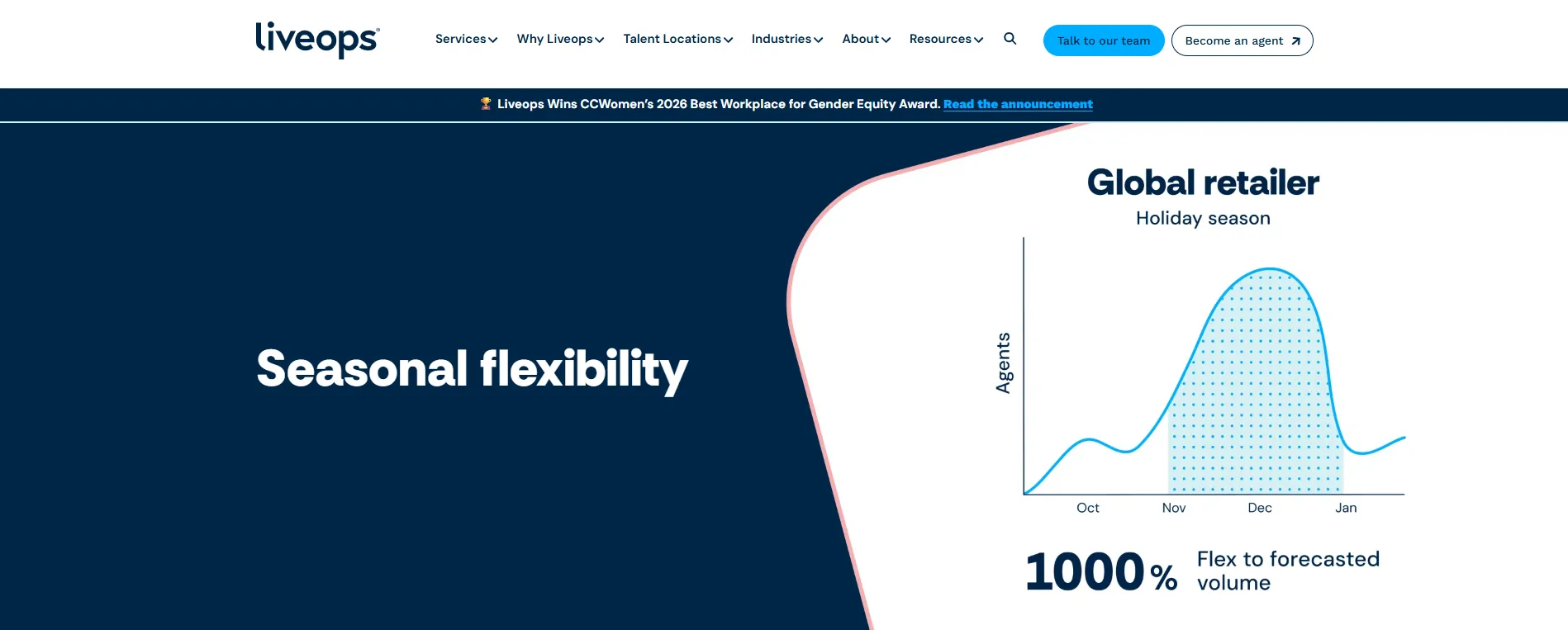
Liveops runs a flexible, on-demand agent model built for exactly the peak-season problem this guide keeps returning to. Its own materials describe ramping service up to 1,000% for seasonal peaks with scheduling in 30-minute increments, so you neither understaff Cyber Monday nor pay for idle seats in February. A published retail engagement describes a global retail client scaling voice and messaging support through experienced US-based agents ahead of a high-volume holiday season, and a sports-apparel brand achieving 300% flexibility during peaks across a seven-year partnership. Pricing follows a pay-per-use model.
Honest limitation: the model centers on voice and messaging surge coverage; retailers outsourcing broad back-office scope pair it with another provider.
8. PartnerHero: best for DTC brands blending AI and human support
Best for: design-conscious DTC brands that want brand-aligned human teams with AI automation handling routine ticket volume.
PartnerHero pairs CX professionals with AI from its parent Crescendo, whose Augmented AI handles routine requests such as returns and shipping updates while humans manage complex issues, with 24/7 coverage in 50+ languages. Its named retail proof includes Lovepop, which relies on PartnerHero through extreme seasonal volume spikes. Crescendo acquired PartnerHero in October 2024, and the combined offer prices AI plus human work as a bundle.
Honest limitation: classic per-agent rates are no longer published following the acquisition, so model the per-resolution economics carefully at your ticket volume.
9. Influx: best entry point for smaller stores
Best for: small and mid-size stores that want managed support live within a week, on month-to-month terms.
Influx runs a follow-the-sun model with 24/7 coverage and an elastic, published month-to-month pricing structure: you pay for the upcoming month of service, with no long-term agent contracts. Its own materials state it keeps at least ten trained agents ready to start within one week, adds 30+ agents in a month across the Americas, APAC, and the EU, and adds 200+ agents with three months’ notice. Retail client work includes Blenders Eyewear, which partnered with Influx to scale and flex fast. Teams plug into all major helpdesks.
Honest limitation: per-agent economics stack linearly, so very high volumes reach enterprise-provider pricing territory without enterprise-provider scope.
Retail Outsourcing Companies at a Glance
| Company | Best for | Peak-scaling proof (self-published) | Delivery footprint | Pricing |
|---|---|---|---|---|
| Helpware | Integrated CX + AI + back office | Pilot to 500+ FTE in 90 to 120 days | 19 locations, 11 countries, 4 continents, 45+ languages | Quote-based |
| TaskUs | Marketplaces, trust and safety | Scales through seasonal and influencer peaks | Global, incl. US and Philippines | Quote-based |
| Teleperformance | Global multilingual scale | Global contact-center network | Global, Paris HQ | Quote-based |
| TTEC | CX tech + operations | Engage operations on six continents | Six continents | Quote-based |
| Peak Support | Digital-first brands | 2,000-person remote-first team | US, Philippines, Colombia, E. Europe, India | Quote-based |
| Global Response | Retail and luxury brands | Long-running retail retention programs | US, Mexico, Philippines, S. Africa, Tunisia | Quote-based |
| Liveops | Seasonal surge coverage | Up to 1,000% ramp, 30-min scheduling | US network + nearshore, offshore | Pay-per-use |
| PartnerHero | DTC brands, AI + human | Lovepop seasonal spike coverage | 24/7, 50+ languages | AI + human bundle |
| Influx | Smaller stores, fast start | 10 agents in a week, 200+ in 3 months | Americas, APAC, EU | Published, monthly |
Which Retail Functions to Outsource First
Start where volume is highest and differentiation is lowest. Four functions dominate retail outsourcing programs.
Customer support. Omnichannel coverage across phone, email, chat, and social is the basics, and it’s the function where outsourced specialists most consistently beat stretched in-house teams. Helpware customer support teams run omnichannel and multilingual programs for retail brands year-round.
Order management and returns. WISMO tickets, order edits, refunds, and returns processing follow repeatable logic, which makes them prime targets for AI-assisted handling.
Back-office operations. Catalog data entry, inventory records, invoice processing, and claims work rarely differentiate your brand, yet they consume headcount that peak season needs elsewhere.
Content moderation. Marketplaces and brands with reviews or user-generated content outsource moderation to keep listings clean and buyers safe without building a specialist team.
Who Should Pick What
- You run a marketplace with trust-and-safety exposure: shortlist TaskUs and Teleperformance.
- Your volume swings 5x between seasons and voice is your main channel: shortlist Liveops.
- You’re a DTC brand under $50M that wants AI handling the routine tickets: shortlist PartnerHero and Influx.
- You need coverage in 20+ language markets: shortlist Teleperformance and TTEC.
- You want one partner across support, AI, back office, and technology, with mid-market attention and enterprise compliance: talk to Helpware. That’s the combination we built the company around, and the reason clients stay an average of five years.
The Bottom Line on Retail Outsourcing Companies
The right retail outsourcing company earns its fee twice: once in the everyday cost per contact, and again in the weeks when your forecast breaks and the partner absorbs it. Rank your shortlist on proof, elasticity, and transparency, then run the six-question stress test before you sign.
If you want to see how an integrated partner handles your specific mix of support, back office, and AI, book a consultation with Helpware. We’ll map your peak-season plan with you, no strings attached.