






Your support queue is growing faster than your team, and every vendor you research describes a different product with the same words. One “SaaS call center solution” is a $30 seat license. Another is a 40,000-person outsourcing firm. Comparing them side by side without a shared definition wastes your evaluation cycle.
Yet the stakes are high and getting it right is crucial. Gartner projects customer service and support spending to reach $47 billion in 2028, with interaction volumes rising 16 percent between 2024 and 2028. Falling behind is expensive: PwC found that 29 percent of customers walk away from a brand after bad customer experience.
A SaaS call center is a cloud-based operation for handling customer calls and conversations, run on subscription software instead of on-premises hardware. SaaS call center solutions come in three forms: software platforms your team operates, outsourced providers that staff the operation for you, and integrated managed solutions combining platform, people, and AI. The top five solutions to consider in 2026 are Helpware, TaskUs, TTEC, Five9, and Aircall, and this guide explains which model each represents and when it fits.
Key takeaways
- A SaaS call center uses cloud-based software to manage customer interactions, with no on-premises hardware required.
- There are three main approaches: using call center software in-house, outsourcing customer support to a CX provider, or choosing a fully managed solution that combines technology and support.
- Helpware is our top pick for integrated managed services for growing and mid-market SaaS companies. TaskUs and TTEC are strong choices for enterprise outsourcing, while Five9 and Aircall lead the software category.
- Software licensing is only part of the total cost. Staffing, training, quality assurance, and day-to-day management usually have a much bigger impact on your budget.
- The right option depends on your business stage. Many companies start with software, then move to a managed or outsourced solution as customer volume, support hours, or compliance needs grow.
What Is a SaaS Call Center?
We mentioned it briefly above, but let’s go deeper. A SaaS (Software as a Service) call center is a cloud-based system for managing inbound and outbound customer conversations through the internet, paid for as a subscription. Calls route over VoIP instead of phone lines, agents work from a browser or app anywhere, and the provider maintains the infrastructure, updates, and security. Nothing is installed on-premises.
How a SaaS call center works
Customer calls arrive over the internet and pass through routing logic, typically an interactive voice response (IVR) menu and automatic call distribution that matches each caller with the right agent. Agents handle conversations in a web workspace connected to the CRM or helpdesk, so customer history appears alongside every call. Supervisors watch queues, listen in, and pull performance analytics in real time. Adding capacity means adding subscriptions, not installing hardware.
Core capabilities to expect
- Call routing and IVR: Menus and skill-based rules that move each caller to the right person fast.
- Omnichannel handling: Voice alongside email, chat, SMS, and social conversations in one workspace.
- CRM and helpdesk integration: Automatic call logging and screen pops with full customer context.
- AI features: Transcription, call summaries, sentiment analysis, QA automation, and virtual agents.
- Analytics and monitoring: Real-time dashboards for queues, agent performance, and customer satisfaction.
- Compliance controls: Encryption, access management, and certifications such as SOC 2, HIPAA, and GDPR readiness where regulated data is involved.
The Three Ways to Run a SaaS Call Center
Here is the distinction most roundups skip. The term “SaaS call center solutions” describes three different types of service, and vendors from all three categories compete for the same search result.
| Model | What you buy | What you operate | When it wins |
|---|---|---|---|
| Software platform (Five9, Aircall) | Licenses per seat | Everything: hiring, training, QA, workforce management | Low volume, simple calls, management bandwidth in-house |
| CX outsourcing provider (TaskUs, TTEC) | An operated service on the provider’s scale | Governance through SLAs and shared metrics | Enterprise volume, global coverage, large multi-site programs |
| Integrated managed solution (Helpware) | Platform, trained team, and AI as one engagement | Strategy and governance; the partner runs daily operations | Scaling companies where volume, coverage, or compliance outrun hiring |
The models are not rivals so much as stages. Many companies start on software, add an outsourced or managed team when hiring can’t keep pace, and keep both running in a hybrid setup.
How We Chose These Five Solutions
We scored candidates on fit for SaaS support and sales workflows, AI capability, scalability and global reach, compliance readiness, total operating cost, and proof of outcomes. The list deliberately mixes all three models so you compare the actual decision, not just software against software.
Our rankings are compiled using publicly available information and objective evaluation criteria. We strive to ensure that every ranking is fair, transparent, and based on the same methodology for all companies.
Top 5 SaaS Call Center Solutions to Consider
| Solution | Model | Best for |
|---|---|---|
| Helpware | Integrated managed solution | Mid-market and scaling SaaS companies wanting platform, people, and AI in one partnership |
| TaskUs | CX outsourcing provider | High-growth tech companies needing digital-first support at large scale |
| TTEC | CX technology and outsourcing | Enterprises pairing contact center technology with outsourced operations |
| Five9 | Software platform | High-volume contact centers staffed in-house |
| Aircall | Software platform | Small and mid-sized teams deploying fast on an existing CRM |
1. Helpware
Helpware is a business process management provider founded in 2015 that runs customer experience operations for 400+ clients, including SaaS companies such as Zendesk and Samsara. The model is integrated: omnichannel customer support, technical support from L1 through L3, and back-office operations, with AI modules for chatbots, voice AI, agent assist, and QA automation built into delivery.
- One integrated partner: Agents, platform, and AI in a single engagement instead of three vendors to stitch together.
- Proven scale: 19 locations across 11 countries, 45+ languages, and growth from a 30-to-60-day pilot to 500+ agents in 90 to 120 days.
- Certified compliance: SOC 2 Type II, ISO 27001, ISO 9001, HIPAA, and GDPR.
- Results that hold: 90 percent CSAT, 86 percent employee satisfaction, and five-year average client partnerships against a one-to-two-year industry norm.
The trade-off is shared control. Therefore, teams set on owning every workflow in-house belong in the software category.
2. TaskUs
TaskUs is a publicly traded (Nasdaq: TASK) provider of outsourced digital services and next-generation customer experience, founded in 2008 and headquartered in Texas. It serves high-growth technology companies across social media, ecommerce, gaming, streaming, fintech, and healthtech.
- Digital-native scale: Roughly 47,000 people across 28 locations in 13 countries as of late 2023.
- Trust and safety depth: Content moderation and platform-protection work alongside omnichannel customer and technical support.
- AI-equipped delivery: Agents work with the AssistAI knowledge assistant built on the company’s own TaskGPT platform.
For platforms with heavy user-generated content or very large support volumes, TaskUs brings operational depth few providers match. On the flip side, since engagements skew toward larger programs, earlier-stage companies often find the entry threshold high.
3. TTEC
TTEC (Nasdaq: TTEC) is one of the largest global customer experience companies, founded in 1982 and serving 750+ clients with employees across six continents. Its two-segment structure is the differentiator.
- TTEC Digital: Designs, builds, and operates contact center technology, CRM, AI, and analytics solutions.
- TTEC Engage: Staffs customer engagement, tech support, back-office, and fraud prevention operations.
- Platform coverage: Managed services for contact center stacks from Amazon Web Services, Cisco, Genesys, Google, and Microsoft.
That pairing suits enterprises that want one partner across both the technology layer and the outsourced operation. The scale that makes TTEC strong for global enterprise programs also makes it a heavier match for smaller, fast-moving SaaS teams.
4. Five9
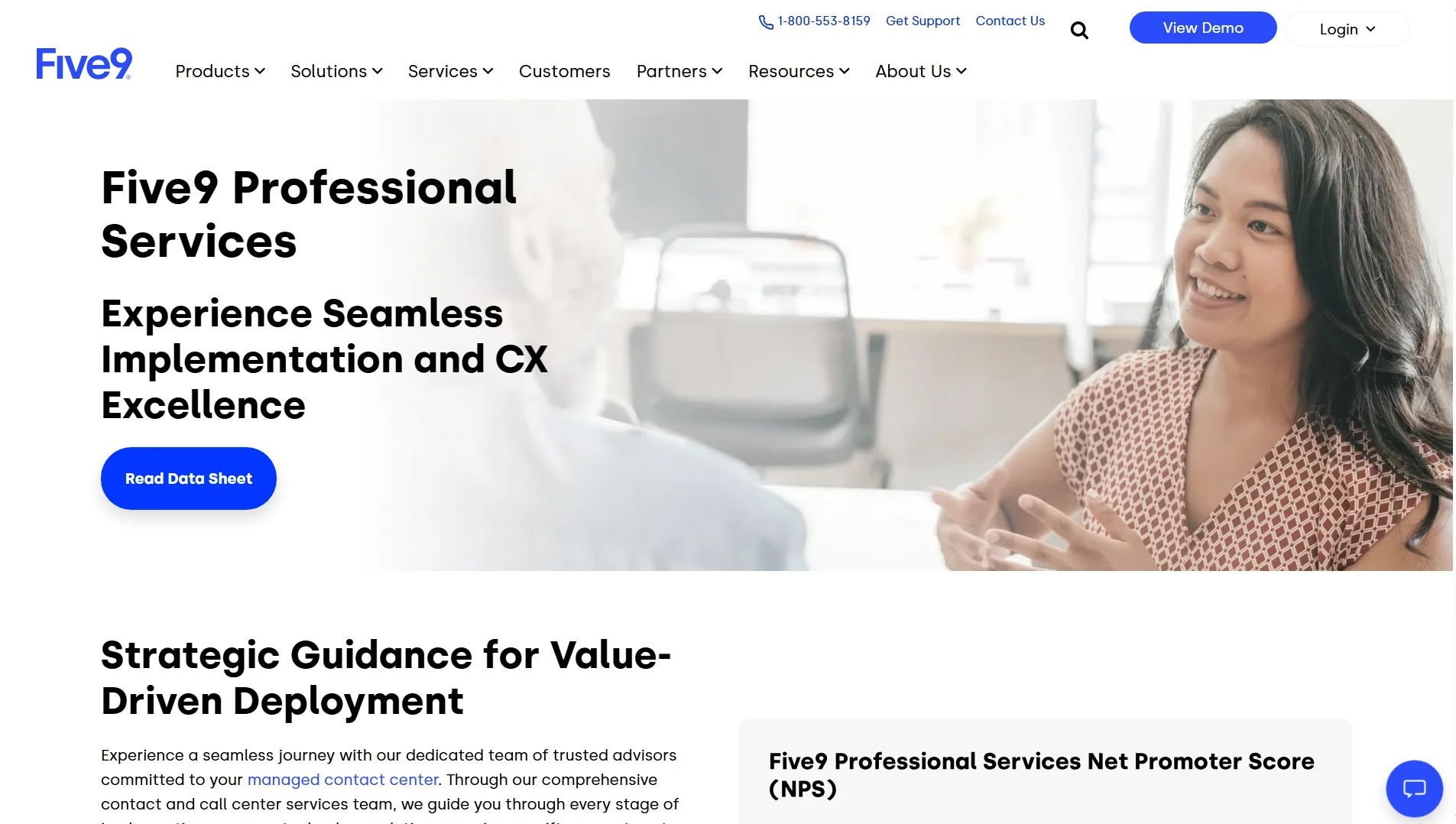
Five9 is a cloud contact center platform for inbound, outbound, and blended operations that your own team staffs and runs.
- AI automation: Intelligent Virtual Agents absorb routine interactions before they reach a person.
- Enterprise tooling: Predictive dialing plus workforce management for forecasting and scheduling.
- CRM connectors: Pre-built integrations for Salesforce, ServiceNow, Microsoft Dynamics, Oracle, and Zendesk.
- Pricing: From $119 (Digital) and $159 (Core) per seat per month with a 50-seat minimum, as of July 2026.
Five9 rewards genuine enterprise scale and its seat minimum rules out small teams by design.
5. Aircall
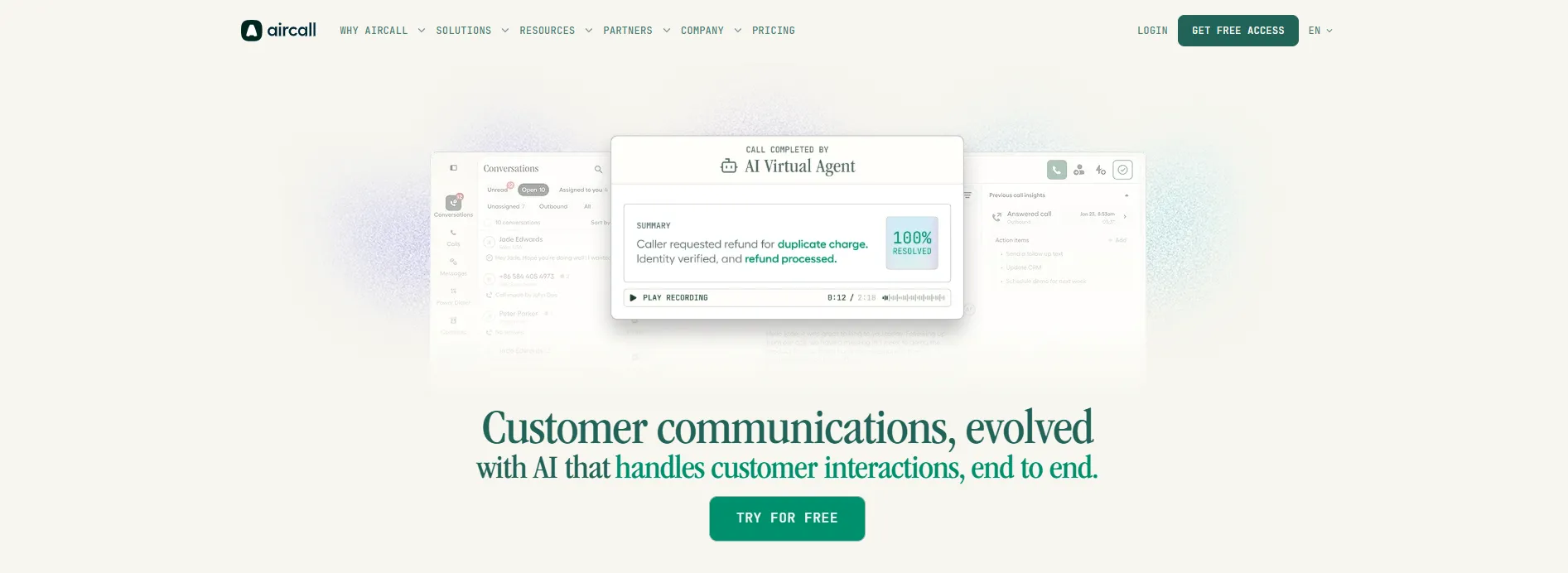
Aircall is a cloud phone system for small and mid-sized teams that runs in the browser and on mobile with no hardware.
- Speed to live: Numbers, routing, IVR, and shared call inboxes are ready within days.
- Integration depth: 100+ connections across CRM, helpdesk, and ecommerce tools.
- Built-in coaching: Call whispering and live monitoring for supervisors.
- Pricing: Essentials at $30 and Professional at $50 per user per month billed annually, with a three-license minimum, as of July 2026.
It is the fastest route to a professional call operation when your CRM is already the system of record and call volume stays manageable in-house.
More solutions worth a look
Three software platforms narrowly missed this shortlist and deserve a mention. CloudTalk fits growing SMB teams going global, with local numbers in 160+ countries and plans from $19 to $49 per user per month billed annually. Dialpad brings the strongest native AI in the software category, with real-time transcription and sentiment analysis on every call from $80 per user per month. Nextiva consolidates voice, chat, SMS, and social conversations into one inbox from $15 per user per month billed annually. All prices as of July 2026, check them at the time of reading.
How to Choose Between SaaS Call Center Solutions
- Name your model first. Decide between software, outsourced, or integrated before comparing vendors. Cross-model feature comparisons mislead.
- Price the operation, not the license. Within the software category, agent salaries, recruiting, training, QA, and support operations add to the per-seat price. In the managed services, one fee usually covers the stack.
- Check compliance before the demo. Regulated data narrows the field fast. Request SOC 2 and ISO reports up front from any provider.
- Test the scaling story. Ask every vendor the same question: what happens when volume doubles in a quarter? Software answers with seats, and outsourcing and managed partners answer with people.
Specialists working in the industry often have a hard time choosing from the sea of options, which have led them to learn to look deeper than what’s on the surface of the offer. Here’s one comment from a relevant Reddit thread:

“Keep an eye on call quality, flexibility with devices and integrations, and how customizable their call flows are. Some systems make routing changes easy, others don’t. Also check their porting and SMS registration process, that’s where a lot of providers fall short.”
If you find integrated managed solutions suitable for your business, you can contact Helpware for a quote based on your specific needs.
The Bottom Line
A SaaS call center is the cloud-based way to run customer conversations, and the solution behind it is a bigger decision than a software license. Five9 and Aircall equip teams that staff their own operation. TaskUs and TTEC run operations at enterprise scale. Helpware combines the platform, the people, and the AI in one accountable engagement built for companies still scaling.
If your queue is growing faster than your hiring plan, talk to our CX team. We offer a 30-to-60-day pilot around your actual volume, channels, and compliance requirements, then prove the numbers before you commit.