








Most healthcare organizations watch their denial rate but miss another number that matters: how many denied claims your team never works at all.
About 15 percent of claims are denied the first time they go out. Hospitals spend close to $19.7 billion a year appealing them, and only about half those appeals succeed, according to HFMA.
Prior authorization follows the same pattern. In 2024, Medicare Advantage insurers denied 4.1 million requests. Only 11.5 percent were appealed. But 80.7 percent of the appeals that were filed got overturned, in full or in part, KFF reports.
Most denied claims are worth appealing, yet some never get appealed, because nobody has the time. It’s echoed across the industry:

“The cost to insurance is negligible. The cost in time to doctors is very much not negligible.
Writing the prior auth. Receiving denial. Writing the dispute. Faxing it. Calling to confirm receipt. Calling again after hunting for the right number. Calling again in a week to follow up. Telling them yes I did fax it and they confirmed receipt, and I have a name and time. Arranging the peer to peer.
It’s a stupid time sink and it’s intended that way.”
And the volume keeps rising. In the Experian Health State of Claims 2025 survey, as reviewed by Business Wire, 41 percent of providers said at least 10 percent of their claims were denied. In 2022, that figure was 30 percent.
The right denial management partner depends on where your denials originate and what kind of work is needed to recover them. That is why the providers below are assessed by the types of denials they handle, the expertise they bring, and the operational gaps they can fill.
If you run a telehealth or digital health operation and your denials start with eligibility, insurance verification, prior authorization, or credentialing, Helpware ranks first here. If you fight large clinical denials that need doctors and attorneys to review them, Aspirion would be your best fit. For complex claims and payer underpayments, Revecore. Below you get ten denial management companies ranked, the criteria we used, a scorecard for testing any vendor, and what each pricing model costs.
Key Takeaways
- More than 80 percent appealed Medicare Advantage denials get overturned. The barrier is staff time, not whether the claim is valid.
- Denial management covers two different jobs: fixing claims after they are denied and stopping denials before they happen. Most vendors do the first and describe it as the second.
- The right partner depends on your setting. Hospital clinical denials, physician group volume, and telehealth eligibility problems need three different approaches.
- Pricing models differ, and each one rewards different vendor behavior. Ask how your vendor gets paid before you sign.
- Use the ten-question scorecard below to tell real prevention work from ordinary rework.
Our rankings are compiled using publicly available information and objective evaluation criteria. We strive to ensure that every ranking is fair, transparent, and based on the same methodology for all companies.
How We Ranked These Providers
We scored every provider against six weighted criteria. The same criteria applied to Helpware and to every competitor.
| Criterion | Weight | What It Measures |
|---|---|---|
| Prevention depth | 25% | Whether the provider staffs or automates work before the claim is submitted: eligibility, registration, prior authorization, coding review, credentialing |
| Appeal and recovery | 20% | Strength on clinical, technical, and administrative appeals, including doctor or attorney review for large denials |
| Root-cause analytics | 15% | Whether denial data leads to real changes in front-end workflow, broken out by payer, CPT code, provider, and service line |
| Compliance and security | 15% | HIPAA, SOC 2, ISO 27001, HITRUST, and similar attestations |
| Pricing transparency | 15% | Whether pricing is published or clearly explained before you sign |
| Setting and specialty fit | 10% | Match to hospital, physician group, telehealth, or enterprise environments |
Prevention carries the most weight for one reason. Reworking a denial recovers one claim. Fixing the process that caused it will stop all similar ones in the future.
Research from Deloitte, cited by HFMA above, found that automated claim scrubbing and predictive validation prevent up to 85 percent of avoidable denials and cut administrative cost per claim by roughly 25 percent.
The 10 Denial Management Companies at a Glance
| Company | Best For | Where They Work in the Claim Lifecycle | Typical Pricing Model |
|---|---|---|---|
| Helpware | Telehealth and digital health providers that need prevention staffed upstream | Before submission: eligibility, verification, prior auth, credentialing | Per-FTE managed teams |
| Aspirion | Complex clinical denials at hospitals | After denial: clinical and legal appeals | Contingency |
| Revecore | Complex claims and payer underpayments | After denial: specialty recovery | Contingency |
| R1 RCM | Large health systems that want full-cycle outsourcing | End to end | Managed services |
| Ensemble Health Partners | Hospital revenue cycle outsourcing | End to end, central business office | Managed, incentive-based available |
| Waystar | Technology-led denial prevention | Pre-submission edits plus denial workflow | Platform subscription |
| athenahealth | Practices that want denials handled inside the EHR | Built into the whole cycle | Percentage collections |
| Omega Healthcare | High-volume denial and A/R work at scale | After denial: A/R follow-up | Per-FTE or per-transaction |
| GeBBS Healthcare Solutions | Coding-driven prevention at scale | Coding and A/R | Per-FTE or per-transaction |
| Plutus Health | Mid-sized practices that want automation and clear pricing | After denial, with RPA support | Percentage collections |
The 10 Providers in Detail
1. Helpware: Best for Telehealth and Digital Health Denial Prevention

Helpware runs back-office healthcare operations, with presence across four continents for around-the-clock coverage in 45+ languages. Teams handle claims processing, insurance verification, and provider credentialing—the points where most preventable denials begin. Healthcare clients include Headspace, HealthComp, and NexHealth. We integrate with Epic, Oracle Health, and athenahealth, and hold HIPAA and SOC 2 Type II attestations.
Best for: telehealth and digital health providers whose denials start upstream, at eligibility, insurance verification, prior authorization, or credentialing.
Where we are weaker: Helpware provides operational teams, not denial analytics or automated workflows, so it is usually paired with a separate RCM platform.
2. Aspirion: Best for Complex Clinical Denials
Aspirion works only on denials. Clinicians, coders, and attorneys work together to overturn clinical, technical, and administrative denials for hospitals. Its AI tools flag gaps in documentation and model payer contracts, so the team catches underpayments that in-house billing staff usually miss. Reported credentials include Best in KLAS Denials Management in 2024 and 2025, HITRUST r2 certification, and coverage in 45 states.
Best for: hospitals fighting complex clinical denials that need clinician and attorney review.
Where they are weaker: the model is built for hospital-scale, high-value denials. Smaller practices rarely reach the volume that makes it work.
3. Revecore: Best for Complex Claims and Underpayments
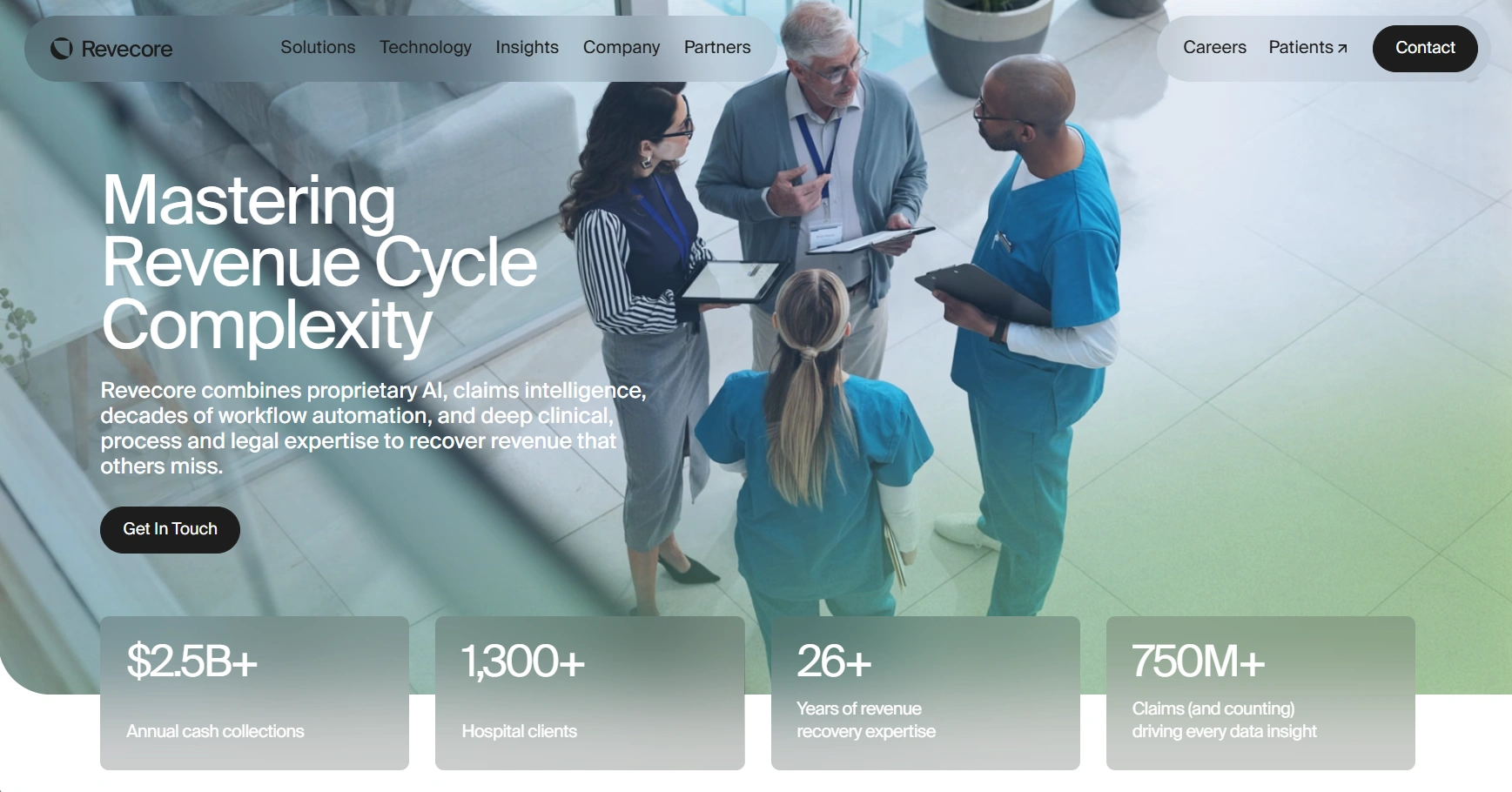
Revecore takes the claims most billing teams avoid: motor vehicle accident, workers compensation, and other complex reimbursement categories. Its ReClaim platform pairs a rules engine with machine learning to spot underpayments and denial patterns before they repeat across a health system. Reported credentials include repeated Best in KLAS wins for Complex Claims and Underpayment Recovery, and HFMA Peer Review status. Public sources describe close to 1,200 hospital clients across 45 states.
Best for: hospitals with complex claims and payer underpayments, including motor vehicle accident and workers compensation.
Where they are weaker: narrow by design. Routine commercial denials sit outside the specialty.
4. R1 RCM: Best for Large Health Systems
R1 RCM runs one the largest end-to-end revenue cycle businesses in the United States. Its AI platform prioritizes denial work, gathers documentation automatically, and reads payer contracts, all inside a full outsourcing model built for hospital claim volume.
Best for: large health systems that want denial work handled inside full-cycle outsourcing.
Where they are weaker: denial management arrives inside a broad outsourcing relationship. Buying denial work on its own is not the usual route.
5. Ensemble Health Partners: Best for Hospital Revenue Cycle Outsourcing
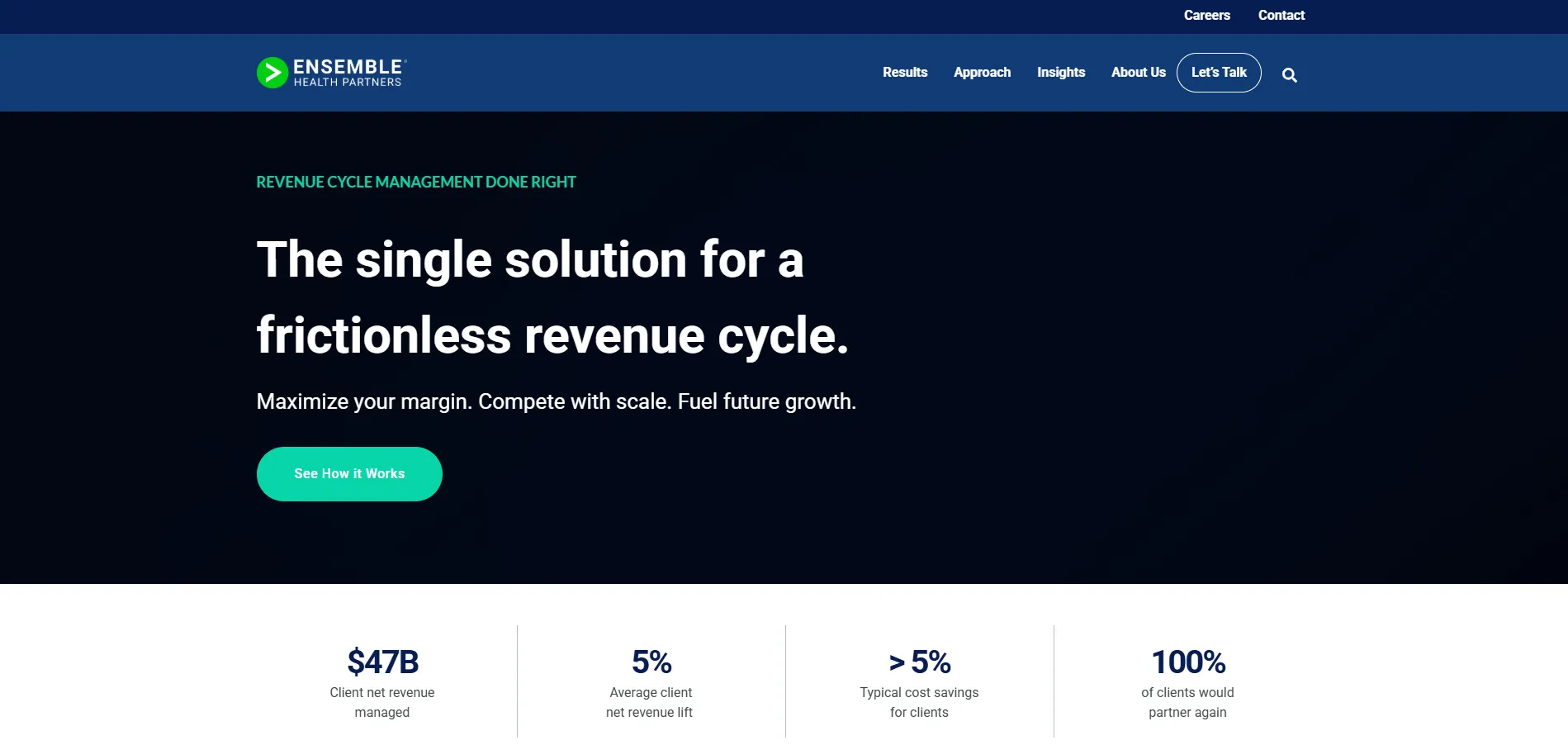
Ensemble Health Partners folds denial and underpayment recovery into a central business office model. Its analytics trace each denial back to a root cause, and its EIQ tool reads the medical record to flag denial risk inside existing workflows. Client satisfaction scores rank among the strongest in the category.
Best for: health systems outsourcing the revenue cycle to a central business office model.
Where they are weaker: built for health systems. Ambulatory and digital health organizations fall below the target size.
6. Waystar: Best for Technology-Led Denial Prevention

Waystar took the top overall spot in the Black Book Q1 2026 Agentic and Generative AI RCM Benchmark, across 20 qualifying vendors. The platform runs more than 1,000 claim edits before submission and connects to every major EHR.
Best for: organizations with billing staff already in place that want prevention built into claim submission.
Where they are weaker: Waystar is a platform, not a service. You still need billing staff or a services partner to run it.
7. athenahealth: Best for Denials Handled Inside the EHR

Athenahealth runs a cloud-based EHR and revenue cycle platform on a network model, so billing rules and payer intelligence update across every client at once. Performance-based pricing is available for some clients. That suits ambulatory practices that want denial work built into the record.
Best for: ambulatory practices that want denial management built into the EHR.
Where they are weaker: the denial capability comes with the platform. If you plan to keep your current EHR, this option is out.
8. Omega Healthcare: Best for High-Volume A/R and Denial Work
Omega Healthcare runs one the larger global revenue cycle outsourcing workforces in the industry, with staff across the United States, India, and the Philippines. It handles high-volume denial and A/R workflows for hospitals and large practice groups that need throughput above everything else. Everest Group named it a Leader in its 2023 RCM Operations PEAK Matrix assessment.
Best for: hospitals and large practice groups that need high-volume denial and A/R throughput.
Where they are weaker: scale, not specialization. Specialty denial nuance is not among core strengths.
9. GeBBS Healthcare Solutions: Best for Coding-Driven Prevention

GeBBS Healthcare Solutions pairs a large certified coding workforce with its own iAR platform. The platform routes denied and aging claims to the right specialist and keeps claims inside payer filing windows at hospital volume. Everest Group also names GeBBS a Leader in RCM operations.
Best for: organizations whose denials come mainly from coding and documentation errors.
Where they are weaker: strongest where denials come from coding. Eligibility and authorization failures get less coverage.
10. Plutus Health: Best for Mid-Sized Practices That Want Clear Pricing
Plutus Health brings automation-heavy denial work to practices too small for enterprise revenue cycle firms. RPA bots and Lean Six Sigma workflows speed up appeals, and the teams specialize in behavioral health, cardiology, and free-standing emergency billing. Pricing runs as a percentage collection with no upfront setup fee.
Best for: mid-sized practices that want automation-led denial work and clear pricing.
Where they are weaker: limited depth for hospital-grade clinical appeals.
The Prevention Scorecard: 10 Questions That Separate Real Prevention from Rework
Every vendor says it does root-cause analysis, but the claim is just that, a claim. Ask these ten questions in the demo and give one point for each answer in the right-hand column. A score below six means you are buying rework with a dashboard attached to it.
| Ask This | Rework-Only Answer | Real Prevention Answer |
|---|---|---|
| Which staff sit before claim submission? | “Our analysts review denials daily” | Named roles at registration, eligibility, prior auth, or credentialing |
| What share of denials do you prevent versus recover? | Recovery rate only | Both numbers, tracked separately |
| Who changes the front-end process when you find a root cause? | “We report it to you” | A named owner and a set schedule |
| Show me a denial trend that stopped repeating. | A general case study | A specific payer, CARC code, and before-and-after volume |
| Do you handle prior authorization? | “We appeal auth denials” | Submits and tracks authorizations before service |
| How do you handle credentialing denials? | Not covered | Runs or coordinates credentialing directly |
| What is your eligibility verification hit rate? | No number | A measured rate with a denominator |
| How does your reporting break denials down? | Total count | By payer, CPT code, provider, and service line |
| How fast does a new payer rule reach your workflow? | “We monitor changes” | A stated turnaround, in days |
| What happens to your fee if denials drop? | Revenue falls, no answer | Names the tension and explains the model |
Question 10 tells you the most. A pure contingency vendor earns more when denials rise. And while that is not a reason to avoid contingency pricing, it is a reason to ask how the vendor handles the conflict.
Which Model Fits Your Organization
Here is a short list to help narrow down the selection of vendors.
Hospitals and health systems. Large clinical and technical denials need doctor and attorney review, plus recovery on contract underpayments. Aspirion and Revecore build their whole model around this and back it with independent validation.
Enterprise full-cycle outsourcing. Systems that want denials folded into the whole revenue cycle need scale and platform depth. R1 RCM, Ensemble Health Partners, and Omega Healthcare place denial recovery inside broader operations.
Telehealth and digital health. Denials here cluster upstream: eligibility failures, multi-state licensing and credentialing gaps, prior authorization for virtual visits, and payer rules that change state by state. This calls for staff at the front end, not an appeals team at the back. Helpware built its healthcare practice around exactly this work.
Physician groups and mid-sized practices. These practices need fast responses and clear pricing more than enterprise tooling. Plutus Health and athenahealth fit here, the first as a service, the second as a platform.
Technology-first buyers. Organizations with billing staff already in place and a tooling gap want prevention built into submission. Waystar leads on pre-submission edits, GeBBS brings coding-driven automation at scale.
What Denial Management Actually Costs
There are four main pricing models on the market, and each suits different vendor behaviors. Use these structures to negotiate.
| Model | How It Works | What It Rewards | What to Watch |
|---|---|---|---|
| Contingency | A percentage of what the vendor recovers | High appeal volume | No reason to reduce denials, so ask how prevention gets funded |
| Per-FTE managed team | A monthly rate per dedicated staff member | Steady capacity and upstream work | Cost tracks headcount, not results. Agree on productivity metrics upfront |
| Percentage collections | A percentage of total collections, not just recovered denials | Alignment with overall revenue | Bundles denial work into a wider scope. Isolate what you are buying |
| Per-claim or per-transaction | A flat fee per claim touched | Throughput and predictable volume | Rewards touches, not resolutions. Cap or measure repeat touches |
Weigh those fees against what fighting denials already costs you. In 2023, hospitals spent an average of $57.23 in administrative costs on each denied claim they fought, up from $43.84 the year before, according to a Premier survey of 280 hospitals in 23 states. Premier notes that labor accounts for about 90 percent of claims processing costs. That is why the pricing model matters: most of what you pay for is staff time.
Ready to Find Where Your Denials Start?
Most denied revenue is recoverable. The obstacle is staff time, not the merit of the claim. If your denials trace back to eligibility, verification, prior authorization, or credentialing, that work belongs upstream, where it gets staffed, measured, and fixed at the source.
Talk with our healthcare operations team about where your claims break down.