







Take this scenario: a user uploads a violent video overnight, but your in-house moderation queue doesn’t open until morning. By the time your team sees it, thousands of people have watched it, shared screenshots, and tagged your brand. For image, video, and live content, even a short gap in coverage can become a visible problem for the platform and its users.
Users are increasingly aware of those risks. In Deloitte’s 2024 Connected Consumer Survey, 37% of US respondents said they worried that their digital activity could expose them to harmful content or people. At the same time, AI-generated content is making it harder to know what can be trusted online. Deloitte’s 2025 Connected Consumer findings found that 74% of respondents familiar with generative AI said its growing use makes it harder to trust what they see online.
The scale of the problem is visible in the moderation data itself. Researchers recorded 353.12 million moderation records submitted by the eight largest social platforms during the first 100 days of the EU DSA Transparency Database. That volume shows why moderation can’t rely on a single queue, a single detection method, or human review alone.
This guide compares 10 UGC moderation providers across managed teams and moderation APIs. You’ll see which providers cover image, video, audio, and live content, where human review fits alongside automated detection, and what to ask about 24/7 coverage, languages, moderator wellness, compliance, and time to action. We’ve also broken down the criteria used to compare them, so you can apply the same framework to your own vendor shortlist and decide where automation, human review, or a combination of both makes the most sense.
Key Takeaways
- 10 providers were compared across two groups: Helpware, TaskUs, Teleperformance (TP), Concentrix, TELUS Digital, WebPurify, and Besedo for managed moderation teams, plus Hive, Sightengine, and Microsoft Azure AI Content Safety for moderation APIs.
- Human moderators handle the cases AI can’t reliably resolve, including context, satire, cultural nuance, severe-harm decisions, and appeals. APIs are useful for screening large volumes quickly and routing flagged content to human review.
- Content type matters when choosing a provider. Image and recorded video are widely supported, while audio and live-stream moderation have more gaps. These capabilities should be confirmed before signing.
- 24/7 coverage needs to be verified, not assumed. Staffing should cover every language and content type around the clock, with a clear time-to-action SLA for live content, plus plans for holidays, surges, and moderator wellness.
- The comparison uses seven criteria: modality coverage, human + AI workflow, 24/7 and language coverage, compliance and security, moderator wellness, reporting and transparency, and onboarding flexibility.
- The right setup depends on the platform. Smaller teams can start with an API and add human review as volume or complexity grows, while platforms handling live streams, voice, marketplaces, or high-risk content may need managed moderation from the start.
- A hybrid model can cover both speed and judgment: AI handles the first pass at scale, while trained human reviewers handle uncertain, high-severity, and context-heavy cases.
UGC Moderation Services at a Glance: 10 Providers Compared
The table below summarizes the capabilities each provider publishes on its own website or documentation
| Provider | Type | Best for | Content types confirmed on official site | Scale or delivery fact |
|---|---|---|---|---|
| Helpware | Managed team + AI-assisted | Image, video, and live stream review with human judgment | UGC, image and video screening, video, live streams, chat, community | 19 locations, 45+ languages |
| TaskUs | Managed team | High-risk social, gaming, and GenAI safety | Live and recorded content, listings and ads, GenAI outputs | 30+ languages |
| Teleperformance (TP) | Managed team | Global enterprise trust and safety programs | Content moderation, GenAI red teaming, ID verification, fraud | Teams in close to 100 countries |
| Concentrix | Managed team | Multimedia and immersive platform moderation | Multimedia UGC, reviews, virtual environments | 250+ clients, 20+ languages |
| TELUS Digital | Managed team | Player communities and ad review | Comments, images, links, live events, voice | 35+ countries, 50+ languages |
| WebPurify | Managed team + API | Apps that want an API and live reviewers from one vendor | Text, images, video, live broadcasts | No crowdsourced reviewers |
| Besedo | Platform + human team | Marketplaces, classifieds, and dating | Text, images, video, chat | 100+ languages |
| Hive | API | Multimodal and AI-generated media detection | Images, video, livestreams, audio, deepfakes | Stream sampling at 1 FPS by default |
| Sightengine | API | Developer teams starting small | Images, video, live streams, audio, deepfakes | Free plan for testing |
| Azure AI Content Safety | API | Microsoft cloud teams and GenAI apps | Text, images, text-plus-image | Images up to 4 MB |
How We Scored Image, Video, and UGC Moderation Providers
We scored each provider against seven weighted criteria, using the same evidence requirements for every company. The framework can also be used as a starting point for your own vendor scorecard.
| Criterion | Weight | What we looked for |
|---|---|---|
| Modality coverage | 25% | Published support for image, video, audio, and live content |
| Human + AI workflow | 20% | Clear escalation from automated flags to trained reviewers |
| 24/7 and language coverage | 15% | Published language counts and round-the-clock staffing |
| Compliance and security | 15% | Named certifications and data handling rules |
| Moderator wellness | 10% | Documented programs for reviewers exposed to harmful content |
| Reporting and transparency | 10% | Audit trails that fit DSA-style reporting |
| Onboarding flexibility | 5% | Pilots, API trials, or free plans |
We used only publicly available information from official provider websites and documentation, then applied the same criteria and evidence requirements to every provider.
The Moderation Routing Map: What AI Flags and Humans Review
AI can quickly flag obvious violations across large volumes of content, but it can’t reliably make every moderation decision on its own. The key is deciding what the API can clear automatically and what should go to a trained reviewer.
| Content type | AI first pass handles | Human review | Ask your vendor |
|---|---|---|---|
| Images | Nudity, weapons, gore, hate symbols | Art, medical, news, or breastfeeding context | “What confidence threshold routes an image to review?” |
| Recorded video | Frame-level flags with timestamps | Satire, fast cuts, or context outside the flagged frame | “How many frames per second do you sample?” |
| Live streams | Sampled frames and audio segments | Any high-severity flag during a live broadcast | “What is your time to action on a live flag?” |
| Audio and voice | Transcribed profanity and hate speech | Slang, coded language, or non-English speech | “Which languages does speech moderation cover?” |
| Text in images and memes | OCR text extraction | Irony, dog whistles, and in-group references | “Do you moderate text inside images?” |
| AI-generated media | Deepfake and synthetic media scores | Impersonation reports and appeals | “Who reviews a disputed deepfake flag?” |
Why it matters: Defining the handoff before signing helps prevent your API and moderation team from reviewing the same content twice. Our guide to human-in-the-loop AI solutions explains the model in more depth.
If you’re still deciding whether outsourcing makes sense, our guide to content moderation outsourcing pros and pitfalls covers the tradeoffs around cost, quality control, and data security.
Managed UGC Moderation Services: 7 Teams for Image and Video Review
1. Helpware: best overall for AI-assisted human moderation

Best for: Mid-market and enterprise platforms that need trained reviewers for image, video, and live content, with AI handling the initial screening.
Helpware combines AI-assisted detection with trained human moderators who review the content that needs more context or judgment. Through its content security and moderation services, teams review images and video, oversee UGC, manage chat, and moderate live streams. That makes the model useful for platforms where moderation can’t stop at a simple yes-or-no classification.
The delivery model is designed for global coverage, too. Helpware provides multilingual support in 45+ languages from 19 locations across four continents, while its hub-and-spoke model combines onshore, nearshore, and offshore teams for 24/7 coverage. AI flags harmful content first, while moderators handle region-specific context and higher-risk cases.
That human layer also connects to Helpware’s broader data operations. Its AI data annotation and LLM training teams build labeled datasets and support AI model training, giving the moderation operation a way to feed human decisions back into the systems doing the first-pass detection.
The operation is backed by SOC 2 Type II, ISO 27001, ISO 9001, HIPAA, GDPR, and PCI DSS, along with an 86% employee satisfaction rate and a five-year average client partnership.
Bottom line: Helpware fits platforms that need human judgment across image, video, and live content, while also wanting one partner for moderation, support, and data operations.
2. TaskUs: best for high-risk social, gaming, and GenAI safety
Best for: Social, gaming, and marketplace platforms dealing with severe-harm content, as well as companies building GenAI products.
TaskUs approaches moderation as part of a broader trust and safety operation rather than as a standalone content queue. Its social media moderation practice covers 30+ languages, and the company reports 24/7 moderation of both live and recorded content in its UGC moderation case study.
That becomes particularly relevant when the content being reviewed is difficult or potentially traumatic. TaskUs uses safety consultants to train and coach moderators who handle severe-harm categories, alongside a frontline well-being model designed to support the people doing that work. For marketplaces, the same operation can extend into identity verification, listing and ad moderation, and scam response.
TaskUs also works with AI companies on GenAI safety. Human reviewers can assess AI-generated outputs against a company’s policies, creating a human layer for cases where automated enforcement alone isn’t enough.
Bottom line: TaskUs is particularly relevant when severe-harm moderation, moderator well-being, and GenAI safety all need to sit within the same trust and safety program.
3. Teleperformance (TP): best for global enterprise trust and safety
Best for: Enterprise platforms that want moderation, fraud prevention, and GenAI safety under one global program.
Teleperformance, or TP, takes a broad approach to trust and safety. Its trust and safety services combine human and AI systems across content moderation, red teaming, identity verification, fraud prevention, and generative AI safety evaluations. For a large platform, that means moderation can sit alongside other forms of digital risk management instead of being managed as a separate operation.
Its global footprint is a major part of that model. TP has multilingual teams in close to 100 countries, which supports programs that need coverage across multiple markets rather than a single language or region. The company has resilience programs for moderators and uses QA and calibration processes to keep decisions consistent across teams and shifts.
Bottom line: TP makes the most sense for large, multinational programs where content moderation needs to connect with fraud, identity, and GenAI safety operations.
4. Concentrix: best for multimedia and immersive platforms
Best for: Global platforms moderating reviews, multimedia UGC, and virtual or gaming environments.
Concentrix goes beyond traditional social content moderation by combining UGC review with trust and safety work across reviews, profiles, and immersive environments. Its trust and safety practice covers multimedia UGC as well as virtual and immersive experiences, making it relevant to platforms where users interact through more than a standard feed.
The same operation can also address fraud. Concentrix analyzes profiles and interactions to identify suspicious behavior and prevent scams, while its moderators support programs across 20+ languages and 250+ clients, according to the company’s published materials.
Its focus on immersive platforms is particularly useful for gaming and virtual environments, where moderation often involves understanding interactions rather than simply identifying individual pieces of content. Concentrix also says its moderators are members of the Trust & Safety Professional Association.
The main constraint is language coverage. With 20+ languages published, Concentrix has a narrower stated language footprint than several of the other managed providers in this comparison.
Bottom line: Concentrix is worth considering when moderation extends beyond conventional UGC into reviews, profiles, gaming, and virtual environments.
5. TELUS Digital: best for player communities and ad review
Best for: Games, short-form video, and social platforms with high-volume, multilingual moderation needs.
TELUS Digital combines content moderation with a wider set of platform integrity tools. Its content moderation solutions are delivered across 35+ countries and 50+ languages, with moderator wellness programs built into the delivery model.
For gaming and social platforms, the offering extends beyond removing individual pieces of content. TELUS Digital also works with user risk scoring, watchlists, ad review, and other tools designed to identify risky behavior across a platform. In one games platform case study, the company added voice moderation and moderation appeals to the program, giving players a way to challenge decisions as well as expanding coverage into voice interactions.
That combination makes TELUS Digital particularly relevant for communities where moderation isn’t limited to text and images. Voice, appeals, and user-level risk signals can all become part of the same operation.
Bottom line: TELUS Digital fits gaming and social communities where multilingual coverage, voice moderation, appeals, and broader platform-risk signals all matter.
6. WebPurify: best for an API and live reviewers from one vendor

Best for: Social, dating, and live broadcast apps that want to start with automated moderation and add human review without changing providers.
WebPurify takes a more flexible approach to moderation delivery. Its profanity, image, and video moderation products can be accessed through an API, while its live moderation teams can work inside a client’s existing tools. That gives smaller platforms a relatively straightforward path from automated screening to human review as their moderation needs grow.
The same model extends to live broadcasts. WebPurify describes near-real-time moderation of images, video screen grabs, and text, so the service isn’t limited to content that can be reviewed after publication.
The company also takes a specific position on how its human review operation is staffed. WebPurify doesn’t use crowdsourced reviewers and doesn’t retain client content, with content submitted through URLs for review rather than being stored or shared.
Bottom line: WebPurify is a practical option for apps that want an API today but may need live human moderation as their content volume and risk increase.
7. Besedo: best for marketplaces, classifieds, and dating
Best for: Marketplaces and dating platforms where fake listings, scams, and fake profiles are a major moderation concern.
Besedo is built around the kinds of problems that don’t always look like traditional content violations. The company combines AI trained on more than 20 years of data with expert moderators to identify fake listings, scams, suspicious profiles, and attempts to move users off-platform.
Its content moderation API covers text, images, and video, with custom filters that can escalate uncertain cases to human moderators. Besedo’s AI can moderate content in milliseconds, including a 50 ms response time for chat, while human reviewers handle more complex cases within minutes.
That combination is particularly useful for marketplaces and dating platforms, where a single suspicious listing or profile can involve several signals at once. Besedo also supports 100+ languages and full GDPR compliance, giving the service a broad geographic reach.
Bottom line: Besedo is a strong specialist option when fake listings, scams, and suspicious profiles are central to the moderation problem.
UGC Moderation APIs: 3 Tools for Automated Image, Video, and Audio Screening
APIs don’t replace a moderation team. They screen large volumes of content, identify likely violations, and help determine which items need human review. The three tools below take different approaches to that workflow, so the right choice depends on the content types you need to screen and how much human review you plan to add.
8. Hive: best for multimodal and AI-generated media detection
Best for: Platforms that need image, video, livestream, and audio screening from one vendor.
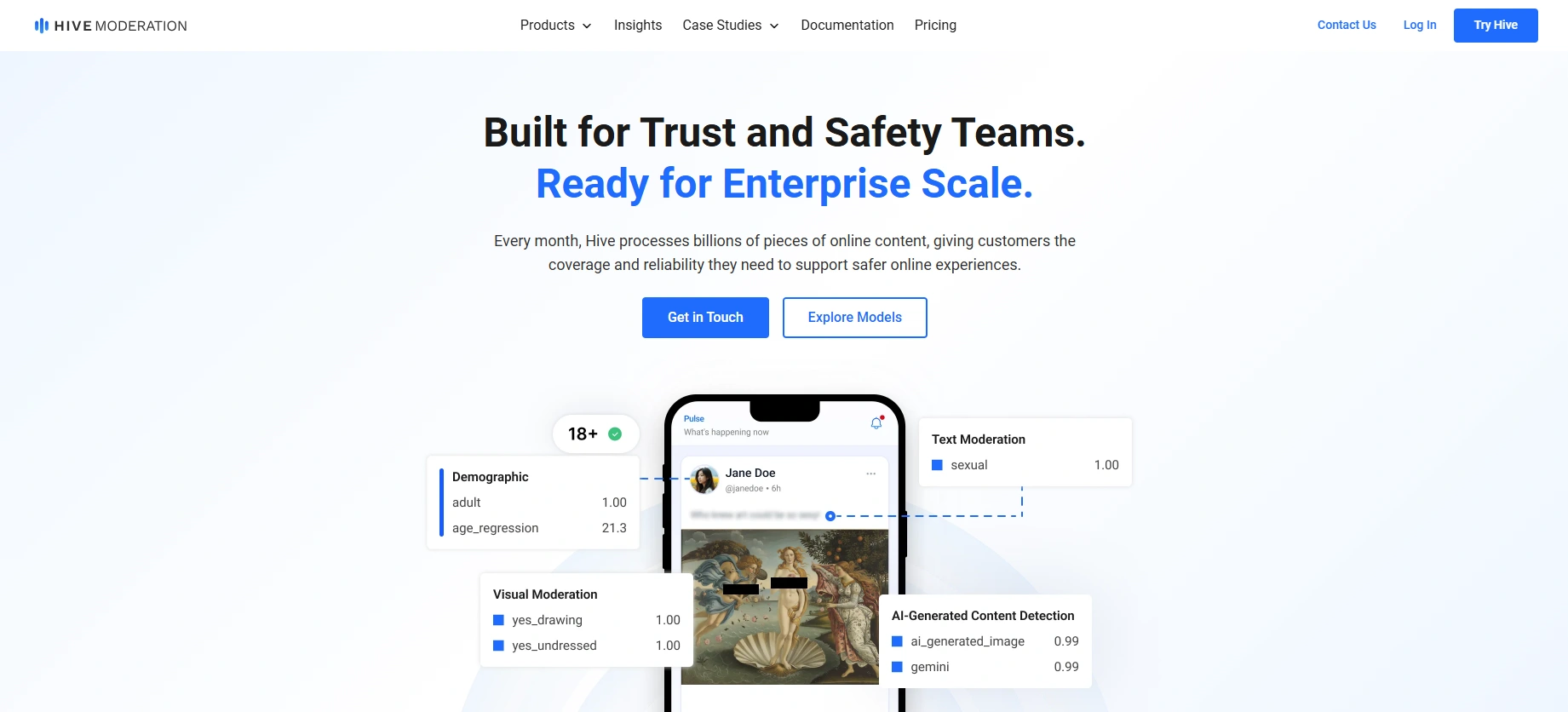
Hive is the broadest multimodal option in this group. Its visual moderation model breaks video into frames and returns timestamped moderation results, while livestreams can be submitted through an RTMP or HLS URL. Hive samples livestream frames at one frame per second by default, giving teams a way to monitor ongoing broadcasts without processing every frame.
The same platform extends into audio. Hive’s speech moderation API returns a transcript alongside moderation scores, so audio can be screened alongside visual content.
That makes Hive particularly useful when moderation needs to follow content across several formats rather than stopping at images or text. In practice, flagged livestream moments and ambiguous cases can then move to a managed moderation team for human review and appeals.
The main consideration is setup. Hive requires you to contact the company to enable video processing and allocate stream capacity, so it’s less of a plug-in-and-go option for teams that want to start immediately.
9. Sightengine: best for developer teams starting small
Best for: Startups and product teams that want to test automated moderation before committing to a larger program.
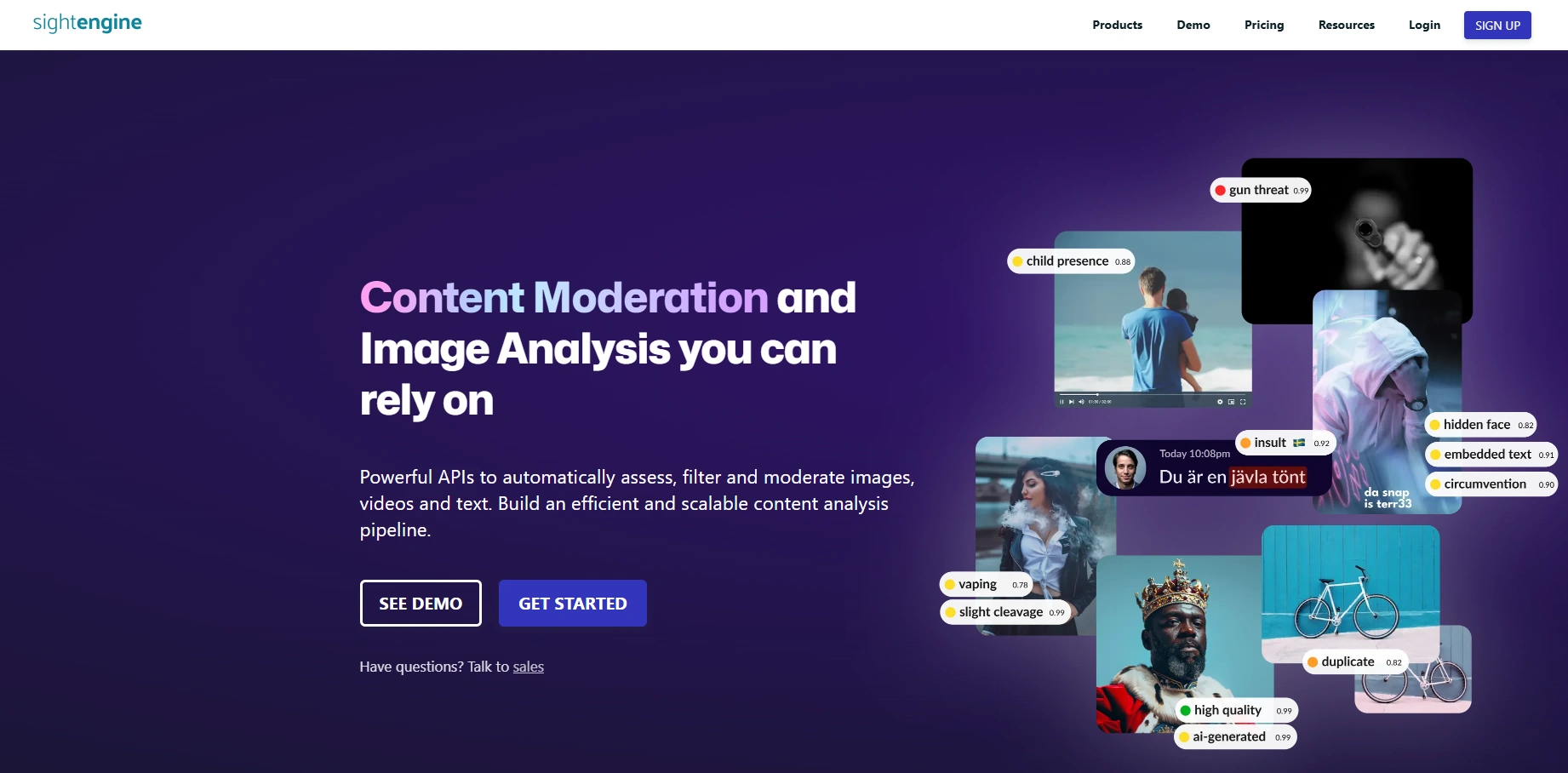
Sightengine takes a more developer-friendly approach, with APIs covering many of the moderation tasks a growing platform is likely to need. Its video moderation API detects nudity, violence, hate, self-harm, weapons, and drugs and returns frame-level timestamps. The wider product also covers images, live streams, audio profanity detection, deepfakes, and text embedded in images.
Audio moderation is part of the platform as well, with transcription and profanity detection available through its API. That gives teams a way to build automated screening across several content types before adding human review for context-heavy cases, disputed decisions, and appeals.
Sightengine is also relatively easy to test. The company offers a free plan with no time limit, which makes it useful for teams that want to validate the workflow before committing to paid usage.
The main thing to check before building around it is live-stream coverage. Some plans don’t include live-stream support, so the required tier should be confirmed before the implementation is designed around real-time moderation.
10. Microsoft Azure AI Content Safety: best for GenAI app guardrails
Best for: Teams already working in Microsoft Azure that need moderation for text, images, and AI-generated content.
Azure AI Content Safety is more focused than Hive or Sightengine, but that focus makes sense for teams building GenAI applications inside the Microsoft ecosystem. Azure AI Content Safety can detect harmful user-generated and AI-generated content in text and images, while its multimodal API can analyze text and images together.
It also goes beyond traditional UGC moderation. Prompt Shields help detect prompt attacks, which makes the service relevant when the moderation problem includes user prompts and AI-generated outputs rather than just posts uploaded by users.
There are some clear boundaries to the service. Microsoft’s overview lists no video or audio moderation, and image files are limited to 4 MB. Teams that need those modalities will therefore need another API for video or audio, along with human review for context-heavy cases and appeals.
For an Azure-based GenAI application, though, that narrower scope can still be useful because content moderation and prompt-safety controls can be handled within the same cloud environment.
Is It Really 24/7? Questions That Expose Gaps in UGC Monitoring
“24/7” appears on plenty of moderation proposals, but the label doesn’t tell you who is actually working at 2 a.m., which languages are covered, or how quickly a live violation reaches a reviewer. Before you sign, ask for the staffing and escalation details behind the claim.
| What to ask | What to look for | Why it matters |
|---|---|---|
| Could you show me your staffing by hour and language? | Named shifts covering every language you serve | A team can be technically available 24/7 while leaving some languages uncovered overnight. |
| What is the time to action for a live flag? | A written SLA measured in minutes | A live violation can spread widely before a standard review queue picks it up. |
| Who covers holidays and traffic surges? | Buffer staffing and a documented surge plan | Product launches, viral events, and sudden spikes can overwhelm a thin roster. |
| Which content types are covered 24/7? | The same coverage for text, images, video, audio, and live content that you require | 24/7 text moderation doesn’t help if video or audio queues sit unattended overnight. |
| How do you support moderators working overnight? | Wellness programs and support available across every shift | Moderators handling harmful content need the same protections and support regardless of when they work. |
A real 24/7 operation should cover the languages and content types you actually serve, not just maintain a general overnight queue. It should also define how quickly high-severity content is reviewed, who handles holiday and traffic spikes, and how moderators are supported across every shift.
Team, API, or Both? Choosing a UGC Moderation Setup
There isn’t one moderation setup that works for every platform. An early-stage app may only need an API and a small human review function, while a live-streaming platform may need trained reviewers available around the clock. The table below shows how different content and risk profiles can shape the starting point and what to add as the operation grows.
| Your situation | Start with | Add next |
|---|---|---|
| Early-stage app, low volume, mostly images | Sightengine or WebPurify API | A small human review team for appeals and context-heavy cases |
| Live streaming or voice chat | Hive for visual and audio screening | A managed moderation team with a written live-content SLA |
| Marketplace with fake listings | Besedo | Fraud detection outsourcing for chargebacks and account abuse |
| Gaming community with voice and chat | TELUS Digital or TaskUs | Player support from a gaming BPO partner |
| GenAI product with user prompts | Azure AI Content Safety | Human review for flagged or disputed outputs |
| Social or community platform with image, video, and live content | Helpware managed team | An API for first-pass screening |
If social media is a major part of your moderation workload, our guide to social media moderation covers the main moderation types and where each one fits.
Get Image and Video Moderation Coverage Without the Gaps
UGC moderation works best when automation and human review have clearly defined roles. APIs can screen large volumes quickly and flag likely violations, while trained moderators handle context, high-risk decisions, and appeals. The important part is making that handoff clear before content starts flowing through the system.
For many platforms, that means combining an API with a managed moderation team rather than expecting either one to handle every case. Start with a defined pilot, measure accuracy and time to action, and use those results to adjust your routing rules before scaling.
If image, video, and live content are central to your platform, Helpware can provide the human review layer alongside the AI tools you already use. Explore our moderation services or talk to our moderation specialists to learn more.