








The global concierge medicine market reached an estimated USD 24.63 billion in 2026 and is forecast to grow at a 9.05% compound annual growth rate through 2031, reaching USD 37.9 billion. Between 2018 and 2023, the number of US concierge practices jumped 83.1% while affiliated clinicians climbed 78.4%, signaling a structural shift away from volume-based care toward membership models built around access, prevention, and continuity.
Yet pricing in this sector remains genuinely opaque. Membership fees range from USD 99 per year for a tech-forward hybrid platform to more than USD 50,000 per year for ultra-luxury programs. Between those poles sit physician-network franchises, employer-sponsored primary care operators, concierge urgent-care providers, and healthcare BPO partners supporting the administrative and patient-facing operations behind every membership practice. For operations leaders, CFOs, and procurement teams building a business case, that range tells you almost nothing without understanding what actually drives it.
What follows is a breakdown of the five pricing models used across the concierge healthcare industry, an explanation of the seven cost drivers that move any quote up or down, and a comparison of ten leading companies so you can evaluate price and value together.
Pricing Models for Concierge Healthcare Companies
The model a provider selects determines not just the number on your invoice but how costs scale, where risk sits, and what you receive in exchange. Choosing a vendor without first understanding its pricing architecture is like reading only the total on a complex contract. The structure beneath that number matters at least as much.
Annual retainer / membership fee pricing
The most common model in the market. Patients pay a fixed annual or monthly fee covering a defined service bundle: same-day access, extended consultations, direct physician communication, and an annual wellness assessment. Insurance still handles covered visits, labs, and specialist referrals on top of the membership fee. MDVIP’s fee averages USD 2,500 to USD 5,000 per year, and PartnerMD runs USD 2,300 to USD 2,500 annually. Best suited for individuals and employers who want predictable cost and relationship-based primary care.
Per-contact / on-demand pricing
Common among hybrid and tech-forward platforms. Patients pay only when they use the service, with no standing annual commitment. Amazon One Medical’s on-demand care tier starts at USD 29 for a direct message consult and USD 49 for a video visit. This model suits low-frequency users or organizations testing concierge access before committing to a full membership.
Tiered membership pricing
Providers structure two or three membership tiers, each covering a progressively broader service scope at a higher price point. Sollis Health’s Standard tier begins at USD 4,000 per year, and its Platinum tier adds house calls, advanced imaging coverage, and dedicated liaisons at a higher rate. Tiered models transfer the level-of-service decision to the buyer and allow providers to capture wallet share across income segments.
Employer-sponsored per-member-per-month (PMPM) pricing
Used predominantly by employer-facing operators such as Crossover Health. The employer pays a fixed PMPM rate covering access to on-site or near-site primary care, telehealth, and care navigation for all enrolled employees. Cost per enrolled employee scales down with workforce size, making this model attractive to mid-market and enterprise organizations that want to reduce downstream emergency department spend and absenteeism.
Physician conversion / franchise fee pricing
Specialist consultants such as SignatureMD and Specialdocs charge physicians a conversion fee and ongoing royalty, typically one-third of the annual membership fee per patient, to access their marketing, technology, and operational platform. From a patient perspective the fee structure looks like a standard retainer, but the underlying economics differ because a third party captures a share of that fee.
Healthcare BPO hourly or managed-service pricing
For healthcare organizations outsourcing the patient-facing and administrative operations that power concierge programs, BPO providers such as Helpware charge per agent hour or as a fixed monthly managed-service fee. Rates typically run USD 8 to USD 15 per hour depending on service complexity, delivery location, and engagement scale. This model applies to practices and health plans that want to support member enrollment, patient scheduling, prior authorization, insurance verification, and 24/7 multilingual contact operations without building internal headcount.
Buyers in the premium individual tier tend to prioritize annual retainer and tiered models for their simplicity and all-access guarantees. Employers gravitate toward PMPM structures for their budget predictability at scale. Healthcare operators sourcing back-end support most often evaluate BPO hourly or managed-service arrangements.
Cost Drivers of Concierge Healthcare Companies
Understanding what pushes a concierge healthcare quote up or down lets you stress-test any vendor’s proposal rather than simply accept it. What follows are the seven variables that most consistently move the number.
Service scope and specialty depth
Primary care access is the baseline for every membership tier. The moment a provider adds cardiology coordination, psychiatric access, pediatrics, or dedicated geriatric programs, the fee climbs. Mordor Intelligence data shows cardiology currently captures 27.31% of the concierge medicine market, reflecting the premium that physicians and patients alike attach to specialty access. When comparing quotes, ask exactly which specialty touchpoints are included in the base fee and which trigger an additional charge.
Patient-to-physician ratio
Traditional primary care panels run 2,000 to 2,500 patients per physician. MDVIP caps panels at 600, and some ultra-premium practices hold panels as low as 300. A lower ratio costs the provider more per patient served, and that cost passes through to membership pricing. Practices that advertise same-day access but do not disclose their panel ratio may be running numbers that make that promise difficult to sustain long-term. Always ask for the current patient-to-physician ratio, not just the stated cap.
Delivery model and geographic footprint
In-person care at purpose-built, 24/7 facilities carries higher fixed costs than hybrid or virtual-first models. Sollis Health operates physical centers staffed by ER-trained physicians with on-site imaging, which is why its base rate starts at USD 4,000 per year. Virtual-only platforms carry lower real estate and staffing overhead and can offer lower membership fees, though they cannot perform physical examinations or in-house diagnostics. For BPO partners operating on behalf of concierge practices, delivery location matters too: onshore US delivery commands a premium over nearshore or offshore operations.
Compliance and certification requirements
HIPAA, SOC 2 Type II, and GDPR compliance are not optional for any provider handling protected health information. Building and maintaining certified compliance infrastructure costs money, and providers who invest in it pass some of that cost to buyers. What you gain in exchange is meaningful: a SOC 2 Type II audited partner reduces your regulatory exposure substantially compared to one offering only contractual assurances. For BPO partners supporting concierge healthcare operations, providers with genuine compliance depth command higher rates than those offering only a business associate agreement.
Technology and telehealth integration
Platforms that invest in proprietary apps, continuous remote monitoring, AI-assisted triage, and asynchronous messaging tools pass infrastructure costs into membership pricing. Amazon One Medical’s technology investment is reflected in its scale: 200+ offices, real-time app access, and an on-demand care tier. Providers without that infrastructure tend to price lower but offer narrower access windows.
Agent attrition and workforce stability (BPO context)
For healthcare organizations evaluating BPO partners to run patient support operations behind their concierge programs, agent attrition is a hidden cost driver most procurement teams underweight. Industry-average BPO attrition runs 6 to 8% per month. Providers with low attrition, such as Helpware’s 2.8% monthly rate, reduce the retraining cycles that erode the value of your per-agent hourly rate. An agent who knows your clinical workflows and HIPAA protocols from month three delivers materially more value than one still ramping at month five.
Volume and scalability commitments
Providers that guarantee a fixed membership size can price more predictably. For employer-sponsored programs, your negotiating power increases significantly with headcount: a 5,000-employee group purchasing PMPM primary care access will always command a lower rate than a 200-person company. Ask every vendor what their current capacity utilization looks like and how they handle peak access periods.
With these drivers mapped, you can evaluate any concierge healthcare proposal against what it actually includes, rather than where the number sits relative to a competitor’s headline fee. The next section applies that lens to ten leading providers.
Top 10 Concierge Healthcare Companies for 2026: At a Glance
| Company | Services | Global presence | Employees | Year est. |
|---|---|---|---|---|
| Helpware | Patient support, healthcare BPO, technical support, back office, CX consulting | USA, Mexico, Philippines, Ukraine, Georgia, Puerto Rico, Poland, Germany, Albania (19 locations) | ~4,000 | 2015 |
| MDVIP | Preventive primary care, wellness programs, chronic disease management | USA, 45 states and D.C. (1,400+ physicians) | ~1,400 physicians | 2000 |
| Amazon One Medical | Primary care, pediatrics, telehealth, chronic condition management | USA, 20+ cities (200+ offices) | ~4,500 | 2007 |
| Sollis Health | Concierge urgent/emergency care, diagnostics, care navigation, house calls | USA: New York, California, South Florida (10+ centers) | ~200-300 clinicians | 2016 |
| SignatureMD | Concierge primary care, executive physicals, wellness plans | USA (national network of affiliated physicians) | Not disclosed | 2006 |
| PartnerMD | Concierge primary care, executive health, health coaching | USA: VA, MD, GA, SC, TX | Not disclosed | 2003 |
| Crossover Health | Employer on-site/near-site primary care, telehealth, occupational medicine | USA (nationwide employer campuses) | ~1,000 | 2010 |
| Castle Connolly Private Health Partners | Physician conversion support, concierge primary care, wellness programs | USA: New York and select metros | Not disclosed | 2014 |
| Specialdocs Consultants | Physician transition consulting, concierge practice management support | USA (national, independent physicians) | Not disclosed | 2002 |
| Priority Physicians | Concierge primary care, executive physicals, ancillary health services | USA: Indiana and Midwest | Not disclosed | 2002 |
Top 10 Concierge Healthcare Companies: Overview
#1 Helpware

HIPAA-compliant healthcare BPO and patient support partner powering the administrative and CX operations behind concierge medicine programs (90% CSAT, 2.8% monthly attrition, SOC 2 Type II certified).
What makes Helpware CX a credible first choice for concierge healthcare organizations is not that it competes directly with physician membership networks, but that it fills the operational gap those networks cannot afford to ignore. Founded in 2015 and operating across 19 locations in 11 countries, Helpware CX delivers HIPAA-compliant patient support, member enrollment and navigation, insurance verification, appointment scheduling, prior authorization inquiries, and back-office operations for healthcare payers, concierge practices, telehealth platforms, and health plans. Its 4,000-person workforce operates in 45 languages, enabling multilingual patient engagement that is often the deciding factor for health plans serving diverse member populations.
The compliance architecture is third-party audited: SOC 2 Type II, HIPAA, GDPR, and ISO 27001 certifications are verified through independent audit, not contractual assurances alone. Its AI-assisted quality monitoring system flags compliance risks in real time across 100% of written interactions and calls. For concierge medicine companies scaling their member support operations without scaling headcount, Helpware’s 5-year average client partnerships and 2.8% monthly attrition rate (versus the 6 to 8% industry average) translate directly to more consistent patient interactions and lower retraining cost over the engagement lifecycle.
Why we picked it
It is the only provider in this comparison that addresses the operations infrastructure layer of concierge medicine. For healthcare organizations needing HIPAA-compliant patient-facing support at scale, Helpware’s combination of compliance depth, multilingual coverage, and low attrition is operationally differentiated from every other entry on this list.
- Services offered: HIPAA-compliant patient support, member enrollment and navigation, insurance verification, prior authorization inquiries, appointment scheduling, healthcare data entry, back-office operations, 24/7 omnichannel contact center services, CX consulting (strategy, technology, operational transformation), AI data annotation
- Pros: SOC 2 Type II, HIPAA, GDPR, ISO 27001 certified, 2.8% monthly attrition vs 6-8% industry average, 90% CSAT, 45 languages with native-speaker model, 19 global locations for 24/7 coverage, 5-year average client partnerships, AI quality monitoring across 100% of interactions
- Cons: Consultative sales process means a longer procurement cycle, may be over-engineered for simple, high-volume transactional work without compliance requirements
- Industry expertise: Healthcare and telehealth, SaaS and software, ecommerce and retail, fintech and banking, gaming and entertainment, logistics, public sector
- Best for: Mid-market to enterprise healthcare organizations ($50M+ revenue) that need HIPAA-compliant patient-facing support, member navigation, or back-office operations, including concierge medicine networks, health plans, and telehealth platforms
- Pricing: Starting at $8-$15 per hour depending on service complexity, delivery location, and engagement model.
- Rating: 5.0 (Clutch)
- Year established: 2015
- Location: Lexington, Kentucky (HQ), USA, Mexico, Philippines, Ukraine, Georgia, Puerto Rico, Poland, Germany, Albania
#2 MDVIP

The largest membership-based primary care network in the United States, with 1,400+ affiliated physicians serving 400,000+ patients across 45 states.
Founded in 2000 and headquartered in Boca Raton, Florida, MDVIP operates the country’s most established concierge medicine franchise. Its affiliated physicians cap patient panels at 600 versus the traditional primary care load of 2,000 to 2,500, enabling same-day or next-day appointments averaging 30 minutes. Peer-reviewed studies document 79% fewer hospitalizations for Medicare patients in MDVIP-affiliated practices, translating to an estimated USD 600 million in annual savings. Ninety-six percent of affiliated physicians report satisfaction with the model, and patient membership renewal rates consistently exceed 90%.
Why we picked it
It is the market-share leader by physician count and the most widely available option for patients seeking concierge primary care access at a mid-range price point across the contiguous US.
- Services offered: Preventive primary care, Annual Wellness Program (advanced labs, screenings, personalized care plan), chronic disease management, same-day/next-day appointments, 24/7 physician availability
- Pros: Largest national network (1,400+ physicians, 45 states), compatible with Medicare and most commercial insurance, 90%+ annual membership renewal rate, evidence base from 11 peer-reviewed published studies
- Cons: Franchise structure means care quality varies by individual physician, does not directly employ physicians, limiting standardization, limited to primary care only
- Best for: Individuals and families seeking affordable concierge primary care with Medicare compatibility and broad geographic availability
- Pricing: Annual membership averages $2,500-$5,000/year ($200-$400/month), patients retain existing insurance coverage
- Year established: 2000
- Location: Boca Raton, Florida (HQ), 45 states and D.C.
#3 Amazon One Medical
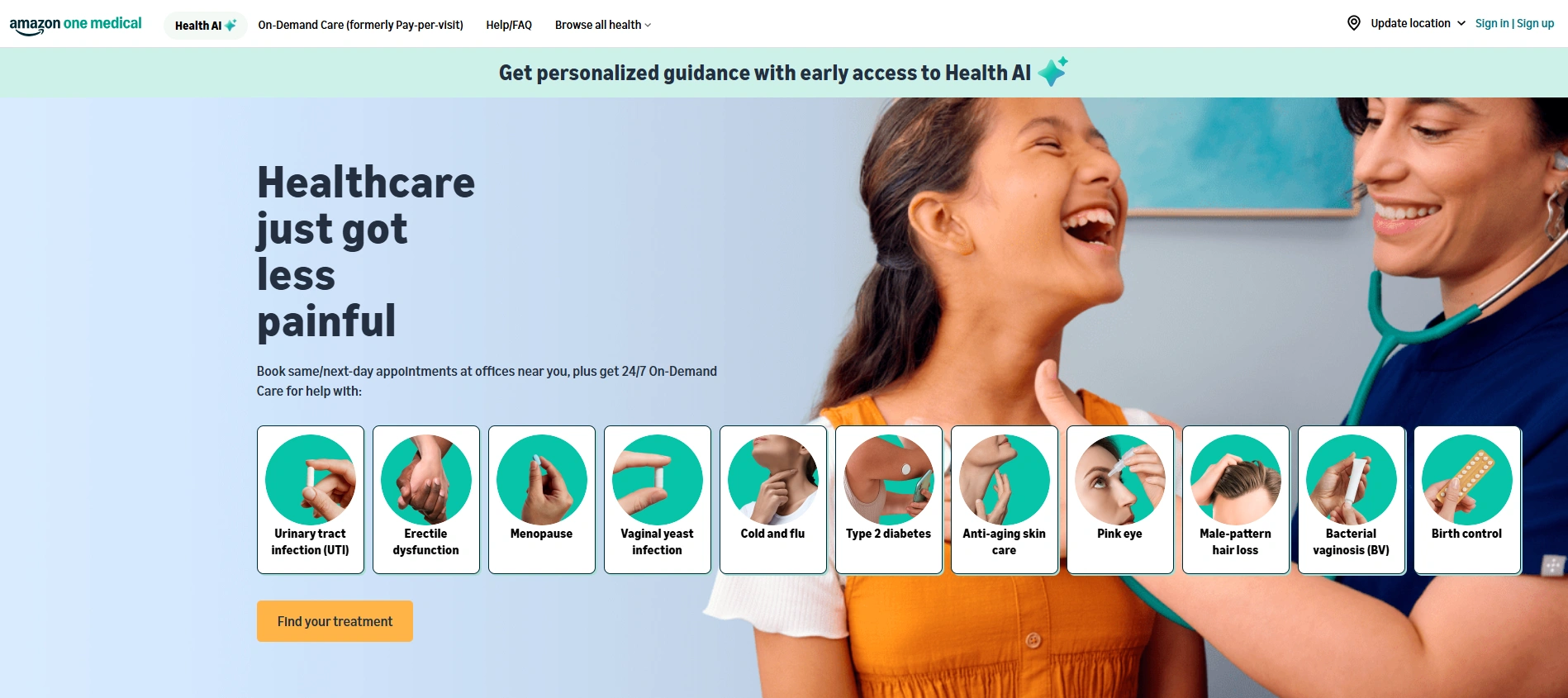
Technology-powered membership primary care with 200+ US offices and a USD 99/year Amazon Prime entry tier, the most accessible price point in this comparison.
Originally founded as 1Life Healthcare in 2007 and acquired by Amazon in a USD 3.9 billion transaction in 2023, One Medical now operates across more than 20 US cities with over 200 brick-and-mortar offices and approximately 815,000 members. Amazon Prime members access One Medical membership for USD 99 per year, with non-Prime memberships at USD 199 per year. That pricing sits below every physician-network competitor in this list. Covered in-person and video visits are billed to insurance, keeping the membership fee as the access cost only. Employer partnerships allow companies to sponsor membership fees for their workforce.
Why we picked it
It represents the lowest cost of entry for concierge-adjacent primary care access and the widest distribution of in-person locations, making it the default choice for employers and individuals who want modern primary care at a consumer price point.
- Services offered: Primary care, pediatrics, chronic condition management, mental health support, 24/7 on-demand telehealth, in-house lab services, prescription renewals, care navigation
- Pros: USD 99/year Prime membership (lowest in this list), 200+ offices in 20+ cities, employer sponsorship program, accepts most major insurance plans, 24/7 app-based virtual care included in membership
- Cons: Covered appointments still billed to insurance (membership covers access only), concentrated in major US metros, Amazon integration raises patient privacy questions for some
- Best for: Amazon Prime members, employers seeking affordable workforce health benefits, individuals in major metros who want tech-forward primary care without a high membership fee
- Pricing: USD 99/year (Prime members), USD 199/year (non-Prime), on-demand care from USD 29 per visit
- Year established: 2007 (One Medical), Amazon acquisition completed 2023
- Location: San Francisco, California (HQ), 20+ US cities
#4 Sollis Health

The only 24/7 concierge urgent and emergency care membership, with ER-trained physicians, on-site advanced imaging, and 99% emergency department avoidance among members.
Founded in 2016 and headquartered in New York City, Sollis Health holds a genuinely differentiated position: it is the first and only membership provider to combine concierge access with emergency care capabilities, including on-site CT, X-ray, MRI (at select locations), ultrasound, and in-house lab turnaround in under an hour. The company has raised USD 80.4 million across two funding rounds and operates 10+ centers across New York, California, and South Florida. Its 17,000+ members keep 99% of health events out of the emergency department, a measurable ROI claim that employers and high-net-worth individuals can price against the cost of a single ER visit.
Why we picked it
It occupies a category of its own. No other provider in this comparison pairs concierge access with ER-level diagnostics, making it the right choice for buyers whose primary concern is avoiding emergency department delays during acute health events.
- Services offered: 24/7 urgent and emergency care, advanced on-site diagnostics (CT, X-ray, MRI, ultrasound, in-house lab), care navigation, specialist network access (2,000+), house calls, travel medical support, patient advocacy
- Pros: Only 24/7 concierge urgent/emergency care provider, 99% ED avoidance among members, on-site hospital-grade diagnostics, ER-trained physicians, specialist appointments 67% faster than average
- Cons: Geographic concentration (NY, CA, South Florida only), not covered by insurance, higher base price than primary care-only competitors, not a primary care replacement
- Best for: High-net-worth individuals in NY, CA, or South Florida who want immediate ER-level care without hospital wait times, and employers supplementing primary care with emergency access
- Pricing: Standard Membership from USD 4,000/year (adults), Platinum tier at higher rate, family packages available, fully out-of-network
- Year established: 2016
- Location: New York City (HQ), NY, Los Angeles, San Francisco, South Florida (10+ centers)
#5 SignatureMD
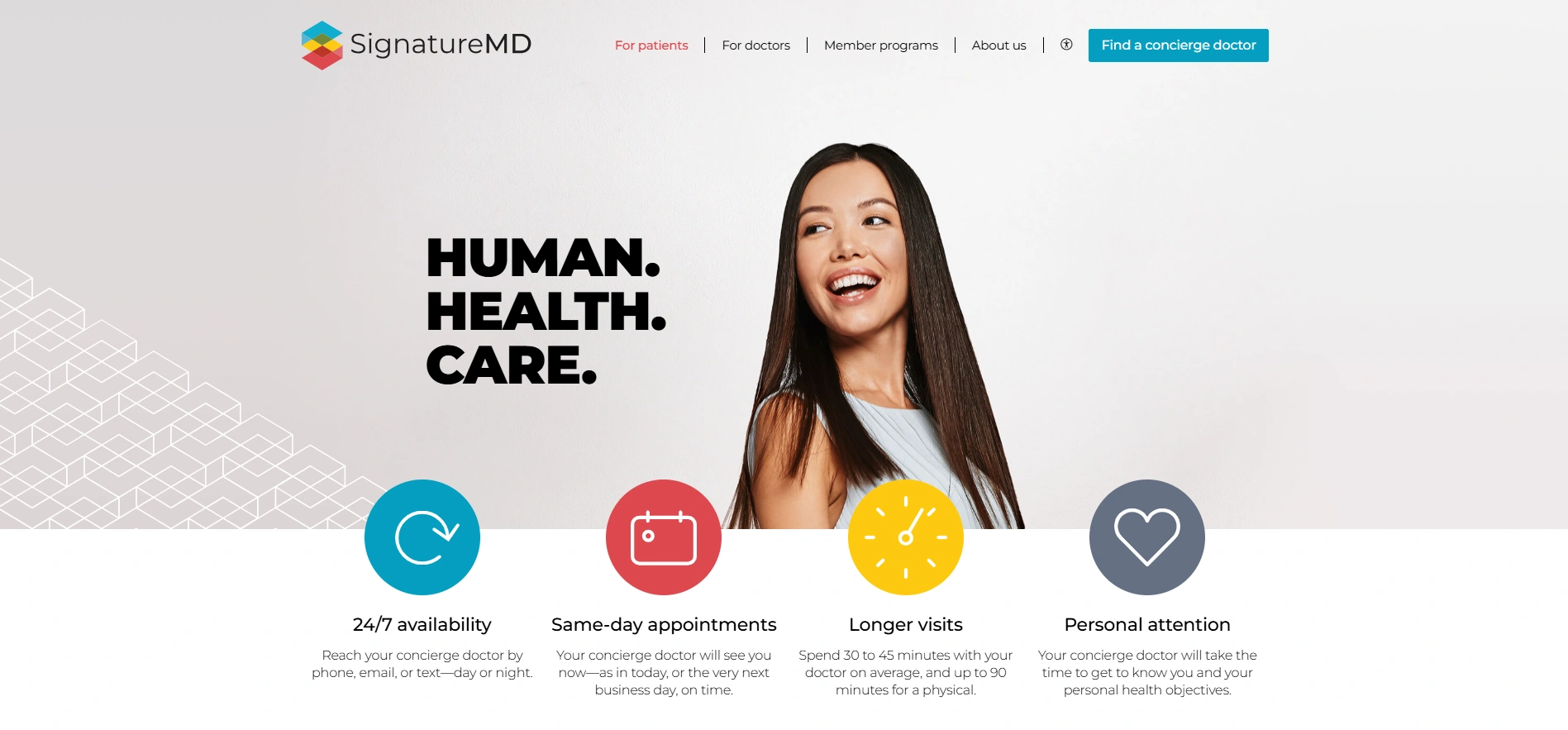
One of the nation’s largest concierge medicine conversion firms, enabling independent physicians to offer membership care while retaining full clinical autonomy and insurance billing.
Founded in 2006 and headquartered in Florida, SignatureMD operates as a platform company for independent physicians, providing the marketing, technology, training, and patient communication infrastructure that enables a solo or group practice to convert to a concierge model without abandoning insurance billing. Its affiliated physicians charge patients USD 1,500 to USD 2,000 per year for the membership component, while continuing to bill insurance for covered services. A 2025 analyst review noted a 14% increase in physician inquiries for SignatureMD in Q4 2025, reflecting growing physician interest in practice conversion amid burnout concerns.
- Services offered: Concierge practice conversion support, annual executive physicals, preventive wellness programs, extended appointments, 24/7 physician access, care coordination
- Pros: Lower membership fee than most competitors (USD 1,500-2,000/year), physicians retain full autonomy and insurance billing, flexible practice model, growing national physician network
- Cons: Patient experience varies by individual affiliated physician, service quality not centrally standardized, franchise royalty means physicians share revenue long-term
- Best for: Cost-conscious patients seeking concierge access at a lower price point, independent physicians exploring practice conversion without leaving insurance-based billing
- Pricing: USD 1,500-2,000/year membership fee, patients retain insurance coverage for covered services
- Year established: 2006
- Location: Florida (HQ), national network of affiliated physicians
#6 PartnerMD
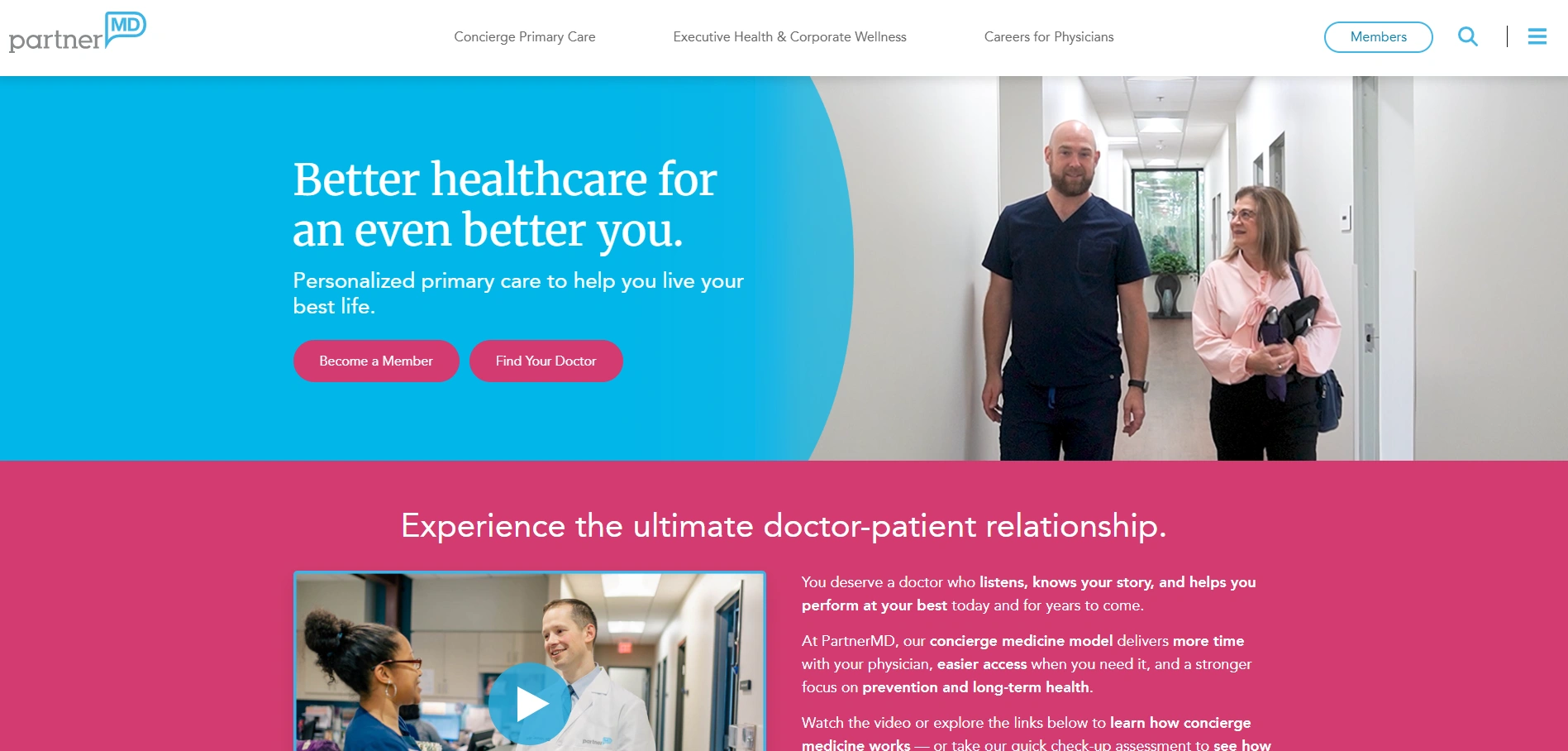
Regional concierge primary care with an executive health focus, team-based care model, and physician-guaranteed 24/7/365 access in the mid-Atlantic and Southeast.
Founded in 2003, PartnerMD differentiates itself through a team-based care model pairing each patient with a physician, health coach, and nutritionist. The company focuses on select markets in Virginia, Maryland, Georgia, South Carolina, and Texas. Its 24/7/365 access guarantee routes patients directly to a PartnerMD physician, not a nurse practitioner or outside provider. Annual membership runs USD 2,300 to USD 2,500, placing it in the mid-range of the physician-network category.
- Services offered: Concierge primary care, executive health programs, annual wellness physicals, health coaching, nutrition counseling, 24/7 physician access
- Pros: Team-based model includes health coach and nutritionist, 24/7 direct physician access (not NP routed), strong regional reputation, transparent pricing published online
- Cons: Limited to select mid-Atlantic and Southeast markets, smaller network than MDVIP, limited geographic expansion pace
- Best for: Individuals and executives in VA, MD, GA, SC, or TX seeking team-based concierge primary care
- Pricing: USD 2,300-2,500/year (USD 192-208/month)
- Year established: 2003
- Location: Richmond, Virginia (HQ), Virginia, Maryland, Georgia, South Carolina, Texas
#7 Crossover Health
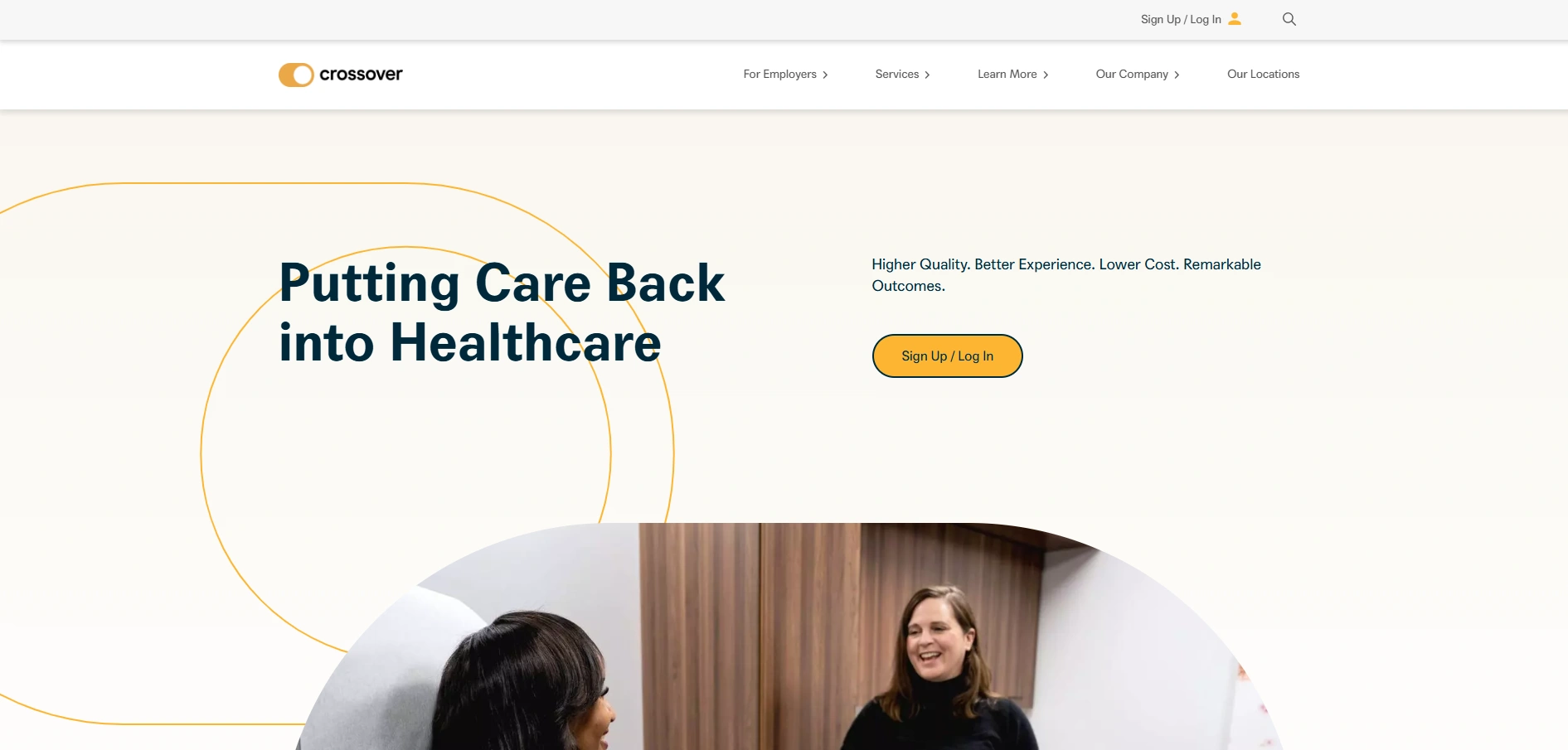
Employer-focused advanced primary care operator combining on-site, near-site, and virtual delivery, reporting a 9% reduction in total cost of care for clients in 2025.
Founded in 2010 and based in California, Crossover Health targets large employers seeking to reduce downstream healthcare spend through proactive, accessible primary care. Its model operates across employer campuses (on-site), nearby clinics (near-site), and a national virtual network, supported by care navigators who manage specialist referrals and continuity. A 2023 move into occupational medicine extended its value proposition beyond primary care, making it a broader workforce health partner for distributed enterprises.
- Services offered: Employer-sponsored primary care, telehealth, occupational medicine, care navigation, mental health support, preventive care, specialist referral management
- Pros: PMPM model aligns cost with workforce size, 9% reduction in total cost of care reported for clients, occupational medicine integration, national virtual network extends reach beyond physical campuses
- Cons: Designed exclusively for employers, not individual patients, client concentration risk with large employers, complex telehealth compliance across multiple states
- Best for: Large enterprises with 1,000+ employees seeking to reduce ER utilization and absenteeism through employer-sponsored advanced primary care
- Pricing: Employer PMPM model, custom pricing based on workforce size and service scope
- Year established: 2010
- Location: California (HQ), nationwide employer campuses
#8 Castle Connolly Private Health Partners
Physician equity conversion specialist enabling independent doctors to own and build equity in a concierge practice through the T.H.R.I.V.E. model.
Founded in 2014 and headquartered in New York, Castle Connolly Private Health Partners (CCPHP) focuses specifically on the physician side of the concierge medicine transition. Its T.H.R.I.V.E. solution enables independent physicians to convert their practices to a membership model while building equity in the business, a structure that differs from SignatureMD’s and MDVIP’s royalty arrangements. CCPHP has been active in New York and select markets, with recent physician partnerships in the Southeast and Midwest.
- Services offered: Physician concierge practice conversion, membership program design, patient wellness programs, practice management support, physician equity building
- Pros: Physician equity model aligns long-term incentives, strong brand recognition through Castle Connolly physician credentialing heritage, structured wellness and coaching layer
- Cons: Smaller network and limited geographic reach compared to MDVIP or SignatureMD, less transparent public pricing
- Best for: Independent physicians seeking a concierge conversion model with an equity component, and their patients seeking personalized primary care
- Pricing: Custom pricing per physician program, patient fees set by affiliated physicians
- Year established: 2014
- Location: New York, New York (HQ), select US metros
#9 Specialdocs Consultants

A pioneer in concierge medicine practice management consulting, supporting 26 new physician clients in 2024 with a turnkey conversion model focused on back-office reliability.
Founded in 2002, Specialdocs Consultants is one of the earliest players in the concierge medicine enablement space. It functions as a pure practice management consultant, providing physicians with the operational playbook, technology, legal guidance, and marketing support to convert to a membership model. It does not set standardized patient fees but works with each physician to design a program appropriate for their market. Its 2024 growth of 26 new physician clients reflects sustained demand from independent primary care physicians facing burnout in volume-based practice environments.
- Services offered: Concierge practice transition consulting, operational and legal guidance, marketing support, ongoing practice management, physician coaching
- Pros: Pioneer with 20+ years of concierge medicine experience, turnkey model reduces barriers for physicians, strong back-office operational reputation, national network
- Cons: Patient experience fully dependent on individual affiliated physician, higher barrier to entry for solo practitioners
- Best for: Established independent physicians seeking a proven, comprehensive conversion model with long-term practice management support
- Pricing: Custom per-physician engagement, patient membership fees set at physician discretion
- Year established: 2002
- Location: National (Illinois-based)
#10 Priority Physicians
Midwest concierge medicine leader founded in 2002, operating a ‘Total Access’ philosophy with patient-to-physician ratios near 300:1 in Indiana and surrounding states.
Founded in 2002 in Indianapolis, Priority Physicians is among the earliest purpose-built concierge medicine practices in the US. Its defining characteristic is an exceptionally low patient-to-physician ratio of approximately 300:1, compared to the 600:1 cap at MDVIP. That ratio underpins a genuine zero wait time commitment and allows physicians to offer same-day appointments, comprehensive annual physicals, and ancillary health services within the membership. The practice serves primarily Indiana and surrounding Midwest markets and has built a track record for care continuity that aligns with its patient retention model.
- Services offered: Concierge primary care, comprehensive executive physicals, ancillary health services, membership health programs, 24/7 access
- Pros: Among the lowest patient-to-physician ratios in the market (~300:1), genuine zero wait time model, long track record since 2002, strong regional reputation in Indiana and Midwest
- Cons: Geographically concentrated in Indiana and surrounding Midwest, limited expansion to national markets
- Best for: Individuals in Indiana and the Midwest seeking highly personalized concierge primary care with extremely low patient volume per physician
- Pricing: Custom membership pricing, contact vendor for current rates
- Year established: 2002
- Location: Indianapolis, Indiana (HQ), Indiana and Midwest
Why Choose Helpware as Your Concierge Healthcare Operations Partner
Helpware CX starts at USD 8 to USD 15 per hour for patient support and healthcare BPO operations. That is not the lowest number in the outsourcing market, and it is not designed to be. What it prices in is a compliance infrastructure that costs real money to maintain: third-party-audited SOC 2 Type II, HIPAA, GDPR, and ISO 27001 certifications, AI quality monitoring across 100% of interactions, and an attrition rate of 2.8% per month versus the 6 to 8% industry average. When you run the math on what agent turnover actually costs a healthcare organization in retraining, protocol reinforcement, and patient interaction consistency, that attrition differential often more than closes the gap on the hourly rate.
For concierge medicine networks, health plans, and telehealth platforms, what Helpware CX delivers is the operational infrastructure those physician-facing programs cannot build themselves at scale: HIPAA-compliant member enrollment and navigation, multilingual patient support across 45 languages, 24/7 omnichannel contact center operations, insurance verification, prior authorization inquiry management, and back-office administrative workflows, all from a single partner operating across 19 global locations with genuine compliance depth at the delivery level. Clients including Headspace, HealthComp, NexHealth, and Pfizer (Lucira) reflect the breadth of healthcare organizations that have chosen Helpware for exactly this operational layer.
Helpware CX is the right fit for mid-market to enterprise healthcare organizations ($50M+ revenue) that view patient experience as a clinical variable, not just an administrative cost. It is not the right fit for organizations that need pure high-volume transactional processing without compliance depth, or for physician practices seeking a membership conversion consultant. For those use cases, the firms further down this list are better starting points.
Why the numbers work:
- 2.8% monthly attrition vs 6-8% industry average : lower hidden retraining costs and more consistent patient interactions
- 90% CSAT : fewer patient escalations and repeat contacts across every engagement
- 5-year average client partnerships : onboarding investment amortizes across a long engagement horizon
- SOC 2 Type II, HIPAA, GDPR, ISO 27001 certified : no compliance remediation costs or audit surprises downstream