








The Philippines IT-BPM industry closed 2025 with $40 billion in export revenues and 1.9 million workers, growing 5% in earnings even as the global outsourcing market grew at just 3%. For ecommerce brands evaluating support partners, that scale means real choice. It also means real complexity. Vendor pricing for ecommerce outsourcing in the Philippines spans roughly $8 to $25 per hour depending on agent skill level, channel mix, coverage hours, and compliance scope. That range is nearly useless without understanding what drives it.
This guide is for ecommerce operations leaders, finance heads, and procurement teams comparing ecommerce outsourcing companies in the Philippines. It breaks down how providers price their services, what variables move quotes up or down, and which 10 vendors are worth a serious conversation. By the end you should be able to read any Philippine BPO proposal and know what’s negotiable.
Pricing Models for Ecommerce Outsourcing in the Philippines
Before comparing vendors, it pays to understand how Philippine BPOs structure their fees. Different models suit different ecommerce operations, and the wrong model multiplies cost as you scale. What looks cheap at 5 agents can become punishing at 50.
Hourly rate (per agent hour) pricing
The most common model in the Philippines, billed by hours staffed rather than tickets handled. Rates typically run $8 to $18 per hour for English-language ecommerce support, with premium tiers reaching $25 for technical accounts. Best suited for stable ecommerce volume where you can forecast staffing needs in advance.
Per-seat / per-agent-per-month pricing
A flat monthly fee per dedicated agent, usually $1,200 to $2,800 per seat depending on skill level and shift. This works well for ecommerce brands that want a predictable budget line and a team that learns the brand voice over time, rather than rotating agents.
Per-contact / per-ticket pricing
The provider charges by the resolved interaction, often $1 to $5 per ticket and $3 to $8 per voice contact. Where this works is for ecommerce brands with seasonal volatility, holiday spikes, or low ongoing volume. Where it breaks down is on complex tickets that absorb agent time without a corresponding rate increase.
Outcome-based / performance pricing
Fees tied to specific KPIs such as CSAT, first-contact resolution, or order recovery rate. Few Philippine BPOs lead with this model, but most established providers will agree to performance components on top of a base rate. Best for mature ecommerce operations with clean baseline metrics.
Managed service / fixed monthly pricing
A flat monthly fee covers a defined scope including agents, supervisors, QA, and tools. Best for ecommerce brands that want a single line item and zero invoice variance.
Hybrid pricing
A base seat fee plus variable charges for volume above a threshold. Most Philippine BPOs default to this for mid-market ecommerce accounts because it absorbs seasonality without forcing renegotiation every quarter.
For most growth-stage ecommerce brands, per-seat or hybrid models offer the best cost predictability. Per-ticket suits low-volume DTC stores. Hourly rates suit operations leaders who want maximum flexibility on coverage windows.
Cost Drivers of Ecommerce Outsourcing in the Philippines
Knowing the model is only half the work. The bigger question is what moves the price within any given model. Five to seven variables shape almost every Philippine ecommerce BPO quote you’ll receive, and a buyer who understands them can negotiate from a stronger position.
Agent attrition rate
What you don’t see on the proposal is the cost of churn. The Philippine BPO industry averages around 30 to 60 percent annual attrition for entry-level voice roles, which translates to constant retraining cycles you eventually pay for in lower quality, missed SLAs, or higher hourly rates. Providers with low attrition, such as Helpware’s 2.8% monthly rate, reduce hidden retraining costs that erode the apparent benefit of cheaper per-agent benchmarks.
Channel mix
Voice support is the most expensive channel because it requires real-time agent availability. Email and chat run cheaper because agents can handle three to five conversations concurrently. An ecommerce account that’s 80% chat and 20% voice will price meaningfully lower than one that’s 60% voice.
Coverage hours
Twenty-four-seven coverage typically costs 30 to 50 percent more than business hours alone. For most ecommerce brands, 16-hour coverage with chat handoff overnight strikes the right balance.
Agent skill tier
A general customer support agent in the Philippines runs $8 to $12 per hour. A specialist handling Shopify Plus, Amazon Seller Central, returns disputes, and chargebacks runs $13 to $20. A team lead or QA analyst runs $15 to $25.
Volume and ramp speed
Seasonal ecommerce spikes (Black Friday, holiday, Q4) require providers who can ramp 20 to 200 percent within weeks. Providers with that infrastructure charge a small premium during peak windows. Providers without it leave you understaffed when revenue matters most.
Compliance and security requirements
PCI-DSS, GDPR, and SOC 2 certifications add cost because they require certified facilities, documented processes, and recurring audits. For ecommerce brands handling payment data or EU customer information, these are non-negotiable. Providers that lack the certifications will appear cheaper but transfer the compliance risk back to you.
Language requirements
English-only is the Philippine baseline. Spanish, Portuguese, or Asian-language support typically requires native-speaker hubs in other regions, which adds 20 to 40 percent.
With these drivers in mind, you can read any vendor quote with a clear sense of what’s reasonable, what’s negotiable, and what’s likely to creep up on renewal.
Calculate Your Ecommerce Outsourcing Costs
Now that you know what drives pricing, you can put real numbers to your situation.
Use Helpware’s cost calculator to get a personalized estimate based on your support volume, coverage hours, channel mix, and compliance scope. Or speak with our team for a custom quote on dedicated ecommerce teams in the Philippines.
Unlock your hidden CX savings with Helpware
Get ROI projection for current support needs.
-40% annually
/monthly costs with Helpware
vs
/internal team costs (approx)
Your requirements fall outside our standard parameters.
Let's discuss your results
Fill in your details to schedule a consultation.
-40% annually
/monthly costs with Helpware
vs
/internal team costs (approx)
Your requirements fall outside our standard parameters.
-40% annually
/monthly costs with Helpware
vs
/internal team costs (approx)
Your requirements fall outside our standard parameters.
Support staff included in the package:
Shared Team Leader
Shared L&D Specalist
Shared QA Specialist
Account Executive by default
Shared Ops Delivery Manager
Admin/Finance/Legal support for the agents by default
1-2 Dedicated Team Leaders
Shared L&D Specialist
Shared to 1 Dedicated QA Specialist
Shared Ops Manager
Account Executive by default
Admin/Finance/Legal support for the agents by default
Shared Real Time Analyst
2-5 Dedicated Team Leaders
0,5 to 1,5 Dedicated L&D Specialists
1-2 Dedicated QA Specialists
Up to half of a dedicated Ops Manager
Account Executive by default
Admin/Finance/Legal support for the agents by default
1 Dedicated Real Time Analyst
Ready to get a personalized estimate for your team?
Contact us for a personalized assessment tailored to your specific needs.
*These projections are estimates for informational purposes only and do not represent a formal offer. Contact us for a personalized quote.
Thank you!
You’ll hear from us within one business day.
Top 10 Ecommerce Outsourcing Companies in the Philippines for 2026: At a Glance
| Company Name | Services | Global Presence | Employees | Year Est. |
|---|---|---|---|---|
| Helpware | Customer support, technical support, back office, call center, CX consulting | USA, Mexico, Philippines, Ukraine, Georgia, Puerto Rico, Poland, Germany, Albania (19 locations) | ~4,000 | 2015 |
| TaskUs | Customer experience, content moderation, AI services, trust & safety | USA, Philippines, India, Mexico, Colombia, Greece, Romania (30 locations) | ~61,400 | 2008 |
| Concentrix | Customer engagement, digital CX, AI services, retail & ecommerce | 70+ countries | ~455,000 | 1983 |
| Cloudstaff | Remote staffing, customer support, ecommerce ops, back office | Philippines, India, Colombia, Kenya (21 delivery centers) | ~7,000 | 2005 |
| Sourcefit | Offshore staffing, customer support, BPO, EOR services | Philippines, Dominican Republic, South Africa, Madagascar, Armenia | ~2,000 | 2009 |
| SupportNinja | Customer support, technical support, content moderation, back office | USA, Philippines, Ireland, Singapore, Romania | ~1,900 | 2015 |
| Boldr | Customer support, sales support, data annotation, back office | Philippines, Mexico, Canada, South Africa, USA (7 locations) | ~1,500 | 2017 |
| Magellan Solutions | Inbound/outbound call center, back office, ecommerce support | Philippines (Mandaluyong, Metro Manila) | ~1,248 | 2005 |
| Outsourced | Dedicated offshore staffing, ecommerce, virtual assistants | Philippines (Manila) | ~1,000 | 2012 |
| SuperStaff | Customer support, back office, ecommerce, healthcare BPO | Philippines, Colombia, USA | ~500–1,000 | 2009 |
Top 10 Ecommerce Outsourcing Companies in the Philippines: Overview
#1 Helpware

Mid-market and enterprise ecommerce BPO partner combining 19 global locations with deep retail and ecommerce expertise.
Helpware’s ecommerce and retail BPO services are built for online brands that need to scale fast, hold brand voice across channels, and absorb unpredictable volume spikes without sacrificing customer experience. The company operates in the Philippines as part of a 19-location footprint including USA, Mexico, Ukraine, Georgia, Puerto Rico, Poland, Germany, and Albania. Its ecommerce case study portfolio includes a print platform that tripled seasonal agent capacity while cutting average handle time by 56% and escalations by 30%.
Why we picked it
Where Helpware separates from larger competitors is operational depth at the mid-market tier, with documented 90% CSAT and 2.8% monthly attrition.
- Services offered: Customer support (omnichannel, multilingual), back-office operations, order processing, technical support, call center (inbound/outbound), CX consulting.
- Pros: Native-speaker support in 45 languages, 19 locations for 24/7 ecommerce coverage, 90% CSAT and 2.8% attrition (vs 6-8% industry average), SOC 2, HIPAA, GDPR certified, 5-year average client partnerships.
- Cons: Longer sales cycle due to consultative scoping. May be over-engineered for very small DTC stores under 1,000 monthly tickets.
- Industry expertise: Ecommerce & Retail, SaaS & Software, Healthcare & Telehealth, Fintech & Banking, Gaming & Entertainment, Logistics.
- Best for: Mid-market to enterprise ecommerce brands ($10M-$500M revenue) wanting a strategic BPO partner with retail-specific case studies and compliance depth.
- Pricing: Starting at $8-$15 per hour depending on service complexity, location, and engagement model.
- Year established: 2015
- Location: Lexington, Kentucky (HQ). Philippines, USA, Mexico, Ukraine, Georgia, Puerto Rico, Poland, Germany, Albania.
- Rating: 4.8 on Clutch
#2 TaskUs
Public-listed CX and content moderation provider built around Philippine operations.
TaskUs was founded in 2008 by Bryce Maddock and Jaspar Weir, who chose the Philippines for their first office in Bacoor, Cavite. The company now operates approximately 61,400 staff across 30 locations in 13 countries, with Philippine sites in Taguig, Quezon City, Cavite, Batangas, and Angeles. TaskUs serves fast-growing sectors including ecommerce, AI, gaming, streaming, food delivery, and fintech, and went public on Nasdaq in 2021.
Why we picked it
For ecommerce brands that need scale and a culture-led model, TaskUs has built genuine retention infrastructure. The trade-off is that the consultative tier is more relevant for larger ecommerce operations than small DTC merchants.
- Services offered: Digital customer experience, content moderation, AI services, trust and safety, risk and response.
- Pros: Significant Philippine footprint, strong content moderation expertise, public-company governance, deep ecommerce client base including DoorDash and Stitch Fix.
- Cons: Premium pricing relative to mid-tier Philippine BPOs. Sweet spot is enterprise volume.
- Industry expertise: Ecommerce, social media, gaming, streaming media, fintech, healthcare, ride-sharing.
- Best for: Mid-market to enterprise ecommerce brands needing significant scale and content moderation alongside customer support.
- Pricing: Custom pricing, contact vendor.
- Rating: 4.1 on Glassdoor
#3 Concentrix
Global CX leader with one of the largest Philippine workforces in the country.
Concentrix is a publicly traded American business process outsourcing company headquartered in Newark, California, founded in 1983. After the Webhelp combination closed in September 2023, the company now operates with approximately 455,000 employees across 70+ countries. Its retail and ecommerce vertical covers customer engagement, digital CX, and AI-augmented operations across Pasig, Makati, Quezon City, and several other Philippine sites. In 2025, Concentrix made the Fortune 500 at #426. Publicly traded (NASDAQ: CNXC).
Why we picked it
Concentrix offers ecommerce buyers a level of geographic redundancy and tooling investment that’s hard to match. Where it makes sense is for brands operating in multiple regions that need consistent delivery standards across them.
- Services offered: Customer engagement, digital CX operations, CX consulting, AI services, retail & ecommerce support.
- Pros: Global footprint across 70+ countries, Fortune 500 governance, deep technology investment, multilingual capability following Webhelp integration.
- Cons: Enterprise-only sales motion. Less suited to ecommerce brands under $50M revenue.
- Industry expertise: Retail & ecommerce, banking, healthcare, technology, automotive, travel, telecommunications.
- Best for: Enterprise ecommerce and global marketplaces requiring multi-country delivery with consistent SLAs.
- Pricing: Custom pricing, contact vendor.
- Rating: ~3.9 / 5 on Glassdoor
#4 Cloudstaff
Australian-founded staffing pioneer with deep Pampanga roots and high-retention model.
Cloudstaff was founded in 2005 by Australian entrepreneur Lloyd Ernst and operates from 21 delivery centers across the Philippines, India, Colombia, and Kenya. The company has approximately 7,000 staff in the Philippines, concentrated in Angeles City, Davao, Manila, and Cebu. Cloudstaff differentiates on a staff retention rate it audits at 98%, and supports both office-based and work-from-home models.
Why we picked it
Cloudstaff’s modular staffing approach lets ecommerce brands build specific roles, say a Shopify specialist plus a returns coordinator, rather than buying a full department. That flexibility makes the math work for growth-stage brands.
- Services offered: Remote staffing, customer support, ecommerce operations, back office, marketing, development.
- Pros: ISO 27001 and ISO 9001 certified, PCI-DSS accredited offices, HIPAA compliant, 98% audited retention rate.
- Cons: Staff augmentation model requires more client management than fully managed BPO.
- Industry expertise: Ecommerce, network building, media services, graphic design, tourism, finance.
- Best for: Growth-stage ecommerce brands building dedicated teams for Shopify, Amazon, or Magento operations.
- Pricing: Custom pricing, typically 50-70% savings vs local hiring per Cloudstaff.
- Rating: Not publicly rated on major BPO indices
#5 Sourcefit
Quezon City-headquartered offshore staffing firm with transparent unit-cost pricing.
Sourcefit was founded in 2009 by American entrepreneur Andy Schachtel and is headquartered at Exxa Tower, Bridgetowne IT Park, Quezon City. The company operates from the Philippines, Dominican Republic, South Africa, Madagascar, and Armenia, employing more than 2,000 professionals globally. Sourcefit serves over 220 clients across ecommerce, IT, healthcare, finance, and hospitality, including a Stevie Award for AI integration in workflows.
Why we picked it
Sourcefit publishes a transparent pricing formula based on raw salary plus taxes, benefits, infrastructure, and management fee, which is rare in this market. Ecommerce brands building business cases will appreciate that.
- Services offered: Offshore staffing, customer support, BPO services, Employer of Record, AI tools.
- Pros: Transparent pricing model, no setup fees or long-term commitments, Knit AI platform for workforce management, Stevie Award recognition.
- Cons: Best fit for SME and mid-market budgets. Less suited to enterprise scale.
- Industry expertise: Ecommerce, IT, finance, healthcare, marketing, hospitality, construction.
- Best for: Startup and SME ecommerce brands wanting transparent, no-lock-in offshore staffing.
- Pricing: Custom pricing based on salary plus management fee.
- Rating: 4.8 on Clutch
#6 SupportNinja
Tech-focused BPO with growing Philippine presence and ecommerce specialization.
SupportNinja was founded in 2015 and is headquartered in Dallas, Texas, with approximately 1,900 employees across the USA, Philippines, Ireland, Singapore, and Romania. The company runs two Philippine offices in Metro Manila and Clark with about 950 combined seats. SupportNinja was acquired by BV Investment Partners in 2021 and has been an Inc. 5000 multiple-year recipient.
Why we picked it
What separates SupportNinja for digitally native ecommerce brands is process orientation. Their onboarding model emphasizes platform integration depth, which matters when you’re running on Gorgias, Zendesk, or a custom stack.
- Services offered: Customer support, technical support, content moderation, data processing, finance and accounting.
- Pros: Strong tech ecosystem fit, Inc. 5000 listed multiple years, Outsource Partner of the Year recognition in 2025.
- Cons: Smaller Philippine footprint than enterprise providers. Best for mid-volume ecommerce.
- Industry expertise: SaaS, AI, ecommerce, healthcare, supply chain, fintech.
- Best for: Digitally native ecommerce brands with strong platform integration needs.
- Pricing: Custom pricing, contact vendor.
- Rating: Inc. 5000 ranked #2653 in 2025
#7 Boldr

B Corp-certified ethical BPO with strong DTC ecommerce roster.
Boldr was established in 2017 and is the first global B Corp Certified BPO and the first B Corp Certified BPO in the Philippines. The company serves 100+ client partners with 1,500 team members across 5 countries and 7 city locations, with offices in the Philippines, Mexico, Canada, South Africa, and the United States. Its ecommerce roster includes Caraway, UrbanStems, Urth, and Babylist, the last of which Boldr reports has saved $6 million annually through their partnership.
Why we picked it
For ecommerce brands with explicit ESG commitments, Boldr’s B Corp certification and impact sourcing model provide vendor alignment that purely cost-driven BPOs cannot.
- Services offered: Customer support, sales support, data annotation, back office, content moderation.
- Pros: B Corp certified, impact sourcing with living wages, deep DTC ecommerce client base, low attrition rates.
- Cons: Time-to-hire can be longer than enterprise BPOs, particularly for non-English-speaking agents.
- Industry expertise: Ecommerce, SaaS, marketplaces, DTC consumer brands, social impact.
- Best for: Mission-driven D2C and ecommerce brands wanting vendor alignment with their values.
- Pricing: Project sizes start at $1,000+. Custom pricing.
- Rating: 4.8 on Clutch
#8 Magellan Solutions
Mandaluyong-based call center built around the SME ecommerce segment.
Magellan Solutions was founded in 2005 by Fred Chua, a University of the Philippines engineering graduate and former eTelecare supervisor. The company operates 1,248 employees and 1,000 capable seats in Mandaluyong City, Metro Manila, with ISO 27001:2013 certification from Bureau Veritas. Magellan serves clients across the US, Europe, and Asia Pacific, ranging from startups to Fortune 50 telecom companies.
Why we picked it
For SMEs that want a Philippines-headquartered partner with 20 years of ecommerce experience without enterprise pricing, Magellan offers a useful middle path.
- Services offered: Inbound and outbound call center, technical support, lead generation, back office, ecommerce support.
- Pros: ISO 27001 certified, 20 years of operational experience, transparent pricing for SME budgets, multilingual capabilities.
- Cons: Single-country delivery, which limits redundancy options.
- Industry expertise: Ecommerce, telecom, healthcare, financial services, retail.
- Best for: SME and mid-market ecommerce brands wanting a stable Philippine partner.
- Pricing: Flexible for shared and dedicated services.
- Rating: 4.5/5.0 on Clutch
#9 Outsourced
Manila-based offshore staffing firm with high retention and ISO certification.
Outsourced was founded in 2012 to support an Australian digital agency and has grown to over 1,000 employees across multiple Manila offices. The company is ISO certified for both quality management and information security, and reports retaining more than 98% of its staff. Outsourced serves ASX and NASDAQ-listed companies as well as smaller ecommerce brands building dedicated remote teams.
Why we picked it
Outsourced strips the staff augmentation model down to its useful core: dedicated full-time agents, ISO-certified facilities, and a 98% retention claim ecommerce brands can verify.
- Services offered: Dedicated offshore staffing, customer support, ecommerce ops, virtual assistants, back office.
- Pros: ISO certified for quality and information security, claimed 98% staff retention, 100+ in-house support team.
- Cons: Staff augmentation rather than fully managed model. Requires more client direction.
- Industry expertise: Ecommerce, digital marketing, finance, IT, web development, healthcare.
- Best for: Ecommerce brands wanting dedicated, named team members rather than shared agent pools.
- Pricing: Custom pricing based on role.
- Rating: Not publicly rated on major BPO indices
#10 SuperStaff
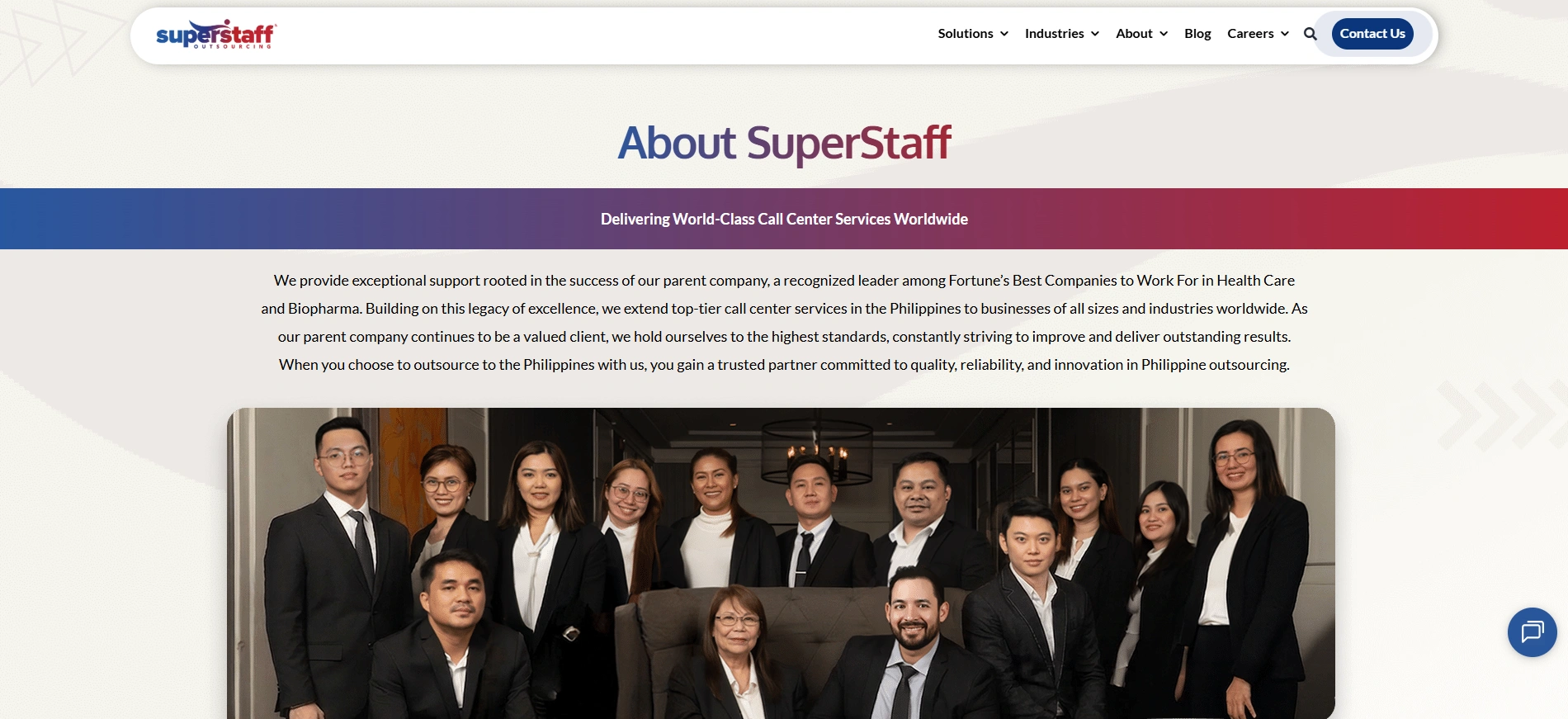
Makati-based BPO with US onshore, Philippines offshore, and Colombia nearshore.
SuperStaff was founded in 2009 to support a US-based parent company recognized in Fortune’s Best Companies to Work For in Health Care and Biopharma. The company is headquartered at 6780 Ayala Avenue, Makati, with operations in Clark, Angeles, Colombia, and the United States. SuperStaff reports 92% employee retention and recently achieved ISO 27001:2022 certification at its Makati headquarters.
Why we picked it
What sets SuperStaff apart for ecommerce buyers is its onshore-nearshore-offshore model under one contract.
- Services offered: Customer support, technical support, accounting, healthcare operations, ecommerce specialists with Shopify and inventory management knowledge.
- Pros: ISO 27001:2022 certified, three-region delivery model, 92% retention rate, 32-language capability.
- Cons: Smaller scale than top-tier BPOs. Best for mid-market accounts.
- Industry expertise: Ecommerce, healthcare, biopharma, tech support, accounting.
- Best for: Ecommerce brands needing US, Philippines, and Latin America blended teams under one vendor.
- Pricing: 30-60% cost reduction vs Western markets per company estimate.
- Rating: 4.5 / 5 on GoodFirms
Worth exploring: the best ecommerce call centers in 2026
Why Choose Helpware as Your Ecommerce Outsourcing Partner
For ecommerce operations leaders building a procurement business case, the question isn’t whether Helpware is the cheapest option in the Philippines. It isn’t, and the company’s $8 to $15 per hour range reflects deliberate investment in retention, training, and compliance infrastructure. The relevant question is what the total cost of ownership actually looks like over a 12 to 24 month engagement, once you factor in attrition, escalations, and seasonal scale.
Helpware’s ecommerce and retail BPO services are built specifically for online brands managing brand voice across channels and absorbing volume spikes. The company runs Philippines hubs as part of a 19-location footprint, which means you can blend offshore Philippine teams with onshore US oversight or nearshore Mexico support under one contract. The print platform case study, which tripled seasonal agent capacity while cutting average handle time by 56% and escalations by 30%, illustrates how process redesign, not just headcount, drives ecommerce CX outcomes. Multilingual coverage in 45 languages closes the gap that Philippines-only providers cannot.
Where Helpware is the right fit: mid-market and enterprise ecommerce brands ($10M-$500M revenue) that view CX as a competitive advantage and want strategic vendor partnerships. Where it isn’t the right fit: very small DTC brands under 1,000 monthly tickets, or operations seeking the absolute cheapest hourly rate without regard to retention or quality.
Why the numbers work:
- 2.8% monthly attrition vs 6-8% industry average means lower hidden retraining costs that erode per-agent benchmarks
- 90% CSAT means fewer escalations, fewer chargebacks, and fewer repeat contacts
- 5-year average client partnerships mean onboarding investment pays off rather than restarting every 12 months
- SOC 2, HIPAA, GDPR certified means no compliance remediation costs for ecommerce brands handling payment or EU data