








The global medical billing outsourcing market is projected to grow from around $18 billion to nearly $40 billion between 2025 and 2032, at a compound annual growth rate of 11.9%, according to Fortune Business Insights. Meanwhile, a 2024 survey by the Healthcare Financial Management Association (HFMA) identified payer challenges, prior authorization complexity, and workforce shortages as the three leading stressors for revenue cycle departments. What those numbers tell you is straightforward: healthcare finance is growing fast, getting harder to manage internally, and increasingly dependent on outside partners to keep claims moving and margins intact.
That said, pricing for healthcare finance services is far from transparent. Depending on whether you are buying RCM software, outsourcing your billing department, or hiring a BPO partner for patient-facing financial operations, the cost structure, contract terms, and value levers look completely different. This guide exists to cut through that opacity.
It is written for CFOs, VP Operations, and revenue cycle directors who are building a business case, benchmarking current contracts, or evaluating a new vendor. You will learn how healthcare finance outsourcing is priced, what drives costs up or down, and how the ten leading providers compare on structure, scope, and value.
Pricing Models for Healthcare Finance Outsourcing
Before you evaluate a single vendor, understand how the service is priced. The model a company uses tells you as much about risk distribution as it does about cost. Here are the six pricing structures you will encounter across the healthcare finance outsourcing market.
Percentage-of-collections pricing
The provider charges a fixed percentage of net patient revenue (NPR) collected on your behalf, typically ranging from 2% to 8% depending on service scope and collection complexity. This model aligns vendor incentives with your outcomes: they earn more when you collect more. It is the dominant model for end-to-end RCM outsourcing, and it works best for health systems that want shared accountability rather than a staffing contract.
Hourly rate pricing
You pay a per-agent-hour fee for dedicated or shared staffing across billing, coding, claims, or patient financial services. Rates span $8 to $35 per hour depending on delivery geography, specialization level, and whether you are onshore, nearshore, or offshore. Hourly pricing is common for BPO-style healthcare finance support and is the easiest model to benchmark across vendors.
Per-claim or per-transaction pricing
It’s a fixed fee per claim submitted, per account worked, or per denial appealed. This model is common in medical coding, claims scrubbing, and clearinghouse services. It rewards processing volume and is straightforward to audit. The risk is that vendors optimize for throughput over accuracy, so SLA terms around first-pass clean claim rate matter more than the per-claim fee itself.
Subscription and platform licensing
Technology-first RCM vendors, including Waystar and Experian Health, price their platforms on a subscription basis tied to organization size, transaction volume, or the number of providers using the system. Annual contracts typically include core functionality with optional modules priced separately. This model works best for organizations that want software tools and retain internal staff to operate them.
Outcome-based or performance-tiered pricing
A base fee covers operations, with variable incentive payments tied to specific metrics such as denial rate reduction, days in AR, or NPR improvement above baseline. Ensemble Health Partners uses this structure: a fixed rate on collections plus tiered incentives when the vendor outperforms defined targets. This model is emerging as the gold standard for large-system engagements because it makes the vendor a financial stakeholder, not just a service provider.
Consulting day rate or project-based pricing
Consulting firms such as Guidehouse price revenue cycle advisory services by the consulting day or as a fixed-price project with milestones. Day rates for senior healthcare finance consultants typically run $2,500 to $6,000+, depending on practice area and seniority. This model is appropriate for point-in-time revenue cycle assessments, system implementations, or denial management remediation, not for ongoing operational support.
Your budget profile and risk tolerance determine which model fits. Cost-conscious buyers with high claim volume and internal IT capacity often do well with per-claim or subscription models. Organizations that want vendor accountability on outcomes should consider percentage-of-collections or performance-tiered structures. BPO-style operations support, including patient access and billing, typically fits hourly or managed service pricing.
Unlock your hidden CX savings with Helpware
Get ROI projection for current support needs.
-40% annually
/monthly costs with Helpware
vs
/internal team costs (approx)
Your requirements fall outside our standard parameters.
Let's discuss your results
Fill in your details to schedule a consultation.
-40% annually
/monthly costs with Helpware
vs
/internal team costs (approx)
Your requirements fall outside our standard parameters.
-40% annually
/monthly costs with Helpware
vs
/internal team costs (approx)
Your requirements fall outside our standard parameters.
Support staff included in the package:
Shared Team Leader
Shared L&D Specalist
Shared QA Specialist
Account Executive by default
Shared Ops Delivery Manager
Admin/Finance/Legal support for the agents by default
1-2 Dedicated Team Leaders
Shared L&D Specialist
Shared to 1 Dedicated QA Specialist
Shared Ops Manager
Account Executive by default
Admin/Finance/Legal support for the agents by default
Shared Real Time Analyst
2-5 Dedicated Team Leaders
0,5 to 1,5 Dedicated L&D Specialists
1-2 Dedicated QA Specialists
Up to half of a dedicated Ops Manager
Account Executive by default
Admin/Finance/Legal support for the agents by default
1 Dedicated Real Time Analyst
Ready to get a personalized estimate for your team?
Contact us for a personalized assessment tailored to your specific needs.
*These projections are estimates for informational purposes only and do not represent a formal offer. Contact us for a personalized quote.
Thank you!
You’ll hear from us within one business day.
Cost Drivers of Healthcare Finance Outsourcing
Two vendors can quote the same pricing model and land at very different total costs. Here is what actually moves the number.
Service scope and revenue cycle coverage
A front-end-only engagement covering patient access, eligibility, and pre-authorization costs considerably less than end-to-end RCM that includes coding, claims submission, AR follow-up, denials management, and payment posting. Vendors quoting a low base rate often exclude mid- and back-cycle work. When comparing proposals, map them to the same revenue cycle scope before putting them side by side.
Delivery geography
Onshore delivery in the US carries fully-loaded labor costs of $45 to $80 per hour per FTE. Nearshore delivery from Mexico or Puerto Rico runs roughly $18 to $35 per hour. Offshore delivery from India or the Philippines can reduce that to $8 to $20 per hour. For HIPAA-sensitive functions, some organizations require onshore or nearshore delivery, which eliminates the cheapest options from consideration. Providers such as Helpware operate across multiple delivery geographies, enabling clients to place work in the model that balances cost and compliance requirements for each function.
Coding specialization and certification requirements
Medical coding for inpatient facility billing, subspecialty physician billing, or complex procedural categories requires certified coders (CPC, CCS, or equivalent), and those credentials command a premium. Vendors that staff non-certified coders against complex work lower their headline rate but increase your denial rate and downstream AR costs. Ask vendors for their first-pass clean claim rate and coder certification mix before accepting any coding services proposal.
Agent attrition and workforce stability
High attrition in BPO environments is a real cost driver that rarely appears in vendor proposals. Every time an agent turns over, you pay for recruiting, onboarding, and the productivity ramp before a replacement performs at standard. Industry attrition in BPO healthcare finance ranges from 6% to 8% monthly. Providers with demonstrably lower attrition, such as Helpware’s 2.8% monthly rate vs. the industry average of 6-8%, reduce those hidden retraining costs that erode the per-agent pricing benchmark you were quoted. Ask vendors for their 12-month attrition figures in your delivery geography and factor that into the total cost model.
Compliance infrastructure and certification depth
HIPAA compliance is table stakes. SOC 2 Type II certification, HITRUST, and PCI-DSS add cost for vendors who maintain them. That cost is worth paying if your organization operates in regulated states or handles high volumes of protected health information. For hospital systems under state or federal audit risk, the cost of non-compliant vendor operations in a breach scenario dwarfs any pricing savings. Require evidence of certification, not self-attestation.
Technology stack and integration complexity
Vendors that integrate natively with Epic, Cerner, or Meditech charge a premium for the integration build and ongoing support. Organizations running legacy patient accounting systems face higher implementation costs and longer timelines before a vendor reaches steady-state performance. Ask for the EHR integration history relevant to your platform and time-to-performance data from comparable implementations.
Payer mix complexity and denial volume
A payer mix dominated by commercial insurers with low denial rates requires less appeals work than one heavy in Medicare Advantage or Medicaid managed care. High-denial payer environments require experienced AR follow-up staff and strong denial management protocols, which cost more. Industry denial rates average between 8% and 12% according to Business Research Insights. Vendors that can document their denial resolution rates and first-pass clean claim performance against your payer mix are the ones worth engaging.
Once you understand these drivers, you can build a realistic cost model before comparing vendor proposals. The next step is putting your actual numbers to work.
Top 10 Healthcare Finance Companies for 2026: At a Glance
| Company | Key Services | Global presence | Employees | Year est. | Pricing |
|---|---|---|---|---|---|
| Helpware | Healthcare BPO, billing support, claims processing, patient support, RCM ops | USA, Philippines, Mexico, Ukraine, Georgia, Poland, Uganda (19 locations) | ~4,000 | 2015 | $8–$15/hr |
| Ensemble Health Partners | End-to-end RCM managed services, CDI, patient access, coding | USA (Cincinnati, national) | Not disclosed | 2014 | Fixed rate on collections + performance incentives |
| R1 RCM | End-to-end RCM, patient access, coding, claims, AR management | USA, India, Philippines (multiple) | ~27,200 | 2003 | Custom. Contact vendor |
| Optum (UnitedHealth) | RCM platforms, payment processing, financial engagement, HSA management | USA, India, global (180+ locations) | ~10,000 | 2011 | Custom. Contact vendor |
| Waystar | Cloud-native RCM software, claims management, prior auth, payment analytics | USA (Louisville, national) | Not disclosed | 2017 | Subscription + volume tiers |
| Guidehouse | RCM consulting, revenue integrity, extended business office, advisory | USA, global | Not disclosed | 2018 (from PwC Public Sector) | Consulting day rate / project-based |
| Access Healthcare | RCM outsourcing, medical coding, CDI, AR management, patient access | USA, India (Dallas HQ) | ~40,000 | 2011 | Custom. Contact vendor |
| Conifer Health Solutions | End-to-end RCM, patient financial services, value-based care support | USA (Frisco, TX, national) | ~20,000 | 2012 | Custom. Contact vendor |
| GeBBS Healthcare Solutions | Medical coding, billing, RCM outsourcing, AR management | USA, India, worldwide | ~11,000 | 2006 | Per-claim / hourly / project-based |
| Experian Health | Patient access, eligibility verification, claims management, payment analytics | USA, global | Not disclosed | 2016 | Subscription + module licensing |
Top 10 Healthcare Finance Companies: Overview
#1 Helpware

Helpware CX is a specialized BPO provider that approaches the healthcare revenue cycle from the patient operations layer: the intersection of billing accuracy, compliance rigor, and patient experience that most RCM technology vendors treat as out of scope. Founded in 2015 and headquartered in Lexington, Kentucky, Helpware’s healthcare BPO services cover medical billing and coding, claims processing, HIPAA-compliant RCM operations, insurance verification, patient appointment scheduling, and healthcare data entry. The company operates from 19 locations across four continents, including US-based delivery hubs for compliance-sensitive functions, and supports clients in 45 languages.
The combination of dedicated team models, compliance infrastructure, and measurable workforce stability is what makes Helpware operationally distinct from the technology-first RCM firms. Where many BPO vendors pool agents across clients, Helpware builds dedicated teams, which means your institutional knowledge stays with your account rather than cycling through shared resources.
Why we picked it
Helpware consistently delivers 90% CSAT across healthcare clients and maintains a 2.8% monthly attrition rate versus the 6-8% industry average. For revenue cycle operations where agent knowledge of payer rules and coding nuances directly affects clean claim rates, that workforce stability is a measurable financial asset, not just an HR metric.
- Services offered: Medical billing and coding, claims processing, insurance verification, patient appointment scheduling, healthcare data entry, HIPAA-compliant RCM support, back-office healthcare operations, patient financial services
- Pros: 2.8% monthly attrition vs. 6-8% industry average. 19 locations for 24/7 coverage. 90% CSAT consistently across clients. SOC 2 Type II, HIPAA, GDPR certified. 5-year average client partnerships. 45 languages with native-speaker model
- Cons: Consultative sales process and longer onboarding timeline. Not a technology platform for organizations wanting self-serve analytics without managed services
- Industry expertise: Healthcare and telehealth, SaaS, fintech and banking, ecommerce, logistics, gaming, public sector
- Best for: Mid-market to enterprise healthcare organizations ($50M-$500M revenue) that need compliant, patient-facing revenue cycle operations managed by a dedicated partner
- Pricing: $8-$15/hr depending on service complexity, location, and engagement model.
- Rating: 5.0 on Clutch
- Year established: 2015
- Location: Lexington, Kentucky (HQ), USA, Mexico, Philippines, Ukraine, Georgia, Puerto Rico, Poland, Germany, Albania, Uganda
#2 Ensemble Health Partners
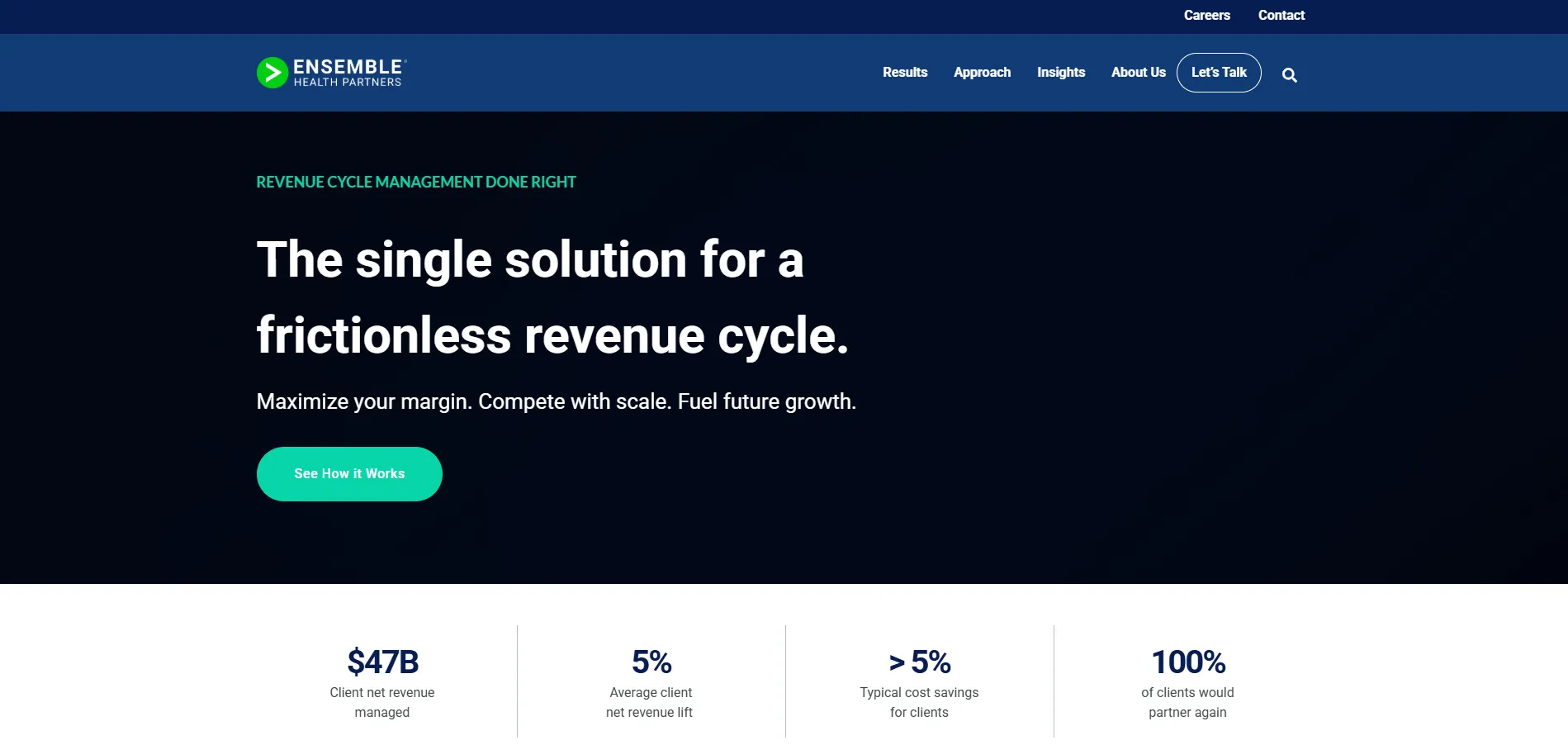
Ensemble Health Partners is the top-ranked end-to-end RCM outsourcing provider in the United States, consistently recognized as Best in KLAS for revenue cycle outsourcing. Founded in 2014 and headquartered in Cincinnati, Ohio, Ensemble is a Tenet Healthcare subsidiary that manages $32 billion in net patient revenue for 600+ clients across hospitals, health systems, and employed physician groups. Its model is genuinely end-to-end: patient access, clinical documentation improvement, coding, claims, AR management, and patient financial services all delivered by a single partner with shared accountability on financial outcomes. The pricing structure reinforces this alignment, with a fixed rate on collections plus performance-tiered incentives tied to metrics that matter to your CFO, not just operational KPIs.
Why we picked it
Ensemble reports 102% year-one cash collection achievement and a 5% average NPR lift across clients. In 2025 KLAS interviews, health system CEOs and CFOs describe a partner that delivers without requiring management overhead. The June 2025 agentic AI platform built with Cohere adds automation depth while preserving the people-driven model that earned its reputation.
- Services offered: End-to-end RCM managed services, patient access, CDI, coding, claims management, AR follow-up, denials management, patient financial services
- Pros: Best in KLAS RCM outsourcing 2025. 102% year-one cash collection. Performance-linked pricing. Strong partnership reputation in KLAS client interviews
- Cons: Tenet Healthcare parent affiliation can create conflict concerns for competing health systems; transition complexity is high for large-system implementations; not suited for small practices
- Best for: Large health systems and hospital networks seeking a single strategic partner to own and improve the entire revenue cycle
- Pricing: Fixed rate on collections with performance-tiered incentives. Contact vendor for system-specific quotes
- Rating: Best in KLAS (RCM Outsourcing 2025)
- Year established: 2014
- Location: Cincinnati, Ohio (HQ), national US operations
#3 R1 RCM
R1 RCM is one of the largest publicly traded revenue cycle management companies in the US, founded in 2003 (originally as Accretive Health) and headquartered in Murray, Utah. The company employs more than 27,200 people and processes over $30 billion in annual patient revenue for 1,000+ clients, including Ascension, Intermountain Healthcare, and Rush. R1’s platform approach combines AI-powered automation, robotic process automation, and predictive analytics across the front, middle, and back revenue cycle. The company earned Best in KLAS awards across multiple RCM categories for 2025 and 2026, though a KLAS report published in September 2025 noted that clients of R1 have cited inconsistent performance from offshore teams and slower-than-expected AI impacts in operational settings.
- Services offered: Patient access, coding management, claims management, AR management, denials management, patient billing and payment
- Pros: 27,200+ employees at significant scale. $30B+ annual patient revenue processed. 1,000+ clients. Best in KLAS multiple categories 2025-2026
- Cons: KLAS reports mixed client satisfaction on offshore delivery quality and AI execution; large-system focus limits agility for mid-market clients
- Best for: Large hospitals and health systems with NPR over $1B that need a technology-enabled managed services partner at enterprise scale
- Pricing: Custom pricing. Contact vendor for quotes
- Rating: Best in KLAS (multiple categories 2026)
- Year established: 2003
- Location: Murray, Utah (HQ), US, India, Philippines
#4 Optum (UnitedHealth Group)
Optum is the health services and technology division of UnitedHealth Group, founded in 2011 and headquartered in Eden Prairie, Minnesota. Operating across 180+ locations worldwide, Optum offers a broad portfolio that spans revenue cycle management platforms, payment processing, financial engagement, and HSA administration. Its RCM platform, Optum Integrity One, launched in May 2025 with an AI-driven interface that consolidates coding, clinical documentation, and billing workflows. In a pilot program, the platform delivered a 20%+ coding productivity increase. Optum is recognized as a Leader in the 2025 Everest Group RCM Platforms PEAK Matrix and the IDC MarketScape for US RCM Services 2025-2026.
- Services offered: RCM platforms, revenue integrity, financial clearance, patient billing, payment processing, HSA and FSA administration, prior authorization automation
- Pros: 180+ global locations. Everest and IDC MarketScape Leader 2025. AI-driven Integrity One platform for integrated workflows
- Cons: KLAS reports note staff turnover, inconsistent denials management, and slow progress on key initiatives for some clients
- Best for: Large health systems needing integrated RCM technology with UnitedHealth ecosystem connectivity
- Pricing: Custom pricing. Contact vendor for quotes
- Rating: Everest Group RCM Platforms Leader 2025
- Year established: 2011
- Location: Eden Prairie, Minnesota (HQ), USA, global operations
#5 Waystar

Waystar is a cloud-native RCM software platform formed in 2017 through the merger of Navicure and ZirMed, now publicly traded and headquartered in Louisville, Kentucky. The platform processes $5 billion in annual patient payments and generates $4 billion in out-of-pocket estimates across 500,000+ providers, 1,000 health systems, and 5,000 payers. What distinguishes Waystar in 2026 is its agentic AI architecture, the first of its kind in the RCM software market according to Black Book Research. The platform integrates with all major EHR and practice management systems and has earned Best in KLAS or Category Leader recognition 16 times across multiple product categories.
- Services offered: Claims management, financial clearance, prior authorization, patient payment engagement, eligibility verification, denial management analytics
- Pros: 500,000+ providers on platform. $5B annual patient payments processed. Black Book #1 Agentic AI RCM 2026. 4.4/5 on G2
- Cons: Technology platform, not a managed services provider: organizations need internal staff to operate it. Not a fit for orgs seeking outsourced operations
- Best for: Organizations with internal billing teams that want automation-first software to reduce manual touchpoints across the claims lifecycle
- Pricing: Subscription and volume-based licensing. Contact vendor at waystar.com
- Rating: 4.4 on G2
- Year established: 2017
- Location: Louisville, Kentucky (HQ), national US
#6 Guidehouse

Guidehouse is a management consulting and professional services firm with deep roots in healthcare finance advisory, formed in its current shape in 2018 following PwC’s divestiture of its public sector practice. The firm acquired Navigant Consulting in 2019, significantly expanding its healthcare revenue cycle consulting footprint. Guidehouse provides RCM outsourcing, extended business office solutions, and revenue cycle consulting to hospitals and health systems, earning a 92.6/100 score from KLAS Research. Where Guidehouse differs from managed services providers is the consulting-first model: the firm does not take operational ownership of your revenue cycle in the way Ensemble or R1 does, but it brings structured methodology and management expertise to revenue integrity challenges, payer contract optimization, and organizational transformation.
- Services offered: Revenue cycle consulting, RCM outsourcing, extended business office, revenue integrity, coding compliance, denial management, CDI advisory
- Pros: 92.6 KLAS score. Strong consulting methodology. High client satisfaction in KLAS 2025 report. Navigant healthcare expertise incorporated
- Cons: Consulting-first model means higher day rates than managed services; not suited for organizations that want full operational transfer
- Best for: Health systems looking for expert consulting to diagnose revenue cycle performance gaps and manage targeted improvement programs
- Pricing: Consulting day rate / project-based. Contact vendor for quotes
- Rating: 92.6 KLAS Research
- Year established: 2018 (from PwC public sector practice)
- Location: McLean, Virginia (HQ), national and international offices
#7 Access Healthcare
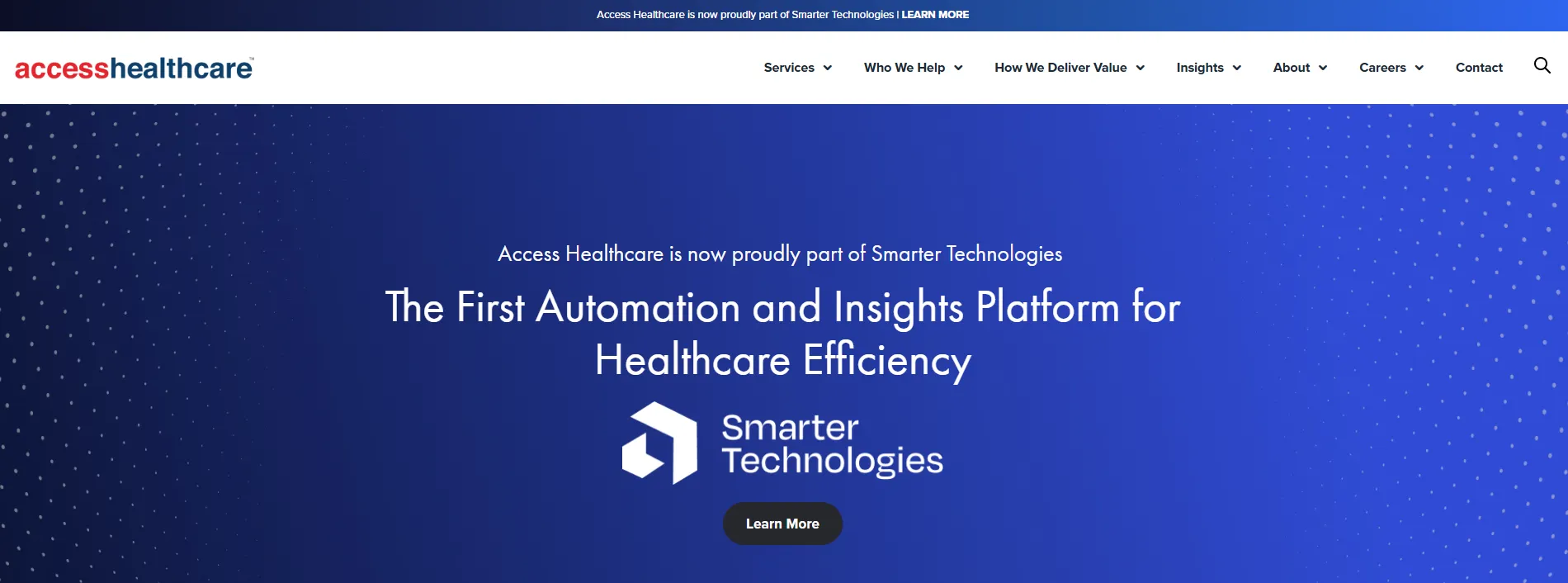
Access Healthcare is a large-scale RCM outsourcing firm founded in 2011 and headquartered in Dallas, Texas, with 40,000+ employees operating from US and India delivery centers. The company’s scale puts it in the same tier as R1 and Ensemble for high-volume hospital system outsourcing. What Access Healthcare is particularly recognized for is automation density: the firm applies robotic process automation across claims workflows at a depth that reduces manual review fatigue in high-volume billing environments. In January 2025, the company received a strategic investment from New Mountain Capital, underscoring market confidence in its growth. Access Healthcare serves hospitals, health systems, medical groups, billing companies, and health plans across patient access, coding, CDI, and AR management.
- Services offered: Medical coding, CDI, patient access, AR management, denials management, healthcare analytics
- Pros: 40,000+ employees. Strong automation density in claims workflows. Strategic investment from New Mountain Capital 2025. Broad payer mix experience
- Cons: Less recognized in KLAS than Ensemble. Client satisfaction data is less publicly documented than top-tier peers
- Best for: Hospital systems and large medical groups that need high-volume coding and AR management with automation-heavy delivery
- Pricing: Custom pricing. Contact vendor for quotes
- Rating: Not publicly rated on major platforms
- Year established: 2011
- Location: Dallas, Texas (HQ), US and India delivery centers
#8 Conifer Health Solutions
Conifer Health Solutions is a Tenet Healthcare subsidiary founded in 2012 and headquartered in Frisco, Texas, with 20,000+ employees operating RCM services for hospitals, health systems, and value-based care organizations. Conifer provides end-to-end revenue cycle services alongside patient communication, financial clearance, and value-based care support. The company’s connection to Tenet gives it deep hospital operations experience but can raise the same conflict-of-interest considerations for competing health systems that apply to Ensemble. Conifer serves over 800 clients and manages more than $25 billion in annual revenue.
- Services offered: End-to-end RCM, patient financial services, value-based care financial support, financial clearance, revenue integrity
- Pros: 20,000+ employees. 800+ client organizations. Strong value-based care financial support capabilities. Deep hospital operations experience
- Cons: Tenet parent affiliation creates the same conflict considerations as Ensemble for competing systems; less technology-differentiated than Waystar or R1
- Best for: Health systems seeking end-to-end outsourcing with value-based care financial support capabilities
- Pricing: Custom pricing. Contact vendor for quotes
- Year established: 2012
- Location: Frisco, Texas (HQ), national US operations
#9 GeBBS Healthcare Solutions
GeBBS Healthcare Solutions is an RCM outsourcing firm founded in 2006 and operating from US headquarters with global delivery through India-based teams, employing 11,000+ coding and billing specialists. GeBBS is recognized for medical coding expertise, with certified coders across inpatient, outpatient, and physician specialties, and offers end-to-end RCM services that include billing, collections, denial management, and AR follow-up. The company’s pricing model is flexible, offering per-claim, hourly, or project-based structures that make it accessible for mid-market organizations not ready for a full managed services contract. GeBBS clients include health systems, independent physician groups, and billing companies.
- Services offered: Medical coding, medical billing, RCM outsourcing, AR management, denial management, coding compliance audit
- Pros: 11,000+ coding specialists. Flexible pricing models (per-claim, hourly, project). Certified coder depth across specialties. Accessible for mid-market
- Cons: Primarily India-based delivery, which may limit eligibility for compliance-sensitive onshore requirements; less recognized in KLAS than top-tier peers
- Best for: Mid-market hospitals, physician groups, and billing companies seeking specialist coding and billing support with flexible contract structures
- Pricing: Per-claim, hourly, or project-based. Contact vendor for quotes
- Year established: 2006
- Location: Los Angeles, California (HQ), US and India
#10 Experian Health
Experian Health is a division of Experian, the global data and analytics company, focused specifically on healthcare financial operations. Founded in 2016 through Experian’s acquisition of Passport Health Communications, the company brings payer connectivity, eligibility analytics, and claims management capabilities built on the broader Experian data infrastructure. Experian Health’s platform serves providers across patient access, identity verification, eligibility, contract management, and patient financial engagement. It earned a 90.3/100 KLAS score in contract management and is widely used among health systems that want real-time payer connectivity and data-driven financial clearance without a full managed services commitment.
- Services offered: Patient access, eligibility verification, patient identity, claims management, contract management analytics, patient financial engagement
- Pros: 90.3 KLAS score in contract management. Experian data infrastructure for identity and payer analytics. Strong eligibility and financial clearance capabilities
- Cons: Technology platform rather than a managed services partner. Limited managed services for organizations that need operational staffing
- Best for: Health systems that need data-driven patient access, eligibility, and contract analytics integrated into existing billing operations
- Pricing: Subscription and module licensing. Contact vendor for quotes
- Rating: 90.3 KLAS (contract management)
- Year established: 2016 (via Passport acquisition)
- Location: Franklin, Tennessee (HQ), US and global
Why Choose Helpware as Your Healthcare Finance Outsourcing Partner
Helpware CX operates in the $8 to $15 per hour range, which positions it at or above some offshore-only providers. What that number does not tell you is the total cost of the relationship. When agent attrition runs at 6% to 8% per month across the industry, and Helpware’s is 2.8%, you are looking at a meaningful reduction in retraining cycles, onboarding cost, and the institutional knowledge loss that directly affects clean claim rates. When CSAT runs at 90% consistently, you see fewer escalations, fewer repeat contacts from patients confused by their bills, and better collection rates on self-pay balances. Sticker price and total cost of ownership are not the same number in healthcare finance operations.
For healthcare organizations specifically, Helpware’s BPO model integrates the administrative and patient-facing sides of the revenue cycle into one partner. The healthcare BPO services span medical billing and coding, claims processing, insurance verification, patient appointment scheduling, healthcare data entry, and HIPAA-compliant RCM support. Operations run from 19 locations across four continents, including US-based hubs for functions where onshore delivery is a compliance or contractual requirement. SOC 2 Type II, HIPAA, and GDPR certification means your data governance requirements are handled by the vendor before they become your problem.
Helpware is the right fit for mid-market to enterprise healthcare organizations ($50M to $500M revenue) that treat patient experience as a financial variable, not just a satisfaction metric. It is not the right fit for health systems that want a pure technology platform, for organizations seeking the lowest per-claim price in an offshore-only model, or for solo practices that need a light billing service at commodity pricing. That honesty matters when you are evaluating a partner you intend to work with for five years.
Why the numbers work:
- 2.8% monthly attrition vs. 6-8% industry average, which means lower hidden retraining costs on dedicated teams
- 90% CSAT: fewer patient billing escalations and repeat contacts that erode collection efficiency
- 5-year average client partnerships, so onboarding investment and institutional knowledge pay off over the contract term
- SOC 2 Type II, HIPAA, GDPR certified: no compliance remediation costs in the event of an audit or breach