







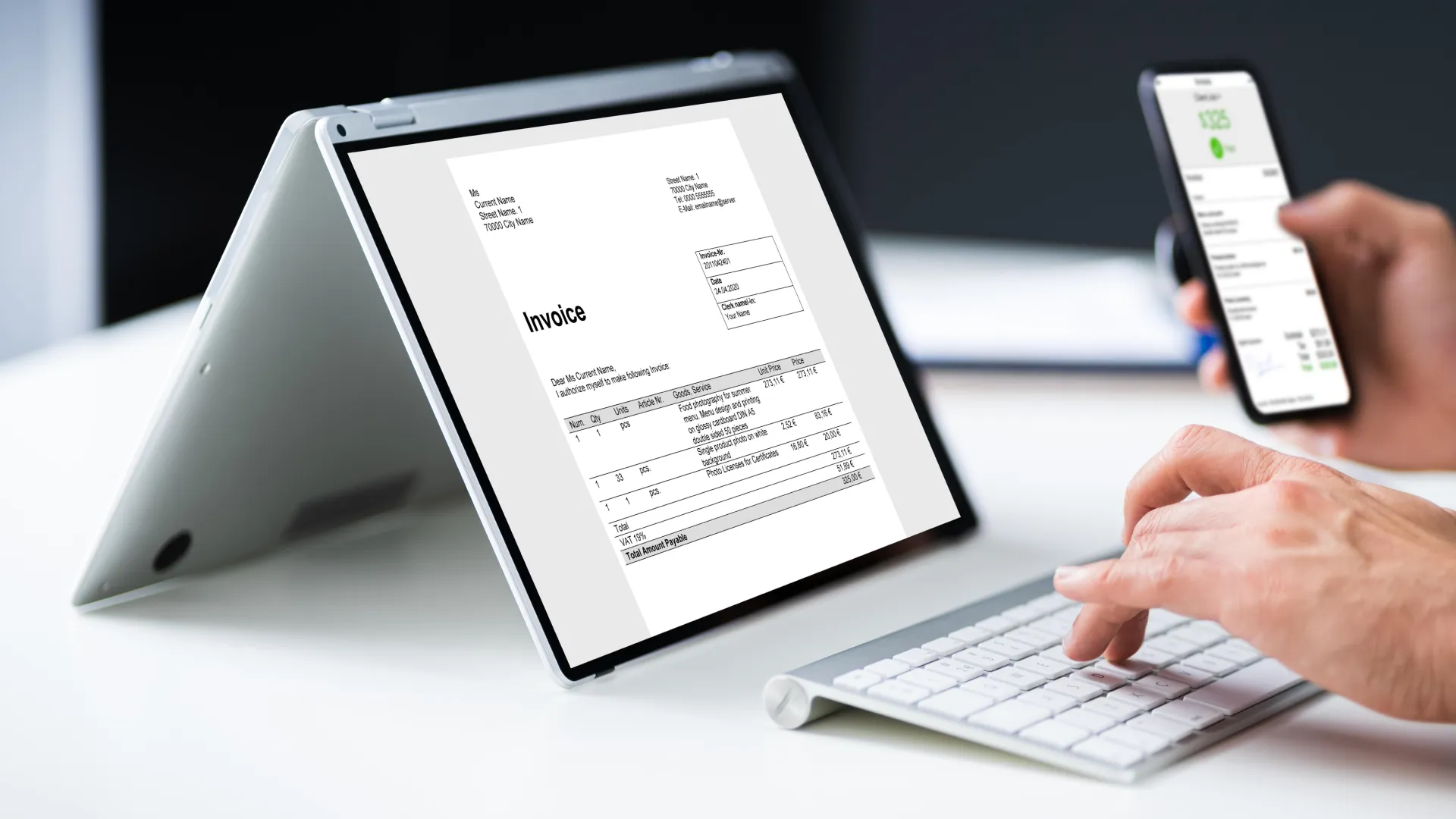
Grand View Research’s 2025 BPO Market Analysis puts the finance and accounting BPO segment at 21.4% of the $328.37 billion global BPO market — the single largest segment by revenue. Inside that figure is a growing volume of organizations that have concluded processing supplier invoices in-house is simply not worth the cost. Yet Ardent Partners’ 2025 AP Benchmarking Report found that Best-in-Class AP teams process invoices in 3.1 days versus 17.4 days for everyone else — a gap that compounds directly into cash flow, vendor relationship management, and month-end close timelines.
Pricing for outsourced invoice processing is opaque. Vendors rarely publish their rates. Hourly models, per-invoice fees, and managed-service retainers mean completely different things to your total cost depending on volume, complexity, and compliance requirements. This guide is written for finance and operations leaders evaluating invoice processing outsourcing for the first time or renegotiating an existing contract. You will learn which pricing models exist, what actually drives the cost up or down, and how 10 leading providers compare on services, locations, and price point.
Pricing Models for Invoice Processing Services
Before comparing any vendor, understand the model they are selling. What looks like an attractive rate in one model can become an expensive one in another as soon as your volume changes, your exception rate spikes, or your ERP integration needs expand.
Per-invoice pricing
The vendor charges a flat rate for each invoice processed, typically ranging from $0.50 to $5 depending on document complexity, format variety, and accuracy requirements. This model is transparent and easy to budget when volumes are stable — but costs can spike sharply during seasonal surges, audit periods, or any period when exception volumes rise. It is best suited for low-to-moderate, predictable invoice volumes with standardized document formats.
Hourly rate / FTE-based pricing
Common in full-service BPO arrangements, this model charges a rate per agent hour or per dedicated full-time equivalent. Rates range from under $8/hour for offshore teams in India or the Philippines to $25-$40/hour for specialized onshore US AP analysts. What matters here is not the hourly rate in isolation but which party bears the cost when volume drops or peaks — and how the contract handles ramp periods.
Monthly retainer / managed service pricing
A fixed monthly fee covers a defined scope: a committed invoice volume, channel coverage, and SLA commitments. This model gives finance teams predictable costs and holds the vendor accountable against measurable targets. Retainers for small-scale programs typically start around $650/month and scale into five figures for enterprise accounts with high complexity.
Output-based / transaction-volume pricing
The vendor is paid based on the number of invoices or transactions completed within a period, often with tiered pricing at volume thresholds. This model aligns vendor incentives with throughput, which is useful for high-volume programs — but it can create pressure to process exceptions quickly rather than accurately.
Hybrid (base + variable) pricing
A base fee covers a committed minimum volume, with variable charges applied above the threshold. This model works well for organizations with a predictable steady-state volume and manageable seasonal peaks, giving both parties cost visibility without punishing efficiency.
Project-based pricing
Used for one-time invoice backlogs, legacy migrations, or audit-period surges. Vendors quote a fixed fee for a defined scope and timeline. This is the right model when the need is temporary rather than ongoing — for example, clearing a backlog before transitioning to a managed service arrangement.
For most organizations outsourcing invoice processing at scale, the managed retainer or hybrid model delivers the strongest cost predictability. Per-invoice pricing suits smaller, lower-complexity programs. Enterprise buyers processing thousands of invoices per month typically negotiate custom hybrid structures that reflect their volume commitments and SLA requirements.
Cost Drivers of Invoice Processing Services
Two organizations processing 2,000 invoices per month can receive vendor quotes that differ by 60% — because their actual operational requirements are different. Understanding what moves the cost up or down is the most valuable thing you can bring into a vendor conversation.
Invoice complexity and format mix
Invoices that arrive as structured PDFs or EDI files cost significantly less to process than scanned paper invoices in multiple formats, languages, or currencies. The more standardized your supplier base, the lower your extraction and validation costs. Vendors relying purely on OCR struggle with non-standard formats; providers with human validators behind the automation layer handle complexity at higher cost but produce meaningfully higher accuracy rates.
Delivery location
Offshore processing in India, the Philippines, or Eastern Europe runs at $8-$15 per agent hour. Nearshore delivery in Mexico, Latin America, or Eastern Europe for European buyers sits at $12-$22. Onshore US teams for compliance-sensitive or legally constrained programs range from $25 to $40+. The cost gap is real, but factor in time zone coordination needs, language requirements, and any data residency rules that govern where your financial data can be processed before making a location decision.
Volume and predictability
High-volume, stable-volume programs attract lower per-unit rates because vendors can plan capacity and staffing efficiently. Unpredictable volumes, seasonal surges, and rush-period backlogs cost more in every model. When estimating costs, ask vendors how they handle volume spikes and whether you pay for unused committed capacity during quiet periods.
Agent attrition
This is the cost driver vendors almost never raise in the sales process. High staff turnover means constant re-training on your specific workflows, which reduces accuracy during ramp periods and produces hidden retraining costs absorbed into your engagement over time. Providers with demonstrably low attrition — Helpware’s monthly attrition rate is 2.8% against an industry average of 6-8% — reduce that cost in ways that don’t appear in the hourly rate but show up clearly in total cost over a 12 or 24-month contract.
Compliance and data security requirements
If your invoices contain regulated data — healthcare billing, financial records under SOX, GDPR-scoped vendor information — you need a provider with verified certifications: SOC 2 Type II, HIPAA, ISO 27001, PCI-DSS. Each certification layer adds real cost on the vendor side, which flows through to your contract. Non-certified providers look cheaper in the initial quote and more expensive in the audit or in a data incident.
ERP and system integration
Connecting an outsourcing provider to your ERP (SAP, Oracle, NetSuite, Microsoft Dynamics) adds integration work that many providers price separately from their AP service fee. Ask upfront whether integration is included in the base scope, billed as a one-time project fee, or handled through a pre-built connector that requires minimal custom development. Surprises here routinely inflate first-year total cost.
Language and currency complexity
Processing invoices from domestic suppliers in a single currency is a fundamentally different operational problem from processing invoices from 40 countries in 12 currencies with varying tax and legal requirements. If your supplier base is international, confirm that the vendor has native-language validation capability for the specific languages involved — not just generic multilingual support.
With these seven drivers mapped, you can build a structured comparison across any shortlist of invoice processing vendors.
Calculate Your Invoice Processing Costs
Now that you know what drives pricing, put real numbers to your situation.
Use Helpware’s cost calculator to get a personalized estimate based on your invoice volume, coverage hours, compliance requirements, and service scope. If your program is complex or you want a custom quote from someone who can map a solution to your actual workflow, speak with our team directly.
Unlock your hidden CX savings with Helpware
Get ROI projection for current support needs.
-40% annually
/monthly costs with Helpware
vs
/internal team costs (approx)
Your requirements fall outside our standard parameters.
Let's discuss your results
Fill in your details to schedule a consultation.
-40% annually
/monthly costs with Helpware
vs
/internal team costs (approx)
Your requirements fall outside our standard parameters.
-40% annually
/monthly costs with Helpware
vs
/internal team costs (approx)
Your requirements fall outside our standard parameters.
Support staff included in the package:
Shared Team Leader
Shared L&D Specalist
Shared QA Specialist
Account Executive by default
Shared Ops Delivery Manager
Admin/Finance/Legal support for the agents by default
1-2 Dedicated Team Leaders
Shared L&D Specialist
Shared to 1 Dedicated QA Specialist
Shared Ops Manager
Account Executive by default
Admin/Finance/Legal support for the agents by default
Shared Real Time Analyst
2-5 Dedicated Team Leaders
0,5 to 1,5 Dedicated L&D Specialists
1-2 Dedicated QA Specialists
Up to half of a dedicated Ops Manager
Account Executive by default
Admin/Finance/Legal support for the agents by default
1 Dedicated Real Time Analyst
Ready to get a personalized estimate for your team?
Contact us for a personalized assessment tailored to your specific needs.
*These projections are estimates for informational purposes only and do not represent a formal offer. Contact us for a personalized quote.
Thank you!
You’ll hear from us within one business day.
Top 10 Invoice Processing Services for 2026
| Company | Services | Global presence | Employees | Year est. |
|---|---|---|---|---|
| Helpware CX | Back office, invoice processing, customer support, technical support, CX consulting | USA, Mexico, Philippines, Ukraine, Georgia, Puerto Rico, Poland, Germany, Albania (19 locations) | ~4,000 | 2015 |
| Genpact | Finance & accounting BPO, invoice processing, analytics, risk, IT services | USA, India, Philippines, China, Mexico, UK, Poland and more (30+ countries) | ~125,000 | 1997 |
| Conduent | Finance & accounting BPO, transaction processing, healthcare claims, government services | USA, UK, India, Philippines, Poland, Mexico, Jamaica and more (24 countries) | ~54,000 | 2017 |
| Infosys BPM | Procure-to-pay, finance & accounting BPO, HR, procurement, analytics | India, USA, Poland, Philippines, Australia, Brazil, Mexico and more (13 countries) | ~60,966 | 2002 |
| Datamatics | Finance & accounting BPO, intelligent document processing, RPA, IT services | USA, India, Philippines, UK, Germany, Australia (4 continents) | ~7,700 | 1975 |
| Invensis Technologies | Finance & accounting BPO, back office, invoice processing, healthcare BPO | India (HQ), USA | Not disclosed | 2000 |
| ARDEM Incorporated | Invoice processing, accounts payable, data entry, RPA, business process automation | USA (HQ), India, Latin America | Not disclosed | 2004 |
| Flatworld Solutions | Finance & accounting, invoice processing, call center, data entry, software development | USA, India, Philippines, UK, Bolivia, Colombia | ~5,000 | 2004 |
| OWorkers | Invoice processing, data entry, data annotation, content moderation, customer support | Bulgaria, Madagascar, Egypt (3 centers) | ~400 | 2013 |
| Whiz Consulting | Invoice processing, accounts payable, bookkeeping, payroll, accounting | India (HQ), USA, UK, Australia | ~150 | 2013 |
Top 10 Invoice Processing Services: Overview
#1 Helpware CX

A BPO company founded in 2015 that manages invoice tracking, data entry, accounts payable coordination, and financial back office operations for 400+ clients across healthcare, SaaS, e-commerce, fintech, and logistics.
What separates Helpware CX from most invoice processing vendors is the operational model behind the delivery. Helpware CX’s back office operations combine AI-powered automation with human review to handle invoice tracking, data entry, accounts payable support, and financial document management within clients’ existing ERP and accounting environments. The team is not a transactional labor pool — it is recruited, trained, and managed as an operational extension of the client’s finance function. Built for mid-market to enterprise organizations, Helpware’s back office practice applies quality assurance protocols that hold accuracy through high-volume periods. The company reduces back office costs for clients by up to 50% while maintaining the process reliability and institutional knowledge that commodity providers cannot sustain.
Why we picked it
The 5-year average client partnership is the most practical performance indicator on this list. Teams that build real process knowledge of client workflows, exception types, and ERP environments deliver measurably better outcomes over time than providers whose staff turns over constantly.
- Services offered: Invoice tracking and management, data entry, accounts payable coordination, back office administration, customer support (omnichannel, multilingual), technical support, CX consulting (strategy, technology, operational transformation).
- Pros: 2.8% monthly attrition vs. 6-8% industry average, reducing hidden retraining costs; 90% CSAT consistently maintained across clients; native-speaker support in 45 languages; SOC 2, HIPAA, GDPR, PCI-DSS certified; 5-year average client partnerships.
- Cons: Longer initial sales cycle due to consultative onboarding; not the right fit for purely transactional, high-volume commodity invoice work where the lowest per-invoice rate is the only evaluation criterion.
- Industry expertise: Healthcare and telehealth, SaaS and software, e-commerce and retail, fintech and banking, logistics, gaming and entertainment, public sector, automotive.
- Best for: Mid-market to enterprise organizations ($50M-$500M revenue) that need compliance-ready back office support as part of a broader finance operations or CX strategy.
- Pricing: Starting at $8-$15 per hour depending on service scope, delivery location, and engagement model.
- Rating: 4.8 ★ (Clutch)
- Year established: 2015
- Location: Lexington, Kentucky (HQ); USA, Mexico, Philippines, Ukraine, Georgia, Puerto Rico, Poland, Germany, Albania
#2 Genpact
The world’s largest dedicated finance and accounting BPO provider, processing invoices for Fortune 500 clients across 30+ countries since its founding as a GE Capital unit in 1997.
Genpact built its entire business model around accounts payable and financial operations — it started as the internal AP processing unit for General Electric before spinning off as an independent company in 2005. Today, with 125,000+ employees, the company brings Six Sigma process discipline and its proprietary AI platform, Genpact Cora, to invoice processing at genuine enterprise scale. Its finance and accounting practice covers accounts payable end-to-end: document management, invoice processing, approval routing, resolution management, and travel and expense processing. The client base spans the majority of the Fortune 500 across financial services, manufacturing, healthcare, and consumer goods.
Why we picked it
The scale and F&A process depth are genuinely difficult to match anywhere else in the market. Genpact is built for global enterprises that need a single provider capable of processing invoices across dozens of countries, currencies, tax jurisdictions, and regulatory environments at once.
- Services offered: Accounts payable outsourcing (invoice processing, approval management, document management), invoice-to-cash, record-to-report, treasury, tax, finance analytics, CFO advisory, supply chain management.
- Pros: 125,000+ employees with deep Six Sigma F&A expertise; Genpact Cora AI platform for intelligent automation; serves the majority of Fortune 500 companies; proven global multi-currency capability.
- Cons: Services primarily designed for large enterprise engagements; mid-market organizations may find the onboarding complexity and contract structure disproportionate to their actual volume.
- Industry expertise: Banking and financial services, insurance, healthcare, manufacturing, consumer goods, retail, high-tech.
- Best for: Large enterprises with global, multi-currency, multi-jurisdiction AP programs that need a single outsourcing partner.
- Pricing: Custom enterprise pricing — contact vendor.
- Rating: Not publicly listed on Clutch.
- Year established: 1997
- Location: New York City (HQ); operations in 30+ countries including India, Philippines, China, Mexico, UK, Poland.
#3 Conduent
A large-scale BPO and transaction processing company with over 30 years of AP operations history, spun off from Xerox in 2017 and now serving commercial, government, and healthcare clients across 24 countries with 54,000+ employees.
Conduent was formed in 2017 as a Xerox spin-off, inheriting decades of transactional processing expertise across finance and accounting, healthcare claims, and government program administration. With 54,000+ employees across 24 countries, Conduent’s finance and accounting practice handles AP at enterprise scale for regulated commercial clients and government agencies — environments where compliance infrastructure, audit readiness, and institutional process depth are not optional. The company’s F&A and procurement services have served clients for over 30 years, with documented Gartner Peer Insights reviews noting improvements in invoice processing time across large-scale deployments.
Why we picked it
Conduent is one of the few providers on this list with verifiable experience running AP programs inside both large healthcare payers and government entities simultaneously — two buyer segments where compliance failure is not just a service issue but a regulatory one.
- Services offered: Finance and accounting BPO, accounts payable, healthcare claims administration, human capital management, government program administration, transaction processing, customer experience management.
- Pros: Enterprise-grade compliance infrastructure proven across government and healthcare; 54,000+ professionals across 24 countries; over 30 years of AP operations history.
- Cons: Service model built primarily for large enterprise and government clients; mid-market buyers may find onboarding timeline and contract structure more than their program requires.
- Industry expertise: Healthcare, government, financial services, communications, manufacturing, transportation.
- Best for: Large enterprises and government agencies requiring a compliance-proven transaction processing partner at scale.
- Pricing: Custom enterprise pricing — contact vendor.
- Rating: Gartner Peer Insights reviews available.
- Year established: 2017
- Location: Florham Park, New Jersey (HQ); USA, UK, India, Philippines, Poland, Mexico, Jamaica, and 17 additional countries.
#4 Infosys BPM
The BPM subsidiary of Infosys Ltd. (NYSE: INFY), with 60,966 professionals processing 12 million invoices annually at 99% accuracy across 38 global delivery centers in 13 countries.
Infosys BPM was established in April 2002 as Progeon, an Infosys-Citigroup joint venture, before becoming a wholly owned Infosys subsidiary. Its Procure-to-Pay practice processes 12 million invoices per year at 99% accuracy, manages USD 95 billion in client spend, and resolves vendor queries from 23 countries — figures that are specific and independently positioned in the Everest Group Finance and Accounting Outsourcing PEAK Matrix, where Infosys BPM was designated a Leader in 2024. The company’s 18,000+ dedicated F&A professionals operate across 38 delivery centers and work with the Infosys Topaz generative AI platform for accounts payable automation. Close to 3,000 professionals are dedicated specifically to serving over 45 P2P clients.
Why we picked it
The P2P operation metrics here are specific and documented rather than marketing claims: 12 million invoices, 52,000 active vendors, $40 billion in payments at 99.5% straight-through processing. For finance leaders evaluating auditability, these are the benchmarks that matter.
- Services offered: Procure-to-pay outsourcing (invoice processing, vendor management, claims management), invoice-to-cash, record-to-report, treasury, tax, HR BPO, analytics, AI-powered AP on Cloud.
- Pros: 12 million invoices processed annually at 99% accuracy; 18,000+ dedicated F&A experts; Everest Group FAO PEAK Matrix Leader 2024; Infosys Topaz AI integration for AP automation.
- Cons: Built for enterprise-scale P2P programs; mid-market buyers may find the program structure and onboarding timeline more resource-intensive than specialist mid-market providers.
- Industry expertise: Financial services, manufacturing, consumer packaged goods, technology, healthcare, retail, utilities.
- Best for: Multinational enterprises with complex P2P programs spanning multiple geographies, currencies, and regulatory environments.
- Pricing: Custom enterprise pricing — contact vendor.
- Rating: Everest Group FAO PEAK Matrix Leader 2024
- Year established: 2002
- Location: Bengaluru, India (HQ); 38 delivery centers in 13 countries including USA, Poland, Philippines, Australia, Brazil, Mexico, Costa Rica.
#5 Datamatics
A 50-year-old IT and BPO company with 3,100+ dedicated finance professionals processing 21 million invoices annually through its proprietary FINATO AI platform, serving clients including Ingram Micro across four continents.
Datamatics, founded in 1975 with headquarters in Mumbai, brings five decades of process management experience to finance and accounting outsourcing through FINATO — a proprietary unified platform combining AI, intelligent document processing, and smart workflow automation for autonomous finance operations. With 3,100+ dedicated F&A professionals and 21 million invoices processed annually, Datamatics handles scale-intensive AP programs across banking, financial services, insurance, healthcare, and manufacturing. Ingram Micro has cited Datamatics as “transformational” in processing accounts payable invoices across Europe. The company’s global footprint spans the USA, India, the Philippines, UK, and Germany.
Why we picked it
The 21 million invoices per year figure is meaningful evidence of volume capacity — and pairing it with a named global enterprise client gives independent validation that the number is real rather than promotional.
- Services offered: Finance and accounting BPO (accounts payable, accounts receivable, order-to-cash, procure-to-pay), intelligent document processing (FINATO platform), RPA, call center, data science, IT services.
- Pros: 21 million invoices processed annually; 3,100+ F&A specialists; proprietary FINATO platform for autonomous finance operations; 50-year operational track record.
- Cons: Technology-driven platform model is optimized for high-volume programs — organizations with lower invoice volumes may not recover the platform integration cost.
- Industry expertise: Banking and financial services, insurance, healthcare, manufacturing, international organizations, media and publishing.
- Best for: Enterprise and upper mid-market organizations with high invoice volumes that benefit from an AI-driven processing platform with deep F&A domain expertise.
- Year established: 1975
- Location: Mumbai, India (HQ); delivery centers in USA, India, Philippines; additional offices in UK and Germany.
#6 Invensis Technologies
A Bengaluru-based BPO firm with 25 years of finance and accounting outsourcing experience, serving healthcare, logistics, and financial services clients at offshore rates under $25/hour.
Invensis Technologies, established in 2000 in Bengaluru, India, with a US presence in Lewisville, Texas, operates across finance and accounting, back office, healthcare BPO, e-commerce support, and IT outsourcing. Its invoice processing practice covers data capture, validation, approval routing, three-way matching, reconciliation, compliance, and archiving — handling diverse document types including PDFs, scanned paper, and EDI-format invoices. The 25-year operating history in F&A outsourcing gives Invensis a process track record that many younger offshore providers cannot match. Client references describe improved AP workflow efficiency and elimination of processing backlogs across ongoing multi-year engagements.
- Services offered: Invoice processing (AP), accounts payable and receivable, bookkeeping, payroll, revenue cycle management, back office BPO, IT outsourcing, healthcare BPO, e-commerce support.
- Pros: 25 years of F&A outsourcing experience; multi-format invoice capability (PDF, paper, EDI); documented healthcare and logistics sector expertise; competitive offshore pricing.
- Cons: Offshore-primary delivery model may not suit programs with domestic US data residency requirements; fewer independent third-party reviews than larger-scale providers.
- Industry expertise: Healthcare, logistics, financial services, insurance, e-commerce, telecommunications, energy and utilities.
- Best for: Small to mid-market organizations in healthcare and logistics seeking cost-focused AP outsourcing at proven offshore rates.
- Pricing: Under $25/hour (Clutch-reported); minimum project size $1,000.
- Rating: 4 client reviews on Clutch.
- Year established: 2000
- Location: Bengaluru, India (HQ); Lewisville, Texas (USA).
#7 ARDEM Incorporated
A US-headquartered invoice processing specialist founded in 2004 with a proprietary ARDEM Invoice Manager platform and delivery across the US, India, and Latin America, serving government agencies, Fortune 500s, and established mid-market companies.
ARDEM Incorporated, founded in 2004 in Hillsborough, New Jersey, built its entire service model around accounts payable and invoice processing rather than offering it as a secondary service line within a broader BPO catalog. Its proprietary ARDEM Invoice Manager (AIM) combines OCR, AI capture, and cloud-based client reporting for real-time invoice status visibility. ARDEM claims a 30% immediate cost reduction on invoice processing costs versus in-house handling. The client roster includes the US Army, Veterans Administration, Department of Interior, CNN, HubSpot, and Ted Baker London, reflecting both government compliance rigor and commercial mid-market experience. Certifications include ISO 27001, SOC 2 Type II, HIPAA, PCI, and GDPR.
- Services offered: Invoice processing and AP outsourcing, data entry, document conversion, RPA, business process automation, freight billing, utility bill management, insurance outsourcing.
- Pros: Deep invoice processing specialization; proprietary AIM platform with client-facing reporting dashboard; government sector track record (GSA contract holder); comprehensive compliance certifications (SOC 2 Type II, ISO 27001, HIPAA).
- Cons: Team size is smaller than enterprise-scale providers — best suited for established mid-market organizations rather than global enterprises processing thousands of invoices daily across multiple currencies.
- Industry expertise: Utilities and energy, healthcare and life sciences, retail, logistics, manufacturing, government and non-profits, insurance.
- Best for: Mid-market organizations and government agencies seeking a dedicated US-based invoice processing partner with proven offshore delivery capability.
- Pricing: Custom pricing.
- Year established: 2004
- Location: Hillsborough/Princeton, New Jersey (HQ); delivery centers in India and Latin America.
#8 Flatworld Solutions
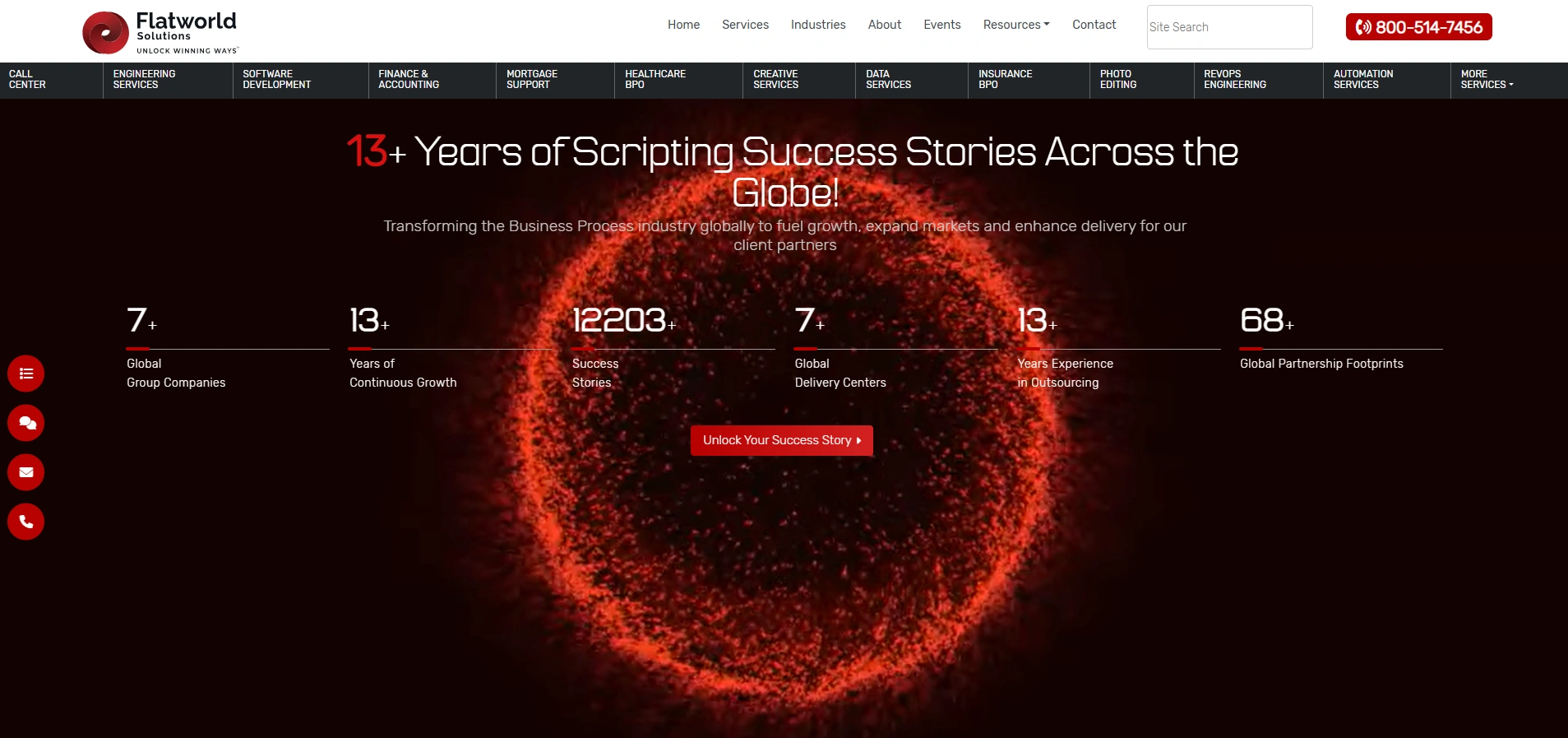
A global BPO and IT services company with 18,000+ clients across 100 countries, applying Lean Six Sigma methodology and ISO 27001-certified delivery for invoice processing and F&A outsourcing from India, the Philippines, and Latin America.
Flatworld Solutions, founded in 2004 with headquarters in Princeton, New Jersey, operates delivery centers in Bangalore, Davao (Philippines), Bolivia, and Colombia. Its finance and accounting outsourcing practice applies Lean Six Sigma discipline to invoice processing, combining OCR, AI-powered data capture, and automated ERP integration for clients across 100 countries. The company holds ISO 9001:2015 quality and ISO/IEC 27001:2022 data security certifications, with Clutch clients noting 98% satisfaction in communication and service quality. A 2023 Boyne Capital private equity investment supported operational expansion. F&A and non-technical support services are typically priced at $10-$15/hour.
- Services offered: Invoice processing, finance and accounting outsourcing (AP, AR, bookkeeping, payroll), call center, data entry, software development, healthcare BPO, engineering services.
- Pros: 18,000+ global clients; Lean Six Sigma process discipline; ISO 27001:2022-certified data security; combined F&A and call center capability in a single vendor relationship.
- Cons: Breadth of service offering means invoice processing is one of many practices — buyers with complex, compliance-heavy AP requirements may prefer a more specialized provider.
- Industry expertise: Healthcare, finance and banking, e-commerce, manufacturing, logistics, legal, media and publishing.
- Best for: Small to mid-market businesses seeking cost-effective offshore invoice processing with established quality certification and a broad F&A service catalog.
- Pricing: $10-$15/hour for non-technical and F&A support; minimum project size $1,000.
- Rating: 4.7 ★ (Clutch, 23 reviews)
- Year established: 2004
- Location: Princeton, New Jersey (HQ); Bangalore, India; Davao, Philippines; Bolivia; Colombia.
#9 OWorkers
A multilingual BPO specialist founded in 2013 with delivery centers in Bulgaria, Madagascar, and Egypt, processing invoices in 22 languages at starting rates from $4/hour for organizations with high international supplier volumes.
OWorkers, founded in 2013 and headquartered in Plovdiv, Bulgaria, takes a deliberately focused approach: high-volume data processing and invoice validation in 22 languages, delivered by 400+ employed (not contracted) staff. The company partners with leading OCR, AI, and RPA platforms for the technology layer, while its human teams handle validation, exception management, and quality assurance. ISO 27001 certification and biometric physical security at all three delivery centers address the data protection requirements that invoice processing work demands. Clients from Walmart, Xerox, and HyperConnect have used OWorkers’ data processing services. Most clients report cost savings approaching 80% compared to Western European or North American in-house processing costs.
- Services offered: Invoice processing and validation, data entry, data processing, data annotation, content moderation, customer support, KYC processing.
- Pros: 22-language processing capability for international supplier invoice volumes; competitive starting rate from $4/hour; ISO 27001 and GDPR certified; employed-staff model for consistency and retention.
- Cons: Three delivery centers across two continents means less geographic redundancy than larger enterprise providers; team size may be a ceiling constraint for very large programs.
- Industry expertise: Technology, e-commerce and marketplaces, financial services, insurance, retail and distribution.
- Best for: Organizations with high volumes of multilingual invoices from international supplier bases, or those combining OCR/RPA technology with a human validation layer at competitive cost.
- Pricing: Starting from $4/hour; volume and language dependent
- Rating: Client references from Walmart and Xerox
- Year established: 2013
- Location: Plovdiv, Bulgaria (HQ); Madagascar; Egypt.
#10 Whiz Consulting
A financial outsourcing firm founded in 2013 with 150+ dedicated professionals serving small and mid-market businesses in the US, UK, and Australia with invoice processing, accounts payable, bookkeeping, and advisory services.
Whiz Consulting, founded in 2013 in Noida, India, focuses on accounting and financial outsourcing for small and mid-market businesses across the US, UK, and Australia. Its invoice processing practice covers end-to-end AP workflow: invoice capture, validation, vendor communication, payment scheduling, and reconciliation, delivered by a team of 150+ professionals certified across Xero, QuickBooks, NetSuite, MYOB, and Microsoft Dynamics. Monthly AP and bookkeeping plans start at $650/month, which makes Whiz Consulting one of the more accessible entry points for organizations that need dedicated F&A support without the overhead of building an in-house team. Documented client engagements span five-year relationships across recruitment, professional services, and retail.
- Services offered: Invoice processing, accounts payable, bookkeeping, accounts receivable, payroll, tax preparation, financial reporting, business advisory.
- Pros: Accessible pricing from $650/month; 150+ certified professionals across 20+ accounting platforms; documented five-year client relationships; tailored for SME and mid-market buyers.
- Cons: Team size limits capacity for large-volume enterprise AP programs; fewer independent third-party reviews than larger providers on this list.
- Industry expertise: Recruitment and professional services, retail, healthcare, general business across US, UK, and Australia.
- Best for: Small to mid-market businesses that need dedicated outsourced AP and invoice processing at predictable monthly pricing without enterprise-scale complexity.
- Pricing: Monthly plans starting at $650/month; custom pricing available for larger engagements.
- Rating: 1 verified review on Clutch; positive reference from 5-year client engagement.
- Year established: 2013
- Location: Noida, India (HQ); Dallas, Texas; Sydney, Australia; London, UK.
Why Choose Helpware CX as Your Invoice Processing Partner
Helpware CX is not the cheapest provider on this list. At $8-$15 per hour, the rate sits in the mid-range — above pure offshore commodity providers and below US-onshore specialists. That math deserves unpacking before you anchor on the hourly number.
What most invoice processing quotes leave out entirely is the cost of your provider’s staff turnover. Every time an AP team member leaves and a replacement is trained on your ERP configuration, exception workflows, and vendor-specific documentation, your error rate rises for weeks and your finance team absorbs the correction work. At an industry-average attrition rate of 6-8% per month, that cycle repeats throughout the contract. Helpware CX’s monthly attrition of 2.8%, documented across its back office operations, means significantly fewer retraining cycles and meaningfully more institutional knowledge retained inside the engagement over time.
The supporting operational metrics reinforce the picture. A 90% CSAT score maintained consistently is not a marketing statement — it reflects accuracy, responsiveness, and process reliability in the day-to-day delivery. The 5-year average client partnership length shows that most organizations that engage Helpware CX don’t leave when the initial contract ends, which is the most honest proxy for sustained quality that any buyer can evaluate.
For invoice processing specifically, Helpware CX’s back office teams handle invoice tracking, data entry, accounts payable coordination, and financial document management within existing client ERP environments. The engagement scales with volume and adapts to compliance requirements — SOC 2, HIPAA, GDPR, and PCI-DSS certifications cover the most common regulated-industry needs. The service model is built for organizations where finance operations are a strategic function rather than a pure cost center.
Where Helpware CX is not the right fit: organizations whose primary evaluation criterion is the lowest possible per-invoice rate without regard for quality metrics, and pure high-volume transactional commodity programs where any standardized offshore provider will perform comparably.
Why the numbers work:
- 2.8% monthly attrition vs. 6-8% industry average — fewer hidden retraining costs over the life of the contract
- 90% CSAT — fewer processing errors, fewer vendor disputes, fewer reconciliation cycles
- 5-year average client partnerships — onboarding investment amortized across a longer, more productive engagement
- SOC 2, HIPAA, GDPR, PCI-DSS certified — no compliance remediation costs when your auditors ask for evidence