







According to IBISWorld, the US telehealth services market reached $34.9 billion in 2025, growing to an estimated $36.1 billion in 2026. Yet for patients trying to refill a routine prescription online, that market growth has produced a bewildering set of choices with pricing structures that are anything but transparent. A telehealth consultation for a refill can run as low as $29 out of pocket on one platform and over $200 on another, for identical medications. According to Doctronic’s 2025 pricing analysis, virtual consultations for prescription refills typically cost under $40 and take 10 to 15 minutes, compared to $200 or more for a traditional in-person visit. That gap matters. But the consultation fee is only one variable. Membership requirements, medication delivery models, insurance acceptance, and operational support quality all affect what you actually pay and how reliable the service is over time.
This guide serves two audiences. First, patients comparing platforms to find the fastest, most affordable way to refill a prescription online. Second, healthcare operators and telehealth entrepreneurs evaluating both patient-facing platforms and the BPO support partners that determine whether those platforms deliver on their service promises at scale. We break down the pricing models, explain the key cost drivers, and compare ten companies so you can evaluate cost and value together.
Pricing Models for Telehealth Prescription Refill Services
The pricing model a telehealth platform uses determines not just your upfront cost but how predictable that cost is over time. Before comparing any specific company, it helps to understand how these services are priced across the industry, because the same consultation can be billed in fundamentally different ways depending on the platform you choose.
Per-visit pricing. The simplest model: you pay a flat fee each time you request a consultation or refill, with no membership required. Sesame Care operates this way, with visits starting as low as $29. Per-visit pricing works well for patients who need occasional refills and want full cost transparency before they commit. The trade-off is that it does not bundle medication delivery, so you fill the prescription separately at a pharmacy.
Subscription or membership pricing. Platforms like PlushCare ($19.99 per month) and Nurx charge an ongoing fee that opens access to consultations at lower copay rates. Subscription models tend to favor patients with chronic conditions who need regular refills, since the per-visit cost drops significantly after the membership fee is factored in. Watch for hidden consultation fees layered on top of the membership.
Bundled consultation plus medication delivery. Companies like Hims & Hers and Ro build the consultation into a subscription that also ships the medication directly to your door. This all-in model is convenient and eliminates a separate pharmacy trip, but makes price comparison harder because the medication cost is included in the monthly fee rather than billed separately. Ro’s Body Program starts at $145 per month, which covers consultation and medication.
Insurance-integrated pricing. Teladoc Health and MDLIVE are both deeply integrated with major US health plans. For members, general medical visits can cost as little as $0 per visit with insurance. Cash-pay pricing at Teladoc starts at $89 per visit without insurance. This model works best for patients whose health plan includes a telehealth benefit, and poorly for anyone paying out of pocket.
Per-service consultation fee plus ongoing support fee. Nurx charges a consultation fee per service line ($15 to $80 depending on condition) plus a $3 monthly support fee in months when orders are processed. This creates a lower entry point than a full subscription but adds recurring charges that some users find opaque.
BPO managed service pricing. For telehealth operators, the cost of the patient support operation behind a prescription refill service is typically priced on a per-agent-hour or managed service basis. Providers like Helpware CX price at $8 to $15 per hour for offshore delivery. This model is relevant to healthcare companies building or scaling a telehealth prescription program and evaluating operational partners.
Patients with insurance and chronic conditions tend to get the best value from integrated platforms like Teladoc or MDLIVE. Cash-pay patients seeking one-off refills often find better value on per-visit marketplaces like Sesame. Telehealth operators building patient support functions should evaluate managed service BPO pricing separately from the platform cost.
Cost Drivers of Telehealth Prescription Refill Services
The consultation fee or monthly subscription is rarely the whole story. Several structural variables determine the actual total cost of a telehealth prescription refill experience, whether you are a patient comparing options or a healthcare operator building a support team around a refill platform. Understanding these drivers lets you ask better questions of any vendor you evaluate.
Insurance coverage and plan design. For patients, this is the single biggest cost variable. With a health plan that includes a telehealth benefit, a Teladoc or MDLIVE visit can cost $0. Without insurance, the same visit can cost $89 or more. Before choosing a platform, confirm whether it is in network with your insurance and how your plan designs the telehealth copay. Note that Hims, Hers, and Sesame are cash-pay only and do not accept insurance.
Medication type and channel. The consultation fee is just the first line item. Whether the medication is a cheap generic or a brand-name GLP-1 drug determines the total cost of the episode. Generic blood pressure medication refilled through Sesame’s SesameRx service can run as low as $1 to $11 for a 30-day supply. Brand-name Wegovy for weight management can cost $199 to $499 per month without insurance. Always separate the consultation cost from the medication cost when comparing platforms.
Membership fees and hidden recurring charges. PlushCare charges $19.99 per month on top of the per-visit fee. Nurx charges a $3 monthly support fee in months when orders are processed. Ro’s Body Program requires a membership at $74 per month on annual plans before the medication cost. These fees are easy to miss in initial comparisons. Calculate total annual cost, not just the advertised consultation price, before committing to a subscription model.
Prescription delivery model. Platforms that ship medication directly to your door charge for that convenience, either through higher subscription fees or medication premiums. Platforms that route prescriptions to a local pharmacy let you use your insurance for the medication, which can dramatically lower out-of-pocket costs for covered drugs. If your refill is for a medication covered by your insurance, a platform that sends the prescription to a local pharmacy is usually cheaper than one that bundles delivery.
Agent attrition in BPO support operations. For telehealth operators, one of the most underappreciated cost drivers is the turnover rate of the support team managing patient inquiries around prescription refills. High attrition forces repeated onboarding cycles, which erode agent quality and add direct cost. Helpware CX’s 2.8% monthly attrition rate compares favorably with the 6 to 8% industry average, meaning lower hidden retraining costs over a multi-year engagement.
State coverage and regulatory compliance. Telehealth prescribing laws vary by state. Some platforms operate in all 50 states, while Nurx is available in only 36. Platforms with broader coverage typically invest more in compliance infrastructure, which can affect pricing but also reliability. Controlled substances face additional federal restrictions under the DEA, which rules them out of most telehealth prescription services entirely.
HIPAA compliance and data security infrastructure. For healthcare operators, compliance certification is both a cost item and a risk variable. Platforms and BPO partners without SOC 2 or HIPAA certification expose operators to remediation costs and regulatory liability. Baking compliance in from the start is consistently cheaper than retrofitting it after a security incident.
With these drivers understood, you are equipped to evaluate actual providers on total cost, not just the rate card.
Calculate Your Telehealth Support Costs
Now that you understand what drives pricing, you can put real numbers to your specific situation. If you are a telehealth operator evaluating BPO partners for patient support around prescription refill workflows, use the Helpware cost calculator to get a personalized estimate based on your support volume, coverage hours, language requirements, and service complexity.
Use Helpware’s cost calculator to estimate your operational support investment. Or speak with our team for a custom quote on HIPAA-compliant patient support services for telehealth prescription programs.
Unlock your hidden CX savings with Helpware
Get ROI projection for current support needs.
-40% annually
/monthly costs with Helpware
vs
/internal team costs (approx)
Your requirements fall outside our standard parameters.
Let's discuss your results
Fill in your details to schedule a consultation.
-40% annually
/monthly costs with Helpware
vs
/internal team costs (approx)
Your requirements fall outside our standard parameters.
-40% annually
/monthly costs with Helpware
vs
/internal team costs (approx)
Your requirements fall outside our standard parameters.
Support staff included in the package:
Shared Team Leader
Shared L&D Specalist
Shared QA Specialist
Account Executive by default
Shared Ops Delivery Manager
Admin/Finance/Legal support for the agents by default
1-2 Dedicated Team Leaders
Shared L&D Specialist
Shared to 1 Dedicated QA Specialist
Shared Ops Manager
Account Executive by default
Admin/Finance/Legal support for the agents by default
Shared Real Time Analyst
2-5 Dedicated Team Leaders
0,5 to 1,5 Dedicated L&D Specialists
1-2 Dedicated QA Specialists
Up to half of a dedicated Ops Manager
Account Executive by default
Admin/Finance/Legal support for the agents by default
1 Dedicated Real Time Analyst
Ready to get a personalized estimate for your team?
Contact us for a personalized assessment tailored to your specific needs.
*These projections are estimates for informational purposes only and do not represent a formal offer. Contact us for a personalized quote.
Thank you!
You’ll hear from us within one business day.
Top 10 Telehealth Prescription Refill Services for 2026: At a Glance
| Company | Services | Coverage | Employees | Est. |
|---|---|---|---|---|
| Helpware | Healthcare BPO, patient support, tech support, back office | USA, Mexico, Philippines, Ukraine, Georgia, Puerto Rico, Poland, Germany, Albania (19 locations) | ~4,000 | 2015 |
| Teladoc Health | Urgent care, primary care, dermatology, mental health | USA, Canada, 175+ countries (enterprise platform) | Not disclosed | 2002 |
| MDLIVE | Urgent care, primary care, dermatology, mental health | USA, Puerto Rico | ~2,000 providers | 2009 |
| PlushCare | Primary care, urgent care, mental health, weight loss | All 50 US states | Not disclosed | 2015 |
| Hims & Hers | Sexual health, dermatology, mental health, weight loss | All 50 US states | Not disclosed | 2017 |
| Sesame Care | Primary care, urgent care, mental health, dermatology | All 50 US states | Not disclosed | 2019 |
| Nurx | Birth control, sexual health, dermatology, mental health | 36 US states | Not disclosed | 2016 |
| GoodRx Care | Primary care, dermatology, mental health, weight loss | All 50 US states | Not disclosed | 2011 |
| Ro Health | Weight loss, sexual health, fertility, hair loss | All 50 US states (all counties) | Not disclosed | 2017 |
| Wisp | Women’s health, sexual health, birth control, UTI | All 50 US states | Not disclosed | 2018 |
Top 10 Telehealth Prescription Refill Services: Overview
#1 Helpware

Helpware CX’s healthcare BPO services are purpose-built for telehealth operators who need HIPAA-compliant patient support at scale, with 4,000+ team members, 19 global locations, and a 2.8% monthly attrition rate that consistently undercuts the industry average.
What differentiates Helpware CX in the telehealth prescription refill space is the combination of compliance depth and operational flexibility that most BPO providers cannot deliver simultaneously. Founded in 2015, the company supports telehealth companies, health plans, and provider groups by handling the full patient communication spectrum: inbound support for prescription inquiries, insurance verification, refill request management, back-office documentation, and 24/7 multilingual patient engagement across 45 languages. Rather than plugging healthcare clients into a generic call center template, Helpware CX builds customized support workflows specific to each platform’s prescription refill process, including eligibility verification, pharmacy coordination support, and proactive outreach for patients whose refills are due.
Why we picked it
Helpware CX earned the top position for telehealth operators because of the combination of verified compliance certifications (SOC 2, HIPAA, GDPR, ISO 27001) and operational metrics that directly reduce the total cost of patient support over time. A 90% CSAT rate and 5-year average client partnerships demonstrate sustained quality, not short-term performance.
- Services offered: Patient support (omnichannel, multilingual), technical support, back office operations, insurance verification, prior authorization support, CX consulting, data operations
- Pros: 2.8% monthly attrition vs 6-8% industry average, 90% CSAT, native-speaker support in 45 languages, SOC 2/HIPAA/GDPR/ISO 27001 certified, 5-year average client partnerships, 19 global locations for 24/7 coverage
- Cons: Longer sales cycle due to consultative onboarding. May be over-engineered for simple, high-volume transactional prescription routing that does not require multilingual depth or compliance specialization
- Industry expertise: Healthcare and telehealth, SaaS and software, e-commerce and retail, fintech and banking, gaming and entertainment, logistics, public sector
- Best for: Telehealth companies, health plans, and provider groups needing HIPAA-compliant, multilingual patient support operations with genuine compliance infrastructure and flexible engagement models
- Pricing: Starting at $8-$15 per hour depending on service complexity, location, and engagement model.
- Rating: 4.8 ★ (Clutch)
- Year established: 2015
- Location: Lexington, Kentucky (HQ). Global delivery from USA, Mexico, Philippines, Ukraine, Georgia, Puerto Rico, Poland, Germany, Albania
#2 Teladoc Health

Teladoc Health is among the largest telehealth networks in the United States, with board-certified providers licensed to practice in all 50 states and available 24 hours a day, 7 days a week for general medical visits, dermatology, mental health, and primary care, including prescription refills for non-controlled maintenance medications.
Founded in 2002 and headquartered in Purchase, New York, Teladoc Health operates across 175 countries and is deeply integrated with major US health plans, making it the default telehealth option for tens of millions of insured Americans. General medical visits can cost as low as $0 per visit for members covered under an employer or health plan benefit. For cash-pay patients, visits start at $89. Teladoc’s general medical providers can renew a 30-day supply of many maintenance prescriptions up to twice per calendar year, with prescriptions sent electronically to the pharmacy of the patient’s choice. Controlled substances are not available through the platform.
Why we picked it
Teladoc earns the second spot for patients who already carry health insurance, because the combination of $0 copay potential and 24/7 provider access makes it one of the most accessible refill options for covered users.
- Services offered: Urgent care, primary care, dermatology, mental health (therapy and psychiatry), nutrition, back and joint care
- Pros: $0 visits for many insured members, 24/7 provider access, board-certified physicians with an average of 20+ years experience, available in 175+ countries, HIPAA-compliant platform
- Cons: Refill limitations for general medical visits (30-day supply, up to twice per year). Inconsistent provider quality noted in user reviews. Cash-pay pricing at $89 per visit is above average for routine refills
- Industry expertise: Enterprise health systems, employer benefits programs, Medicare and Medicaid plans
- Best for: Patients with employer-sponsored or plan-provided telehealth benefits seeking covered prescription refills for maintenance medications
- Pricing: $0 with qualifying insurance coverage. Cash-pay from $89 per general medical visit. Specialty visits priced separately
- Year established: 2002
- Location: Purchase, New York (HQ). Operates in 175+ countries
#3 MDLIVE
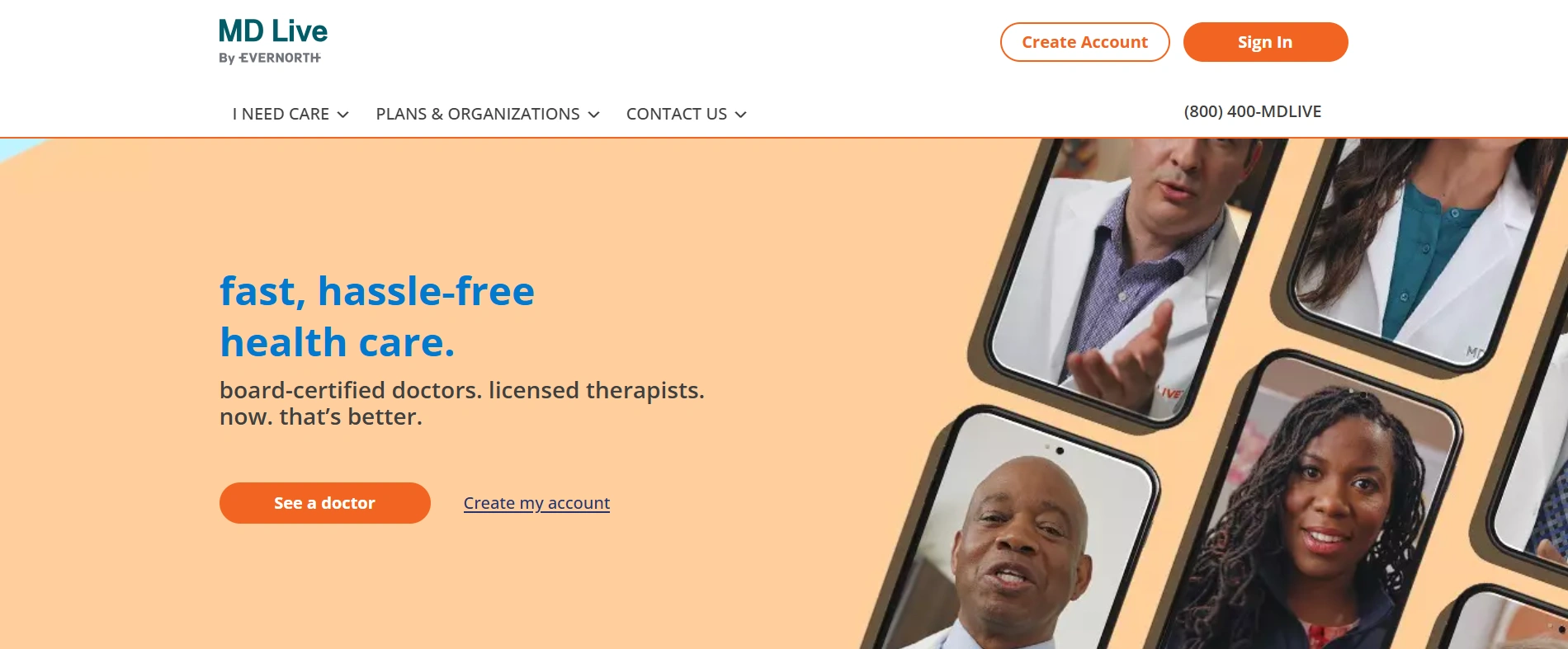
MDLIVE is a telehealth platform with a network of 2,000+ board-certified doctors and licensed therapists available by phone or video for urgent care, primary care, dermatology, and mental health, including prescription refills for non-controlled medications. Founded in 2009, MDLIVE holds two National Committee for Quality Assurance (NCQA) certifications and is accredited by the American Telemedicine Association, credentials that carry weight for health plans and employers evaluating telehealth vendor quality.
MDLIVE integrates with major US health plans including Cigna, Humana, and Aetna. Cash-pay urgent care visits that can facilitate a prescription refill run $0 to $89 depending on coverage. The platform covers more than 80 non-emergency conditions and positions itself as an affordable alternative to urgent care clinic visits for routine prescription renewals.
- Services offered: Urgent care, primary care, dermatology, mental health (therapy and psychiatry), wellness screenings
- Pros: NCQA certified, average provider experience of 15 years, integrates with major health plans, 24/7 availability, prescriptions sent electronically to 65,000+ pharmacies
- Cons: No controlled substance prescriptions. Some users report longer wait times for specialist appointments. Mobile compatibility issues noted in user reviews
- Best for: Patients insured through Cigna, Humana, or Aetna plans with MDLIVE telehealth benefits
- Pricing: $0 to $89 for urgent care visits depending on coverage. Psychiatric visits $0 to $299. Therapy $140 to $179 per session before insurance
- Year established: 2009
- Location: Sunrise, Florida (HQ). Operates across USA and Puerto Rico
#4 PlushCare
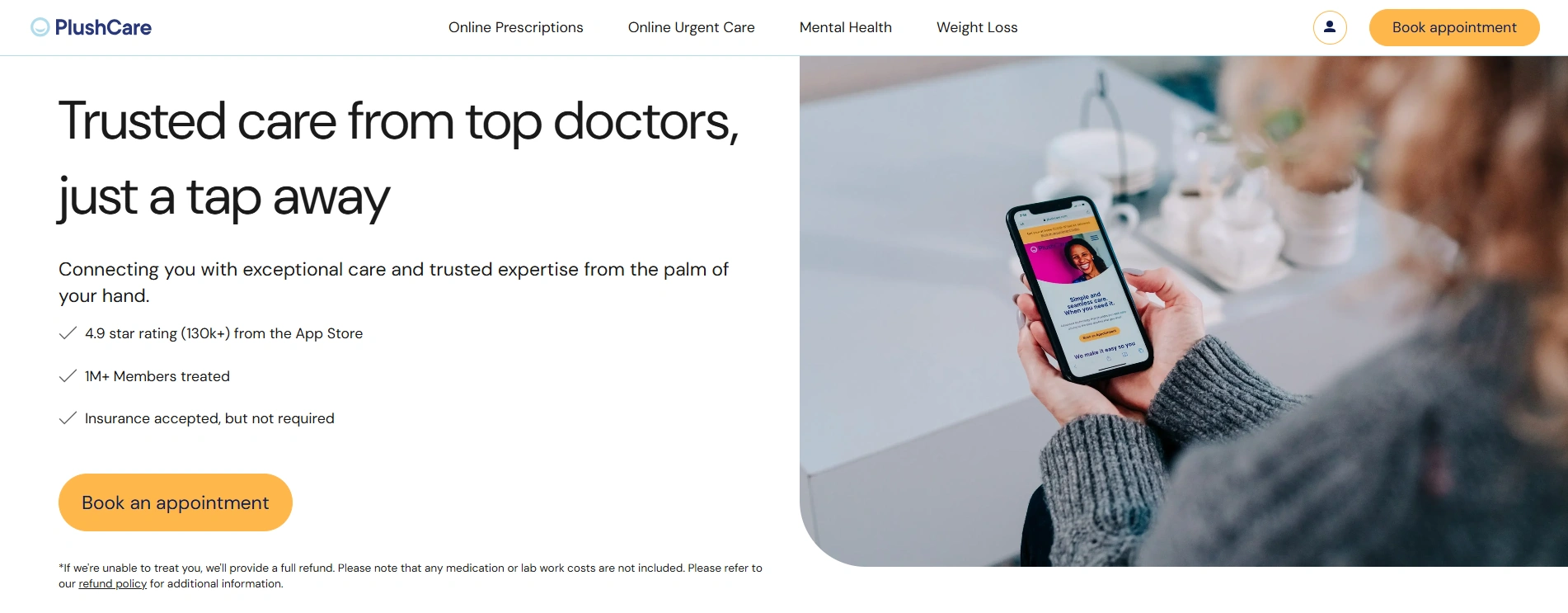
PlushCare is a full-service telehealth platform owned by Accolade (NASDAQ: ACCD) and founded in 2015. The company stands out in the prescription refill category for two reasons: it exclusively uses board-certified physicians rather than nurse practitioners or physician assistants, and it accepts over 100 insurance plans, including Aetna, Cigna, UnitedHealthcare, Anthem, and Humana. That insurance depth is a meaningful differentiator over cash-pay competitors. With insurance, the total cost for a GLP-1 prescription program can drop to roughly $75 per month versus $350 or more per month without coverage.
PlushCare offers same-day appointments across all 50 states, with evening and weekend availability. The platform covers urgent care, chronic conditions, mental health, weight loss, dermatology, and primary care, and can also prescribe controlled substances including ADHD medications, which distinguishes it from most telehealth competitors. That said, psychiatric services do not include controlled substance prescriptions.
- Services offered: Urgent care, primary care, mental health, weight loss (GLP-1), chronic disease management, sexual health, dermatology, prescription refills
- Pros: Board-certified physicians only, accepts 100+ insurance plans, same-day appointments, can prescribe ADHD medications, covers all 50 states, family plan covers up to five members
- Cons: Membership fee of $19.99 per month required. $129 cash-pay consultation fee without insurance is above average. Active class action lawsuit in California regarding subscription enrollment practices
- Best for: Insured patients seeking broad primary care with prescription coverage who want to use their insurance for both the visit and the medication
- Pricing: $19.99 per month membership, $30 with insurance copay, $129 without insurance per visit, medication billed separately through pharmacy
- Year established: 2015
- Location: San Francisco, California (HQ). Operates in all 50 states
#5 Hims & Hers
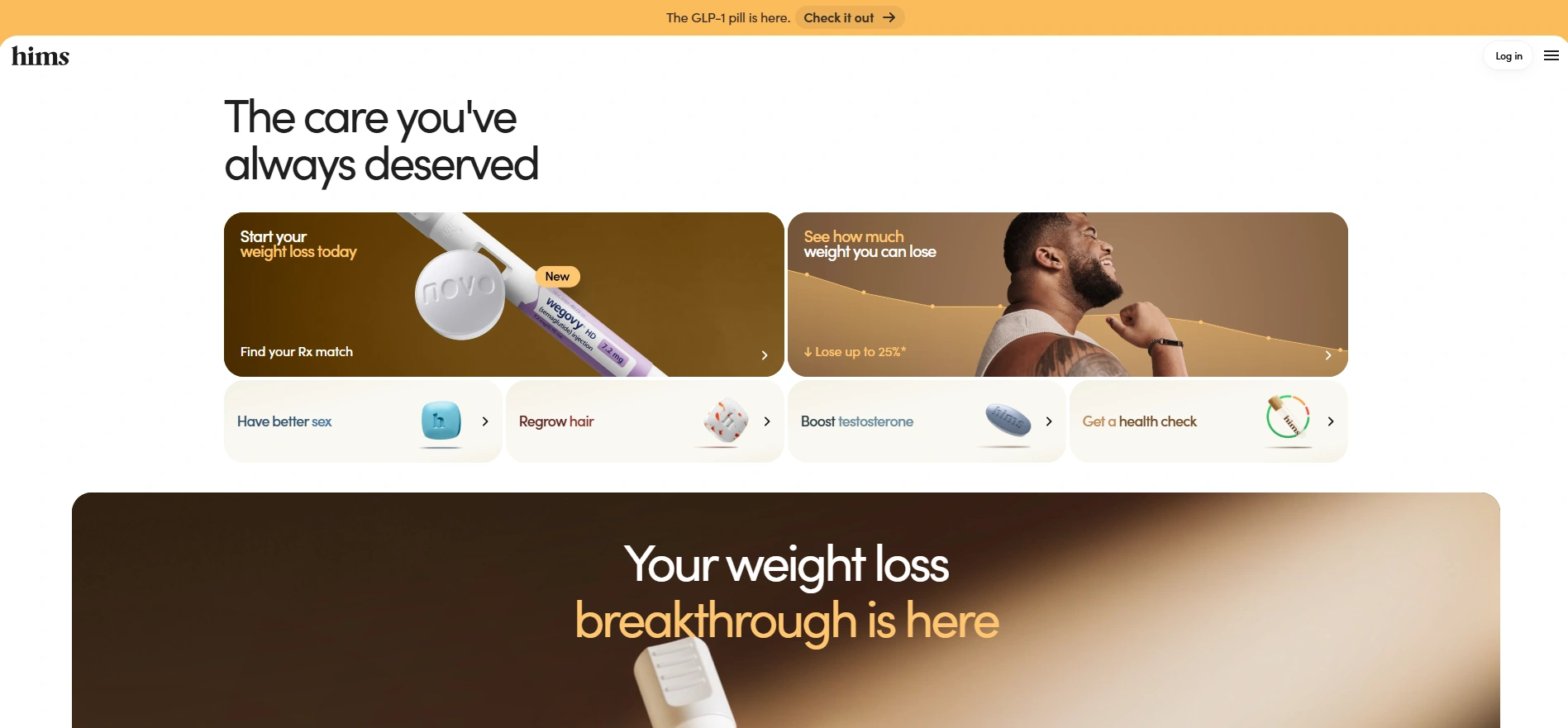
Hims & Hers is a direct-to-consumer telehealth company operating two distinct platforms for men and women. Founded in 2017 and publicly traded (NASDAQ: HIMS), the company focuses on specific condition categories including sexual health, dermatology, mental health, hair loss, and weight management. What sets Hims & Hers apart is the bundled subscription model: the monthly fee covers both the consultation and the medication shipped directly to the patient’s door, which eliminates the separate pharmacy trip that most telehealth platforms require.
Pricing starts at $25 per month for mental health subscriptions, $15 per month for hair loss, and $199 per month for weight management programs. The platform does not accept insurance, which is one of the most common reasons users explore alternatives. That said, the all-in pricing model with automatic refills makes it a strong option for patients with predictable, stable prescriptions who prefer a single monthly charge over variable pharmacy costs.
- Services offered: Sexual health (ED, birth control, STI), dermatology (acne, anti-aging), mental health (anxiety, depression), hair loss, weight loss (GLP-1), primary care
- Pros: All-in subscription includes medication and delivery, available in all 50 states, provider messaging 24/7, no insurance required, automatic refill management
- Cons: Does not accept insurance. Limited formal follow-up appointment structure. September 2024 FDA warning related to weight loss marketing claims. Subscription pricing can be higher than insurance-covered alternatives
- Best for: Patients without insurance or with high deductibles who want a single predictable monthly cost for ongoing prescriptions in the supported condition categories
- Pricing: Mental health from $25 per month, hair loss from $15 per month, weight management from $199 per month, primary care visits at $39 per visit
- Year established: 2017
- Location: San Francisco, California (HQ). Operates in all 50 states
#6 Sesame Care
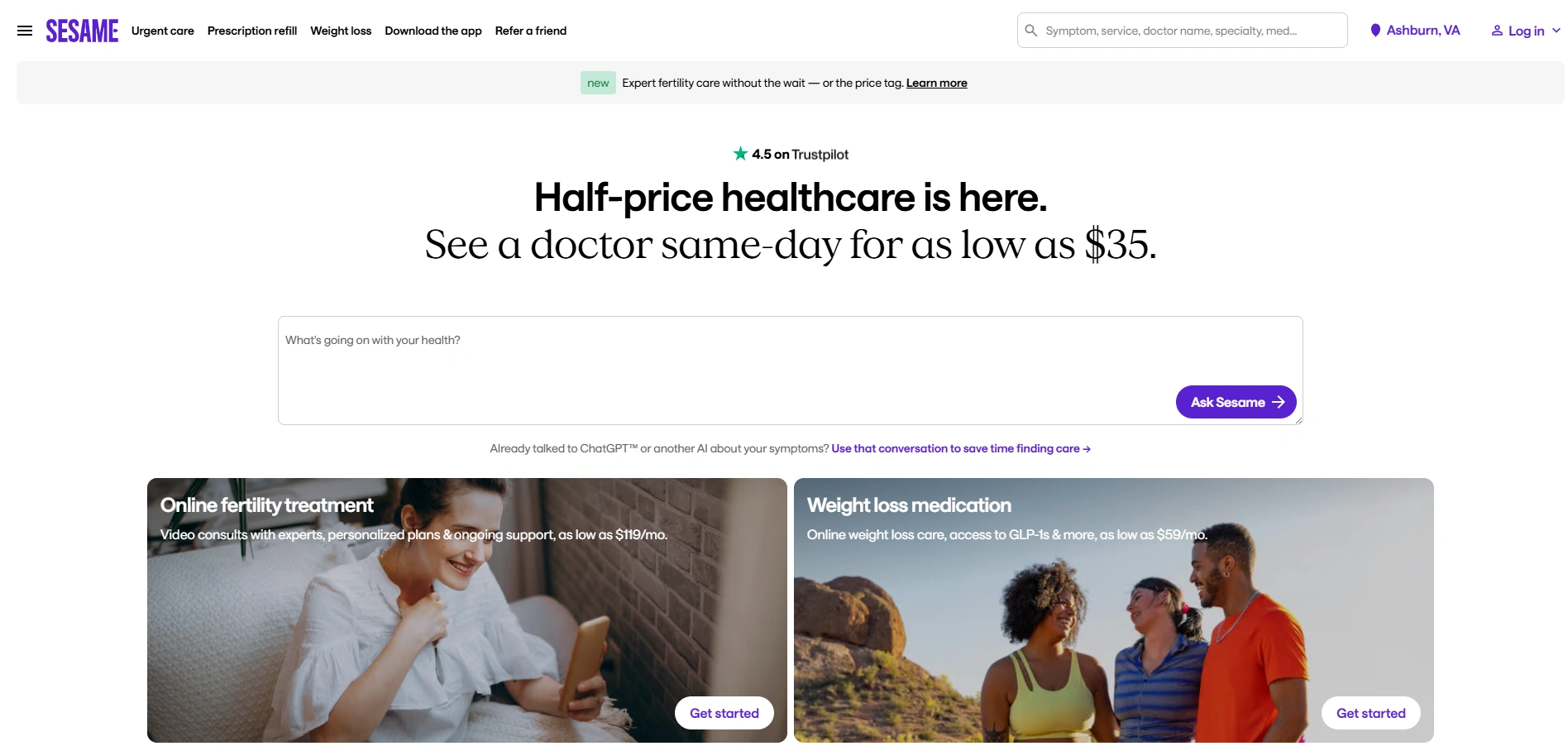
Sesame Care operates as a direct-to-consumer telehealth marketplace where patients pay providers directly, eliminating insurance billing entirely. Founded in 2019, the platform offers 383 services across 36 medical specialties through both telehealth and in-person visits. Consultations start at $29 per visit, making Sesame one of the most affordable cash-pay options for prescription refills. Patients choose their own provider from a vetted pool, which gives more control over the care relationship than platforms that assign providers randomly.
Sesame’s prescription service, SesameRx, offers generic medications starting as low as $1 for a 30-day supply with free delivery for members. The platform does not ship medications directly for telehealth-prescribed drugs; instead, providers send prescriptions electronically to the patient’s chosen pharmacy. Sesame does not prescribe controlled substances through telehealth visits.
- Services offered: Primary care, urgent care, mental health, dermatology, weight loss, women’s health, chronic disease management, prescription refills, lab work
- Pros: Visits from $29, no membership required, provider choice, transparent upfront pricing, SesameRx generics from $1, same-day appointments often available, HSA/FSA eligible
- Cons: Does not accept insurance. No controlled substance prescriptions via telehealth. No bundled medication delivery. Some users report customer service issues with billing disputes
- Best for: Cash-pay patients seeking affordable one-off prescription refills who want price transparency and provider choice without a subscription commitment
- Pricing: Visits from $29, optional Plus membership at $7 per month, SesameRx generics from $1 with free delivery
- Year established: 2019
- Location: New York, New York (HQ). Operates in all 50 states
#7 Nurx
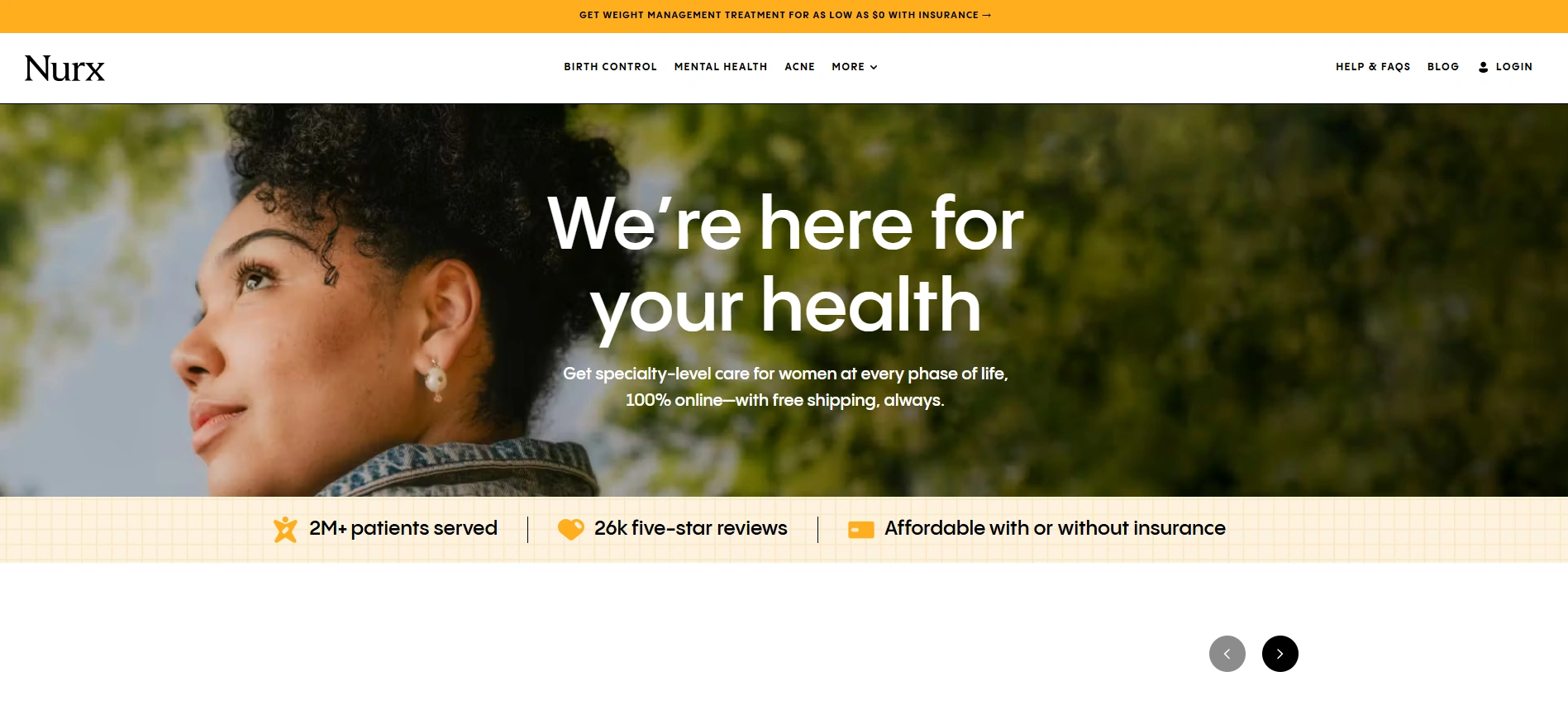
Nurx is a specialty telehealth platform founded in 2016 and based in San Francisco, focused primarily on women’s health, sexual health, and contraception. The company merged with Thirty Madison in 2022, which brought together complementary telehealth brands. Nurx accepts most major insurance plans, including Medicaid programs in many states, which is unusual in the direct-to-consumer telehealth category. With insurance, many birth control prescriptions through Nurx carry no copay under the ACA contraceptive coverage mandate.
Consultation fees vary by service line: $15 to $80 per consultation depending on condition type, plus a $3 monthly support fee in months when orders are processed. Nurx ships medication directly to patients in a 3-month supply with automatic refills, which eliminates the pharmacy trip for the supported condition categories. The platform operates in 36 states and does not prescribe controlled substances.
- Services offered: Birth control (50+ types), emergency contraception, sexual health (STI testing, PrEP, herpes treatment), dermatology (acne, rosacea), mental health, migraine management, weight management
- Pros: Accepts major insurance including Medicaid, $0 copay possible for covered birth control, direct medication delivery with automatic refills, consultation includes unlimited provider messaging for one year
- Cons: Only available in 36 states. $3 monthly support fee adds ongoing cost. Customer service response times of 3 to 6 days noted in reviews. Billing disputes cited frequently. No controlled substance prescriptions
- Best for: Patients in covered states seeking insured birth control and women’s health prescriptions with home delivery and ongoing provider access
- Pricing: Consultation fees $15 to $80 depending on service, $3 monthly support fee when orders are active, medication often $0 with insurance
- Year established: 2016
- Location: San Francisco, California (HQ). Available in 36 states
#8 GoodRx Care
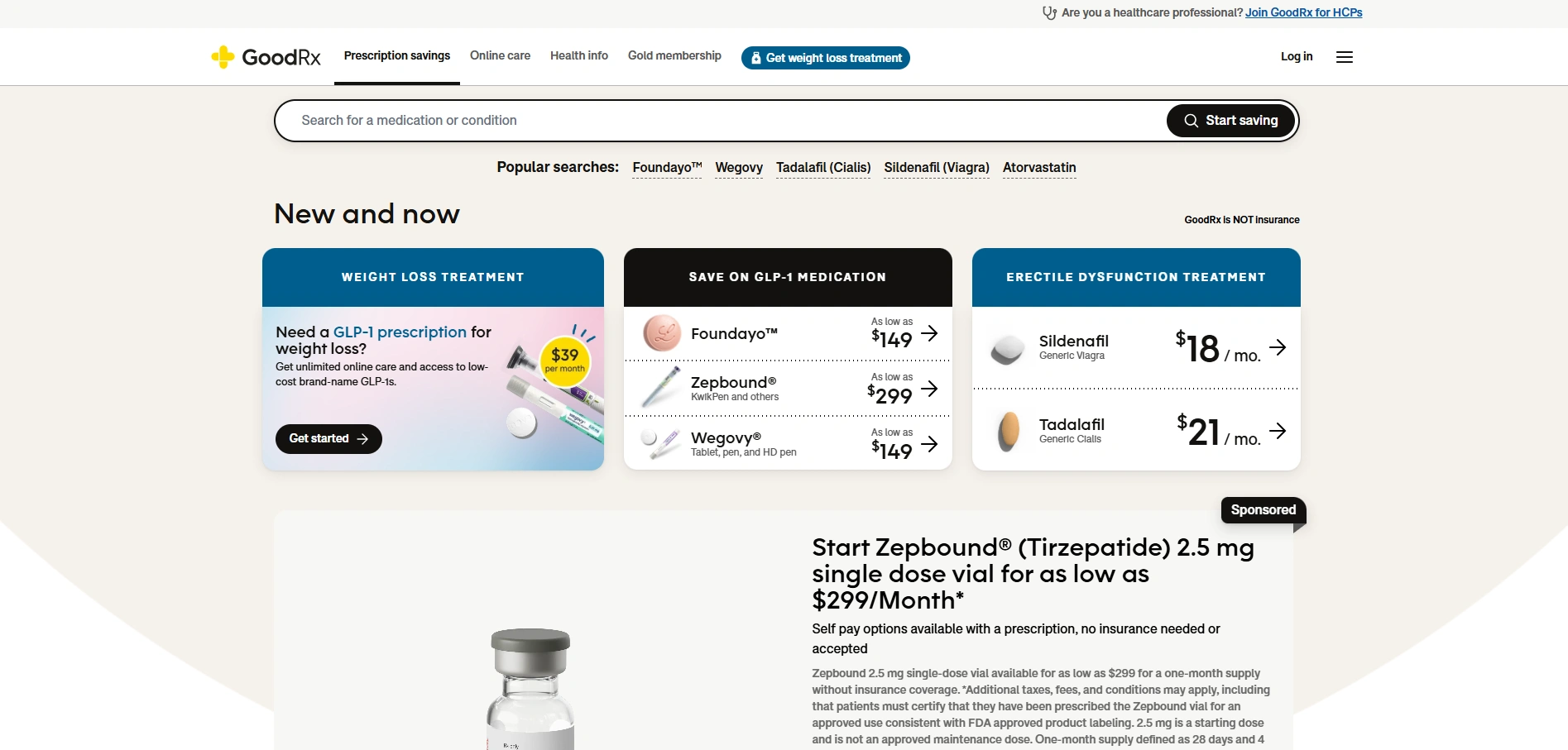
GoodRx Care is the telehealth arm of GoodRx, the prescription savings platform founded in 2011. The service offers consultations for over 100 conditions including primary care, dermatology, mental health, and prescription refills for chronic conditions like high blood pressure, asthma, high cholesterol, and migraines. GoodRx Care’s strength is the integration with GoodRx’s core pharmacy discount tool, meaning patients can immediately search for the lowest cost to fill the prescription their provider just wrote.
The platform accepts insurance for most medical visits, and consultation fees for cash-pay patients are competitive with the broader telehealth market. GoodRx Care is available in all 50 states. It does not offer medication delivery; prescriptions are sent to the pharmacy of the patient’s choice.
- Services offered: Primary care, urgent care, dermatology, mental health, sexual health, weight management, chronic condition management, prescription refills
- Pros: Integrated with GoodRx pharmacy discount tool, accepts insurance, available in all 50 states, transparent consultation fees, strong brand trust from GoodRx pharmacy pricing platform
- Cons: No medication delivery (prescriptions sent to pharmacy only). Limited to condition categories GoodRx Care supports. Less breadth than full-service competitors like PlushCare
- Best for: Patients who already use GoodRx for pharmacy savings and want a telehealth option that integrates with their existing medication cost management
- Pricing: Consultation fees vary by service. Insurance accepted for most visits
- Year established: 2011 (GoodRx). GoodRx Care telehealth added subsequently
- Location: Santa Monica, California (HQ). Operates in all 50 states
#9 Ro Health
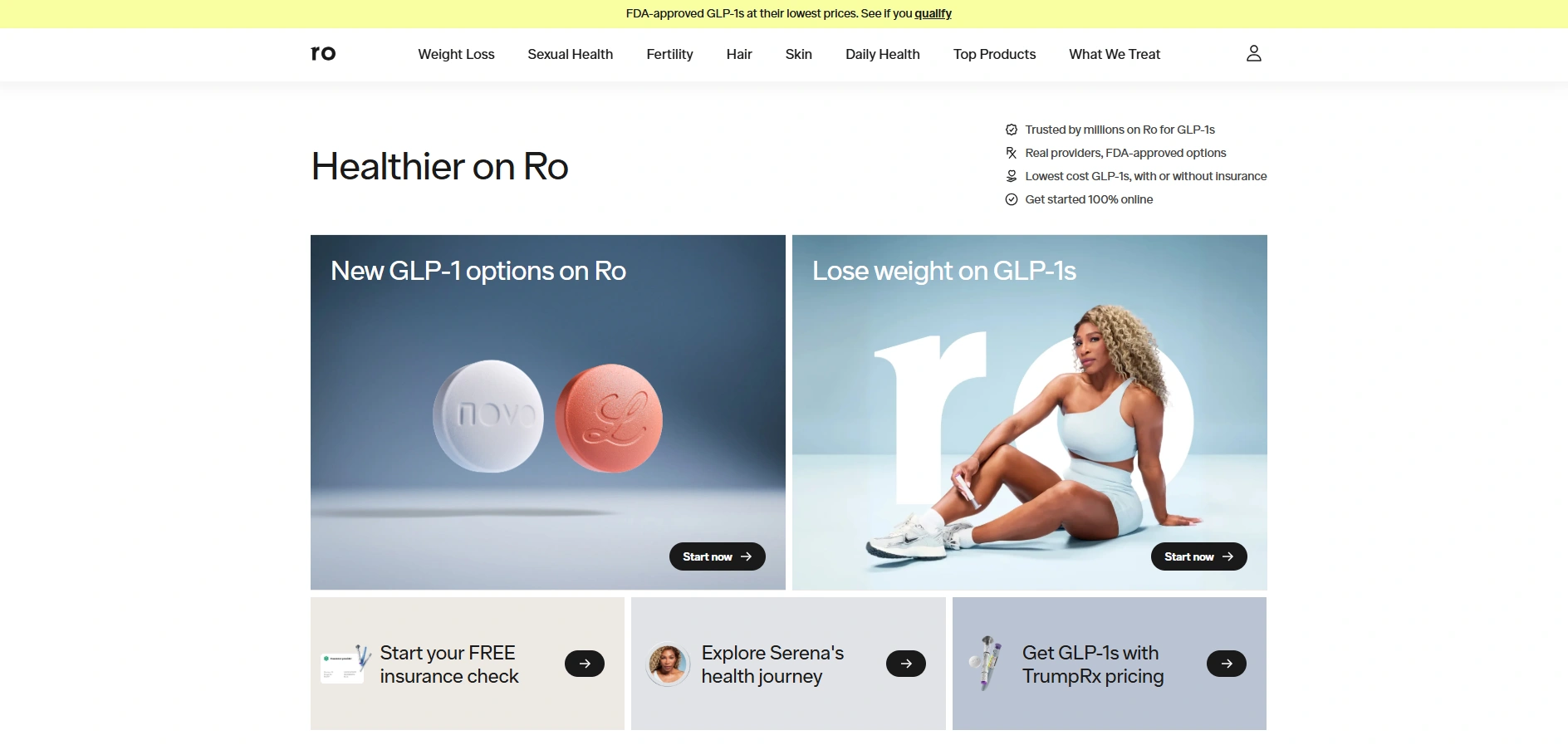
Ro (formerly Roman) is a direct-to-patient telehealth company founded in 2017 and headquartered in New York City. What makes Ro structurally unique is that it is the only telehealth company to offer nationwide telehealth, labs, and pharmacy services through a vertically integrated platform. Ro has reached patients in every county in the United States, including 98% of primary care deserts, which gives it geographic reach that most competitors cannot match. Online visits are free; patients pay for the medication and any program membership.
Ro’s Body Program for weight management starts at $145 per month and includes GLP-1 medication and one-to-one coaching. The company also offers sexual health, fertility, hair loss, and dermatology services. Prescriptions are dispensed through Ro’s own pharmacy network and shipped in discreet packaging, generally arriving within two days. Ro does not accept insurance for its program memberships but offers an insurance concierge service to help patients navigate GLP-1 coverage.
- Services offered: Weight management (GLP-1, coaching), sexual health (ED, birth control, fertility), hair loss, dermatology, primary care
- Pros: Free online consultations, nationwide coverage including primary care deserts, vertically integrated telehealth and labs and pharmacy, fast 2-day delivery, insurance concierge for GLP-1 coverage navigation
- Cons: Program memberships are cash-pay only. No insurance accepted for membership costs. Limited condition scope compared to full-service platforms. GLP-1 weight management advertising drew controversy in 2025
- Best for: Cash-pay patients seeking GLP-1 weight management or sexual health prescriptions with fast delivery, especially in areas with limited in-person provider access
- Pricing: Consultations free, Body Program from $74 per month on annual plan, medication costs billed separately, GLP-1 programs start around $145 per month
- Year established: 2017
- Location: New York, New York (HQ). Operates in all 50 US states and counties
#10 Wisp

Wisp is a San Francisco-based telehealth company founded in 2018 and focused on sexual and reproductive health, women’s health, and conditions like urinary tract infections, bacterial vaginosis, and birth control. Wisp was acquired by WELL Health Technologies in 2021 for approximately $41 million. The platform is available in all 50 states and offers both asynchronous (messaging) and synchronous (video) consultations, with a model designed for fast, low-friction prescription access rather than ongoing care management.
Wisp’s pricing is among the most transparent in the category: consultation fees are posted upfront by condition, and medications are often shipped directly from partner pharmacies. The platform is particularly strong for patients seeking discreet access to sexual health prescriptions, birth control, or UTI treatment without an in-person visit. Wisp does not accept insurance for the consultation fee but works with patients to route prescriptions to pharmacies that do accept insurance for the medication.
- Services offered: Birth control, UTI treatment, bacterial vaginosis, herpes treatment, STI prevention (PrEP), vaginal health, menopause, women’s reproductive health
- Pros: Available in all 50 states, upfront transparent pricing, fast consultation turnaround, discreet direct medication delivery, strong focus on women’s sexual and reproductive health
- Cons: Consultation fee not covered by insurance. Narrower condition scope than full-service competitors. Not suitable for complex primary care or chronic condition management
- Best for: Patients seeking fast, private access to women’s health and sexual health prescriptions without an in-person visit or long wait times
- Pricing: Consultation fees vary by condition. Prescription costs billed separately at pharmacy
- Year established: 2018
- Location: San Francisco, California (HQ). Operates in all 50 states
Why Choose Helpware as Your Telehealth Prescription Support Partner
At $8 to $15 per hour, Helpware CX is not the cheapest BPO option in the market. That is a deliberate position. The math works differently when you account for total cost of ownership rather than just the hourly rate. Providers with 2.8% monthly attrition versus the industry average of 6 to 8% require significantly fewer retraining cycles over a multi-year engagement. Platforms with 90% CSAT generate fewer escalations and repeat contacts, which reduces the per-interaction cost over time. These are measurable, financial variables, not marketing claims.
For telehealth prescription refill programs specifically, Helpware CX brings capabilities that are difficult to find at competitive pricing. The healthcare BPO team manages the full patient communication stack around prescription workflows: inbound support for refill inquiries, insurance verification assistance, back-office documentation, pharmacy coordination support, and proactive patient outreach for upcoming refills. The team holds SOC 2, HIPAA, ISO 27001, and GDPR certifications through third-party audit, and delivers in 45 languages with native speakers in each, a combination that few mid-market BPO providers can replicate at comparable pricing.
Helpware CX is the right fit for telehealth companies, health plans, and provider groups with $50M or more in revenue that treat patient experience as a competitive variable rather than a cost center. It is not the right fit for organizations that need pure, high-volume transactional prescription routing without multilingual depth or compliance specialization. For those use cases, a lower-cost commodity BPO will perform adequately.
For operators building or scaling a prescription refill service, the correct question is not “what is the hourly rate?” but “what does unreliable patient support cost us in churn, escalations, and compliance exposure over three years?” On that calculation, Helpware CX’s operational metrics make a compelling case.
Why the numbers work:
- 2.8% monthly attrition vs 6-8% industry average: lower hidden retraining costs over multi-year engagements
- 90% CSAT: fewer escalations, fewer repeat contacts, stronger patient experience metrics
- 5-year average client partnerships: onboarding investment amortizes over a much longer value cycle
- SOC 2, HIPAA, GDPR, ISO 27001 certified: compliance is built in, not bolted on after contracting