








Healthcare revenue cycle management (RCM) is one of the fastest-moving sectors in US healthcare administration. According to Towards Healthcare’s 2026 Market Analysis, the US RCM market stands at $72.96 billion in 2026 and is projected to reach $195.92 billion by 2035, expanding at an 11.6% CAGR. With claim denial rates climbing and administrative costs consuming more than 40% of total hospital spending, the stakes of choosing the right RCM partner have never been higher.
Not all RCM vendors are built the same. Some operate at hospital-system scale with proprietary AI platforms. Others specialize in patient-facing billing transparency or compliance-intensive back-office functions. And a growing tier of healthcare BPO providers blends end-to-end RCM with patient support, insurance verification, and HIPAA-compliant operations in a single managed service model.
This guide covers the 10 best healthcare RCM companies in the US in 2026, how they differ, and which operating contexts each one fits best.
Overview: Top Healthcare RCM Companies Compared
| Company | Core RCM Services | Delivery Model | Employees | Year Est. |
|---|---|---|---|---|
| Helpware CX | Billing & coding, claims processing, insurance verification, patient support | BPO managed services | ~4,000 | 2015 |
| R1 RCM | End-to-end RCM, AI-powered platform, coding, denial mgmt | Technology + managed services | ~27,000 | 2003 |
| Ensemble Health Partners | Full-cycle RCM outsourcing, CDI, patient access, AR mgmt | Managed services partnership | ~10,000 | 2014 |
| Conifer Health Solutions | Revenue cycle outsourcing, patient access, AR management | Managed services | ~5,000 | 2008 |
| Waystar | Cloud-based RCM platform, claims mgmt, denial mgmt, patient billing | SaaS platform | ~1,500 | 2017 |
| Access Healthcare | Medical coding, billing, RCM platform, AI automation | BPO + technology | ~40,000 | 2011 |
| GeBBS Healthcare Solutions | Medical coding, CDI, billing, RCM outsourcing | BPO managed services | ~14,000 | 2005 |
| Omega Healthcare | RCM, coding, billing, AR management, analytics | BPO managed services | ~30,000 | 2003 |
| AGS Health | RCM, medical coding, CDI, patient access | Technology-enabled BPO | ~12,000 | 2004 |
| Optum (Change Healthcare) | RCM platform, analytics, claims management, payer connectivity | Technology + consulting | ~300,000 | 1999 |
#1 Helpware CX
HIPAA-compliant, SOC 2-certified BPO partner purpose-built for healthcare organizations that treat patient experience and revenue cycle operations as two sides of the same coin
What makes Helpware CX distinctive in a field of specialized RCM firms isn’t that it tries to out-code R1 or out-engineer Waystar. It’s that Helpware approaches the revenue cycle from the patient experience layer outward, which is exactly where healthcare organizations face their sharpest operational challenges. Founded in 2015, Helpware CX has built a healthcare BPO model that combines medical billing and coding, claims processing, HIPAA-compliant RCM solutions, insurance verification, patient appointment scheduling, and healthcare data entry into a single managed service. Operating across 19 locations in 11 countries, including US-based delivery hubs for compliance-sensitive functions, Helpware supports clients including Headspace, HealthComp, NexHealth, CompIQ, and Pfizer (Lucira).
What’s operationally significant is the combination of compliance infrastructure and patient-facing expertise in one partner. Helpware holds SOC 2 Type II, HIPAA, and GDPR certifications. Its AI-assisted quality monitoring system flags compliance risks in real time across 100% of written interactions and calls, which matters enormously for behavioral health and telehealth organizations handling sensitive protected health information. The company’s 2.8% monthly attrition rate (against an industry average of 6-8%) means that the agents processing specialty claims carry institutional knowledge from month to month, rather than resetting after every staff cycle. That translates directly to fewer coding errors, faster resolution, and more consistent CSAT scores across the revenue cycle.
Why we picked it
Helpware’s 90% CSAT score and 5-year average client partnerships reflect a level of operational continuity that pure-process RCM vendors rarely achieve at comparable compliance depth. For regulated healthcare segments, including telehealth, digital health platforms, and multi-state health systems, Helpware’s healthcare BPO services remove the compliance barrier that prevents many organizations from outsourcing patient-facing revenue cycle functions. Its 45-language delivery model is directly relevant for health systems serving diverse patient populations.
- Services offered: Medical billing and coding, claims processing, HIPAA-compliant RCM solutions, insurance verification, patient appointment scheduling, healthcare data entry, call center services (inbound/outbound), patient support (omnichannel, multilingual), back-office operations
- Pros: SOC 2 Type II, HIPAA, and GDPR certified; AI-assisted quality monitoring across 100% of interactions; 2.8% monthly attrition (vs. 6-8% industry average); 45 languages with native speakers; 19 global locations; 90% CSAT; 5-year average client partnerships
- Cons: Consultative onboarding model requires longer ramp time; not the right fit for organizations whose primary need is standalone high-volume claims software; premium pricing compared to offshore-only providers
- Industry expertise: Telehealth and digital health, healthcare payers, healthcare providers, medical devices, behavioral health, SaaS healthcare platforms
- Best for: Mid-market to enterprise healthcare organizations ($50M-$500M revenue) that need compliance-certified, human-centered RCM and patient support in a single outsourced partner
- Pricing: $8-$15/hour; three flexible engagement models (HW.Talent, HW.Team, HW.Hub). Contact vendor for scope-based quotes
- Rating: 4.8 ★ (Clutch), 4.8 ★ (Gartner)
- Year established: 2015
- Location: Lexington, Kentucky (HQ); USA, Mexico, Philippines, Ukraine, Georgia, Poland, Albania, South Africa
#2 R1 RCM
The dominant revenue cycle platform for US hospital systems, processing 270 million payer transactions annually and partnering with 95 of the top 100 US health systems
Founded in 2003 as Accretive Health and rebranded in 2017, R1 RCM is the closest thing the US healthcare RCM market has to a structural incumbent at hospital-system scale. The company partners with more than 1,000 providers across the United States, including 95 of the top 100 health systems, and handles over 270 million payer transactions annually. Taken private in November 2024 in a $8.9 billion deal by TowerBrook Capital Partners and Clayton, Dubilier & Rice, R1 has since accelerated its AI investment, including the acquisition of Phare Health, an AI platform for inpatient coding and clinical documentation improvement.
R1’s platform integrates automation, AI, and human expertise across the complete revenue cycle, from patient intake and registration through billing, denial management, and final collections. Where they distinguish from managed services competitors is the Healthcare Revenue Operating System concept: modular, intelligent infrastructure that clients can deploy across specific bottlenecks or as full end-to-end outsourcing. That flexibility at scale is rare.
Why we picked it
R1 is the natural first call for large health systems managing hundreds of millions in net patient revenue. Its infrastructure, data scale (27,000+ employees, 270M+ transactions), and hospital-system pedigree justify the premium. The 2024 acquisition of Phare Health and partnership with Palantir for its R37 AI lab signal a meaningful capability expansion into autonomous coding and predictive denial management. That said, smaller practices and mid-market provider groups often find R1 overbuilt for their operational needs.
- Services offered: End-to-end RCM, patient registration and access, medical coding and CDI, billing, denial management, patient financial experience, regulatory navigation, revenue integrity, prior authorization
- Pros: Partners with 95 of top 100 US health systems; 270M+ payer transactions annually; modular platform allowing point-solution or full-cycle deployment; AI-native architecture with Phare Health coding integration
- Cons: Enterprise focus can make it costly and complex for mid-market providers; 2024 data breach incident raised concerns for compliance-sensitive clients; onboarding timelines run long for complex health systems
- Industry expertise: Hospital systems and health networks, physician groups, academic medical centers, specialty providers
- Best for: Large health systems and hospital networks with significant annual NPR requiring enterprise-grade RCM infrastructure
- Pricing: Custom pricing based on NPR and service scope. Contact vendor for quotes
- Rating: 4.1 ★ (Gartner Peer Insights)
- Year established: 2003
- Location: Murray, Utah (HQ); operations across USA and India
#3 Ensemble Health Partners
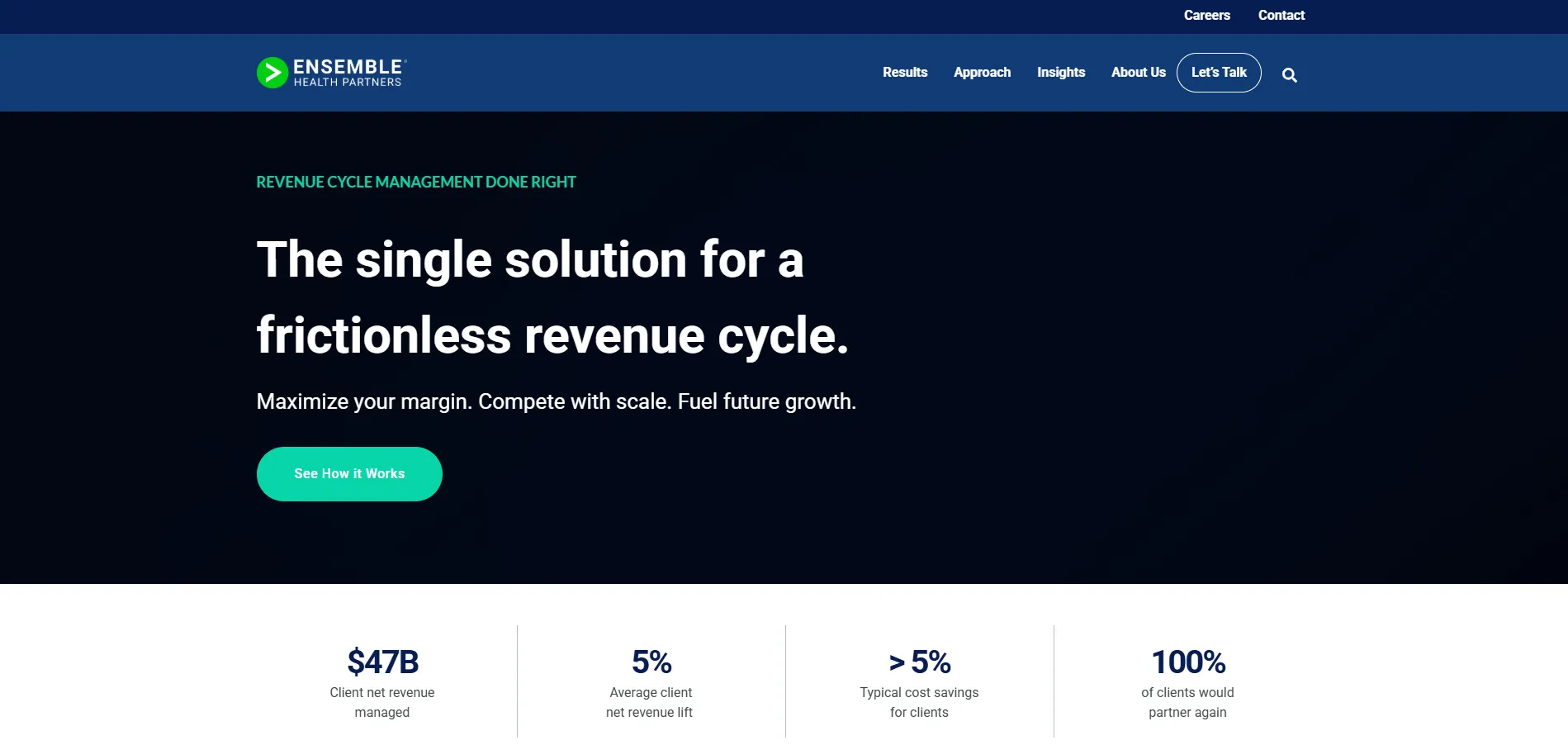
Best-in-KLAS RCM managed services partner for mid-sized to large health systems, managing $42 billion in net patient revenue for 250+ clients
Founded in 2014 by Judson Ivy and headquartered in Cincinnati, Ohio, Ensemble Health Partners has carved out a distinct position in the RCM market: the strategic managed services partner for mid-sized to large health systems that want to run their revenue cycle with a long-term external team rather than a technology platform alone. The company manages more than $42 billion in net patient revenue for over 250 healthcare providers across the US. It has earned Best in KLAS recognition for RCM outsourcing and is rated #1 in every customer experience category by KLAS Research, including loyalty, operations, relationship, services, and value.
What sets Ensemble apart from both the technology-first players (like Waystar) and the mega-scale BPO operations (like R1) is a genuine partnership model with shared accountability on financial outcomes. Their pricing structure reflects this: a fixed rate on collections with tiered incentives tied to performance, not hourly billing or platform licensing. The company consistently reports 102% year-one cash collection achievement and 5% average NPR lift across clients.
Why we picked it
Ensemble has earned a reputation that holds up under client scrutiny. In 2025 KLAS interviews, health system CEOs, CFOs, and VPs describe an operational partner that doesn’t require “hand-holding” to deliver results. The launch of an agentic AI platform in partnership with Cohere in June 2025 adds meaningful automation depth without abandoning the people-driven model. For health systems that need a strategic partner to own and improve their entire revenue cycle, Ensemble competes with few peers.
- Services offered: End-to-end RCM outsourcing, patient access and financial clearance, medical coding and CDI, AR management, business intelligence and analytics, denial management, agentic AI revenue cycle platform
- Pros: Best in KLAS for RCM outsourcing; manages $42B in NPR; 102% year-one cash collection performance; shared-risk pricing model; IDC MarketScape Leader 2025
- Cons: Limited focus on solo practices or small physician groups; managed services model requires operational transfer, which can be a significant transition for larger systems; not a standalone software platform
- Industry expertise: Mid-sized to large hospital systems, academic health centers, specialty hospitals, children’s hospitals
- Best for: Health systems and large hospital organizations seeking a long-term strategic managed services partner with performance-linked pricing
- Pricing: Fixed rate on collections with performance-tiered incentives. Contact vendor for system-specific quotes
- Rating: Best in KLAS (RCM Outsourcing 2025), 4.5 ★ (Peer Reviews)
- Year established: 2014
- Location: Blue Ash, Cincinnati, Ohio (HQ)
#4 Conifer Health Solutions
A Tenet Healthcare subsidiary serving 600+ clients with $32 billion in managed NPR, combining 35+ years of RCM operational expertise with AI and Google Cloud integration
Conifer Health Solutions was founded in 2008 as a Tenet Healthcare subsidiary and has grown into one of the largest standalone RCM operations in the US. Headquartered in Frisco, Texas, Conifer serves more than 600 healthcare providers, including hospitals, health systems, physician practices, employers, and unions, managing over $32 billion in net patient revenue annually. In November 2025, the company announced a collaboration with Google Cloud to embed advanced AI across its end-to-end RCM platform, building on existing investments in robotic process automation and intelligent content processing.
Conifer’s breadth is notable. Alongside standard revenue cycle outsourcing, it offers financial risk management for value-based care arrangements, population health management, and employer-funded health plan administration. That makes Conifer relevant for health systems navigating the shift from fee-for-service to value-based reimbursement, where billing complexity meets risk-pool finance. The company reports annual revenue of approximately $1.3 billion as of 2026.
Why we picked it
Conifer’s operating model, built by operators for operators, reflects three-and-a-half decades in the trenches of healthcare revenue management. For organizations dealing with the complexity of payer mix diversity, value-based contracts, and large physician group billing, Conifer brings rare end-to-end depth. The Google Cloud AI integration adds a layer of automation that positions Conifer well for the next wave of claims automation and autonomous coding.
- Services offered: Revenue cycle outsourcing, front-end patient access and financial clearance, clinical revenue integrity, AR management, financial risk management, population health management
- Pros: Serves 600+ clients; $32B in managed NPR; 35+ years healthcare domain expertise; value-based care financial risk capabilities; Google Cloud AI integration announced 2025
- Cons: Tenet Healthcare parent affiliation can create conflict concerns for competing health systems; transition complexity is high for full-cycle outsourcing engagements; mid-market and smaller providers may find the platform overbuilt for their needs
- Industry expertise: Hospitals and health systems, physician groups, employers and unions, value-based care organizations
- Best for: Large health systems and health networks navigating both fee-for-service and value-based care financial complexity
- Pricing: Custom pricing. Contact vendor for quotes
- Rating: 4.0 ★ (Peer Reviews)
- Year established: 2008
- Location: Frisco, Texas (HQ)
#5 Waystar
Cloud-native RCM software platform processing $2.4 trillion in annual gross claims for 1 million+ providers, with the industry’s first agentic AI revenue cycle architecture
Formed in 2017 through the merger of Navicure and ZirMed and now publicly traded on NASDAQ (WAY), Waystar operates a different model than the managed services firms above. This is a software platform first. Waystar’s cloud-native RCM platform spans financial clearance, patient eligibility, prior authorization, claims management, denial management, patient billing and payments, and analytics. Its platform processes over 5 billion healthcare payment transactions and $2.4 trillion in annual gross claims, covering approximately 60% of US patients. Over 1 million providers use Waystar across hospital systems, ambulatory practices, specialty providers, and physician groups.
In January 2026, Waystar introduced agentic AI capabilities to its platform, advancing toward what it describes as the industry’s first autonomous revenue cycle. Its data advantage is meaningful: proprietary intelligence built from 7.5 billion historical transactions enables denial prediction models and automation that improve with scale. Waystar was rated #1 Overall in Black Book’s Q1 2026 Agentic and Generative AI Revenue Cycle Management Benchmark.
Why we picked it
What Waystar offers is what software-first RCM buyers want: deep automation, analytics-driven denial prevention, and seamless EHR/PM integration without the managed services overhead. It integrates with virtually every major EHR system and is the default clearinghouse partner for many mid-market and enterprise provider networks. Clients including Piedmont, CHRISTUS Health, Cincinnati Children’s, and Atlantic Health System reflect the range of settings Waystar serves.
- Services offered: Financial clearance and eligibility verification, prior authorization automation, claims management and clearinghouse, denial and appeals management, patient billing and payment processing, analytics and reporting, agentic AI revenue cycle platform
- Pros: 5B+ transactions annually; covers ~60% of US patients; rated #1 in Black Book Agentic AI RCM benchmark 2026; integrates with all major EHR/PM systems; publicly traded with strong market validation
- Cons: Software platform model means clients own operational execution; not a managed services provider; smaller practices may find platform investment overhead relative to their billing volume
- Industry expertise: Hospitals, health systems, ambulatory practices, physician groups, specialty providers
- Best for: Healthcare organizations seeking a technology-first RCM platform with advanced AI automation rather than managed services outsourcing
- Pricing: Subscription and volume-based licensing. Contact vendor for quotes at waystar.com
- Rating: #1 Black Book Agentic AI RCM 2026, 4.4 ★ (G2)
- Year established: 2017 (merger founding)
- Location: Louisville, Kentucky (HQ); Atlanta, Chicago, Salt Lake City offices
#6 Access Healthcare
Technology-enabled RCM BPO serving hospital systems with 40,000+ specialists across the US and India, with strong KLAS recognition for coding and AR management
Access Healthcare was founded in 2011 and is headquartered in Dallas, Texas. With 40,000+ employees across US and India delivery centers, it operates at a scale that puts it in the same tier as R1 and Ensemble for large-system RCM outsourcing. In January 2025, the company received a strategic investment from New Mountain Capital, underlining market confidence in its growth trajectory. Access Healthcare serves hospitals, health systems, medical groups, billing companies, and health plans, covering patient access, medical coding, clinical documentation improvement, and AR management.
Where Access Healthcare earns particular recognition is in automation density. The company applies robotic process automation across claims workflows at a rate that meaningfully reduces the role of fatigue-prone manual review in high-volume billing environments. That automation depth is relevant for compliance: bots don’t make HIPAA mistakes the way fatigued agents do.
Why we picked it
Access Healthcare has consistently high KLAS scores for both coding accuracy and client satisfaction in AR management. For high-volume, documentation-heavy billing environments that need to scale without proportionally scaling headcount, Access Healthcare offers a strong operational model.
- Services offered: Medical coding, clinical documentation improvement, patient access, AR management, RCM platform, billing, denial management, health information management
- Pros: 40,000+ specialists; strong RPA automation across billing workflows; New Mountain Capital investment 2025; KLAS-recognized for coding accuracy and AR management
- Cons: India-centric delivery model means patient-facing functions are limited compared to US-first BPO providers; time zone constraints can affect real-time escalation workflows
- Industry expertise: Hospital systems, health systems, medical groups, billing companies, health plans
- Best for: Large healthcare organizations seeking scale-driven RCM outsourcing with high automation density
- Pricing: Custom pricing based on scope and volume. Contact vendor for quotes
- Rating: 4.3 ★ (KLAS)
- Year established: 2011
- Location: Dallas, Texas (HQ); India delivery centers
#7 GeBBS Healthcare Solutions
KLAS-recognized RCM and coding specialist with 14,000+ employees serving US health systems from East Haven, Connecticut
GeBBS Healthcare Solutions was founded in 2005 and is headquartered in East Haven, Connecticut. With 14,000+ employees across US and offshore delivery centers, GeBBS specializes in medical coding, clinical documentation improvement, revenue cycle management, and health information management. The company has earned consistent KLAS recognition for coding accuracy and RCM performance, with a workforce trained across complex payer-specific claim requirements, physician group billing, and hospital-based coding.
GeBBS’s strength lies in coding depth and quality systems. The company employs certified coders trained in IPPS, OPPS, HCC, and specialty-specific coding environments, making it a natural fit for academic medical centers, multi-specialty groups, and health systems dealing with complex payer mixes.
Why we picked it
For organizations where coding accuracy is the primary revenue cycle constraint, GeBBS delivers specialized expertise at scale. Its KLAS recognition is earned in peer reviews, and its client base spans community hospitals, academic medical centers, and national health systems. The trade-off is that GeBBS focuses primarily on coding and RCM rather than patient-facing support functions, so organizations needing omnichannel patient experience support will need a second vendor.
- Services offered: Medical coding, CDI, AR management, revenue cycle outsourcing, health information management, compliance auditing, remote staffing for coding
- Pros: KLAS-recognized for coding accuracy; 14,000+ trained RCM specialists; 20+ years of healthcare domain expertise; strong physician group and hospital coding capabilities
- Cons: Less focus on patient-facing revenue cycle functions (scheduling, patient billing support); primarily offshore delivery; limited multilingual support compared to global BPO providers
- Industry expertise: Academic medical centers, multi-specialty groups, community hospitals, health systems
- Best for: Organizations whose primary RCM bottleneck is coding quality, CDI, and documentation accuracy at scale
- Pricing: Custom pricing based on coding volume. Contact vendor for quotes
- Rating: 4.2 ★ (KLAS)
- Year established: 2005
- Location: East Haven, Connecticut (HQ); offshore delivery centers
#8 Omega Healthcare
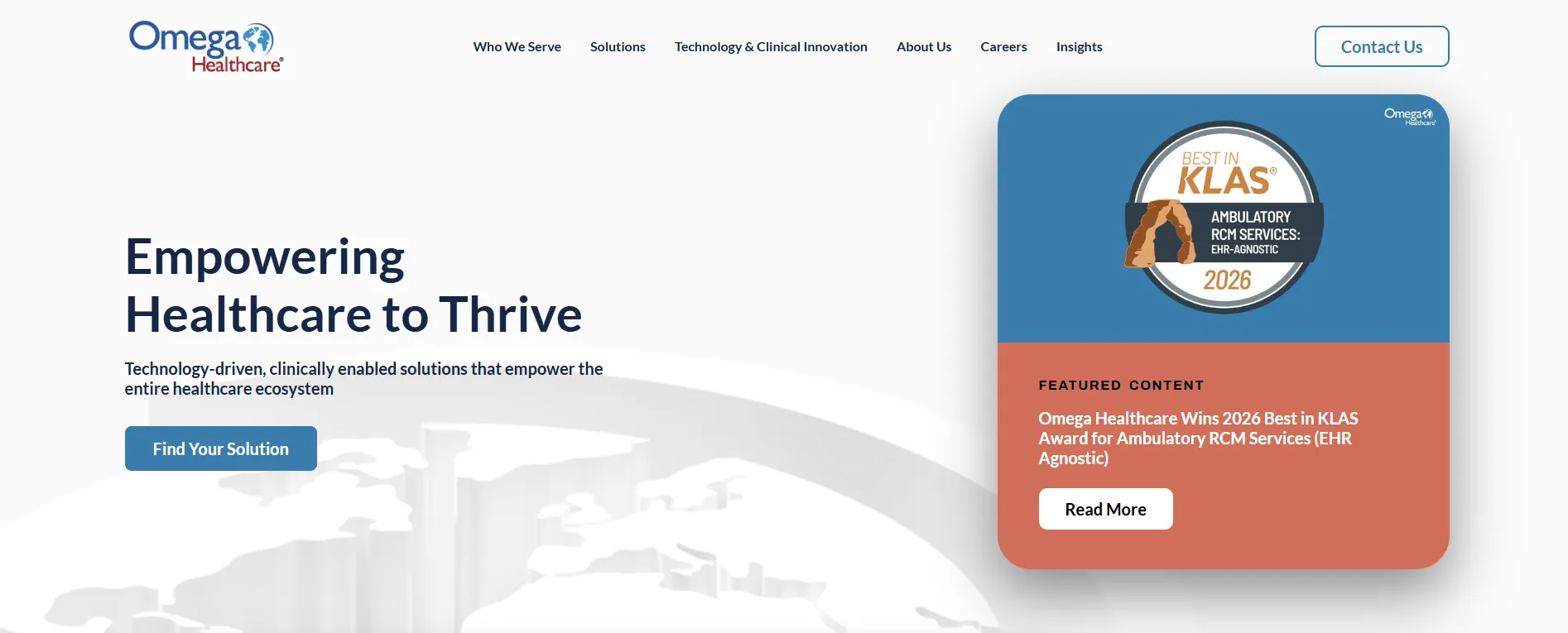
Large-scale BPO and RCM outsourcer with 30,000+ employees, serving healthcare providers with end-to-end revenue cycle, coding, and analytics from global delivery centers
Omega Healthcare has been a recognized RCM outsourcing provider in the US market since 2003, building a workforce of 30,000+ across global delivery centers that serve US healthcare providers in coding, billing, AR management, denial management, and analytics. The company operates across a wide spectrum of healthcare settings, from physician practices to multi-facility hospital groups, with particular depth in end-to-end revenue cycle operations.
What Omega Healthcare brings at this scale is cost-efficiency on high-volume transactional workflows. For healthcare organizations managing large claim volumes where per-unit cost reduction matters more than bespoke service design, Omega’s offshore delivery model produces measurable margin improvement.
Why we picked it
Omega Healthcare competes in a value-oriented segment of the RCM market. Organizations dealing with sustained AR backlogs, high denial rates across standardized payer classes, and cost pressure on administrative functions find real value in Omega’s model. The trade-off is that the high-volume, offshore orientation means customization for complex, compliance-intensive workflows is more limited than with consultative managed services providers.
- Services offered: Medical coding, billing, AR management, denial management, prior authorization, patient payment services, analytics and reporting
- Pros: 30,000+ employees; cost-effective offshore delivery model; broad service coverage from front-end to collections; experience across diverse healthcare settings
- Cons: Offshore-first delivery can be a limitation for compliance-sensitive or patient-facing revenue cycle functions; less personalized engagement model than consultative managed services providers
- Industry expertise: Physician groups, multi-specialty practices, hospital systems, ambulatory surgery centers
- Best for: Healthcare organizations prioritizing cost reduction on high-volume, standardized RCM processes
- Pricing: Custom pricing based on volume and scope. Contact vendor for quotes
- Year established: 2003
- Location: US operations with global delivery centers
#9 AGS Health
Technology-enabled RCM and coding specialist combining AI-powered automation with clinical expertise for hospital systems and large physician groups
AGS Health was founded in 2004 and operates as a technology-enabled RCM company, serving hospital systems, health systems, and large physician groups with medical coding, CDI, patient access, and end-to-end revenue cycle outsourcing. With 12,000+ employees, AGS Health has built a reputation for combining AI-powered automation with certified clinical coding expertise, particularly in complex specialty areas including oncology, cardiology, and interventional radiology.
The company has invested in proprietary technology to automate pre-audit and claim scrubbing workflows, reducing manual review touchpoints while maintaining accuracy standards required for high-value specialty billing.
Why we picked it
AGS Health’s specialty coding depth and AI-augmented workflow design make it a strong pick for health systems and large physician groups where specialty billing accuracy directly affects reimbursement rates. It’s less suited to organizations needing broad patient-facing support alongside their RCM function.
- Services offered: Medical coding, CDI, patient access, AR management, RCM outsourcing, AI-powered coding automation, prior authorization support
- Pros: Specialty coding expertise in oncology, cardiology, radiology; AI-augmented workflow automation; 12,000+ trained specialists; strong physician group and health system track record
- Cons: More limited patient-facing capabilities compared to full-service BPO providers; not designed as a primary patient support partner
- Industry expertise: Hospital systems, health systems, large physician groups, specialty practices
- Best for: Health systems and physician organizations where specialty billing accuracy and AI-augmented coding automation are the primary RCM needs
- Pricing: Custom pricing. Contact vendor for quotes
- Year established: 2004
- Location: US operations with offshore delivery centers
#10 Optum (Change Healthcare)
The largest healthcare data and analytics company in the US, offering RCM technology, payer connectivity, and analytics infrastructure at system-wide scale through its Change Healthcare acquisition
Optum, a subsidiary of UnitedHealth Group, is the largest healthcare technology and services company in the US, with a 300,000+ person workforce operating across virtually every domain of US healthcare. Its revenue cycle capabilities, enhanced by the $13 billion acquisition of Change Healthcare in 2022, span RCM software, analytics, payer connectivity, and consulting for both providers and payers. Optum’s Change Healthcare clearinghouse processes a significant share of US healthcare claims, making it a foundational piece of the national billing infrastructure.
The February 2024 Change Healthcare cyberattack exposed the risks inherent in that level of centralization, disrupting billing workflows across thousands of healthcare providers for weeks. The incident has led many provider organizations to re-examine single-vendor dependency on Optum’s claims infrastructure. That said, Optum’s data advantage remains unmatched, and its analytics and population health capabilities extend well beyond point-solution RCM.
Why we picked it
Optum belongs on this list because its market footprint is simply too large to ignore. For large health systems already embedded in the UnitedHealth Group ecosystem, Optum’s RCM solutions offer tight integration with payer data, analytics, and population health infrastructure. For organizations considering a single-vendor dependency after the 2024 incident, a diversified vendor strategy is worth evaluating.
- Services offered: Claims management, payer connectivity, RCM software, analytics and reporting, medical coding, population health management, CX consulting, payer-provider engagement
- Pros: Largest healthcare data asset in the US; tight payer integration through Change Healthcare clearinghouse; analytics and population health capabilities beyond typical RCM
- Cons: The February 2024 Change Healthcare cyberattack raised significant systemic risk concerns; size creates a level of institutional complexity that mid-market providers find difficult to navigate; pricing and contracting are not transparent
- Industry expertise: Hospital systems, health systems, physician groups, health plans, payers, government programs
- Best for: Large health systems and payers seeking integrated RCM and analytics infrastructure with deep UnitedHealth Group ecosystem connectivity
- Pricing: Custom enterprise pricing. Contact vendor for quotes
- Year established: 1999 (Optum); Change Healthcare acquisition 2022
- Location: Minnetonka, Minnesota (UnitedHealth HQ); national operations
Helpware CX: Our Top Choice
Among the 10 companies on this list, Helpware CX occupies a distinct position that the pure-play RCM technology platforms and mega-scale hospital billing operations don’t fill. What sets Helpware apart isn’t raw transaction volume or proprietary RCM software. It’s that Helpware manages the revenue cycle from the patient experience layer, which is precisely where healthcare organizations in the digital health, telehealth, and mid-market provider space face their hardest operational problems.
Rarely do BPO providers combine HIPAA, SOC 2 Type II, and GDPR certifications with a 90% CSAT score, 2.8% monthly attrition, and 45-language delivery capability in a single managed service. Most compliance-focused RCM vendors sacrifice service breadth for compliance depth, or sacrifice compliance rigor for speed and cost. Helpware’s operational model doesn’t make that trade.
The genuine trade-off is worth stating: Helpware’s consultative onboarding model runs longer than plug-and-play RCM software, and its premium pricing reflects that operational depth. Organizations whose primary need is high-volume claims clearinghouse software will find R1 or Waystar a better fit. But for healthcare organizations that treat patient experience as a clinical differentiator, and need a single compliance-certified partner to manage billing, coding, claims, insurance verification, and patient support across a multilingual operation, Helpware earns the top spot.
What to Look For in a Healthcare RCM Partner
Choosing an RCM company in 2026 requires more than comparing denial rate benchmarks. The market has bifurcated between technology-first platforms (like Waystar) and people-first managed services operations (like Ensemble and Helpware). Neither is universally better. What matters is where your operational risk is concentrated.
If your primary challenge is claims automation, EHR integration, and prior authorization throughput, a software platform is the right starting point. If your challenge is operational continuity, coding accuracy under complex payer mixes, and patient-facing billing experience across a multilingual population, a managed services partner with certified staff, compliance infrastructure, and low attrition delivers more durable outcomes.
The single most underweighted metric in RCM vendor evaluation is staff attrition. When billing and coding specialists turn over at 6-8% monthly, institutional knowledge resets constantly. That shows up in coding errors, denial rates, and CSAT. Not until you’ve experienced the downstream impact of high RCM staff turnover does the value of providers who invest in their people become clear.