








The US medical billing outsourcing market reached $6.95 billion in 2025 and is growing at a 12,56% annual rate through 2033, according to Grand View Research. That growth reflects a simple reality: billing is getting harder. ICD-10 complexity, payer contract variability, prior authorization bottlenecks, and HIPAA enforcement all push practices toward outsourcing. According to MGMA’s 2025 research, 36% of medical groups plan to outsource or automate part of their revenue cycle management in 2025.
What those numbers cannot tell you is which company to choose. A 500-bed hospital system and a 3-physician behavioral health group need completely different things from a billing partner. The right fit depends on size, specialty, compliance obligations, technology stack, and how much operational control you want to retain.
This guide skips the generic ranked list. It identifies which provider wins for which situation, with a full comparison table and 10 vendor-vetting questions to carry into every sales conversation.
TL;DR: Quick Picks
- Helpware CX — Best Overall: HIPAA-compliant, SOC 2-certified, and built for mid-market and enterprise healthcare operations, Helpware CX combines AI-assisted quality monitoring across 100% of interactions with 2.8% monthly attrition — one of the lowest staff turnover rates in the industry.
- R1 RCM — Best for Large Hospital Systems: Serving 94 of the top 100 US health systems with 180M+ annual payer transactions and a new AI lab (R37) built in partnership with Palantir, R1 RCM is the dominant choice for enterprise-scale revenue cycle transformation.
- Tebra — Best for Independent Practices: Purpose-built for private practices of 1-10 providers, Tebra combines EHR, billing, scheduling, and a vetted billing partner network into a single platform designed to reduce denials without adding administrative staff.
Top 10 Medical Billing Companies in the US: Winners by Use Case
Best for HIPAA-Compliant Managed Billing Operations
What distinguishes compliance-focused billing from standard RCM outsourcing? The certifications, audit cadences, staff training protocols, and QA frameworks that prevent HIPAA violations before they become reportable incidents. Organizations handling PHI at scale (telehealth networks, behavioral health groups, multi-state health systems) cannot afford a billing partner that treats compliance as a checkbox.
#1 Helpware CX

Helpware CX operates with SOC 2 Type II, HIPAA, ISO 27001, and GDPR certifications. What sets it apart from similarly certified competitors is the operational rigor underneath those credentials. Every client interaction passes through AI-assisted quality monitoring at 100% coverage, not sampled audits. Billing specialists receive regular HIPAA training and the company maintains strict security controls across people, processes, and technology. For healthcare organizations tracking HIPAA updates, insurance rule changes, and coding revisions on a weekly basis, Helpware’s dedicated compliance expertise removes a significant administrative burden.
The combination of 2.8% monthly attrition (versus the 6-8% industry average) and 90% CSAT means clients do not cycle through new agents who lack the institutional knowledge to code accurately. Across 19 locations and 45 languages, Helpware CX scales managed billing operations without sacrificing the compliance continuity that regulated healthcare environments require.
#2 GeBBS Healthcare Solutions
Founded in 2005 and headquartered in East Haven, Connecticut, GeBBS Healthcare Solutions operates with 14,000+ employees across US and offshore delivery centers. It has earned KLAS recognition for coding and RCM accuracy, with a workforce trained across medical coding, clinical documentation improvement (CDI), and complex payer-specific claim requirements. GeBBS is particularly strong for organizations that need deep ICD-10 and CPT coding depth, not just claims submission.
#3 Access Healthcare
Access Healthcare, founded in 2011 and headquartered in Dallas, runs 24 global delivery centers with 27,000+ professionals and over 3,500 robotic process automation (RPA) bots. That automation density is notable for compliance work: bots do not make HIPAA mistakes the way fatigued agents do. For high-volume, documentation-heavy billing environments that need to scale without proportionally scaling headcount, Access Healthcare is a strong fit.
Skip if: Your primary need is a simple clearinghouse or basic claims submission software. These providers are managed-service operations, not software platforms.
Best for Large Hospital Systems and Enterprise Health Networks
Enterprise hospital billing is a different category entirely. A health system managing hundreds of millions in net patient revenue needs a partner with proprietary technology, massive payer-transaction infrastructure, and the ability to run denial management at a scale that smaller firms cannot match.
#1 R1 RCM
R1 RCM serves 94 of the top 100 US health systems and processes 180M+ annual payer transactions across 550M patient encounters. No other company on this list operates at that scale. In March 2025, R1 launched R37, an advanced AI lab developed in exclusive partnership with Palantir Technologies, targeting autonomous coding, denial management, and claims accuracy at enterprise speed. R37 handles autonomous mid-cycle coding with a DRG-V safety net, and R1 has deployed agentic RCM worker solutions with enterprise clients.
Administrative costs account for more than 40% of US hospital expenses, with over $160 billion spent annually on RCM operations. R1 is the most credible contender for tackling that number at scale. Its data repository of 20,000 proprietary payment algorithms and 1.2 billion annual workflow actions gives R37’s AI models a training foundation no startup can replicate.
#2 Omega Healthcare
Omega Healthcare, founded in 2003 and headquartered in Boca Raton, Florida, employs 35,000 people across the US, India, Colombia, and the Philippines, serving 350+ healthcare organizations. Its partnership with Microsoft produces over 20 AI-powered RCM solutions deployed across the client base. For enterprise health networks that need global delivery capacity combined with AI-accelerated coding and revenue capture, Omega is a direct R1 alternative worth evaluating.
#3 Conifer Health Solutions
Founded in 2008 and spun off from Tenet Health, Conifer Health Solutions is based in Dallas and manages over $32 billion in net patient revenue across 600+ clients with 7,700+ employees. Its collaboration with Google Cloud on AI-powered RCM positions Conifer for health systems that want enterprise-grade delivery with a familiar US-based operational footprint. Conifer is particularly strong for health systems already inside the Tenet ecosystem.
Skip if: You are a physician group or independent practice. These providers operate at health system scale and do not typically engage smaller organizations.
Best for Mid-Market Health Systems Seeking True RCM Partnership
Mid-market health systems (typically 50 to 500 beds or $50M to $500M in net patient revenue) face a specific problem. Enterprise RCM vendors treat them as low priority. Smaller billing services lack the technology depth and reporting transparency that CFOs require. What this segment needs is a genuine operational partner, not a vendor.
#1 Ensemble Health Partners
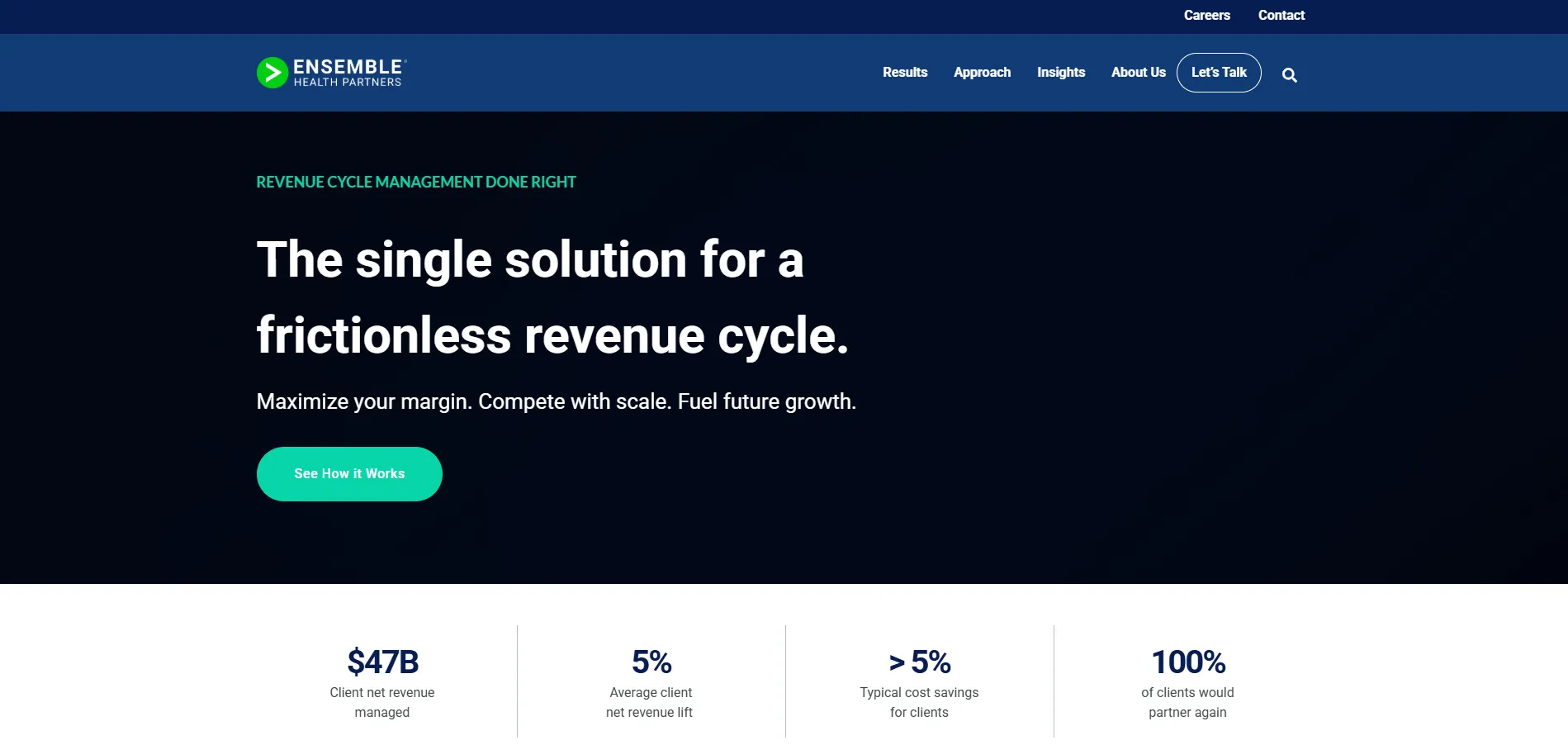
Founded in 2014 and headquartered in Cincinnati, Ohio, Ensemble Health Partners employs 10,000+ people and manages over $29 billion in net patient revenue. Its model is distinguished by a notable commitment: 100% year-one goal achievement for every new client. The firm reports an average 5% NPR lift for clients after year one, with outcomes tracked against pre-engagement baselines. For mid-market health systems that want transparency, defined KPIs, and an operator willing to put performance on paper, Ensemble is the clearest choice.
#2 Access Healthcare
Access Healthcare’s automation-dense delivery model makes it an effective choice for mid-market health systems that need high-volume claim processing without building a proportional internal team. The 3,500+ RPA bots operating across its delivery infrastructure handle repetitive tasks at a speed and accuracy that mid-market in-house billing teams struggle to match. Access Healthcare fits organizations that want automation-first delivery at a mid-market price point, rather than the partnership-model intensity that Ensemble brings.
Skip if: You need guaranteed outcome commitments written into the contract from day one. Mid-market vendors vary significantly on what they will put in writing, and this distinction is worth pressing hard in contract negotiations.
Best for Independent and Small Private Practices
The independent practice billing market is structurally different from everything above. A 3-physician internal medicine practice does not need 27,000 employees and 24 delivery centers. It needs a platform that integrates with its EHR, catches denials before they reach the payer, and does not require a dedicated billing coordinator to manage.
#1 Tebra
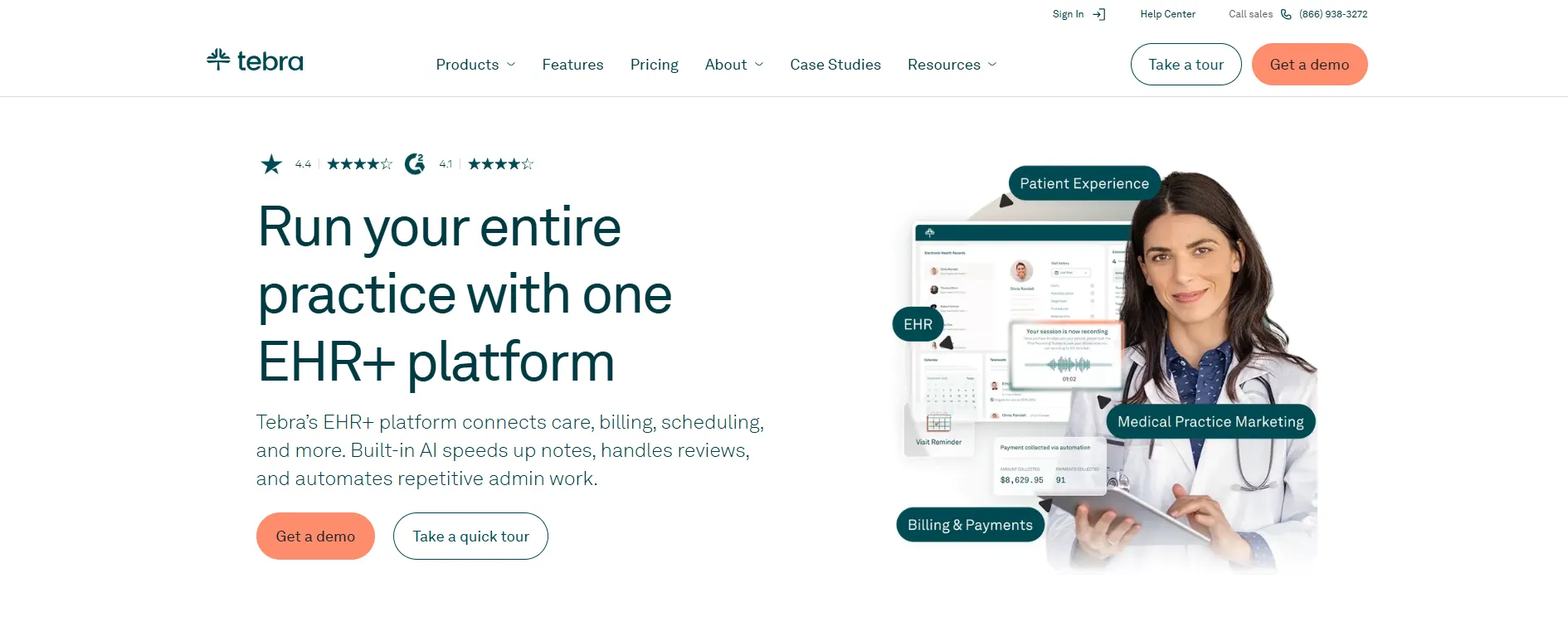
Formed in 2021 through the merger of Kareo (founded 2004) and PatientPop, and headquartered in Irvine, California, Tebra is purpose-built for independent and small private practices across primary care, mental health, pediatrics, chiropractic, dermatology, and other specialties. Its platform combines EHR, scheduling, billing, patient engagement, and practice marketing in a single system with transparent pricing.
For billing specifically, Tebra offers two paths: self-managed billing within the platform, or a managed billing option that connects practices with a vetted network of specialty-specific billing partners. The built-in claims scrubbing rules engine catches coding errors before submission, reducing denials without requiring internal billing expertise. What makes Tebra the clear choice for this segment is its integrated design. A solo physician does not toggle between three systems to check eligibility, post payments, and send patient statements. Those workflows run from a single screen.
#2 athenahealth
Founded in 1997 and headquartered in Boston, athenahealth serves 160,000+ providers across its cloud-based EHR and RCM platform. Its network-based claim scrubbing identifies payer-specific denial patterns across its entire provider base and applies those learnings to individual practices. For independent practices that are part of larger ACOs, IPAs, or physician networks requiring interoperability and referral coordination, athenahealth’s network effect gives it a clear advantage over point solutions.
Skip if: You are looking for a traditional managed billing service where a third party handles everything. Both Tebra and athenahealth are primarily software platforms, not full-service billing operations.
Best for Telehealth, Behavioral Health, and Specialty Billing
Telehealth and behavioral health billing carry complications that standard RCM workflows do not address. Cross-state licensure, payer-specific telehealth coverage policies, behavioral health parity laws, prior authorization for psychiatric services, and PHI sensitivity all add layers requiring specialized expertise. A billing partner that handles routine primary care claims will generate preventable denials in these categories.
#1 Helpware CX
Helpware CX’s healthcare BPO services are designed for exactly this compliance complexity. The service covers medical billing and coding, claims processing, RCM solutions, patient appointment scheduling, and healthcare data entry, with HIPAA, SOC 2, and GDPR compliance built into every workflow layer.
For telehealth providers operating across multiple states, Helpware’s 45-language, 19-location delivery model means patient-facing billing support does not break down at state borders. Its AI-assisted quality monitoring system flags compliance risks in real time across 100% of written interactions and calls, which is critical for behavioral health organizations handling sensitive PHI. Helpware’s 2.8% monthly attrition means the agents handling specialty claims carry institutional knowledge from month to month, rather than resetting after every staff cycle.
#2 Infinx
Founded in 2012 and headquartered in San Jose, California, Infinx employs approximately 4,400 people and focuses on AI-powered prior authorization and autonomous medical coding. Its acquisition of Glidian significantly strengthened prior authorization automation, addressing the single biggest reimbursement bottleneck for telehealth and behavioral health providers. For organizations whose primary billing pain point is prior auth turnaround time, Infinx addresses that specific problem with targeted technology depth that a full-service BPO typically cannot match on prior auth alone.
Skip if: You need full-cycle back-office support beyond billing, including patient engagement, scheduling coordination, and insurance verification at volume. Infinx is point-solution focused. Helpware CX covers the full administrative workflow.
Top 10 Medical Billing Companies in the US for 2026: Comparison
| Company | Core Services | Delivery | Employees | Best For | Est. |
|---|---|---|---|---|---|
| Helpware CX | Medical billing, claims processing, RCM, patient support, back office | 19 locations, 4 continents | ~4,000+ | Compliance-first operations, telehealth, specialty billing, mid-market | 2015 |
| R1 RCM | End-to-end RCM, autonomous coding, denial management, agentic AI (R37) | US-based, enterprise delivery | ~27,000+ | Large health systems, enterprise RCM transformation | 2003 |
| Omega Healthcare | RCM, coding, CDI, accounts receivable, AI automation | US, India, Colombia, Philippines | ~35,000+ | Enterprise health networks, global delivery capacity | 2003 |
| GeBBS Healthcare Solutions | Medical coding, CDI, RCM, claims management | US and offshore | ~14,000+ | KLAS-rated coding accuracy, ICD-10/CPT depth | 2005 |
| Conifer Health Solutions | Revenue cycle management, patient access, value-based care | Dallas, TX (US-based) | ~7,700+ | Health systems in Tenet ecosystem, $32B NPR managed | 2008 |
| Access Healthcare | Claims processing, RPA automation, coding, denial management | 24 delivery centers globally | ~27,000+ | High-volume automation, mid-market RCM | 2011 |
| Ensemble Health Partners | End-to-end RCM, CDI, denial management, performance guarantees | Cincinnati, OH | ~10,000+ | Mid-market health systems, outcome-guaranteed partnerships | 2014 |
| Tebra | EHR platform, claims scrubbing, managed billing partner network | Irvine, CA (cloud-based) | ~1,000+ | Independent practices, 1-10 providers, specialty practices | 2021 |
| Infinx | Prior authorization automation, AI coding, RCM analytics | San Jose, CA | ~4,400+ | Telehealth prior auth, behavioral health, specialty billing | 2012 |
| athenahealth | Cloud EHR, network-based RCM, patient engagement | Boston, MA | ~5,000+ | Independent practices in ACOs and IPAs, 160,000+ providers | 1997 |
Ready to Cut Billing Costs Without Cutting Corners? Start Here.
The right medical billing company does not just process claims faster. It reduces denial rates, keeps your A/R below 40 days, protects you from HIPAA enforcement risk, and frees your clinical staff to focus on patients instead of paperwork.
What you need depends on where you sit. A hospital CFO managing $200M in net patient revenue needs a different conversation than a behavioral health group practice onboarding its first billing partner. This guide covered both.
If compliance and operational continuity are your top criteria, Helpware CX is the starting point. With SOC 2 Type II, HIPAA, ISO 27001, and GDPR certifications, 2.8% monthly attrition, and AI-assisted quality monitoring across 100% of interactions, Helpware CX delivers the compliance architecture and staffing stability that regulated healthcare environments require. Use the cost calculator to build your business case, or talk to the team directly to scope a pilot program.
If you run a large health system evaluating enterprise RCM transformation, put R1 RCM and Ensemble Health Partners at the top of your shortlist. If you run an independent practice, Tebra is the fastest path from demo to live billing without adding headcount.
Use the 10 vetting questions above in every vendor conversation. The difference between the right billing partner and the wrong one shows up in those answers long before it shows up in your A/R report.
Unlock your hidden CX savings with Helpware
Get ROI projection for current support needs.
-40% annually
/monthly costs with Helpware
vs
/internal team costs (approx)
Your requirements fall outside our standard parameters.
Let's discuss your results
Fill in your details to schedule a consultation.
-40% annually
/monthly costs with Helpware
vs
/internal team costs (approx)
Your requirements fall outside our standard parameters.
-40% annually
/monthly costs with Helpware
vs
/internal team costs (approx)
Your requirements fall outside our standard parameters.
Support staff included in the package:
Shared Team Leader
Shared L&D Specalist
Shared QA Specialist
Account Executive by default
Shared Ops Delivery Manager
Admin/Finance/Legal support for the agents by default
1-2 Dedicated Team Leaders
Shared L&D Specialist
Shared to 1 Dedicated QA Specialist
Shared Ops Manager
Account Executive by default
Admin/Finance/Legal support for the agents by default
Shared Real Time Analyst
2-5 Dedicated Team Leaders
0,5 to 1,5 Dedicated L&D Specialists
1-2 Dedicated QA Specialists
Up to half of a dedicated Ops Manager
Account Executive by default
Admin/Finance/Legal support for the agents by default
1 Dedicated Real Time Analyst
Ready to get a personalized estimate for your team?
Contact us for a personalized assessment tailored to your specific needs.
*These projections are estimates for informational purposes only and do not represent a formal offer. Contact us for a personalized quote.
Thank you!
You’ll hear from us within one business day.
10 Questions to Ask Every Medical Billing Company Vendor
Before signing a billing contract, your vetting conversation matters more than your sales conversation. These questions expose the gaps that standard sales decks conceal.
1. What certifications do you hold, and can you provide current audit documentation?
HIPAA compliance is often stated but rarely documented in vendor conversations. Ask for the most recent SOC 2 Type II audit report, HIPAA risk assessment results, and ISO 27001 certification if applicable. A provider confident in its compliance posture will share audit summaries without hesitation. A response of “we’re fully compliant” with no documentation tells you something important about how that organization operates under scrutiny.
2. What is your staff attrition rate, and how does it affect account continuity?
High attrition is one of the most underestimated billing risks. Billing staff who leave take coding knowledge, payer-specific experience, and relationship context with them. Ask for monthly attrition figures, not annual averages. The industry averages 6-8% monthly. Providers operating at 2-4% represent a structural advantage in continuity and accuracy. Anything above 8% should trigger a direct conversation about how quality is maintained during turnover cycles.
3. What is your clean claims rate, and how do you handle coding errors?
Ask for documented clean claims rates, denial rates by payer type, and a description of the error correction workflow. Strong answers include a specific percentage (industry benchmark is 95%+ first-pass clean claims) and a clear escalation path when errors occur. Weak answers generalize about “quality processes” without data. Your contract should include clean claims rates as KPIs with defined remediation triggers.
4. What is your prior authorization workflow for specialty and telehealth claims?
Prior authorization is where revenue gets held and where most billing vendors underinvest. Ask how they track auth expiration dates, how quickly they respond to auth denials, and whether they have dedicated staff or automation for telehealth payers. If your specialty requires high prior auth volumes (behavioral health, physical therapy, certain diagnostics) this question alone will differentiate capable vendors from ones that will generate A/R backlogs.
5. How do you monitor for HIPAA violations across your workforce?
Ask whether monitoring is sampled or 100% coverage, whether it applies to both voice and written interactions, and what the escalation process looks like when a violation is detected. 100% AI-assisted monitoring is the current standard for compliance-critical operations. Sampled audits (5-10% of interactions) are insufficient for organizations that handle behavioral health PHI or have experienced prior HIPAA enforcement action. The answer reveals both technical infrastructure and compliance culture.
6. What reporting do I receive, and how frequently?
Request a sample reporting dashboard before signing. Look for denial rates by payer and code, days in accounts receivable (benchmark: under 40 days), clean claims rates, and collection rates by provider. Vendors who offer weekly reporting with real-time dashboard access operate with a transparency advantage over those delivering monthly summaries. Find out whether reports come from account managers or from the platform itself. Platform-generated data is harder to manipulate.
7. How do you price your services, and what is excluded from the base rate?
Most billing companies price on a percentage of collections (typically 4-10% depending on specialty and volume) or on a per-claim basis. Ask what is not covered: setup fees, clearinghouse fees, denial rework above a certain threshold, coding audits, and state-specific compliance add-ons are common upsells. Get a fully loaded cost estimate, not a headline percentage, and ask for references from clients of similar size and specialty mix.
8. What happens to my data if we end the contract?
Data portability is non-negotiable in billing contracts and frequently ignored in sales conversations. Ask for the specific data export format, the timeline for receiving your data after contract termination, and whether fees are associated with data retrieval. Billing data contains years of patient financial history and claim records. Vendors that make exit difficult are giving you a direct signal about how they view the long-term relationship.
9. How do you stay current with payer policy changes and coding updates?
Billing codes update annually (ICD-10, CPT, HCPCS), and payer-specific policies change throughout the year with little advance notice. Ask whether the vendor employs dedicated coding specialists and compliance officers who track regulatory changes, and how updates reach your account team. Strong vendors describe a structured update process with documented rollout timelines. Weak vendors describe informal processes that depend on individual employee awareness. That is a meaningful risk in high-turnover environments.
10. What performance guarantees are in the contract, and what triggers early exit?
Standard billing contracts run 12-24 months. Ask whether the contract includes performance guarantees tied to specific KPIs (clean claims rates, denial rates, days in A/R) and what the remediation and early exit process looks like if those guarantees are not met. Vendors who resist putting performance commitments in writing are the vendors who most need to be pressure-tested on this question. A confident operator welcomes accountability clauses because they know they will hit the targets.