








After months of laborious preparation, you’ve finally launched your startup. Your product is up and running, waiting to be discovered by its target audience. It might feel that the hard part is over, and that you can finally sit back and enjoy the fruits of your brainchild.
But here’s the reality: Without a thought-out digital marketing strategy, even the best product will fade into obscurity. No matter how valuable your solution is and what problems it solves, you still need that initial push to put it in front of the right people.
That’s where the real challenge begins.
Startup budgets are tight and marketing channels abundant. With so many options, there are just as many ways to go wrong. What channels to prioritize? How to effectively market your product without spending a fortune? What’s the best way to build trust with your potential customers? How to increase brand awareness through smart digital marketing for startups?
These and many other questions will be covered in today’s digital marketing guide. In the following paragraphs, we provide a step-by-step marketing playbook that you can follow to grow your startup and maximize return on investment.
With the intro out of the way, let’s dive right in.
Why Digital Marketing Is Important for Startups
In the old days, there were essentially two ways to promote a small business: You could do it through physical advertising (flyers, billboards, direct mail, etc.) or TV/radio commercials. Both options were quite expensive and therefore inaccessible to many startup owners.
Digital marketing has changed the game for good, especially for businesses just starting out. Today, you can advertise your product without paying top dollar: You can start small, test different methods, and scale what works. We would go as far as to say that digital marketing for startups is the fastest, most budget-friendly, and most measurable way to acquire customers.
With the right strategy, you can:
- Acquire customers quickly and understand what channels work best in your particular case to prioritize them and optimize spending on digital marketing for startups.
- Reach a global audience, targeting people who want your product, regardless of their geographical location.
- Get your business in front of your target audience and increase brand awareness.
- Collect actionable data to optimize your marketing campaigns, improve your offering, and fine-tune your brand.
However, to be successful in your marketing efforts, you need to be smart about how you approach digital marketing for startups. Your primary goal is to build a reliable pipeline: Attention → first visit → first conversion (signup, lead, or sale) → activation → retention → referrals. Instead of trying every tactic (although you will test many of them), prioritize a few things that lower customer acquisition costs (CAC) and increase customer lifetime value (CLV) over time.
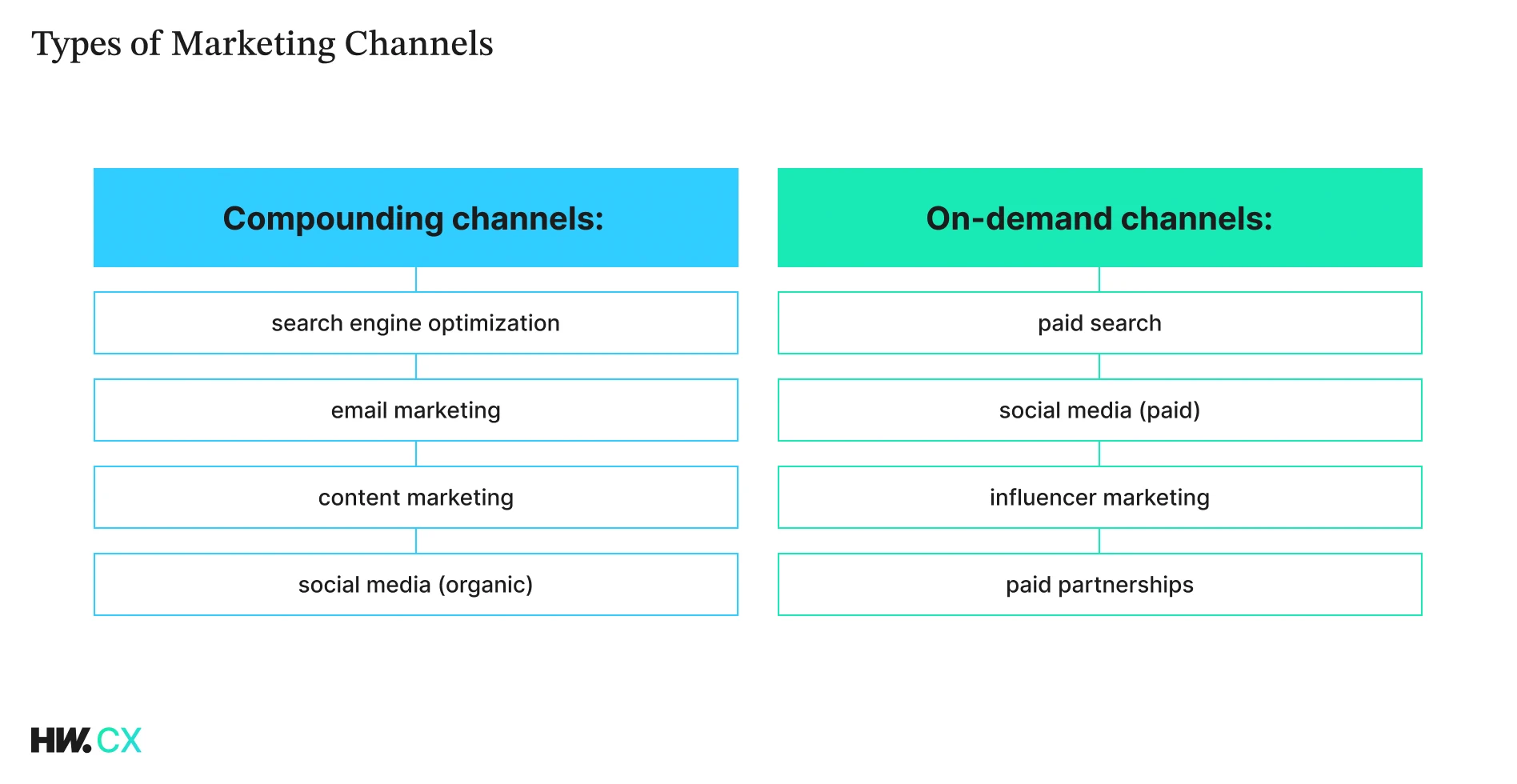
There are two types of channels in digital marketing: compounding channels and on-demand channels. Compounding channels build value over time: The more effort you put in, the bigger the returns in the long run. They include SEO, email, content, product-led loops, and more. On-demand channels, on the other hand, give immediate but temporary results. You can switch them on and off whenever needed. They include paid search, paid social, influencer marketing campaigns, and more.
Efficient startups mix one compounding and one on-demand channel early; then add a second compounding channel once the first shows traction.
5 Best Digital Marketing Strategies for Startups to Grow in 2025
Now that we’ve talked about the importance of digital marketing for startups, let’s discuss actionable steps to help your startup reach potential customers.
#1 Finetune your offering
Before investing in ads, clearly communicate your product’s value on your website. Give your audience a straightforward idea of who you are, what you do, and how you can help. Start with the homepage: It should include one core job that you do (not three). Ideally, your H1 should finish the sentence “We exist to help you ____.” For example, “We help businesses automate workflows through AI.” The same goes for your CTA: Make it single-focused and easy to understand (“Try for free,” “Get the demo,” “Check pricing,” etc.). Build trust straight away: Add client logos, testimonials, success stories, user counts (e.g., “used by 10,000 happy customers worldwide”), and other information that might be relevant.
For effective digital marketing for startups, it’s essential to use Google Analytics 4 and similar analytics tools from the very beginning. They’ll help you learn what your audience likes and how they behave so you can target people with similar preferences in your ads to expand your reach. Also, take care of the technical side of things: Optimize your website for mobile to comply with mobile-first indexing best practices. Make sure your site loads in less than 3 seconds to decrease bounce rates.
Quick test: Spend $100 on Google ads for your brand and a few competitor keywords. If people convert at 2–5%, your landing page is doing well.
#2 Don’t shy away from email marketing
Email marketing is a staple of digital marketing for startups. It’s a powerful and evolving tool, resilient to algorithm changes and with best-in-class ROI. It generates between $36 and $40 for every dollar spent, which translates to a staggering 3,600% to 4,000% return on investment. That’s why it’s absolutely crucial that you add a form to your website and collect email addresses from visitors. Don’t forget to incentivize them to leave their email info by offering something in return: it can be a discount, something free (an ebook, a white paper, etc.), a promo code, and so on.
Once you have an email list, you can share updates about your services, products, and anything related to your target audience’s interests. It’s important not to overdo it and be strategic about when and how often you send emails.
We suggest the following email flow:
- Welcome emails (2–3 emails). Show the value of your product and guide people to get started.
- Reminders. If someone starts a signup or checkout but doesn’t finish, send a helpful reminder. As a rule of thumb, you should send no more than two reminders within 48 to 72 hours.
- Onboarding. Help users take their first key step in your product. This works best for complicated solutions that involve multiple steps and features.
- Newsletter. Share tips, updates, or any relevant content to stay in touch with your audience. Most companies send one letter per week, which is a safe frequency to keep readers engaged without entering the annoying zone.
#3 Leverage social media channels
No digital marketing plan for startup owners would be complete without a social media strategy. Social media platforms are where your audience is, and where discovery happens. This is especially true for startups focused on app marketing, since visual content and short-form videos often drive app downloads and engagement. As of 2025, there are a whopping 5.24 billion active social media users around the globe, spending 2 hours 22 minutes online on average. In other words, over 60% of the global population uses social platforms, so it would be a mistake to sleep on them. We believe paid social can become an effective digital marketing strategy for startups seeking to increase brand awareness and drive traffic.
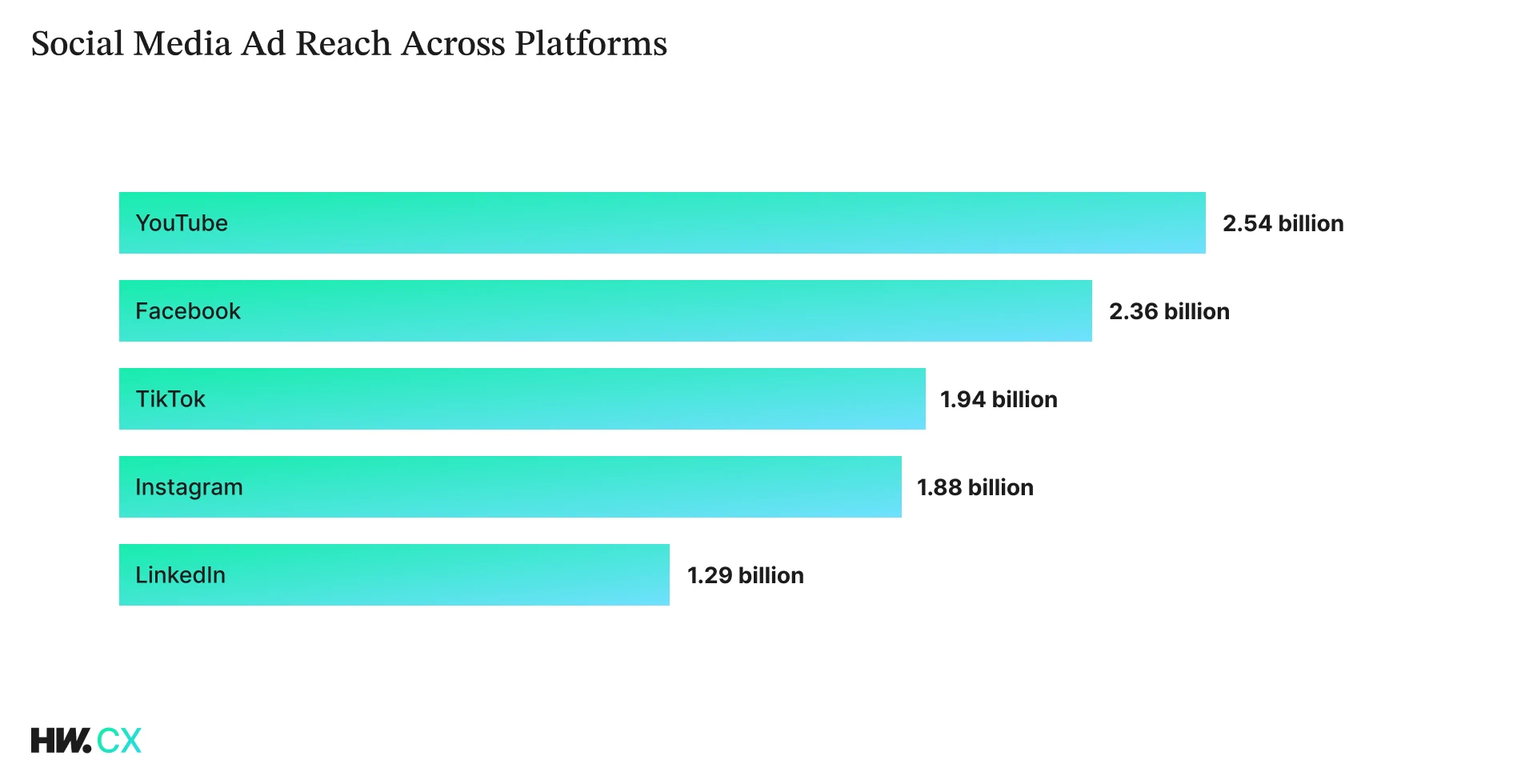
When you run ads on social media platforms, there are usually two ways to pay:
- Cost per mile (cost per 1000 impressions). This is how much it costs to get 1000 views on your advertisement. On Facebook and Instagram, for example, the average CPM in 2025 is $8.15
- Cost per click (CPC). This metric shows how much it costs for someone to actually click on your ad. A typical CPC is around $0.70; however, for ecommerce it’s typically closer to $1 per click.
These numbers can shift depending on your audience, industry, and how good your ads are. However, when compared to other channels, social media marketing campaigns are one of the most cost-efficient ways to achieve business growth.
For someone who is just testing the waters in paid social, we’d recommend starting simple. In the early stages, you will need only three types of ad groups:
- Prospecting (broad). These are ads aimed at a wider audience who haven’t heard of your product yet.
- Remarketing. Ads targeting people who visited your website, engaged with its content, but didn’t complete the target action (a purchase, a sign-up, etc.).
- Lookalike audiences. Ads targeting users with similar preferences and interests to your target audience. If you have at least 1,000 customers or email list subscribers, you’ll be able to set lookalikes and reach new people.
When it comes to advertisements themselves, we’d suggest testing different ads rather than creating just one and relying on it. Start with 3 simple concepts: for example, a demo, a customer testimonial, or a before/after comparison. For each concept, make different variations (change the opening line, visuals, etc.). Watch the performance of each ad closely and cut the “losers” while putting more budget for the “winners.”
Certain ad types convert better than others when it comes to digital marketing for startups: product demos, user-generated content, before/after comparisons, and bundles and discounts (for e-commerce). Your ultimate goal is to get a customer acquisition cost (CAC) that works for your business and leaves enough room for healthy profit margins and customer lifetime value (LTV).
#4 Invest in content and search engine optimization
Investing in high-quality content and SEO services is one of the most obvious yet essential digital marketing tips for startups. If you manage to rank high for your target keywords (and provided that they have reasonable search volumes), you will get lots of website traffic for free. According to Onefirefly, the top spot on Google usually gets 39.8% of clicks. The best part? Unlike on-demand channels, which bring immediate but temporary results, search engine optimization continues to attract visitors for months and even years after your content is published. The caveat: SEO, and content marketing in particular, are slow burners, so you have to be patient and invest consistently before you can see tangible results. It also helps to understand the SEO pricing breakdown to plan your budget effectively and set realistic expectations for long-term growth.
Here’s how you can start:
- List 3 to 5 “jobs” that your product does for users. For example, if you have a fitness app, it may help users track workout progress, create personalized exercise plans, offer nutrition advice—you got the idea.
- Once it’s done, find 20–40 keywords for each job. Use Ahrefs, Semrush, or similar platforms to get the idea of how popular and competitive the terms are. Importantly, they should cover different stages of the purchase funnel (awareness, interest, and readiness to buy). Following on the fitness app example, these keywords may look like this: Exercise motivation tips (awareness), fitness tracker app (interest), best paid fitness app (readiness to buy).
- Create content for these keywords. For a start, 3–5 pages for each stage of the purchase funnel should be more than enough. For the awareness stage, create educational and insightful marketing content (e.g., how to motivate yourself to work out after work). For the interest stage, it can be something like “Top 10 fitness tracker apps in the market”. For the ready-to-buy stage, you can focus on more promotional content, such as product comparisons (showcasing the benefits of your solution compared to competitors), success stories, product demos, etc.
- Get backlinks from authoritative websites. Monitor the performance of your pages once you acquire enough backlinks. Double down on the pages that show good performance.
- Use SEO-related metrics to track your success. These include search rankings, CTRs for organic keywords, average time spent on page, bounce rates, exit rates, pages per session, conversion rates, referring domains, and other key performance indicators.
- Regularly update your content. Whenever you experience ranking drops or more relevant information is available, edit your content accordingly.
#5 Collaborate with influencers
Over 80% marketers deem influencer marketing effective, while 63.8% of brands are planning to partner with influencers in 2025. Although it can be a fruitful digital marketing strategy for startups, it’s important to recognize that influencer collaborations may not be suitable for every business and industry. It works best for products that people can show visually: gadgets, beauty products, food, garments, and the like. In other words, everything that will look good in a photo or video. So if you, say, build highly advanced medical equipment for hospitals, you’d better prioritize another startup marketing channel.
With that said, how do you actually collaborate with influencers on a startup budget? Here are a few tips:
- Focus on micro-influencers. A micro-influencer is someone who has between 1,000 and 100,000 followers. They are affordable and typically have loyal audiences that trust them, allowing you to tap into that trust. Negotiate for content usage rights so that you can use their videos in ads, which usually gives the best ROI when it comes to digital marketing for startups.
- Pay smart. Mix a flat fee with a bonus for actual results (or an affiliate percentage). Use tracking links and codes to see which influencers deliver the best results.
- Keep your creative brief simple. Explain the problem your product solves, highlight its key benefits, give the influencer 1–2 lines they must say, and specify what they can’t say. After that, let the influencer promote your product in their own style—that’s how they built their audience in the first place.
- Measure results. Track immediate sales and signups. Look for a boost in direct traffic or purchases in the week after the post.
Hiring a Digital Marketing Agency for Startups: Is It Worth It?
Should you do marketing in-house or hire an agency that offers digital marketing services for startups? Let’s break down the advantages and disadvantages of both options.
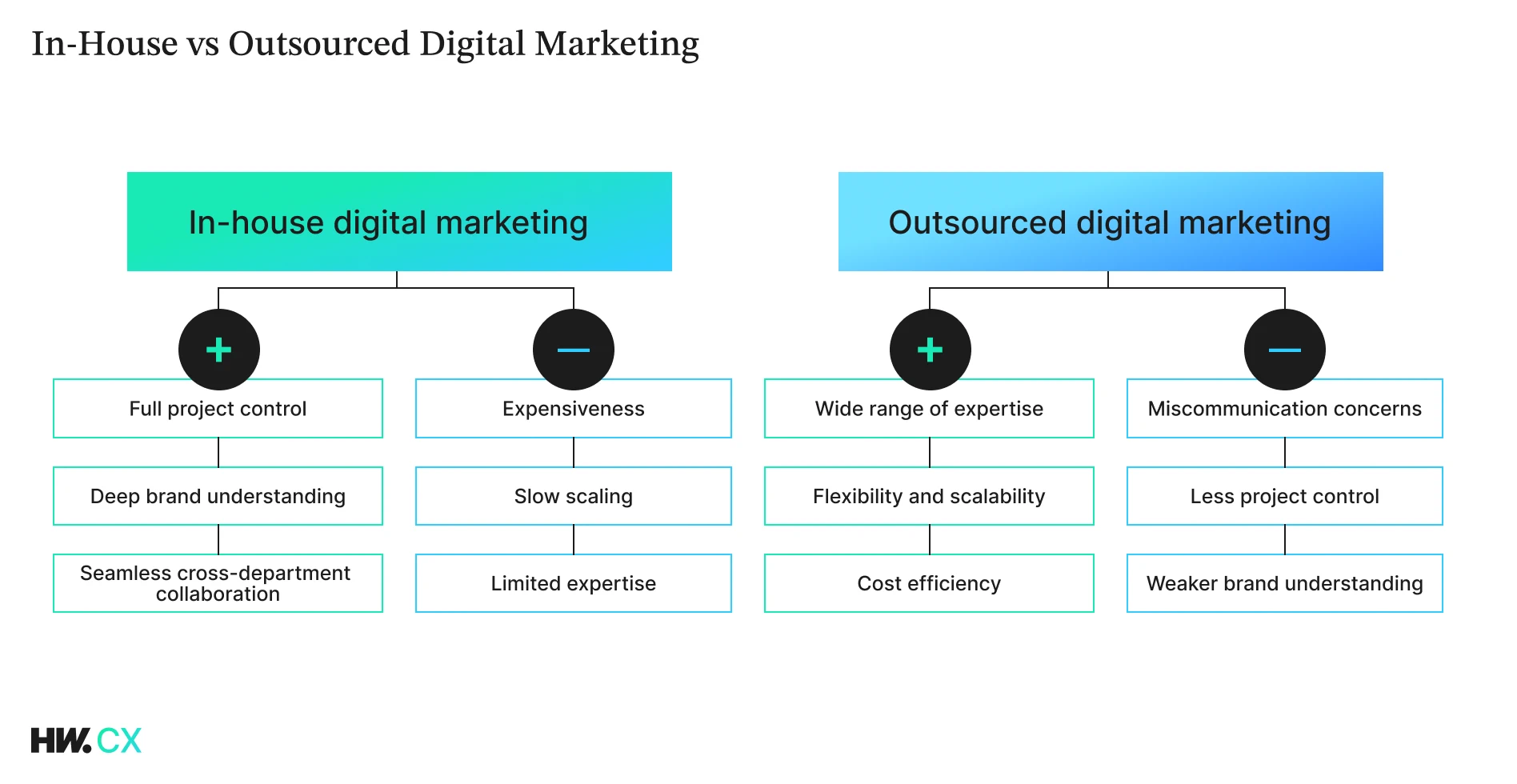
In-house digital marketing for startups
Pros:
- Full control. You’re fully in charge of the marketing efforts and can make adjustments on the fly. No need to wait for the external party.
- Deep brand understanding. Your in-house team lives and breathes your brand. You can rest assured that every campaign will reflect your brand identity and the messaging will be on point.
- Seamless integration with other departments. An in-house marketing team can work hand in hand with other departments within your organization (sales, customer service, business development), which gives it a holistic understanding of your marketing needs so it can come up with the best digital marketing strategies for startups.
Cons:
- Expensiveness. When hiring marketers in-house, you need to cover salaries, employee benefits, taxes, office space, health insurance, recruitment services, and much more. By outsourcing digital marketing for startups to a third party, you pay only for the services you get.
- Slow scaling. As your business grows, so do your marketing needs. To handle them, you need to hire more marketers, which typically requires 2–3 weeks (or even more, depending on the expertise). With a digital marketing agency, you can scale your team up and down much faster.
- Limited expertise. Depending on your location, it can be hard to find professionals with relevant expertise. When working with an agency, however, you usually have access to a global talent pool, allowing you to find the right candidate faster.
Outsourced digital marketing for startups
Pros:
- Wide range of expertise. Companies providing digital marketing for startups typically have specialists across all channels, be it SEO, paid search, content marketing, social media management, and so on. You’ll be saved from the hassle of finding and hiring all these experts on your own.
- Ultimate flexibility. As noted above, agencies enable you to scale teams up and down whenever you need. You won’t be constrained by employment contracts and ethical concerns. You will stay flexible and agile, being able to act in accordance with your business needs.
- Cost efficiency. You pay for the outcomes, not overhead. No need to cover salaries, taxes, health insurance, recruitment services, and other expenses associated with in-house employees.
Cons:
- Miscommunication concerns. Since agencies juggle multiple clients and projects, there’s always room for miscommunication: For example, an important message from you might just get lost in the shuffle. Things can get even more complicated if the external team is in a different time zone.
- Less control. When you work with an agency, you’re handing over a degree of control over your digital marketing strategy for startups. While the agency will consult with you and seek your approval on major decisions, they’re ultimately the ones executing the strategy.
- Weaker brand understanding. Agencies need time to fully grasp your brand’s vision, values, and tone of voice. This learning curve may initially slow down campaigns and lead to messaging inconsistent with your startup.
As you can see, both options have tradeoffs that you need to consider before deciding. If you’re more inclined toward working with an agency and seeking a reliable partner who will grow your business with a thought-out digital marketing strategy for startups, let us introduce you to what we do at Helpware.
At Helpware, our team offers digital marketing services built to fuel your growth at every stage. From strategy to execution to ongoing support, we’ll help you market smarter—always with your business goals front and center. Whether you need to kick off a major campaign with a fixed-scope sprint or want steady, long-term support with a predictable monthly subscription, we offer both models to align with your budget and growth stage.
Digital Marketing for Startups: Wrapping Up
So what is the best digital marketing strategy for startups? The short answer: It depends on your business, industry, and goals and needs. To find the most effective channel in your specific case, you should test out different options and prioritize those that are most fruitful.
Digital marketing for startups is easier with a clear framework. Start by defining your target audience and the “jobs” your product does for them. From there, experiment with a mix of organic and paid channels (SEO, content marketing, social media, email, and influencer collaborations) while tracking performance with Google Analytics 4 and similar tools.
As data comes in, double down on what works and scale gradually. Remember, there’s no one-size-fits-all approach. The best digital marketing strategy for startups is the one that drives sustainable growth for your business. So don’t be afraid to experiment and try different methods.
We hope this guide helps you reach new heights. And if you need assistance with everything marketing, Helpware is here for you. Contact us today to jumpstart your growth!