







The neck-breaking speed at which customer service trends are shifting is truly amazing. Clients more and more often opt for AI-driven self-service platforms, looking for immediate answers, but at the same time, they want brands to carry out empathic and personalized interactions. There is also a plethora of modern digital CX solutions taking the market by storm, so it is the perfect time to take a look at what customer support will look like in 2026.
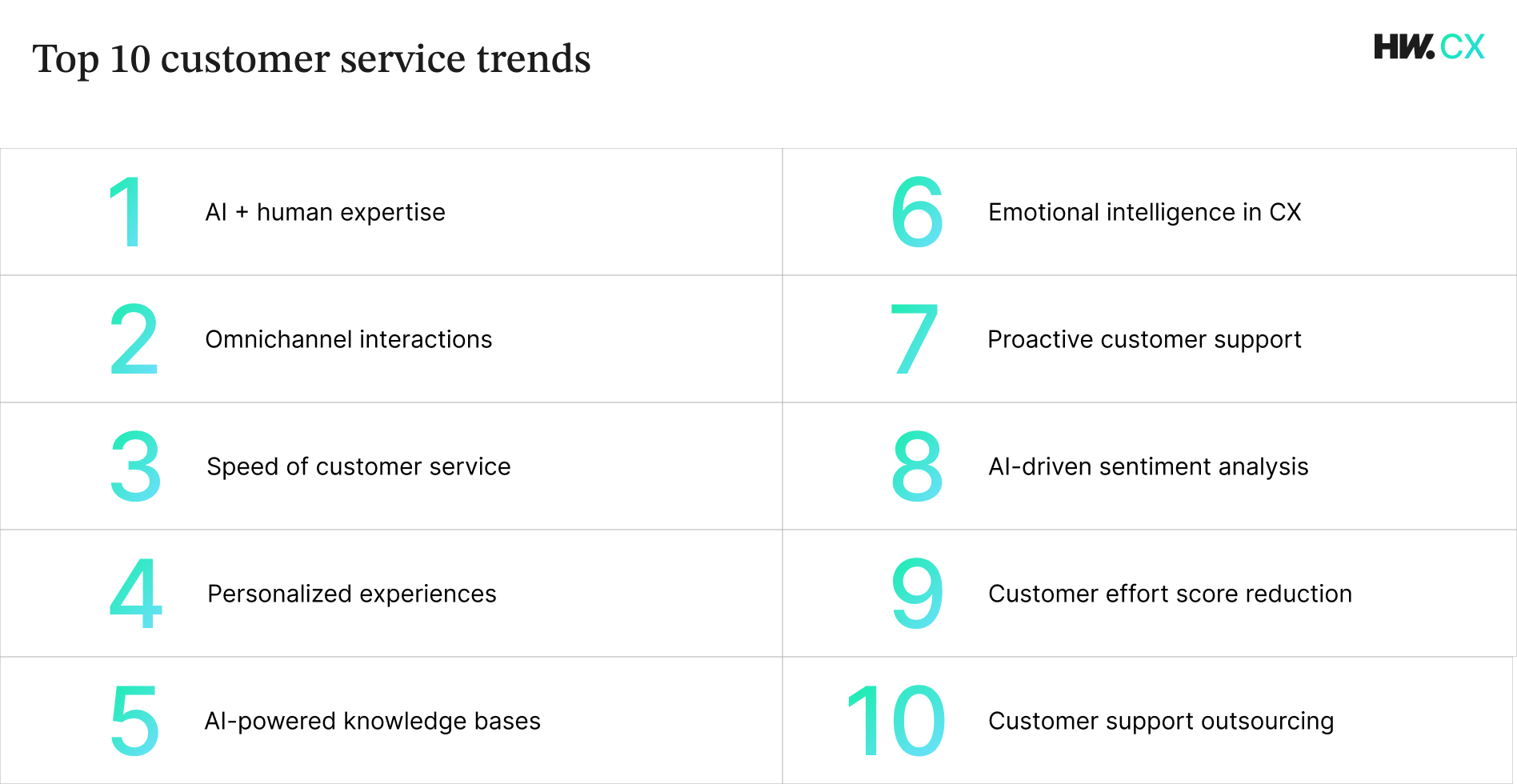
Top 10 Customer Service Trends to Follow in 2026
Although we’ve just entered 2026, it’s possible to analyse the major shifts that have a deep impact on the way companies generate meaningful customer experiences, and that will continue to make big waves through the rest of the year.
As an experienced business process outsourcing (BPO) provider, Helpware CX thinks proactively and has already implemented some of these customer service trends into our daily operations and witnessed positive dynamics in our partners’ Customer Satisfaction Score (CSAT), Net Promoter Score (NPS), churn rate, and other relevant CX-based metrics. Now, you’ll also be able to reinforce your customer experience strategy and stay ahead of the fierce competition. With no further due, here are the customer service trends to follow in 2025:
1. AI + human agents make the perfect duo
AI took the customer experience industry by surprise. Five years ago, no customer service representative could have dreamed that a chatbot would be skilled enough to solve their clients’ issues from end to end. And now, AI has become a pivotal element in pretty much all the latest customer service interactions.
Today, many AI customer service companies rely on a hybrid model where automated bots handle routine inquiries, while human agents step in when conversations require judgment, empathy, or deeper context. Contrary to the popular belief that with the rise of AI, human interactions are going out of fashion, it won’t be the case. At least in 2026. Customers still prefer to work with human agents regarding complex issues or sharing personal data.
2. Omnichannel interaction remains essential
Customers’ desires can feel a bit too extreme sometimes. Present-day customers expect companies to be “omnipresent”. Phone calls, video support, social media messaging, SMS texts, live chat, email, and in-app support, etc., are all communication channels that your target audience will rely on to ask for your help. Thankfully, omnichannel customer support strategies are here to save the day!
Companies can organize and conduct all live customer interactions through a single screen. How? With the help of a sophisticated customer relationship management (CRM) tool. The last thing customers want is to jump back and forth, from platform to platform, when their problem could be solved through the channel they used to contact the company in the first place. That is exactly what CRMs can do: seamless interactions in the channels people feel most comfortable with.
Although modern CRM software usually involves considerable expenses, plus the time and energy needed to train CSRs to make the most out of the tool, modern BPO companies are taking advantage of the most advanced CRM platforms to stay competitive in the BPO market. Otherwise, the risks of falling behind are very high.
3. Speed continues to be a top priority
Patience is running low these days. Users involved with FinTech, Healthtech, Ecommerce, and SaaS, just to name a few of the most demanding industries, often rely on quick support to handle urgent issues. If not solved promptly, they will look for another provider who can meet their needs more effectively. Nowadays, customers want “always immediate service,” which means no longer waiting in line, no longer being on hold, etc. Maybe that is the reason why AI chatbots are actively taking the stage in customer support. With them, the First Response Time (FRT), aka time to answer, has decreased to seconds, which cannot help but have a positive impact on a customer’s mood.
4. Personalized experiences reign supreme
Personalized customer service has certainly evolved throughout the years. When a company knows a customer’s name, preferences, behavioral patterns, and overall relationship with the brand, the customer’s attitude toward that brand inevitably becomes more positive. That’s exactly why companies are investing heavily in personalization and treating it as a top strategic priority. From the customer’s perspective, statistics show that 71% prefer a personalized shopping experience, although, frankly, that number feels conservative. Who would willingly say no to relevance? Moreover, over 75% of consumers are more likely to buy from brands that deliver a personalized user experience. And even in today’s low-trust era, 82% of consumers are willing to share their data in exchange for a truly customized experience. In other words, personalization is king.
5. AI knowledge bases are on the rise
Millennials are those lone rangers who prefer to do things on their own. Even concerning complex tech problems or researching or comparing products or services that are designed to make their lives better, they feel more comfortable walking down their buyer journey by themselves. The reason? They just grew up as independent users, relying on search engines, blogs, videos, and other resources to collect and apply information. That’s exactly where knowledge bases come in handy. By enabling high-quality knowledge bases inside websites, support sections, FAQs, and other self-service portals, it’s possible to achieve customer satisfaction even without a direct conversation with an agent.
6. Emotional intelligence on demand
It’s not like your call center agents are obliged to possess a psychology degree to serve your clients. Not for now, at least. However, remember that people want to be treated as people. As long as your agents keep that in mind throughout every single conversation, having good relationships with your clients should not be a problem.
While people skills are not easy to measure, as it all comes down to the client’s subjective opinion of how the interaction went, the following examples can give you a good idea of what attributes are expected from your customer service:
- Self-awareness of the tone of voice means sounding like your brand.
- Self-regulation is about adapting quickly and calmly to any situation.
- Internal motivation refers to the attitude your customer support agents bring to the table.
- Empathy means understanding and responding to the feelings of others.
7. Proactive support before the customer even asks
Not that proactive customer service is something groundbreaking in 2026, but this trend is holding its position tight. Modern AI analytics handles this proactivity perfectly: the tools anticipate issues, alert customers about potential service disruptions, expiring subscriptions, unusual account activity, product misconfigurations, etc. Such an approach pays dividends in the form of fewer inbound tickets, higher trust, and customers who feel taken care of. What is important to take into account is that proactive support should feel less like surveillance, but more like foresight.
8. AI-enabled intent & sentiment analysis
While AI still struggles with nuanced emotions such as sarcastic or ironic utterances, there has been significant progress in analyzing what exactly customers want and how they feel about their inquiry. Modern CX platforms can now flag conversations as “at risk,” “frustrated,” or “high priority” based on linguistic patterns, response timing, and behavioral signals. It enables AI tools to perform warm handoffs to the right agents, already enriched with context about what the customer anticipates or expects from the interaction. By the time an agent joins the conversation, they know the customer’s mood, the likely pain point, and the outcome the customer is hoping for. That gives agents a head start: they can either move straight toward a resolution or focus on calming the customer down before they blow up with frustration. For agents, it’s a sanity saver and a serious boost to first-contact resolution.
9. Customer effort reduction as a core KPI
Customer satisfaction is no longer the main metric in customer support. What is gaining ground as a key performance indicator in 2026 is the Customer Effort Score (CES). The logic is simple: customers will only be delighted when things are easy.
Reduce steps, minimize handovers, avoid repetitive questions, shorten resolution paths, and you’ll be at the top. Because the simplicity and natural flow of interactions directly correlate with retention.
10. Outsourcing customer support is key
Outsourcing customer service will continue to be a leading factor for business development tactics. Fortunly calculated that the global outsourced customer experience market is projected to reach $80.7 billion by 2028, growing at a CAGR of 3.42%.
Customer support trends in 2026 are all about choosing cost-effective solutions for companies that aim to focus on growing their revenue while taking proper care of their most important assets: their customers.
More importantly, customer service delivered by a third-party vendor is not only about cutting costs. Outsourced customer support professionals become real experts in your brand, product, and processes. Such knowledge enables them to design the most enjoyable resolution journey for your customers, which makes them feel heard and valued.
Other benefits of outsourcing customer support include:
- You have access to cutting-edge technology.
- Outsourced customer service experts are data-enabled.
- 24/7 problem-resolution service is available.
- You can offer great customer service in multiple languages.
- Agents can personalize interactions according to each industry.
- Effortless execution of omnichannel support.
Integrate the Top Customer Support Trends with Helpware CX
Whether we like it or not, customer service trends will remain in a constant state of change. While it’s true that preparing for such a wide range of outcomes is impossible, companies can make one straightforward yet important move: invest in establishing solid customer relationships today.
No one knows for certain what the future of customer service will be like. However, the essence of CX has been and will continue to be the same: providing the efficient and prompt resolution of any arising problems and maintaining trusting relationships with customers. Customer service trends come and go, but the bonds you create with your customers are here to stay. And Helpware knows well how to make them even stronger.
We design teams of amazing people, train them to know your product inside and out, and gear them up with the latest tech to meet your customers’ expectations. No matter the time zone, language, or complexity of the issue, we will always be there for your customers.