







Your startup needs customer support, financial administration, and reliable data operations, but building an in-house team takes time and puts pressure on limited budgets. Recent NFIB research shows that 32% of small business owners have job openings they cannot fill, while 87% of those hiring or trying to hire report few or no qualified applicants. According to SHRM’s recruiting benchmarks, the median time-to-fill for nonexecutive positions is 39 days.
Cost pressures add to the challenge. The Federal Reserve’s latest Small Business Credit Survey found that 77% of small employer firms faced rising costs for goods, services, or wages, tariff-related costs, or both.
For startups facing these pressures, outsourcing offers an alternative to expanding in-house headcount. But deciding what to outsource requires more than comparing labor costs. This guide examines which functions to delegate, which to automate or retain in-house, how outsourcing models and pricing compare, and how to choose a partner and measure results.
What Is Outsourcing for Startups?
Outsourcing for startups is an arrangement in which a company contracts an external provider to handle specific business functions, such as customer support, bookkeeping, data annotation, or software development. Depending on the engagement model, the provider may also manage recruitment, training, supervision, and quality assurance, while the startup retains responsibility for business objectives and outcomes.
Startups typically work with external specialists through three models. Freelancers handle individual projects or defined deliverables. A business process outsourcing (BPO) provider manages ongoing operations, including staffing, supervision, and quality control. Staff augmentation adds specialists who work within the startup’s existing processes under its direct management. Each model offers different levels of operational control, flexibility, and management responsibility.
Benefits of Outsourcing for Startups
Outsourcing helps startups manage growing workloads without committing to permanent headcount across every business function. The value depends on which processes you delegate, how the engagement is structured, and whether the provider can deliver the required quality at a sustainable cost.
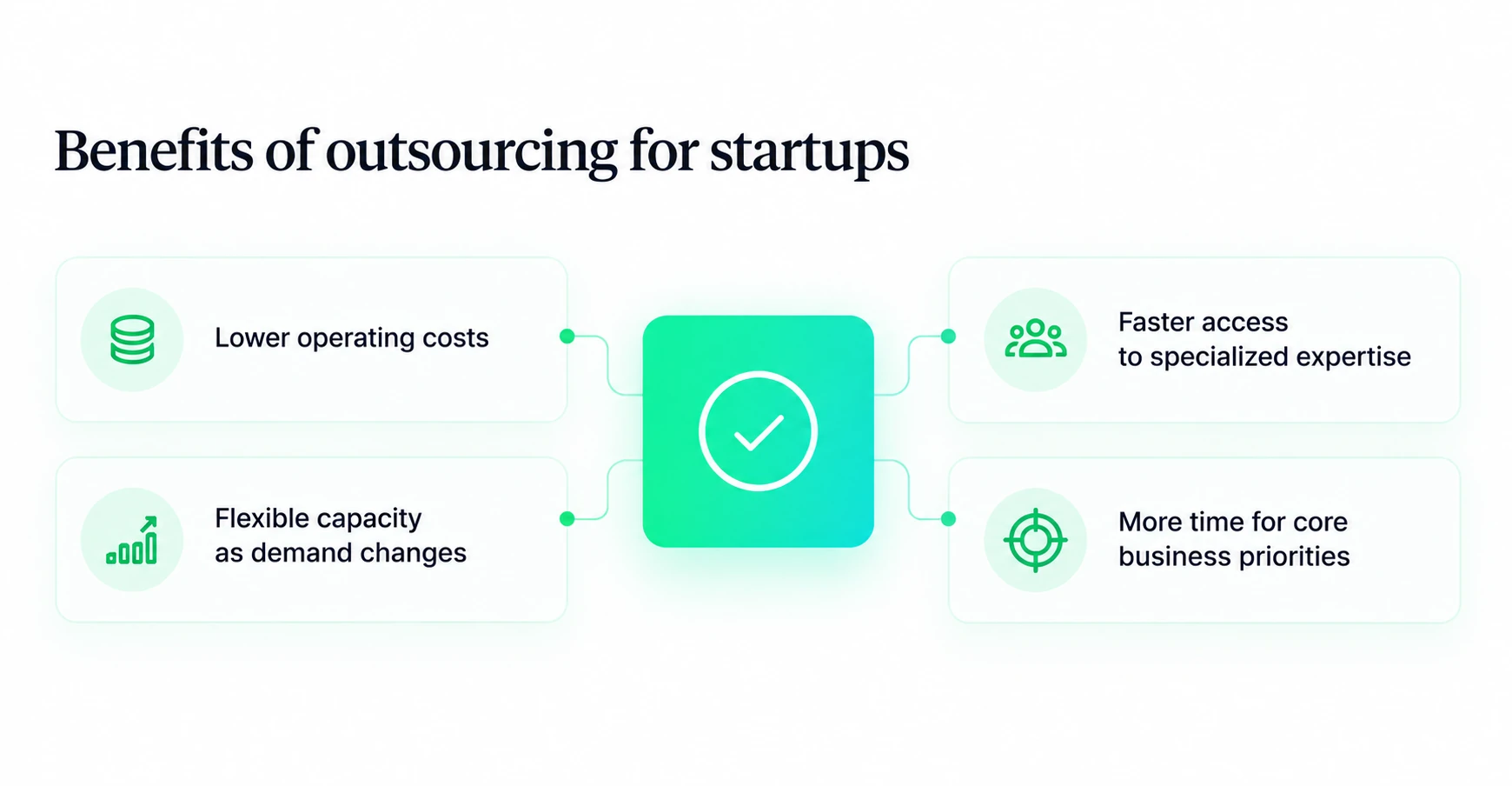
Lower operating costs
Outsourcing can reduce recruitment, onboarding, infrastructure, and management expenses. However, actual savings depend on provider rates, contract terms, and the internal resources needed to manage the relationship. Comparing the total cost of outsourcing with in-house hiring gives startups a more reliable basis for budgeting.
Faster access to specialized expertise
Startups can bring in experienced customer support agents, data specialists, or back-office professionals without recruiting each role individually. This is particularly useful when a function requires specific skills but does not justify building a permanent internal department.
Flexible capacity as demand changes
External teams can help startups handle product launches, seasonal peaks, and rapid customer growth. Depending on the contract, companies can increase or reduce capacity without restructuring their internal workforce.
More time for core business priorities
Delegating recurring operational tasks gives founders and internal teams more time for product development, customer relationships, and strategic decisions. The benefit is greatest when outsourced workflows are clearly documented and require limited day-to-day intervention.
When Should a Startup Start Outsourcing?
The right time is when work is sufficiently repeatable to hand off, demand exceeds internal capacity, and the expected benefit justifies transition and oversight costs. A funding round alone is not a reason to outsource.
| Signal | What to check before outsourcing | When to hold off |
|---|---|---|
| Founders handle support after hours | Ticket volume, common issues, escalation ownership | Most tickets still reveal unresolved product problems |
| Back-office work delays core priorities | Hours spent, error rates, approvals | Process and data ownership are unclear |
| A launch creates a short-term workload spike | Forecast volume and duration | Demand is too uncertain for the provider minimum |
| AI/data projects need large-scale review | Quality rubric, dataset access, auditability | Model requirements and acceptance criteria are changing weekly |
| Hiring cannot meet a deadline | Total recruitment time and coverage gap | The role owns core architecture or strategic customer knowledge |
What Should Your Startup Outsource First?
The right starting point depends on where your startup faces operational pressure. Some functions become candidates for outsourcing when workloads increase; others require specialized skills that are difficult to hire in-house. The table below shows where external teams can help, what your company should continue to own, and how to measure results.
| Startup situation | What to outsource | Keep in-house | Success measures |
|---|---|---|---|
| SaaS: Growing support backlog | Customer support, Tier-1 inquiries, account troubleshooting, and after-hours coverage | Product escalations, key accounts, product feedback priorities | First response time, resolution rate, CSAT |
| Ecommerce: Order spikes and seasonal demand | Customer inquiries, order tracking, returns processing, and routine back-office tasks | Refund policies, sensitive disputes, commercial decisions | Backlog, order accuracy, cost per contact |
| Fintech: Onboarding and processing delays | Document intake, data entry, verification support, and back-office processing | Risk decisions, compliance accountability, payment approvals | Processing time, error rate, audit trail completeness |
| AI startup: Data preparation and model evaluation | Data annotation and LLM training support, dataset review, and evaluation operations | Model design, evaluation criteria, product decisions | Annotation agreement, rework rate, throughput |
| Digital platform: Growing user-generated content | Content moderation, abuse detection, routine policy enforcement, and review queues | Moderation policies, sensitive appeals, trust and safety decisions | Review time, policy accuracy, appeal overturn rate |
| AI-powered product: Human review bottlenecks | Human-in-the-loop operations, AI output review, exception handling, and quality checks | Intervention rules, risk thresholds, final accountability | Review accuracy, exception rate, turnaround time |
| Scaling startup: High-volume repetitive work | Data processing, classification, validation, and microtasking | Task specifications, acceptance criteria, quality thresholds | Cost per task, accuracy, throughput |
| Startup operations: Administrative overload | Invoice processing, data entry, reconciliation support, and routine HR administration | Budget ownership, financial approvals, hiring decisions | Processing time, accuracy, cost per transaction |
| Early-stage startup: Limited marketing capacity | SEO execution, content production, paid campaign operations, and reporting | Positioning, brand strategy, messaging, marketing budget | Qualified leads, acquisition cost, conversion rate |
For specific delivery approaches, explore customer service for startups, and determine whether a managed support team fits your volume.
How Much Does Outsourcing for Startups Cost?
Startup outsourcing costs depend on the services you need, team size, required expertise, operating hours, and delivery location. The pricing model also affects your total spend, particularly when workloads fluctuate or your business needs to scale quickly.
Most BPO providers structure their pricing around dedicated resources, completed work, fixed project fees, or a combination of these approaches.
| Pricing model | How it works | Best suited for |
|---|---|---|
| Dedicated Team / FTE-Based | A recurring monthly fee based on the number of specialists assigned to your operations | Ongoing customer support, back-office processing, and data operations |
| Per Transaction / Contact | Charges based on the number of processed transactions, completed tasks, or customer interactions | High-volume operations with measurable output |
| Fixed Price / Project-Based | An agreed fee for a defined scope of work or deliverable | One-time projects, data annotation assignments, and clearly scoped operational work |
| Hybrid Pricing | Combines a fixed team or base fee with variable charges based on usage or workload | Startups that need consistent coverage with additional capacity during demand spikes |
Which Pricing Model Fits Your Startup?
For ongoing operations: Dedicated team pricing works well when you need consistent service coverage and predictable staffing. It gives you an established team for recurring work, although minimum commitments and underused capacity can increase costs during quieter periods.
For fluctuating transaction volumes: Per-transaction or per-contact pricing aligns charges more closely with actual activity. Check how the provider defines a billable unit, handles complex cases, and prices volume changes.
For clearly defined projects: Fixed-price contracts offer budget predictability when deliverables, timelines, and acceptance criteria are agreed upfront. Changes to the scope may result in additional charges.
For growing startups with variable demand: Hybrid pricing can provide baseline operational coverage while accommodating seasonal peaks, product launches, or unexpected increases in workload. Review minimum fees, volume thresholds, and additional capacity rates before committing.
When comparing proposals, look beyond the quoted rate. Include onboarding, training, software, internal oversight, minimum commitments, and potential transition costs. Compare providers against the same workload, service coverage, and quality requirements to understand the total cost.
For a more detailed breakdown of pricing factors, see our guide to customer service outsourcing cost.
Unlock your hidden CX savings with Helpware
Get ROI projection for current support needs.
-40% annually
/monthly costs with Helpware
vs
/internal team costs (approx)
Your requirements fall outside our standard parameters.
Let's discuss your results
Fill in your details to schedule a consultation.
-40% annually
/monthly costs with Helpware
vs
/internal team costs (approx)
Your requirements fall outside our standard parameters.
-40% annually
/monthly costs with Helpware
vs
/internal team costs (approx)
Your requirements fall outside our standard parameters.
Support staff included in the package:
Shared Team Leader
Shared L&D Specalist
Shared QA Specialist
Account Executive by default
Shared Ops Delivery Manager
Admin/Finance/Legal support for the agents by default
1-2 Dedicated Team Leaders
Shared L&D Specialist
Shared to 1 Dedicated QA Specialist
Shared Ops Manager
Account Executive by default
Admin/Finance/Legal support for the agents by default
Shared Real Time Analyst
2-5 Dedicated Team Leaders
0,5 to 1,5 Dedicated L&D Specialists
1-2 Dedicated QA Specialists
Up to half of a dedicated Ops Manager
Account Executive by default
Admin/Finance/Legal support for the agents by default
1 Dedicated Real Time Analyst
Ready to get a personalized estimate for your team?
Contact us for a personalized assessment tailored to your specific needs.
*These projections are estimates for informational purposes only and do not represent a formal offer. Contact us for a personalized quote.
Thank you!
You’ll hear from us within one business day.
Choosing the Right Outsourcing Delivery Model
Where your outsourcing team operates affects service costs, working-hour overlap, language availability, and how easily your team can collaborate with external specialists. For US startups, the main options are onshore, nearshore, and offshore delivery. Each offers different advantages depending on the work involved and the coverage your customers need.
| Delivery model | Example Helpware locations | US business-hour overlap | Relative cost | Best suited for | What to consider |
|---|---|---|---|---|---|
| Onshore | United States, Puerto Rico | Full or substantial | Generally higher | Complex customer interactions, regulated workflows, high-value accounts | Higher staffing costs; availability of specialized talent |
| Nearshore | Mexico | Full or substantial, depending on US time zone | Often lower than US onshore | Real-time collaboration, English-Spanish support, customer service during US business hours | Language proficiency, hiring capacity, local labor costs |
| Offshore | Philippines, Uganda, Ukraine | Varies by location and shift schedule | Potentially lower, depending on location | High-volume support, back-office processing, AI data operations, extended-hours coverage | Shift arrangements, handoffs, data security, business continuity |
Startups can also combine locations to match different operational needs. For example, a nearshore team might handle live customer interactions during US business hours, while an offshore team covers overnight inquiries or processes back-office work outside peak hours. The right combination depends on customer demand, service-level requirements, and the total cost of managing multiple locations.
For a closer comparison, explore onshore vs. nearshore vs. offshore outsourcing and the operational considerations of offshore outsourcing.
How to Evaluate an Outsourcing Partner
Choosing an outsourcing partner requires more than comparing service offerings and hourly rates. A provider may have experience supporting large enterprises but lack the flexibility, commercial terms, or delivery model that works for an early-stage startup. Look for a partner with relevant experience in your industry, a clear approach to managing daily operations, and the ability to adjust resources as your needs change.
Start by defining the scope of work, expected volumes, service hours, quality standards, and systems the provider will need to access. Share the same requirements with every shortlisted vendor so you can compare proposals on a consistent basis. Ask for relevant client examples, measurable performance results, and clear explanations of how the provider will manage your account.
The following criteria can help you evaluate both operational fit and contractual commitments.
| Evaluation area | Questions to ask |
|---|---|
| Minimum commitment | What is the minimum team size, contract length, and ramp-down notice? |
| Ramp-up | What training, documentation, and staffing lead times are included? |
| Operational ownership | Who manages day-to-day performance, coaching, and escalations? |
| Quality assurance | How are errors sampled, reported, corrected, and audited? |
| Security and compliance | Which controls apply to our specific workflows, systems, and delivery locations? |
| Pricing transparency | What is included in the quote, and what triggers additional fees? |
| Exit and transition | Who owns the data, knowledge base, and work product? What transition support is included? |
Request customer references that reflect your company’s size, industry, and operational requirements. Verify the scope of published certifications and data-processing arrangements rather than assuming they cover every service or location. Pay particular attention to contract flexibility, accountability for service quality, and the process for transferring operations if the partnership ends.
For a closer look at potential challenges, explore the risks of outsourcing and how to address them before signing a contract.
How Helpware Supports Growing Startups
As startups grow, customer inquiries, administrative workloads, and data operations can quickly outpace internal resources. Helpware helps companies expand operational capacity through dedicated teams, AI-assisted workflows, and managed front- and back-office solutions.
Our teams handle customer and technical support, order processing, data operations, and other recurring business processes. We manage recruitment, onboarding, training, quality assurance, and day-to-day delivery, while your team retains control over business priorities, policies, and critical decisions. With delivery operations across multiple regions and support in 45+ languages, we can align staffing and service hours with your customers and growth plans.
Our client results demonstrate how this approach works in practice:
- Faster scaling: A furniture brand doubled its support headcount in three weeks, improved QA scores from 85% to 90%, and reduced call abandonment by 20%.
- More efficient technical support: For a SaaS client, Helpware unified customer communication channels and established a Zendesk-based support operation capable of handling more than 1,000 tickets per month.
- Higher support quality: A growing ecommerce company introduced live chat, improved agent onboarding, and achieved 98% QA scores.
Whether you need to establish your first outsourced support function or expand an existing operation, Helpware can help define the right team structure, workflows, and performance targets for your business.